
Mastering Careers & Skills
Drinking-Water Treatment Operator · free sample from the book itself
Before most of the town is awake, a treatment operator is already walking the plant. The walk has an order, because the water has an order: it begins where raw water arrives from the reservoir, passes the basins where chemicals are mixed and solids settle, crosses the filters, rests in the clearwells after disinfection, and leaves under pressure toward the town. At each stop the operator looks, listens, reads a gauge, and writes something down. Nothing in that walk is decoration. A drinking-water plant is a promise made continuously, and the operator is the person who keeps it.
This book teaches that person's craft whole: where the water comes from, what is in it, how the treatment train removes or inactivates what does not belong in drinking water, how the machines and the laboratory work, what the federal standards require, and how the graded examinations that test this knowledge are shaped. It teaches for two readers at once, because they are the same person at two moments: the complete beginner who has never stood in a filter gallery, and the working operator preparing for a graded certification examination. This chapter maps the field itself — what the work is, what a day contains, and what the numbers about the occupation honestly say.
Begin with the plainest definitions the book will offer. Drinking-water treatment is the work of taking water from a source — a reservoir, a river, or a well — and changing its quality through physical and chemical processes until it meets the standards for water delivered to the public. A treatment operator is the worker who runs, watches, adjusts, and records those processes. A public water system is a system that provides water for human consumption to the public; systems of that kind live under legally enforceable federal drinking-water standards, which Chapter 35 teaches in full. (Source: U.S. EPA, National Primary Drinking Water Regulations.) The operator's craft sits exactly at the meeting point of those three ideas: a source that changes, a process that must answer the change, and a standard the finished water must meet every day, not on average across good days.
Treatment is not one act. It is a sequence, and operators name the sequence the treatment train — the ordered line of processes the water passes through, each one preparing the water for the next. This book's teaching specimen, introduced properly in §1.6, runs a conventional surface-water train: intake and screens, rapid mix, flocculation, sedimentation, filtration, disinfection, clearwell storage, and high-service pumping. Each of those words is defined where its own chapter teaches it; here, hold only the shape.
At the intake, screens keep out the large material that never belonged in a plant — branches, leaves, debris carried by the source. In rapid mix, a coagulant chemical is blended into the raw water quickly and evenly. In flocculation, gentle stirring lets the tiny particles the coagulant has destabilized gather into larger clumps called floc. In sedimentation, the water moves slowly enough that most of that floc settles out by gravity. In filtration, the water passes through a bed of granular media — or, in other plant designs, through membranes or other filter forms — which strains out what settling left behind. In disinfection, a disinfectant inactivates disease-causing organisms that filtration alone cannot be trusted to remove completely. Then the finished water waits in storage, ready to meet the town's demand.
Two ideas in that paragraph carry the whole book. The first is that the steps protect each other: settling lightens the filters' load, filtration lightens disinfection's load, and no single step is asked to do everything. The second is that almost nothing the operator most cares about can be seen with the naked eye — the particles coagulation targets are too small to see individually, and the organisms disinfection targets cannot be seen at all. Turbidity — the cloudiness of water, caused by suspended material, and measured in nephelometric turbidity units, abbreviated NTU — is a central measurement precisely because it stands in for so much that is invisible: water leaving the filters at very low turbidity is water the train is handling well. The specimen plant filters to 0.08 NTU on its own record, a figure Chapter 15 returns to against the federal turbidity limits. The craft, in one sentence, is managing the invisible by measuring it faithfully and adjusting the visible — flows, doses, levels, run times — in answer.
Figure 1.1 (Class P) — The Cedar Bend plant from the air: intake pumphouse at the reservoir shore, rapid-mix and flocculation basins, sedimentation basins, the filter building, and the two clearwell cells, laid out in the order the water flows.
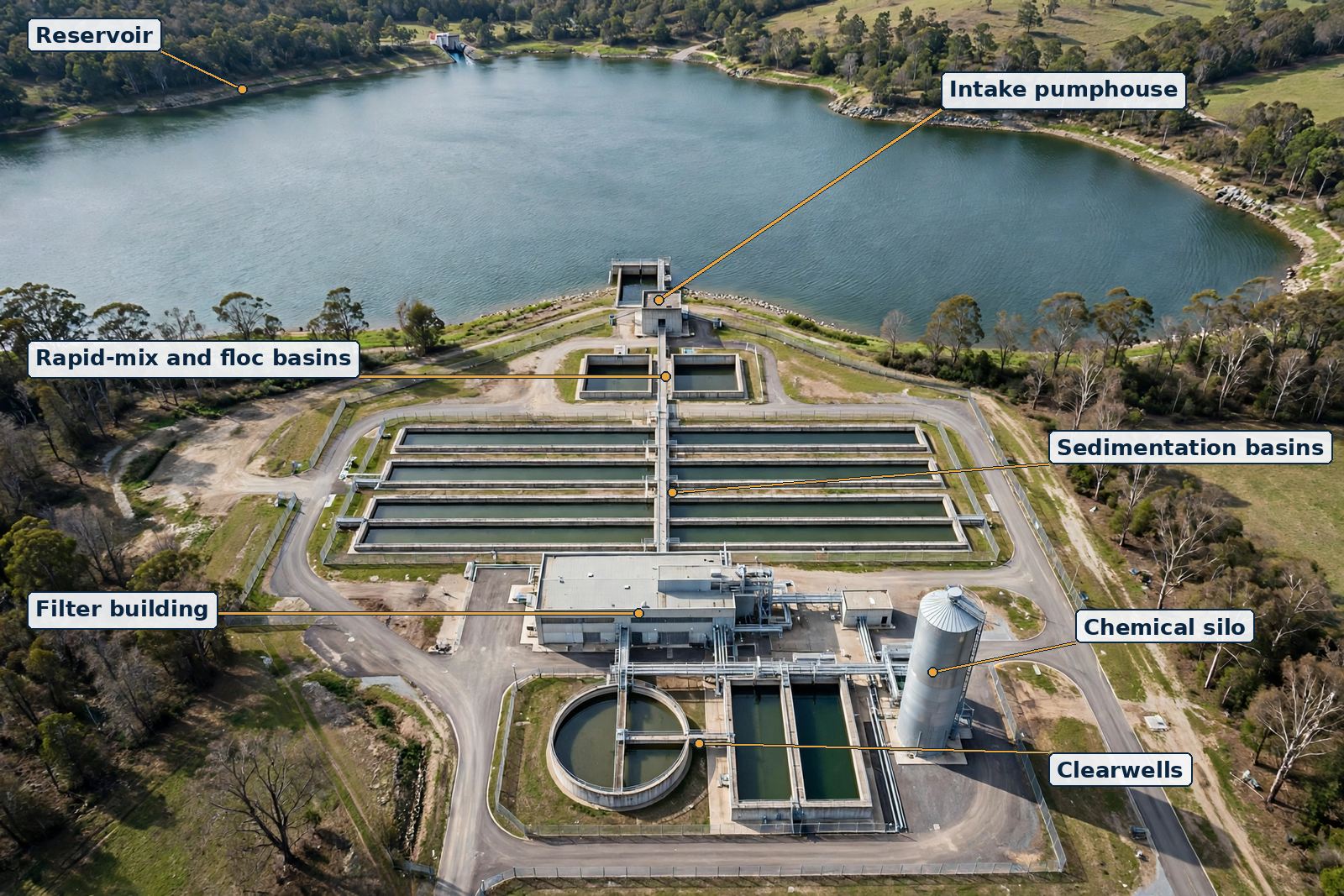
Figure 1.1 — The Cedar Bend plant from the air: intake pumphouse at the reservoir shore, rapid-mix and flocculation basins, sedimentation basins, the filter building, and the two clearwell cells, laid out in the order the water flows.
Ask what a treatment operator actually does all day and the honest answer is a duty list, not a slogan. The U.S. Bureau of Labor Statistics — BLS, the federal agency that describes occupations and reports their employment and pay — lists the duties of the occupation this book teaches toward, and this chapter teaches them as a working sequence, because in the plant they interlock. One fence must be stated before the list, and it stands wherever this book prints the occupation's figures: BLS publishes no drinking-water-only operator occupation. Its occupation, Water and Wastewater Treatment Plant and System Operators, is a combined water and wastewater occupation — one statistical occupation covering both crafts — and this book says so wherever the figures print, instead of printing a split figure no source supports. (Source: BLS, Occupational Outlook Handbook.)
The duties, in the shape of a working day, are these. The operator operates or controls an entire process or system of machines, often through control boards, to transfer or treat water. That is the center of gravity: the plant is one connected process, and the operator holds the whole of it, not one machine at a time. The operator adds chemicals, such as chlorine and lime, in the right amounts — dosing is a measured act with a computed answer, not a pour-and-hope act, and Part II of this book builds the mathematics that makes the amount right. The operator collects and tests water samples — the laboratory is not a separate world from the plant floor; it is the plant floor's way of knowing. The operator reads and records meters, gauges, and test results, because a reading that is not written down cannot be compared with yesterday's reading, and comparison is how change is caught early. The operator inspects equipment and monitors operating conditions — the rounds of §1.1, formalized. The operator cleans and maintains equipment, tanks, and filter beds — treatment is physical plant, and physical plant that is not maintained becomes a process problem before it becomes a mechanical one. The operator keeps records of operations — the log is the plant's memory and, in a regulated field, its evidence. And the operator responds to emergencies and follows safety procedures — the duty Chapter 4 and Chapter 38 build into a discipline. (Source: BLS, Occupational Outlook Handbook.)
Hold the shape of that list. It is part process control, part applied chemistry, part measurement, part record-keeping, and part maintenance, carried out by one person on one shift who is answerable for all of it at once — larger than the valve-turning picture, and more physical than the laboratory picture. Both corrections are the point of printing the list in Chapter 1.
A beginner often sorts plant tasks into real work — dosing, backwashing, repairing — and paperwork — sampling, recording, logging. The field does not recognize that sort, and this section explains why before the habit forms. Every adjustment an operator makes rests on a measurement. The coagulant dose answers the raw water's measured turbidity and alkalinity. The chlorine feed answers a measured residual. A filter comes out of service for backwashing because measured head loss or measured effluent turbidity says its run has ended. Judgment in this craft is not the opposite of measurement; judgment is what measurement is for.
Consider one worked episode, small and complete. The specimen plant's clearwells hold 1.0 million gallons of finished water in two cells, and the average day's flow is 8.4 million gallons per day — MGD, the plant's working unit of flow. How long could storage alone supply the town at that rate? The relation is a definition: storage time equals stored volume divided by flow. In the same unit: 1.0 ÷ 8.4 = 0.119 of a day; converting, 0.119 × 24 hours = 2.86 hours, which the plant's documents round to 2.9 hours of storage at average-day flow. That is the specimen's own documented figure, and its meaning is a judgment: less than three hours of buffer is the plant's stated reason that finished-water storage continues in the system's tanks beyond the plant fence. The arithmetic took three steps; the operator's work was knowing which three, which numbers belonged in them, and what the answer obliged the system to do. Every calculation in this book is taught in exactly that form — worked end to end, and tied to the decision it serves.
The record is the other half of measurement. An operating log is the plant's dated, signed, sequential account of its own operation — readings, doses, events, and actions in the order they happened. Chapter 10 teaches its anatomy in full. Here, hold its standing: in a field where the product is consumed by the public and the standards are legally enforceable, the record is how a plant proves, months later, what it did on a given night. The craft treats it as part of the treatment itself.
Some readers open this book deciding whether the field is worth entering, and they deserve the occupation's published numbers stated exactly as their source states them, fenced so they cannot be misread. The figures below are the whole-occupation figures for the combined occupation named in §1.3 — water and wastewater treatment plant and system operators together — because that is the only occupation BLS publishes for this work. There is no drinking-water-only figure, and this book prints none.
BLS reports a median annual wage of $60,020 per year ($28.86 per hour), May 2025, for that whole occupation. The same source's range markers are a 10th percentile of $39,110 and a 90th percentile of $91,060, and it counts employment of 128,490 in the occupation. (Source: BLS, Occupational Outlook Handbook; BLS, Occupational Employment and Wage Statistics, May 2025.) Read those sentences with the discipline this book will hold you to every time a number appears. A median is the middle of everyone in the occupation — half earn more, half earn less — across veterans and beginners, every employer type, and every place. It is not a starting wage, not an offer, and not a promise about any one reader. The percentile markers describe the spread of the whole occupation, not a ladder any individual is guaranteed to climb. The employment count is the occupation's size, not a count of vacancies waiting for any reader.
BLS also states the entry shape and outlook, printed here only in BLS's own framing. The typical entry education is a high school diploma or equivalent, with long-term on-the-job training as the training pattern. BLS projects employment to decline about 6 percent from 2025 to 2035, with about 10,000 openings per year, nearly all from replacing workers who leave or retire. (Source: BLS, Occupational Outlook Handbook.) Those sentences belong together: a shrinking total can still produce steady openings when the workforce turns over, and replacement openings are real doors — Chapter 2 builds the entry map on exactly that shape. No other pay figure appears anywhere in this book, and no figure in it is a promise of a job or an income.
Worked examples need a plant, and a book that invented new numbers for every example would teach arithmetic and unteach judgment. So this book teaches on one specimen throughout: the Cedar Bend Water Treatment Plant, a fictional conventional surface-water plant, presented as a specimen — its numbers are its own documented design and operating values, labeled as its own, and they are never stated as rules for any other plant.
Learn its outline now; every later chapter adds its room to this house. Cedar Bend draws raw water from the Cedar Bend Reservoir. Its design capacity — the flow the plant was built to treat — is 12 MGD. Its average day runs at 8.4 MGD, and its peak day at 11.2 MGD. Those flows also live in the plant's other working unit, gallons per minute — gpm. The conversion is arithmetic, not a table to memorize yet: a day holds 1,440 minutes, so the average day is 8,400,000 gallons ÷ 1,440 minutes = 5,833 gpm, and the peak day is 11,200,000 ÷ 1,440 = 7,778 gpm. Chapter 7 builds the full unit family formally; here the point is that one flow wears several units, and the operator must be at home in all of them.
The train, in the water's order, is the one §1.2 described: intake and screens, one rapid-mix basin, four flocculation basins, four sedimentation basins, six dual-media filter cells, disinfection, two clearwell cells of 500,000 gallons each, and high-service pumps. Its raw water, on the specimen's record, runs at turbidity between 8 and 60 NTU across the seasons — a range that is itself a lesson: the source is not a constant, and the operator's doses move with it. Its settled water leaves at about 2 NTU and its filtered water at 0.08 NTU, on its record. When a chapter says the specimen's record, it is drawing this section's fence: those are Cedar Bend's facts — the method transfers to every plant; the numbers belong to this one.
Every beginner asks some version of the same question — what makes this official? — and the honest answer has two halves, stated here and proved in Chapter 3. The first half: the knowledge this craft is examined on is organized, in the framework this book teaches, by Water Professionals International — WPI, the body that now publishes the standardized examinations built by the Association of Boards of Certification, abbreviated ABC, whose name the examination pattern still carries. WPI publishes standardized Water Treatment Operator examinations in four graded classes and publishes, for each class, the criteria describing what a candidate needs to know. Chapter 3 lays that ladder out whole.
The second half is the fence, and it is not fine print. Operator certification is granted by the reader's certifying authority — the agency or board that adopts the examinations and certifies operators under its own rules. Grades, eligibility, passing standards, fees, and renewal belong to that authority, not to WPI's published criteria and not to this book. This book grants nothing and satisfies no requirement — not eligibility, not experience, not any training hour. It prepares the knowledge the examinations test, and it says so wherever the ladder is taught. No book can train the hands: plant rounds, bench technique, and every supervised skill are learned in person, in real plants and programs. The examinations test the knowledge underneath those skills; that knowledge, whole and in order, is what the following chapters teach. A reader who keeps the halves separate — WPI examines on a published pattern; authorities certify on their own terms; employers and programs train the hands; this book prepares the knowledge — will never be misled by any advertisement in this field.
Part I finishes the entry map: the doors in (Chapter 2), the graded ladder whole (Chapter 3), and safety as the first skill (Chapter 4). Part II builds the foundations in dependency order — water itself, the chemistry the plant stands on, and the mathematics of the plant in three chapters — because no procedure in this book rests on a principle the book has not taught first. Part III walks the treatment train end to end, one chapter per process. Part IV teaches the machines and the instruments. Part V teaches the operator's laboratory and the regulatory frame. Part VI teaches the whole craft at work — process control, troubleshooting as a reasoning order, and emergencies. Part VII closes with the graded examinations in full and the road from here.
Read in order the first time. Every term is defined where it first appears, bolded so you can see it arrive, and collected again at each chapter's end and in the glossary. When a later chapter sends you back, go back without embarrassment — working operators look things up for a living. One boundary runs through every chapter: chemical handling, work around energized equipment, and every other hazardous act are taught as knowledge and reasoning only — what the qualified operator does, in what order of reasoning, and what each reading means. The hands are trained in person, under supervision, through the doors Chapter 2 describes.
Key terms of this chapter. Drinking-water treatment — changing source water's quality through physical and chemical processes until it meets drinking-water standards; Treatment operator — the worker who runs, watches, adjusts, and records those processes; Public water system — a system providing water for human consumption to the public, under enforceable federal standards; Treatment train — the ordered sequence of processes the water passes through; Floc — the larger clumps formed when destabilized particles gather during flocculation; Turbidity — the cloudiness of water from suspended material, measured in NTU; NTU — nephelometric turbidity units, the unit of turbidity measurement; BLS — the U.S. Bureau of Labor Statistics, the agency that describes occupations and reports their employment and pay; Median — the middle value of a whole set, half above and half below, never a starting figure or a promise; Log — the plant's dated, signed, sequential account of its own operation; MGD — million gallons per day, a working unit of plant flow; gpm — gallons per minute, a working unit of plant flow; Design capacity — the flow a plant was built to treat; WPI — Water Professionals International, the body that now publishes the ABC-built standardized operator examinations; ABC — the Association of Boards of Certification, the body that built the examination pattern WPI now publishes; Certifying authority — the agency or board that adopts the examinations and certifies operators under its own rules.
Tags: FIELD — the field, its doors, and the shared foundations. The key, with every option explained, is in this chapter's key file.
Q1. Drinking-water treatment is best defined as — A. delivering source water to the public unchanged, provided it looks clear B. changing source water's quality through physical and chemical processes until it meets drinking-water standards C. testing finished water after delivery to confirm what was sent D. storing water long enough that everything in it settles out on its own
Q2. In the conventional treatment train this book teaches, the step that follows sedimentation is — A. disinfection, with filtration reserved for plants that choose it B. rapid mix, where the coagulant is blended in C. filtration, which strains out what settling left behind D. high-service pumping, which sends settled water to town
Q3. The Bureau of Labor Statistics occupation that covers this book's field is — A. a combined water and wastewater occupation — Water and Wastewater Treatment Plant and System Operators — with no drinking-water-only occupation published B. a drinking-water-only occupation with its own separate figures C. an occupation covering plumbers and pipefitters instead of plant operators D. a laboratory-only occupation with no plant duties
Q4. Cedar Bend's two clearwell cells hold 1.0 MG in total, and its average day is 8.4 MGD. Storage time at average flow is — A. 8.4 hours, found by multiplying volume by flow B. 0.84 hours, found by dividing flow by volume C. 11.9 hours, found by dividing flow by volume and converting D. about 2.9 hours, found by dividing 1.0 MG by 8.4 MGD to get 0.119 of a day, then multiplying by 24 hours
Q5. The BLS median of $60,020 per year (May 2025) is printed in this book only as — A. the starting wage a new operator should expect B. the whole-occupation median for the combined water and wastewater occupation — the middle of everyone in it — not a starting wage, an offer, or a promise C. a drinking-water-only figure separated from wastewater by BLS D. a guaranteed outcome for readers who finish the book
Q6. An operator's rounds — looking, listening, reading gauges, and writing down what is found — belong to which listed duty pair? A. Inspect equipment and monitor operating conditions; read and record meters, gauges, and test results B. Set the federal standards; enforce them against other systems C. Manufacture treatment chemicals; deliver them to other plants D. Design new plants; approve their construction
Q7. Turbidity matters so centrally to the operator because — A. it is a purely decorative measurement with no process meaning B. it can be judged accurately by looking at a glass of water C. it stands in for much that is invisible — suspended material the train must remove — and tracks how well the train is handling the water D. it measures the chlorine dose the plant applied yesterday
Q8. Cedar Bend's average-day flow of 8.4 MGD, expressed in gallons per minute using 1,440 minutes in a day, is — A. 58,330 gpm, found by multiplying 8,400,000 by 1,440 B. 840 gpm, found by dividing 8,400,000 by 10,000 C. 12,096 gpm, found by multiplying 8.4 by 1,440 without converting units D. 5,833 gpm, found by dividing 8,400,000 gallons by 1,440 minutes
Q9. Which statement about certification is true as this book states it? A. This book certifies operators who complete its exercises B. Certification is granted by the reader's certifying authority under its own rules; this book prepares the knowledge the examinations test and satisfies no requirement C. WPI grants operator certification directly to candidates who pass its examinations D. Completing any training program automatically certifies the graduate
Q10. The BLS outlook for the combined occupation is printed in this book as — A. rapid growth driven by new plants, with openings mostly from expansion B. no projection of any kind, because BLS publishes none C. employment projected to decline about 6 percent from 2025 to 2035, with about 10,000 openings per year, nearly all from replacing workers who leave or retire D. a promise that every reader will find an opening
Q11. The operating log's standing in this craft is — A. part of the treatment itself — the plant's dated, signed record of readings, doses, events, and actions, and its evidence months later B. optional paperwork a good operator can skip on quiet nights C. a private diary the operator keeps for personal reference only D. a form completed only when something has already gone wrong
Q12. The steps of the train protect each other in this sense — A. any single step can be skipped whenever the plant is busy B. filtration makes disinfection unnecessary by removing everything C. disinfection repairs whatever coagulation failed to do D. settling lightens the filters' load, and filtration lightens disinfection's load, so no single step is asked to do everything
Q13. The published examinations this book's ladder is built on are — A. written separately by each plant for its own staff B. the product of a textbook publisher's practice series C. standardized Water Treatment Operator examinations published by WPI — the examinations built by ABC — in graded classes D. issued by BLS as part of its occupation description
Q14. Cedar Bend's raw-water turbidity ranges from 8 to 60 NTU across the seasons on its record. The lesson that range teaches is — A. source water is a constant, so doses can be set once and left alone B. the source changes, and the operator's doses and judgments must move with the measured change C. turbidity above 10 NTU means the plant must shut down, as a rule D. seasonal ranges are a defect in the specimen's design
Q15. Hands-on skill — plant rounds, bench technique, supervised hazardous work — is trained — A. in person, under supervision, in real plants and training programs; this book prepares the knowledge underneath those skills B. by reading this book alone, however carefully C. by passing a written examination, which also trains the hands D. only after certification, never before it
Feras Alzubi
Exam Prep Series
2026 Edition
© 2026 Feras Alzubi. All rights reserved.
No part of this book may be reproduced, stored in a retrieval system, or transmitted in any form or by any means — electronic, mechanical, photocopying, recording, or otherwise — without the prior written permission of the author, except for brief quotations in reviews and other uses permitted by copyright law.
Every practice question, explanation, case file, and worked example in this book is original to this book. The practice questions are this book's own, written against the published content areas and need-to-know criteria for the graded Water Treatment Operator examinations; they are not any body's examination items, and no examination item of Water Professionals International, the Association of Boards of Certification, or any other body is reproduced, recalled, paraphrased, or adapted anywhere in these pages. No passage of any textbook, manual, standard, or manufacturer's publication is reproduced into usable form. The content areas, task lists, and standards named in this book are the bodies' own published frameworks, named and cited as frameworks; the teaching built on them is this book's own.
Not-affiliated disclosure. This book is an independent study guide. It is not published by, affiliated with, endorsed by, or approved by Water Professionals International, the Association of Boards of Certification (ABC), or the U.S. EPA. None of those bodies wrote, reviewed, approved, or sponsored this book. The name Drinking-Water Treatment Operator is used in this book as a statement of fact about the graded operator examinations this book prepares readers to study for. The graded examinations are the examinations of Water Professionals International; the regulatory standards discussed are published by the U.S. EPA; certification decisions belong to the reader's own certifying authority alone. This book confers no certification, no eligibility, and no authorization of any kind, and it satisfies no requirement of any certifying authority — not eligibility, not experience, and not any training.
Specimen notice. The plant worked throughout this book — the Cedar Bend Water Treatment Plant, drawing raw water from the Cedar Bend Reservoir, with its Well No. 3 — is a fictional specimen plant, labeled a specimen on its face at first use. All specimen facts are fictional and illustrative. No real plant, employer, person, or place is depicted, and every device, tool, and product named is a generic type. Design bases, doses, and figures attached to the specimen are that specimen's own documented values, labeled as theirs — never regulatory requirements, industry limits, benchmarks, or pay figures.
Front Matter
Part I — The Field and Its Doors
Part II — Foundations: Water, Chemistry, and the Mathematics of the Plant
Part III — The Treatment Train
Part IV — The Machines and the Instruments
Part V — The Laboratory and the Law
Part VI — The Whole Craft at Work
Part VII — The Examinations and the Road
Back Matter
This page states the graded examinations themselves, from their publisher's own need-to-know criteria. Every panel on this page prints in its stamped form, with its source stamp on its face. Water Professionals International (WPI) — the body that now publishes the examinations built by the Association of Boards of Certification (ABC), whose name the pattern still carries — publishes standardized Water Treatment Operator examinations in four classes, Class I the lowest and Class IV the highest. (Source: WPI, Need-to-Know Criteria for Water Treatment Operators, Classes I–IV.)
The shape shared by all four classes. Each class's examination carries 100 questions in the same five content areas, weighted by class as the panels below print. Questions are written at recall and application levels, and calculation items appear among them, presented in US and Metric units. Each examination may add up to 10 unscored pre-test questions, unidentified and unscored. The ABC formula/conversion table is administered with the examination. Every question is referenced to publications of the CSUS Office of Water Programs, the American Water Works Association, or the Water Environment Federation. All examination questions are WPI's copyrighted property; this book's practice questions are original items of this book and are never represented as WPI's. (Source: WPI, Need-to-Know Criteria for Water Treatment Operators, Classes I–IV; ABC, Formula/Conversion Table for Water Treatment, Distribution and Laboratory Exams.)
This book also uses one term of its own on this page and throughout: analysis is this book's own name for the evidence-reasoning level its case batteries and troubleshooting chapters practice — breaking a situation into its evidence and reasoning to a conclusion that fits all of it. The criteria do not publish that level; the examinations' published levels are recall and application only.
| Content area | Questions |
|---|---|
| Treatment Process | 31 |
| Laboratory Analysis | 16 |
| Equipment Operation & Maintenance | 26 |
| Source Water Characteristics | 15 |
| Security, Safety, Compliance & Administrative Procedures | 12 |
Class I total: 100 questions. (Source: WPI, Need-to-Know Criteria for Water Treatment Operators, Class I.)
| Content area | Questions |
|---|---|
| Treatment Process | 32 |
| Laboratory Analysis | 16 |
| Equipment Operation & Maintenance | 24 |
| Source Water Characteristics | 15 |
| Security, Safety, Compliance & Administrative Procedures | 13 |
Class II total: 100 questions. (Source: WPI, Need-to-Know Criteria for Water Treatment Operators, Class II.)
| Content area | Questions |
|---|---|
| Treatment Process | 33 |
| Laboratory Analysis | 16 |
| Equipment Operation & Maintenance | 23 |
| Source Water Characteristics | 15 |
| Security, Safety, Compliance & Administrative Procedures | 13 |
Class III total: 100 questions. (Source: WPI, Need-to-Know Criteria for Water Treatment Operators, Class III.)
| Content area | Questions |
|---|---|
| Treatment Process | 35 |
| Laboratory Analysis | 17 |
| Equipment Operation & Maintenance | 20 |
| Source Water Characteristics | 14 |
| Security, Safety, Compliance & Administrative Procedures | 14 |
Class IV total: 100 questions. (Source: WPI, Need-to-Know Criteria for Water Treatment Operators, Class IV.)
The passing score, stated plainly. WPI publishes no passing score in its need-to-know criteria for any class, so this page records that absence rather than filling the space: no passing score for any class prints anywhere in this book, from any source, and no figure in this book should be read as one. Passing standards, eligibility, fees, and renewal belong to each certifying authority — the agency or board that adopts the examinations and certifies operators under its own rules. Sitting arrangements and application terms belong to that authority as well. The discipline this book teaches, wherever the ladder appears, is to ask your own certifying authority for its current terms and to rely on its answer, not on any book's.
A note on weights, so two different things are never confused. The content-area weights above are facts about WPI's examinations. This book's own study apparatus — the diagnostic strands and the Strand Repair Sets — is sized by this book's own design, echoing the examinations' published shape as Chapter 39 teaches it. No score on any instrument in this book converts to, or predicts, a result on any class's examination.
Four classes over one craft. The graded ladder is one ladder, not four trades. The Class I operator and the Class IV operator run the same train — intake, coagulation, flocculation, sedimentation, filtration, disinfection, storage, and delivery — and the four classes examine that same body of knowledge at rising depth, in the same five content areas, with the emphasis shifting as the panels on the Exam Blueprint page print: treatment process carries more weight at the higher classes, and the judgment the criteria describe grows from operating a process, through adjusting and analyzing it, to directing the whole plant's treatment reasoning. This book is built in the ladder's own shape: foundations first, then the train whole, then the machines, the laboratory, and the law, and only then the examination layer itself, in Chapter 39.
Who grants what. Certification is granted by the reader's certifying authority under its own rules — the agency or board that adopts the graded examinations and certifies operators. WPI publishes the examinations and the need-to-know criteria that describe them. This book grants nothing and satisfies no requirement: not eligibility, not experience, not any training hour, and not any part of an application. It prepares the knowledge the examinations test, and it says so wherever the ladder is taught. Before relying on any term of certification — eligibility, experience, education, fees, sitting arrangements, passing standards, or renewal — the reader asks their own certifying authority and follows its answer.
What a book cannot teach with the hands. Treatment work is hands-on work. Plant rounds, bench technique, feeder calibration, chlorine and chemical handling, confined-space work, and energized work are trained in person, under supervision, by employers and training programs, and assessed there. This book teaches those subjects as knowledge and reasoning only — what the qualified operator does and in what order of reasoning, what the readings mean, and what decision each reading gates — and states that boundary inside the teaching, briefly and professionally, wherever it is reached. The graded examinations test the knowledge underneath the hands-on skills; that knowledge is what this book prepares.
The family this volume belongs to. Drinking-water treatment is one of three sibling crafts examined on the same graded pattern, and this line gives each craft its own volume. The companion volumes are signposts here, never substitutes: #118, Wastewater Treatment Operator, teaches the wastewater treatment craft whole, and #119, Water Distribution Operator, teaches the distribution craft whole. This book teaches drinking-water treatment whole and fences no treatment topic on the ground that a companion covers it; a reader whose work crosses the fence reads the companion for that craft's teaching, in its own cover.
No promise is made. This book promises no job, no certificate, no grade, no score, no income, and no advancement. WPI examines; certifying authorities certify; employers and programs train; this book prepares field knowledge and readiness underneath all of it.
The rhythm. This book teaches, then tests. Each of the 40 chapters teaches its body whole — terms defined at first use, worked examples carried step by step, the Cedar Bend specimen plant carrying the arithmetic — and closes with 15 exercises and skills checks. A separate key explains the correct answer and every wrong option for every item, so a wrong answer teaches as much as a right one. Two case batteries then work whole plant problems end to end as reasoning, and eight Strand Repair Sets give focused extra practice by strand. The planned apparatus totals 820 items: the 50-item diagnostic, 600 chapter items, 50 case files, and 120 repair-set items.
The two readers. This book is written for two readers at once: the complete beginner who has never walked a treatment plant, and the working operator preparing for a graded certification examination. The beginner loses nothing: Part II teaches water, chemistry, and the mathematics of the plant from zero, in dependency order, before any treatment chapter rests on them, and Part I teaches the field and its doors before any of it. The working operator loses nothing either: the foundations are the same chemistry, mathematics, and record craft the examinations test, and Parts III through VI teach the train, the machines, the laboratory, and the working judgment whole.
Start with the diagnostic. Take the Drinking-Water Treatment Readiness Diagnostic next, before Chapter 1, and read Chapters 1–3 first whatever it shows. The diagnostic is this book's own readiness instrument — not any body's examination, not a replica of one, and not a prediction of its contents. Its 50 items run in five strands matching the examinations' content areas: Treatment Process, 15 items; Equipment Operation & Maintenance, 12 items; Laboratory Analysis, 8 items; Source Water Characteristics, 6 items; and Security, Safety, Compliance & Administration, 9 items. Score it by strand in the Readiness Tracker, study the chapters your weakest strands point to, and return to the matching Strand Repair Set when a strand needs more work.
How the apparatus fits together. The Diagnostic maps where you stand, strand by strand, before you read. The chapters teach the whole craft in order and test each chapter as you finish it. The Treatment Case Battery A works process cases — a raw-water event, a floc that will not form, a filter run ending early, a disinfection shortfall — and the Plant Case Battery B works equipment, laboratory, and compliance cases, every case running situation, evidence, reasoning chain, conclusion, and why, on the Cedar Bend specimen. The Strand Repair Sets RS1–RS8 give 15 more items on any strand the diagnostic or the case batteries show to be weak, each set routing back to its chapters. The Study Plans in the back matter lay out 4-week, 8-week, and 12-week paths; the Cheat Sheets gather the book's own taught methods — the pounds-formula family, the detention and loading family, the CT method, and the conversion table; the Glossary defines the field's language; and the Coverage Crosswalks map the whole field, the published content areas at all four classes, and the examined job tasks to the chapters that teach them.
Study rhythms. Read a chapter in one sitting where you can; work its 15 items closed-book in a second sitting; read the key in a third, including the explanations of the options you did not choose. Worked examples are work episodes — an alum feed checked against the day's flow at Cedar Bend, a disinfection contact time found short at peak flow, a jar test read against a raw-water change — and every computation is shown end to end and serves the decision the episode turns on.
One specimen, all the way through. Every worked number in this book runs on the same fictional plant, the Cedar Bend Water Treatment Plant, or is a round number labeled illustrative on its face. When a number appears in two chapters, it is the same number. Learn the specimen once and every later chapter's arithmetic starts familiar — which is the point: on the job, an operator reads one plant deeply, not fifty plants shallowly.
The safety boundary, stated professionally. Chlorine gas and chemical handling, confined spaces, energized equipment, work at height and over water, and laboratory chemicals are taught in this book as knowledge and reasoning only. No chapter gives a sequence a reader could perform for a hazardous act, and no case file's conclusion is instructions for performing a fix — every conclusion is a reasoned judgment with its why. These skills are trained and assessed in person, under supervision, by employers and training programs. Where a chapter reaches the supervised door, it names it and stops there, by design.
What this book will not do. It will not certify you, qualify you, license you, or authorize you to perform any act. It will not substitute for your employer's program, your plant's procedures, qualified supervision, the standards themselves, or the manufacturer's own instructions. It promises no job, no certification, no score, no income, and no advancement.
End of the free sample. The complete book continues from here — the full A-to-Z course in book form, delivered as an EPUB you can read in Apple Books, Google Play Books, ReadEra, Thorium Reader, Adobe Digital Editions, or Send to Kindle.
Buy this ebook — $11.99 Back to the book page
Payments are securely processed by Payhip.