
Mastering Careers & Skills
Dental Assistant Certificate (CDA) · free sample from the book itself
1. C — Three. GC, RHS, and ICE are three separately passed components within five years (DANB, 2026 CDA Application Packet). A is wrong: there is no single combined pass — the 245-question same-administration form still yields three results. B omits one component. D adds a fourth component that does not exist in the CDA. 2. A — 95 in 75 minutes (DANB, GC Exam Outline, effective July 1, 2022). B gives the RHS/ICE shape, not GC's. C and D use superseded or invented counts — 120 was the old GC count and appears only in this chapter's dated currency note. 3. B — RHS. DANB states there are no eligibility requirements for RHS and ICE; GC alone is gated by the pathways. A reverses the rule. C denies the published open door. D wrongly frees GC. 4. Key: D — High school graduation or equivalent. Pathway II is a whole rule, not hours alone: DANB's 2026 CDA Application Packet requires 3,500 hours of approved work experience and high school graduation or its equivalent, verified by a licensed dentist. The hours without the diploma or equivalent do not meet the pathway, and the diploma or equivalent without the hours does not either — the two elements stand together. - A — Wrong. An RDH license belongs to Pathway I, the education route; it is not the element Pathway II adds to the hours. - B — Wrong. A CODA degree belongs to Pathway I as well — graduation from a CODA-accredited program is that pathway's route, not Pathway II's. - C — Wrong. A prior CDA belongs to Pathway III, which gathers the former-CDA and prior-education routes. - D — Correct. High school graduation or equivalent is the element the packet pairs with the 3,500 hours.
5. Key: A — At least 2 years, at most 4 years. Pathway II hours must be accrued inside a window that has both a floor and a ceiling: at least two years and at most four years (DANB, 2026 CDA Application Packet). The floor forbids compressing the hours into a short burst, and the ceiling forbids stretching them indefinitely; this accrual window is a different clock from the five-year completion period. - A — Correct. At least 2 years, at most 4 years states both bounds the packet publishes. - B — Wrong. At least 1 year, at most 2 compresses accrual below the published two-year floor. - C — Wrong. Any period ignores the window entirely; the packet bounds accrual at both ends. - D — Wrong. Exactly 5 years confuses the accrual window with the five-year completion period — two different clocks (§1.6).
6. D — 400. A minimum passing scaled score of 400 must be obtained on each component (all three outlines). A and B are other points on the 100–900 scale with no published passing meaning. C states a percentage; DANB publishes no percentage passing standard. 7. Key: C — A point on a 100–900 criterion-referenced scale. DANB's outlines define the result as a scaled score on a 100–900 criterion-referenced scale: performance is measured against a fixed standard of competence, and a scaled score is neither a number-correct nor a percent-correct score. The 400 is the point on that constructed scale where the passing standard sits (§1.4). - A — Wrong. 400 questions correct counts questions, which the scale expressly does not; the number is a scale point, not a tally. - B — Wrong. 44 percent correct divides 400 by 900 — the conversion trap §1.4 warns against; no such conversion exists on an adaptive exam. - C — Correct. A point on a 100–900 criterion-referenced scale is the outlines' own description of the score. - D — Wrong. The class average describes norm-referencing; on these exams performance is not compared to the performance of others.
8. Key: C — $450, including the $75 application fee DANB's 2026 CDA Application Packet prints the fee whole: the full CDA in the same administration costs $450, and both fee tables state that exam fees include the $75 nonrefundable application fee. The budgeting figure is therefore $450 in total, not $450 plus the fee. - A — Wrong. $375 is the price of any two-component pair, not of the full three-component administration. - B — Wrong. $450 plus a separate $75 repeats the circulation error of adding the application fee on top of a figure that already includes it. - C — Correct. $450, including the $75 application fee, is the packet's figure stated whole. - D — Wrong. $525 is that same adding-on error carried through to its total.
9. A — Digital only. No film-based concepts have been tested on RHS since July 7, 2022 (RHS outline). B is the pre-2022 position. C was never the published rule for the current outline. D is false — radiography is half the exam's Purpose and Technique domain. 10. C — 60 days from application approval to schedule and take the exam (2026 Packet). A and B are shorter invented windows. D confuses the testing window with the one-year certification validity. 11. Key: D — Five years. The five-year period is the credential's long clock: all three component passes must fall within a single five-year period to earn the CDA (DANB, 2026 CDA Application Packet; §1.6). The period frames the three passes together; it is neither the renewal cycle nor the Pathway II accrual window, which are separate clocks. - A — Wrong. One year is the certification validity and renewal cycle, not the completion period. - B — Wrong. Two years is the Pathway II minimum accrual period, a different clock from completion. - C — Wrong. Ten years doubles the published period. - D — Correct. Five years is the completion period the packet publishes.
12. Key: B — With no limit, by new application at full fee The Candidate Handbook's retake rule has two distinct halves: a failed exam may be retaken with no limit, by new application at the full fee — though state law may require added education after failures — while a passed exam may be passed only once. The absence of a cap applies to the failed exam; the once-only rule applies to the passed one. - A — Wrong. Once only invents an attempt cap for a failed exam that DANB does not publish. - B — Correct. With no limit, by new application at full fee states the Handbook's rule for a failed exam whole. - C — Wrong. Twice only invents a different cap; the Handbook publishes no number of permitted retakes for a failed exam. - D — Wrong. Never reverses the rule: it is the passed exam, not the failed one, that may not be sat again.
13. Key: A — 12 CDE credits For a holder of one DANB certification, the 2026 Recertification Requirements set annual renewal at 12 continuing dental education credits — including, inside those 12 rather than in addition to them, 1 credit on OSHA's Bloodborne Pathogens standard and 2 credits in infection prevention, control, or safety. The total grows only when the holder holds more certifications. - A — Correct. 12 CDE credits is the total for holding one certification, with the named credits inside it. - B — Wrong. 6 is half the required total for one certification. - C — Wrong. 18 is the total for holding two DANB certifications, not one. - D — Wrong. 24 is the total for holding three DANB certifications, not one.
14. Key: D — 50%. The outlines state that the average candidate answers around 50% of the questions correctly, because these exams are computer-adaptive: scoring follows the difficulty of the questions answered, and the exam continually locates the level at which the candidate's knowledge sits (§1.4). The figure describes that adaptive matching; it is not a fixed-form percentage a candidate should expect to feel. - A — Wrong. 25% is not the outlines' stated average; it understates the published figure by half. - B — Wrong. 75% is not the outlines' stated average; an adaptive exam that probes harder after correct answers does not leave its average candidate there. - C — Wrong. 90% is not the outlines' stated average; near-total correctness is incompatible with an exam designed to find each candidate's ceiling. - D — Correct. 50% is the average share the outlines publish.
15. Key: A — Officially available in early 2027 and not yet usable DANB's announcement of September 23, 2026 describes an additional pathway in preparation and states that it would be officially available in early 2027. As of this edition, checked October 31, 2026, the announced route appears in no 2026 application packet, the packet publishes exactly three pathways, and no reader can use the announced route to qualify (§1.3). - A — Correct. Officially available in early 2027 and not yet usable states the announcement's status exactly. - B — Wrong. Available now as Pathway IV asserts a present availability that no 2026 packet supports. - C — Wrong. A replacement for Pathway II misstates the announcement: it adds a route; it does not replace Pathway II. - D — Wrong. Required for all applicants invents a requirement the announcement does not impose.
Key-letter census: A 5 · B 2 · C 4 · D 4 (= 15). No letter exceeds 40%. Designated census: KI 15 · CALC 0 — Chapter 1 carries no designated family; the register opens at CALC-04 in Chapter 6 (§5.4).
Maya has just been hired as a trainee in a general dental office. On her first evening she searches for a study book and finds two. One promises to prepare her for a 320-question dental assistant exam. The other — this one — tells her the credential is three separate exams totaling 245 questions. Both books cannot be describing the same current test, and Maya is right to pause before she studies a single page. Which shape is real matters more than any fact inside either book, because pacing, timing, and readiness all depend on it.
This chapter settles that question from the publisher of the exams themselves, the Dental Assisting National Board, known everywhere in this field as DANB. It gives you the whole map before any detail: what a Certified Dental Assistant is, what the three component exams are called and how each one is shaped, who may take each one and when, what the whole route costs stated whole, how passing is defined, and what this book will and will not do for you. Read it even if you have worked in an operatory for years. Experienced assistants are often the readers most misled by older material, because the older shapes were once true.
A note on how this book handles numbers, because Chapter 1 is where you will meet most of them. Every exam figure in this chapter comes from DANB's published component outlines, its 2026 CDA Application Packet, its Candidate Handbook updated June 22, 2026, or its certification pages, checked on October 31, 2026. Where a figure belongs to this book rather than to DANB — a study suggestion, for example — the text says so. You will never have to guess whose number you are reading.
A dental assistant is the clinical support professional of dentistry. The dentist diagnoses and treats. The dental hygienist provides preventive and periodontal care within a separate license. The dental assistant prepares the room and the instruments, supports the dentist at the chair during procedures, makes and processes dental images where state law allows, handles dental materials, maintains the record, controls infection at every step, and keeps the day moving safely from one patient to the next. Chapter 2 builds that job from zero, room by room. This chapter is about the credential that certifies knowledge of it.
The Certified Dental Assistant credential, abbreviated CDA, is DANB's national certification for dental assistants. DANB is the nationally recognized credentialing agency for dental assistants, and its CDA program — including the three component exams this book prepares you for — is accredited by the National Commission for Certifying Agencies, as DANB's 2026 application packet states. Accreditation matters to a beginner for a simple reason: it means an outside body has reviewed how the exams are built and maintained. You are not studying for a certificate invented by a prep company. You are studying for a credential with published outlines, a published passing standard set by a formal study, and published rules for eligibility, retakes, and renewal. All of those rules are teachable, and this chapter teaches them.
Here is the first fact to hold firmly, because everything else hangs on it: the CDA is not one exam. It is three component exams, each passed separately. Their names, as DANB publishes them, are General Chairside Assisting, abbreviated GC; Radiation Health and Safety, abbreviated RHS; and Infection Control, abbreviated ICE. To earn the CDA, you must pass all three within a five-year period (DANB, 2026 CDA Application Packet). The exams may be taken together in one administration or separately, in any order your eligibility allows, spread across that five-year window. A strong result on one component does not rescue a weak result on another. There is no combined CDA score and no compensating average, and Section 1.4 explains why that is not a technicality but the structure of the credential itself.
The same components also serve sibling credentials, which you may meet in job postings and which Chapter 22 returns to at orientation depth. RHS and ICE are also components of DANB's NELDA credential, alongside an anatomy, morphology, and physiology exam, and ICE is also a component of the COA credential for orthodontic assisting. This book prepares you for the CDA. It names the siblings only so that a posting requiring, for example, RHS alone does not confuse you: RHS alone is a real, separately passable component with its own result, whether or not its holder ever completes the full CDA.
One more boundary belongs at the very front, and this book prints it wherever duties are discussed. Passing a DANB component exam, or earning the CDA, conveys authority to perform duties only in states that recognize it. What a dental assistant may legally do — which duties may be delegated, whether radiography requires a state permit or a particular credential, how a state registers or licenses assistants — is set by each state's dental practice act and state dental board, and it differs by state. DANB itself prints that limit in every component outline. This book therefore teaches the national exams completely and prints no state's duty list. When you need to know what you may do in your operatory on Monday morning, the authority is your state board's current rules, and Chapter 2 shows you how that delegation frame works in plain language.
DANB publishes a separate exam outline for each component. An outline is the exam's own description of itself: how many questions it contains, how long candidates have, what share of the exam each content domain carries, and what topics fall inside each domain. This book is built on the GC Exam Outline effective July 1, 2022, and the RHS and ICE Exam Outlines effective March 12, 2025 — the current editions as checked for this book. Because the outlines are DANB's documents, this book maps their domain names and weights, quotes their factual figures with citation, and teaches the underlying subject matter in its own words. It does not reprint an outline as a chapter.
General Chairside Assisting (GC) contains 95 multiple-choice questions in 75 minutes (DANB, GC Exam Outline, effective July 1, 2022). Its four domains, in published order and with published shares, are Evaluation at 17 percent, Patient Management and Administration at 17 percent, Chairside Dentistry at 50 percent, and Dental Materials at 16 percent. Half the exam, in other words, is chairside dentistry itself — the four-handed work of Part II of this book — and the other half divides among evaluating the patient, managing the patient and the office's administration, and knowing dental materials. Part II teaches GC in exactly that domain order, in Chapters 5 through 11.
Radiation Health and Safety (RHS) contains 75 multiple-choice questions in 60 minutes (DANB, RHS Exam Outline, effective March 12, 2025). Its three domains are Purpose and Technique at 50 percent, Radiation Characteristics and Protection at 25 percent, and Infection Prevention and Control at 25 percent. Half the exam asks what dental images are for and how acceptable images are obtained as a matter of knowledge; a quarter asks how radiation behaves, what it does to tissue, and how patients and operators are protected; and a quarter applies infection prevention specifically to radiography. Part III teaches RHS in Chapters 12 through 15. One currency fact belongs with the shape itself: the RHS exam tests digital radiography only. No film-based concepts have been tested on the RHS exam since July 7, 2022 (DANB, RHS Exam Outline, effective March 12, 2025). This book's radiography is therefore digital — sensors, phosphor plates, holders, and software — and film appears only in a short dated note in Chapter 12 explaining why older books still teach darkrooms.
Infection Control (ICE) contains 75 multiple-choice questions in 60 minutes (DANB, ICE Exam Outline, effective March 12, 2025). Its four domains are Prevention of Disease Transmission at 20 percent, Prevention of Cross-contamination at 34 percent, Process Instruments and Devices at 26 percent, and Occupational Safety and Administration Protocols at 20 percent. The largest single share is cross-contamination — the daily discipline of surfaces, barriers, waterlines, and waste — and Part IV teaches the whole ICE system in Chapters 16 through 20, from the Centers for Disease Control and Prevention guidance and the Occupational Safety and Health Administration standards that DANB's own outline assigns as its sources. DANB tests that system; it does not author it, and this book always names the real authority at the point of use.
Taken together in the same administration, DANB itself headlines the sum on its CDA exam page: 245 questions, 195 minutes, and a 60-day test window. The arithmetic is the components' own: 95 plus 75 plus 75 questions is 245, and 75 plus 60 plus 60 minutes is 195. Notice what that headline is and is not. It is a description of one long administration containing three exams. It is not a single 245-question exam with a single result. Inside that administration you still earn three separate pass-or-fail outcomes, and Chapter 21 treats the decision to sit components together or separately as the genuine strategic choice it is.
Remember the number — the shapes. GC: 95 questions, 75 minutes. RHS: 75 questions, 60 minutes. ICE: 75 questions, 60 minutes. Combined in one administration: 245 questions, 195 minutes. (DANB, GC Exam Outline effective July 1, 2022; RHS and ICE Exam Outlines effective March 12, 2025; DANB CDA exam page.)
If you own or borrow an older preparation book, you will likely meet a different exam: 320 questions in total, with GC at 120 questions, RHS at 100, and ICE at 100, and domain structures to match — an ICE exam divided into six domains, an RHS exam divided differently from the current three. Those shapes come from superseded DANB outlines. They were once real, and they are no longer the exams anyone sits. The same warning applies inside the current outlines' topics: older material teaches film radiography at length, because film was once tested; it has not been tested since July 7, 2022. This book mentions the old shapes in this note and nowhere else as a test shape, weight, or summary, for a practical reason: a practice test built to a dead shape trains your pacing for an exam that no longer exists. When two sources disagree about the shape of your exam, trust the current published outline of the body that gives the exam, and check its effective date. That habit — source first, date checked — is the whole method of this book in miniature.
Eligibility is where candidates most often receive confident, wrong advice, because the rule is asymmetric and the asymmetry is the point. DANB's 2026 packet states it in one passage, and this book prints it in that structure and no other: "To earn CDA certification, you must pass the RHS, ICE and GC exams within a five-year period. The exams may be taken together or separately. There are no eligibility requirements to take the RHS and ICE exams. You must meet the requirements of one of the three eligibility pathways to qualify to take the GC exam" (DANB, 2026 CDA Application Packet).
Read that slowly, because it contains real career information. The door to RHS is open today. The door to ICE is open today. A person who has never worked in a dental office may apply for RHS or ICE, prepare, sit, and pass, and hold that component pass while building toward GC. The gate stands only in front of GC, the chairside component — sensibly, since GC tests the knowledge of work that DANB wants candidates to have learned through a program, through supervised experience, or through a prior dental education. If you are a career switcher reading this book from zero, your route may rationally begin with ICE and RHS while your GC eligibility is still accumulating. Chapter 21 prices those sequencing choices honestly; this section states the gate itself.
Every GC pathway also requires, in addition to the pathway itself, current DANB-accepted, hands-on cardiopulmonary resuscitation (CPR), Basic Life Support (BLS), or Advanced Cardiovascular Life Support (ACLS). Two details matter. The course must include a hands-on component from a provider DANB accepts — DANB publishes the accepted-provider list, and this book points you to DANB for it rather than inventing a list of its own — and the certification must be current through the entire 60-day testing window that opens when your application is approved, not merely current on the day you apply. A CPR card that expires in the middle of your window is a scheduling problem you can prevent in week one of your planning, and the study plans in this book's front matter place it there for exactly that reason.
Pathway I is the education route in its standard form: graduation from a dental assisting or dental hygiene program accredited by the Commission on Dental Accreditation, known as CODA, or holding a current Registered Dental Hygienist license. CODA is the accrediting body for dental education programs in the United States, and its name will recur throughout your career. Students who are scheduled to graduate from a CODA-accredited program within 90 days of applying may apply early using DANB's Intent to Graduate form or an equivalent letter from the program director — a detail worth knowing if you are a student who wants a testing window that opens near graduation rather than months after it.
Pathway II is the experience route, and it must always be printed whole, because shortened versions of it mislead. It requires high school graduation or its equivalent, and a minimum of 3,500 hours of approved work experience as a dental assistant, accrued over at least two years and at most four years, and verified by a licensed dentist on DANB's Employer Work Experience Statement. That statement is the only documentation DANB accepts for the hours; employer letters and pay stubs are not accepted in its place. Notice the shape of the rule. The hours alone are not the pathway — the diploma or equivalent is also required. The hours cannot be compressed into a single intense year, because the two-year floor forbids it, and they cannot be stretched indefinitely, because the four-year ceiling forbids that too. And the verification belongs to a licensed dentist, which means a working assistant should confirm early that the dentist who will verify the hours understands the form and the accrual window, rather than discovering a documentation problem after 3,500 hours have passed. If you are the working, on-the-job-trained reader this book names in its front matter, Pathway II is likely your route, and your daily work is already building the experience half of it while this book builds the knowledge half.
Pathway III gathers several prior-education routes: former DANB CDA status; graduation from or enrollment in a CODA-accredited Doctor of Dental Surgery (DDS) or Doctor of Dental Medicine (DMD) program; graduation from a dental degree program outside the United States or Canada; or graduation from or enrollment in a post-baccalaureate program affiliated with a United States or Canadian dental school that DANB accepts, where the accepted program must encompass a full dental assisting curriculum of at least 300 hours. Each branch carries its own documentation in the packet, and the packet — not any summary, including this one — is the document to follow when you assemble yours.
Exam trap — the shortened pathway. Any source that describes Pathway II as simply "3,500 hours of experience" has dropped two thirds of the rule: the high-school-or-equivalent requirement and the two-to-four-year accrual window with dentist verification. On the exam's administrative questions and in real life alike, print and remember the pathway whole.
On September 23, 2026, DANB announced an additional CDA pathway in preparation, for graduates of qualifying non-CODA programs housed in institutions accredited by an agency recognized by the United States Department of Education, with program criteria DANB described in outline — at least 900 total instructional hours including 300 clinical hours, or 700 hours including 200 clinical hours plus at least 200 additional hours of candidate work experience — with programs applying for DANB approval on a rolling basis. DANB stated that the new pathway would be "officially available in early 2027." As of this edition, checked October 31, 2026, it appears in no 2026 application packet, the packet publishes exactly three pathways, and no reader can use the announced route to qualify. It is printed here, dated and labeled as an announcement, so that a reader who meets it in news coverage is not confused about its status. It is not in this book's pathway table, eligibility summaries, or study plans. If and when DANB publishes it as an operative pathway, a future edition will teach it as one.
DANB publishes the passing standard identically in all three outlines, and this book prints it only in DANB's published form. The exams are criterion-referenced: a candidate's result is measured against a fixed standard of competence, not against other candidates. Results are reported as scaled scores ranging from 100 to 900, and, in the outlines' words, "a minimum passing scaled score of 400 must be obtained to pass the exam" — on each component, separately. The standard is set through a modified Angoff study, a formal process in which a panel of subject-matter experts judges the level a minimally competent candidate must reach, with the result approved by DANB's Board of Directors.
Three clarifications from the outlines prevent the three commonest misreadings. First, a scaled score "is neither a 'number correct' nor a 'percent correct' score." The number 400 is a point on a constructed scale, not 400 of anything you counted. Second, performance "is not compared to the performance of others" — there is no curve and no quota; in principle every candidate in a window could pass, or none could, without changing anyone's standard. Third, DANB publishes no per-domain minimum. Your domain profile on a score report is diagnostic information for study, not a set of separate hurdles; the hurdle is the component's overall scaled score. It follows, and this book states it wherever practice results appear, that no text may convert 400 into a percentage or a raw number correct. On these exams, as the next paragraph explains, no such conversion exists to print.
The reason is the delivery form. DANB's exams use computer adaptive testing, abbreviated CAT. In a computer-adaptive exam, the difficulty of the questions you receive responds to your performance as you go: answer correctly and the exam probes at a harder level; answer incorrectly and it probes lower, continually locating the level at which your knowledge sits. Scoring is based on the difficulty of the questions answered correctly, not merely their count. The outlines add the sentence that makes the whole form intelligible, and this book prints it wherever the standard is taught: "the average candidate will answer around 50% of the questions correctly." Sit with that sentence until it changes how the exam feels. On a well-matched adaptive exam, a strong candidate and a struggling candidate may both answer roughly half their questions correctly — the strong candidate's half drawn from much harder questions. A 400 is therefore not "44 percent of 900," and a practice percentage is not a scaled score in disguise. It also means the felt experience of the real exam — persistently difficult, because it keeps finding your ceiling — is the exam working as designed, not evidence that you are failing. Chapter 21 builds your pacing psychology on exactly that fact.
Practice in this book respects the same fence. Every practice result is reported as a raw count by component and then by domain, labeled as this book's apparatus, with the standing statement that no practice result converts to a scaled score. Readiness guidance is given per component, mirroring the credential's grain: you become ready for GC, ready for RHS, and ready for ICE as three separate judgments, never as one blended total. A reader who is strong in infection control and weak in materials has a precise, useful fact — ICE readiness rising, one GC domain to repair — and a blended average would destroy exactly that information while implying a compensation the real credential does not allow.
Two delivery facts complete the picture. A small number of pretest questions may appear on each DANB exam, randomly distributed and not counted in the final result; DANB publishes no count for them, and candidates cannot identify them, so the handbook's advice is simply to answer every question to the best of your ability. This book's practice tests imitate the real sittings' shape — counts, timing, weights — but never their concealment: every practice item in this book is scored for you, and each test's face says so. And a candidate must answer all questions on a real exam to receive a pass or fail result at all. Official results are posted to the candidate's online DANB account within one to three business days after the exam, with mailed results following in two to four weeks — a DANB-published interval, and a useful one for planning, since it means a component's outcome is known quickly enough to plan the next step inside the same season.
Remember the number — the standard. Scaled scores run from 100 to 900 on each component; the minimum passing scaled score is 400 on each component; the average candidate answers around 50 percent of questions correctly because the exam is adaptive. (DANB, GC, RHS, and ICE Exam Outlines.)
Fees are where this book's honesty rule costs the shelf a comfortable error, so read this section with the same care as the eligibility section. DANB's 2026 packet publishes two fee tables — traditional and active military — and prints on the face of both that exam fees include the $75 nonrefundable application fee. The figures, from the 2026 CDA Application Packet, are these. The full CDA — all three components in the same administration — costs $450 for traditional applicants and $425 for active military. Any single component costs $270 (military $265). Any two-component pair costs $375 (military $365). Every one of those figures already includes the $75 application fee. Confirm current fees at danb.org before applying, because fees are exactly the kind of figure a new packet can change, and this book's figures carry their 2026 basis on their face.
Secondary coverage in circulation frequently adds the $75 on top and reports the CDA at $525. That figure is an error, and this book names it as one, because a candidate budgeting $525 has misunderstood the packet, and a candidate who believes the combined price is $525 may wrongly conclude that buying components separately is cheaper than it is. The honest comparison runs the other way. Bought singly, the three components cost $270 plus $270 plus $270, which is $810 of this book's arithmetic on DANB's published single-component prices — labeled as book arithmetic, because DANB publishes the three single prices and the $450 combined price, and the $810 is simply their sum. The combined administration therefore saves a candidate $360 against the singles route. But the singles and pairs routes are not irrational, and Chapter 1 will not pretend otherwise: eligibility may force sequencing, since a Pathway II candidate cannot sit GC until the hours and verification are complete but may sit RHS and ICE at $270 each, or together as a $375 pair, while accruing them. Study readiness may also argue for separating sittings. The fee table is decision information inside the five-year rule, and the right purchase is the one that matches your eligibility and readiness — priced whole, either way.
Two more money rules shape real planning. A failed exam is retaken by new application at the full fee for that component or combination; there is no limit on the number of retakes of a failed exam, though state law may require additional education after failures, and DANB's handbook states both halves of that rule. Conversely, a passed exam may be passed only once — you cannot re-sit a passed component to improve a score, which is one more reason a pass is a permanent asset inside your five-year ledger. And cancellation has a price of its own: under the packet's payer policy, cancellation after authorization retains an additional $40 beyond the nonrefundable application fee. None of these figures is a reason for fear. Together they are a reason for the discipline this book teaches throughout: apply when the component in question is genuinely ready, inside a window you can actually use.
Remember the number — the fee. CDA, all three components: $450 total, with the $75 nonrefundable application fee included — not $450 plus $75. Singles $270; pairs $375. (DANB, 2026 CDA Application Packet.)
Two clocks govern the whole credential, and confusing them is a classic beginner error, so this book draws them side by side on its clock plate — Figure 1.1, printed with this section — and names them every time either appears.
Figure 1.1 — The CDA clocks: five years and sixty days. At this teaching point the book's clock plate draws the credential's two clocks side by side: the 60-day testing window that opens when an application is approved, and the five-year completion period inside which all three component passes must stand — with the annual renewal cycle and its grace period, and OSHA's published program clocks, printed alongside, each clock carrying its publisher's name.
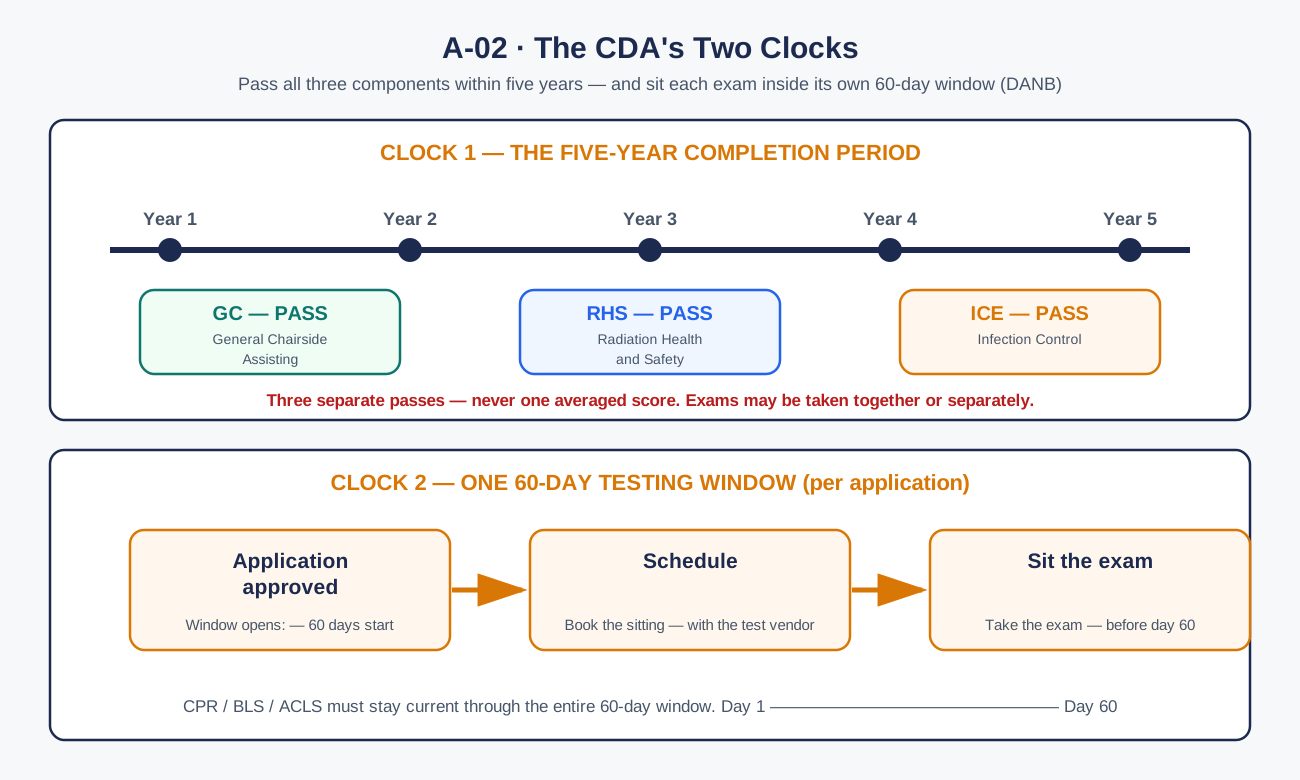 Figure 1.1 — A-02 Five-year completion clock and 60-day testing window for the CDA
The short clock is the 60-day testing window. Once DANB approves your application, you have 60 days from approval to schedule and take your exam, booking through Pearson VUE — DANB's test vendor — either at a test center or, where offered, by remote online proctoring. The window is a calendar-day window, and it starts on approval, not on the day you first look at the scheduling calendar. If you cannot schedule within the original window, you may request one new 60-day window, and the request must come within 60 days after the original window ends; after that, a new application at full fees is required. The practical consequence is that application timing is itself a study decision: applying starts a clock, so the study plans in this book end preparation first and place the application at the point where sixty days is comfortably more time than you need to schedule and sit — not at the beginning of a hopeful season. Appointment discipline differs by delivery mode in one detail worth memorizing: in-person appointments must be canceled with Pearson VUE more than 24 hours in advance, while online proctored appointments may be canceled up to the appointment start time, with a request to cancel the testing window following to DANB before the window expires in either case.
The long clock is the five-year completion period. All three component passes must fall within a single five-year period to earn the CDA. Passes do not expire one by one on a rolling basis inside that period in the way candidates sometimes fear, but a pass earned more than five years before the final component is completed cannot be counted toward that completion — the period is the frame, and the three passes must stand inside it together. For most candidates five years is generous. For the Pathway II reader it is also a planning tool: RHS and ICE passes earned early, while GC hours accrue, sit safely inside a five-year frame that easily contains a two-to-four-year accrual. Chapter 22 turns the five-year ledger into a worked planning exercise on your own dates; for now, hold the two clocks distinctly — sixty days to use an approval, five years to complete a credential.
Certification, once earned, runs on a third, annual rhythm, previewed here and taught fully in Chapter 22. CDA certification is valid for one year and renewed annually. Renewal requires 12 continuing dental education credits for a certificant holding one certification — including, inside those twelve rather than in addition to them, one credit on OSHA's Bloodborne Pathogens standard and two credits in infection prevention, control, or safety — plus current hands-on CPR, BLS, or ACLS maintained separately (CPR does not count toward the credits), answers to DANB's Background Information Questions, and a $75 renewal fee, with a $20 late fee and a three-month grace period after expiration (DANB, 2026 Recertification Requirements). The renewal structure is named now for one reason: the infection-control content of Part IV is not exam decoration. It is the subject DANB requires you to keep studying every year of your certified working life, which is exactly the weight Part IV gives it.
This book teaches the knowledge the three component exams test, in the order a beginner can actually learn it: foundations first (Part I), then GC (Part II), RHS (Part III), and ICE (Part IV), then the exam layer itself (Part V). Its practice architecture mirrors the credential's structure — component tests at the components' published shapes and weights, chapter quizzes that repair by domain, and composite forms that are the three components sat as DANB's same-administration form, never a blended invention. Every item in it is original, written from the published outlines and the public authorities behind them. No actual exam questions exist in any legitimate preparation book, including this one: DANB treats its item bank as confidential, its Candidate Handbook sets out the disciplinary apparatus behind that confidentiality, and any source claiming to sell real DANB questions is telling you something about itself, not about the exam. Outline topic lists define coverage; they are not disguised as questions here, and no practice item from DANB's affiliated study programs is reproduced or paraphrased.
The book's second honesty is about hands. DANB's outlines describe their own exams as testing knowledge-based competence, and this book teaches to exactly that standard: what each procedure is, its purpose, its sequence, its instruments, its safety principles, and how its errors are recognized — never step-by-step hands-on instruction on a patient. Radiography is taught the same way throughout Part III: principles, factors, image purposes, positioning knowledge, and protection, never as exposure instruction to perform. Working through this book therefore does not qualify you to perform any duty. Clinical skill is built in an accredited program or in supervised practice, and legal authority to perform a duty comes from your state's rules within the dentist's delegation — the two frames of Chapter 2. A reader who understands that boundary can trust everything inside it: the book promises the knowledge the exams test, completely, and promises nothing it cannot deliver.
The third honesty is about numbers, and it is this book's signature. Later chapters will teach you systems whose details candidates desperately want as single memorized figures — a sterilizer cycle, a disinfectant contact time, an exposure setting, a material mixing ratio. The authorities behind these exams largely refuse to publish such universals: the CDC's dental infection-prevention summary directs you to the sterilizer's, the instruments', and the product's own instructions for exactly those values, and DANB's outlines test factors, classifications, and monitoring rather than memorized settings. So this book prints the deference itself, in words you can act on, and where a worked example needs such a value, the example states where the value came from — the instructions for that load, that product, that patient — and teaches the method, not the number. Published program numbers are different in kind and are printed proudly with their publishers named: DANB's shapes, fees, and clocks; the CDC's water standard and monitoring intervals; OSHA's program deadlines. Chapter 18's sterilizer system and Chapter 13's exposure factors will show you the discipline working. For now, simply notice the rule, because a preparation book that invents one universal cycle has failed you precisely where accuracy matters most.
Finally, what this book never prints, as a matter of standing policy: no pass rate, because DANB publishes none in any source read for this book, and an invented rate would be a guess wearing a uniform; no salary, placement, or job-growth claim, and no promise that any reader will pass — permitted language is the honest kind, that this book prepares you for the published exams and is aligned to their published outlines; and no state's duty list, fee, or permit rule, for the reasons Section 1.1 gave. If a future edition's verification finds DANB has published a figure this edition lacks, the errata commitment in the back matter is how it will reach you.
This book was planned for three readers at once, and knowing which one you are today tells you how to use it. The total beginner — a career switcher or new student who has never stood in an operatory — reads from Chapter 1 forward, letting Part I build the office, the team, the teeth, and the record before any component part begins, and may sit RHS and ICE with no eligibility gate while GC preparation proceeds. The working assistant accumulating Pathway II hours reads with a different eye: Parts II and IV describe your daily work made exact and testable, and your risk is not ignorance of the job but unexamined habit where the CDC or OSHA system differs from your office's custom — the chapters flag those collisions deliberately. The program student or recent graduate, including the Intent to Graduate applicant, already has supervised hands; your gap is exam craft — the adaptive form, component strategy inside the two clocks, and the outlines' exact grain — so Part V and the domain-tagged practice sets carry your heaviest load. All three readers take the diagnostic in the front matter first, because its results are reported by component and domain and will route each of you differently — which is, once again, the credential's own structure doing the teaching.
Exam trap — the averaged credential. Any study plan, score report, or piece of advice that speaks of your "overall CDA percentage" has already misled you. There are three exams, three scaled scores, and three passes. Plan, study, and judge readiness three times.
Abstract rules become usable when you watch them decide real cases. The three readers below are invented, but every rule applied to them is DANB's published rule from this chapter.
Renata, the career switcher. Renata has worked in retail for six years, holds a high school diploma, and has never worked in a dental office. She asks whether she must wait years before any credential progress is possible. The map says no. RHS and ICE carry no eligibility requirements, so Renata may apply, prepare, and sit both — as a $375 pair in one administration or as two $270 singles — while she looks for her first assisting position. If she passes both, those passes sit in her five-year ledger. Her GC route is Pathway II: she will need 3,500 hours of approved work experience accrued over at least two and at most four years, verified by a licensed dentist, plus the diploma she already holds, plus current hands-on CPR, BLS, or ACLS current through her eventual 60-day GC window. Notice what the map forbids her to be told: that she is "ineligible for the CDA" full stop. She is ineligible for one component today and fully eligible for two, and that distinction is the difference between a two-year head start and two lost years.
Devon, the working assistant. Devon has assisted full-time in a general practice for three years and keeps rough pay records but has never confirmed who will verify his hours. Two risks hide in that sentence. First, DANB accepts only its Employer Work Experience Statement, verified by a licensed dentist, for Pathway II hours — pay stubs are not accepted in its place — so Devon should confirm his verifying dentist and the form now, at roughly three years in, while correction is still cheap. Second, his accrual arithmetic deserves a check: three years of full-time assisting plausibly exceeds 3,500 hours, but the hours must be approved work experience within the two-to-four-year window, and only the verified statement settles the question. Meanwhile Devon, like Renata, could already hold RHS and ICE passes; many working assistants sit ICE first, because Part IV's system is their daily work made exact, and use that pass to learn the adaptive exam's feel before GC.
Priya, the program student. Priya graduates from a CODA-accredited dental assisting program in ten weeks and wants to test close to graduation while her coursework is fresh. Pathway I covers her on graduation, and the Intent to Graduate route lets a student scheduled to graduate within 90 days apply with that form or a director's letter, so her application need not wait for the diploma to be in hand. Her planning problem is the short clock, not the gate: an approved application opens a 60-day window, her CPR must remain current through the whole window, and the combined administration — 245 questions, 195 minutes, $450 with the application fee included — is a legitimate choice for a candidate whose program just rehearsed all three domains, provided her practice results are ready per component, not merely strong on average. If her materials practice lags, the map offers the honest alternative: sit GC and ICE, repair Dental Materials in the domain sets, and take RHS inside the same five-year period — remembering that a passed component is final and a failed one is retaken at full fee, so sequencing by readiness is money, not just comfort.
Three different people, one map, no invented rules. That is the standard every later chapter is held to. Before you turn the page, try the exercise on your own situation, in writing: name your component order, your GC pathway or your plan to reach one, the date your CPR currency runs to, and the window in which you would want an approval to open. Four short lines, all drawn from this chapter's published rules, turn a credential that felt abstract into a plan with dates — and every later chapter, from the operatory tour to the five-year ledger, exists to fill those four lines in.
The CDA is DANB's national Certified Dental Assistant credential, earned by passing three separate component exams — GC (95 questions, 75 minutes; Evaluation 17%, Patient Management and Administration 17%, Chairside Dentistry 50%, Dental Materials 16%), RHS (75 questions, 60 minutes; Purpose and Technique 50%, Radiation Characteristics and Protection 25%, Infection Prevention and Control 25%; digital radiography only since July 7, 2022), and ICE (75 questions, 60 minutes; Prevention of Disease Transmission 20%, Prevention of Cross-contamination 34%, Process Instruments and Devices 26%, Occupational Safety and Administration Protocols 20%) — within five years, in the same administration totaling 245 questions and 195 minutes if taken together. RHS and ICE have no eligibility requirements; GC requires one of three pathways, each plus current hands-on CPR, BLS, or ACLS: Pathway I, a CODA-accredited program or an RDH license (with a 90-day Intent to Graduate route); Pathway II, high school or equivalent plus 3,500 dentist-verified hours accrued over two to four years; Pathway III, former CDA status or specified dental-degree and accepted post-baccalaureate routes. Passing is a scaled score of at least 400 on each component, on a 100-to-900 criterion-referenced scale set by a modified Angoff study, delivered adaptively, with the average candidate answering around 50 percent correctly; no percentage conversion and no averaging exist. The full CDA application costs $450 including the $75 nonrefundable application fee (singles $270, pairs $375); retakes of failed components are unlimited at full fee, and a passed component may be passed only once. An approved application opens a 60-day testing window; certification lasts one year and renews annually with 12 CDE credits including one bloodborne-pathogens credit and two infection-control credits, plus a $75 fee. An additional pathway announced in September 2026 for early 2027 is not yet usable. This book teaches the exams' knowledge completely, in knowledge form, with every figure sourced — and certifies no hands and no state's duties.
--- ## Chapter Quiz — Chapter 1 (untimed; answers and explanations in ch-01-key.md)
1. How many separate component passes are required to earn the CDA? A. One combined pass B. Two C. Three D. Four
2. The GC exam contains how many questions, in how much time? A. 95 in 75 minutes B. 75 in 60 minutes C. 100 in 60 minutes D. 120 in 90 minutes
3. Which component has no eligibility requirements, alongside ICE? A. GC B. RHS C. Neither; all three are gated D. Both GC and RHS
4. Pathway II requires 3,500 hours of work experience plus which other element? A. An RDH license B. A CODA degree C. A prior CDA D. High school graduation or equivalent
5. Over what accrual period must Pathway II hours be gathered? A. At least 2 years, at most 4 years B. At least 1 year, at most 2 C. Any period D. Exactly 5 years
6. The minimum passing scaled score on each component is: A. 300 B. 500 C. 70 percent D. 400
7. A scaled score of 400 is best described as: A. 400 questions correct B. 44 percent correct C. A point on a 100–900 criterion-referenced scale D. The class average
8. The full CDA application fee (same administration, traditional) is: A. $375 B. $450 plus a separate $75 C. $450, including the $75 application fee D. $525
9. The RHS exam has tested which radiography since July 7, 2022? A. Digital only B. Film only C. Film and digital equally D. Neither
10. After application approval, the testing window is: A. 30 days B. 90 days C. 60 days D. One year
11. All three component passes must fall within: A. One year B. Two years C. Ten years D. Five years
12. A failed component may be retaken: A. Once only B. With no limit, by new application at full fee C. Twice only D. Never
13. Annual renewal for a CDA-only holder requires how many CDE credits? A. 12 B. 6 C. 18 D. 24
14. The average candidate on DANB's adaptive exams answers about what share correctly? A. 25% B. 75% C. 90% D. 50%
15. The pathway DANB announced in September 2026 is, as of this edition: A. Officially available in early 2027 and not yet usable B. Available now as Pathway IV C. A replacement for Pathway II D. Required for all applicants
Quiz address map. Items 1–2, 9, 14: Program knowledge — component shapes (GC/RHS/ICE outlines). Items 3–5: Program knowledge — GC eligibility, Pathways I–III (2026 CDA Application Packet). Items 6–7: Program knowledge — passing standard (all three outlines). Items 8, 10–13: Program knowledge — fees, windows, retakes, renewal (2026 Packet; Candidate Handbook; 2026 Recertification Requirements). Item 15: Program knowledge — announced pathway status (DANB announcement, September 23, 2026). If you missed the eligibility items, re-read §1.3 before Chapter 2; if you missed the scoring items, re-read §1.4 — both return in every later chapter's practice.
---
Google Play Books Exam Prep Series
2026–2027 Edition · Built on DANB's GC Exam Outline (effective July 1, 2022) and RHS/ICE Exam Outlines (effective March 12, 2025) · Confirm the current packet, fees, and your pathway at DANB before applying.
Built on DANB's GC Exam Outline (effective July 1, 2022), RHS and ICE Exam Outlines (effective March 12, 2025), the 2026 CDA Application Packet, and the Candidate Handbook (updated June 22, 2026); infection-control content checked against CDC and OSHA publications on October 31, 2026.
Feras Alzubi
Published October 31, 2026.
Extent: 22 chapters of review prose, the complete practice layer of 1,100 questions with worked keys, 118 worked calculation items, 28 labeled figures, a 350-term glossary, four cheat sheets, two crosswalk appendices, and references.
Counts in this book. The practice census is exact, and it is this book's own: 1,100 practice questions — a 60-question diagnostic, a 15-question quiz closing each of the 22 chapters, two full 245-question practice forms, and eleven 20-question domain repair sets. Inside that census, 118 items are designated calculations in four families — radiation relationships (36), sterilization and program clocks (38), material quantity reasoning (22), and appointment and office time math (22) — each one computed from values its question supplies, by a method the chapters teach. The register was designed at 140 and is reported as built at 118, short, not padded; Appendix C prints the full table with its provenance.
---
Dental Assistant Certificate (CDA) — 2026–2027 Edition
© 2026 Feras Alzubi. All rights reserved. No part of this book may be reproduced, distributed, or transmitted in any form or by any means without the prior written permission of the copyright holder, except as permitted by law.
Google Play Books edition. No ISBN has been assigned to this edition, and no other edition identifier is asserted.
All practice questions, worked examples, scenarios, and figures in this book are original work, written from the published component outlines named below, from the public CDC and OSHA guidance behind the infection-control and occupational-safety chapters, and from scenarios invented for this book. No DANB examination question, and no item from any DANB or DALE Foundation preparation product, is reproduced or paraphrased in this book. No DANB or DALE artwork, form, or score image is reproduced; every figure is original to this book.
This book prepares you for one credential, in one published version, earned by passing three separate component exams:
- Credential: Certified Dental Assistant (CDA) — DANB's national certification for dental assistants, earned by passing the General Chairside Assisting (GC), Radiation Health and Safety (RHS), and Infection Control (ICE) exams within a five-year period (DANB, 2026 CDA Application Packet). - GC outline basis: DANB, General Chairside Assisting (GC) Exam Outline and References, effective July 1, 2022 — read in full for this book: the complete domain outline, suggested references, acronym list, and the exam development, passing-standard, and scoring text. - RHS outline basis: DANB, Radiation Health and Safety (RHS) Exam Outline and References, effective March 12, 2025 — read in full, including the complete domain outline, acronym list, and radiography-terms list. - ICE outline basis: DANB, Infection Control (ICE) Exam Outline and References, effective March 12, 2025 — read in full, including the complete domain outline and acronym list. - Program basis: DANB, 2026 CDA Application Packet (updated May 13, 2026) — read in full: eligibility pathways, both fee tables, the testing window, and all application forms; and DANB, Candidate Handbook (updated June 22, 2026) — read in full: delivery, pretest items, results, retakes, and disciplinary apparatus. - Renewal basis: DANB, 2026 Recertification Requirements (updated May 15, 2026) — read in full: validity, continuing dental education (CDE) credits and their composition, fees, grace, audit, and reinstatement. - Infection-control basis: Centers for Disease Control and Prevention, Summary of Infection Prevention Practices in Dental Settings: Basic Expectations for Safe Care (October 2016) — read in full. This is the CDC synthesis DANB's own outlines assign for infection control. - Occupational-safety basis: Occupational Safety and Health Administration, Bloodborne Pathogens Standard, 29 CFR 1910.1030 — regulatory text read in full, with OSHA's bloodborne-pathogens guidance page read as corroboration. - Currency stamp: examination figures, fees, pathways, and program rules in this edition were checked on October 31, 2026. DANB revises its outlines, packets, and fees; confirm the current packet, fees, and your pathway at danb.org before applying.
---
This book is an independent study guide. It is not published by, affiliated with, endorsed by, or approved by the Dental Assisting National Board (DANB), and DANB did not participate in its creation. Exam names and trademarks belong to their respective owners. Passing any exam also depends on the candidate's own preparation; no book can guarantee a result.
DANB, CDA, RHS, and ICE are DANB's marks, used in this book only to identify the exams and their published structure. DANB's outlines are DANB's documents: this book quotes them only in short factual passages — counts, times, weights, eligibility, and the published form of the scoring standard — with citation, maps their domain names in the crosswalk at the back of the book (names are facts), and teaches the underlying subject matter from the CDC, OSHA, and its own professional exposition.
This book teaches knowledge; it does not certify hands. DANB's component exams test knowledge-based competence, in DANB's own words. This book teaches the knowledge the exams test — what each procedure is, its sequence and instruments, its safety principles, and how errors are recognized and corrected. It does not teach hands-on technique on patients, and working through it does not qualify you to perform any duty: clinical skill is built in an accredited program or supervised practice, and legal duties are set by your state (see the state-scope note below). Radiography is taught the same way — principles, factors, image purposes, positioning knowledge, and protection — never as step-by-step exposure instruction.
State scope. This book prepares you for DANB's national component exams. What a dental assistant may legally do — which duties may be delegated, whether radiography requires a state permit or DANB certification, how a state registers or licenses assistants — is set by your state's dental practice act and dental board, and differs by state. DANB states that passing its exams or earning the CDA conveys authority only in states that recognize it. Check your state board's current rules for the duties you will perform. No state duty list, permit rule, or state fee appears in this book.
Number discipline. This book does not print universal sterilizer cycles, disinfectant contact times, exposure settings, or material mix ratios, because the authorities behind this exam do not set them: the CDC directs you to the sterilizer's, the instruments', and the product's own instructions, and DANB's outlines test factors, classifications, and monitoring — not memorized settings. Where a worked example needs such a value, the example states where the value comes from (the instructions for that load, that product, that patient), and the method — not the number — is what is taught. The numbers this book does print as facts are the published program and guidance numbers: DANB's exam shapes, fees, and clocks; the CDC's published monitoring and water standards; and OSHA's published program clocks — each with its publisher named where it appears.
Digital radiography only. The RHS exam tests digital radiography only; no film-based concept has been tested on the RHS exam since July 7, 2022 (DANB, RHS Exam Outline, effective March 12, 2025). This book's radiography is digital — sensors, PSP plates, holders, software viewing and mounting. Film appears only in a short dated note in Chapter 12, where a legacy term still carried in the outline's acronym list needs it.
Every examination figure in this book comes from DANB's published component outlines, its 2026 CDA Application Packet, its Candidate Handbook, or its certification pages, checked on October 31, 2026. Every infection-control rule is cited to the CDC or OSHA publication that issues it. DANB publishes its exam outlines openly for candidates; this book is an independent preparation built on those published outlines and on the public guidance behind them — not a DANB product. The full source list, with publisher, document, version or date, and what each source supports, is the References at the back of the book.
---
The credential on one spread. Every figure below is footnoted to its source; the passing standard is printed only in DANB's published form.
Certified Dental Assistant (CDA) — pass three component exams, each passed separately, within a five-year period. The exams may be taken together or separately (DANB, 2026 CDA Application Packet).
| Component | Shape | Domains, with published shares |
|---|---|---|
| GC — General Chairside Assisting | 95 multiple-choice questions · 75 minutes | Evaluation 17% · Patient Management and Administration 17% · Chairside Dentistry 50% · Dental Materials 16% (DANB, GC Exam Outline, effective July 1, 2022) |
| RHS — Radiation Health and Safety | 75 questions · 60 minutes | Purpose and Technique 50% · Radiation Characteristics and Protection 25% · Infection Prevention and Control 25% (DANB, RHS Exam Outline, effective March 12, 2025) |
| ICE — Infection Control | 75 questions · 60 minutes | Prevention of Disease Transmission 20% · Prevention of Cross-contamination 34% · Process Instruments and Devices 26% · Occupational Safety and Administration Protocols 20% (DANB, ICE Exam Outline, effective March 12, 2025) |
| Same administration | 245 questions · 195 minutes | DANB's own headline form for the three taken together (DANB, CDA exam page) |
Delivery and format. Computer adaptive testing (CAT): exams are scored on the difficulty of questions answered correctly, each candidate receives the same domain percentages, and — in DANB's published sentence — the average candidate will answer around 50% of the questions correctly (DANB, GC, RHS, and ICE Exam Outlines). A small number of unscored pretest questions may appear; DANB publishes no pretest count (DANB, Candidate Handbook, updated June 22, 2026). Exams are delivered at Pearson VUE test centers and by remote online proctoring, where offered. Official results appear in the candidate's online DANB account within 1–3 business days; a candidate must answer all questions to receive a pass/fail result.
Passing — in DANB's published form only. Results are scaled scores ranging from 100 to 900, and a minimum passing scaled score of 400 must be obtained to pass the exam — on each component (DANB, GC, RHS, and ICE Exam Outlines). The exams are criterion-referenced; the standard is set by a modified Angoff study approved by DANB's Board. A scaled score is neither a "number correct" nor a "percent correct" score, and performance is not compared to the performance of others. There is no combined CDA score, and no component's score compensates for another's: the CDA is three passes. No pass rate appears on this page or anywhere in this book — DANB publishes none in the sources read for this edition.
Eligibility — as DANB publishes it. There are no eligibility requirements to take the RHS and ICE exams. To qualify to take the GC exam, a candidate must meet one of three pathways, each plus current DANB-accepted, hands-on CPR, BLS or ACLS, current through the whole testing window (DANB, 2026 CDA Application Packet):
- Pathway I — graduation from a Commission on Dental Accreditation (CODA)-accredited dental assisting or dental hygiene program, or a current Registered Dental Hygienist (RDH) license. Students within 90 days of graduating from a CODA program may apply on an Intent to Graduate form. - Pathway II — high school graduation or equivalent and a minimum of 3,500 hours of approved work experience, accrued over at least two years to a maximum of four years and verified by a licensed dentist on DANB's Work Experience Statement. - Pathway III — former DANB CDA status, or graduation from or enrollment in a CODA-accredited DDS or DMD program, or graduation from a dental degree program outside the U.S. or Canada, or graduation from or enrollment in a post-baccalaureate program affiliated with a U.S. or Canadian dental school on DANB's list of accepted programs (a full dental assisting curriculum of at least 300 hours).
Announced route — not a pathway in this edition: DANB announced on September 23, 2026 an additional pathway for qualifying non-CODA programs, stated by DANB to be officially available in early 2027. As of this edition it is not a route a candidate can use, and it does not appear in the pathway list above (DANB announcement, September 23, 2026; see Chapter 1).
The two clocks. You have five years to pass all three components. Once an application is approved, you have 60 days to schedule and take the exam; one new 60-day window may be requested within 60 days after the original window ends, after which a new application at full fees is required (DANB, 2026 CDA Application Packet).
Fees — 2026 packet, checked October 31, 2026; confirm at danb.org before applying. CDA (all three components, same administration) $450 (active military $425) · any single component $270 ($265) · any two-component pair $375 ($365). Every fee above includes the $75 nonrefundable application fee — the $450 is the total, not $450 plus $75 (DANB, 2026 CDA Application Packet, both fee tables).
Retakes. A failed exam may be retaken with no limit on attempts, by reapplying at the full fee; state law may require additional education after failures. A passed component may be passed only once — it is not re-sat for a better score (DANB, Candidate Handbook, updated June 22, 2026).
After you pass — validity and renewal, in outline. Certification is valid for one year and is renewed annually: 12 CDE credits for one certification, including 1 credit on OSHA's Bloodborne Pathogens standard and 2 credits in infection prevention, control or safety inside the 12; current hands-on CPR/BLS/ACLS maintained separately (it does not count toward CDE); Background Information Questions; and a $75 renewal fee, with a $20 late fee and a three-month grace period (DANB, 2026 Recertification Requirements). Chapter 22 teaches renewal in full.
---
Three readers, in one arc from zero to exam-ready:
- The total beginner — a career switcher or new student who has never been in an operatory. Start in Part I, which builds the office, the team, the teeth, and the record from zero. Note what the eligibility structure makes possible: you may sit RHS and ICE with no eligibility gate at all while you prepare for GC. - The working, on-the-job-trained assistant — accumulating Pathway II's 3,500 hours. Your daily work is Parts II and IV in action; this book makes that knowledge exact, named, and testable, and Chapter 1 and Chapter 22 keep your five-year ledger and your 60-day windows straight. - The CODA-program student or recent graduate — including the 90-day Intent to Graduate route. Your program taught the hands; your gap is exam craft: CAT form, component strategy inside the five-year and 60-day clocks, and the outlines' exact grain. Part V is written for you first, but read it before your first full practice form, not after.
Whichever reader you are: this book does not replace an accredited program or supervised practice, and it never advises readiness on any basis except its own labeled, per-component guidance below.
The book follows one patient's visit as its spine — the patient arrives, the record and the room are ready, the examination evaluates, chairside work proceeds four-handed, images are made only when indicated, instruments return through processing, and the record closes and the room turns over. Part I builds the foundations (Chapters 1–4). Part II teaches GC (Chapters 5–11), Part III teaches RHS (Chapters 12–15), and Part IV teaches ICE (Chapters 16–20), each part following its outline's published domain order. Part V is the exam layer (Chapters 21–22). Chapter space serves the beginner's teaching load; practice item counts serve the published weights strictly — where the two diverge, the blueprint says so openly, and the crosswalk at the back of the book shows both.
- Every practice item carries a triple address: its component and domain, in the outlines' published names; its chapter; and its item class — KI (knowledge) or a designated-calculation family, CALC-01 (radiation relationships), CALC-02 (sterilization and program clocks), CALC-03 (material quantity reasoning), or CALC-04 (appointment and office time math). A designated calculation is an item whose key you must compute from values the stem itself supplies, by a method the book has taught step by step. Every value a calculation needs — including every clinical parameter and every ratio — is stated in its stem; no item asks you to recall a setting. - The diagnostic comes first. The diagnostic test (designed at 60 items, this book's design) is scored by component, then by domain — never as one blended score, because the credential is never one blended pass. Its routing table sends you to the chapters and domain repair sets each weak domain needs. - Practice is component-first. Each component has its own full timed test at its published shape (GC 95 items in 75 minutes; RHS 75 in 60; ICE 75 in 60), and the two full CDA practice forms (designed at 245 items each, this book's design) are the three component sittings taken together. Every practice item is scored for you; this book's tests imitate the real sittings' counts, timing, and weights — they do not imitate adaptivity, and they hide no unscored items. - How to read a practice result — this book's guidance, labeled as such. DANB reports each component as a scaled score from 100 to 900, with 400 the minimum passing score on each component; a scaled score is not a percentage, the three components are never averaged, and no practice result converts to a scaled score. This book's readiness threshold is 80 percent of this book's items correct in a component, with no domain of that component left near empty — the labeled book-guidance line the full practice forms print on their faces. It governs practice in this book only; DANB's standard remains the scaled form stated above. Treat readiness as a per-component judgment, earned component by component with no domain left near empty — mirroring the credential itself.
- DANB's published outlines themselves — the GC, RHS, and ICE Exam Outlines are DANB's documents, published openly for candidates. Read the domain lists for the components you will sit; this book's crosswalk maps them to chapters. - The CDC Summary — Summary of Infection Prevention Practices in Dental Settings (CDC, 2016), the synthesis behind Part IV. - The OSHA standard — the Bloodborne Pathogens Standard, 29 CFR 1910.1030, behind Chapter 19. - Your state board's current rules — for the duties you will actually perform (see the state-scope note on the Disclosure page). This book teaches the national exams; your state sets the job's legal edges.
The diagnostic scoring grids — score the diagnostic by component, then by domain (never as one blended score):
| Component | Domain | Items in the diagnostic |
|---|---|---|
| GC (23) | Evaluation | 4 |
| GC | Patient Management and Administration | 4 |
| GC | Chairside Dentistry | 11 |
| GC | Dental Materials | 4 |
| RHS (19) | Purpose and Technique | 10 |
| RHS | Radiation Characteristics and Protection | 5 |
| RHS | Infection Prevention and Control | 4 |
| ICE (18) | Prevention of Disease Transmission | 3 |
| ICE | Prevention of Cross-contamination | 6 |
| ICE | Process Instruments and Devices | 5 |
| ICE | Occupational Safety and Administration Protocols | 4 |
Record your score beside each row. The chapter-routing rule: a weak domain routes to its home chapters (Crosswalk A, Appendix A) and to its domain repair set — GC domains to Chapters 5–11, RHS domains to Chapters 12–15, ICE domains to Chapters 16–20 — before any retake of a full form.
The one-page progress tracker doubles as your five-year ledger — keep one row per event:
| Ledger row | What to record | |---|---| | Diagnostic profile | Date taken; per-domain scores from the grid above | | Chapter quizzes | Date and score for each chapter's 15 items | | Full Practice CDA — Form 1 | Date; GC / RHS / ICE scores, each against the 80-percent book-guidance line | | Full Practice CDA — Form 2 | Date; GC / RHS / ICE scores, each against the 80-percent book-guidance line | | Application approved | Date — this date opens your 60-day testing window | | Window closes | Approval date + 60 days; every sitting must land inside it | | Component passes | One row per component: GC pass date · RHS pass date · ICE pass date | | Five-year completion | All three passes must stand within five years of the first | | Renewal | Certification is valid one year; renewal date, 12 CDE credits (with the 1 + 2 composition), and the $75 renewal fee | The tracker doubles as your five-year ledger: record each application date, each 60-day window's dates, and each component pass as it lands. The ledger is also practice — applying the program clocks to your own real dates is CALC-02 and CALC-04 work on the dates that matter most.
The four cheat sheets are printed at the back of this book, after the glossary. By design, the sheets are: the numbers sheet (published program and guidance numbers only, each with its publisher); the Spaulding sheet (contact classes to processing decisions, CDC, 2016); the clocks sheet (DANB's and OSHA's published clocks on one page, publishers labeled); and the radiation-relationships sheet (the CALC-01 relationships, each with one worked miniature). No cheat sheet contains a passing percentage, a sterilizer cycle, a disinfectant time, an exposure setting, a mix ratio, or a state rule.
---
Both plans are this book's guidance (Blueprint design rule) — a scheduling apparatus built from the book's chapters and practice layers, not a DANB program and not a promise of any result. Both plans are built component by component, both place the administrative tasks in week 1, and both end at a full timed form taken component by component. Adjust the pace to your starting point; do not adjust the order — foundations first, one component at a time, the exam layer last.
Week 1, both plans — the administrative tasks, placed first on purpose: confirm your GC pathway and gather its documentation (Pathway I diploma, transcript, or director letter, or the Intent to Graduate form; Pathway II high school documentation and the dentist-verified Work Experience Statement; Pathway III documentation for your branch); confirm your DANB-accepted hands-on CPR, BLS or ACLS is current and will stay current through the whole 60-day window; decide which components you will take together and which separately, priced from the Exam Blueprint page; and time your application so the 60-day window opens when you can actually sit. An approved application starts a clock — apply when the plan says you are nearly ready, not when you start studying.
- Week 1 — Foundations and the map. Administrative tasks (above). Chapter 1 (the credential's honest map), then Part I, Chapters 2–4. Take the diagnostic at the end of the week; score it by component and domain and record the profile on your tracker. - Week 2 — GC. Part II, Chapters 5–11, with each chapter's quiz taken the day the chapter is finished. Close the week with the domain repair sets for your two weakest GC domains from the diagnostic profile. - Week 3 — RHS, then ICE. Part III, Chapters 12–15 (digital radiography only; CALC-01 worked examples done by hand, not skimmed), then Part IV, Chapters 16–20. Chapter quizzes as you go; the Spaulding sheet and the clocks sheet reviewed at the week's end. - Week 4 — The exam layer and the full form. Part V, Chapters 21–22. Take Full Practice CDA — Form 1 as three timed component sittings; score each component separately; route every weak domain to its repair set and its home chapter; then take Form 2 the same way. Finish by updating your five-year ledger and confirming your application timing against the 60-day clock.
For readers who already work in an operatory or are finishing a program — the plan compresses reading, never the component structure.
- Week 1 — Foundations skimmed, components taught. Administrative tasks (above) on day 1. Chapter 1 in full; Chapters 2–4 read for the visit spine, tooth language, and the record. Diagnostic on day 2, scored by component and domain. Then Part II (GC, Chapters 5–11) and Part III (RHS, Chapters 12–15) in sequence, chapter quizzes the same day, with priority depth on the domains your diagnostic profile marks weakest. - Week 2 — ICE, the exam layer, and both forms. Part IV, Chapters 16–20, in the week's first half. Part V, Chapters 21–22. Full Practice CDA — Form 1 as three timed component sittings; one repair pass through the routed domain sets and home chapters; Form 2 as three timed component sittings. Close by updating your five-year ledger, confirming CPR currency through your whole window, and setting your application date.
Reader on Pathway II, still accumulating hours: your sequencing advantage is real — RHS and ICE carry no eligibility gate. A variant of either plan that sits RHS and ICE first, then takes GC when your hours and documentation complete, is a legitimate use of the published structure; keep every pass inside the same five-year period, and keep the ledger current.
End of the free sample. The complete book continues from here — the full A-to-Z course in book form, delivered as an EPUB you can read in Apple Books, Google Play Books, ReadEra, Thorium Reader, Adobe Digital Editions, or Send to Kindle.
Buy this ebook — $9.99 Back to the book page
Payments are securely processed by Payhip.