
Mastering Careers & Skills
Data Center Operations: Mastering the Craft · free sample from the book itself
Feras Alzubi
The Complete Course Series — Google Play Books
This book teaches the whole field of data center operations — the facilities, power chain, cooling plant, physical infrastructure, protection systems, and operating craft that keep the world's computing running — from absolute zero to advanced practice, and it teaches, inside that field course, the complete associate credential layer of the field: the Data Center Certified Associate (DCCA), the foundational certification offered by Schneider Electric through its free online Schneider Electric University course path. This book prepares; Schneider Electric certifies. Chapter 32 states exactly what is published about that credential and what is not, and the difference matters.
© 2026 Feras Alzubi. All rights reserved.
No part of this book may be reproduced, stored in a retrieval system, or transmitted in any form or by any means — electronic, mechanical, photocopying, recording, or otherwise — without the prior written permission of the author, except for brief quotations in reviews and for the reader's own study use of the practice items printed here.
Originality statement. This book is an original work, written from scratch for this series. Every chapter, practice item, worked example, scenario, and figure in it is original to this book. No other book's text, items, or teaching material appears in it in any form — not copied, not paraphrased, not adapted. The facts it teaches about examinations, standards, and guidelines are drawn from the issuing bodies' own publications, which are named in the chapters and collected in the References; those publications' own text is never reproduced here.
Not-affiliated disclosure. This is an independent study guide and field course. It is not published by, affiliated with, endorsed by, or approved by Schneider Electric, CompTIA, ASHRAE, or the Uptime Institute, and none of those organizations participated in its creation. "DCCA," "Data Center Certified Associate," "Schneider Electric University," "Energy University," "CompTIA," "Server+," "A+," "ASHRAE," and "Uptime Institute" are used in this book nominatively only — to name the credentials, organizations, guidelines, and classifications that are the subjects taught.
Scope note. This book teaches the knowledge of data center operations — its systems, methods, and professional judgments — for learning and for examination preparation. It is not an employer's operating procedure, not a substitute for site-specific procedures (SOPs, MOPs, and EOPs) or for manufacturer instructions, and not authorization to perform any task: work on real electrical, mechanical, and life-safety systems is performed only by qualified, authorized people under their site's procedures, and Chapter 12 and Chapter 26 teach that boundary as content. Nothing in this book promises a job, a certification outcome, or an examination result; it teaches the field and the credential's published subject matter, and it says so wherever a reader might be tempted to forget it.
Edition. 2026 Edition — built on Schneider Electric's published DCCA development path and topic areas (verified against Schneider Electric's own pages in November 2026), ASHRAE TC 9.9's Thermal Guidelines for Data Processing Environments (5th edition, 2021), the Uptime Institute's published Tier Classification summary, and CompTIA's published Server+ (V5) exam objectives.
Front matter — Title page · Copyright page · Contents · The Field and Its Credential · How to Use This Book · Diagnostic instructions and readiness tracker · Diagnostic (50 items) with key
Part I — Foundations
Part II — Power
Part III — Cooling
Part IV — The Physical Plant & IT Equipment
Part V — Protection
Part VI — Operations: Running the Floor
Part VII — The Credential & the Career
Back matter — Practice Test A (100 items) with key · Practice Test B (100 items) with key · Topic Repair Sets (120 items) with key · Study Plans · Cheat Sheets · Figure Program · Glossary · Errata & Verification Notes · References & Further Reading · Coverage Crosswalk
This page states, in one place, the facts the whole book stands on — what the field is, what its associate credential is, and exactly which facts about that credential its issuer publishes. Everything here traces to the issuer's own publications, verified in November 2026; the chapters carry the full account, and the verification notes in the back matter record the discipline.
The field. Data center operations is the discipline of keeping a computing facility's critical physical infrastructure running — power, cooling, racks and space, cabling, fire protection, physical security, and the management systems that watch over all of them — so that the IT equipment inside never loses the conditions it needs. It is physical, shift-based, procedure-driven work, done by technicians and operators in facilities that range from a single enterprise computer room to hyperscale campuses. Part I teaches the field's map; Parts II through VI teach each system and the operating craft; Part VII teaches the credential and the career.
The credential. The field's associate-level certification is the Data Center Certified Associate (DCCA), offered by Schneider Electric through Schneider Electric University (the online platform formerly presented as Energy University). In Schneider Electric's own published words, the DCCA "indicates a foundational knowledge of critical physical infrastructure in the Data Center," demonstrating "a base level proficiency in the elements of: cooling, power, racks, cabling, fire protection, management, and physical security," for people who will "participate on a team that designs or upgrades the physical layer of the Data Center." Those seven elements are this book's organizing spine — they are also, not coincidentally, the field's own seven systems, which is why this course can teach the field whole and carry the credential inside it.
What Schneider Electric publishes about the DCCA — and what this book therefore prints:
| Published fact | As Schneider Electric states it |
|---|---|
| The issuer | Schneider Electric, through Schneider Electric University |
| The preparation path | A development path of 14 courses, each taking less than one hour, taken free online at your own pace |
| The exam | Taken online through your own account on the platform, after the path courses; the courses are free, the certification exam comes at a cost |
| Prerequisites | None published — no degree, experience, or prior certification requirement appears on Schneider Electric's official pages |
| Credential life | Schneider Electric's launch-era statement says the credential never expires (stated 2014; see Chapter 32 for the currency note) |
What Schneider Electric does not publish — and what this book therefore never prints, here or anywhere: the current exam fee (the only fee figure any official Schneider page has carried dates from 2014, and no current official page restates a price, so treat any fee you meet elsewhere — in either direction — as unverified until your own account's registration screen shows it), the exam's question count, its duration, its passing mark, and its retake terms. Any book, site, or course that quotes those numbers for the DCCA is quoting something Schneider Electric has not published. This book's two practice tests are this book's own design — 100 items in 120 minutes, proportioned across the seven topic areas by the composition of Schneider's own published 14-course path — and the face of each test says so. They rehearse the credential's published subject matter at full depth; they do not impersonate an unpublished exam shape.
The wider landscape, honestly. The DCCA is an associate credential — a foundation, respected as evidence that its holder knows the physical layer's fundamentals. It is not a license, no employer is required to demand it, and it does not manufacture the experience many employers ask for; Chapter 5 teaches the entry path as it actually is, including the experience gate and the real doors around it. Two CompTIA certifications overlap this field from the IT side — Server+ and A+ — and Chapter 33 maps that overlap exactly, from CompTIA's own published objectives. The book's posture throughout: credentials are evidence; competence is the product; this book builds the competence and rehearses the evidence.
The rhythm. Every chapter teaches, then tests. Read the chapter, work its examples with a pencil, then take its 15-item quiz closed-book, then read the key — every key explains the right answer and why each wrong answer is wrong, because the wrong answers are where the field's traps live. Items you miss name the section to re-read; the readiness tracker below turns those misses into a repair list, and the Topic Repair Sets in the back matter drill exactly the areas your scores flag.
Choose your route.
The diagnostic. Fifty items follow this front matter, spanning all seven topic areas plus operations and safety. Take it before Chapter 1, timed loosely (about a minute an item), and score it by area in the tracker. It is a map, not a verdict: its job is to tell the book where to work hardest for you.
A note on numbers. Where this book prints a number — a temperature envelope, a domain weight, a path length — the number traces to the publication named beside it, and the back matter's verification notes say what was checked and when. Where a number belongs to someone else and is not published — your employer's procedures, a manufacturer's ratings, the DCCA's unpublished exam parameters — the book teaches the concept and routes the figure to its owner. That discipline is itself part of the field: data center work runs on verified numbers, and so does this book.
Instructions. Answer all 50 items. Choose the single best answer. There is no penalty for a wrong answer; a guess teaches more than a blank. When you finish, score yourself with the key that follows the diagnostic, and enter your score by area in the tracker: the key tags every item with its area, and the areas are the seven DCCA topic areas plus Operations and Safety & Career. Any area under 60 percent goes on your repair list in pencil — you will re-score the same areas after the repair sets, and the tracker has a second column waiting.
Power — Items: 8 · First score: /8 · After repair: /8
Cooling — Items: 8 · First score: /8 · After repair: /8
Availability & Management — Items: 8 · First score: /8 · After repair: /8
Racks & Space — Items: 4 · First score: /4 · After repair: /4
Cabling — Items: 4 · First score: /4 · After repair: /4
Fire Protection — Items: 4 · First score: /4 · After repair: /4
Physical Security — Items: 4 · First score: /4 · After repair: /4
Operations — Items: 6 · First score: /6 · After repair: /6
Safety & Career — Items: 4 · First score: /4 · After repair: /4
Raw counts only. No score in this book converts to a prediction about any examination — Schneider Electric publishes no passing mark, and this book does not invent one. The tracker measures what you have learned, which is the only honest use of it.
© 2026 Feras Alzubi
All rights reserved.
Mastering Careers & Skills
A data center is a building — or a defined space inside a building — whose entire purpose is to keep computing equipment running continuously: powered, cooled, connected, protected, and watched, every minute of every day, for years at a time. Everything in this book follows from that sentence. The servers, storage systems, and network equipment inside are usually called the IT load; everything that exists to serve them — the electrical plant, the cooling plant, the racks, the cables, the fire and security systems, and the people who run it all — is the facility, and the discipline of running the facility is data center operations.
Notice what the definition does not say. It does not say a data center is a room full of computers. A room full of computers with no engineered power path, no serious cooling, and no one watching it is an office waiting for an outage. What makes a facility a data center is the infrastructure of continuity wrapped around the computing: power that survives the failure of the power grid, cooling that removes heat exactly as fast as the equipment makes it, physical protection against fire, water, and intruders, and an operations team that monitors all of it around the clock. When you read job postings, tour a facility, or sit an examination in this field, the subject is almost never the computers themselves. It is the continuity.
This book teaches the facility side — the operations side — whole: from the first principles a complete beginner needs, through the systems at working depth, to the field's associate credential, the Data Center Certified Associate (DCCA), whose own published topic areas map one-to-one onto the systems this chapter introduces. If you are new, begin here and go in order. If you already work on a floor, this chapter is still worth your hour: it names the whole map, and experienced technicians regularly discover that the parts of the map they have never worked are exactly the parts their next promotion — or their next incident — will ask about.
Computing used to live where its users lived: a mainframe in a company's own basement, servers in a closet down the hall. Three forces pulled it into dedicated facilities. The first is concentration: modern computing is dense. A single rack of today's servers can draw more power than an entire office floor of desks, and produce the heat of a dozen space heaters from a footprint the size of a wardrobe. Ordinary buildings cannot feed that density or remove that heat. The second force is dependence: banking, hospitals, logistics, communications, and government now run on computing that cannot pause. When a payment network stops, the loss is not measured in inconvenience; it is measured in money, safety, and trust, by the minute. The third force is economics: it is cheaper to build one hardened facility for ten thousand servers than to harden ten thousand server closets.
The result is a building type that behaves less like real estate and more like a machine. A large data center consumes as much electricity as a small town, converts essentially all of it to heat, and is engineered — like a power station or a hospital — around the assumption that components will fail and the mission must not. That assumption, failure is normal and must be survivable, is the field's founding idea. You will meet it in every chapter: in redundant power paths, in cooling units installed one beyond need, in procedures written for the worst ten minutes of the year rather than the average day.
"Data center" names a family, not a single form. You will work in, visit, or read about four broad types, and the operations craft differs in emphasis among them.
| Type | What it is | Operations emphasis |
|---|---|---|
| Enterprise | Owned and run by one organization for its own computing — a bank's, a university's, a government's facility | Serving one internal customer; long-lived equipment; change at the owner's pace |
| Colocation | A landlord facility: the operator provides building, power, cooling, and security; many customers install their own IT equipment in leased space, cages, or suites | Customer service is the craft — tickets, remote hands, access discipline, and strict separation between customers |
| Hyperscale | Very large facilities run by cloud and internet companies for their own platforms, built in repeating patterns at campus scale | Standardization and automation; work is highly procedural; fleets of identical equipment |
| Edge | Small facilities placed near users or machines — a few racks in a regional site, a telecom facility, a factory floor cabinet row | Unattended operation, remote monitoring, and dispatch-based maintenance; breadth over depth |
Real facilities blend these: a colocation provider may run a campus that looks hyperscale; an enterprise may lease colocation space while it builds. The type matters less than the shared skeleton — every one of them contains the same seven systems of §1.5, and the skills in this book transfer among all four. A technician who understands the power chain in an enterprise room understands it on a hyperscale campus; the scale, the paperwork, and the employer change, the physics does not.
Two more distinctions belong in your vocabulary early. A data hall (or computer room) is the white space — the room of racks — inside the facility; the electrical rooms, mechanical galleries, loading dock, and offices around it are the facility's support spaces, and much operations work happens in both. And a facility's size is usually quoted not in square feet but in critical power capacity — the megawatts of IT load the plant can support — because power, not floor area, is the binding constraint on everything a data center can do.
Take the tour every new hire takes, in the order the building itself teaches.
You arrive at a perimeter: fencing, controlled vehicle access, cameras, and a security office — the first of the layered physical protections of Chapter 25. Inside, past the mantrap and the access-controlled doors, the building divides roughly into three worlds. The electrical world: the utility service entrance, switchgear rooms, UPS halls with their rows of cabinets and battery rooms, generator yard outside with its fuel storage. The mechanical world: chiller plant or condenser yards, pumps, air handlers, the great air volumes moving through plenums and containment aisles. And the IT world: the data halls themselves — long aisles of racks, fronts facing fronts across cold aisles (Figure 1.1), overhead or underfloor pathways dense with power whips and cable tray, the quiet roar of ten thousand fans.
Figure 1.1 (Class P) — A data hall aisle: racks face front-to-front across a contained cold aisle.
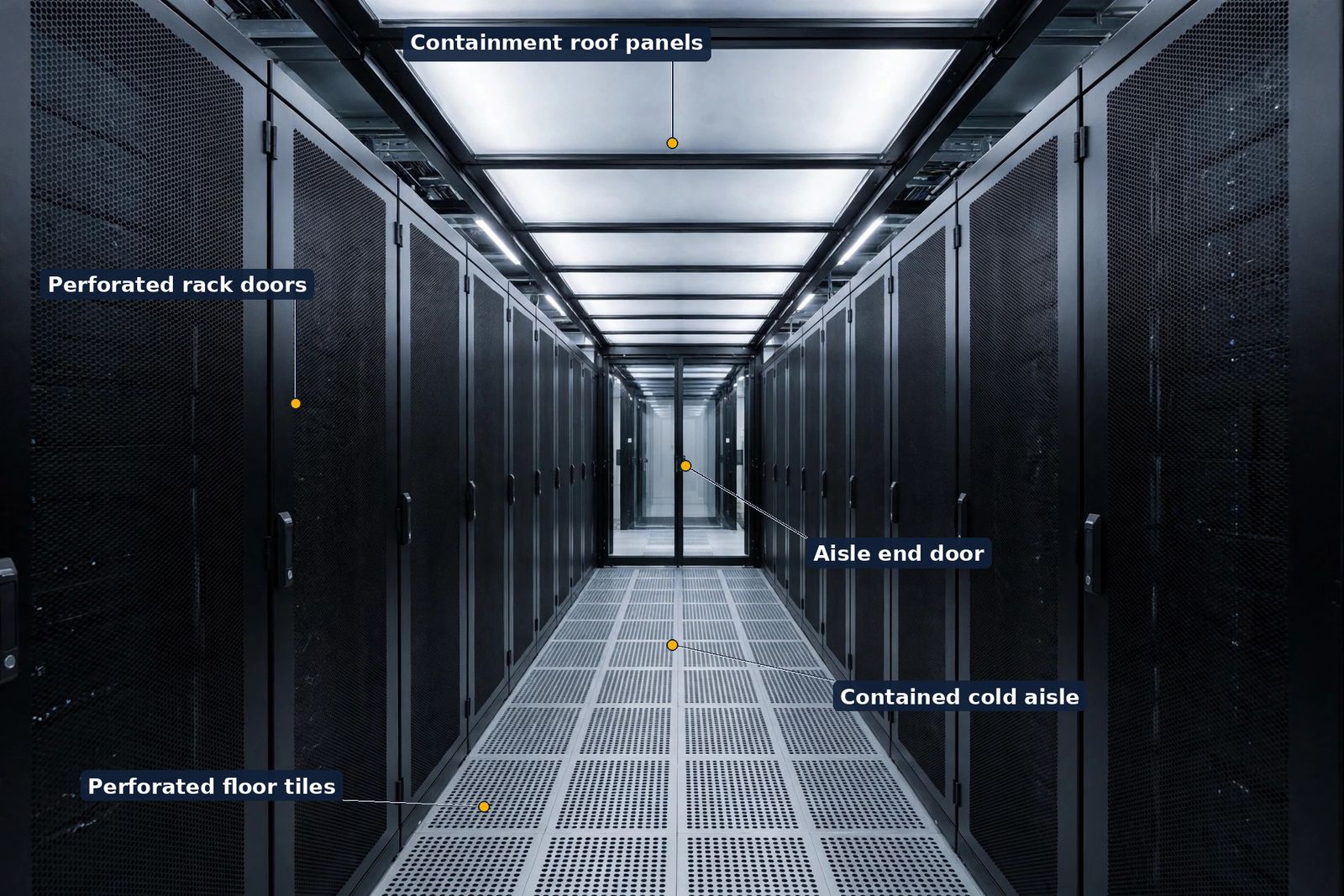
Figure 1.1 — A data hall aisle: racks face front-to-front across a contained cold aisle.
Between those worlds sits the nerve center: the operations room — called variously the NOC (network operations center), the BMS room, or simply "ops" — where screens trend the building's power, temperatures, and alarms, and where the shift team works the tickets, rounds, and procedures of Part VI. Above all of it, literally and logically, sits the documentation: the procedures, drawings, asset records, and monitoring systems that make the building known as well as built. Chapter 23's lesson — one room, one system — starts on this tour: the three worlds are one machine, and the operator's job is to hold the whole of it in mind at once.
Schneider Electric's published description of the DCCA names the elements of the credential as cooling, power, racks, cabling, fire protection, management, and physical security. That list is quoted in the front matter, and it earns its place there because it is not merely an exam outline — it is the field's own anatomy. Every data center, of every type in §1.3, runs on these seven systems, and this book is organized around them (Figure 1.2):
Figure 1.2 (Class A) — The seven systems map: the IT load at the center, the seven systems around it.
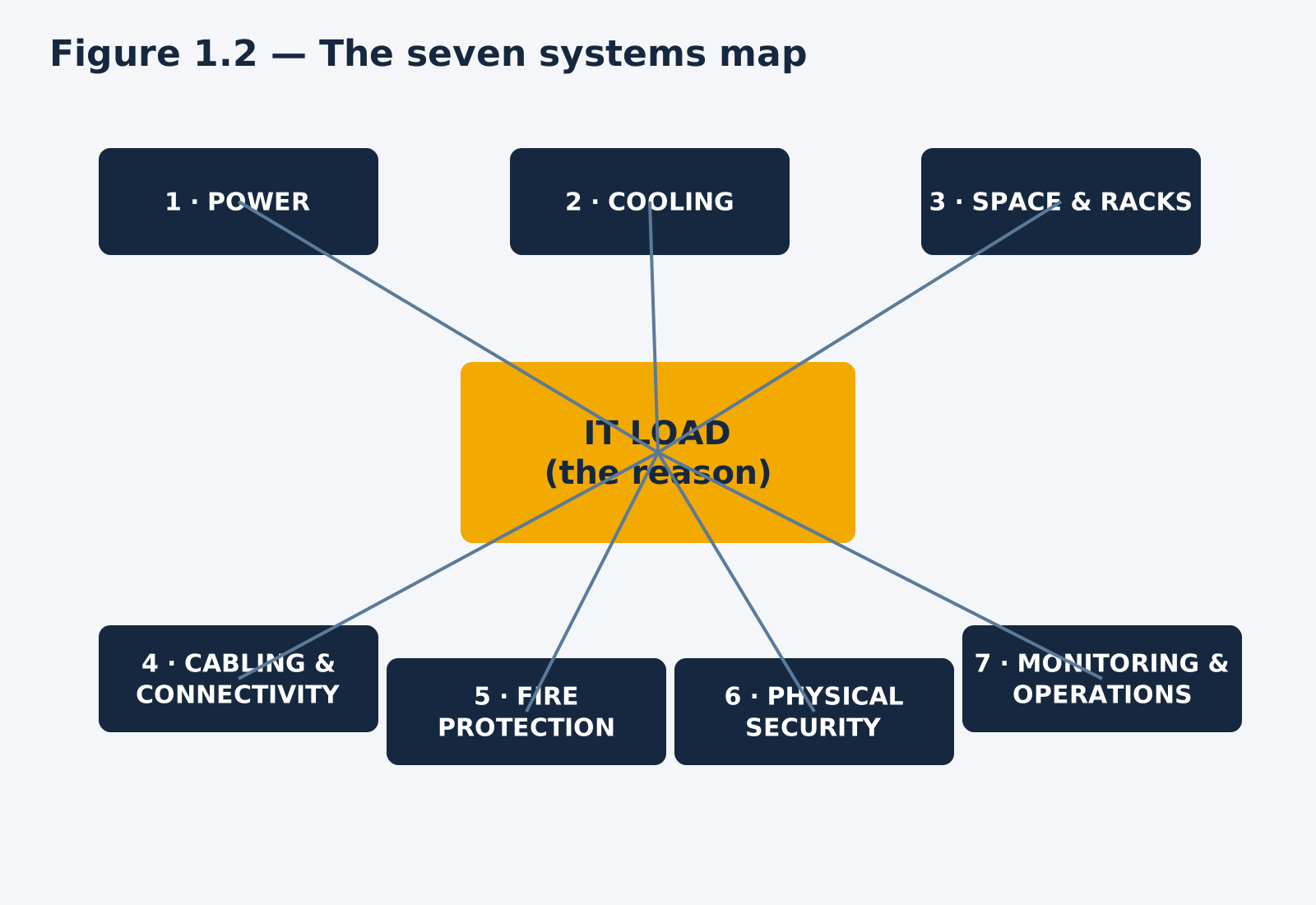
Figure 1.2 — The seven systems map: the IT load at the center, the seven systems around it.
To Schneider's seven, this book adds the two subjects the credential's list implies but does not name: availability — the mathematics of uptime that sizes all the redundancy (Chapter 3) — and safety and operations craft, the human disciplines that the management element presupposes (Chapters 5, 26, and Part VI). A useful way to hold the map: six systems serve the load directly; the seventh — management — serves the other six; and the operator serves them all.
Operations people sometimes talk as if the facility were the product. It is not. The product is continuous computing service, and the facility is its life-support. That ordering explains several features of the field that surprise newcomers. Maintenance is scheduled around the load's needs, not the technician's convenience — which is why so much of it happens at night. Changes are guilty until proven innocent: a modification that has not been planned, approved, and given a back-out path (Chapter 29) does not happen, however clever it is. And the customer's measure of you is brutally simple — was it up? — which is why the field tracks availability to three decimal places and treats a minute of downtime as a serious event.
It also explains the field's defining emotional texture: long stretches of quiet, disciplined routine — rounds, trends, preventive maintenance — punctuated by rare intervals of intense, procedural urgency when something fails. The craft taught in Part VI is largely the art of making the quiet stretches catch problems early, so the urgent intervals stay rare and short.
A data center's operations team is a ladder of roles, and Chapter 5 climbs it in full; the sketch here fixes the vocabulary. Data center technicians (levels I through III in most organizations) do the floor work: rounds, rack installations, cabling, remote hands, first response. Critical facilities / operations engineers and operators run the electrical and mechanical plant: switching, maintenance, alarm response. Shift leads and operations managers own the schedule, the change calendar, and the incident bridge. Around them: security officers, network and IT teams (who own the load itself — a boundary Chapter 22 teaches carefully), project and capacity planners, and the vendors who maintain the great machines under contract. Employers organize these roles differently — one person's "technician III" is another's "senior operator" — but the work itself is constant, and this book teaches the work.
Design builds the facility; construction commissions it; operations is everything after the ribbon-cutting, forever: monitoring, maintaining, repairing, changing, documenting, and improving a live plant that may not pause. Two phrases from the field belong in your permanent vocabulary. Day-2 operations is the common name for this whole discipline — the work of day two and every day after. And run-the-business work — rounds, tickets, PMs (preventive maintenance tasks) — is its daily substance, as distinct from change-the-business work (installations, upgrades, expansions), which operations also supports and controls through the change process.
Hold one more distinction, because examinations and interviews both probe it: operations is not babysitting. A well-run facility's quiet is manufactured — by design margins, by maintenance, by monitoring, and by operators who catch a drifting temperature trend on Tuesday so that no alarm fires on Friday. The diagnostic you took in the front matter, and every quiz in this book, are built to that standard: they test whether you understand the systems well enough to operate them, not merely to name them.
Part I finishes the foundations: the seven systems in depth (Chapter 2), availability's mathematics (Chapter 3), the field's numbers and units (Chapter 4), and the honest account of the job and the doors into it (Chapter 5). Parts II and III take the two great plants in turn. Part IV covers the physical plant and the IT equipment's care. Part V is protection — fire, security, safety. Part VI is the operating craft itself. Part VII closes with the credential (Chapter 32), the CompTIA bridge (Chapter 33), and your first ninety days and beyond (Chapter 34). The back matter carries the rehearsal apparatus: two full practice tests, repair sets keyed to the seven areas, study plans, cheat sheets, and the glossary.
Key terms of this chapter. IT load — the computing equipment and the power it draws. Facility / critical infrastructure — everything that serves the load. Data center operations — the discipline of running the facility continuously. Data hall — the room of racks. Critical power capacity — the IT load, in kilowatts or megawatts, a facility can support. Day-2 operations — the run-forever discipline after construction. Remote hands — operator work performed on a customer's or another team's equipment at their written direction (Chapter 28). PM — preventive maintenance task.
Tags: the primary tag names the topic area the item feeds (FIELD = the field's map and vocabulary). The key, with every option explained, is in this chapter's key file.
Q1. What makes a facility a data center, rather than merely a room with computers in it? A. The number of servers it contains B. The presence of a raised floor C. The engineered infrastructure of continuity around the computing — power, cooling, protection, and monitoring that keep the load running through failures D. Ownership by a technology company
Q2. In data center vocabulary, the "IT load" is: A. The total weight of the racks on the floor B. The computing equipment — servers, storage, network gear — and the power it draws C. The number of tickets a shift handles D. The cooling plant's output
Q3. A colocation facility's operations team chiefly provides: A. The customers' software support B. Internet service to homes in the area C. Equipment leasing only, with no operations staff D. Building, power, cooling, and security, plus services such as remote hands, while customers own their IT equipment
Q4. A facility's size is most meaningfully quoted in: A. Critical power capacity — the IT load its plant can support B. Square feet of office space C. The number of parking spaces D. Ceiling height
Q5. The field's founding design assumption is that: A. Equipment, properly bought, does not fail B. Downtime is acceptable if it is scheduled C. Components will fail, and the mission must survive their failure D. The utility grid is perfectly reliable
Q6. Which list matches Schneider Electric's published elements of the DCCA? A. Networking, databases, operating systems, cloud, security, programming, support B. Design, construction, sales, finance, marketing, legal, management C. Power, water, gas, sewage, roads, zoning, permits D. Cooling, power, racks, cabling, fire protection, management, physical security
Q7. Edge facilities differ from hyperscale facilities chiefly in that edge facilities are: A. Not really data centers B. Small and placed near users, often lightly staffed or unattended, relying on remote monitoring C. Always owned by governments D. Built without cooling systems
Q8. The operations room's trending screens exist primarily to: A. Let operators watch the plant's condition continuously and catch drift before it becomes failure B. Entertain the night shift C. Replace the need for rounds D. Record video of visitors
Q9. "Day-2 operations" refers to: A. The second day of construction B. The day after an examination C. The whole discipline of running the facility after it is built and commissioned — monitoring, maintaining, changing, documenting D. A two-day maintenance window
Q10. A new operator asks why nearly all maintenance happens at night. The best answer is: A. Electricity is free at night B. Work is scheduled around the load's and customers' needs, and the quietest, lowest-risk windows are usually at night C. Regulations forbid daytime work D. The equipment is turned off at night anyway
Q11. Which pair of roles most directly owns the electrical and mechanical plant's operation? A. Security officers and recruiters B. Sales staff and accountants C. Software developers and database administrators D. Critical facilities operators/engineers and data center technicians
Q12. The emotional texture of operations work is best described as: A. Constant emergency B. Entirely predictable desk work C. Long, disciplined routine — rounds, trends, maintenance — punctuated by rare, procedural urgency when something fails D. Improvisation under pressure, most days
Q13. A hyperscale campus's operations craft is distinguished by: A. Standardization and repetition — fleets of identical equipment worked through highly procedural methods B. A complete absence of procedures C. Each building being run as a unique craft project D. Customers installing their own equipment in cages
Q14. Which statement about the facility and the load is correct? A. The facility is the product; the load is incidental B. The load exists to justify the facility's budget C. The two are unrelated businesses sharing a roof D. The product is continuous computing service; the facility is its life-support, and maintenance and change are scheduled around the load
Q15. The management system among the seven systems is distinctive because it: A. Carries the largest electrical load B. Watches and governs the other six — monitoring, documentation, and procedure C. Is the only system with no physical components anywhere D. Operates only during business hours
End of the free sample. The complete book continues from here — the full A-to-Z course in book form, delivered as an EPUB you can read in Apple Books, Google Play Books, ReadEra, Thorium Reader, Adobe Digital Editions, or Send to Kindle.
Buy this ebook — $12.99 Back to the book page
Payments are securely processed by Payhip.