
Mastering Careers & Skills
Data Center Liquid Cooling: Mastering the Craft · free sample from the book itself
Walk into a data center in your mind before you ever walk into one in person. A data center is a facility built to house computing equipment — rows of cabinets holding servers that store, process, and move information — together with the power and cooling equipment that keeps those servers alive. The computing equipment has a formal short name the field uses constantly: IT equipment, for information technology equipment, meaning the servers and the networking and storage devices that do the computing work itself. Everything else in the building exists to serve the IT equipment: to feed it electricity, and to carry away its heat.
That second job — carrying away heat — is the subject of this book, and it is larger than a beginner expects. Electricity that enters a server does not stay electricity. The server spends it doing computation, and computation, as a physical matter, ends as heat inside the machine. Chapter 3 teaches that conversion from zero, carefully and completely. For this chapter, hold the plain version: every watt of electrical power a server draws becomes, in the end, a watt of heat that must leave the building, or the building's temperature climbs until the equipment protects itself by slowing down or shutting off. Cooling is therefore not a comfort system for computers, the way air conditioning is a comfort system for people. It is a load-bearing part of the machine. A data center that cannot remove heat cannot compute, whatever its servers could do on paper.
For decades, the field removed that heat with air: cool air delivered to the servers, warmed air collected and cooled again. Chapter 5 teaches that air-cooled baseline honestly and completely, because it is the foundation this specialty stands on. This chapter states the problem that pushed beyond it. As computing equipment grew more powerful, each cabinet of servers drew more power and therefore made more heat, packed into the same floor space. Air is a thin carrier of heat — Chapter 4 will show, from zero, why a moving liquid carries far more heat in the same space than a moving gas — and a point arrives where moving enough air through a cabinet stops being practical: the fans grow enormous, the noise and energy cost climb, and the air simply cannot pick up heat from the hottest components fast enough. The field's answer is the subject of this book: liquid cooling, the family of methods that bring a liquid coolant to, or even around, the computing equipment itself, so that liquid — not air alone — does the heavy work of carrying heat away.
This book teaches that whole specialty from zero to advanced practice. It assumes nothing: not heat, not fluids, not air cooling, not data-center experience. Chapters 3 and 4 build the science from the ground. Chapters 5 and 6 build the baseline and the problem. Only then, from Chapter 8 onward, does the liquid specialty itself begin, piece by piece. Chapter 1's job is narrower and wider at once: to show you the field whole — the problem it solves, the path heat travels, the architectures it works in, the rooms it works in, and the people who work there — so that every later chapter has a map to hang on.
It is tempting to meet liquid cooling as a catalogue: this device, that device, a cabinet with pumps in it. Resist that order. The specialty makes sense, and its equipment stops looking arbitrary, when the problem is stated as physics first and as product second.
The physics is a chain of three facts. First, computing makes heat in proportion to the power it draws: more computation in a cabinet means more watts drawn and more watts of heat to remove. Second, heat must travel. It is generated inside small components on circuit boards, and it must end up outdoors, rejected to the environment, or the facility warms without limit. Between the component and the outdoors lies a path, and every step of that path has a capacity — a rate at which it can carry heat — set by the materials and fluids doing the carrying. Third, the path is only as strong as its weakest step. If the first step, from the component into whatever touches it, can carry only so much heat per second, then no generosity downstream can rescue it: the component's temperature rises until the balance is forced, by throttling or failure. Engineers call the amount of heat packed into a given space heat density, and the story of modern computing is a story of heat density climbing: more power in each component, more components in each server, more servers in each cabinet, more cabinets on the same floor.
Air cooling meets that climb with a carrier that has real virtues — air is everywhere, it does not leak onto electronics, and the equipment for moving it is mature — and one decisive limit: a given volume of air carries relatively little heat as it warms by a given amount, compared with the same volume of a liquid warmed by the same amount. Chapter 4 states that comparison carefully, as characterisation, and builds the ideas of flow and temperature difference that make it precise. The consequence here is simple to hold. To remove a large heat load with air, you must move a very large volume of air, very reliably, through very small passages inside the servers — and both the moving and the passages get harder as density rises. Direct-to-chip liquid cooling, rear-door heat exchangers, and immersion cooling — the three architectures of §1.4 — are three different answers to the same physics: put liquid where the heat is densest, and let air go back to doing what it does well.
One more piece of physics belongs in this opening, because it disciplines everything the specialty claims. Liquid cooling does not make heat disappear, and it does not repeal the need for the rest of the cooling plant. It changes where heat is picked up and how it travels the first and hardest part of its journey. The heat still ends outdoors. What liquid buys is capacity at the point of pickup and efficiency along the path — and it buys them at a price this book never hides: liquid systems bring water-based coolant near electrical equipment, and that nearness creates the leak discipline, the water-quality discipline, and the safety discipline that occupy whole chapters later. A technician who understands the trade — capacity bought with discipline — understands the field's character. Liquid cooling is not magic and it is not a fashion. It is an engineering answer to a density problem, adopted where the physics of air runs out.
Every liquid-cooling system in this book, whatever its architecture, walks heat along the same chain. Learn the chain now, at the level of a map, and each later chapter will simply zoom into one link of it.
The chain begins at the chip — the book's plain word for the heat-making integrated-circuit components inside a server, above all its processors. The chip is where electrical power becomes heat, in a package far smaller than your palm. Heat generated in so small a place is intensely concentrated, which is exactly why the first step of the chain matters most. From the chip, heat passes into a coolant. In two of the three architectures the coolant is a liquid that flows through purpose-built passages touching the chip's package; in the third, the whole server sits immersed in the liquid. Chapter 3 teaches the two ways heat moves at this step — through solid contact and carried by a moving fluid — in plain words and from zero.
The coolant, now warmed, travels to a coolant distribution unit (CDU): a cabinet of pumps, a heat exchanger, a reservoir, and controls that sits between the IT equipment and the building. The CDU is the heart of the liquid system and gets its own chapter, Chapter 11. Inside the CDU, the coolant does not mix with the building's water. It hands its heat across the surfaces of a heat exchanger — a device in which two fluids pass close to each other, separated by solid material, so heat crosses from the warmer fluid to the cooler one while the fluids themselves stay apart — to the facility's water on the other side. That separation is one of the field's organising ideas, and Chapter 12 names the two loops it creates: the loop on the IT side and the loop on the facility side, with the CDU as the boundary between them.
The facility water, now carrying the heat, travels to the building's heat-rejection equipment, where the heat is finally given up outdoors — to the outside air, directly or through the facility's wider cooling plant, which this book treats strictly as the upstream neighbour at scope level: what arrives at the boundary, what is handed back, and who owns what. The refrigerant-based plant that may stand behind that boundary belongs to a neighbouring occupation and a companion book, and this book teaches none of it. What matters for the chain is the shape: chip, coolant, CDU, facility water, outdoors. Figure 1.1 draws that shape as the book's first map.
Figure 1.1 (Class A) — The heat chain map: heat leaving the chip, carried by coolant to the CDU, handed to facility water, and rejected outdoors.
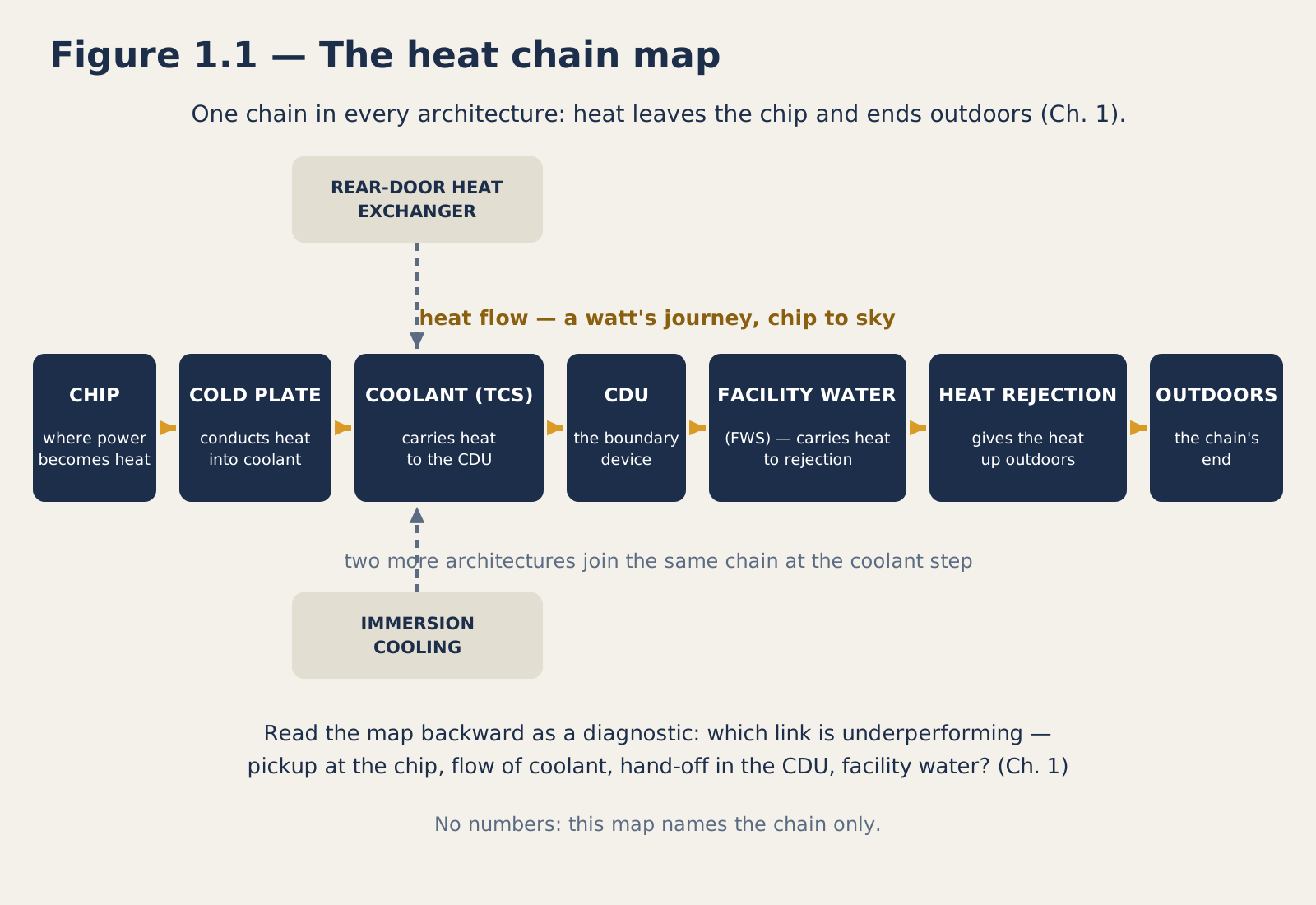
Figure 1.1 — The heat chain map: heat leaving the chip, carried by coolant to the CDU, handed to facility water, and rejected outdoors.
Read the map in both directions, because technicians use it both ways. Forward, it is the story of a watt of heat leaving a processor and ending in the sky. Backward, it is a diagnostic instrument: a server running hot is a question about which link of the chain is underperforming — the pickup at the chip, the flow of the coolant, the hand-off inside the CDU, the facility water beyond it — and Part IV's troubleshooting method is, in large part, the disciplined asking of that question. No link can be skipped in the reasoning, and no link can carry more than its capacity. That is the whole field in one sentence, and the rest of the book is its working out.
The chain of §1.3 is constant. What varies between installations is where the liquid goes and how much of the heat it picks up directly. The field works in three architectures, and a technician must be able to recognise each on sight and state, honestly, where each fits.
In direct-to-chip cooling — the field also shortens it in speech to direct liquid cooling — coolant flows through cold plates: flat metal blocks with internal passages, mounted directly on the server's hottest components, in firm contact with the chip's package. The cold plate is the specialty's first artefact and Chapter 9 is devoted to it. Coolant arrives at the server through hoses and connectors, passes through the cold plates on the hottest chips, and carries their heat away, while air still handles the server's lesser heat sources. This architecture puts liquid precisely at the densest heat, inside the server, and it is the form most closely tied to the heat chain of §1.3: cold plates inside servers, a distribution network through the racks, a CDU at the boundary.
In the second architecture, liquid never enters the server at all. A rear-door heat exchanger is a coil — a panel of fluid passages with fins — fitted to the back of a server cabinet, with fans that draw the cabinet's exhaust air through it. Facility-side water flows through the coil; the hot air leaving the servers gives up its heat to that water as it passes, and leaves the door cooled. The servers themselves remain ordinary air-cooled servers; the liquid works at the door. Chapter 13 teaches this architecture whole, including where it honestly fits: it captures heat at the cabinet boundary, before the hot exhaust can burden the room, without asking anything of the servers inside.
In the third architecture, immersion cooling, the servers are submerged in a tank of dielectric fluid — a liquid that does not conduct electricity, so that electronics can operate while bathed in it. Heat passes from every surface of the immersed equipment into the fluid. Immersion comes in two forms, taught in Chapters 14 and 15: in single-phase immersion, the fluid stays liquid throughout and is circulated to a heat exchanger that cools it; in two-phase immersion, the fluid boils at the equipment's hot surfaces, and the vapour condenses back on cooled surfaces above, in a continuous cycle. Immersion asks the most of its fluid and its servicing discipline and returns the most complete contact between coolant and equipment; this book teaches both forms at teaching level — what each is, how each works, how each is serviced at method level, and where each honestly fits — and it teaches no immersion-fluid handling, transfer, or disposal procedure anywhere, because that hands-on work is gated by the employer's program.
Figure 1.2 shows the most common of these landscapes as the field first meets it: a liquid-cooled hall built on the direct-to-chip architecture.
Figure 1.2 (Class P) — A liquid-cooled data hall row: server racks with visible rack manifolds and neatly routed coolant hoses, and a coolant distribution unit cabinet standing at the end of the row.
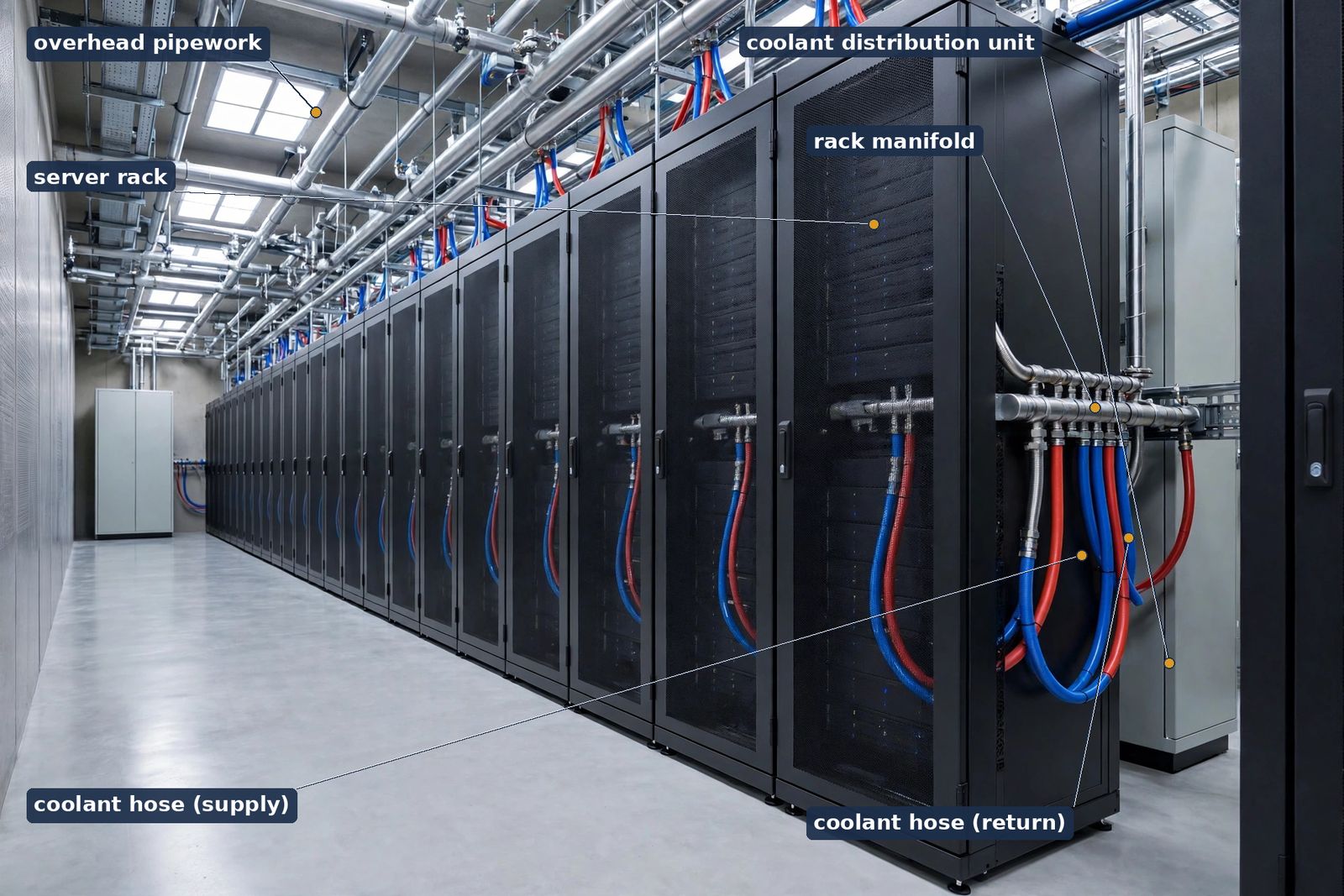
Figure 1.2 — A liquid-cooled data hall row: server racks with visible rack manifolds and neatly routed coolant hoses, and a coolant distribution unit cabinet standing at the end of the row.
Three architectures, one chain. A real facility may run more than one of them — immersion in one hall, direct-to-chip in the next, rear doors on a row of general-purpose cabinets — and the technician's foundations do not change between them: the same heat, the same fluids, the same boundary at the CDU or its equivalent, the same discipline about water quality, leaks, and records. Learn the chain and the foundations once, and each architecture becomes a variation you can reason about rather than a new trade you must memorise.
Now assemble the room whole, in the one view every later chapter zooms into, following the direct-to-chip arrangement of Figure 1.2. The hall is a room of cabinet rows. Each cabinet — the field's working word is rack, for the framed cabinet that holds servers stacked one above another — holds servers whose cold plates are plumbed, through short hoses and connectors designed to join and separate without tools spraying coolant, to the rack's distribution rails. Those rails have a name you will use daily: a manifold is the pipework that distributes coolant to many connections and collects it back — in a rack, typically a supply rail carrying cooled coolant to each server connection and a return rail carrying warmed coolant away. Chapter 10 teaches manifolds, hoses, and the connectors — quick disconnects — as objects in their own right.
The rack manifolds connect, in turn, to the room's larger pipework, and the room's loops gather at the CDU standing at the end of a row or in a gallery beside the hall: pumps moving the coolant, the heat exchanger where the IT-side loop hands its heat to the facility side, the reservoir that gives the loop its breathing room, filtration that keeps the coolant clean, and the control panel through which the unit is watched and directed. Beyond the CDU lies the facility side — plant-room pipework, valves, gauges, and the heat-rejection equipment outdoors — taught in Chapter 16 as the boundary country the liquid technician must understand without absorbing the neighbouring trades that own it.
Stand back and notice what the room is, organisationally. The IT equipment belongs, in most facilities, to one team; the facility systems, including the liquid plant, to another; and the liquid-cooling technician works the seam between them, on equipment that is plumbing and electronics at once, in a room where a computing outage and a plumbing failure can be the same event viewed from two desks. Chapter 33 maps those working interfaces properly. For Chapter 1, hold the portrait: racks plumbed like radiators in a row, a cabinet of pumps and exchange at the row's end, pipework overhead or underfloor tying the room to the plant beyond the wall — and every watt of it existing because air, alone, could no longer carry what the chips produce.
The roles recur through this book, named here in outline and taught whole in Chapter 2. Liquid-cooling technicians install, commission, operate, monitor, and maintain the liquid systems themselves: the loops, the CDUs, the rack distribution, the immersion plant. Data-center facilities technicians keep the wider facility — its power, its air cooling, its rounds and records — within which the liquid systems live; the generalist body of that work belongs to a companion book in this series and is signposted, never re-taught, wherever it begins. Around them stand the neighbouring roles the liquid technician works beside daily: mechanical and facilities colleagues who own the plant beyond the boundary, IT colleagues who own the servers the loops cool, and the design engineers whose documents the installations follow — degree-qualified neighbours, named in this book without any pay or employment figure attached to them, because they are not this book's reader outcome.
Employers hire liquid-cooling crews from two established occupational pools, and Chapter 2 prints those two occupations' own published figures, separately and whole, as the book's only pay and employment anchors. The first pool is the occupation of heating, air conditioning, and refrigeration mechanics and installers: the mechanical and thermal workforce whose trade is temperature control in buildings, and whose ranks supply many of the specialty's entrants. The second pool is the occupation of maintenance and repair workers, general: the facilities operations-and-maintenance workforce that fixes and maintains machines, mechanical equipment, and buildings, and from whose ranks facilities crews are drawn. Neither occupation is "liquid cooling technician" — no published occupation carries that name — and this book never pretends otherwise. It names the pools honestly, prints their figures in the front matter and in Chapter 2 only and in their fenced form, and teaches the liquid-cooling craft that a worker from either pool must add to their background to work this specialty with authority. Chapter 1 names the pools and prints no figures for them; that discipline — figures in exactly two places, never scattered — is part of the book's accuracy law, and you will see it kept on every page.
One idea stands apart from the map because it governs how a technician may move inside it. Liquid cooling deliberately brings water-based coolant — or, in immersion, tanks of dielectric fluid — into the immediate neighbourhood of electrical equipment that represents enormous value and whose interruption carries real consequence. The specialty is safe in service, at scale, across the industry — and it is safe because of a discipline, not by accident. Three habits carry most of that discipline, and each gets whole chapters later; meet them now as the field's character.
The first is water-quality discipline. A liquid loop is a small, closed, chemical environment. What grows in it, what corrodes in it, and what deposits inside its narrowest passages decide whether it cools well in its fifth year or fails in its second. Chapter 8 teaches coolants and water as the invisible discipline: what flows, what is watched, and why — by characterisation and method, never by invented numeric limits. The second is leak discipline: detection built into the installation — sensing devices, trays, alarms — and a response taught, in Chapter 25, as recognition, system-level isolation, and escalation under the site's own plan, never as a printed procedure that displaces that plan. The third is energy discipline: a loop holds stored energy — it is pressurized, and it stays pressurized when its pump stops — and the rules that govern work around stored energy, taught by their shape in Chapters 19, 26, and 31, treat a stopped loop as a loaded system, never as a safe one, until the employer's program has isolated and depressurized it.
State the book's safety law once, plainly, where every reader meets it early: liquid-work hazards — pressurized coolant, stored energy, hot surfaces, electrical equipment in the presence of water, coolant chemicals, immersion fluids — are taught in this book at recognition, rules, and response-method level only. No step-by-step hazardous procedure prints anywhere in these pages: no opening of a live loop, no entering of an immersion tank, no chemical dosing, no energized-work procedure. Hands-on qualification happens in an employer's training and qualification program, on that employer's equipment, under the governing documents. A beginner sometimes reads that fence as the book withholding something. Read it instead as the field's own shape: the knowledge that keeps a technician safe and employable for a career is recognition and judgment, and those this book teaches without limit.
Close the map with the standing honesty this book keeps on its face, stated in full in the front matter and taught whole in Chapter 2. No license and no occupation-specific certification for "liquid cooling specialist" — or any equivalent title — exists as a licensed occupation. No government license and no single named certification gates data-center liquid-cooling work as an occupation. Hiring runs through the two anchor occupations named in §1.6, through employer training and qualification programs, and — where a task falls inside another occupation's licensed scope, such as refrigerant handling or electrical work — through that occupation's own rules, which are that jurisdiction's and that occupation's, never this book's. The adjacent real credentials belong to their own occupations and their own books: the data-center operations associate layer is signposted to the companion Data Center Operations volume, and EPA refrigerant-handling certification belongs to the HVACR occupation and its companion volume. This book signposts both and prepares for neither.
This book therefore promises readiness and knowledge only — never a credential, never eligibility, never a job. What it does do, if you work it whole, exercises included, is give you the field entire: the heat and fluids underneath it, taught from zero; the systems piece by piece; the work in its life order, from reading a job to handing one over; operations, maintenance, and troubleshooting by cause chain; the hazards by recognition; the standards landscape by scope; and the judgment to know what you do not yet know. In a field whose employers train and qualify their own crews, the applicant who arrives already speaking the specialty's language — cold plate, manifold, CDU, loop, boundary, cause chain — starts that training far ahead. That is a book's honest promise, and it is enough. Chapter 2 now walks through the door this chapter has mapped: the roles, the employers, and the credential landscape exactly as it stands.
Tags: FIELD — the field and the problem it solves; CHAIN — the heat chain and the architectures; ROLES — who works there. The key, with every option explained, is in this chapter's key file.
Q1. Cooling in a data center is best described as: A. A comfort system for the people who work in the hall B. A load-bearing part of the machine — a data center that cannot remove heat cannot compute C. An optional extra fitted after the servers are chosen D. A system that matters only in hot climates
Q2. Every watt of electrical power a server draws becomes, in the end: A. A watt of heat that must leave the building B. Stored information with no physical cost C. A watt of light visible in the hall D. Half a watt of heat, the rest being destroyed
Q3. The specialty states its problem as physics before product because: A. Products are not taught anywhere in the book B. Vendors asked the book to delay naming equipment C. The chain — heat made, heat travelling, the weakest link setting the limit — explains why each device exists D. Physics is easier than equipment study
Q4. Heat density means: A. The weight of a server per shelf B. The number of cabinets in a row C. The price of cooling per cabinet D. The amount of heat packed into a given space — the quantity that has climbed as computing grew
Q5. In the heat chain, the CDU's role is to: A. Generate the facility's chilled water from refrigerant B. House the boundary where the IT-side coolant hands its heat, across a heat exchanger, to facility water C. Replace the servers' own fans entirely D. Store the building's backup power
Q6. A heat exchanger is a device in which: A. Two fluids pass close, separated by solid material, so heat crosses while the fluids stay apart B. Two fluids are mixed together to average their temperatures C. Heat is converted back into electricity D. Coolant is stored under pressure
Q7. Direct-to-chip cooling puts liquid: A. Only in the plant room, far from the servers B. In a coil on the back of the cabinet door C. Through cold plates mounted on the server's hottest components D. In a tank the whole room sits inside
Q8. A rear-door heat exchanger works by: A. Spraying water over the servers as they exhaust B. Drawing the cabinet's exhaust air through a water-fed coil so the air gives up its heat at the door C. Boiling fluid inside each server D. Replacing the cabinet door with a fan wall
Q9. Dielectric fluid is: A. A coolant that conducts electricity strongly B. A cleaning solvent for circuit boards C. A fluid used only in facility pipework D. A liquid that does not conduct electricity, so electronics can operate while immersed in it
Q10. A manifold in a rack is: A. The pipework that distributes coolant to many server connections and collects it back B. The CDU's control panel C. A sensor that measures flow D. The tank in an immersion system
Q11. Quick disconnects are: A. Electrical breakers that trip on a leak B. Labels used to mark disconnected hoses C. Connectors designed to join and separate fluid connections as part of the rack's distribution D. Valves that drain the whole loop at once
Q12. Liquid-cooling crews are hired from the two anchor pools of: A. Software developers, and network architects B. Heating, air conditioning, and refrigeration mechanics and installers, and maintenance and repair workers, general C. Electricians only, with no second pool D. A published occupation named liquid cooling technician
Q13. This book prints the two anchor occupations' pay and employment figures: A. In every chapter, wherever the occupations are named B. On the cover and in the description C. Nowhere at all D. In the front matter and in Chapter 2 only, separately boxed and whole-occupation
Q14. Stored energy in a liquid loop means: A. Energy saved in the facility's batteries B. Coolant held in the reservoir for later use C. The loop stays pressurized when its pump stops, and is treated as a loaded system until isolated and depressurized under the employer's program D. Heat stored in the servers overnight
Q15. This book teaches liquid-work hazards at the level of: A. Recognition, rules, and response method only — no step-by-step hazardous procedure prints B. Full step-by-step procedures for opening live loops C. Theory with no safety content D. Procedures copied from governing documents
Data center — a facility housing computing equipment together with the power and cooling equipment that keeps it alive. IT equipment — the servers and the networking and storage devices that do the computing work itself. Liquid cooling — the family of methods that bring a liquid coolant to, or around, computing equipment so liquid carries the heavy heat load. Heat density — the amount of heat packed into a given space; the quantity whose climb drives the specialty. Coolant distribution unit (CDU) — the cabinet of pumps, heat exchanger, reservoir, and controls at the boundary between the IT-side loop and facility water. Heat exchanger — a device in which two fluids pass close, separated by solid material, so heat crosses while the fluids stay apart. Cold plate — a flat metal block with internal passages, mounted on a hot component so coolant flowing through it carries the heat away. Direct-to-chip cooling — the architecture in which coolant flows through cold plates mounted on the server's hottest components. Rear-door heat exchanger — a water-fed coil with fans fitted to a cabinet's back, cooling the exhaust air at the door. Immersion cooling — the architecture in which servers are submerged in dielectric fluid that removes their heat. Dielectric fluid — a liquid that does not conduct electricity, so electronics can operate while bathed in it. Manifold — pipework that distributes coolant to many connections and collects it back. Quick disconnect — a connector designed to join and separate a fluid connection as part of a distribution system. Stored energy — energy held in a system — here, a loop's pressure — that remains after its driving equipment stops.
Feras Alzubi
2026 Edition
© 2026 Feras Alzubi. All rights reserved.
No part of this book may be reproduced, stored in a retrieval system, or transmitted in any form or by any means — electronic, mechanical, photocopying, recording, or otherwise — without the prior written permission of the author, except for brief quotations in a review or other fair use permitted by law.
Originality statement. This book is an original work written for this publication. Its text, explanations, worked examples, exercises, skills checks, and case material were created fresh from the field's primary and authoritative sources. No part of this book is copied, recalled, or adapted from any other book, course, or question bank, and its practice items are original items written for this book — not any body's actual, recalled, paraphrased, or adapted items.
Not-affiliated disclosure. This book is an independent study guide. It is not affiliated with, endorsed by, sponsored by, or approved by ASHRAE, the Open Compute Project Foundation, or OSHA, and none of those bodies participated in its creation. ASHRAE, the Open Compute Project Foundation, and OSHA are named in this book only as bodies whose guidance, specifications, and workplace rules liquid-cooling technicians work alongside; naming them does not imply any relationship between them and this book or its author. No exam body gates this field. No license or certification for liquid cooling specialist exists as a licensed occupation, this book confers none and prepares for none, and it confers no license, certificate, credential, eligibility, or qualification of any kind. It promises readiness and knowledge only.
This book teaches the whole data-center liquid-cooling field from zero to advanced practice, for a reader who may never have worked in a data center, never have touched a cooling system, and never have studied heat or fluids. No prerequisite is named, assumed, or required anywhere in this book. Read it in order the first time. Part I builds the foundations and the field — why data centers turn to liquid cooling, the honest entry path, heat taught from zero, fluids taught from zero, the air-cooled baseline taught from zero, the data-center thermal problem, and the numbers of cooling. Part II walks the liquid systems piece by piece, from coolant itself through cold plates, manifolds, hoses, and quick disconnects, the coolant distribution unit, the Technology Cooling System loop, rear-door heat exchangers, immersion in both its forms, and the facility water system. Part III covers installation and commissioning. Part IV covers operations, monitoring, maintenance, and troubleshooting. Part V covers the hazards of liquid work at recognition level, the standards landscape by scope, the adjacent roles a technician works beside, and the technician's judgment.
Every technical term is bolded and defined where it first appears. A term is defined once, at its first use; later chapters restate a foundation idea in plain words at the point of use rather than assuming it. Each chapter ends with a Key Terms list collecting that chapter's new terms in one-line definitions, and the glossary at the back of the book is compiled from those lists.
Each chapter follows the same rhythm: a plain opening, why the subject exists, the full working detail, a worked example or realistic scenario, and then a check. The check is the chapter's Exercises & Skills Checks — 15 items in every chapter, with a key that explains the correct answer and why each wrong option is wrong. Calculation items are worked step by step in the key. Do the exercises before you read the key; a wrong answer you have reasoned about teaches more than a right answer you have guessed.
The book also carries a 50-item diagnostic, divided into five strands of ten items each — Heat & Fluids Foundations; Direct-to-Chip & TCS Systems; Immersion, Rear-Door & Facility Systems; Commissioning, Operations & Maintenance; and Safety, Standards & Judgment — with a strand tracker so you can see which part of the field needs your next study hour. Two batteries of guided liquid-cooling case files and eight strand repair sets complete the practice apparatus. The diagnostic and the rest of the apparatus are this book's own design, disclosed as such on their faces; they are not presented as, or modelled on, any certification examination, because no examination gates this field.
A note on hands. Liquid-cooling work is hands-on work, and hands-on qualification happens in an employer's own training and qualification program, on that employer's equipment, under that employer's procedures and the governing documents. This book teaches method, judgment, recognition, and reasoning — how a system works, what a good reading looks like, how to reason from a symptom to a cause, and when to stop and escalate. It does not teach step-by-step performance of hazardous procedures, and where a topic touches hands it says plainly that the employer's program is the gate. That is not a gap in the book. It is the honest shape of the field.
A note on numbers. System values that vary by manufacturer and design are taught in this book as method and as reasoning, never as one product's specification. Where a worked example needs a specific number, the example states that number as its own given. The values that do not vary — unit definitions and conversions, and the occupation figures on the next page, printed exactly as their source states them — are printed exactly, with their source named.
Finally, a note on safety. Liquid-work hazards — pressurized coolant, stored energy in pumps and loops, hot surfaces, electrical equipment in the presence of water, coolant chemicals, and immersion fluids — are taught in this book at recognition, rules, and response-method level only. Chapter 31 is not a chapter to skim, and the safety reasoning begins in Part I: a loop holds stored and pressurized energy even when its pump is stopped, and a technician who understands that early reads every later chapter differently. Read the safety chapters before you need them, and return to them whenever a later chapter names a hazard family.
The figures on this page are the only pay and employment figures this book prints. Liquid-cooling work is hired from two established occupations, so this page prints two separate anchor sets — one for each occupation employers actually hire liquid-cooling crews from. The two sets are printed in separate labelled boxes, exactly as their source states them. They are never averaged, never blended, and never labelled "liquid cooling technician pay," because the U.S. Bureau of Labor Statistics publishes no such occupation. Each set describes a whole occupation — everyone in that occupation, at every level of experience, in every region and every kind of employer. A median is the middle of the whole occupation. It is not a starting wage, not an offer, and not a promise about any one reader, employer, or place.
Box 1 — Mechanical/thermal anchor. U.S. Bureau of Labor Statistics, Occupational Outlook Handbook, "Heating, Air Conditioning, and Refrigeration Mechanics and Installers" (SOC 49-9021), read 2026-11-08: median $61,010 per year, $29.33 per hour (May 2025, whole-occupation); 440,900 jobs (2025); job outlook +11% (2025–35); employment change +48,200; about 40,600 openings per year; typical entry education: postsecondary nondegree award; work experience: none; on-the-job training: long-term on-the-job training. The profile's own outlook sentence ties growth in part to commercial construction including data centers, and its licensing text states that the EPA requires nearly all HVAC technicians to be certified in proper refrigerant handling and that some states and localities require HVAC technicians to be licensed — that certification and licensing belong to the HVACR occupation.
Box 2 — Facilities operations-and-maintenance anchor. U.S. Bureau of Labor Statistics, Occupational Outlook Handbook, "General Maintenance and Repair Workers" (SOC 49-9071, "Maintenance and repair workers, general"), read 2026-11-08: median $49,590 per year, $23.84 per hour (May 2025, whole-occupation); 1,621,800 jobs (2025); job outlook +4% (2025–35); employment change +68,600; about 148,700 openings per year; typical entry education: high school diploma or equivalent; work experience: none; on-the-job training: moderate-term on-the-job training.
Read the two boxes as two different doors, not as one number. The first box describes the mechanical and thermal workforce — the heating, air conditioning, and refrigeration mechanics and installers from whose ranks liquid-cooling crews with a cooling trade background are drawn. The second box describes the general maintenance and repair workforce — the people who fix and maintain machines, mechanical equipment, and buildings for a living — from whose ranks facilities operations and maintenance crews are drawn. Chapter 2 teaches both doors whole: the roles employers hire into, the kinds of employers who hire, the honest credential landscape stated exactly as it stands, and why this book confers no credential on anyone. Two neighbouring bodies of knowledge are signposted there and throughout the book, never re-taught here: general data-center facility operations and its associate credential layer belong to the companion volume Data Center Operations (Book 257 in this series), and refrigerant handling and its EPA certification belong to the HVACR occupation and to the companion volume HVAC & Refrigeration Technology (Book 259 in this series).
Diagnostic and strand tracker. Before Chapter 1, or after a first reading of Part I, work the book's 50-item diagnostic. Score it by its five strands, record the strand scores in the tracker that travels with the diagnostic key, and let the weakest strand set your next study hour. Return to the tracker after each part of the book; the repair sets at the back are keyed to the same strands, so a weak strand always has a named next step.
Front matter — Title page · Copyright page · How to Use This Book · The Occupation at a Glance · Contents
Diagnostic — 50 items in five strands of ten, with a strand readiness tracker and key
Part I — Foundations and the Field — Chapter 1: The Field: Why Data Centers Turn to Liquid Cooling · Chapter 2: Entering the Field: Roles, Employers, and the Honest Credential Landscape · Chapter 3: Heat From Zero: Temperature, Energy, and How Heat Moves · Chapter 4: Fluids From Zero: Flow, Pressure, and Pumping · Chapter 5: The Air-Cooled Baseline: How Air Cooling Works and Where It Runs Out · Chapter 6: The Data Center Thermal Problem: Chips, Racks, and Heat Density · Chapter 7: Numbers of Cooling: Loads, Flow, and Temperature Differences
Part II — The Liquid Systems, Piece by Piece — Chapter 8: Coolants and Water: What Flows Inside the Loops · Chapter 9: Cold Plates: Taking Heat Off the Chip · Chapter 10: Manifolds, Hoses, and Quick Disconnects · Chapter 11: Coolant Distribution Units: The CDU at the Heart of the Loop · Chapter 12: The Technology Cooling System Loop: From Rack to CDU · Chapter 13: Rear-Door Heat Exchangers: Liquid at the Door, Air in the Rack · Chapter 14: Immersion Cooling I: Single-Phase Systems · Chapter 15: Immersion Cooling II: Two-Phase Systems at Teaching Level · Chapter 16: Facility Water Systems and the TCS/FWS Boundary
Part III — Installation and Commissioning — Chapter 17: Reading a Liquid-Cooling Job: Drawings, Schedules, and Design Literacy · Chapter 18: Site Preparation and Setting Liquid Equipment · Chapter 19: Installation Method: Pipework, Manifolds, and Rack Connections · Chapter 20: Filling, Flushing, and Water Quality at Start-Up · Chapter 21: Commissioning I: Testing, Balancing, and Functional Verification · Chapter 22: Commissioning II: Acceptance, Documentation, and Handover
Part IV — Operations, Maintenance, and Troubleshooting — Chapter 23: Operating Liquid-Cooled Halls: Modes, Loads, and Daily Practice · Chapter 24: Monitoring and Alarms: What the Sensors Are Telling You · Chapter 25: Leak Detection and Response: Recognition, Rules, and Response Method · Chapter 26: Preventive Maintenance: The Regime That Keeps Loops Alive · Chapter 27: Troubleshooting Method: Symptoms, Evidence, and Cause Chains · Chapter 28: Faults of the Rack Side: Cold Plates, Quick Disconnects, Manifolds, and Hoses · Chapter 29: Faults of the Plant Side: CDUs, Pumps, Heat Rejection, and Controls · Chapter 30: Reliability and Failure Modes: How Liquid Systems Fail and How They Are Protected
Part V — Safety, Standards, and the Career — Chapter 31: Hazards of Liquid Work: Recognition, Rules, and Response Method · Chapter 32: The Standards Landscape by Scope: ASHRAE, OCP, and the Governing Documents · Chapter 33: Adjacent Roles and Working Interfaces: Facilities, Mechanical, and IT Teams · Chapter 34: The Technician's Judgment and Growing in the Field
Every chapter closes with 15 Exercises & Skills Checks and a Key Terms list; every chapter's key explains the correct answer and why each wrong option is wrong (510 chapter items).
Back matter — Liquid Cooling Case Battery A (25 guided case files) with key · Liquid Cooling Case Battery B (25 guided case files) with key · Strand Repair Sets (8 × 15 = 120 items) with key · Study Plans (2-week intensive / 4-week standard) · Cheat Sheets · Figure Program (38 figures — 26 photorealistic plates, 12 diagrams) · Errata & Edition Notes · References · Coverage Crosswalk · Glossary (327 entries)
End of the free sample. The complete book continues from here — the full A-to-Z course in book form, delivered as an EPUB you can read in Apple Books, Google Play Books, ReadEra, Thorium Reader, Adobe Digital Editions, or Send to Kindle.
Buy this ebook — $12.99 Back to the book page
Payments are securely processed by Payhip.