
Mastering Careers & Skills
Welding Inspector Certificate (CWI) · free sample from the book itself
What does a Certified Welding Inspector actually hold, and what exactly stands between a working welder, fitter, or quality technician and that credential? The short answer is a three-part examination, an eligibility ladder judged on documents, a vision standard, and a set of rules about scoring that are widely repeated and widely mis-stated. This chapter gives you all of it at the grain AWS itself publishes it — the credential's three levels and what each may do, the education-and-experience ladders printed as the tables they are, the vision requirement and its form, the three examination parts in their real shapes, the 72 percent standard with its one honest qualification, the fees dated to the list they came from, and the two fences that govern how this book teaches: the Part B fence, which keeps a book from pretending to be a pair of hands, and the code-text fence, which keeps a study guide from pretending to be a code book. There is no quiz at the end of this chapter. Its test is the 60-item diagnostic that follows it, taken cold, and its product is a decision you will make with full information: which credential to apply for, on which code, on which plan.
Learning objectives. When you finish this chapter you will be able to: state what the CAWI, CWI, and SCWI levels are and what work each level may accept; read your own position on the CWI and CAWI eligibility ladders using the substitution table as a table; state the vision standard and the Visual Acuity Form's two deadlines; describe each examination part — its setting, its item count, its time, its book rule, and its passing standard — in its published shape; state the composite rule exactly, including what it does not do; state the retest rules, the renewal rhythm, and the nine-year horizon; elect a Part C code with the published edition list in front of you; and state, in plain words, what this book teaches in full, what it teaches as knowledge only, and what you must obtain and do outside it.
Content frame. This chapter is orientation, and it is built entirely from AWS's own publications: AWS B5.1:2013-AMD1, Specification for the Qualification of Welding Inspectors (qualification levels, eligibility, vision, and the Clause 7 subject weights); AWS QC1:2016, Standard for AWS Certification of Welding Inspectors (certification rules, the examination table, scoring, retests, renewal, recertification); the AWS Certification Department's examination-information documents for Parts A, B, and C (the live forms' counts, times, and rules); and the AWS Certification & Education Price List effective January 1, 2026 (every fee in this chapter). Where a widely repeated claim could not be verified in those documents — a pass rate, a salary figure, a ranking of the parts by difficulty — this chapter prints none of it, and Section 1.13 explains why that silence is deliberate.
A Certified Welding Inspector is a person AWS has certified, against a published qualification standard, to inspect welds and accept or reject work against governing documents. Certification is earned in one sitting of a three-part examination: Part A tests welding knowledge with the book closed, Part C tests code navigation with your own code book open, and Part B tests your hands and eyes on physical replicas measured against a specification AWS supplies. Each part must be passed at 72 percent; no part's strength rescues another part's failure. Before the examination comes eligibility — education traded against experience on a published ladder, experience of a published kind, and eyesight that meets a published standard — and after it comes a credential valid for three years at a time, renewed twice, then recertified in full at year nine. Everything else in this chapter is that paragraph with its numbers, its tables, and its fine print restored.
B5.1 qualifies welding inspectors at three levels, and QC1 certifies them under three program names, and keeping the levels straight matters because they differ in authority, not merely in seniority. The Associate Welding Inspector, certified as the CAWI, is the entry level. A CAWI may perform inspection work, but only under the active supervision of a CWI or an SCWI, and the final acceptance of any inspected work — the signature that says this weldment meets its documents — belongs to the supervisor, never to the associate (QC1:2016 §4.4). That single rule explains the whole design of the level: the associate examination is the full examination, taken early, so that supervised practice is performed by someone whose knowledge has already been measured; what the associate lacks is not knowledge but the experience and the independent standing the full credential requires.
The Welding Inspector, certified as the CWI, is this book's target and the field's working inspector. A CWI inspects independently: examining welds visually and by the methods the job invokes, measuring against specifications and codes, accepting or rejecting work, writing the reports that record those decisions, supervising and training associates, and auditing suppliers whose weldments the CWI's organization will receive. The duties are spelled out as working knowledge in Chapter 2, from B5.1's own account of the levels' duties and capabilities, because the examination tests them (Duties and Responsibilities is a published Part A subject) and because the field practices them daily.
The Senior Welding Inspector, certified as the SCWI, stands above the CWI in scope: supervising inspectors and associates, writing welding procedures, and qualifying welders. Since April 1, 2025, the senior credential is no longer earned by a single senior examination — AWS retired that route — but by earning four stackable CWI endorsements in any order: Welder Performance Qualifier, Welding Procedure Qualifier, Welding Coordination and QA, and Nondestructive Examination Coordination, on top of prerequisites that include six of the previous eight years certified as a CWI and fifteen years of experience. This book maps that path in Appendix A as orientation and teaches nothing toward it. Naming the boundary here, at the start, is the same discipline the book applies to itself everywhere: a CWI book that hinted at SCWI preparation would be claiming scope it does not teach, and this one does not.
One distinction will serve you through the whole book: B5.1 qualifies — it sets what a person at each level must be and know — while QC1 certifies — it runs the program that examines people against B5.1 and issues the credential. Rules about who may do the work live in B5.1; rules about how the credential is earned, kept, or lost live in QC1. Both are AWS standards, freely downloadable, and the book cites each by name and clause wherever it relies on one.
Eligibility is three gates, each independent: an education-and-experience ladder, a requirement about the kind of experience, and a vision standard. A candidate strong at one gate and short at another is short. Begin with the ladder (B5.1 §5.2). The base rungs for the Welding Inspector level are these: a high school diploma or GED with 5 years of qualifying experience; an 8th-grade education with 9 years; or an education below 8th grade with 12 years. The ladder's logic is visible in its shape: formal education and field experience trade against each other, and the trade is steep — leaving school early costs years, not months, because the credential certifies judgment that schooling and experience build by different routes to the same place.
Post-high-school education then substitutes for experience under a published table (B5.1 §5.2.2), capped at 4 years of substitution however much education a candidate holds. A bachelor's degree or higher in welding engineering or welding technology substitutes for up to 4 years. An associate degree or higher in welding technology, engineering technology, engineering, or the physical sciences substitutes for up to 3 years. Completed engineering or technical courses substitute for up to 2 years. Completed trade or vocational courses substitute for up to 1 year. Applied at their maxima against the high-school rung, the first two rows produce the two results candidates most often quote — the bachelor's route leaving 1 further year of qualifying experience, the associate route leaving 2 — and this book prints those results only inside the table that produces them, because the detached slogan version ("a degree means one year") hides both the rung it was computed against and the cap that bounds it, and candidates with an 8th-grade rung or a partial substitution are mis-served by the slogan. Read your own case off the table: find your rung, find your substitution row, subtract, and what remains is the qualifying experience you must document.
The second gate is the kind of experience (B5.1 §5.5). Qualifying experience must be documented and verifiable — AWS verifies employment and may accept third-party vendor verification, and undocumented years, however real, do not adjudicate — must stand in direct relationship to weldments fabricated to national or international standards, and must be drawn from at least 3 of 10 named areas: design and procedure development; base- and filler-metal control; welder or welding-operator work; discontinuity detection and measurement; repair welding; written procedure preparation; welder and procedure qualification; code application and interpretation; quality-control operations including records and corrective action; and teaching welding. Most working welders and inspectors satisfy the breadth rule without noticing, because a career touches several areas; the candidate at risk is the specialist whose decade sits inside one area, who should read this gate early — ideally years early — and broaden deliberately while there is time.
Two worked readings fix the method. Renata, a fictional candidate, holds a high school diploma and an associate degree in engineering technology, and has four years of documented work split among welding, discontinuity detection, and quality-control records. Her rung is 5 years; her substitution is up to 3; she needs 2 further years, and she already documents 4 years across three named areas. She is eligible on education-and-experience and on breadth, and her remaining gate is vision. Marcus, also fictional, left school after 8th grade, holds trade-course certificates, and has eight years of documented welding work, all of it production welding in one area. His rung is 9 years; his trade courses substitute for up to 1; he needs 8 further years and documents 8 — the arithmetic passes — but his experience sits in a single named area, so the breadth gate does not yet pass, and the honest advice is not "take the examination" but "spend the next stretch of work in two more areas, documented." Eligibility advice that skips the second gate fails candidates the first gate passed.
Figure A-17 — Eligibility decision flowchart (Class A diagram). The ladders drawn as a decision chart: from your record — education plus verifiable welding experience — the CAWI path (high school/GED plus 2 years, then supervised practice) and the CWI path (high school/GED plus 5 years) branch apart, with the vision standard — Jaeger J2 at 12 inches or more, plus color and gray-scale tests — stated beneath.
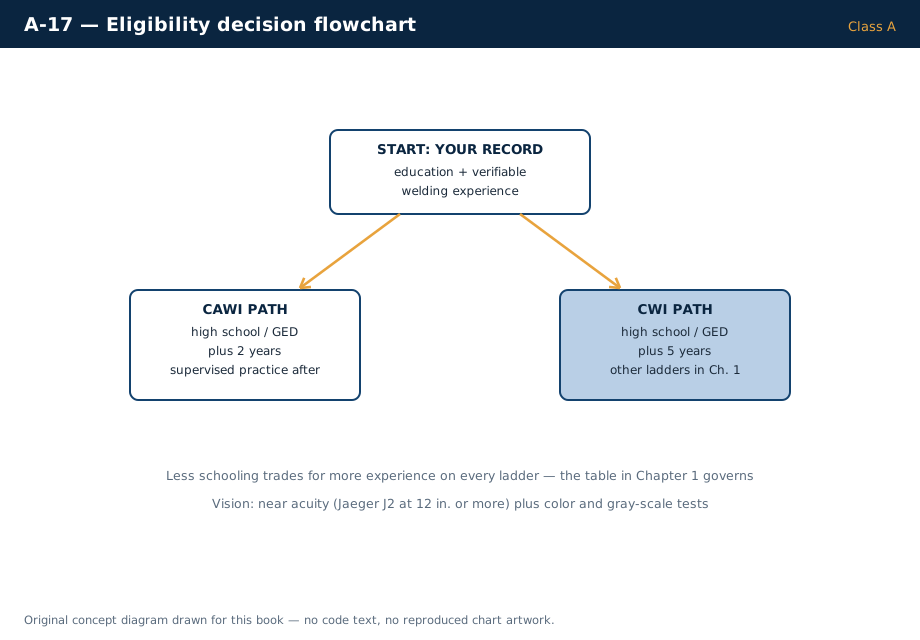
The associate ladder (B5.1 §5.1) is the same structure at lower levels: high school or GED with 2 years; 8th grade with 4 years; below 8th grade with 6 years; 8th grade plus 1 year of vocational welding schooling with 3 years; or 2 years of post-high-school education in welding, engineering technology, engineering, or the physical sciences with 6 months. The associate sits the identical three-part examination — the same forms, the same sitting — at 60 percent per part instead of 72 (QC1:2016 §7.1). The credential is then held for a maximum of 3 years and is not renewable (QC1:2016 §15.1); the holder practices under supervision as Section 1.2 described, and upgrades to CWI when the Welding Inspector experience requirement is met, with progression requiring a minimum of 72 percent on each part (QC1:2016 §14; the CAWI program page states the same threshold).
The choice between applying now as a CAWI and waiting to apply as a CWI is therefore a real decision with published terms, and it deserves better than folklore. Apply as a CAWI when your experience is short of the CWI ladder but meets the associate ladder, and when supervised employment is actually available to you — the associate credential without a supervising CWI or SCWI to work under is a credential without a workplace, because its practice rule is supervision. Wait, and apply directly as a CWI, when your documented experience will meet the full ladder within a time shorter than the effort of two applications — remembering that the CAWI hold cannot be extended, so an associate who does not reach the CWI ladder inside three years holds an expired credential and a story, not a shortcut. Either way, the examination preparation is the same preparation: this book. The diagnostic prints both benchmark lines, 72 and 60, and a CAWI-track reader uses the lower line as orientation while studying the same chapters to the same depth — the examination does not know which standard you will be scored against, and neither do its questions.
The vision standard (B5.1 §6.1) has three components. Near-vision acuity: the ability to read Jaeger Number 2 letters or smaller at a minimum distance of 12 inches, in at least one eye, with or without correction, or an equivalent measure. A color perception test. And a contrast differentiation test — the ability to distinguish shades of gray. B5.1 attaches its own note to the second and third: the employer enforces the color and gray-scale requirements for the specific job application, so the tests document the capability and the employing organization sets its job standard. The near-vision component carries no such softness: failure to meet the near-vision standard is failure to meet B5.1, full stop, because an inspector who cannot read fine detail at working distance cannot perform the examination's — or the job's — most basic act. (Candidates who encounter "Jaeger J1" in secondary material are reading a conflicting claim; the primary standard specifies J2, and J2 is what this book prints.)
The procedure belongs to QC1 (§8) and carries two deadlines that belong in your plan from the first week. The AWS Visual Acuity Form is completed by a licensed eye-care or medical professional, with the professional's license number recorded. The eye examination may be no more than 1 year before the examination date — an older examination, however thorough, is outside its window. And the results are due no later than 60 days after the examination date, on pain of the consequence QC1 states without qualification: the candidate's records and scores are voided. A passport-style color photograph accompanies the record. Treat the form the way Chapter 2 will teach you to treat every inspection document: as part of the work, filed on time, because a passed examination with a voided record certifies nothing.
You will meet the examination in three rooms, and they ask three different things of you. Part A — Fundamentals is a computer-based examination at a Prometric test center: 150 scored questions plus 15 unscored pretest questions, 165 presented, in a maximum of 135 minutes, closed book — no references brought in, none provided on screen (AWS Certification Department, Part A Examination Information, Rev. 03.01.2024; QC1:2016 §6.2.2 sets the 150-question floor). The pretest questions are indistinguishable from scored ones and exist for AWS's own item development; the working consequence for you is pacing: 165 questions in 135 minutes is about 49 seconds a question, and the discipline of Chapter 23 — answer, mark, move, return — is built on that arithmetic. Part A's subjects, with their published minimum weights, are listed in Section 1.7.
Part B — Practical is a paper-based examination at AWS authorized test centers: 46 questions in a maximum of 120 minutes, open book against the Book of Specifications (AWS Certification Department, Part B Practical Examination Information, Rev. 03/03/2021). QC1's floor for Part B is a minimum of 40 questions; the live form carries 46, and this book prints both numbers, each labeled, because a candidate who meets only one of them in print deserves to know which is the standard and which is the form. The Book of Specifications is a sample code AWS developed for this examination — it is not D1.1, not Section IX, not any commercial code — and AWS publishes it as a free download in seven languages, which means the one Part B document you may study in advance is the document AWS itself hands you. Everything else at the Part B table is supplied on the day and stays confidential: the Exam Exhibits Booklet, holding sample welding documents — procedure qualification records, welding procedure specifications, welder qualification records — and photographs including full-color NDE exhibits; the four-piece Plastic Weld Replica Set — T-joint, groove, bend, and pipe specimens; and the Inspection Tool Kit: fillet weld gauges, a V-WAC gauge, a dial caliper, a ruler, a C4.1 gauge, a protractor, a hi-lo gauge, a magnifying glass, a mirror, and a flashlight. Chapters 11 and 14 teach every one of those tools — what it measures, how a reading is taken, read, and recorded — because the tool list is published and its knowledge is teachable. What no chapter can teach is the measurement itself, in your hands, on the day; Section 1.10 states that fence in full.
Part C — Code Book returns to Prometric: an open-book computer-based examination of 50 to 60 scorable questions depending on the code elected, with about 5 further unscored pretest questions on selected English forms, in a maximum of 135 minutes on forms with pretest questions and 120 minutes on forms without (AWS Certification Department, Part C Examination Information, Rev. 02.11.2025; QC1's floor is a minimum of 46). You elect one code on your application (QC1:2016 §6.2.4) and bring the specified reference books for it; electronic copies of the English references are also provided at testing for most examinations — the document's own phrase is "most," and this book prints "most," because a candidate whose code is the exception needs the printed book in hand, not a summary's reassurance. Section 1.8 lists the electable codes and their published editions. Examinations in the United States and Canada use customary units; international examinations use metric units.
Delivery and sequencing, as published: applications are submitted online through the My AWS Portal — since January 15, 2026, AWS accepts no paper applications for certifications or endorsements — and on approval a confirmation letter is emailed, after which you schedule Parts A and C at Prometric. Part B is offered at various United States locations (international candidates apply through AWS international agents); when taken with AWS's seminar week it is typically held on the Saturday or Sunday following, at the same location. Your Part B score is released only after Parts A and C are complete, by email, allowing about two weeks — a sequencing fact worth knowing before the wait feels like news. Examination check-in requires government identification and the confirmation letter. Nothing in the primary documents this book rests on fixes an application deadline window, an order in which the parts must be taken beyond the published sequencing, or a calculator rule for the computer-based parts; those operational details live in AWS's current application materials, and this book prints no version of them rather than print an unverified one — check the current CWI Application Handbook and your confirmation letter, and follow those documents where they speak.
The body of knowledge is published as minimum percentages in B5.1:2013-AMD1 Clause 7, confirmed identically in each part's examination-information document. Minimums do not sum to 100 — Part A's sum to 82, Part B's to 86, Part C's to 85 — and that is not an error to be fixed but a design to be understood: AWS guarantees at least these shares and distributes the balance itself. This book's practice forms meet every minimum and disclose their own distribution of the balance in each form's instructions, so you always know which numbers are AWS's and which are the book's design arithmetic on AWS's basis.
Part A — Fundamentals. Definitions and Terminology, 12 percent. Welding Processes, 12 percent. Symbols — Welding and NDE, 10 percent. Weld Examination, 10 percent. Welding Performance, 9 percent. Test Methods — NDE, 8 percent. Heat Control and Metallurgy of carbon and low-alloy steel, 6 percent. Welding-Related Calculations, 6 percent. Duties and Responsibilities, 4 percent. Destructive Tests, 3 percent. Cutting, 2 percent. Read the table as a study budget: a fifth of the examination is processes, a fifth is the language of the field (definitions and symbols together exceed a fifth), and no subject is small enough to skip — 2 percent of 150 scored questions is still 3 questions, and parts are passed at a line where 3 questions matter.
Part B — Practical Applications. Welding Inspection and Flaws, 34 percent. Procedure and Welder Qualifications, 28 percent. Mechanical Test and Properties, 8 percent. NDE, 8 percent. Utilization of Specification and Drawings, 8 percent. Two domains — what you see on the specimen, and whether the paperwork qualifies the work — carry nearly two-thirds of the practical between them, which is why this book's Part B knowledge core (Chapters 11–14) and its qualification chapters (18–19) are built as heavily as they are.
Part C — Code Applications. Qualification, 25 percent. Fabrication, 25 percent. Inspection, 25 percent. Reports and Records, 5 percent. Materials and Design, 5 percent. Three equal pillars and two small ones: the code examination is, three times over, about qualifying work, making work, and examining work, inside one code's organization — which is why Chapters 20–22 teach a navigation method that transfers across codes instead of a memorized map of one.
Appendix B prints this same crosswalk with the chapters that teach each subject, so the coverage can be audited — by you, before you pay for anything beyond the sample, exactly as a crosswalk is for.
The election is made on the application, is yours to verify against AWS's current list before you submit (QC1:2016 §6.2.4 makes that verification the candidate's duty), and binds your retests: a Part C retest uses the same code as the original examination throughout the 3-year retest period. The published electable examinations and editions (Part C Examination Information, Rev. 02.11.2025) are: AWS D1.1, Structural Welding Code — Steel, 2020 edition; API 1104, Welding of Pipelines and Related Facilities, 22nd edition; AWS D1.2, Structural Welding Code — Aluminum, 2014; AWS D1.5, Bridge Welding Code, 2020, including Clause 12; AWS D15.1, Railroad Welding Specification, 2019; AWS D17.1, Specification for Fusion Welding for Aerospace Applications, 2017 with Amendment 1; ASME BPVC Section IX, 2019, with B31.1 Power Piping (2018) and B31.3 Process Piping (2018); an ASME Section VIII Division 1 plus Section IX combined examination; and an ISO/EN Standards examination. Using an edition other than the listed one is at the candidate's own risk — the document's warning, repeated here because a code book bought by its cover rather than its edition is the most preventable failure in the whole journey.
Choose by two tests, in this order. First, the experience match: elect the code family your documented work actually lives under — structural steel for the building and fabrication inspector, API 1104 for pipeline work, Section IX where pressure-equipment qualification dominates — because Part C's scenarios presume a reader who has met the code's world, and navigation speed under the clock is built from familiarity no method can counterfeit in six weeks. Second, the employer-sector test: elect the code your next three years of work will invoke, since the credential's Part C is also a signal employers read. This book teaches the navigation method code-generically and works it in depth against the organizations of D1.1 (Chapter 21) and of API 1104 and Section IX (Chapter 22), with the remaining electable codes mapped at orientation grain at Chapter 22's close — because the method transfers, while the code book on your desk must be the one your work is judged by. And a practical word that is also a fence consequence: buy or borrow the code book early, in its listed edition, and study Chapters 20–22 with it open. A navigation method practiced without the book it navigates is rehearsal without an instrument.
The passing standard is 72 percent on each part — for Part A, for Part B, and for Part C alike — verified in the primary standard itself: QC1:2016 §6.2.2's examination table sets the CWI minimum score at 72 percent per part, each part's examination-information document states 72 percent for its own part, and QC1 §7.1 sets the deliberate contrast that proves the figure is a chosen standard and not a habit: the CAWI sits the same examination at 60 percent. This book prints 72 percent as a primary fact cited to QC1, and you are entitled to know that it was verified there rather than repeated from the preparation literature, because the figure decides how you will read every practice score in the book.
Now the qualification, stated exactly, because the preparation literature mangles it in a direction that costs candidates real examinations. QC1:2016 §6.2.3 defines a composite: the simple average of the three parts' scores. A candidate whose composite reaches 72 percent while one part sits below 72 has not passed, and no strong part lifts the weak one. What the composite governs is retest eligibility: at a 72 percent composite with a failed part, the candidate may retake the failed part (or parts) under the retest rules of Section 1.11. Below a 72 percent composite, that door is not the one the standard opens. Learn the rule in its two sentences and refuse every softer version: certification requires 72 percent on each part; the composite preserves the right to repair a failure by retest, and it does nothing else. Every practice report in this book prints the rule beside the score, and Part B knowledge checks never print a percentage framed as readiness at all — a knowledge score and a practical performance are different kinds of thing, and the book's reporting refuses to blur them even when a blur would flatter the reader.
The Part B fence. Part B examines a performance: your hands seating gauges on plastic replicas of real weldments, your eyes reading exhibits, your judgment deciding acceptance against a specification, all against a clock. This book teaches everything about that performance that is knowledge — the stations and their order of work; every published tool and how its reading is taken, read, and recorded; the specimen types and the exhibit and document types; the method of working a specification from requirement to reading to comparison to decision to record; and the domain weights that tell you where the questions concentrate. It does not contain, reproduce, or paraphrase the Book of Specifications' acceptance criteria or text, the confidential Exhibits Booklet, or the Replica Set's specific specimens; the book's own figured specimens and sample documents are original teaching material, created and written for this book. And it does not — this is the fence's sharpest edge — claim that studying it substitutes for holding the tools. The hands-on protocol is therefore printed as a required complement, scheduled inside every study plan in the front matter: obtain or borrow the published toolkit's instruments; measure real welds wherever you legitimately can — employer work, shop practice, scrap and training coupons; record your readings and your decisions in a practice log the way Chapter 14 teaches; and study AWS's free Book of Specifications download as a document, learning its kind and its organization before the day it is handed to you as an examination. AWS also offers optional Part B training, priced as training and labeled optional wherever this book mentions it. A candidate who has only read about a fillet gauge arrives at Part B knowing what the gauge is; a candidate who has seated one two hundred times arrives knowing what it says. The examination pays the second candidate, and this book's honesty about the difference is worth more to you than any pretense would be.
The code-text fence. Part C examines navigation: finding and applying requirements inside a real code, in the code's own words, under time pressure. Teaching that skill requires this book to describe how each electable code is organized — its parts, clauses, and articles; where qualification, fabrication, and inspection live inside it; how its tables and figures are found and read — and to drill the method on paraphrase and structural fact. It does not license this book to reproduce the code: no clause language, no acceptance tables, no essential-variable tables from D1.1, API 1104, Section IX, or any other electable code appear anywhere in these pages, and every navigation exercise names the structural location you would open in your code book rather than quoting what you would find there. The same grain governs the AWS standards this book itself rests on: B5.1, QC1, and A2.4 are taught in the book's own words and cited by document and clause — their published facts (ladders, figures, weights, the symbol system taught in the book's own drawings) are the book's substance, and their prose is not reprinted. If you catch this book appearing to quote a code, you have caught an error; the Errata and Edition Note tells you how corrections are issued.
Fees (AWS Certification & Education Price List, effective January 1, 2026 — every figure in this section is from that list and is dated to it). The initial CAWI/CWI examinations, all parts, cost $1,255 for AWS members and $1,520 for non-members; non-member prices include a 3-year AWS Individual Membership unless noted. The listed prices include the Prometric seat fees — $60 for one part, $120 for all parts — so the seat fee is inside the examination price, not added to it. Part B carries additional facility fees set by the Accredited Test Facility; AWS publishes no figure for them, and this book prints none — contact the facility. Applications not submitted through the online system carry a $125 non-refundable fee; since January 15, 2026, the online My AWS Portal is the application route. Retests: Part A or Part C alone, $445 (member and non-member alike); Parts A and C together, $870; Part B, $385; all parts, $915 member and $1,180 non-member. The CAWI-to-CWI upgrade: $325 member, $590 non-member. Renewal at years 3 and 6 by work experience: $650 member, $915 non-member. Nine-year recertification by the Part B examination route: $1,165 and $1,430; by the non-examination routes: $795 and $1,060. Appendix A prints the complete table, including the endorsement prices — which live in the appendix, labeled as endorsement prices, and nowhere else — and the disclosure that three renewal-by-examination rows of the 2026 list were not cleanly readable in this book's research and therefore print no figures at all. A book that guesses at a fee fails its reader at the exact point where the reader is spending money; this one would rather show you a labeled gap.
Retests (QC1:2016 §6.2.5): a maximum of 3 retests within 3 years of the original test date. The first retest requires no additional training. The second and third require documented training in the failed B5.1 subjects — 40 hours for a full three-part reexamination, 16 hours for a retest of one or two parts. A Part C retest is taken with the same code as the original examination throughout the period; the election of Section 1.8 therefore deserves the care this chapter gave it. AWS may also administer the examination in split form (§6.2.7): Part A first at the full standard, then Parts B and C on the same day, with a maximum of 4 attempts per stage in 3 years and a first Part A retest no earlier than 24 hours after the prior examination's start. Holders of the CWE credential are exempt from Parts A and B (§6.2.6) — a rule that belongs to that credential's holders and is printed here so the map is whole.
The credential after (QC1:2016 §§10, 15, 16): certification takes effect on the first day of the month following the examination and is valid 3 years. Renewal falls at years 3 and 6 — filed no earlier than 11 months before expiration, with a 60-day administrative extension during which the certification is considered expired — on an attestation of continued B5.1 activity including no continuous inactivity over 2 years in the prior 3 years; a holder who cannot attest renews by passing Part B. Renewals are limited to two consecutive 3-year periods, and at year 9 the holder recertifies in full: by the Part B Practical examination (or a Committee-approved endorsement at the certifying scores), or by experience plus continuing education — 80 professional development hours across the 9 years, 20 of them in the final 3-year period, one contact hour being at least 50 minutes and one CEU counting as 10 PDHs — or by the published recertification-course route. Miss the deadline and its extension and the standard requires passing all three parts again; an expired holder who does not recertify is treated as a new applicant. The horizon sounds distant on examination day. Calendar it anyway: the inspectors who lose credentials to paperwork are rarely the ones who failed examinations.
Follow Dana, a fictional candidate, through the whole machinery of this chapter. Dana welds and inspects in a fabrication shop, holds a high school diploma, and documents six years across welding, discontinuity detection, and procedure-qualification support — three named areas, so the breadth gate passes; the ladder asks 5 years and Dana documents 6, with employment verification kept in the order Chapter 2 teaches. Dana books the eye examination in the application month — inside the 1-year window by construction — and diaries the form against the 60-day post-examination deadline. The application goes in online at the non-member price; Dana elects AWS D1.1 (2020) for Part C — the shop's work is structural steel, so both of Section 1.8's tests point the same way — and buys the code book in that edition the same week. The confirmation letter arrives; Parts A and C are scheduled at Prometric; the Part B facility confirms its session and its own facility fee. Dana studies on the 12-week plan: diagnostic cold in week 1, hands-on protocol from week 7 — a borrowed toolkit, the shop's scrap bin measured and logged, the free Book of Specifications worked as a document — and the five timed forms and checks across weeks 8 to 12 under their real conditions. The Part B score arrives by email about two weeks after Parts A and C are complete. Nothing in the story is luck: every step that could have surprised was printed in this chapter before it was met in life. That is what orientation is for.
Two silences in this book are deliberate, and both deserve a sentence rather than a gap. First: no outcome statistics. You will find no pass rate, no ranking of the parts by difficulty, no salary figure, and no employment claim anywhere in this book, because none was verified in a primary AWS source during its research — the circulating figures come from aggregators, conflict with each other, and fail the standard this series holds every number to. A preparation book that prints an invented pass rate is telling you, in advance, how it treats every other number it prints. Second: no examination content. Every item in this book is original; AWS's published sample items exist and their types informed this book's design, but no sample item is reproduced or paraphrased here, and nothing in these pages is, or claims to be, an actual examination question.
One disclosure is owed about editions. B5.1:2025, the standard's third edition — approved as an American National Standard on July 30, 2024 — exists and supersedes the 2013 edition as a standard. The examination basis, however — the edition every current AWS examination-information document cites, and the edition the SCWI transition documents anchor to — is B5.1:2013-AMD1, and every weight, ladder, and rule in this book is built on that basis. Before this book's release, production re-verifies the cited basis against AWS's live publications under the Errata and Edition Note's standing rule: if AWS has re-based the examination on the 2025 edition, the compositions, crosswalks, and chapters are conformed to the change before anything ships. Until that re-verification speaks, the honest sentence is the one printed here: two editions exist, the examination's documents name one of them, and this book follows the examination.
This book is a complete study guide for the CWI examination that teaches the field whole: the science foundations from zero, the five arc processes and cutting, metallurgy and heat control, joints and geometry, the complete symbol system in its own drawings, visual examination and the full discontinuity taxonomy, measurement practice, six NDT methods and the destructive tests, procedure and welder qualification, the codes' organizations and the navigation method, and an item layer — diagnostic, chapter quizzes, two full Part A forms, two Part C navigation forms, two Part B knowledge checks, and four repair sets — built in the examination's published shapes with every answer explained, right and wrong. It is a book that serves the CAWI reader fully, on the same examination at the published associate standard, with the hold and the upgrade mapped. It is not a substitute for the elected code book, which you must obtain in its published edition; it is not hands-on Part B practice, which you must do with real tools under the protocol this book schedules; it is not an AWS publication, an endorsement, or a promise — the disclosure in the front matter says so in the standard words; and it does not prepare anyone for the SCWI beyond the orientation map in Appendix A. Three things, and only three, a reader still needs from outside this book: the code book, the practice, and AWS itself at application time. Chapter 1 has now named all three. The rest of the book is the work.
The composite lifts a failed part into a pass — it does not; it preserves retest eligibility only. A bachelor's degree "means" one year of experience — the substitution table, read against its rung and its 4-year cap, produces that result for one case and different results for others. The vision standard is Jaeger J1 — the primary standard specifies J2 at 12 inches. Part B examines D1.1 — it examines AWS's own Book of Specifications, a sample code written for the examination. Part B has 40 questions — QC1's minimum is 40; the live form carries 46, and the two numbers answer different questions. Part C lets you bring any edition — the published editions govern, and an unlisted edition is used at the candidate's own risk. The CAWI is a lesser examination — it is the same examination at 60 percent, with supervised practice and a 3-year non-renewable hold. The seat fee is added to the examination price — it is included in it. Renewal is a formality that never ends — renewals are limited to two, and year 9 is a recertification with published teeth.
72 percent per part to certify as CWI (QC1:2016 §6.2.2); 60 percent per part for CAWI (§7.1). Part A: 150 scored + 15 pretest, 135 minutes, closed book. Part B: 46 questions (QC1 minimum 40), 120 minutes, paper-based, Book of Specifications. Part C: 50–60 scorable, 120/135 minutes, open book, code elected on the application. Eligibility: HS/GED + 5 years; 8th grade + 9; below 8th + 12; substitution capped at 4 years; experience in at least 3 of 10 areas. CAWI: HS/GED + 2 years and its ladder; 3-year non-renewable hold. Vision: Jaeger J2 at 12 inches minimum, plus color and gray-scale tests; eye examination within 1 year before; form due within 60 days after. Initial examination $1,255 / $1,520 (2026 list). Retests: maximum 3 in 3 years; training 40 hours (full) or 16 hours (one or two parts) for the second and third. Certification valid 3 years; renewals at 3 and 6; recertification at 9 — Part B, or endorsement, or 80 PDHs with 20 in the final 3 years.
Cheat-sheet box — Chapter 1 on one screen. Three parts, three rooms: A closed-book knowledge (150 + 15, 135 min), B hands-on replicas against the Book of Specifications (46, 120 min), C open-book navigation in your elected code (50–60, 120/135 min). 72 percent each part; the composite only preserves retest rights. Ladder: 5 / 9 / 12 years by education, substitution capped at 4, experience documented across 3 of 10 areas. Eyes: J2 at 12 inches, form inside 1 year before and 60 days after. Money: $1,255/$1,520, seat fees included, Part B facility fee separate and unpublished. After: 3-year validity, renew at 3 and 6, recertify at 9. Fences: Part B taught as knowledge — practice is yours to do; Part C taught as method — the code book is yours to bring.
The Complete Welding Inspection Course — 1,120 Practice Questions, Diagnostic & Timed Part A/C Forms, Every Answer Explained
Feras Alzubi
Google Play Books Exam Prep Series — Book 47
Copyright © 2026 Feras Alzubi. All rights reserved. No part of this book may be reproduced in any form without the author's written permission, except for brief quotations in reviews.
This book was built against the American Welding Society's published examination basis as read on November 2, 2026: AWS B5.1:2013-AMD1, Specification for the Qualification of Welding Inspectors, Clause 7 (the examination subject weights every practice form in this book is built on); AWS QC1:2016, Standard for AWS Certification of Welding Inspectors (the certification rules, including the 72 percent passing standard in §6.2.2); the AWS Certification Department's examination-information documents for Parts A, B, and C; and the AWS Certification & Education Price List effective January 1, 2026. A third edition of B5.1 (B5.1:2025) exists as a standard; the examination documents AWS publishes cite the 2013 edition as amended, and this book follows the examination basis, not the newest shelf edition. The Errata and Edition Note at the back of this book records the production re-verification of every one of these facts against AWS's live publications, with its date, and states the standing rule that follows from it: if AWS has changed a load-bearing fact, this book is conformed to the change before release, and AWS's current publications govern over this book wherever they differ.
Measured counts for this edition (measured from the finished book; where a designed count and a measured count ever differ, the measured count governs): 25 chapters; 203,815 words of chapter prose; 1,120 fully explained practice items — a 60-item entry diagnostic, 24 chapter quizzes of 20 items, two 150-item Part A practice forms, two 50-item Part C navigation forms, two 40-item Part B knowledge checks, and four 25-item repair sets; 67 figures (45 recognizable labeled images of physical subjects and 22 diagrams); a glossary of 280 entries (240 definitions and 40 see-references); and three cheat sheets. Free sample: Chapter 1 and the 60-item diagnostic.
This book is an independent study guide. It is not published by, affiliated with, endorsed by, or approved by the American Welding Society (AWS), and AWS did not participate in its creation. AWS, CWI, CAWI, and SCWI are referenced solely to identify the certification this book prepares readers for; the certification names and marks belong to the American Welding Society. Passing any examination also depends on the candidate's own preparation; no book can guarantee a result.
Every practice item in this book is original, written fresh for this book against the published body of knowledge — the subject names and minimum weights of B5.1:2013-AMD1 Clause 7 — and against the field knowledge this book teaches. No item is an actual, recalled, paraphrased, or adapted examination question, and no item reproduces or paraphrases an AWS published sample item. AWS's own documents describe the examination's shape — its parts, counts, times, and rules — and this book mirrors that published shape in its practice forms; the questions inside the forms are this book's own. Every item carries a full explanation: why the keyed answer is right and why each wrong answer is wrong.
This book prepares you for the full Certified Welding Inspector journey — all three parts of one examination — and it teaches the three parts at the grain each part honestly allows. The distinction matters enough to print here, on the first pages, rather than in fine print at the back.
Part A (Fundamentals) is taught whole. Part A is a closed-book knowledge examination: 150 scored questions in 135 minutes, with nothing brought in and nothing provided on screen. Everything it examines is knowledge — welding processes, symbols, examination methods, metallurgy and heat control, qualification, calculations, duties — and knowledge is what a book teaches best. Chapters 2 through 23 teach every published Part A subject from zero, and Part VIII gives you two full 150-item practice forms under the real clock and the real closed-book rule.
Part C (Code Book) is taught whole as method. Part C is an open-book navigation examination: 50 to 60 scorable questions in 120 or 135 minutes, answered against one code book that you elect on your application and you bring to the test center. A book can teach you how the electable codes are organized, how to classify a question, find the governing requirement, and apply it under the clock — and Chapters 20 through 22 and the two Part C navigation forms teach exactly that, in full. What no study book can do is be the code book. This book therefore never reproduces code text — no clause language, no acceptance tables, no essential-variable tables from AWS D1.1, API 1104, ASME Section IX, or any other electable code — and you must obtain your elected code book, in the edition AWS publishes for the examination, before you work the Part C chapters. Chapter 1 lists the electable codes and their published editions and tells you how to choose among them with your eyes open.
Part B (Practical) is taught as knowledge, under a fence this book states plainly and repeats. Part B is a hands-on performance: 46 questions in 120 minutes, answered by measuring physical plastic weld replicas — a T-joint, a groove weld, a bend specimen, and a pipe specimen — with a supplied inspection tool kit, and deciding accept or reject against AWS's own Book of Specifications, a sample code written for the examination. This book teaches Part B's knowledge layer completely: every tool in the published kit and how a reading is taken, read, and recorded; the replica specimen types and the exhibits and document types the examination uses; the method of working a specification — find the requirement, take the reading, compare, decide, record; and the published domain weights, so you know where the questions concentrate. What this book cannot supply is the hand skill itself: the feel of a fillet gauge seated on a real weld, the judgment of a reading taken with your own hands. No book can. Chapters 11 through 14 and Chapter 24 therefore teach the knowledge in full and route you, as a scheduled and required complement — not a footnote — to hands-on practice: your own toolkit work on real welds, employer or shop specimens, AWS's free Book of Specifications download studied as a document, and AWS's optional Part B training if you choose it. A study guide that claimed to replace that practice would be misleading exactly the reader who can least afford it. This one does not make that claim — here, at the head of every Part B chapter, in the instructions to both Part B knowledge checks, and in the store description.
Three things, then, a reader of this book still needs from outside it — all three are fences, not gaps, and Chapter 1 names them again: your own elected code book in the published edition, for Part C; hands-on Part B practice with real tools on real or replica welds; and AWS itself at application time, because eligibility is adjudicated by AWS on your documentation and program facts are confirmed against AWS's current publications when you apply. Everything else — the field knowledge whole, the symbol system, the measurement science, the qualification logic, the item layer in the published shapes, and the career map after certification — is inside this book.
Two readers are served, and both are named. The CWI candidate is the book's target. The CAWI reader — the Certified Associate Welding Inspector candidate, who sits the same three-part examination at 60 percent per part instead of 72 percent, works under supervision, and holds the credential for a maximum of three years while building experience toward CWI — is a legitimate reader of this same book, and the book serves that reader fully: the diagnostic routes you, the scoring pages print the 60 percent reference line beside the 72 percent line, and Appendix A maps the CAWI hold and the upgrade path. The Senior Certified Welding Inspector (SCWI) appears in Appendix A as orientation only — the stackable endorsement path and its prerequisites — because this is a CWI book and it makes no SCWI preparation claim.
A safety boundary, stated once here and observed everywhere. This book teaches inspection as knowledge and method. It does not qualify you, by itself, to perform live inspection, welding, cutting, or testing work; that competence is built and authorized under employer, code, and supervision requirements. Where safety conditions belong to a topic, the book names them and identifies ANSI/AWS Z49.1, Safety in Welding, Cutting, and Allied Processes, as the governing safety standard. All scenarios in this book are fictional teaching scenes, written for this book; any resemblance to a real person, employer, or job is coincidental.
The CWI examination has three parts. Each part is passed separately at 72 percent; there is no averaging into a pass. The table below states the examination as AWS's own documents publish it (AWS QC1:2016 §6.2.2 sets the standards and the minimum counts; the AWS Certification Department's examination-information documents state the live forms). CAWI candidates sit the same examination at 60 percent per part (QC1:2016 §7.1).
Part A — Fundamentals. Computer-based at Prometric test centers. 150 scored questions plus 15 unscored pretest questions (165 presented). Maximum 135 minutes. Closed book: no references may be brought in and none are provided on screen. Passing standard: 72 percent.
Part B — Practical. Paper-based at AWS authorized test centers. 46 questions (QC1's published minimum is 40; the current examination form carries 46). Maximum 120 minutes. Open book against the supplied Part B Examination Book of Specifications — a sample code developed for the examination, which AWS also publishes as a free download. The candidate measures a four-piece plastic weld replica set (T-joint, groove, bend, and pipe specimens), reads sample documents and photographs from an Exam Exhibits Booklet, and uses a supplied inspection tool kit. Passing standard: 72 percent.
Part C — Code Book. Computer-based at Prometric test centers. 50 to 60 scorable questions depending on the code elected, with about 5 additional unscored pretest questions on selected English forms. Maximum 135 minutes on forms with pretest questions, 120 minutes on forms without. Open book: you bring the specified reference books for your elected code, and electronic copies of the English references are provided at testing for most examinations. You elect one code on your application. Passing standard: 72 percent.
The composite rule, stated exactly. Certification requires 72 percent on each part. QC1:2016 §6.2.3 also defines a composite — the simple average of the three parts — and gives it one job only: a candidate whose composite reaches 72 percent with one part failed may retake the failed part. A strong part never lifts a failed part into a pass, in the real examination or in this book's practice reports, which print this rule beside every score.
Subject weights (B5.1:2013-AMD1 Clause 7, published minimum percentages). Part A: Definitions and Terminology 12; Welding Processes 12; Symbols — Welding and Nondestructive Examination 10; Weld Examination 10; Welding Performance 9; Test Methods — Nondestructive Examination 8; Heat Control and Metallurgy (carbon and low-alloy steel) 6; Welding-Related Calculations 6; Duties and Responsibilities 4; Destructive Tests 3; Cutting 2. Part B: Welding Inspection and Flaws 34; Procedure and Welder Qualifications 28; Mechanical Test and Properties 8; Nondestructive Examination 8; Utilization of Specification and Drawings 8. Part C: Qualification 25; Fabrication 25; Inspection 25; Reports and Records 5; Materials and Design 5. These are published minimums — they do not sum to 100 — and this book's practice-form compositions disclose exactly how the balance is distributed (see the Measured Counts Note and the instructions printed with each form).
Eligibility, in brief (the full table is Chapter 1 and Appendix A). For CWI: a high school diploma or GED with 5 years of qualifying welding-related experience, or 8th-grade education with 9 years, or below 8th grade with 12 years; post-high-school education substitutes for experience up to a cap of 4 years, printed as the substitution table itself in Chapter 1 — never as a single detached number. Experience must be documented, verifiable, and drawn from at least 3 of the 10 qualifying areas B5.1 names. Vision: near vision sufficient to read Jaeger Number 2 letters at a minimum of 12 inches in at least one eye, with or without correction, plus color perception and gray-scale contrast tests, documented on the AWS Visual Acuity Form. For CAWI: the same structure at lower experience levels (high school or GED with 2 years, and its own ladder, printed whole in Appendix A).
Fees, as published (AWS Certification & Education Price List, effective January 1, 2026). Initial CAWI/CWI examinations, all parts: $1,255 for AWS members, $1,520 for non-members (non-member prices include a 3-year AWS Individual Membership unless noted). The listed prices include the Prometric seat fees ($60 per part for Part A or Part C; $120 for all parts). Additional facility fees set by the Accredited Test Facility apply to the Part B practical examination — AWS publishes no single figure; contact the facility for its pricing. A $125 non-refundable fee applies to applications not submitted through the online system; since January 15, 2026, applications are submitted online through the My AWS Portal. Retest and renewal fees are printed whole, with their dates, in Chapter 1 and Appendix A.
After the examination. A Part B score is released only after Parts A and C are complete (allow about two weeks, by email). Retests: a maximum of 3 retests within 3 years of the original test date; the first retest needs no additional training, and documented training is required for the second and third; a Part C retest uses the same code as the original examination. Certification is valid 3 years, renewable at years 3 and 6, with a full recertification at year 9 — by the Part B examination, by an approved endorsement, or by experience plus 80 professional development hours across the 9 years (20 of them in the final 3-year period). Chapter 25 and Appendix A map the whole horizon.
Front matter: title page and disclosures; this Exam Blueprint Page; How to Use This Book; the study plans; the 60-item entry diagnostic (the diagnostic follows Chapter 1 in the reading order, so the free sample — Chapter 1 plus the diagnostic — can be taken before any other chapter).
Part I — The Credential and the Craft. Chapter 1: The Inspector, the Credential, and This Book. Chapter 2: Duties, Ethics, Documents, and Safety. Chapter 3: Welding Science Foundations.
Part II — Processes, Heat, and Joints. Chapter 4: Welding Processes I — SMAW and GTAW. Chapter 5: Welding Processes II — GMAW, FCAW, SAW, and the Allied Processes. Chapter 6: Cutting and Gouging. Chapter 7: Metallurgy and Heat Control. Chapter 8: Joints, Weld Geometry, and Fit-Up.
Part III — Symbols and Drawings. Chapter 9: Welding Symbols — the A2.4 System. Chapter 10: NDE Symbols, Drawings, and Specification Reading.
Part IV — Examination of Welds (the Part B knowledge core; the Part B fence heads every chapter). Chapter 11: Visual Examination and the Inspector's Toolkit. Chapter 12: Discontinuities I — Cracks, Fusion, and Geometry. Chapter 13: Discontinuities II — Process-Related, Subsurface, and Service. Chapter 14: Measurement Practice — Gauges, Readings, and Records.
Part V — Testing. Chapter 15: NDT Methods I — VT, PT, MT. Chapter 16: NDT Methods II — RT, UT, and Leak Testing. Chapter 17: Destructive and Mechanical Testing.
Part VI — Qualification. Chapter 18: Welding Procedure Qualification — WPS and PQR. Chapter 19: Welder Performance Qualification.
Part VII — Codes and the Part C Method (the code-text fence heads every chapter). Chapter 20: Codes, Standards, and the Inspector's Library. Chapter 21: Part C Method — Navigating AWS D1.1. Chapter 22: Part C Method — Navigating API 1104 and ASME Section IX.
Part VIII — The Examination. Chapter 23: Part A Mastery — Fundamentals Under the Clock. Chapter 24: Part B Mastery — The Practical as Knowledge. Chapter 25: Part C Mastery, Examination Day, and the Credential After.
Back matter: the timed practice layer in full (Part A Forms A-1 and A-2; Part C Forms C-1 and C-2; Part B Knowledge Checks B-1 and B-2; the four repair sets); the three cheat sheets (the symbol system; the gauge-use sheet; the Part C navigation sheet); the glossary; Appendix A — Eligibility and Architecture Map; Appendix B — Crosswalk at Published Grain; Appendix C — References; Errata and Edition Note.
The rhythm of every chapter is teach, then test. Each teaching chapter opens by simplifying its subject to a plain statement a beginner can hold, explains why the subject exists, gives the full detail with its sources, shows the subject in a labeled figure, a worked example, or a realistic fictional scenario, gives you a task to do, and closes with a cheat-sheet box that compresses the chapter onto one screen and a 20-item quiz whose key — in the companion key file — explains every answer, right and wrong. Chapter 1 is the exception by design: it carries no quiz, because its job is orientation — the credential, the examination, the fences, and your plan — and the 60-item diagnostic that follows it does the testing.
Start with the diagnostic, cold. Take the 60-item entry diagnostic before you study anything. It carries 20 items for each part's domain, chosen by this book and disclosed as book-chosen; it is untimed. Score it by part-domain, not only in total: the diagnostic's report routes each weakness to the chapters and repair sets that answer it, and it prints both benchmark lines — 72 percent for the CWI reader, 60 percent for the CAWI reader — as orientation only. The diagnostic makes no readiness prediction, and neither does any other score in this book.
Read the field chapters in order the first time. Part II assumes Part I; the symbol chapters assume the joint geometry of Chapter 8; the measurement chapters assume the toolkit of Chapter 11. A second pass can be diagnostic-driven, but the first pass is the book's order, because each foundation is taught inside the chapter that first needs it — shop mathematics, electricity and heat, materials vocabulary, and drawing literacy in Chapter 3; document literacy in Chapter 2 — and later chapters spend those foundations without re-teaching them.
Respect the two fences as you read. Chapters 11 through 14 and Chapter 24 carry the Part B fence at their head: they teach knowledge completely and hand skill not at all, and their study instructions include the hands-on protocol — obtain or borrow the toolkit instruments, measure real welds wherever you legitimately can (employer work, shop practice, scrap), and work AWS's free Book of Specifications download as a document — scheduled as an activity in every study plan below. Chapters 20 through 22 carry the code-text fence: they teach navigation against your own code book, so have the book open beside them. An exercise that names a structural location in your code is asking you to open your code at that location and find the requirement in the code's own words; the learning is in the finding.
Use the timed forms under their real conditions. Part A forms: 150 items, 135 minutes, closed book, nothing at hand — taken that way, or the score means nothing. Part C forms: 50 items, 120 minutes, your own elected code book open. Part B knowledge checks: 40 items, untimed, reported as raw counts with domain routing — never as a percentage of practical readiness, because a knowledge check is not the practical. Every form report restates the composite rule: parts pass separately, in practice as in fact.
Keep the book's numbers with their sources. Every load-bearing figure in this book — counts, times, scores, weights, fees — carries its source at the point of use, and Appendix C lists every source in reader form. Where AWS publishes a minimum and a live form above it (Part B's 46 questions against QC1's minimum of 40), the book prints both, each labeled. Where a fact could not be verified from a primary AWS source, the book prints neither a guess nor a silence disguised as knowledge: it says what is published and stops there.
The 12-week standard plan (the employed candidate). Weeks 1–2: Part I (Chapters 1–3) and the diagnostic, cold, at the start of week 1. Weeks 3–5: Part II (Chapters 4–8), one chapter roughly every three days with its quiz the same evening the chapter is finished. Week 6: Part III (Chapters 9–10) — the symbol system repays slow, drawn practice; copy the symbols by hand as you read. Weeks 7–8: Part IV (Chapters 11–14), and begin the hands-on protocol in week 7: toolkit instruments in hand, real measurements recorded in a practice log, the Book of Specifications download worked as a document. Week 8 ends with Part A Form A-1 under the full clock. Weeks 9–10: Part V and Part VI (Chapters 15–19); Part B Knowledge Checks B-1 and B-2 at the end of week 10, after at least two weeks of hands-on practice. Weeks 10–11: Part VII (Chapters 20–22) against your own code book, then Part C Forms C-1 and C-2 on separate days. Week 12: Part VIII (Chapters 23–25), Part A Form A-2, and the repair sets aimed at your weakest domains — symbol misreads, gauge and reading errors, discontinuity confusion, navigation failures — one set per weakness the forms exposed.
The 6-week compressed plan (the experienced inspector). Week 1: the diagnostic, cold, then Chapters 1–3 sampled by diagnostic weakness rather than read whole. Weeks 2–3: Parts II and III, again diagnostic-led, with every chapter quiz taken even where the prose is sampled — a missed quiz item sends you back to its section. Week 4: Parts IV and V, with the hands-on protocol started on day 1 of the plan, not of this week — compressed study compresses reading, never practice. Week 5: Parts VI and VII against your code book, and all five full forms and checks taken across the plan's final two weeks on separate days, under their real conditions. Week 6: Part VIII, the second Part A form, and the repair sets. If the diagnostic shows a foundations gap — in shop mathematics, in electricity, or in drawing literacy — do not stay on the compressed plan for that material: drop back to the standard plan's pace for the chapters the diagnostic names, because a compressed plan cannot repair a foundation it rushes past.
The CAWI-track plan. The same plans, read with the 60 percent reference lines, plus one addition the CWI reader does not need: treat the plan's end as a stage, not a destination. The CAWI credential is held a maximum of three years and is not renewable; the years under supervision are the experience the CWI ladder counts, so keep the employment documentation your future CWI application will be judged on from the first month — Appendix A states what AWS verifies and what the upgrade requires. A CAWI-track reader whose experience already approaches the CWI ladder should read Chapter 1's substitution table before choosing which credential to apply for: the associate examination and the full examination are the same sitting at two standards, and applying at the level your documentation already supports saves a second application.
Every plan carries the same closing checklist, printed in full with Chapter 25: submit the application online through the My AWS Portal; file the Visual Acuity Form within its published windows (the eye examination no more than 1 year before the examination date; results due no later than 60 days after it); schedule Parts A and C at Prometric on the confirmation letter's instructions; confirm your Part B session and its facility fee with the test facility; bring identification and, for Part C, your elected code book in its published edition; and calendar your renewal the month you are certified, not in the month it falls due.
The counts in the Copyright and Version Page and in the Contents — 25 chapters, 203,815 words of chapter prose, 1,120 items, 67 figures, 280 glossary entries — are this edition's measured counts, taken from the finished book. They replace the counts this edition was designed to (200,000 prose words; 64 figures; about 280 glossary terms), and the differences are recorded in the Errata and Edition Note, as this note promised while the designed counts stood: where a designed count and a measured count ever differ, the measured count governs. The practice-layer arithmetic prints exactly: 60 diagnostic items, 24 quizzes of 20 items (480), two Part A forms of 150 items (300), two Part C forms of 50 items (100), two Part B knowledge checks of 40 items (80), and four repair sets of 25 items (100) — 1,120 items in total, each with a full explanation of the key and of every distractor.
Google Play Books Exam Prep Series — Welding Inspector Certificate (CWI). Built against AWS B5.1:2013-AMD1, AWS QC1:2016, the AWS Certification Department examination-information documents for Parts A, B, and C, and the AWS Certification & Education Price List effective January 1, 2026, as read on November 2, 2026; the production re-verification date and its result are recorded in the Errata and Edition Note at the back of this book, and that note's standing rule — AWS's current publications govern over this book wherever they differ — applies to every page.
The Complete Welding Inspection Course — 1,120 Practice Questions, Diagnostic & Timed Part A/C Forms, Every Answer Explained
Feras Alzubi
Google Play Books Exam Prep Series
End of the free sample. The complete book continues from here — the full A-to-Z course in book form, delivered as an EPUB you can read in Apple Books, Google Play Books, ReadEra, Thorium Reader, Adobe Digital Editions, or Send to Kindle.
Buy this ebook — $11.99 Back to the book page
Payments are securely processed by Payhip.