
Mastering Careers & Skills
Surgical Technologist Certificate (CST) · free sample from the book itself
1. Key: D — The CST is NBSTSA's NCCA-accredited national certification, and only an NBSTSA-certified technologist may use the CST title. The credential is certification, not licensure, and the initials are NBSTSA's registered mark, usable only while certification is current. (§1.1; entry 03 of the source register, entry 06 of the source register.) · KI - A — Wrong. The CST is not a state license; licensure is a separate act of a state under its own rules (§1.1). - B — Wrong. AST is the professional association and continuing-education authority; NBSTSA, not AST, awards the credential (§1.2). - C — Wrong. No license issues the CST automatically; the credential follows NBSTSA's own eligibility, examination, and currency requirements.
2. Key: C — NBSTSA certifies; AST is the association and recognized CE authority; CAAHEP and ABHES accredit programs; PSI delivers the examination. Each body does one kind of work, and the examination assumes the candidate can keep the roles apart. (§1.2; entry 02 of the source register, entry 04 of the source register, entry 09 of the source register.) · KI - A — Wrong. Both halves are reversed: NBSTSA certifies, and CAAHEP/ABHES — not NBSTSA — accredit programs. - B — Wrong. NBSTSA sets the passing standard through its standard-setting process; PSI delivers the examination and conducts the job analysis, and accredits nothing. - D — Wrong. NCCA accredits the certification program itself and never touches an individual application; PSI does not accredit programs of certification.
3. Key: B — Diploma, transcript, or a notarized, signed letter on official school letterhead from the program director or registrar stating graduation date and degree type. Those are the forms of graduation evidence NBSTSA publishes for the accredited-program route. (§1.3; entry 02 of the source register.) · KI - A — Wrong. An employer's letter attests to employment, not graduation, and appears in no route's evidence list. - C — Wrong. A review-course attendance certificate is not graduation from an accredited program. - D — Wrong. A surgeon's statement, however favorable, is not among the evidence NBSTSA accepts for any pathway.
4. Key: C — There is no experience-only route to the CST. Eligibility runs through graduation from a CAAHEP/ABHES-accredited program, graduation from a military training program, or current/previous CST certification — and NBSTSA's own policy names experience without the graduation requirements as a ground that cannot be appealed. (§1.3; entry 02 of the source register, entry 06 of the source register.) · KI - A — Wrong. No year-count of experience substitutes for graduation under any published route. - B — Wrong. A surgeon's co-signature creates no pathway; the accepted evidence is graduation evidence. - D — Wrong. The eligibility requirements themselves may not be appealed; the $100 appeal addresses eligibility decisions, not missing requirements.
5. Key: B — She remains eligible, because she was enrolled and graduated while the program held accreditation. NBSTSA's eligibility policy asks whether the program held accreditation across the candidate's enrollment, not whether it holds accreditation today. (§1.3; entry 06 of the source register.) · KI - A — Wrong. Revocation after graduation does not retroactively cancel the eligibility of those who graduated under the accreditation. - C — Wrong. No second program is required where the policy's enrolled-or-graduated condition is met. - D — Wrong. The policy resolves her CST eligibility directly; it does not redirect her to another credential.
6. Key: D — Six months from authorization, or the fees are forfeited. The ATT eligibility period is six months, and the examination must be taken before it expires. (§1.4; entry 06 of the source register, entry 02 of the source register.) · KI - A — Wrong. Three months understates the published ATT period. - B — Wrong. Twelve months doubles it; no published rule gives a year. - C — Wrong. The window runs from authorization, not from a first scheduling attempt — an unscheduled ATT still expires.
7. Key: C — One no-charge reschedule at least 48 hours ahead, with the new date inside the ATT window. Rescheduling cannot extend the six-month window. (§1.4; entry 02 of the source register.) · KI - A — Wrong. The published allowance is one no-charge reschedule under stated conditions, not unlimited free changes. - B — Wrong. A timely reschedule inside the window requires neither a new application nor a new fee. - D — Wrong. Missing a sitting is an absence with fees forfeited (subject to the documented-emergency rules), not a rescheduling method.
8. Key: B — Two current forms of identification bearing name and signature, one photographic, with the name matching the ATT. Without them the candidate is not admitted and the fees are forfeited. (§1.4; entry 02 of the source register.) · KI - A — Wrong. One identification, however good, is half the published requirement. - C — Wrong. Social Security cards and student identifications are expressly not acceptable as the primary photographic identification. - D — Wrong. Both documents must be current and carry name and signature; "any two documents" drops conditions the rule states.
9. Key: A — July 9. Derivation: the proof deadline is 60 days after the May 10 test date. May 10 + 21 days reaches May 31; 30 more days reaches June 30 (51 days elapsed); 9 more days reaches July 9 at 60 days. (§1.4; entry 02 of the source register.) · DEC-05 - B — Wrong. June 9 is only 30 days after May 10 — half the published window. - C — Wrong. June 10 is 31 days after the test date; it confuses the calendar date with the day count. - D — Wrong. July 29 is 80 days after May 10, twenty days past the deadline; proof arriving then leaves the results invalidated.
10. Key: A — 175 presented: 150 scored and 25 pretest items, randomly distributed and indistinguishable. That is the sitting's shape in the outline's and handbook's own form. (§1.5; entry 01 of the source register, entry 02 of the source register.) · KI - B — Wrong. The 200/175 form is the superseded shape still circulating in older coverage; no current NBSTSA primary publishes it (§1.12). - C — Wrong. Twenty-five of the presented items are unscored pretest items; "all scored" overstates the scored count by 25. - D — Wrong. The presented count is 175, not 150; 150 is the scored subset within it.
11. Key: B — Four hours; the practice examination is uncounted, and breaks add no time. The candidate may break whenever they wish, but the clock runs through the break. (§1.5; entry 02 of the source register.) · KI - A — Wrong. Three hours is the length of NBSTSA's separate practice platform, not of the examination — and the practice examination is not inside the four hours in any case. - C — Wrong. No time is added back for breaks; that is the handbook's explicit rule. - D — Wrong. No 3¾-hour form and no scheduled break exists in the published sitting.
12. Key: A — Item 131. Derivation: 175 items ÷ 240 minutes ≈ 0.73 items per minute; at 180 minutes, 180 × 175 ÷ 240 ≈ 131. This is this book's checkpoint arithmetic from NBSTSA's published figures. (§1.5 worked example; entry 01 of the source register, entry 02 of the source register.) · DEC-05 - B — Wrong. Item 88 is the 120-minute checkpoint, not the 180-minute one. - C — Wrong. Item 100 assumes a rounder pace than 175-in-240 gives; at 180 minutes it leaves the candidate roughly 31 items behind the checkpoint pace. - D — Wrong. Item 175 at 180 minutes would mean finishing with an hour unused — a pace of nearly one item per minute, far above the sitting's average requirement.
13. Key: B — $680. Derivation: the non-member examination fee is $340 per attempt, and each retake requires a new application and the total fee again: $340 + $340 = $680. (§§1.8–1.9; entry 02 of the source register.) · DEC-05 - A — Wrong. $460 is the member total for two attempts ($230 × 2); the stem specifies a non-member. - C — Wrong. $580 mixes the superseded non-member fee ($290 × 2); the current handbook publishes $340. - D — Wrong. $790 adds a charge no published fee supports; two full non-member attempts total $680.
14. Key: D — 98 of the 150 scored questions, a criterion-referenced raw passing point established in December 2023. This book prints the standard in that form only. (§1.6; entry 05 of the source register.) · KI - A — Wrong. No scaled-score system for this examination is published by NBSTSA; the 390/600 form is an invention of secondary coverage (§1.12). - B — Wrong. The standard is a raw count, never a percentage; NBSTSA does not publish it in percentage form. - C — Wrong. 102 of 150 was the pre-2023 passing point, superseded by the December 2023 standard setting.
15. Key: C — Modified-Angoff standard setting, panel estimate 96 within 92–101, NBSTSA establishing 98 of 150 with Board approval. Judges defined the minimally competent practitioner and rated items against that definition across rounds with performance data; the standard-setting form then became the base form to which later forms are equated. (§1.6; entry 05 of the source register, entry 02 of the source register.) · KI - A — Wrong. The point is not a fixed percentage and not original to the credential; it is re-derived at standard settings following job-analysis cycles. - B — Wrong. The standard is criterion-referenced, not norm-referenced: candidate performance does not curve it. - D — Wrong. PSI delivers the examination; pretest items serve future forms, and the passing point is NBSTSA's, set by its committee process and Board approval.
16. Key: D — Perioperative Care 97, Ancillary Duties 23, Basic Science 30. The three domain counts sum to the 150 scored questions: 97 + 23 + 30 = 150. (§1.7; entry 01 of the source register, entry 04 of the source register.) · KI - A — Wrong. Perioperative Care carries 97, not 90; the outline's largest domain is larger than this option allows. - B — Wrong. This option swaps the Ancillary and Basic Science counts; Ancillary Duties is 23 and Basic Science is 30. - C — Wrong. 68 is the Intraoperative subcategory count inside Perioperative Care, not the domain count, and Basic Science is 30, not 59.
17. Key: A — Intraoperative Procedures, 68 scored questions. It is nearly half the scored examination by itself, which is why Part IV of this book is its longest part. (§1.7; entry 01 of the source register.) · KI - B — Wrong. Preoperative Preparation carries 19 — the figure this option pairs with the wrong subcategory name in C as well. - C — Wrong. Postoperative Procedures carries 10, not 19. - D — Wrong. 97 is the whole Perioperative Care domain, not its Intraoperative subcategory.
18. Key: A — Immediate reapplication with a new application and the full fee, capped at three examinations in one calendar year. The absence of a waiting period and the presence of the cap are both published rules, and Chapter 17 plans around the two together. (§1.9; entry 02 of the source register, entry 06 of the source register.) · KI - B — Wrong. NBSTSA publishes no waiting period before reapplying. - C — Wrong. Retakes are allowed within the same calendar year, up to the three-examination cap. - D — Wrong. Every attempt requires the total testing fee again; no attempt inside an old ATT window is free.
19. Key: D — Two years, 30 CE credits including at least 4 Live, earned in-cycle with no rollover, credits to AST and the $40 renewal application to NBSTSA before expiration. That is the current cycle in NBSTSA's and AST's published form. (§1.10; entry 04 of the source register, entry 07 of the source register, entry 09 of the source register.) · KI - A — Wrong. Every element is superseded: the four-year cycle and 60 credits were retired January 1, 2020, and the current renewal fee is $40, not $25. - B — Wrong. Only 4 of the 30 credits must be Live, and renewal is two-step — AST receives the credits, NBSTSA receives the application and fee. - C — Wrong. The cycle is two years, not four, and extra credits expressly do not roll over.
20. Key: C — The TS-C is NCCT's different credential, with its own examination and routes including experience-based ones; this book prepares for the CST only. The two credentials are not interchangeable, and neither body's examination prepares for the other's. (§1.11.) · KI - A — Wrong. The TS-C belongs to the National Center for Competency Testing, not to NBSTSA. - B — Wrong. The examinations are separate instruments from separate bodies; neither substitutes for the other with any employer or body. - D — Wrong. The CST title is NBSTSA's registered mark, usable only by those NBSTSA has certified and who keep the certification current — employment in the role confers no right to it.
Part I — Foundations: the Credential, the Room, Sterile Principles, the Language. This chapter is the credential map: it teaches no surgical technique yet, because it teaches the frame every later chapter stands inside. Every examination figure in it is printed in the form the National Board of Surgical Technology and Surgical Assisting (NBSTSA) itself publishes, and named to its source at the point of use.
Imagine a student in the final month of an accredited surgical technology program. She has done everything her instructors asked. She has bought two study guides, worked through hundreds of practice questions, and filled a notebook with numbers she intends to memorize: how many questions the examination has, how many she must answer correctly, what the examination costs, and how often she will have to renew the credential once she earns it.
There is one problem, and it is not effort. Almost every number in her notebook came from websites and older books that describe an examination NBSTSA no longer gives. Her notebook says the examination has more questions than it does. It names a passing point NBSTSA replaced in December 2023. It lists fees from an older edition of the candidate handbook. It describes a renewal cycle NBSTSA retired on January 1, 2020. She has been studying hard — for a credentialing system that has already changed underneath her study materials.
This chapter exists so that your notebook holds the current numbers, in NBSTSA's own published form, before you study a single fact of surgical content. It gives you the whole road first: what a surgical technologist is, what the Certified Surgical Technologist (CST) credential is and is not, who may sit for the examination and on what evidence, how the sitting is shaped and timed, how it is scored, what it costs, what happens after a pass and after a failure, and how the credential is kept. It also draws a line this book will hold for eighteen chapters: the difference between the CST and a second, different credential with a similar name, and the difference between learning the knowledge this examination tests and being trained to work in an operating room — which is your program's job, and which no book can do for you.
A word about how this book handles every number you are about to meet. Every examination figure in this chapter comes from NBSTSA's own publications: the Surgical Technologist Certifying Examination Content Outline (effective January 1, 2023), the 2025 Candidate Handbook (1st Edition, V4, with Revised Applications and Fees), NBSTSA's CST Certification, Policies, and Renewals pages, and NBSTSA's CST Standard Setting Report (December 2023) — each read in full for this book, with the reading recorded in this book's source register. Where a number belongs to this book rather than to NBSTSA — a pacing checkpoint, a study suggestion — the text says so plainly. And where older sources disagree with NBSTSA's current publications, this chapter names the disagreement directly, in Section 1.12, because you will meet the older numbers everywhere else you look.
A surgical technologist is the member of the operating room team who prepares the operating room, arranges and manages the sterile instruments and supplies a procedure requires, maintains the sterile field throughout the case, and passes instruments and supplies to the surgeon as the procedure unfolds. In NBSTSA's own framing, the work centers on managing surgical instruments, maintaining a sterile field, and preparing the operating room, across surgical specialties. Chapter 2 introduces the room and each team role from zero; for now, hold the simple version: the surgeon operates, the anesthesia provider manages the patient's anesthesia and physiology, and the surgical technologist is the person responsible for the sterile field and everything on it.
The CST is the credential that certifies that knowledge nationally. Three facts about it matter from the first page.
First, the CST is awarded by one body only. Only a surgical technologist certified by NBSTSA can be called a CST professional, and the initials may be used only by a person who has passed the examination and who keeps the certification current. CST and Certified Surgical Technologist are registered trademarks of NBSTSA. [per NBSTSA's CST Certification page — entry 03 of the source register; NBSTSA Policies page — entry 06 of the source register]
Second, the credential is independently accredited. The CST program is accredited by the National Commission for Certifying Agencies (NCCA), the accrediting arm of the Institute for Credentialing Excellence, which reviews how the examination is developed, validated, and scored. NBSTSA publishes that the CST is the most nationally recognized surgical technology credential in the United States, that it is preferred or required by most employers nationwide, and that it carries recognition or endorsement from surgical and anesthesia professional bodies — the American College of Surgeons, the Association of Surgical Technologists, and the anesthesia and surgical-assistant organizations NBSTSA names on its certification page. [per NBSTSA's CST Certification page — entry 03 of the source register; NBSTSA, The Standard — entry 04 of the source register]
Third, certification is not a license. NBSTSA certification is a national credential; a state license, where a state requires one, is a separate act of that state under its own rules. NBSTSA publishes that the CST is required by many states. What your own state requires — and what you must file, pay, or renew there — is your state authority's rule, and this book directs you to that authority rather than printing state rules it has not verified state by state. If you remember one sentence from this section, make it this one: the examination earns a national credential; it does not, by itself, license you anywhere.
Exam trap — credential, certificate, and license. A certificate is the document a program issues when you complete a course of study. Certification is the credential a certifying body awards when you meet its requirements and pass its examination. A license is a government's permission to practice. The CST is certification. Your program's diploma is evidence you present to earn eligibility for it; it is not the credential itself, and neither document is a state license.
Beginners routinely tangle five organizations into one blur. The examination assumes you can keep them apart, and your candidacy will go more smoothly if you can. Each body below does exactly one kind of work.
NBSTSA — the National Board of Surgical Technology and Surgical Assisting — is the certifying body. It is solely responsible for all certification decisions for the CST: who is eligible, what the examination contains, what score passes, what the fees are, and how the credential is renewed. NBSTSA is governed by a ten-member board and has certified surgical technologists since 1970; its certification program is the NCCA-accredited program described above. Everything in this chapter that begins "NBSTSA publishes" is NBSTSA speaking about its own examination. [per NBSTSA, 2025 Candidate Handbook — entry 02 of the source register]
AST — the Association of Surgical Technologists — is the profession's association, not the certifying body. It enters your candidacy three ways: the examination fee is lower for AST members (Section 1.8); AST publishes the profession's Standards of Practice, which frame practices this book teaches (Chapter 3); and AST is the authority NBSTSA recognizes for approving and processing renewal continuing education — you will submit credits to AST and your renewal application to NBSTSA, as two separate steps (Section 1.10). [per AST, Continuing Education Policies for the CST and CSFA — entry 09 of the source register; NBSTSA Renewals page — entry 07 of the source register]
CAAHEP and ABHES are accrediting bodies for educational programs. The Commission on Accreditation of Allied Health Education Programs (CAAHEP) and the Accrediting Bureau of Health Education Schools (ABHES) accredit surgical technology programs. Their place in your road is at the start: graduation from a program accredited by one of them is the main route to examination eligibility (Section 1.3). Neither body writes, gives, or scores the examination.
PSI — PSI Services LLC — is the testing company. NBSTSA contracts with PSI to deliver the examination at PSI Assessment Centers and to conduct the formal job task analysis from which the examination's content is built. You will schedule your sitting with PSI, sit at a PSI center (or on your own campus, if your program tests by web-based testing), and be checked in under PSI's administration rules. PSI does not decide whether you pass; it delivers the examination NBSTSA built. [per NBSTSA, 2025 Candidate Handbook — entry 02 of the source register; NBSTSA, The Standard — entry 04 of the source register]
NCCA, finally, accredits the certification program itself, as described in Section 1.1. It never touches an individual candidacy. When a website blurs these roles — when it tells you, for example, that AST certifies, or that NBSTSA accredits your school — it is telling you it does not know this road. Now you do.
NBSTSA retains sole authority over eligibility, and it does not refund processing fees for applicants who turn out to be ineligible — which is why this section is worth reading before you apply, not after. NBSTSA publishes three routes to the examination. [per NBSTSA, 2025 Candidate Handbook — entry 02 of the source register; NBSTSA Policies page — entry 06 of the source register]
Route 1 — graduate of an accredited program. You graduated from a surgical technology program accredited by CAAHEP or ABHES. The evidence of graduation NBSTSA accepts is a copy of your diploma, your transcript, or a notarized, signed letter on official school letterhead from the program director or registrar stating your graduation date and the type of degree you received. This is the route most readers of this book will take, and it is the route this book's beginner path assumes: a reader working through these chapters alongside, or just after, an accredited program.
Route 2 — graduate of a military training program. You graduated from a military training surgical technology program. The evidence is evidence of graduation, your DD214, or your Joint Services Transcript. Military applicants stationed overseas, at a post more than 100 miles from a testing center, may test through their base education office; that application must be received at least 45 days before the requested test date. [per NBSTSA, 2025 Candidate Handbook — entry 02 of the source register]
Route 3 — current or previously certified CST. You already hold, or previously held, the CST. The evidence is evidence of your CST certification. This is the renewal-by-examination route: a credential holder whose certification has lapsed, or who chooses to renew by testing rather than by continuing education, sits the same examination first-time candidates sit (Sections 1.9 and 1.10).
Two edge cases from NBSTSA's published eligibility policy belong with Route 1, because they decide real applications. If your program's accreditation was revoked, rescinded, or not renewed, you remain eligible if you were actively enrolled in, or graduated from, the program while it held accreditation. And if your program was undergoing accreditation while you studied, you are eligible if you were actively enrolled at the time of the accreditation site visit and accreditation was subsequently granted. In both cases, the question NBSTSA asks is not "is the program accredited today?" but "did it hold, or go on to receive, accreditation across your enrollment?" [per NBSTSA Policies page — entry 06 of the source register]
Now the sentence this chapter most needs you to keep, because it is the eligibility confusion candidates bring to this examination more than any other: there is no work-experience-only route to the CST. Years of working in an operating room, however genuine, do not by themselves make a person eligible. NBSTSA's policies make the point from the other direction as well: the eligibility requirements themselves may not be appealed, and the policy's own example of a non-appealable ground is life experience in the role without the graduation requirements. A different credential from a different body does offer experience-based routes — that credential is the TS-C, and Section 1.11 separates it from the CST in full. For the CST, the road runs through an accredited program, a military training program, or a prior CST. There is no fourth road.
One dated orientation note completes the picture. Individuals who were certified before September 1, 1977 — the credential's earliest generation — may obtain current certification by earning and submitting 30 continuing education credits earned in the two years before application, or by retaking and passing the examination. Almost no reader of this book will use that note; it prints here because NBSTSA publishes it, and because it shows how long this credential's memory is. [per NBSTSA, 2025 Candidate Handbook — entry 02 of the source register]
Worked example — reading an eligibility case. A candidate writes: "I have worked as a surgical technologist for six years. My hospital trained me on the job, and my surgeon will write me a letter. May I sit for the CST?" Work it through the published routes. Route 1: no graduation from a CAAHEP- or ABHES-accredited program — not met. Route 2: no military training program graduation — not met. Route 3: no prior CST — not met. The surgeon's letter, however strong, is not among the kinds of evidence any route accepts, and an appeal cannot supply the missing route, because the requirements themselves are not appealable. The correct answer — and the answer the examination's own professional-practice content rewards — is that this candidate is not yet eligible for the CST, whatever their experience. The honest advice to give them is about accredited programs, not about this examination date.
When NBSTSA approves an application, it issues an Authorization to Test (ATT) by email. The ATT is your permission slip and your clock in one document: the ATT eligibility period is six (6) months, and the examination must be taken before that period expires or the fees are forfeited. Everything about scheduling happens inside those six months. [per NBSTSA Policies page — entry 06 of the source register; NBSTSA, 2025 Candidate Handbook — entry 02 of the source register]
You schedule with PSI, online through the link in your ATT or by telephone. Sittings are offered year-round at PSI Assessment Centers, Monday through Saturday, on a first-come basis. Program cohorts may instead test on campus by web-based testing (WBT), arranged through the program — one WBT rule matters enough to learn now: WBT candidates' results are released only after proof of graduation reaches NBSTSA, and that proof must arrive within 60 days of the test date, or the results are invalidated and the fees forfeited. If you test with your cohort before graduation, your score exists but is held until your program's proof lands; the 60-day deadline is therefore part of your examination, not an administrative afterthought. [per NBSTSA, 2025 Candidate Handbook — entry 02 of the source register]
Life intervenes in six-month windows, so NBSTSA publishes a rescheduling rule with exact edges. You may reschedule once, at no charge, if you do so at least 48 hours before your appointment, and the new date must still fall inside your six-month ATT window — rescheduling cannot extend the window. Arriving 15 minutes or more late for an appointment is treated as an absence: you are not admitted, and the fees are forfeited. A short list of genuine emergencies — serious illness, a death in the immediate family, a disabling accident, court or jury duty, an unexpected military call-up, and extenuating circumstances of that order — can be documented to NBSTSA after a missed examination, on the handbook's stated timelines; an undocumented absence simply forfeits the fee and requires a new application. Learn the shape of that rule now, because Chapter 17 works the candidacy calendar end to end: the ATT window, the 48-hour line, and the 60-day WBT deadline are the three dates a candidate actually lives by. [per NBSTSA, 2025 Candidate Handbook — entry 02 of the source register]
Identification at check-in is strict, and its strictness is itself testable knowledge about this sitting. You must present two forms of identification, both current, bearing your name and signature, one of them photographic — a driver's license, state identification, passport, military identification, or permanent resident card. Your name must match the name on your ATT exactly. A candidate without the required identification is not admitted, and the fees are forfeited. Social Security cards, employment badges, student identifications, and temporary identifications do not serve as the primary photographic identification. None of this is bureaucratic decoration: a certification examination is a legal instrument, and the identity chain from application to score report is part of what makes the credential worth holding. [per NBSTSA, 2025 Candidate Handbook — entry 02 of the source register]
Here is the examination itself, in the exact form NBSTSA publishes it. Learn these figures in this form and no other; Section 1.12 shows you the other forms in circulation and why each is wrong.
The examination is a single computer-based sitting presenting 175 multiple-choice questions. Of those, 150 are scored — they count toward your result — and 25 are pretest items: unscored questions NBSTSA is trying out for future forms, randomly distributed through the sitting and indistinguishable from the scored questions. You cannot tell a pretest item from a scored one, and you are not meant to. The practical consequence is simple and worth stating plainly: answer every question as if it counts, because for 150 of the 175, it does, and you will never know which. [per NBSTSA, Surgical Technologist Certifying Examination Content Outline — entry 01 of the source register; NBSTSA, 2025 Candidate Handbook — entry 02 of the source register]
The examination time is four (4) hours. Before the timed examination begins, you take an on-screen practice examination — a tutorial that shows you how the testing software works. Its time is not counted as part of your examination time or your score. Use it fully: it is free orientation, and the candidates who rush it spend scored minutes later relearning the interface. During the four hours, you may take a break whenever you wish, but no additional time is given for time lost during breaks. The clock does not pause for you. Chapter 17 builds your pacing plan on exactly that rule. [per NBSTSA, 2025 Candidate Handbook — entry 02 of the source register]
The testing room itself runs on published rules. No textbooks, notes, telephones, or personal items enter the room; pencils and scratch paper are provided, the scratch paper must be signed, and it must be returned — a candidate who does not return it receives no score report. Testing centers are audio- and video-monitored, a photograph taken at check-in remains on your screen, and all examination questions are NBSTSA's copyrighted property. That last point is a rule of this book as much as of the sitting: NBSTSA names unauthorized possession or distribution of examination materials, including reproduction of questions, as a ground for denial or revocation of certification. Every practice question in this book is therefore original, written to NBSTSA's published outline — never a recalled, reconstructed, or "dumped" examination item. [per NBSTSA, 2025 Candidate Handbook — entry 02 of the source register; NBSTSA Policies page — entry 06 of the source register]
Remember the shape. 175 presented = 150 scored + 25 pretest · 4 hours · the practice examination's time is not counted · breaks are permitted but the clock keeps running. If any source gives you a different shape for this sitting, that source is describing an older examination or a different credential — Section 1.12 names the usual ones.
Worked example — pacing the published sitting (this book's arithmetic, from NBSTSA's figures). You have 240 minutes for 175 presented items. Dividing, 240 ÷ 175 is about 1.37 minutes per item — roughly 82 seconds a question, averaged across the whole sitting. This book's checkpoint method turns that average into three marks on your scratch paper before you begin: at 60 minutes, an on-pace candidate is near item 44 (60 × 175 ÷ 240 ≈ 44); at 120 minutes, near item 88; at 180 minutes, near item 131, leaving the final hour for the remaining items and for returning to flagged questions. Notice what the pretest items do to this arithmetic: because 25 of the 175 items are unscored and invisible, you pace for all 175 — there is no shorter examination hiding inside the sitting. Notice also what breaks do: a ten-minute break is ten minutes taken from the same 240, which is why the checkpoint method, and not the clock alone, tells you whether you can afford one. These checkpoints are this book's study guidance, computed from NBSTSA's published 175 items and 4 hours; NBSTSA itself publishes the figures, not the checkpoints.
The passing standard for this examination is a raw count, and this book prints it in exactly one form: 98 of the 150 scored questions. That is the minimum number of questions that must be answered correctly to pass. It is not a percentage, and this book will never print it as one; it is not a scaled score, and no scaled-score system for this examination is published by NBSTSA. When you meet "70 percent," "a scaled score of 390," or any similar form elsewhere, you are meeting an invention — Section 1.12 fences each one. [per NBSTSA, Surgical Technologist Certifying Examination Content Outline — entry 01 of the source register; NBSTSA, CST Standard Setting Report — entry 05 of the source register]
How was 98 chosen? Not by tradition and not by a fixed fraction. The CST uses criterion-referenced standard setting: the passing point is defined by what a minimally competent practitioner must know, not by how a particular group of candidates performed. In the study NBSTSA published in December 2023, a panel of subject-matter experts first defined the minimally competent practitioner — the entry-level technologist who is just competent enough to practice safely — and then rated every examination item by the share of such practitioners expected to answer it correctly, using the modified Angoff method, across rounds that included real item-performance data and discussion of the items judges disagreed on. The panel's combined estimate produced a cut point of 96, with a defensible range of 92 to 101. After discussion, NBSTSA established 98 out of 150 as the raw score passing point, with final approval resting with the NBSTSA Board of Directors. The form used in that study became the base form of the examination; later forms are built parallel to it and made equivalent by statistical equating, so that 98 means the same standard on your form as on the base form. [per NBSTSA, CST Standard Setting Report — entry 05 of the source register; NBSTSA, 2025 Candidate Handbook — entry 02 of the source register]
Three consequences follow for how you study and how you read your results. First, because the standard is criterion-referenced, there is no curve and no quota: every candidate who answers 98 or more of the scored questions correctly passes, however many others pass or fail that day. Second, because forms are equated, a raw count on one of this book's practice forms is a count of this book's items — useful study information, never a conversion into a predicted examination result. This book reports all practice results as raw counts with study guidance, and you should distrust any product that converts a practice score into a promise. Third, the standard is reviewed when the examination is rebuilt: NBSTSA's handbook notes that the cut score typically changes only at a standard setting following a job-analysis cycle, roughly every four to five years — which is precisely why the older passing point in Section 1.12 is still in circulation, and why your first study act is always to check the date on a number.
Score reports are provided to all candidates, scored and reported by the examination's content areas — the same eight subcategories this book's repair sets are built on (Section 1.14), so that a result, pass or fail, tells you where the knowledge stands. The WBT exception from Section 1.4 applies here: cohort candidates' results release only after graduation proof reaches NBSTSA. [per NBSTSA, Surgical Technologist Certifying Examination Content Outline — entry 01 of the source register; NBSTSA, 2025 Candidate Handbook — entry 02 of the source register]
The examination is built from a job task analysis: NBSTSA, working with PSI, surveys the certified population — in the most recent cycle, 66,965 certified surgical technologists were surveyed and nearly 3,000 responses were analyzed — rates the tasks technologists actually perform by importance and frequency, and admits to the outline only tasks that clear a defined criticality threshold. The analysis repeats every five to seven years. The outline that results, effective January 1, 2023, sorts the 150 scored questions into three domains and eight subcategories, and this book is organized on those same lines. [per NBSTSA, The Standard — entry 04 of the source register; NBSTSA, Surgical Technologist Certifying Examination Content Outline — entry 01 of the source register]
Domain I, Perioperative Care, carries 97 of the 150 scored questions — about two-thirds of your result. Inside it, Preoperative Preparation carries 19, Intraoperative Procedures carries 68, and Postoperative Procedures carries 10. Intraoperative Procedures alone is nearly half the scored examination, which is why Part IV of this book is its longest part and why the instrument population at its center gets a chapter of its own. NBSTSA also publishes that 71 percent of Perioperative Care items require application of knowledge rather than recall — the questions put you in a stated operating-room situation and ask what the knowledge requires there. This book follows that construction: its Perioperative items are written as short scenarios wherever the outline supports one, and its chapters teach rules inside cases, not as bare lists.
Domain II, Ancillary Duties, carries 23 scored questions: Administrative and Personnel, 7, and Equipment Sterilization and Maintenance, 16. The sterilization subcategory outweighs the administrative one by more than two to one — a weighting beginners consistently get backwards, because administrative topics feel familiar and sterilization feels like someone else's department. The outline says otherwise, and Chapter 15 gives sterilization the full chapter its 16 questions earn.
Domain III, Basic Science, carries 30 scored questions — exactly 20 percent of the examination: Anatomy and Physiology, 18; Microbiology, 6; and Surgical Pharmacology, 6. Basic Science is the domain a beginner can most improve by plain study, because its content is the most book-shaped: systems, organisms, drug classes, and the conversions of Section 2.3's designated exercises in the blueprint this book was built from. Part II teaches it whole, before the perioperative parts build on it.
Hold the whole map in one line: 97 + 23 + 30 = 150 — Perioperative Care 97 (19 + 68 + 10), Ancillary Duties 23 (7 + 16), Basic Science 30 (18 + 6 + 6) — and 25 pretest items ride along unscored inside the 175 you will see. Every practice component in this book is composed to those counts, and the crosswalk appendix traces every outline task line to the chapter that teaches it.
Fees print in this book only as the current candidate handbook publishes them — the 2025 Candidate Handbook, 1st Edition, V4, with Revised Applications and Fees — and every fee below carries that edition with it, because fees are the facts most likely to change between editions. [per NBSTSA, 2025 Candidate Handbook — entry 02 of the source register]
The examination fee, for a first attempt or a retake, is $230 for an AST member and $340 for a non-member. That total includes a $60 non-refundable application processing fee. The refund rule follows from the composition: once an application has been processed and the ATT issued, refunds are not issued — the $60 processing portion is never refundable, and a candidate found ineligible does not recover processing fees either. Read your own application, then, the way Section 1.3 taught you to: eligibility first, money second.
The remaining published fees belong to renewal and appeals, and this chapter previews them so the whole price of the credential is visible on one page; Chapter 18 teaches each in its working context. Renewal by continuing education costs a $40 renewal fee paid to NBSTSA. Renewal filed late — 1 to 90 days past expiration, with all continuing education already earned inside the cycle — adds a $100 late fee, for $140 in total. Renewal by examination costs $440 for an AST member and $540 for a non-member. An appeal of an eligibility decision carries a $100 non-refundable fee (Section 1.9). One adjacent price prints because NBSTSA itself publishes it: NBSTSA's own Interactive Practice Test Platform — a 150-question practice examination taken in one three-hour sitting, with 60 days of review access — costs $75. Chapter 17 names it honestly as the certifying body's own study tool. [per NBSTSA, 2025 Candidate Handbook — entry 02 of the source register; NBSTSA, Preparing for the CST Exam — entry 08 of the source register]
Two fee disciplines protect you from the shelf's usual errors. First, AST's charges are AST's: the continuing-education processing fees AST charges — including the substantial processing fee that applies to credits earned during non-membership — are paid to AST under AST's policies and are never part of NBSTSA's fee table, however often secondary sites merge them into one alarming "total cost." Second, this book prints no other money figures at all: no program tuition, no membership dues as a book fact, no state fees, and no "total cost of certification" sum, because NBSTSA publishes none of those and a total assembled from other people's prices would be this book's invention. [per AST, Continuing Education Policies for the CST and CSFA — entry 09 of the source register]
Worked example — the true cost of a retake. A non-member candidate sits the examination in March and does not pass, then reapplies and sits again in June of the same calendar year. What has the examination itself cost her, in NBSTSA's published fees? First attempt: $340. Retake: a new application and the total testing fee again — another $340, including another $60 processing portion. Total: $340 + $340 = $680, with $120 of it non-refundable processing across the two applications. The same path for an AST member is $230 + $230 = $460. The arithmetic is trivial; the planning point is not. A retake costs a full fee every time, which is why Chapter 17 treats a failed attempt as a repair cycle to complete before reapplying — not as a lottery ticket to buy again immediately, even though the rules allow immediate reapplication (Section 1.9).
A candidate who does not pass may submit a new application immediately — there is no waiting period — and the new application, with the total testing fee paid again, produces a new authorization. Against that openness stands one hard cap: no candidate may take more than three (3) examinations in one (1) calendar year. Three sittings, January to December, is the year's whole allowance. [per NBSTSA, 2025 Candidate Handbook — entry 02 of the source register; NBSTSA Policies page — entry 06 of the source register]
Read those two rules together and you have this book's retake doctrine. The absence of a waiting period is an administrative convenience, not a study strategy: nothing in the rules forces a pause, so the discipline must come from the candidate. The three-per-year cap converts haste into a real cost — a candidate who sits in January, March, and May without changing anything between sittings has no fourth sitting until the next calendar year, whatever happens in June. Chapter 17 works that calendar as a planning problem, and this book's repair sets exist for the interval: your score report breaks your result down by the outline's eight subcategories, and the repair set for your weakest subcategory is where the next attempt is actually earned.
Appeals divide cleanly, and the division is itself examinable professional knowledge. A decision about eligibility may be appealed, in writing, to the NBSTSA Board, with the $100 non-refundable appeal fee; appeals are heard at the Board's spring and fall meetings. Two limits bound that right: the eligibility requirements themselves may not be appealed (Section 1.3's experience example), and a pass/fail score is not appealable at all — score concerns fall under NBSTSA's complaint policy instead, in writing, within 30 days. A candidate who believes the examination mismeasured them has a complaint channel; a candidate who simply disagrees with the cut score has none, because the cut score is the Board-approved standard of Section 1.6, not a judgment about an individual. [per NBSTSA, 2025 Candidate Handbook — entry 02 of the source register; NBSTSA Policies page — entry 06 of the source register]
Certification is not a finish line; it is a cycle, and the cycle's current form is the second-most corrupted fact about this credential (Section 1.12 names the corruption). Here is the cycle as NBSTSA and AST now publish it; Chapter 18 teaches it whole, as a worked calendar.
The CST is maintained on a two-year cycle. To renew by continuing education, a CST earns 30 continuing education (CE) credits per cycle, of which at least 4 must be Live CE, from AST-approved sources, earned inside the cycle dates. Credits earned before the cycle opens or after it closes do not count, and extra credits do not roll over into the next cycle — thirty credits this cycle and ten spare is thirty credits next cycle still to earn. [per NBSTSA, The Standard — entry 04 of the source register; NBSTSA Renewals page — entry 07 of the source register; AST, Continuing Education Policies — entry 09 of the source register]
Renewal is a two-step process, and confusing the steps is the commonest renewal failure. Step 1: earn the credits and submit them to AST, which approves and processes continuing education for the CST — NBSTSA recommends having this done about 60 days before your certification expires. Step 2: submit the renewal application and the $40 fee to NBSTSA before the certification expires. Credits at AST without an application at NBSTSA do not renew you; an application at NBSTSA without approved credits behind it cannot succeed. The published alternative is renewal by examination at the fees in Section 1.8, and the published safety net is narrow: renewal filed 1 to 90 days late is accepted only if every credit was already earned inside the cycle, at the additional $100 late fee. Late filing buys filing time; it never buys earning time. [per NBSTSA Renewals page — entry 07 of the source register; NBSTSA Policies page — entry 06 of the source register]
Figure 1.1 (1.1) — The credential timeline. One dated line runs from accredited program, through application and the six-month ATT window, to the four-hour sitting, and out into the repeating two-year renewal cycle of 30 CE credits including 4 Live. Alt text: a horizontal timeline with five labeled stages — program graduation, application and fee, Authorization to Test valid six months, examination sitting, and a looping two-year renewal segment marked 30 CE credits, at least 4 of them Live, submitted to AST, with the $40 renewal application submitted to NBSTSA.
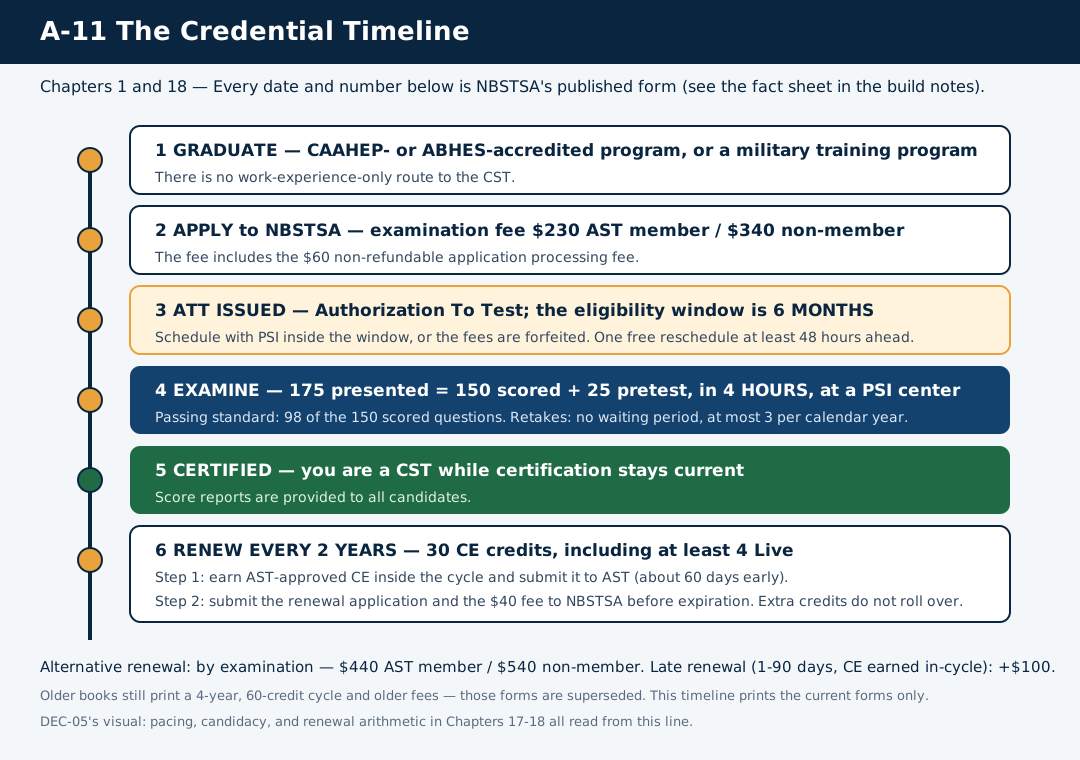 Figure 1.1 — The credential timeline — accredited program, application, six-month ATT window, the examination, and the two-year renewal cycle with 30 CE credits including 4 Live
Why does a first chapter spend this long on a renewal you are two years from needing? Because candidates plan backwards from wrong cycles. A student who believes renewal is a distant, four-year problem under-collects Live credits in year one and discovers in month twenty that Live opportunities cannot be backdated into a closed cycle. You now hold the true shape from the start: two years, thirty credits, four of them Live, earned inside the dates, in two steps, to two different bodies.
This is the only chapter of this book — together with the Exam Blueprint page in the front matter — that discusses the following credential, and it does so for one reason: candidates confuse the two constantly, and the confusion is expensive.
CST stands for Certified Surgical Technologist. It is NBSTSA's credential: NCCA-accredited, gated by graduation from a CAAHEP- or ABHES-accredited program (or the military or prior-CST routes of Section 1.3), tested by the 175-item examination of Section 1.5, passed at 98 of 150, and renewed on the two-year cycle of Section 1.10. It is the credential this book prepares you for, and the only one it prepares you for.
TS-C stands for Tech in Surgery–Certified. It is a different credential, issued by a different body — the National Center for Competency Testing (NCCT) — with its own examination, its own eligibility routes, and its own renewal system. Among the differences that matter most to a confused candidate: the TS-C's eligibility structure includes experience-based routes of the kind Section 1.3 showed the CST does not offer. That single difference explains most of the confusion in the wild: advice written for the TS-C's routes, read by a CST candidate, sounds like permission the CST does not give.
The disciplines that follow are absolute. The two credentials are not interchangeable; neither body's examination prepares for the other's, and passing one says nothing to the other body. Study material built for the TS-C is not CST preparation, whatever its cover claims, and this book contains no TS-C content, items, or claims anywhere outside this distinction. If you are deciding between credentials — because your employer names one, or your state names one, or your own history fits one route and not the other — decide from the two bodies' own publications and your employer's actual requirement, then study for the examination you will actually sit. Every remaining chapter of this book teaches the CST examination against NBSTSA's published outline, and the letters TS-C do not appear again.
Return to the graduate of the opening scenario, whose notebook held five wrong numbers. Each of her errors is a fact that was true, or was never true, and each is still in wide circulation. This section is the book's inoculation: the five stale forms, named as stale, beside the current published form you have already learned. Nothing in the right-hand column of your memory should ever be replaced by the left.
The sitting's size. Older coverage widely describes 200 questions, of which 175 are scored. NBSTSA's current outline, handbook, and certification pages all publish 175 presented: 150 scored and 25 pretest. The doubled form is wrong for the examination you will sit. [watch item 1; per entry 01 of the source register, entry 02 of the source register]
The passing point. Older coverage near-universally gives 102 of 150. That was the established point under the previous standard setting. The December 2023 standard setting (Section 1.6) re-derived the standard and NBSTSA established 98 of 150. Beside it circulate invented scaled forms — a score of 390 on a 600 scale, 350 on a 500 scale, "81," "70 percent" — none of which has any NBSTSA publication behind it at all. The passing standard is a raw count: 98. [watch item 2, watch item 3; per entry 05 of the source register]
The fees. An older handbook generation's fees still print everywhere: $190 member / $290 non-member for the examination, a $25 renewal, $299 / $399 for renewal by examination. The current handbook's revised applications publish $230 / $340, $40, and $440 / $540 (Section 1.8). [watch item 5; per entry 02 of the source register]
The renewal cycle. Older coverage — including dated pages that still rank in search results — describes renewal on a four-year cycle with 60 CE credits. That cycle is real history: holders whose four-year certification ran across the change recertified once with 60 credits. But every credential earned or renewed on or after January 1, 2020 sits in the two-year cycle: 30 credits, at least 4 of them Live (Section 1.10). The four-year form is not your cycle. [watch item 4; per entry 09 of the source register]
The sitting's length. Secondary coverage variously allots this examination three hours, or three and three-quarter hours. The handbook is exact: four (4) hours, with the practice examination before it uncounted and breaks unadded. The likely source of the confusion is NBSTSA's own practice platform, which is a three-hour sitting — a different product, for practice, described in Section 1.8. Do not let the practice tool's clock colonize the real examination in your planning. [watch item 7; per entry 02 of the source register, entry 08 of the source register]
One more absence belongs in this section. Websites also circulate pass rates for this examination — "about two-thirds" is the commonest. No pass rate is published in the NBSTSA sources this book's register rests on, so this book prints no pass rate at all — not in this chapter, not in its store description, not anywhere. A rate nobody can trace to the certifying body is marketing, not information, and a candidate planning around it is planning around fog. What you can plan around is the standard itself: 150 scored questions, 98 to pass, and an outline that tells you exactly where those questions come from. [watch item 6]
The currency habit. Dates are part of facts. Whenever a source gives you an examination number, ask it two questions: whose publication is this, and when? If the answer is "a prep site, sometime," treat the number as a rumor and check it against NBSTSA's current outline and handbook. Chapter 18 returns to this habit at renewal time; the book's errata page exists because NBSTSA will change facts again during this edition's life, and the current primary always outranks this book.
This book teaches knowledge for a written examination. That sentence is a scope fence, and it cuts in both directions, so read both edges.
What the book teaches, it teaches whole: instrument identification, purpose, and classification; procedural sequence knowledge — what happens in what order, and why; sterile-technique principles — what the sterile field is, what breaks it, and what follows a break; and the counts, specimens, medications, sterilization, anatomy, microbiology, and pharmacology the outline assigns, at the outline's knowledge depth. Where the outline phrases a task as a performance — perform the surgical scrub, don gown and gloves — this book teaches the examined knowledge of that task: its purpose, its sequence, its principles, and its named errors, and says so at the teaching point. A candidate who masters these chapters knows everything the written examination can ask about those tasks.
What the book never does is present itself as hands-on operating-room training. It never instructs you to perform a psychomotor skill on a person, and nothing in it counts as clinical experience, a practicum, or a substitute for your accredited program's laboratory and clinical rotations — the settings in which scrubbing, gowning, gloving, draping, and instrument handling are actually learned, with an instructor's hands able to correct yours. That is not a disclaimer pasted over a skills manual; it is a description of two different kinds of learning, both real. Your program trains your hands and attests to your clinical competence. This book trains the knowledge the written examination measures. A reader who has never entered an operating room can finish these foundations chapters understanding the room, the team, and the sterile system as knowledge — and should still expect their program, not this book, to make them safe at a real field with a real patient.
The remaining boundaries take one breath each. This book is not a surgical technology program and not a substitute for one, and using it cannot make an ineligible reader eligible (Section 1.3). It is not preparation for the TS-C or any other body's examination (Section 1.11). It is not a sterilization-parameter reference: the outline publishes topics, not cycle values, and any numeric parameter this book ever prints enters only through its recorded production sources, never from a website's chart. And it is not NBSTSA, AST, PSI, CAAHEP, ABHES, or NCCT, is affiliated with none of them, and was not reviewed or endorsed by any of them. Its authority is narrower and, for study purposes, sufficient: every load-bearing claim in it is traced to those bodies' own publications, in the source notes you have been meeting all chapter.
The book's eighteen chapters follow the road this chapter mapped. Part I, Foundations (Chapters 1–4) assumes nothing and teaches the frame: this chapter, the room and team (Chapter 2), sterile principles (Chapter 3), and the language of surgery (Chapter 4). Part II, Basic Science (Chapters 5–7) teaches the outline's 30 Basic Science questions. Part III, Preoperative Care (Chapters 8–9) covers the case's preparation and the sterile setup. Part IV, Intraoperative Care (Chapters 10–13) — the book's center of gravity, matching the outline's 68-question Intraoperative subcategory — teaches instruments, assisting, counts, specimens, and medications, and procedure knowledge by service. Part V (Chapter 14) covers postoperative care; Part VI (Chapters 15–16), sterilization and professional practice; Part VII (Chapters 17–18), sitting the examination and keeping the credential.
Around the chapters stands the practice architecture, composed to the outline's published counts: a 50-item diagnostic in the front matter, a 20-item quiz closing every chapter with a full key, two timed practice examinations of 175 presented items each, and eight 25-item repair sets keyed to a score report's subcategory breakdown. Worked examples appear wherever a rule has numbers or an order to it, and certain exercises are designated — items whose key is computed or sequence-derived, tagged by family in the key. This chapter's quiz carries the first of them, in the candidacy-and-session-arithmetic family.
Use the book in order the first time through, with the diagnostic taken cold before everything. Retakers should begin at Chapter 17's repair logic and let their score report choose their chapters. Either way, end every chapter the same way — summary, quiz, key — reading the explanations for questions you got right as carefully as those you missed: a right answer held for a wrong reason is the examination's favorite trap.
Close the chapter by making the decisions it has equipped you to make, in their necessary order.
First, confirm your route on Section 1.3's map; if none of the three routes describes you, your next step is a program decision, not a study plan. Second, fix your numbers from primary sources — the sitting's shape, the passing point, your fee, the renewal cycle — and date the page, so a future handbook revision tells you which of your facts predate it. Third, protect the calendar: count your ATT's six months today, mark the 48-hour reschedule line, and start the WBT 60-day proof clock the day you sit. Fourth, take the diagnostic cold and let it order your reading. Fifth, begin Chapter 2 — the room itself, where every later chapter's action takes place.
20 items. Every item is original, written to NBSTSA's published outline and handbook. Tags and the category map follow the quiz; full explanations are in the Chapter 1 Answer Key.
1. Which statement about the CST credential is correct? A. The CST is a state license issued through NBSTSA B. The CST is awarded by AST on completion of an accredited program C. The CST is issued automatically when a state grants a license D. The CST is NBSTSA's NCCA-accredited national certification, and only a technologist certified by NBSTSA may use the CST title
2. Which pairing gives each body its correct role? A. AST certifies technologists; NBSTSA accredits educational programs B. PSI decides the passing standard; CAAHEP delivers the examination C. NBSTSA certifies; AST is the professional association and the recognized authority for continuing-education approval; CAAHEP and ABHES accredit programs; PSI delivers the examination D. NCCA approves individual applications; PSI accredits the certification program
3. A graduate of a CAAHEP-accredited surgical technology program applies to NBSTSA. Which evidence of graduation does NBSTSA accept? A. A letter from the graduate's first employer confirming job performance B. A copy of the diploma, a transcript, or a notarized, signed letter on official school letterhead from the program director or registrar stating the graduation date and degree type C. A certificate of attendance from a weekend review course D. A signed statement from a surgeon the graduate has assisted
4. A surgical technologist with nine years of operating-room experience, trained entirely on the job, asks how to qualify for the CST on experience alone. Which answer is correct? A. Experience over five years substitutes for graduation if an employer attests to it B. Experience qualifies the candidate once a surgeon co-signs the application C. There is no experience-only route to the CST; eligibility runs through an accredited program, a military training program, or prior CST certification D. Experience qualifies the candidate after an appeal to the Board, with the appeal fee
5. A candidate graduated from a program whose accreditation was later revoked. She was enrolled and graduated while the program held accreditation. Under NBSTSA's published policy, she: A. Is permanently ineligible, because the program is not accredited today B. Remains eligible, because she was enrolled and graduated while the program held accreditation C. Is eligible only after completing a second accredited program D. May sit only for a different credential
6. An approved candidate receives the Authorization to Test. Within what period must the examination be taken? A. Three months from authorization B. Twelve months from authorization C. The period ends whenever the candidate first schedules D. Six months from authorization, or the fees are forfeited
7. A candidate must reschedule a booked sitting. Which statement states NBSTSA's published rule? A. Rescheduling is unlimited and free at any time B. Rescheduling always requires a new application and the full fee C. One no-charge reschedule is allowed at least 48 hours ahead, and the new date must fall inside the ATT window D. A sitting may be moved only after it has been missed
8. At check-in, which identification presentation meets the published requirement? A. One photographic identification, if it is current B. Two current forms of identification bearing name and signature, one of them photographic, with the name matching the ATT C. A Social Security card and a student identification D. Any two documents, provided one shows the candidate's photograph
9. A WBT candidate tests on campus with her cohort on May 10. Proof of graduation must reach NBSTSA within 60 days of the test date or her results are invalidated. By what date must the proof arrive? A. July 9 B. June 9 C. June 10 D. July 29
10. Which statement gives the sitting in its published form? A. 175 questions presented: 150 scored and 25 pretest items, randomly distributed and indistinguishable from the scored items B. 200 questions, of which 175 are scored C. 175 questions presented, all of them scored D. 150 questions presented: 125 scored and 25 pretest
11. Which statement about examination time is correct? A. The examination is three hours, including the on-screen practice examination B. The examination is four hours; the on-screen practice examination before it is not counted in examination time or score, and breaks during the four hours add no time C. The examination is four hours, and break time is added back at the end D. The examination is three hours and forty-five minutes, with a scheduled break
12. At this book's published checkpoints, computed from 175 presented items in 240 minutes, an on-pace candidate at 180 elapsed minutes should be near which item? A. Item 131 B. Item 88 C. Item 100 D. Item 175
13. A non-member candidate pays for a first attempt and one retake in the same calendar year. What total has she paid NBSTSA in examination fees, per the current handbook? A. $460 B. $680 C. $580 D. $790
14. Which statement gives the passing standard in its published form? A. A scaled score of 390 on a 600-point scale B. 70 percent of the scored questions C. 102 of the 150 scored questions D. 98 of the 150 scored questions, a criterion-referenced raw passing point established in December 2023
15. How was the current passing point established? A. As a fixed percentage of items, unchanged since the credential began B. By curving each administration to the performance of its candidates C. By modified-Angoff standard setting: subject-matter experts defined the minimally competent practitioner and rated the items, producing a panel estimate of 96 within a defensible range of 92–101, and NBSTSA established 98 of 150 with Board approval D. By PSI, from the difficulty of the pretest items
16. Which distribution matches the outline's published scored counts? A. Perioperative Care 90, Ancillary Duties 30, Basic Science 30 B. Perioperative Care 97, Ancillary Duties 30, Basic Science 23 C. Perioperative Care 68, Ancillary Duties 23, Basic Science 59 D. Perioperative Care 97, Ancillary Duties 23, Basic Science 30
17. Inside Perioperative Care, which subcategory carries the most scored questions, and how many? A. Intraoperative Procedures — 68 B. Preoperative Preparation — 19 C. Postoperative Procedures — 19 D. Intraoperative Procedures — 97
18. A candidate does not pass. Which statement about retaking is correct? A. The candidate may reapply immediately with a new application and the full fee, but may take no more than three examinations in one calendar year B. A six-month waiting period applies before reapplication C. Reapplication is barred until the next calendar year D. The second attempt is free if taken within the original ATT window
19. Which renewal statement describes the current published cycle? A. Four years, 60 CE credits, submitted to NBSTSA with a $25 fee B. Two years, 30 CE credits, all of which must be Live, submitted to AST only C. Four years, 30 CE credits including 4 Live, with extra credits rolling into the next cycle D. Two years, 30 CE credits including at least 4 Live, earned inside the cycle with no rollover; credits submitted to AST and the renewal application with the $40 fee submitted to NBSTSA before expiration
20. Which statement about the TS-C is correct, as this book presents the distinction? A. The TS-C is NBSTSA's second surgical technology credential B. The TS-C and CST examinations are interchangeable for employers C. The TS-C is a different credential from a different body, the National Center for Competency Testing (NCCT), with its own examination and eligibility routes — including experience-based routes the CST does not offer — and this book prepares candidates for the CST only D. TS-C holders may use the CST title once employed as surgical technologists
Google Play Books Exam Prep Series
Feras Alzubi
---
Built on NBSTSA's Surgical Technologist Certifying Examination Content Outline, effective January 1, 2023, with NBSTSA's 2025 Candidate Handbook, 1st Edition, V4 with Revised Applications and Fees, and NBSTSA's CST Standard Setting Report (December 2023), as read October 31, 2026 · Confirm the current outline, handbook, fees, and passing point at nbstsa.org before you apply — this examination's published facts have changed within the prep shelf's living memory, and Chapter 1 names each change.
Counts in this book. Every count in this front matter is an as-built count, counted at production from the as-built item files, key entries, and figure files: 960 practice items — a 50-item diagnostic, a 20-item quiz closing each of the eighteen chapters (360), two full timed practice forms of 175 presented items each (350 presented: 300 scored-shape + 50 pretest-position), and eight 25-item subcategory repair sets (200). Inside that census, 177 items are designated exercises as built (DEC-01 44 · DEC-02 66 · DEC-03 29 · DEC-04 25 · DEC-05 13). The register was designed at 230 designated exercises; it is reported as built at 177, because the restored chapters' outline lines cannot carry the remaining designated items without padding outside the designated whitelist, and the sterilization family is capped by its empty verification record — the shortfall is restated as built, never filled. Chapter prose stands at 148,516 words as built. The book carries 34 labeled figures (22 illustrations of the physical subject matter · 12 abstract teaching diagrams) and a 598-term glossary.
---
Surgical Technologist Certificate (CST) — 2026–2027 Edition.
Copyright © 2026 Feras Alzubi.
All rights reserved. No part of this book may be reproduced or transmitted in any form or by any means without the publisher's prior written permission, except for brief quotations in a review.
Edition bases — the outline-edition statement. Read this page before you rely on any figure in this book.
This edition is built on NBSTSA's current published examination documents, in the editions named here. The content outline is the book's content authority; the handbook is its candidacy authority; the standard-setting report is its passing-point authority.
Version: First edition, published November 1, 2026. Production record — November 1, 2026 (the register's currency re-verification duty, performed on the production date). The content outline and the current Candidate Handbook were re-downloaded from NBSTSA's own site and read: the outline in current circulation (the file this edition is built on, effective January 1, 2023) still publishes 175 presented items (150 scored + 25 pretest) with the domain and subcategory counts this book prints (Perioperative Care 97 — Preoperative Preparation 19, Intraoperative Procedures 68, Postoperative Procedures 10; Ancillary Duties 23 — Administrative and Personnel 7, Equipment Sterilization and Maintenance 16; Basic Science 30 — Anatomy and Physiology 18, Microbiology 6, Surgical Pharmacology 6); the Candidate Handbook in current circulation is still the 2025 1st Edition, V4 with Revised Applications and Fees, still publishing the four-hour sitting and the V4 fees this book prints ($230 AST member / $340 non-member, including the $60 non-refundable application processing fee; renewal by examination $440 / $540). No newer standard-setting publication was found, so the established passing point stands: 98 of the 150 scored questions (December 2023). No surface required rebasing.
Exam names and trademarks belong to their respective owners and are used in this book only to identify the examination and its published structure. CST and Certified Surgical Technologist are registered marks of NBSTSA.
---
This book is an independent study guide. It is not published by, affiliated with, endorsed by, or approved by the National Board of Surgical Technology and Surgical Assisting (NBSTSA), and it is likewise not affiliated with or endorsed by the Association of Surgical Technologists (AST), PSI, the Commission on Accreditation of Allied Health Education Programs (CAAHEP), the Accrediting Bureau of Health Education Schools (ABHES), or the National Center for Competency Testing (NCCT). NBSTSA alone decides eligibility, administers and scores the examination, and awards the credential. Passing any examination also depends on the candidate's own preparation; no book can guarantee a result, and this book makes no pass guarantee of any kind.
Every practice question in this book is original, written to NBSTSA's published content outline. No item is an actual examination question, and none is a recalled or reconstructed one. NBSTSA's examination questions are its copyrighted property, and unauthorized possession or distribution of examination materials — including reproduction of questions — is a named ground for denial or revocation of certification, as NBSTSA's Handbook and Policies record. The outline's own five published sample questions may be discussed in this book as NBSTSA's published samples, attributed as such; they are never absorbed into this book's item bank.
Every examination figure in this book traces to one of the NBSTSA or AST publications named on the Copyright and Version Page, checked on October 31, 2026. The full source register, entry by entry, is printed as the References at the back of this book, and the register's numbered entries (entries 1 through 10) are the authority behind every examination fact printed here. Where secondary materials disagree with those publications — on how many questions are presented, on the passing point, on the fees, on the length of the renewal cycle — the current NBSTSA publications govern, and the superseded forms appear in this book only inside the dated currency notes in Chapters 1 and 18, never as live facts.
The CST's published facts have turned over in layers, and the superseded forms still dominate older preparation books and secondary coverage. This book prints the current published form of each fact, and names the turnover here so a reader arriving from an older source is not misled:
| Fact | What NBSTSA currently publishes — what this book prints | The superseded form still in circulation |
|---|---|---|
| Presented / scored items | 175 presented = 150 scored + 25 pretest (unscored) | "200 questions / 175 scored" |
| Passing point | 98 of the 150 scored questions, established December 2023 | "102 of 150" — the pre-2023 point |
| First-attempt examination fee | $230 AST member / $340 non-member (V4 revised fees) | "$190 / $290" |
| Renewal cycle | 2 years · 30 CE credits including 4 Live | "4 years · 60 CE credits" — retired January 1, 2020 |
| Renewal-by-examination fee | $440 AST member / $540 non-member | "$299 / $399" |
If a source you own states any form in the right-hand column as a current fact, it is describing an earlier edition of this examination's rules. Study its clinical content if you wish; take none of its candidacy facts.
The passing score is the minimum number of questions that must be answered correctly — a criterion-referenced raw cut score, set by a standard-setting committee of subject-matter experts using the modified Angoff method under a psychometrician, with final approval by the NBSTSA Board of Directors, and reviewed at each job-analysis cycle. The current study (panel meeting November 11, 2023; results presented to NBSTSA November 15, 2023) produced a panel-estimated cut point of 96 with a defensible range of 92–101, and NBSTSA established 98 out of 150 as the raw score passing point. The standard-setting form becomes the base form; later forms are made parallel and equivalent by statistical pre-administration equating against the content outline. Score reports are provided to all candidates.
This book therefore prints the passing standard only as "98 of the 150 scored questions" — never as a percentage, and never as a scaled score. No scaled-score form in circulation has an NBSTSA primary behind it, and none prints in this book. Practice results in this book print as raw counts with study guidance attached to the count, explicitly not as pass predictions: no practice result is converted to a percentage of the passing point, to a scaled score, or to a predicted examination outcome — in the text, in a form's scoring guidance, or anywhere else.
This book prints fees only in the form NBSTSA's current Handbook (2025, 1st Edition, V4 with Revised Applications and Fees) publishes them, each with its source named at the point of use:
No program tuition, no AST membership dues figure presented as an NBSTSA fee, no state fee, and no "total cost of certification" figure built by adding amounts together is printed in this book. Confirming read recorded in the source register at production (November 1, 2026): the examination, renewal, late-renewal, renewal-by-examination, and appeal amounts stand as printed. The Handbook's refund line was also read: it names the renewal-by-CE application processing fee ($25) and the examination application processing fee ($60) as the non-refundable portions of those applications — the $25 is a processing component of the $40 renewal, not a separate fee, and it does not print as a fee in this book.
---
The CST examination — NBSTSA's certifying examination for the credential Certified Surgical Technologist (CST). The credential is accredited by the National Commission for Certifying Agencies (NCCA). NBSTSA publishes the CST as the most nationally recognized surgical technology credential in the United States, preferred or required by most employers nationwide and required by many states. Certification is not licensure: NBSTSA certification is the national credential, and any state requirement is the state's own act — confirm your state's rule with its own authority. No state's rule, list of states, fee, or process is printed in this book.
Eligibility — the published pathways (NBSTSA, 2025 Candidate Handbook; NBSTSA, Policies). NBSTSA retains sole authority over eligibility and does not refund processing fees for ineligible applicants.
On approval NBSTSA issues an Authorization To Test (ATT) email. The ATT eligibility period is six (6) months; the examination must be taken before its expiration or fees are forfeited. Scheduling is with PSI, online or by phone, year-round at PSI Assessment Centers (Monday–Saturday sittings), or on campus by web-based testing (WBT) through the candidate's program. One no-charge reschedule is allowed at least 48 hours ahead, inside the ATT window. WBT candidates' results release only after graduation proof reaches NBSTSA — within 60 days of the test date, on pain of invalidation and fee forfeiture.
The CST and the TS-C are different credentials. CST (Certified Surgical Technologist) is NBSTSA's credential — the credential this book prepares for — gated by graduation from a CAAHEP/ABHES-accredited program or the military or prior-CST routes above. TS-C (Tech in Surgery–Certified) is a different credential from a different body — the National Center for Competency Testing (NCCT) — with its own examination, its own eligibility routes (which include experience-based routes the CST does not offer), and its own renewal system. The two credentials are not interchangeable, neither body's exam prepares for the other's, and there is no work-experience-only route to the CST. This book teaches only the CST examination, against NBSTSA's published outline. This distinction is printed here and in Chapter 1; TS-C content, items, and claims appear nowhere else in this book.
The scope fence, stated for the reader. This book teaches knowledge for a written examination: instrument identification, purpose, and classification; procedural sequence knowledge; sterile-technique principles; counts, specimens, medications, sterilization, anatomy, microbiology, and pharmacology at the outline's knowledge depth. It is not hands-on operating-room training, it instructs no reader to perform a psychomotor skill on a person, and nothing in it is clinical experience or a substitute for an accredited program's laboratory and clinical rotations.
The sitting, as NBSTSA publishes it (NBSTSA, Examination Content Outline, effective January 1, 2023; NBSTSA, 2025 Candidate Handbook):
| Fact | Published form |
|---|---|
| Presented items | 175 multiple-choice questions |
| Scored / pretest | 150 scored + 25 pretest (unscored), randomly distributed and indistinguishable from scored items |
| Examination time | 4 hours |
| Tutorial / practice | An on-screen practice examination before the timed examination; its time is not counted toward examination time or score |
| Breaks | Permitted at any time; no additional time is given for time lost during breaks |
| Delivery | Computer-based at PSI Assessment Centers year-round (Mon–Sat); on-campus WBT for program cohorts |
| Identification | Two forms of identification (one photographic), current, bearing name and signature; the name must match the ATT |
| Materials | Pencils and scratch paper are provided, signed, and returned; no notes, phones, or personal items enter the testing room |
| Scoring | Criterion-referenced raw cut score (modified Angoff standard setting, Board-approved); 98 of the 150 scored questions, established December 2023; later forms equated to the base form |
| Examination fee | $230 AST member / $340 non-member, including the $60 non-refundable processing fee |
| ATT window | 6 months from authorization; the exam must be taken inside it or fees are forfeited |
| Rescheduling | One no-charge reschedule at least 48 hours ahead, inside the ATT window; late arrival (15 minutes or more) counts as absent, fees forfeited |
| Retakes | No waiting period; no more than 3 examinations in one calendar year; a new application and the full fee are required each time |
| Maintenance | 2-year cycle · 30 CE credits including at least 4 Live, AST-approved, earned in-cycle, no rollover · $40 renewal; or renewal by examination ($440 / $540); late window 1–90 days at +$100 |
The content weights, exactly as the outline publishes them (NBSTSA, Examination Content Outline, effective January 1, 2023). NBSTSA's construction note, printed here because it shapes how this book writes its items: the examination is built from a job task analysis repeated every five to seven years, and 71% of Perioperative Care items require application of knowledge rather than recall — which is why this book's Perioperative items are written as short operating-room scenarios wherever the outline line supports one.
| Domain (exact published name) | Scored items | Subcategories (scored items) |
|---|---|---|
| I. Perioperative Care | 97 | A. Preoperative Preparation (19) · B. Intraoperative Procedures (68) · C. Postoperative Procedures (10) |
| II. Ancillary Duties | 23 | A. Administrative and Personnel (7) · B. Equipment Sterilization and Maintenance (16) |
| III. Basic Science | 30 | A. Anatomy and Physiology (18) · B. Microbiology (6) · C. Surgical Pharmacology (6) |
| Total scored | 150 | (+ 25 pretest presented = 175 presented) |
Maintaining the credential, in preview (taught in full in Chapter 18): certification runs on a two-year cycle. To renew by continuing education, earn 30 CE credits per cycle, of which at least 4 must be Live CE, all from AST-approved sources and all earned inside the cycle dates — credits earned before or after the cycle do not count, and extra credits do not roll over. Renewal is a two-step process: (1) earn and submit CE credits to AST; (2) submit the renewal application and the $40 fee to NBSTSA before the certification expires — NBSTSA recommends submitting CE 60 days before the expiration date. The alternative is renewal by examination. Holders whose four-year certification expired during the transition recertified once with 60 credits and then entered the two-year cycle; that dated transition note is the four-year cycle's only appearance in this book.
---
Before Chapter 1, answer two questions, because they select everything that follows.
First: which eligibility route is yours? An accredited-program student or graduate, a military-trained technologist, or a prior CST renewing by examination. If none of the three routes on the Exam Blueprint Page is yours yet, this book's foundations part is written for you — but read Chapter 1's eligibility teaching before you plan a sitting date, because no amount of study substitutes for a route. There is no experience-only route to this credential.
Second: where are you in your preparation? A complete beginner who has never stood in an operating room, a program student whose coursework is under way, or a retaker rebuilding from a score report. The three reader paths below are keyed to that answer, and the study plans after them are keyed to your time.
This book is built under a dual-purpose promise: complete knowledge from zero, and the full examination layer on top of it, in the same book. No chapter assumes a program classroom or a clinical rotation.
Path 1 — From zero. You are a prospective student, a career-changer, or a first-term student. Start at Chapter 1 and read Part I (Chapters 1–4) in order: the credential and the examination, the operating room and the team object by object, sterile principles as a complete system, and the language of surgery. Take the diagnostic after Part I, not before it — a diagnostic taken before the foundations measures unfamiliarity, not readiness — then follow the study plan below that matches your time.
Path 2 — The program student or new graduate. You are enrolled in, or newly graduated from, a CAAHEP/ABHES-accredited program, or testing under the military route. Take the diagnostic first. Where it routes you into Part I, read those chapters; where it does not, skim Part I for this book's conventions — the scope fence, the currency notes, and the addresses below — and begin at the part your scores point to.
Path 3 — The retaker. You hold a score report. Read it the way Chapter 17 teaches — by subcategory, as a repair map — then work the retake track in the study plans below before you re-read anything else. Plan inside the published constraint from the first day: no more than three examinations in one calendar year, with no waiting period between attempts and a new application and full fee each time. A retake spent without a repair cycle is an attempt spent, not a repair made; Chapter 17 and the retake track are built around that arithmetic.
Whichever path you are on: every reader is assumed able to learn a system when it is shown, named, and worked, and no reader is assumed to have performed any clinical task. Where a chapter teaches a task the outline phrases as a performance, it teaches the examined knowledge of that task and says so.
Designed structure, labeled as designed: the book as designed comprises eighteen chapters in seven parts, with a prose target of 153,000 words stated in its design — chapter-file prose only, excluding quiz blocks, item banks, figure captions, tables' cell text, and front and back matter. No prose extent is asserted here as an as-built count.
Inside each chapter the architecture is the same, so you can navigate by habit: the content in plain words first, then at examination depth; the physical subject shown in its labeled plate before it is used in prose; worked examples, with designated exercises derived step by step; and a chapter quiz, keyed to the chapter, at the chapter's end. Every term in the glossary at the back of this book is also defined at its first use in the text.
Every practice item in this book carries an address in the item bank: its domain and subcategory in the outline's published names, its outline task line, its chapter, and — for designated exercises — its designated family and derivation. An item that cannot name its outline line is not in this book.
Designed figures, labeled as designed: the practice architecture as designed comprises a 50-item diagnostic, a 20-item quiz at the end of each of the eighteen chapters (360 quiz items as designed), two full timed practice tests of 175 presented items each (350 presented items as designed, of which 300 are scored-shape and 50 occupy pretest positions — see the forms statement below), and one 25-item repair set for each of the eight published subcategories (200 repair items as designed) — 960 items as designed in total, of which, as designed, 910 are scored-shape items and 50 occupy pretest positions, and 230 as designed are designated exercises across the five DEC families (DEC-01 65 · DEC-02 75 · DEC-03 42 · DEC-04 35 · DEC-05 13, as designed). As built and counted at production from the as-built item files, key entries, and figure files: 960 items in total (50 diagnostic · 360 chapter-quiz · 350 practice-form presented · 200 repair), of which 177 are designated exercises as built — DEC-01 44 · DEC-02 66 · DEC-03 29 · DEC-04 25 · DEC-05 13 — and 34 figures as built (22 labeled illustrations of the physical subject matter · 12 abstract teaching diagrams). The as-built counts supersede the designed figures wherever the two differ; the designated census is restated as built, never filled.
Designed figures, labeled as designed: the figure plan as designed comprises 34 figures — 22 labeled illustrations of the physical subject matter (the operating-room suite and its furniture, the instrument population by family, sterilization equipment, drapes, gowns, and gloves, and the anesthesia machine at knowledge level) and 12 abstract teaching diagrams (the sterile field, the count sequence, sterilization cycle phases, the chain of infection, wound classification, and their companions) — each an original drawing made for this book. No figure reproduces a photograph, a manufacturer's illustration, or a clinical image, and no item in this book requires recognizing one.
As designed, each full form is a 175-item, 4-hour sitting rehearsal: 150 scored-shape items composed at the exact published subcategory counts — Preoperative Preparation 19 · Intraoperative Procedures 68 · Postoperative Procedures 10 · Administrative and Personnel 7 · Equipment Sterilization and Maintenance 16 · Anatomy and Physiology 18 · Microbiology 6 · Surgical Pharmacology 6 — plus 25 pretest-position items distributed through the form, unmarked in the sitting pages and identified only in the answer key, where the key tells you they were excluded from your score, exactly as NBSTSA's pretest items are excluded from the real score. This mirrors the real examination's published structure instead of hiding it: the book teaches you to expect 175 items and to pace for 175.
A form is not a prediction. Its items are original; its result is a raw count of this book's items; and no surface in this book converts that count into a percentage of the passing point, a scaled score, or a readiness guarantee. Form instructions rehearse the sitting's rules that a book can rehearse: the uncounted practice session first, breaks that cost time, scratch-paper discipline for designated-exercise working, and the basic four-function standard.
As designed, the diagnostic is a 50-item form composed at the outline's proportions, with its rounding disclosed on its face: Preoperative Preparation 6 · Intraoperative Procedures 23 · Postoperative Procedures 3 · Administrative and Personnel 2 · Equipment Sterilization and Maintenance 6 · Anatomy and Physiology 6 · Microbiology 2 · Surgical Pharmacology 2 — Perioperative Care 32 · Ancillary Duties 8 · Basic Science 10 in total. It is sat in 60 minutes, with an untimed option stated on its face. Score it by subcategory — never as a single blended verdict — then route by this table:
| If this subcategory is weak, re-read | Then work |
|---|---|
| Preoperative Preparation — Chapters 8–9 | The Preoperative Preparation repair set |
| Intraoperative Procedures — Chapters 10–13 | The Intraoperative Procedures repair set |
| Postoperative Procedures — Chapter 14 | The Postoperative Procedures repair set |
| Administrative and Personnel — Chapter 16 | The Administrative and Personnel repair set |
| Equipment Sterilization and Maintenance — Chapter 15 | The Equipment Sterilization and Maintenance repair set |
| Anatomy and Physiology — Chapter 5 | The Anatomy and Physiology repair set |
| Microbiology — Chapter 6 | The Microbiology repair set |
| Surgical Pharmacology — Chapter 7 | The Surgical Pharmacology repair set |
The diagnostic as built is the 50-item form printed with this book's exam layer: Preoperative Preparation 6 · Intraoperative Procedures 23 · Postoperative Procedures 3 · Administrative and Personnel 2 · Equipment Sterilization and Maintenance 6 · Anatomy and Physiology 6 · Microbiology 2 · Surgical Pharmacology 2. Eleven of its items are designated exercises (DEC-01 ×3 · DEC-02 ×3 · DEC-03 ×2 · DEC-04 ×2 · DEC-05 ×1). It is sat in 60 minutes, with an untimed option stated on its face. Its scoring grid and per-subcategory result bands are printed with the form, in raw counts only, labeled as this book's guidance.
Keep one page for the whole candidacy, current by subcategory. A second set of rows on the same page makes it a candidacy ledger — the administrative half of the DEC-05 arithmetic, practiced on your real dates:
| Ledger row | Your entry |
|---|---|
| Eligibility route (accredited program / military program / prior CST), and the evidence you will submit | |
| Program and accreditor (CAAHEP or ABHES), and how you confirmed the accreditation | |
| Application submitted, with the examination fee paid (date and amount, in the published form) | |
| Authorization To Test (ATT) received — copy the six-month eligibility period's dates exactly as issued | |
| PSI appointment scheduled (date, time, center) — or WBT sitting through your program | |
| Reschedule, if used — requested at least 48 hours ahead, new date inside the ATT window (date) | |
| Sitting date, and the two forms of identification you will bring (names matching the ATT) | |
| If WBT: graduation proof submitted to NBSTSA within 60 days of the test date (date) | |
| Score report received — subcategory results copied as your repair map (never converted to a prediction) | |
| If retaking: attempts used in this calendar year, of the maximum of three (count and dates) | |
| After passing: certification expiration date, and the two-year cycle's CE plan — 30 credits including 4 Live, CE submitted to AST about 60 days before expiration, renewal application and $40 to NBSTSA before expiration |
This book does not replace its sources, and it tells you what they are:
---
Every plan in this section is this book's guidance — book apparatus, labeled as such wherever a plan is reprinted. Three plans follow, as designed: a 2-week intensive plan and a 4-week standard plan, each day by day and referenced to chapters and tests, and a retake track keyed to the three-per-calendar-year cap. Every content plan ends, by design, at a full timed form: 175 presented items in 4 hours, sat as one sitting, scored as a raw count by subcategory. No plan's completion is a prediction of any examination outcome, and no practice result in any plan converts to one. Administrative tasks — confirming your eligibility route and evidence, entering your ATT dates in the candidacy ledger, scheduling inside the six-month window — are placed first in every plan, on purpose: an administrative task discovered mid-plan costs study days; the same task done first costs none. Chapter and component references below are to this book's designed structure: eighteen chapters, a 50-item diagnostic, a 20-item quiz per chapter, eight 25-item subcategory repair sets, and two full 175-item forms, all as designed.
For a program student or new graduate whose coursework is complete and whose sitting is close. This plan assumes full study days; if your days are working days, use the 4-week standard plan instead — it covers the same ground at half the daily load. Path 1 (from-zero) readers do not start here.
The default plan: for program students in their final term, new graduates, military-route candidates, and from-zero readers who have completed Part I. One chapter cluster per day at reading pace, quizzes untimed, repair woven in weekly.
Week 1 — Administration, foundations, and the diagnostic
Week 2 — Basic Science and Preoperative Care
Week 3 — Intraoperative Care and Postoperative Care
Week 4 — Ancillary Duties, repair, and forms
*Keyed to the published retake rules: no waiting period before reapplying, a new application and the full fee each time, and no more than three examinations in one calendar year. This track is a repair cycle, not a re-read: it is paced in phases rather than fixed days, because its length is set by your score report, not by the calendar — but it is bounded by the cap from its first step, and no phase of it ends in a sitting taken "to see how it goes."*
---
The cheat sheets bound with this book at production are: the numbers sheet — the examination facts exactly as published (the sitting's shape, the passing standard in its published form, the fees, the ATT window, the retake cap, the renewal cycle), each dated to its source; the counts and sequence sheet — the count moments, the specimen chain, and the setup and turnover sequences as the chapters teach them; the wound-classification sheet — the four surgical wound classes with the taught examples at each class; and the DEC formula sheet — the five designated families' relationships, and nothing beyond them.
No cheat sheet in this book contains a percentage form of the passing standard, a scaled score, a raw-to-practice-result conversion, a pass rate, a state licensing rule, a sterilization cycle value, a drug dose value, or any other figure whose production verification is still outstanding.
The four cheat sheets are printed at the back of this book, after the glossary.
---
End of front matter. The glossary, cheat sheets, References, outline crosswalk appendix, remaining appendices, and errata note are printed as the back matter.
End of the free sample. The complete book continues from here — the full A-to-Z course in book form, delivered as an EPUB you can read in Apple Books, Google Play Books, ReadEra, Thorium Reader, Adobe Digital Editions, or Send to Kindle.
Buy this ebook — $9.99 Back to the book page
Payments are securely processed by Payhip.