
Mastering Careers & Skills
Occupational Therapy Assistant Exam (COTA) · free sample from the book itself
Feras Alzubi
Exam Prep Series
2026 Edition
© 2026 Feras Alzubi. All rights reserved.
No part of this book may be reproduced, stored in a retrieval system, or transmitted in any form or by any means — electronic, mechanical, photocopying, recording, or otherwise — without the prior written permission of the author, except for brief quotations in reviews and other uses permitted by copyright law.
Every practice question, explanation, case file, and worked example in this book is original to this book. The practice questions are original, written against the published examination framework of the National Board for Certification in Occupational Therapy (NBCOT); they are not NBCOT's actual examination items, and no NBCOT examination item is reproduced, recalled, paraphrased, or adapted anywhere in these pages. No passage of any handbook, standard, or assessment publisher's material is reproduced into usable form. NBCOT's domain names and examination framework are NBCOT's own published framework, named and cited as a framework; the teaching built on them is this book's own. Proprietary assessments are named by purpose and role only; their items, forms, and scoring keys are never reproduced.
Not-affiliated disclosure. This book is an independent study guide. It is not published by, affiliated with, endorsed by, or approved by the National Board for Certification in Occupational Therapy (NBCOT). NBCOT did not write, review, approve, or sponsor this book. The name Occupational Therapy Assistant Exam (COTA) is used in this book as a statement of fact about the certification examination this book prepares readers to study for. Certification decisions belong to NBCOT alone; this book confers no certification, no eligibility, and no authorization of any kind, and it satisfies no NBCOT requirement — not the education requirement, not the fieldwork requirement, and not any application step.
Specimen notice. The Alder Lane Occupational Therapy Service and its clients — Mrs. Alvarez, Mr. Chen, Sam, and Ms. Osei — are fictional teaching specimens, labeled specimens on their faces at first use. The service, its staffing, its schedule, its fixtures, and its clients are not real people or a real service. All specimen facts, measures, and figures are fictional and illustrative, and are the specimen's own — never examination facts, market rates, benchmarks, or pay figures. No real employer, person, product brand, or place is depicted.
Front Matter
Part I — The Field and Its Doors
Part II — Foundations: Occupation, Development, and the Body
Part III — Gathering Information with the OTR (Domain 1)
Part IV — Interventions: Occupation-Based Practice (Domain 2)
Part V — The Equipment of the Craft (Domain 2, Tasks 4–6)
Part VI — Methods, Safety, and the Working Setting
Part VII — Standards, Ethics, and Judgment (Domain 3)
Part VIII — The Examination
Back Matter
This section states the examination itself, from its owner's own publications. Every fact here is a registered fact of this book, with its source named on its face. Fees, dates, and program details can change; check NBCOT for the current figures before applying.
What the examination is. The Certified Occupational Therapy Assistant (COTA) examination is the certification examination of the National Board for Certification in Occupational Therapy (NBCOT). Passing it is one part of earning the COTA credential; it is not a license, and what certification does and does not authorize is stated plainly in the next section. The content outline in force for all COTA examinations administered from January 2, 2024, organizes the examination into three domains, 15 tasks, and 59 knowledge statements. (Source: NBCOT, 2022 COTA Examination Content Outline.)
The three domains and their weights. Domain 1, Collaborate and Gather Information — 27%: the work of building the occupational profile with the client, contributing to screening and assessment under the occupational therapist's direction, analyzing occupations and activities, observing and measuring performance, and collaborating with the client, family, team, and supervising therapist so intervention rests on gathered evidence rather than assumption. Domain 2, Select and Implement Interventions — 55%: the work of choosing and carrying out occupation-based interventions — grading and adapting activities, training in self-care and daily occupations, therapeutic activities and groups, motor, cognitive, perceptual, and sensory interventions, psychosocial practice, feeding and eating support, productive-occupation participation, and the orthoses, adaptive equipment, assistive technology, mobility, seating, transfer, and environmental work that supports participation. Domain 3, Uphold Professional Standards and Responsibilities — 18%: the work of practicing inside the law, the practice act, and the setting's rules; ethical and professional conduct; safety and emergency responsibilities; accurate documentation; and evidence-based, quality-minded professional development. The task areas above are described in this book's own words; Crosswalk B in the back matter maps all three domains and their 15 tasks to the chapters that teach them. (Source: NBCOT, 2022 COTA Examination Content Outline.)
Size, sitting, and item types. The COTA examination consists of 190 items in a timed, four-hour, computer-based sitting, taken in person at Pearson test centers. Its items are single-response multiple-choice items with three or four options and six-option multi-select items, of which three of the six options are correct. Scored items and non-scored field-test items are combined in the sitting; NBCOT does not publish the split between them. (Source: NBCOT, Certification Exam Handbook; NBCOT, Foundations of the Certification Examinations.)
Scoring, stated exactly. Scoring is criterion-referenced: performance is judged against a fixed standard, set by the Modified Angoff method, not against other candidates. Overall performance is reported on a standardized scale from 300 to 600, and a total scaled score of at least 450 is required to pass. Pass–fail decisions rest on the total score only — there is no domain-level passing standard, so no single domain can pass or fail a candidate by itself. This book prints no pass rate for this examination, and no figure in this book should be read as one. (Source: NBCOT, Foundations of the Certification Examinations.)
Who may sit, in brief. COTA candidates must graduate from an ACOTE-accredited occupational therapy assistant program, with required fieldwork completed before applying — for OTA students, a minimum of 16 weeks of full-time Level II fieldwork, reflecting more than one practice area, in a maximum of three settings — agree to abide by the NBCOT Code of Conduct, and pass character review. Candidates apply through their own MyNBCOT account only; the application is valid for 90 days, and the Authorization to Test (ATT) letter follows within three business days of approval and is active for 90 days. Chapter 2 teaches the doors in full, and Chapter 39 teaches the application, scheduling, and test-day mechanics, including the service fees NBCOT's handbook itself prices. (Source: NBCOT, Certification Exam Handbook; ACOTE, 2023 Accreditation Standards, Standard C.1.12.)
A note on weights, so two different things are never confused. The domain weights above are facts about NBCOT's examination. This book's own study apparatus — the diagnostic strands and the Strand Repair Sets — is sized by this book's own design, weighted by each strand's place in the book's teaching, not derived from, matched to, or claimed to reflect the examination's blueprint weights. No strand proportion in this book is NBCOT's, and strand performance does not predict examination performance by domain.
The headline honesty fence. This book prepares readers for the NBCOT COTA certification examination. Certification is not licensure. Passing the examination and holding the COTA credential do not, by themselves, authorize any person to practice occupational therapy in any place. Practice requires the reader's own jurisdiction's license or registration, issued under that jurisdiction's occupational therapy practice act, and NBCOT initial certification is one input to that process: all 50 states, the District of Columbia, Guam, and Puerto Rico require initial NBCOT certification for state regulation of occupational therapy. (Source: NBCOT, 2022 Practice Analysis of the COTA: Executive Summary.) The jurisdiction's practice act — not this book, and not the credential alone — governs who may practice, under what supervision, and on what terms, where the reader works. This book names no jurisdiction's rule as a scope claim and prints no jurisdiction's specific fee, supervision ratio, or deadline; the discipline it teaches, everywhere, is lookup discipline — verify the current rule with your own jurisdiction before you rely on it.
What certification is, and what it is not. Certification is NBCOT's attestation that a candidate met its published requirements — the accredited education, the completed fieldwork, the character review and Code of Conduct agreement, and the passing examination score — at the standard NBCOT publishes. It is not permission to practice, not a job, and not proof of competence at any hands-on act. Permission comes from the license; competence at a hands-on act comes from education, fieldwork, supervised practice, and demonstrated service competency in the setting where the act is performed.
Hands-on skills in this book. Transfers, manual techniques, modality application, orthosis fabrication on a client, feeding and swallowing support, and assessment administration are taught in this book as knowledge, method, and reasoning — what each act is, what its measures mean, what the occupational therapy assistant watches for and reports, and where the supervised, authorized act begins. No chapter hands the reader a procedure to perform on a person. Authorization to perform any clinical act comes from the reader's education, fieldwork, licensure, supervision, and service competency — never from this book.
What this book will not do. It will not certify you, license you, qualify you, or authorize you to perform any act. It will not substitute for an accredited program, fieldwork, your supervising occupational therapist, your employer's policies, or your jurisdiction's practice act. It promises no examination result, no job, no income, and no advancement. NBCOT examines and certifies; jurisdictions license; programs and fieldwork educators train; this book prepares the knowledge underneath all of it.
The rhythm. This book teaches, then tests. Each of the 40 chapters teaches its body whole — every technical term defined at first use, concepts carried step by step from the simple form to the worked detail — and closes with 15 practice questions. A separate key explains the correct answer and every wrong option for every question, so a wrong answer teaches as much as a right one. Two Occupational Therapy Case Batteries then work whole cases end to end as reasoning — situation, evidence, reasoning chain, conclusion — and eight Strand Repair Sets give focused extra practice by strand.
The apparatus, counted exactly. The planned apparatus totals 820 explained items: the 50-item Readiness Diagnostic, 600 chapter items (40 chapters × 15), 50 case files (Battery A, 25 rehabilitation cases; Battery B, 25 school, mental-health, home, and community cases), and 120 Strand Repair Set items (RS1–RS8 × 15). The repair sets are RS1 Foundations (Chapters 5–10), RS2 Gathering (Chapters 11–15), RS3 Interventions (Chapters 16–24), RS4 Equipment (Chapters 25–30), RS5 Safety & Setting (Chapters 31–34), RS6 Standards & Ethics (Chapters 35–37), RS7 Examination & Application (Chapters 38–39), and RS8 Field & Career (Chapters 1–4 and 40). The Glossary carries exactly 350 entries, and four printed crosswalks map the chapters to the field body, to the NBCOT COTA outline of three domains and 15 tasks, to the combined-occupation duties, and to the book's foundations.
The two readers, and their two paths. This book is written for two readers at once. The student path serves the prospective or new occupational therapy assistant student who has never seen the field: read in printed order, Part I first — the field, its doors, the partnership, and the hazard map — then the foundations of Part II, which teach occupation, development, and the body from zero before any later chapter rests on them; do not skip Part II to save time, because every later measure, analysis, and intervention lists against it. The candidate path serves the graduate preparing for the COTA examination: take the diagnostic first, let its strands set your order — weakest strands first, their chapters in full — then work the whole book's teaching, close with Part VIII's examination chapters, and use the case batteries and repair sets as your final reasoning practice. Both paths end at the same place: the full published outline, taught A–Z, with its mechanics understood.
Start with the diagnostic, and score it by strand. Take the Occupational Therapy Readiness Diagnostic before Chapter 1. It is this book's own readiness instrument — not an NBCOT examination, not a replica of one, and not a prediction of its contents. Its 50 items run in five strands, sized by this book's own design: FIELD, 10 items; GATHER, 12 items; INTERVENE, 16 items; EQUIP, 6 items; STANDARDS, 6 items. Score it by strand only, never as one combined number, and there is no pass score: nobody expects a beginner to score well before reading the book, and the diagnostic is a map, not a verdict. Enter each strand score in the Readiness Tracker, study the chapters that strand points to, and return to its matching repair set when the strand needs more work: FIELD routes to Chapters 1–4 and RS8; GATHER to Chapters 11–15 and RS2; INTERVENE to Chapters 16–24 and RS3; EQUIP to Chapters 25–30 and RS4; STANDARDS to Chapters 31–37 and RS6.
Study rhythms. Read a chapter in one sitting where you can; work its 15 questions closed-book in a second sitting; read the key in a third, including the explanations of the options you did not choose. Worked examples are work episodes at one fictional service, the Alder Lane Occupational Therapy Service, with its four specimen clients; when a number appears in two chapters, it is the same number. Learn the specimen once and every later chapter's arithmetic starts familiar — which is the point: in practice, an assistant reads one caseload deeply, not fifty caseloads shallowly. The Study Plans in the back matter lay out paced paths through the whole book for both readers.
The figure program, in brief. The book carries 46 figures. Twenty-five are photorealistic plates of the craft's physical objects — adaptive equipment, orthosis and splinting materials, mobility, seating, and transfer equipment, assessment tools, therapeutic activity materials, modality units, and protective equipment laid out — each verified feature by feature against a reference dossier; no figure depicts a person or hands, and no brand is shown. Twenty-one are diagrams in the series palette — process maps, timelines, measurement and scoring diagrams, and document anatomies — whose values are the specimen canon's values only. Figures stand at their teaching points, so the object under discussion is on the page while it is discussed.
The safety boundary, stated professionally. Clinical acts are taught in this book as knowledge and reasoning only, for the reasons stated in Certification Is Not a License. Where a chapter reaches the supervised door — the point where authorized, supervised practice begins — it names that door and stops there, by design.
Every health profession has a subject — the thing it studies, protects, and works to restore. For occupational therapy, that subject is occupation: the meaningful everyday activities people need, want, and are expected to do, from dressing and cooking to schoolwork, paid work, play, rest, and taking part in family and community life. The word does not mean a job alone, though paid work is one occupation among many. It means doing itself — the patterned, purposeful activity through which a person cares for themselves, contributes to others, and lives a recognizable life. When illness, injury, disability, or a change in health interrupts that doing, the loss is never only physical. A person who cannot button a shirt, manage a morning routine, or return to a classroom has lost part of independence and part of identity at once. Occupational therapy exists to address that loss directly, by rebuilding the person's ability to perform the occupations that matter to them, adapting the task or the environment when rebuilding alone is not enough, and finding new ways to participate when the old way is no longer available.
Within that profession, two credentialed roles work together. The occupational therapist, credentialed as an OTR after certification and licensure, holds responsibility for evaluation, for the intervention plan, and for discharge decisions. The occupational therapy assistant, credentialed as a COTA — a Certified Occupational Therapy Assistant — after certification and licensure, works in partnership with the OTR, gathering information, implementing the plan in skilled sessions, monitoring response, and reporting what is observed so the plan can be adjusted. This book prepares you for the assistant's examination and the assistant's work. It teaches the whole field so you understand where your role sits, and it never blurs the boundary between the two roles: understanding what the OTR decides helps you contribute well; it does not transfer that decision to you.
To make the work concrete rather than abstract, this book carries one teaching example through its chapters: the Alder Lane Occupational Therapy Service, a fictional outpatient and community occupational therapy service used in this book as a specimen — a worked example whose stated facts are its own and no one else's. Alder Lane is not a real employer, and no real person works or is treated there. The service has a small clinic with a treatment gym, an ADL apartment — a practice space fitted as a kitchen and bathroom where activities of daily living, shortened to ADLs, can be rehearsed safely — a contract to provide services in a school, and a caseload of visits in people's homes. Its stated staffing is two OTRs, three COTAs, and one rehabilitation aide. Four fictional clients recur across the book so that measures and goals stay consistent: Mrs. Alvarez, 68, recovering after a stroke; Mr. Chen, 45, recovering after repair of a finger tendon injury; Sam, 7, a school pupil with developmental coordination disorder; and Ms. Osei, 34, taking part in a community mental-health group program. When a number belongs to Alder Lane or to one of these clients, the text says so. When a number belongs to the real world, it comes only from a named public source, cited where it prints. That discipline — knowing which numbers are teaching examples and which are sourced facts — is itself a professional habit, and this first chapter practices it from the start.
Ask what a COTA actually does and the most honest answer is a day, described plainly. At Alder Lane, a COTA's stated day is eight treatment sessions of 45 minutes each, with 15-minute documentation blocks between work that must be recorded. The arithmetic is worth doing once, slowly, because scheduling reasoning appears throughout this book: 8 × 45 minutes = 360 treatment minutes, which is 6.0 hours of direct treatment time in the day. The rest of the day is not empty time. It is preparation, documentation, communication with the supervising OTR and the wider team, cleaning and resetting equipment, and travel when the day includes home or school visits. A beginner who pictures the job as back-to-back treatment with nothing between will misread both its demands and its satisfactions.
Picture the shape of such a day, in knowledge terms — what the work is and why it is sequenced as it is, not as a procedure to copy. The day begins with review: the COTA reads the intervention plan for each scheduled client, checks precautions and recent notes, and confirms with the OTR any change since the plan was written. A session then works toward goals the plan already names. With Mrs. Alvarez, whose episode goals in this book are dressing, bathing, and meal preparation, a session might focus on the dressing goal — practicing the component abilities the plan targets, using the strategies and equipment the plan specifies, and observing carefully where performance breaks down. The COTA's skill in that room is threefold at once: delivering the intervention as planned, grading its difficulty in the moment so the client is challenged without being overwhelmed or placed at risk, and watching with measurement in mind — what was achieved, what assistance was needed, what changed since last time. After the session, the observation becomes a note, written promptly and factually, because the note is how the OTR, the team, and the payer record know what happened and how the plan should move next.
Later sessions in the same day look different because occupations differ. In the ADL apartment's practice kitchen, work may center on meal preparation: standing tolerance, safe use of both hands, sequencing of steps, and energy management across a multi-step task. In the treatment gym, work with Mr. Chen may center on the hand program the plan specifies after tendon repair, where respecting healing precautions matters as much as encouraging movement. A school visit shifts the frame again: Sam's occupations are classroom occupations — managing materials, producing schoolwork, joining play — and the COTA's contribution is delivered inside the school day, in collaboration with school staff. A community group session with Ms. Osei and others centers on routine and participation: building the structure of a week that supports health and engagement. The settings change, the clients change, and the occupations change, but the COTA's underlying pattern holds: prepare from the plan, implement with skill, observe and measure, document, and communicate. At the point where the day's work is introduced, what the newcomer is shown first is the room where much of it happens and the everyday objects the work uses.
Figure 1.1 (Class P) — A clinic treatment room with a treatment table, therapy equipment, and an ADL practice area arranged for a session.
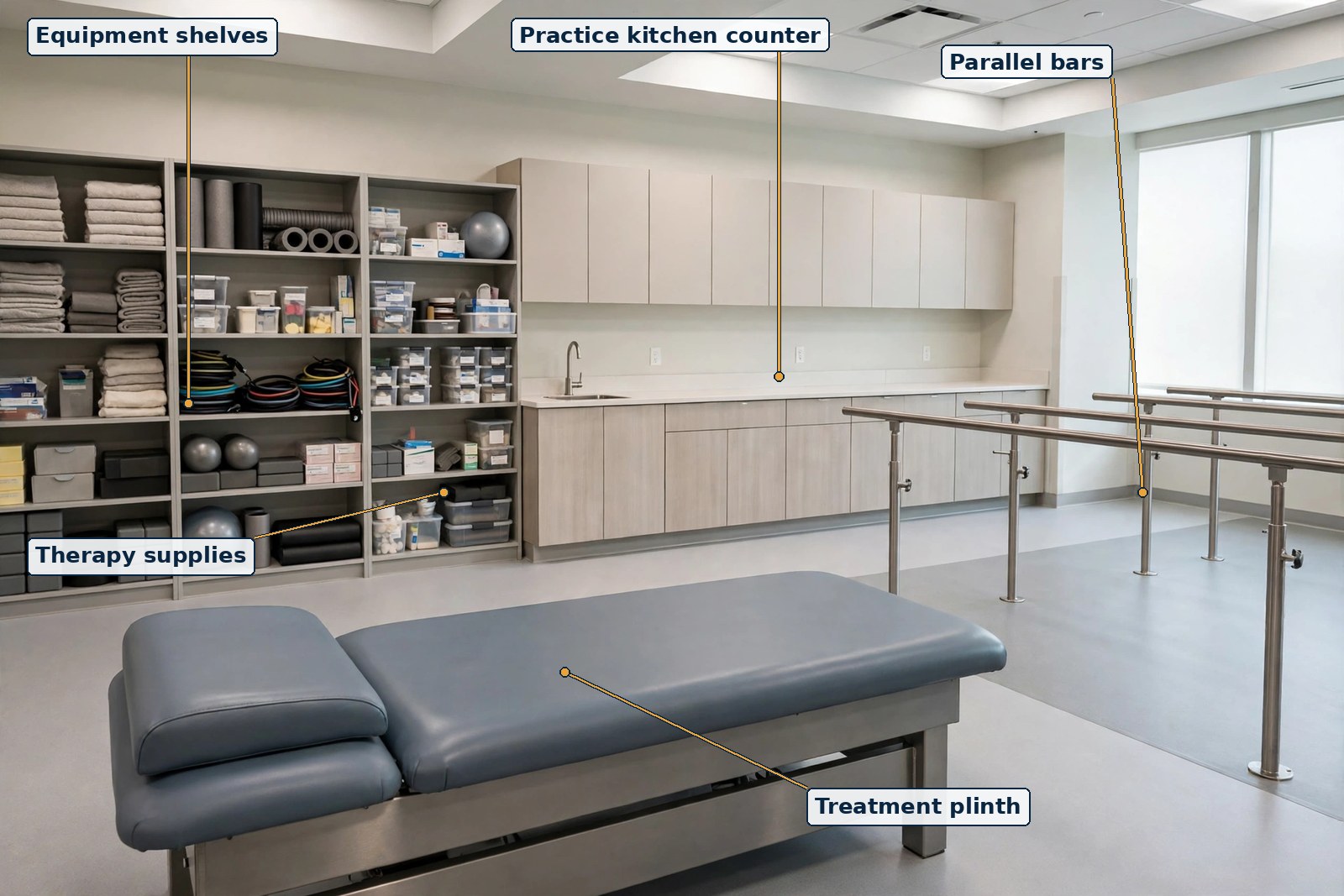
Figure 1.1 — A clinic treatment room with a treatment table, therapy equipment, and an ADL practice area arranged for a session.
Threaded through the day is communication that is easy to undervalue until you see a plan fail without it. The COTA reports a change in a client's status promptly — new pain, unusual fatigue, a fall at home disclosed in conversation, a sudden change in alertness — because the plan was written for the client as evaluated, and a material change may require the OTR to reassess before the plan continues unchanged. The COTA also teaches, constantly: showing a client a safer way to approach a task, explaining to a family member why a piece of equipment is set up as it is, reinforcing the home program the plan includes. Teaching is not an extra added to treatment. For a profession whose goal is independent doing after therapy ends, teaching is how treatment outlasts the session.
COTAs work wherever occupational therapy is delivered, and each setting shapes the same role differently. In outpatient clinics such as Alder Lane's own clinic, clients travel to the service for scheduled sessions, often over weeks, and the work can use specialized equipment, a treatment gym, and practice spaces like the ADL apartment. In hospitals, therapy is delivered within an episode of medical care, where length of stay may be short, medical status may change quickly, and discharge planning — deciding what a person needs to manage safely after leaving — gives the work urgency. In rehabilitation facilities and skilled nursing settings, clients who cannot yet return home receive therapy as part of daily recovery and care, and the occupations addressed are often the most basic self-care tasks first, because those determine what support a person will need. In schools, the client's occupations are educational occupations, services are delivered under the school's own framework for supporting pupils, and collaboration with teachers and school teams defines the working day. In home health and community practice, the COTA works in the person's own environment — the actual kitchen, the actual bathroom, the actual neighborhood — which removes the guesswork from adaptation, because the task and its real context are in front of you, and adds the responsibilities of working alone in the community, managing travel, and safeguarding both client and practitioner outside a clinic's controlled space. In mental-health and community programs, the occupations at the center are often routines, roles, and participation itself: structuring time, re-entering community life, and building habits that support recovery.
No setting on that list is the "real" job and the others variations. Each is the same partnership — OTR direction, COTA implementation and reporting — fitted to a different population, pace, and purpose. A COTA may spend a career mainly in one setting or move among several, and part of professional judgment is recognizing that a technique or routine that serves well in one setting may need rethinking in another: the practice bathroom is forgiving in ways a client's own small bathroom is not; the school day imposes a timetable a clinic day does not. Chapter 3 takes up the partnership that holds across all settings, and later parts of this book return to settings in depth — school practice, mental-health practice, home and community work each receive their own teaching. For now, hold the map whole: one profession, one assistant role, many doors through which clients arrive.
One more setting distinction matters for a beginner's honesty. Not everyone who helps in a therapy department is a COTA. Alder Lane's staffing names a rehabilitation aide alongside its OTRs and COTAs, and that is typical of real services: aides support the department's operation — preparing areas and equipment, assisting with non-treatment tasks under direction — without holding the COTA credential or delivering the skilled intervention that credential covers. Chapter 3 draws that boundary carefully. Naming it here prevents a common misreading of staffing lists and job advertisements, in which every helpful role in a department is assumed to be the same role.
Where can a beginner check what this occupation includes, beyond any single employer's advertisement or any single book's description — this one included? One public source describes the occupation nationally: the U.S. Bureau of Labor Statistics, shortened to BLS, which publishes occupational accounts for the United States in its Occupational Outlook Handbook. Its account must be mapped honestly, starting with its limits, stated here before any duty is quoted. The BLS entry is titled "Occupational Therapy Assistants and Aides." It is a combined entry: it joins assistants and aides in one set of duties and figures, because that is how the national statistics collect them. It is not an assistants-only account, no assistants-only BLS account exists to quote instead, and everything in this section and the next is read under that combined label. The duties below are therefore described in this book as the combined entry's duties — the duties BLS lists for the combined occupation — not as a COTA-only duty list. (Source: BLS, Occupational Outlook Handbook, "Occupational Therapy Assistants and Aides.")
Within that fence, the combined entry's work, as BLS describes it and as this book teaches it, centers on helping clients carry out treatment plans and activities under the direction of the occupational therapist. The day-to-day substance behind that summary, in the entry's own terms, includes helping clients with rehabilitative activities and exercises outlined in a treatment plan developed in collaboration with the occupational therapist; encouraging clients who need support and motivation to take part; monitoring and recording clients' progress and reporting observations to the occupational therapist; preparing materials and assembling equipment used during treatment; and carrying out clerical and department-support duties that keep treatment possible, such as scheduling, answering inquiries, and maintaining inventories. Read that list against §1.2 and the match is close: implement the plan, encourage participation, observe and report, prepare the means of treatment, and keep the service running. That is why the list is worth teaching — it confirms, from a national source independent of this book, that the COTA's day is skilled implementation plus disciplined observation and reporting, not unskilled helping.
Read the list's shape as carefully as its words. Nothing in it assigns evaluation or plan authorship to the assistant; the plan is developed with the therapist, and the assistant's named verbs are helping, encouraging, monitoring, recording, reporting, and preparing. Nothing in it erases the aide's presence in the combined entry either — some support duties in a combined account span both roles, which is exactly why this book labels the list as the combined entry's rather than claiming every line for COTAs alone. Honest mapping means holding both truths at once: the list describes the world of work you are entering, and the credential you are preparing for sits inside that world with its own defined partnership, taught in Chapter 3. Where the BLS account stops — at certification requirements, at supervision law, at examination content — this book stops quoting it and turns to the bodies that own those subjects, which is what honest mapping means in practice.
One set of numbers belongs in this first map, stated exactly as its source states it, whole, and never as anything else. The U.S. Bureau of Labor Statistics reports the following for the combined entry "Occupational Therapy Assistants and Aides," and this book prints the set only in this whole, labeled form, here, in Chapter 2, and in Chapter 40 — quoted whole or not at all, because a number separated from its label is a number waiting to mislead. The combined entry's median pay was $66,050 per year ($31.76 per hour) in 2024. Within the same entry, the median annual wage for occupational therapy assistants was $68,340 in May 2024, and the median annual wage for occupational therapy aides was $37,370 in May 2024. The entry counted 54,400 jobs in 2024. Its outlook for 2024–34 is 18 percent growth, described by BLS as much faster than average, with about 7,900 openings for occupational therapy assistants and aides projected each year, on average, over the decade. The same source states the typical preparation this way: occupational therapy assistants typically need an associate's degree from an accredited occupational therapy assistant program and usually need a state-issued license, while aides typically need a high school diploma or equivalent and receive on-the-job training. (Source: BLS, Occupational Outlook Handbook, "Occupational Therapy Assistants and Aides.")
Read that paragraph with the discipline this book will hold you to every time a number appears. A median is the middle of everyone counted — half earn more, half earn less — across veterans and beginners, every region, and, for the combined figure, both occupations in the entry together. The combined median of $66,050 is therefore not the assistants' median; the book prints the assistants' own median, $68,340, alongside it precisely so the two are never confused, and neither figure is a starting wage, an offer, or a promise about any one reader. The aides' median of $37,370 belongs to a different role with different preparation, and printing it here is part of the honesty of the set: the combined entry contains both roles, and its figures must be read with both in view. The jobs count and the openings figure describe the combined occupation nationally; the growth percentage describes projected change across a decade, in the source's own band wording, and no growth figure promises any individual a job. The preparation sentences describe the typical pattern the source reports — Chapter 2 examines each door in that pattern properly, from the bodies that govern them. No other pay figure appears anywhere in this book.
Close the map by placing this book itself honestly. This book teaches the occupational therapy assistant field whole — its foundations, its gathering and intervention work, its equipment, its settings, its standards — and it prepares you for the NBCOT COTA certification examination: the examination administered by the National Board for Certification in Occupational Therapy, shortened to NBCOT, whose passing earns the COTA certification for those who meet its eligibility requirements. Chapter 2 lays out that road step by step, and Part VIII teaches the examination itself in full. What must be stated plainly here, at the first introduction of the credential, is the distinction the whole book observes: certification is not licensure. Certification is NBCOT's national attestation that a person has met its education, character, and examination requirements. Licensure — permission to practice — is granted by the reader's own jurisdiction under that jurisdiction's occupational therapy practice act, and practice requires it. Passing the examination, holding the certification, and being licensed to practice are three related but distinct facts, and no sentence in this book treats any one of them as another. (Source: NBCOT, Certification Exam Handbook.)
Within that boundary, what the book promises is sized to the truth. It prepares knowledge and readiness: the field taught from zero for the total beginner, and the published examination outline taught in full for the candidate, with 820 original explained practice items whose form and counts are stated exactly in the front matter. It is not NBCOT's official course or material, it satisfies no education, fieldwork, or eligibility requirement by itself, and it promises no examination score, certification, license, job, or income. Certifying bodies examine and certify; jurisdictions license; accredited programs educate and provide fieldwork; employers hire. This book's job is narrower and, done well, valuable: to teach you the field clearly enough that each of those real doors is easier to walk through prepared. Read in order the first time. When a later chapter sends you back to an earlier one, go back without embarrassment — working COTAs look things up for a living, and the habit starts here.
Key terms of this chapter. Occupation — the meaningful everyday activities people need, want, and are expected to do; Occupational therapy — the profession that helps people perform the occupations that matter to them after health changes interrupt doing; OTR — the credentialed occupational therapist, responsible for evaluation, the intervention plan, and discharge decisions; COTA — Certified Occupational Therapy Assistant, the credentialed assistant who implements the plan in partnership with the OTR; Activities of daily living (ADLs) — basic self-care occupations such as dressing, bathing, and meal preparation; Specimen — a fictional worked example carried through a book, whose stated facts are its own; Alder Lane Occupational Therapy Service — this book's fictional specimen service, with a clinic, ADL apartment, school contract, and home-visit caseload; ADL apartment — a practice space fitted as a kitchen and bathroom for rehearsing daily activities safely; Rehabilitation aide — a department support role without the COTA credential, preparing areas and equipment under direction; U.S. Bureau of Labor Statistics (BLS) — the federal agency publishing occupational duties, education, outlook, and wage accounts; Combined entry — a statistical account joining two occupations, here assistants and aides, in one set of duties and figures; Median — the middle value of a whole set, half above and half below, never a starting figure or a promise; Certification — a national body's attestation that its education, character, and examination requirements have been met; Licensure — a jurisdiction's legal permission to practice, granted under its practice act; NBCOT — the National Board for Certification in Occupational Therapy, which administers the COTA certification examination.
Tags: FIELD — the field, its doors, and the specimen service. The key, with every option explained, is in this chapter's key file.
Q1. The subject of occupational therapy, as §1.1 defines it, is — A. paid employment alone B. occupation — the meaningful everyday activities people need, want, and are expected to do C. muscle strength alone D. hospital discharge paperwork
Q2. A new reader meets the Alder Lane Occupational Therapy Service in §1.1. It is correctly understood as — A. a fictional specimen service used as this book's worked example, labeled as fictional at first use B. a real clinic whose records the book reprints C. NBCOT's own training clinic D. the largest employer of COTAs in the country
Q3. At Alder Lane, a COTA's stated day of 8 sessions × 45 minutes equals — A. 240 treatment minutes B. 300 treatment minutes C. 400 treatment minutes D. 360 treatment minutes, or 6.0 hours of direct treatment time
Q4. During a session, Mrs. Alvarez reports new pain and unusual fatigue that were not present at evaluation. The COTA's correct response within the partnership is to — A. rewrite the intervention plan independently B. ignore the report and continue unchanged C. report the change promptly to the supervising OTR, because a material change may require reassessment D. discharge Mrs. Alvarez from the episode
Q5. Which pairing of setting and shaping feature is correct? A. Outpatient clinics require no intervention plan B. Schools center on educational occupations and collaboration with school staff C. Home practice removes the need for documentation D. Mental-health programs center only on physical exercise
Q6. The rehabilitation aide at Alder Lane is best described as — A. a COTA working under a shorter title B. the supervisor of the COTAs C. the person responsible for evaluation D. a department support role without the COTA credential, preparing areas and equipment under direction
Q7. Section 1.4 insists the BLS duties be labeled as the combined entry's duties because — A. the BLS entry joins assistants and aides in one account, so its duties cannot honestly be claimed as a COTA-only list B. BLS publishes no duties at all C. aides do not appear anywhere in the entry D. the duties apply only in one state
Q8. In the BLS combined entry's duties as §1.4 teaches them, the assistant's named verbs center on — A. evaluating, authoring the plan, and discharging B. billing, hiring, and setting department policy C. helping carry out the plan, encouraging participation, monitoring and recording progress, reporting observations, and preparing materials and equipment D. prescribing medication and ordering tests
Q9. The full BLS set in §1.5 reports the combined entry's 2024 median pay as — A. $66,050 per year ($31.76 per hour) B. $68,340 per year for the combined entry C. $37,370 per year for the combined entry D. a starting wage guaranteed to new graduates
Q10. The assistants' own median in the same fenced set is — A. $37,370 in May 2024 B. $68,340 in May 2024 C. $66,050 in May 2024 D. not printed anywhere in the book
Q11. Section 1.5 reports 54,400 jobs (2024), 18 percent growth for 2024–34 described as much faster than average, and about 7,900 openings per year. These figures describe — A. COTAs in a single city B. aides only, nationally C. a promise that every reader will be hired D. the combined occupation of assistants and aides, nationally, as BLS states them
Q12. A median wage, read with §1.5's discipline, is — A. the wage every new graduate receives B. the highest wage in the occupation C. the middle of everyone counted — half earn more, half earn less — not a starting wage, offer, or promise D. the wage set by NBCOT for all COTAs
Q13. Certification and licensure are correctly distinguished in §1.6 as — A. two names for the same document B. certification as NBCOT's national attestation, and licensure as the jurisdiction's legal permission to practice under its practice act C. licensure granted by NBCOT and certification granted by employers D. both granted by the reader's college program
Q14. The typical preparation BLS states for assistants in the fenced set is — A. an associate's degree from an accredited OTA program, and usually a state-issued license B. a high school diploma with on-the-job training only C. a doctoral degree D. no education and no license in any case
Q15. This book's own standing is stated honestly in §1.6 as — A. NBCOT's official course, satisfying eligibility by itself B. a license to practice on completion C. a guarantee of an examination score and a job D. a book that prepares knowledge and readiness, satisfies no eligibility requirement by itself, and promises no score, certification, license, job, or income
Tags: FIELD — the field, its doors, and the specimen service. Every rationale explains why the key is right and why each wrong option is wrong.
Q1 — Key: B. Tag: FIELD. Occupation is the profession's subject: the meaningful everyday activities people need, want, and are expected to do, from self-care to school, work, play, and community life (§1.1). A narrows occupation to paid employment alone, which §1.1 explicitly rejects — a job is one occupation among many. C reduces the subject to one body function, when the profession addresses doing itself, not strength in isolation. D names administrative paperwork, which supports care but is not the profession's subject.
Q2 — Key: A. Tag: FIELD. Alder Lane is this book's fictional specimen service, labeled as fictional at first use, with a clinic, ADL apartment, school contract, and home-visit caseload whose stated facts are its own (§1.1). B claims a real clinic and reprinted records; the specimen is invented and no real records appear. C assigns the service to NBCOT, which certifies individuals and runs no clinic in this book. D invents an employer ranking that no source in the book states.
Q3 — Key: D. Tag: FIELD. The canon arithmetic is 8 × 45 = 360 treatment minutes, which is 6.0 hours of direct treatment time, with documentation blocks and other duties filling the rest of the day (§1.2). A, B, and C each miscompute the product of the two canon numbers given in the stem; none follows from 8 sessions of 45 minutes.
Q4 — Key: C. Tag: FIELD. A material change in status is reported promptly to the supervising OTR, because the plan was written for the client as evaluated and a change may require reassessment before the plan continues (§1.2). A claims plan authorship for the COTA, which belongs to the OTR. B ignores a safety-relevant report, the opposite of the monitoring-and-reporting duty. D claims a discharge decision, which §1.1 reserves to the OTR.
Q5 — Key: B. Tag: FIELD. School practice centers on educational occupations and is delivered in collaboration with teachers and school teams within the school day (§1.3). A is false because outpatient work follows an intervention plan like every other setting. C is false because documentation is required wherever the COTA works, including in homes. D is false because mental-health and community programs center on routines, roles, and participation, not physical exercise alone.
Q6 — Key: D. Tag: FIELD. The aide is a department support role without the COTA credential, preparing areas and equipment and assisting with non-treatment tasks under direction (§§1.2–1.3). A treats two distinct roles as one; holding the aide role does not make a worker a COTA under a shorter title. B reverses supervision — the aide does not supervise credentialed staff. C assigns evaluation to the aide, when evaluation is the OTR's responsibility.
Q7 — Key: A. Tag: FIELD. The BLS entry joins assistants and aides in one combined account, so its duties print in this book only as the combined entry's duties, never as a COTA-only list (§1.4). (Source: BLS, Occupational Outlook Handbook, "Occupational Therapy Assistants and Aides.") B is false because §1.4 quotes the entry's duties at length. C is false because aides are named in the entry's own title. D invents a single-state scope the national account does not have.
Q8 — Key: C. Tag: FIELD. The combined entry's duties, as §1.4 teaches them, center on helping carry out the plan, encouraging participation, monitoring and recording progress, reporting observations to the therapist, and preparing materials and equipment. A lists the OTR's responsibilities — evaluation, plan authorship, and discharge — not the assistant's verbs. B lists management functions no part of the entry assigns to this occupation. D lists medical acts outside occupational therapy practice entirely.
Q9 — Key: A. Tag: FIELD. The fenced set reports the combined entry's median pay as $66,050 per year ($31.76 per hour) in 2024 (§1.5). (Source: BLS, Occupational Outlook Handbook, "Occupational Therapy Assistants and Aides.") B substitutes the assistants' own median for the combined figure, the exact confusion §1.5 fences against. C substitutes the aides' median for the combined figure. D misreads any median as a guaranteed starting wage, which §1.5 explicitly denies.
Q10 — Key: B. Tag: FIELD. Within the same fenced set, the median annual wage for occupational therapy assistants was $68,340 in May 2024 (§1.5). (Source: BLS, Occupational Outlook Handbook, "Occupational Therapy Assistants and Aides.") A gives the aides' median, $37,370, for the wrong role. C gives the combined entry's median, $66,050, not the assistants' own figure. D is false because the assistants' median prints in §1.5 as part of the whole set.
Q11 — Key: D. Tag: FIELD. The jobs count, growth figure, and openings figure all describe the combined occupation of assistants and aides nationally, exactly as BLS states them (§1.5). (Source: BLS, Occupational Outlook Handbook, "Occupational Therapy Assistants and Aides.") A shrinks national figures to one city. B assigns combined figures to aides only. C converts a projection into a personal hiring promise, which §1.5 states no figure in the book makes.
Q12 — Key: C. Tag: FIELD. A median is the middle of everyone counted — half above, half below — across experience levels and regions, and §1.5 states it is not a starting wage, an offer, or a promise. A misreads the median as an entry wage. B describes a maximum, not a middle value. D invents a wage-setting power for NBCOT, which certifies individuals and sets no wages.
Q13 — Key: B. Tag: FIELD. Certification is NBCOT's national attestation that its education, character, and examination requirements have been met; licensure is the jurisdiction's legal permission to practice under its practice act, and practice requires it (§1.6). (Source: NBCOT, Certification Exam Handbook.) A collapses two distinct facts into one document. C reverses the granting bodies — NBCOT certifies, jurisdictions license, employers do neither. D assigns both functions to a college program, which educates but neither certifies nationally nor licenses.
Q14 — Key: A. Tag: FIELD. The fenced set states that assistants typically need an associate's degree from an accredited OTA program and usually need a state-issued license (§1.5). (Source: BLS, Occupational Outlook Handbook, "Occupational Therapy Assistants and Aides.") B states the aides' typical preparation — high school diploma and on-the-job training — for the wrong role. C raises the typical preparation far beyond what the source states. D denies both halves of the source's description.
Q15 — Key: D. Tag: FIELD. The book prepares knowledge and readiness and states plainly that it satisfies no education, fieldwork, or eligibility requirement by itself and promises no score, certification, license, job, or income (§1.6). A claims official-course status and requirement-satisfying power the book disclaims in its own text. B claims a licensing power no book holds. C promises two outcomes — a score and a job — that §1.6 lists among what is never promised.
End of the free sample. The complete book continues from here — the full A-to-Z course in book form, delivered as an EPUB you can read in Apple Books, Google Play Books, ReadEra, Thorium Reader, Adobe Digital Editions, or Send to Kindle.
Buy this ebook — $11.99 Back to the book page
Payments are securely processed by Payhip.