
Mastering Careers & Skills
Construction Coordination for Industrial Buildouts: Mastering the Craft · free sample from the book itself
Production note, not printed as book copy: this file assembles, in order, Title Page · Copyright Page · Contents · The Field and Its Doors · How to Use This Book. The Diagnostic and its key stand in their own files immediately after this one. Author: Feras Alzubi. All credential, employment, and program facts trace to the register in the manuscript brief, read 2026-11-14 from the owning bodies' own publications. No credential fee, no pass score, no pay figure outside the BLS fenced set, and no market lead time or price stated as a fact prints anywhere in this book.
Feras Alzubi
The Complete Course Series
2026 Edition
This book teaches the whole craft of coordinating industrial buildouts from absolute zero to working depth: what an industrial buildout is and who builds it, the physics underneath it — power, heat, and flow — at coordinator depth, the documents that run it, the discipline that defines this field above all others — long-lead equipment procurement — site execution and its interfaces, working in an operating facility, utility interconnection and the energization sequence, acceptance testing, and commissioning and turnover as the coordinator's closing disciplines, with the judgment layer — delay, failure, and recovery — laid over the whole body. One supporting module, taught in Chapter 38, explains the project-management fundamentals and the CAPM door; the CAPM examination layer itself belongs to this line's CAPM exam book, Book 37, and is not duplicated here.
One honesty fact stands at the front, because the whole book stands on it: there is no national license and no single governing exam for construction coordination or construction management in the United States. The doors are degrees, trade and field experience, and employer training under experienced managers, with voluntary professional certification — never a license — available to those who want it. This book prepares field knowledge and readiness, honestly and completely; employers hire, certifying bodies examine and certify, and authorities having jurisdiction regulate their own ground.
Copyright © 2026 Feras Alzubi. All rights reserved.
First edition, 2026. Published by Feras Alzubi.
No part of this book may be reproduced, stored in a retrieval system, or transmitted in any form or by any means — electronic, mechanical, photocopying, recording, or otherwise — without the prior written permission of the author, except for brief quotations in reviews and for the reader's own study use of the exercises and skills checks printed here.
Originality statement. This book is an original work, written from scratch for this series. Every chapter, exercise, worked example, case, figure, and practice question in it is original to this book. The practice questions are original items written for this book, to the body of knowledge this book teaches; they are not any certifying body's, testing organization's, or other publisher's items — not copied, not paraphrased, not adapted. No other book's text, items, or teaching material appears in it in any form. The facts it teaches about occupations, codes, and standards are drawn from the issuing bodies' own publications, which are named in the chapters and collected in the References; those publications' own text is never reproduced here beyond the short scope statements the chapters identify as such. The frameworks named — the Bureau of Labor Statistics' duty list, ASHRAE's commissioning process documents, PMI's domain names and weights — are the bodies' own published frameworks, named and cited as frameworks; the teaching built on them is this book's own.
Not-affiliated disclosure. This is an independent course book. It is not published by, affiliated with, endorsed by, or approved by PMI, CMAA, ASHRAE, NETA, NFPA, IEEE, or the Uptime Institute, and none of those organizations participated in its creation. Each is an independent body. Their documents — PMI's project-management publications, CMAA's and AGC's delivery-method vocabulary, ASHRAE Guideline 0 and Standard 202, ANSI/NETA ATS and ECS, NFPA 70E and 70B, IEEE Std 1547, and the Uptime Institute's Tier Standard: Topology — are taught from, not reproduced, in this book: the book teaches what those documents say and how a coordinator uses them, and it never reprints their text or tables. Their names are used nominatively only — to name the bodies whose published work is among the subjects taught.
Scope note. This book teaches the knowledge of industrial buildout coordination — its principles, vocabulary, documents, arithmetic, and reasoning order — for learning and for entry-path readiness. It is knowledge only: energized work, crane lifts and rigging, confined-space work, hot work, equipment start-up, acceptance testing, and commissioning performance are hands-on acts that belong to qualified parties, trained and assessed in person, and this book never presents itself as instruction to perform them. It is not a substitute for a manufacturer's literature for any product, for a certifying body's own published requirements, for the code or standard edition adopted by your authority, or for your jurisdiction's own publications. Nothing in this book promises a job, a certification, a score, selection, or income; it teaches the field and its doors as they verifiably are, and it says so wherever a reader might be tempted to forget it. This book is not any body's official course. It satisfies no body's course requirement — including PMI's 23 hours of project management education, any CMAA requirement, or any training provider's curriculum — and it says so where those doors are taught.
Provenance note. This book was built from the owning bodies' own publications, verified against those publications at this build's opening gate, 2026-11-14: the U.S. Bureau of Labor Statistics' Occupational Outlook Handbook entry for Construction Managers; OSHA's 29 CFR Part 1926 and 29 CFR 1910.147; ASHRAE Guideline 0-2019 and Standard 202; ANSI/NETA ATS-2025 and ECS; NFPA 70E and 70B; the Uptime Institute's Tier Standard: Topology; IEEE Std 1547-2018 and 1547.1-2020; CMAA's and AGC's published delivery-method and profession vocabulary; and PMI's published CAPM facts, verified on PMI's own publications during this line's CAPM exam-book build, 2026-11-01/02. The worked project that runs through the book — the Kestrel Ridge build — is a fictional specimen invented for this book, and every one of its numbers is labeled as the specimen's own.
Front matter — Title Page · Copyright Page · Contents · The Field and Its Doors · How to Use This Book · Buildout-Readiness Diagnostic (50 items) with key and Readiness Tracker
Part I — The Field and Its Doors
Part II — Foundations: The Physics Underneath
Part III — The Documents That Run the Build
Part IV — Long-Lead Procurement: The Heart of the Industrial Build
Part V — Building It: Execution and Interfaces
Part VI — Utility Interconnection and Energization
Part VII — Commissioning and Turnover
Part VIII — The Supporting Module and the Road
Apparatus — Buildout-Readiness Diagnostic (50 items) with key and Readiness Tracker · Chapter Exercises & Skills Checks (40 chapters × 15 = 600 items) with keys · Buildout Case Battery A (25 guided case files) with key · Buildout Case Battery B (25 guided case files) with key · Strand Repair Sets RS1–RS8 (8 × 15 = 120 items) with key · 820 items in total
Back matter — Study Plans (4-week / 8-week / 12-week) · Cheat Sheets · Figure Program · Errata & Verification Notes · References & Further Reading · Coverage Crosswalks (field map to chapters; BLS Construction Managers duty list to chapters) · Glossary
This section states, in one place, the facts the whole book stands on — what industrial buildout coordination is, how a person actually enters the field, and exactly how the CAPM supporting module sits inside this course. Everything here traces to the issuing bodies' own publications; the chapters carry the full account, and the verification notes in the back matter record the discipline.
The field: coordinating an industrial buildout. An industrial buildout is the construction of a plant, a factory, a manufacturing facility, or a data center — the building, its power and cooling systems, its production lines, and the connections that let it operate — built, fitted out, tested, commissioned, and handed over as a working facility. The coordinator is the person on the construction manager's field team who holds the build together day by day: sequencing the work, tracking the long-lead equipment that owns the schedule, keeping the documents straight, running the interfaces between trades and vendors, and driving the build through energization, commissioning, and turnover. The coordinator's work, as the Bureau of Labor Statistics describes the occupation's duties, is to prepare cost estimates, budgets, and work timetables; interpret and explain contracts and technical information; collaborate with architects, engineers, and other construction specialists; select subcontractors and schedule and coordinate their activities; monitor projects and report progress and budget matters; respond to work delays, emergencies, and other problems; and ensure the project complies with legal requirements such as building and safety codes. On large projects a top-level manager hires other managers for phases — foundations, electrical work — and coordinates them. (Source: BLS, Occupational Outlook Handbook, Construction Managers.) The coordinator is the reader's seat in this book: every worked episode in it is written from that seat.
The headline honesty fact: there is no national license and no single governing exam for this occupation. No national test, no national license, and no national certificate makes a person a construction coordinator or a construction manager licensed to work across the country, and any course or advertisement that implies one should be read with suspicion. What exists instead is a landscape of separate authorities doing separate jobs, and this book's first discipline is never confusing them:
The pay and outlook figures, fenced. This book prints exactly one pay-and-outlook set — the Bureau of Labor Statistics' whole-occupation figures for Construction Managers, the closest published occupation, because BLS publishes no "construction coordinator" occupation entry — and prints them only where they belong: here, in Chapters 1 and 2, where the work and the doors are introduced, and in Chapter 40, where the road from here is mapped. They are printed as labeled whole-occupation figures, edition-stamped, with the growth figure always paired with the openings figure beside it, as projections, never as promises. They are never a starting wage, an offer, a graduate outcome, or a promise to any reader. No other pay figure appears anywhere in this book.
Read the pairing as it is printed: growth and openings together describe the doors the occupation's own handbook projects — not a wage any reader is promised, and not a forecast this book guarantees.
The shape of the work, honestly. An industrial buildout is long, heavy, and unforgiving of lost sequence: equipment ordered a year before it is needed, a transformer that cannot be set until its pad is cured, a production line fitted out inside a plant that is already running, a data hall that cannot be energized until its testing is read and accepted. The coordinator's value is sequence — knowing what owns the schedule, what must be decided before what, and what evidence must exist before the next step is allowed. Chapter 4 teaches the hazard map whole, because the build's hazards — electricity, cranes and rigging, heavy equipment, work in an operating plant — are the first thing a coordinator must see clearly. A book that hid those facts would not be preparing you for the field; it would be selling you a picture of it.
The CAPM supporting module. Chapter 38 teaches project-management fundamentals and the CAPM door as a supporting module only — what the credential is, how the door works, and how coordination experience maps onto it. The verified facts the module rests on are: eligibility is a secondary degree plus 23 hours of project management education completed before the exam, with no experience required; the exam is 150 questions (135 scored plus 15 unscored pretest) in 3 hours, with a 10-minute break after question 75; its four domains carry PMI's published weights — Project Management Fundamentals and Core Concepts 36%, Predictive, Plan-Based Methodologies 17%, Agile Frameworks/Methodologies 20%, Business Analysis Frameworks 27%; the credential is maintained with 15 PDUs every 3 years; the exam is offered in multiple languages; and PMI publishes no pass score — the standard is set psychometrically, and any book quoting one is inventing it. No CAPM fee prints in this book. This book satisfies no body's course requirement — including PMI's 23 hours: a book is study support and cannot itself be the 23 hours. The CAPM examination layer — the exam craft and practice-exam apparatus — belongs to Book 37, this line's CAPM exam book, which carries it in full; this book contains no CAPM practice examination.
What this book is, and is not. This book prepares field knowledge and readiness: the physics underneath the build, the documents that run it, long-lead procurement as a schedule discipline, execution and its interfaces, utility interconnection and energization, acceptance testing, commissioning and turnover, and the judgment to recover when the plan slips. It is not a certifying organization, it satisfies no certification, training, or experience requirement, and it promises no job, credential, score, or income. Employers hire; certifying bodies examine and certify; authorities having jurisdiction regulate their own ground. A book that told you otherwise would be selling you something; this one is teaching you something.
The rhythm: teach, then test. Every chapter follows the same rhythm per concept: simplify → explain → detail → show → do → check. A plain statement first, then the explanation, then the working detail, then a worked example with real numbers computed step by step in the text, then your turn in the chapter's exercises, then the check against a key that explains every option. Read the chapter, work its examples with a pencil — every calculation in this book is shown end to end, with no skipped arithmetic — then take its 15-item exercises & skills checks from memory, with the chapter closed, then read the key. Every key explains the right answer and why each wrong answer is wrong, because the wrong answers are where the field's traps live. Items you miss name the strand to repair, and the back matter's Strand Repair Sets drill exactly the strands your scores flag.
The diagnostic comes first. Before Chapter 1, take the Buildout-Readiness Diagnostic that follows this front matter: 50 items in five strands. It is this book's own design, disclosed as such on its face — an original field-knowledge diagnostic written for this book, in no other test's form. It is a map, not a verdict: nobody expects a beginner to score well before reading the book, and its job is to tell the book where to work hardest for you. Answer all 50, work its calculations with a pencil, and score yourself by strand — never as one combined number — because the strands route you to different parts of the book. Where an item uses the book's specimen build, the Kestrel Ridge build, it says so and labels the numbers as the specimen's own; the chapters introduce the specimen in its place.
The Readiness Tracker. The tracker printed with the diagnostic has one row per strand: Foundations (12 items), Documents & Money (10 items), Procurement (12 items), Execution & Interfaces (8 items), and Commissioning & Turnover (8 items). Enter your first score in the first column. Each strand's row names the chapters that teach it and the repair set that rebuilds it: a weak Foundations strand sends you to Parts I–II first; a weak Documents & Money strand sends you to Part III; Procurement to Part IV; Execution & Interfaces to Part V; Commissioning & Turnover to Parts VI–VII. After you work the repair sets that serve a strand, re-score that strand and enter the new score in the tracker's after-repair column. Raw counts only: no score in this book — diagnostic, exercises, repair set, or case battery — converts to any other test's score, predicts any credential result, or promises a job, a credential, or a license.
The two study rhythms.
The case batteries. The back matter carries Buildout Case Battery A and Buildout Case Battery B — 25 guided case files each: procurement cases, schedule cases, energization cases, commissioning cases, turnover and judgment cases. Every case file runs in the same order, in full: situation → evidence → reasoning chain → conclusion → why. Work them on paper, as reasoning: a conclusion in this book is a reasoned judgment with its why, never a set of instructions for performing a fix. Every case runs on the Kestrel Ridge specimen, with canon numbers only.
The repair sets. The back matter's Strand Repair Sets RS1–RS8 — eight sets of 15 items, each miss routing back to its tagged chapters — rebuild the strands the diagnostic and the chapter checks expose: RS1 foundations, RS2 documents & schedule, RS3 money, RS4 procurement, RS5 execution & interfaces, RS6 utility & energization, RS7 commissioning & turnover, RS8 whole-craft mixed.
Study plans. The back matter carries 4-week, 8-week, and 12-week study plans that pace the two rhythms above. Whichever you choose, keep the rhythm: chapter, exercises, key, repair.
Worked numbers. Every worked example in the chapters uses the book's taught canons — the power, heat, flow, redundancy, schedule, money, and procurement-clock canons — or the book's labeled specimen build, the Kestrel Ridge build, or round numbers labeled illustrative on their faces, so the arithmetic teaches the method without borrowing any manufacturer's figures. No brand's nameplate is ever a teaching anchor in this book, in text or in figure, and no brand is ever named.
The safety frame. This book teaches knowledge and reasoning. Energized work, crane lifts and rigging, confined-space work, hot work, equipment start-up, acceptance testing, and commissioning performance are taught as what the qualified parties do and in what order of reasoning, what the coordinator verifies, schedules, and witnesses, what documents and qualifications must exist before the act, what readings and reports mean, and where the supervised, in-person act begins — never as step-by-step procedures a reader performs from the page. The physical acts belong to certified operators, qualified riggers and signal persons, qualified electrical workers, and licensed testing and commissioning parties, trained and assessed in person. The coordinator's craft is to make their work possible, sequenced, documented, and verified. That boundary is stated inside the teaching wherever it bites — above all in Chapters 4, 22, 24, 25, 27, 31, 32, 34, and 35 — briefly and professionally, as part of the craft itself: knowing where the supervised door stands is part of knowing the field.
A note on numbers. Where this book prints a number — a median, a growth projection, an exam's question count, a tonnage, a lead time in the specimen's own log — the number traces to the publication named beside it, edition-stamped, or is labeled as the specimen's own, and the back matter's verification notes say what was checked and when. Where a number belongs to someone else — a body's current fee at registration, a product's rated values in its manufacturer's literature, a value in a standard's own tables — the book teaches the concept and routes the figure to its owner. That discipline is itself part of the field: industrial builds run on verified numbers, and so does this book.
Drive to the gate on a clear morning and the first thing you notice is scale. A construction coordinator — the person who keeps the people, the equipment, the documents, and the sequence of an industrial build moving together — does not arrive at a finished building. The coordinator arrives at a site that is still becoming a working plant. Steel rises over one hall while concrete is still being poured at another. A tower crane turns over the frame. In the laydown yard, the fenced, open area where equipment and materials are received and staged before they are set in place, crates of switchgear wait under tarps beside a transformer on a trailer. Every object on the ground is a decision already made, or a decision still waiting, and the coordinator's job is to keep those decisions in the right order.
That is the field this book teaches. Construction coordination is the craft of making a complex build happen in sequence: the right trade, with the right equipment, at the right place, at the right time, with the record to prove it. An industrial buildout is the construction of a working industrial facility — in this book, a manufacturing plant and the data hall that supports it — from bare ground to an operating plant that can be handed over to its owner. It is a plant with power, cooling, production lines, and systems that must be tested together before anyone calls the work done. This chapter maps the field whole; later chapters teach the physics, the documents, the long-lead equipment, and the commissioning discipline that closes the build. The map comes first, so every later detail has a place to sit.
Begin with a simple picture. On an industrial build, dozens of parties work at once: designers, the construction manager's field team, trade contractors, equipment vendors, the utility, and the inspectors of the authority having jurisdiction, usually shortened to AHJ, the public body with the legal power to inspect and approve the work. No one of them can see the whole build alone. The electrician knows the electrical work; the mechanical contractor knows the piping; the vendor knows the chiller it sold. Coordination is the work of holding the whole together: sequencing their work so one trade does not block another, checking that the equipment arriving on site matches the equipment that was approved on paper, keeping the schedule honest when a delivery slips, and making sure the record says what actually happened.
The coordinator is the reader's seat in this book. The coordinator is the person inside the construction manager's field team who tracks the moving parts between those parties: the submittal that is still waiting for review, the transformer whose delivery month has moved, the shutdown window that must be agreed before a tie-in can happen, the test report that must be read before energization can be scheduled. Coordination is mostly invisible when it works. It shows up as a day in which the crane, the crew, the pad, and the equipment all arrive together — and it shows up, painfully, when they do not.
Three habits separate coordination from mere scheduling. First, the coordinator reasons from the critical path, the longest chain of dependent activities that sets the project's earliest finish date, which Chapter 12 teaches in full. Second, the coordinator reasons from the equipment: the longest chains are usually set by long-lead equipment — switchgear, transformers, generators, uninterruptible power supply systems, and cooling plant — items that take many months from order to delivery and therefore own the schedule. Third, the coordinator reasons from the record: a decision that is not written down, dated, and filed where the team can find it is a decision the project will have to make again.
Figure 1.1 (Class P) — An industrial buildout at mid-construction: the plant and data hall rising together, a tower crane over the frame, and crated equipment staged in the laydown yard.
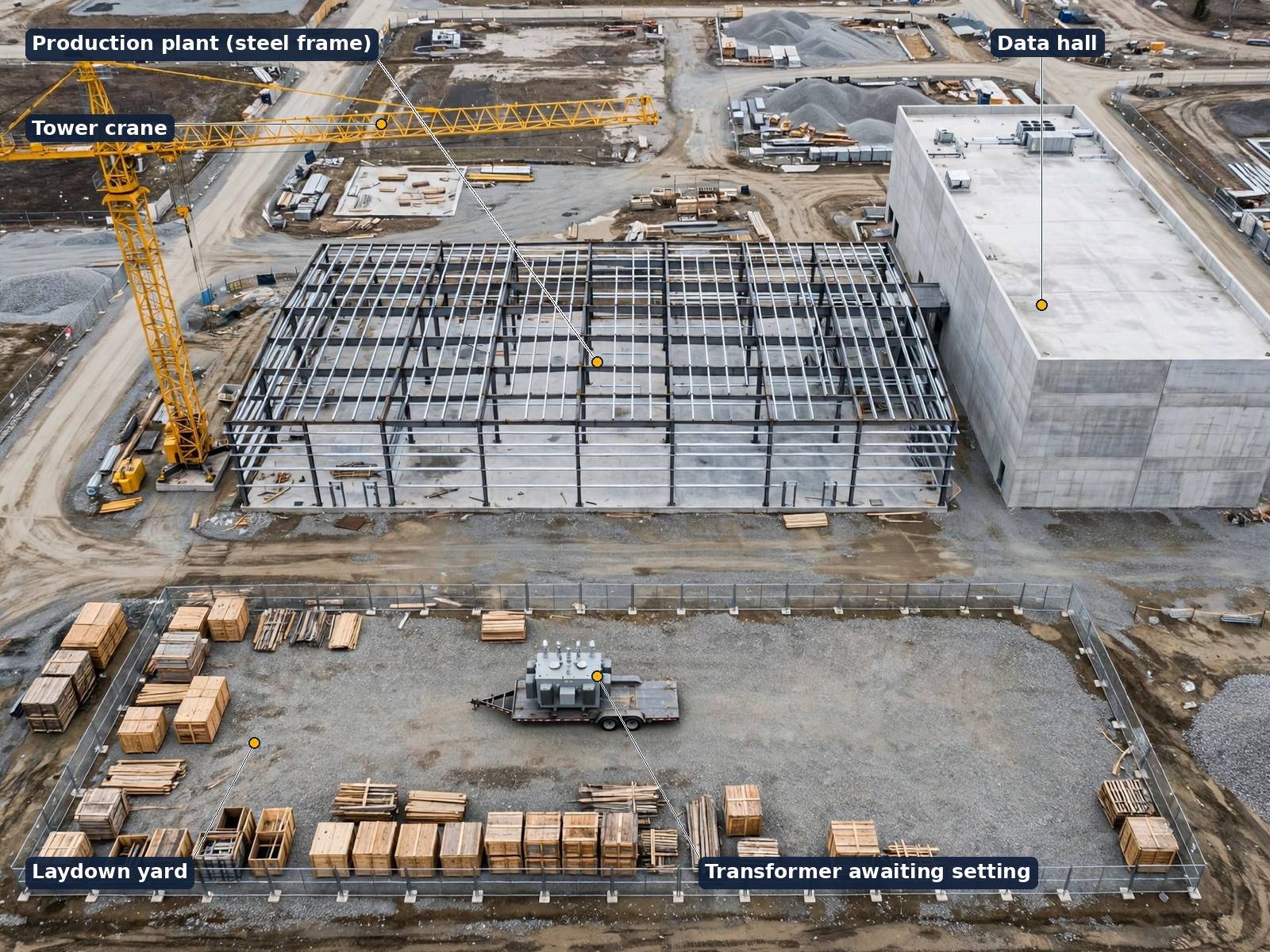
Figure 1.1 — An industrial buildout at mid-construction: the plant and data hall rising together, a tower crane over the frame, and crated equipment staged in the laydown yard.
Look at that figure until its logic is plain. The two buildings rising together are not two separate projects; they share one site, one schedule, and one set of long-lead deliveries. The crated equipment in the laydown yard is not clutter: it is the next month's work, already on site, waiting for its setting date. A coordinator reads a picture like this as a schedule made visible.
A craft is learned faster on one build followed whole than on a hundred disconnected fragments, so this book builds its teaching around a single specimen, returned to in chapter after chapter. The Kestrel Ridge build is a fictional greenfield campus — a build on land that has not been built on before — for Kestrel Ridge Industries. It is this book's specimen, invented for teaching: its layout is typical of real industrial work, and every number attached to it is its own specimen number, labeled as such wherever it appears.
Walk its shape once now, in words; the numbers that govern it arrive in the chapters that teach them. The campus holds a 320,000 square foot motor-components plant with two production halls, Hall A and Hall B, plus a data hall carrying 6 megawatts of IT load — the electrical load of the computing equipment the hall serves — at a Tier III design target, a design target in the Uptime Institute's vocabulary meaning concurrently maintainable, stated as a target and never as a certification. The build is run CM-at-risk, short for construction manager at risk, a delivery method in which the construction manager advises during design, then guarantees a maximum price and holds the trade contracts. That guaranteed maximum price is called the GMP, and on this specimen the GMP is $186,000,000, the specimen's own contract figure.
The power and cooling shape of the specimen is what makes it industrial rather than ordinary. The utility service arrives at 12.47 kilovolts on two feeds. Four 2,500 kVA transformers step that service down to 480Y/277 volts for plant distribution. Four 2,000 kilowatt standby diesel generators stand ready with 48 hours of on-site fuel at design load, the specimen's design choice. The data hall's uninterruptible power supply, shortened to UPS, is two independent systems, A and B, each of four 1,000 kVA modules arranged N+1, meaning one module more than the load needs, so one module can be removed without dropping the load. The data hall's heat is its full 6 megawatts, which Chapter 8 converts step by step to about 1,706 tons of cooling, served by four 800-ton chillers in N+1 arrangement, giving 2,400 tons of firm capacity.
Figure 1.2 (Class A) — The Kestrel Ridge campus map: production halls A and B, the data hall, the substation yard, and the laydown yard in their working relationship.
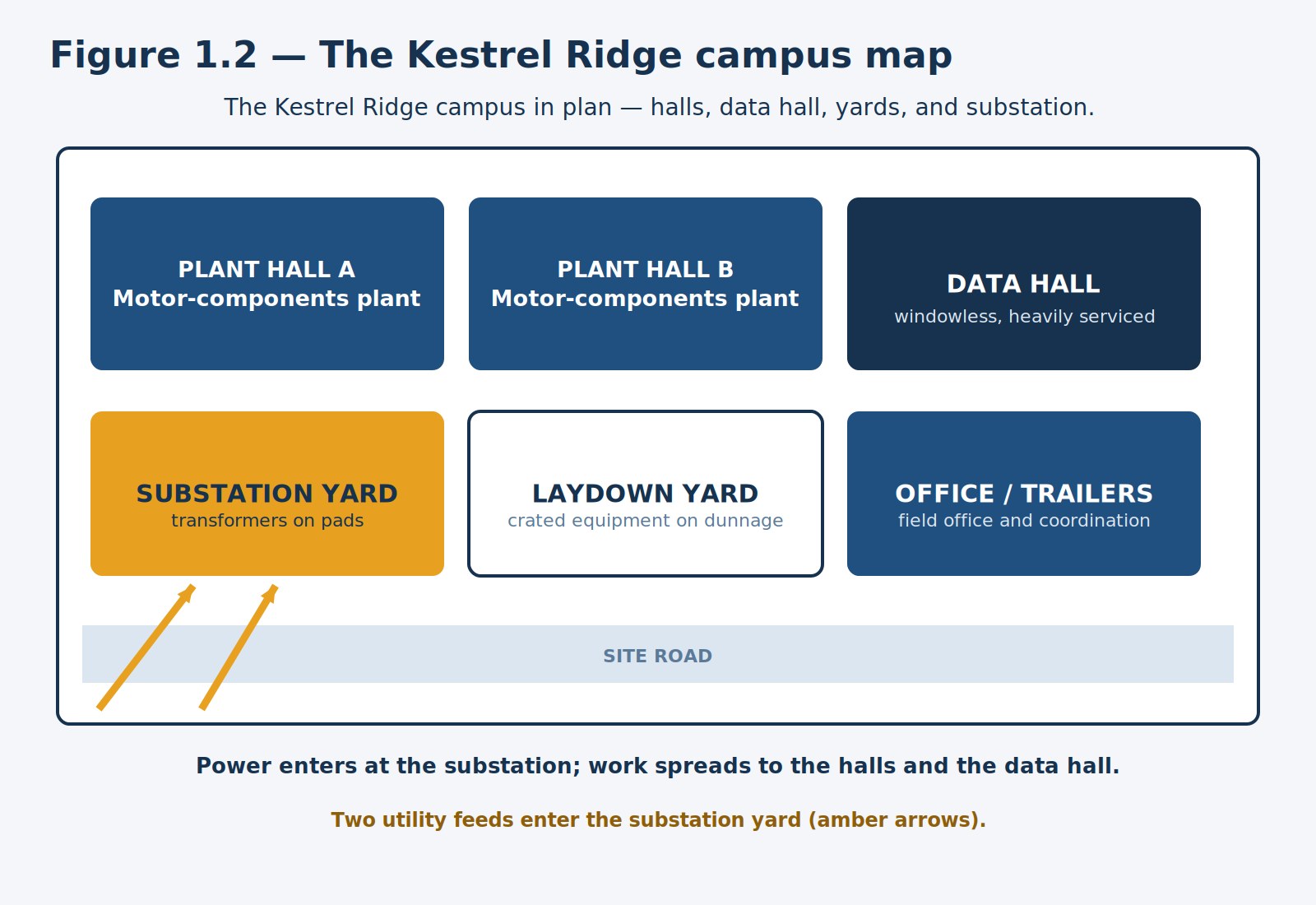
Figure 1.2 — The Kestrel Ridge campus map: production halls A and B, the data hall, the substation yard, and the laydown yard in their working relationship.
Study the campus map as a working relationship, not a picture. The substation yard feeds the plant and the data hall. The laydown yard sits where heavy equipment can be received and moved to its setting position without crossing finished work. Hall A and the data hall turn over first, in Phase 1, so production can start while fit-out continues elsewhere. When later chapters compute a procurement float, read a test report, or reason through a delay, they run it on Kestrel Ridge, so the reader watches one campus accumulate a history — specified, bought, delivered, set, tested, commissioned, and handed over.
When a beginner asks what construction managers actually do, the most honest answer is the occupation's own published duty list. The Bureau of Labor Statistics describes construction managers — the closest published occupation to this book's coordinator, because the Bureau publishes no "construction coordinator" occupation entry — with seven duties, and this book teaches them as the job's own description. Construction managers prepare cost estimates, budgets, and work timetables; interpret and explain contracts and technical information; collaborate with architects, engineers, and other construction specialists; select subcontractors and schedule and coordinate their activities; monitor projects and report progress and budget matters; respond to work delays, emergencies, and other problems; and ensure the project complies with legal requirements such as building and safety codes. (Source: BLS, Occupational Outlook Handbook, Construction Managers.)
Unpack that list slowly, because each line carries a whole part of this book. Preparing estimates, budgets, and timetables is money and schedule as one discipline. Interpreting contracts and technical information is literacy: drawings, specifications, submittals, and the contract stack are the project's language. Collaborating with architects, engineers, and other specialists is the daily work of Chapter 3. Selecting subcontractors and scheduling and coordinating their activities is the heart of the field. Monitoring progress and budget, and reporting both, is the discipline of telling the truth early, when a small slip is still cheap to fix. Responding to delays, emergencies, and other problems is the judgment layer of Chapter 39. Ensuring compliance with building and safety codes is the boundary of Chapter 4: the coordinator does not inspect in place of the AHJ, but makes sure the inspections happen, the qualifications exist, and the work stops when it must.
One more line deserves emphasis. On large projects, a top-level manager hires other managers for phases of the work — foundations, electrical work, and the like — and coordinates them. (Source: BLS, Occupational Outlook Handbook, Construction Managers.) A build as large as Kestrel Ridge is run by a team of managers and coordinators, each owning a phase or a system, all coordinated into one sequence. The reader is learning to be one of those people.
If coordination on any project is about sequence, coordination on an industrial buildout is about sequence under three pressures that ordinary building work rarely carries at this weight. The first is the long-lead pressure. On Kestrel Ridge, the medium-voltage switchgear is released in month 1 with a 58-week lead, the generators with a 64-week lead, and the transformers with a 66-week lead — the specimen's own procurement log, taught in full in Part IV. A switchgear order placed a month late is not a month late in the field; it is a month late against a setting date that the steel, the envelope, and the energization sequence were all built around. The coordinator's first skill is therefore a procurement skill: to see the delivery date before the building is ready for it, and to protect it.
The second pressure is density. The data hall's 6 megawatts of IT load becomes 6 megawatts of heat to remove, and the cooling plant that removes it is itself long-lead equipment with its own delivery clock. Power, cooling, and production are not three separate systems that happen to share a site; they are one system with three faces, and a change in one is a change in all three.
The third pressure is the ending. An industrial buildout ends not when the last trade leaves, but through commissioning — the quality-focused process of achieving, validating, and documenting that the facility and its systems meet the Owner's Project Requirements, shortened to OPR — and through turnover, the phased handover of systems and areas to the owner so the plant can operate. On Kestrel Ridge, commissioning runs from month 19 to month 23, the integrated systems test runs in months 22 to 23, Phase 1 turnover arrives in month 23 with the data hall and Hall A, and Phase 2 turnover and substantial completion — the contract point at which the work is sufficiently complete for the owner to use it for its intended purpose — arrive in month 26. The coordinator's work is therefore judged not at the topping-out ceremony but at the handover: did the systems prove themselves, and can the owner operate what was built? Parts VI and VII teach that ending as a discipline.
One set of national figures belongs in this first map, stated exactly as its source states it and never as anything else. The Bureau of Labor Statistics reports, for the whole occupation of construction managers, a median annual wage of $114,990 per year, May 2025, and counts 609,100 jobs in 2025. The same source's outlook is +9 percent from 2025 to 2035, described as much faster than average, paired — as this book always pairs growth — with about 49,700 openings per year on average, many of them arising from replacement needs, and an employment change of +55,200. (Source: BLS, Occupational Outlook Handbook, Construction Managers.) These are the only pay and employment figures that print anywhere in this book, and they print here labeled as the closest published occupation's figures, because the Bureau publishes no "construction coordinator" entry.
Read those sentences with the discipline this book will require every time a number appears. A median is the middle of everyone in the whole occupation — not a starting wage, not an offer, and not a promise about any one reader. The job count is the occupation's national size, not a count of vacancies. The outlook is a projection, not a guarantee: growth without its openings figure is a half-truth, so this book never prints one without the other. No other pay figure appears anywhere in this book.
The same discipline applies to the specimen's own numbers. The GMP of $186,000,000, the electrical equipment package of $24.6 million, the mechanical equipment package of $18.9 million, and the owner-controlled contingency of $9.3 million are Kestrel Ridge's contract figures — the specimen's own money, labeled as such. They describe one fictional campus, no market, and no reader's prospects.
Every beginner asks some version of the same question — what do I need to be allowed to do this work? — and the honest answer has a shape that surprises people, so this book states it in Chapter 1 and proves it in Chapters 2 and 3. There is no national license and no single governing exam for construction coordination or construction management in the United States. No one test, taken once, authorizes a person to coordinate industrial buildouts across the whole country, and any advertisement that implies one should be read with suspicion.
What exists instead is a set of distinct doors, each owned by a different party. Employers train. Degree programs teach. Trade and field experience builds judgment no classroom can give alone. Two voluntary professional certifications — examined in full in Chapter 38 — attest knowledge, but neither is a license and neither authorizes any regulated act. Some states license construction managers; the fact of that variation prints here, and no state's rule prints anywhere in this book, because the rules are local matters to be looked up where the work is. Skill itself is examined daily by the build itself: a delivery either arrives in time for its setting date or it does not.
This book's promise is sized to that truth. It prepares field knowledge and readiness — the physics underneath the plant, the documents that run it, the long-lead procurement discipline, the interfaces between trades, the energization and commissioning sequence, and the exact shape of the doors. It is not any body's official course, it satisfies no body's prerequisite or training requirement, and it promises no job, credential, score, or income. Certifying bodies examine and certify; employers and schools train; authorities having jurisdiction regulate their own ground. Holding those roles apart is the first professional habit this book teaches.
Part I finishes the entry map: the doors in (Chapter 2), who issues what and who the coordinator works beside (Chapter 3), and safety as the first skill (Chapter 4). Part II builds the foundations in the only order that works — electricity, the power chain, redundancy, heat and cooling — before any system rests on them, because no procedure in this book rests on a principle the book has not taught first. Part III teaches the documents that run the build; Part IV, long-lead procurement, the heart of the industrial build; Part V, execution and its interfaces; Part VI, utility interconnection and energization; Part VII, commissioning and turnover. Part VIII lays the supporting project-management module over the whole body and maps the road from here.
Read in order the first time. One boundary runs through every chapter: energized work, crane lifts and rigging, confined-space work, hot work, equipment start-up, acceptance testing, and commissioning performance are taught as knowledge and reasoning only — what the qualified parties do, what the coordinator verifies, schedules, and witnesses, and what each reading means. The hands are trained in person, under supervision, through the doors Chapter 2 describes.
Key terms of this chapter. Construction coordinator — the person who keeps the people, equipment, documents, and sequence of an industrial build moving together; Construction coordination — the craft of making a complex build happen in sequence, with the right trade, equipment, place, time, and record; Industrial buildout — the construction of a working industrial facility from bare ground to an operating plant; Laydown yard — the fenced open area where equipment and materials are received and staged before setting; Authority having jurisdiction (AHJ) — the public body with the legal power to inspect and approve the work; Critical path — the longest chain of dependent activities that sets a project's earliest finish date; Long-lead equipment — equipment taking many months from order to delivery that therefore owns the schedule; Kestrel Ridge build — this book's fictional greenfield campus specimen, the project every worked example runs on; Greenfield — a build on land not previously built on; Data hall — the building holding the computing equipment and its supporting systems; IT load — the electrical load of the computing equipment a data hall serves; Tier III design target — a design target in Uptime's vocabulary meaning concurrently maintainable, stated as a target, never a certification; CM-at-risk — the delivery method in which the construction manager advises during design, then guarantees a maximum price and holds the trade contracts; GMP — the guaranteed maximum price the CM-at-risk guarantees; Uninterruptible power supply (UPS) — the system that carries the load through a loss of normal power; N+1 — one unit more than the load needs, so one can be removed without dropping the load; Commissioning — the quality-focused process of achieving, validating, and documenting that the facility meets the Owner's Project Requirements; Owner's Project Requirements (OPR) — the owner's objectives and success criteria for the facility; Turnover — the phased handover of systems and areas to the owner so the plant can operate; Substantial completion — the contract point at which the work is sufficiently complete for the owner to use it for its intended purpose; Median — the middle value of a whole set, half above and half below, never a starting figure or a promise.
Tags: FIELD — the field, its doors, and the shared foundations. The key, with every option explained, is in this chapter's key file.
Q1. Construction coordination is best described as — A. the design of a building's architectural finishes B. making a complex build happen in sequence, with the right trade, equipment, place, time, and record C. the manufacture of switchgear in a factory D. the inspection of a finished building only after the owner moves in
Q2. An industrial buildout, as this book uses the term, is — A. the construction of a working industrial facility from bare ground to an operating plant B. the redecoration of an office floor C. the sale of a completed warehouse to a new owner D. the demolition of a plant with no replacement
Q3. The laydown yard on an industrial site is — A. the owner's finished office B. the parking lot for visitors only C. a fenced open area where equipment and materials are received and staged before setting D. the room where drawings are printed
Q4. In the Kestrel Ridge specimen, the campus holds — A. a hospital with two operating wings B. a single small workshop with no data hall C. three office towers and a retail center D. a 320,000 square foot motor-components plant with Halls A and B, plus a data hall of 6 megawatts of IT load
Q5. The Kestrel Ridge build is run CM-at-risk under a GMP of — A. $24,600,000, the electrical equipment package alone B. $186,000,000, the specimen's own contract figure C. $9,300,000, the owner contingency alone D. $114,990, the BLS median wage
Q6. Which duty appears in the BLS duty list for construction managers? A. Designing the provider's advertising B. Manufacturing transformers in a factory C. Selecting subcontractors and scheduling and coordinating their activities D. Setting national energy policy
Q7. On large projects, the BLS account states that a top-level manager — A. hires other managers for phases of the work and coordinates them B. performs every trade's work personally C. works alone with no field team D. reports only to the equipment vendors
Q8. Long-lead equipment matters most to a coordinator because — A. it is always the cheapest equipment on the project B. it is delivered after the plant is already operating C. it never needs to be tested before use D. it takes many months from order to delivery and therefore owns the schedule
Q9. The BLS fenced set for construction managers, as printed in this chapter, is — A. a starting wage guaranteed to every reader of this book B. median $114,990 per year, May 2025; 609,100 jobs in 2025; outlook +9% from 2025 to 2035 with about 49,700 openings per year C. a count of coordinator vacancies in one state D. a forecast that every entrant will be hired within a month
Q10. A median, as this book explains it, is — A. the wage paid in the largest city only B. the highest wage anyone in the occupation earns C. the middle of everyone in the whole occupation, not a starting wage, an offer, or a promise D. the average of the two largest employers' pay scales
Q11. Which statement about permission to do this work is true? A. There is no national license and no single governing exam; the doors are degrees, trade and field experience, and employer training B. This book itself authorizes a reader to perform the work C. One national exam licenses construction coordinators for the whole country D. A voluntary certification is a license that authorizes regulated acts
Q12. Commissioning, as defined in this chapter, is — A. the sale of the finished plant to a buyer B. the ordering of office furniture for the owner C. the demolition of temporary site offices D. the quality-focused process of achieving, validating, and documenting that the facility meets the Owner's Project Requirements
Q13. On the Kestrel Ridge schedule, Phase 1 turnover arrives in month 23 with — A. the laydown yard only B. the data hall and Hall A, so production can start C. the substation yard with no buildings D. Hall B alone, with the data hall still unfinished
Q14. Substantial completion is — A. the moment the GMP is signed B. the day the first drawing is issued C. the contract point at which the work is sufficiently complete for the owner to use it for its intended purpose D. the date the laydown yard is fenced
Q15. This book teaches energized work, crane lifts, rigging, and commissioning performance as — A. knowledge and reasoning only, with the hands trained in person under supervision B. performable step-by-step procedures to be carried out from the book alone C. topics omitted entirely from the book D. skills a reader certifies by completing the chapter exercises
End of the free sample. The complete book continues from here — the full A-to-Z course in book form, delivered as an EPUB you can read in Apple Books, Google Play Books, ReadEra, Thorium Reader, Adobe Digital Editions, or Send to Kindle.
Buy this ebook — $12.99 Back to the book page
Payments are securely processed by Payhip.