
Mastering Careers & Skills
Conflict Resolution at Work: Mastering the Craft · free sample from the book itself
The Complete Conflict Resolution Course from Fundamentals to Advanced: 168 Exercises, Drills, Checks & Plan Steps, All Explained
Feras Alzubi
The Complete Course Series
© 2026 Feras Alzubi. All rights reserved.
No part of this book may be reproduced, stored in a retrieval system, or transmitted in any form or by any means — electronic, mechanical, photocopying, recording, or otherwise — without the prior written permission of the author, except for brief quotations in reviews and other uses permitted by copyright law.
This book is an original work. It was written for this series and is not adapted from, based on, or a summary of any other author's book. The frameworks it teaches are credited to their sources in the text and in the Works Cited, and are explained here in the author's own words, for teaching purposes. All scenarios, dialogues, workplaces, and people in this book are fictional and were created for instruction; any resemblance to a real person or workplace is coincidental.
This book is not affiliated with, endorsed by, or sponsored by any employer, professional body, training provider, or the publishers or authors of the works it cites. Product and organization names mentioned in the text belong to their respective owners and are used for identification only.
Contents of this book. This book contains 168 exercises, drills, checks and plan steps with model answers explained in full, 40 worked dialogues, 7 worksheets, 20 cheat sheets, and a glossary. The counted apparatus is: 120 scenario exercises (six at the end of each of the twenty chapters), 24 diagnostic checks, 12 repair drills, and 12 capstone steps. Every exercise, check, drill, and step is answered or explained in a key, in full — there are no bare answers in this book.
Please read these plainly. This book gives general educational information. It is not legal advice, and nothing in it should be taken as a statement of the law in your workplace, your state, or your country. Where legal or formal matters appear, they are described in general United States federal terms for educational purposes, and you are directed to your own employer's policies, your union if you have one, the relevant agency, or a lawyer for your own situation. Nothing in this book promises any outcome: not income, not a promotion, not job security, and not that any particular conflict will be resolved. Techniques are taught with their limits printed beside them. Harassment, discrimination, retaliation, threats, violence, and safety violations are not peer conflicts to be worked out between colleagues; this book teaches you to recognize them and route them to formal channels, in Chapter 19.
This book is a course, and it is built to be worked, not just read. Begin with the diagnostic that follows this front matter. It takes one sitting, it sorts you by what you most need first, and it sends you to the chapters that will do you the most good soonest. You can then read in the order the diagnostic suggests, or read straight through from Chapter 1 — the chapters are written in teaching order, and either route works. Straight through is the fuller course; the diagnostic route is the faster repair.
Each chapter follows the same shape. It opens with the situation you will actually meet — the moment at the handover board, the counter, the meeting, the group chat — then teaches in five sections, then shows you the craft in worked dialogues. The first dialogue in every chapter is shown twice: once as it goes wrong, once handled well, with short notes on what each line did. Read the weak version slowly. Most readers recognize their own lines in it, and that recognition is where the learning starts. The second, shorter dialogue braids the two together in a different setting.
At the end of each chapter you will find six scenario exercises and, where the chapter carries one, a worksheet to fill in and a repair drill that takes a real failure apart. Do the exercises before you open the key that follows the chapter. The key gives the model answer first and then explains, in full, why it works and what the tempting wrong move would have done. A chapter's cheat sheet gathers its working rules onto one page for the day you need them at work, not at your desk.
Some chapters carry a running story. A warehouse associate and the colleague on the shift after his disagree about handovers, and the book follows that one ordinary conflict as it is missed, climbs, is prepared for, is talked through, is written down, is apologized for, and is repaired. It is fictional, and it is labeled as such. It is there so you can watch the whole craft applied to a single case, start to finish, the way you will have to apply it to your own.
The back matter holds three study plans — a four-week start, a twelve-week practice, and a working year — a coverage map, the works cited, a note on method and sources, and the glossary. The capstone, after Chapter 20, asks you to apply the whole book to one real, current, small conflict of your own, in twelve steps. Keep it small. This craft is learned on small conflicts, and it is the small ones that fill a working life.
One habit matters more than any other in this book: do the written parts. The worksheets, the recaps, the trigger log, and the capstone steps are where reading becomes a skill you still have six months from now.
Four fences stand at the front of this book, in plain words, because everything after them depends on your knowing where the craft stops.
You are a party or a peer — never the mediator of record. This book is written for the person inside the conflict: a colleague, a team member, a shift-mate. You may be one of the two people in it, or a peer whom two colleagues have asked to help them talk. You are not acting as a professional mediator, not as human resources, and not as an investigator, and nothing in this book makes you one. Chapter 13 teaches the peer's part carefully, with its limits and its stopping rules. Formal mediation — a neutral third party running a defined process — is a different, professional practice, and Chapter 18 describes what it actually is so you can tell the two apart.
Some matters are never peer conflicts. Harassment, discrimination, retaliation, threats and violence, and safety violations are formal-channel matters. They are not misunderstandings to be smoothed over, not personality clashes, and not material for a quiet word between colleagues, however well meant. A peer conversation about conduct like that can make things worse for the person harmed and for you. Chapter 19 teaches recognition and routing only: how to see these matters for what they are, how to listen to the person who tells you, how to keep honest notes, and where the matter goes. Every earlier chapter that comes near this boundary says so and points there.
The legal content is general educational information, not legal advice. Where this book describes harassment, retaliation, grievances, charges, or safety duties, it does so in general United States federal terms, drawn from the public guidance of the agencies concerned, and it says so where it prints. Laws, policies, deadlines, and procedures differ by place and by employer. This book does not state your rights in your situation, does not predict the outcome of any complaint, charge, or grievance, and is not a substitute for your employer's policy, your union representative, the relevant agency, or a lawyer consulted about your own facts.
Nothing here promises an outcome. This book does not promise income, a promotion, job security, a better review, or that any conflict you are in will be resolved. Some conflicts end well when they are handled early and fairly; some do not end well however carefully they are handled, and Chapter 20 says so plainly. What this book offers is the craft itself, taught whole — how to see a conflict clearly, raise it while it is small, talk it through, write it down, repair what can be repaired, and recognize what was never yours to handle. Whether and how you use it at work is yours. The demand for the skill is real — LinkedIn's Skills on the Rise 2025 ranks conflict mitigation the second-fastest-growing skill in the United States, and the references at the back document it; what it earns any one reader is not something a book can promise, and this one does not.
Most workplace trouble is misnamed before it is mishandled. This chapter gives you a working definition of conflict, shows you what it is not, and teaches you to spot the moment a useful disagreement starts turning into something that costs people and work.
You know this moment, in one of its forms. A handover takes ninety seconds longer than it should because neither of you quite trusts what the other is saying. A message sits unanswered while you compose replies in your head on the drive home. A meeting ends with everyone polite and nothing decided, and the real conversation happens afterward, in pairs, by the coffee machine.
Nothing dramatic has happened. No one has shouted. And yet the work is already slower, the day is already heavier, and you are spending attention on a colleague that belongs on the job in front of you.
That in-between state is where this book does most of its work. Big blowups are rare. What is common — in wards, warehouses, shops, offices, and crews — is the small, sustained friction that never gets named accurately, so it never gets handled at the right size. Name it too grandly and you escalate a disagreement that needed one question. Name it too lightly and you tolerate a pattern that needed a formal channel weeks ago.
Your first skill, before any technique, is sorting. Is this a disagreement, a conflict, a verdict you are forming about a person, or something that was never a peer conflict at all? Each of those four things asks for a different response from you, and giving the wrong one is how small problems grow.
Here is the definition this book uses, in plain words: a conflict is a disagreement that has begun to disrupt the work and to cost the people in it.
Every part of that sentence earns its place. There must be a disagreement — two views, two needs, or two claims on the same time, stock, space, or standard that do not fit together. The disagreement must have started to disrupt: tasks wait, information stops moving, decisions get relitigated, or people begin working around each other instead of with each other. And it must be costing the people: sleep, temper, willingness, trust. A disagreement that disrupts nothing and costs no one may be interesting, but it does not yet need conflict craft.
This definition follows the one used by CPP, Inc. in its workplace research, which treated conflict as any workplace disagreement that disrupts the flow of work. In a 2008 survey of 5,000 full-time employees in nine countries, 85% of employees said they experienced conflict to some degree — a figure from that 2008 survey worth pausing on, with its limits attached. That 2008 survey was self-reported, it is now old, and it was commissioned by a company that sells conflict-training instruments. Print those limits beside the number and the number is still useful: it tells you that friction at work is normal, not a sign that you or your workplace is uniquely broken.
Notice what the definition does not require. It does not require raised voices. It does not require intent — a colleague can disrupt your work without meaning to, and the disruption is real either way. It does not require both sides to agree that a conflict exists; one side working around the other, quietly and resentfully, is disruption enough. And it does not require you to be right. You can be entirely right about the underlying question and still be standing in a conflict that needs handling, because the handling is about the disruption, not only about who wins the argument.
Hold the definition loosely in one respect: it is a sorting tool, not a measurement. Two colleagues can look at the same week and honestly disagree about whether the disruption threshold has been crossed. When that happens, sort by evidence you can point to — a task that waited, a message that went unanswered, a decision made twice — rather than by how strongly you feel it. Feelings are data, and later chapters take them seriously. For the naming step, observable disruption is the steadier guide.
Disagreement is information. When a colleague says, “That delivery window will not work,” you have just learned something about the window, the route, or what your colleague knows that you do not. A workplace with no disagreement is not a harmonious workplace. It is a workplace where people have stopped telling each other what they see — and the errors arrive later, larger, and without warning.
The research spine of this book makes the point carefully. In a meta-analysis of the research literature, De Dreu and Weingart (2003) found that relationship conflict — friction between people, about the people — was strongly and negatively associated with both team performance and team member satisfaction. Task conflict — disagreement about the work itself — was also negatively associated with both, contrary to what many introductory textbooks had promised. Read that as an association from a meta-analysis, not as a guarantee about any one team, including yours.
The practical finding sits in the detail. Task conflict was less negatively related to performance when it was only weakly correlated with relationship conflict — in plain terms, when a disagreement about the work stayed a disagreement about the work. That is the craft this book teaches, stated in one sentence: the danger is not that disagreement exists; the danger is conversion, when a question about the work becomes a verdict about the person.
Conversion has recognizable mechanics. A claim about a task (“the count is short”) acquires a claim about motive (“you never check”). A single event becomes a pattern word (“always,” “never”). The audience grows — a private question becomes a public correction. The subject quietly changes from what happened to who someone is. You will meet these moves again in Chapter 5, on the escalation staircase, and in Chapter 6, on the words that pour fuel. For now, learn to hear the turn when it happens, including in your own mouth.
So do not set out to eliminate disagreement. You need it, and so does your team. Set out instead to keep disagreement at the size of the question it is actually about, for as long as you can — and to notice promptly when it stops being that size.
Under pressure, the mind reaches for a shortcut: instead of holding a complicated account of what a colleague did, on a particular day, under particular constraints, it files the person. Difficult. Lazy. Political. Not a team player. The shortcut feels like clarity. It is usually the moment your options shrink.
A verdict does three kinds of damage. First, it stops inquiry: if you already know what someone is, you stop asking what happened. Second, it leaks: colleagues hear the label, repeat it, and begin interpreting everything the person does through it. Third, it invites a matching verdict back. Few sentences escalate a workplace faster than a person learning what they have been called in their absence.
Work instead in the discipline this book uses throughout: behavior, in context, with its impact. Not “you are careless,” but “the last two restock sheets were signed before the count was done, and both times the night shift ran short.” Not “she is territorial,” but “when I moved the shared files on Tuesday, she moved them back without a note, and I lost an hour finding them.” Behavior can be checked, discussed, and changed. A verdict can only be defended or resented.
This is not a plea to think well of everyone. Some behavior is serious, and Section 1.4 draws that line plainly. Nor is it a ban on judgment: you will form views of colleagues, as they will of you, and some of those views will be earned over years. The discipline is narrower. In the conversation itself, and in any note you write, speak about what was done and what it cost, not about what the person is. It keeps the door open for the other person to answer the actual charge — and it keeps you honest, because a behavior claim you cannot support with an instance is a verdict wearing a costume.
One more caution, and it binds every chapter that follows: this book never asks you to explain a colleague by naming a condition, a disorder, or a personality type, and it never does so itself. You are not equipped to diagnose anyone at work, and a label of that kind ends conversations rather than opening them. Patterns of observable behavior are your material. Chapter 12 builds a whole method on that discipline.
Some conduct that arrives looking like “a difficult colleague” or “a personality clash” is not a peer conflict at all, and treating it as one can leave you exposed and the conduct unrecorded. This section names the boundary briefly; Chapter 19 teaches recognition and routing in full, and it is the chapter that governs whenever this boundary is in doubt.
Bullying, in the plain sense used here, is a pattern of conduct aimed at a person — repeated undermining, humiliation, exclusion used as a weapon — that persists after its effect is known. Harassment and discrimination, in their legal sense, are unwelcome conduct based on who someone is; in U.S.-federal framing, the EEOC treats harassment as unlawful where the conduct is severe or pervasive enough to create a work environment a reasonable person would consider intimidating, hostile, or abusive, while noting that petty slights and isolated incidents, unless extremely serious, do not rise to that level. Threats, violence, retaliation for raising a protected concern, and orders to violate safety rules belong on the same side of the line. This is general educational information, not legal advice, and your own employer's policy and your own jurisdiction's rules are the ones that govern your case.
The test to carry is simple. Peer-conflict craft — the conversations, worksheets, and drills in this book — is for disagreements between colleagues about work, process, and working relations, where both parties can speak without fear of punishment for speaking. The moment the matter is conduct based on who someone is, or conduct involving threats, coercion, or safety, the craft changes from talk to them to record it, keep yourself safe, and route it through the formal channels in Chapters 18 and 19. A well-meant peer conversation about conduct of that kind is not a brave first step. It can become the reason nothing formal was ever started.
If you are unsure which side of the line you are on, that uncertainty is itself information: pause the peer approach and use Chapter 19's recognition questions before you act.
Conflict left alone rarely stays the same size. The CPP research gives the scale, again with its limits printed beside it. In a 2008 survey, U.S. employees spent an average of 2.8 hours per week dealing with conflict, and that 2008 survey also valued those hours at approximately $359 billion in paid time nationally — a 2008 figure, calculated on 2008 wages of $17.95 an hour, and never to be read as a current cost. The nine-country average in that 2008 survey was 2.1 hours a week. Treat all of it as an old, self-reported snapshot commissioned by an interested vendor — and still notice the shape of the finding. Even a fraction of that time, in your own working week, is time taken from the work itself.
You do not need a national figure to audit your own week. Count the local costs, because they are the ones you can act on. There is the direct cost: the handover repeated, the delivery rechecked, the decision made in the meeting and remade in the corridor. There is the delay cost: work that waits because asking a particular colleague feels expensive. There is the avoidance cost: the route you walk, the shift you will not swap into, the question you do not ask in the meeting where it belonged. And there is the carry-home cost, the rehearsed conversation at midnight, which no survey needs to validate for you.
The same 2008 survey carried the finding this book is built on: training was the biggest driver of high-quality outcomes from conflict in that 2008 survey, yet fewer than half of respondents — 44%, in that 2008 survey — had received any training in handling it. Read that, too, with discipline. It is an association in self-reported survey data, not a promise that learning this craft will resolve any particular conflict of yours, improve your pay, or protect your job. Nothing in this book promises an outcome. What the finding supports is narrower and sufficient: how conflict is handled is a learnable part of the job, and handling is the variable, not the existence of friction.
That is the invitation of the twenty chapters ahead. Not a conflict-free workplace — that workplace does not exist, and pursuing it teaches people to hide disagreement until it is expensive. A workplace, and a working life, where disagreement gets named at its true size, handled with the method that fits its source, and routed without apology when it was never a peer matter to begin with.
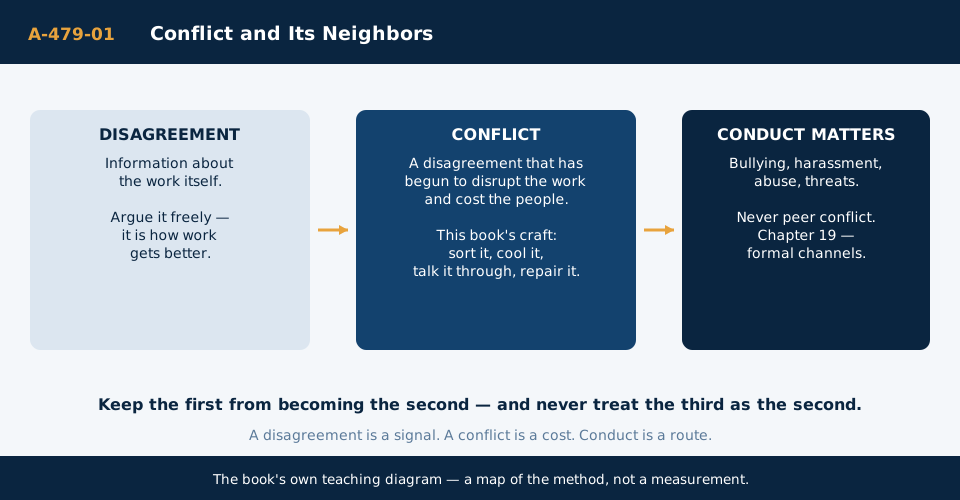
Figure A-01. The diagram places three neighbors side by side — disagreement, conflict, and conduct matters — with the test that separates each from the next: a disagreement is information about the work; a conflict is a disagreement that has begun to disrupt the work and cost the people; conduct matters are never peer conflict and route to Chapter 19's formal channels. Teaching diagram; it sorts situations for handling and measures nothing about any person.
All dialogues in this book are fictional teaching material. Samira, a day-shift nurse, and Tom, an evening-shift nurse on the same hospital ward, share a treatment-room restock cupboard. The weak version shows the exchange curdling. The strong version replays the same facts and keeps the disagreement healthy.
The weak version — the same facts, curdling
Samira: Tom, the glove shelf was empty again at seven this morning. You never restock properly.
Tom: I restocked at six. If days used fewer gloves, there would be some left.
Samira: Everyone knows evenings leave it for us. I have said this before.
Tom: And days love a drama. Fine — check the sheet yourself from now on.
Samira: I will. And I will tell the ward manager who actually keeps this ward running.
Notes on the weak version, line by line
The strong version — the same facts, kept at the size of the question
Samira: Tom, can I check one thing? At seven this morning the glove shelf was empty, and the restock sheet was signed for six. Did something happen after six?
Tom: A trauma admission at six twenty. We went through two boxes, and I did not get back to the cupboard.
Samira: That explains it. The problem is the gap, then — one busy hour empties us. What if the sheet gets a second line: restocked, and used since?
Tom: That works. And if I cannot refill, I will write “empty — admission” so days know it is a gap, not a miss.
Samira: Good. Let us try it this week and look at the sheet together on Friday.
Notes on the strong version, line by line
The limit of the strong version deserves stating: it worked here because both nurses could speak safely, the facts were innocent, and the problem really was a gap in a sheet. The same calm opening would be the wrong tool if the empty shelf were part of a pattern of deliberate undermining — that pattern belongs to the boundary in Section 1.4 and to Chapter 19, not to a better-worded question.
Also fictional. Jess works the floor of a retail store; Priya — no relation to the warehouse Priya you will meet in Chapter 2 — works the till. Jess has just seen next month's Saturday rota.
The weak and strong moves arrive braided here, because that is how grumbles actually sound — half warning, half habit.
Jess (weak): Saturdays again. Management always gives the good shifts to the same people. You watch — I will get every single one.
Priya: Have you counted them?
Jess (strong, after a pause): …No. It feels like every one. Let me actually count before I say that again.
Priya: Count mine too, and we will compare. If it is uneven, we take the count to the rota lead together. If it is even, I owe you a coffee for the drama.
Notes. Jess's first line is a grumble, not a conflict: no work has been disrupted, no colleague has been confronted, and the claim (“always,” “every single one”) has never been checked. Priya's question does the whole job of this chapter in four words — it asks for the evidence before the verdict sets. Jess's strong move is not cheerfulness; it is the decision to count. Notice what the grumble could have become by Friday if it had been repeated instead of checked: a reputation for the rota lead, a small faction at the till, and a disagreement about fairness that nobody could settle because nobody had the numbers. A grumble handled early is information looking for a count. A grumble repeated is conversion in its first, cheapest stage.
On a care-home night shift, two support workers, Ana and Bea, disagree about whether the laundry room should be locked between rounds. Ana wants it locked because supplies have gone missing. Bea wants it open because locking it adds six minutes to every round. For three nights they have argued the point at handover, twice the argument ran long enough to delay the first round, and both now brief the incoming shift leader separately instead of together. Using the definition in Section 1.1, decide: is this a disagreement or a conflict? Name the specific disruption and the specific cost you can point to, and state what Ana or Bea should do differently tomorrow because of your answer.
A delivery driver and a goods-in clerk disagree, in front of a customer, about who should unload a pallet that arrived ninety minutes late. The driver says unloading is the store's job once he has docked. The clerk says drivers have always helped when a delivery is late. Voices stay level, the pallet is unloaded by both of them in twenty minutes, and they part with a handshake and a shared joke about the traffic. A colleague who watched tells you afterward: “Well, that conflict was handled well.” Using Sections 1.1 and 1.2, explain to that colleague, in four or five sentences, why what they watched was not yet a conflict — and what single change in the scene would have made it one.
Rewrite each verdict as behavior, context, and impact, inventing one concrete instance for each. (a) “He is hopeless with paperwork.” (b) “She is completely two-faced about the rota.” (c) “They are just lazy on Fridays.” For each rewrite, check your work against Section 1.3: could the person you are describing answer your sentence by checking a fact, fixing a step, or explaining a constraint? If any of your rewrites still names what the person is rather than what was done, rewrite it again until it does not. Keep each finished sentence under thirty words.
A new starter on your team tells you, quietly, that a senior colleague has begun imitating her accent whenever she speaks in the team huddle, that others have started laughing along, and that it now happens most days. She asks you to “have a friendly word with him, colleague to colleague, and sort it out between us.” Using Section 1.4 and the boundary it draws, explain why you must not handle this as a peer conflict, what you should do instead in the next twenty-four hours, and what you should say to the new starter about why you are not having the friendly word she asked for.
For one working week, keep a private count of the local costs described in Section 1.5 for one friction you are currently part of: minutes spent redoing or rechecking work, minutes work waited because you avoided asking someone, and one note each evening of whether the friction followed you home. At the end of the week, write three sentences. First, the totals, stated plainly. Second, which cost surprised you most. Third, whether your count changes your answer to the naming question — disagreement or conflict — and why. Bring the count, not your feelings about the other person, to any conversation you decide to have.
In a school office, an administrator mentions at least once a day, to whoever is nearby, that the new attendance software is “a joke” and that “nobody asked the people who actually use it.” No task has been delayed, no colleague has been confronted, and the administrator's own attendance work is on time and accurate. Two colleagues have started repeating the joke in the corridor. Using Sections 1.1 and 1.2 and the second specimen, sort this situation: what is it now, what is it at risk of becoming, and what is the smallest useful move available to a colleague who hears the joke tomorrow — a move that checks the claim without either joining the chorus or staging a confrontation?
End of the free sample. The complete book continues from here — the full A-to-Z course in book form, delivered as an EPUB you can read in Apple Books, Google Play Books, ReadEra, Thorium Reader, Adobe Digital Editions, or Send to Kindle.
Buy this ebook — $12.99 Back to the book page
Payments are securely processed by Payhip.