
Mastering Careers & Skills
CNC Machinist Exams (NIMS) · free sample from the book itself
CNC Machinist Exams (NIMS) — Exam Prep Series — 2026 Edition. Every rationale explains why the credited answer is right and why each other option is wrong, with the teaching section cited.
Q1 — Key: B. Tag: TRADE. Machining makes shapes by controlled removal of material with a cutting tool (§1.1). A describes forming, which reshapes without removal. C describes joining, a different family of making. D describes casting and molding, where liquid material hardens in a cavity.
Q2 — Key: A. Tag: SPEC. Meridian Precision Works is this book's fictional specimen shop, invented for teaching and labeled as fiction at first use (§1.4). B is wrong because no real company or real production record appears in this book. C is wrong because no book or shop in it administers NIMS performance assessments. D is wrong because the book never presumes to describe the reader's own employer.
Q3 — Key: C. Tag: TRADE. The setup machinist readies the machine — holding, tools, and offsets — and proves the setup with a fully measured first article before production begins (§1.3). A describes the operator's work on an already proven setup. B understates and isolates programming, which is a separate role and never the whole of setup. D describes a final-inspection duty, not the act of making a machine ready to run a job.
Q4 — Key: D. Tag: TRADE. No state license exists for this trade; NIMS credentials are voluntary industry credentials (§1.1). A invents both a state license and a renewal role for NIMS that neither holds. B misnames a voluntary credential as a state-issued license. C invents a federal machining license that does not exist in the chapter's framing.
Q5 — Key: B. Tag: MATH. The chapter's rule gives RPM = 3.82 × 800 / 2.000 = 1,528 rpm (§1.4). A halves the correct result, as if the diameter had been doubled. C is 3.82 × 800 without dividing by the diameter. D results from dividing by 0.500 in instead of 2.000 in, the end-mill diameter from a different specimen calculation.
Q6 — Key: A. Tag: TRADE. The operator stops and calls for help when anything looks, sounds, or measures wrong; the operator is the process's first witness (§1.3). B compounds the loss by completing a suspect run. C hands the operator a programmer's change without authority or proof. D hides the evidence that setup and inspection need in order to correct the process.
Q7 — Key: C. Tag: SPEC. The specimen bracket's pocket is 2.500 × 1.500 in, cut 0.375 in deep (§1.4). A gives the stock block's footprint and the finished thickness as if they were the pocket. B keeps the pocket's plan size but substitutes the finished thickness, 0.950 in, for its depth. D swaps depth and hole size into a pocket that the canon states plainly.
Q8 — Key: D. Tag: PRINT. A tolerance is the allowed variation on a dimension, the band inside which the part remains the part ordered (§§1.6, 1.7). A confuses tolerance with the nominal dimension itself. B reduces a numeric requirement to an attitude. C makes tolerance personal and variable, when the chapter teaches it as a promise about function stated on the print.
Q9 — Key: A. Tag: TRADE. This book prepares the reader in knowledge, method, and reasoning but cannot administer, simulate for credit, or substitute for any performance assessment, and it confers no credential (§1.8). B invents an assessment administered by a book. C invents a substitution based on exercise scores. D invents direct conferral, which only the issuing system can perform under its own rules.
Q10 — Key: B. Tag: SPEC. Shaft MPW-1140 is turned from 1018 cold-rolled steel bar (§1.4). A names the bracket's material, 6061-T6 aluminum, attached to the wrong part. C names a plate material the canon never assigns to the shaft. D names a plausible bar material that the specimen canon does not use.
Q11 — Key: D. Tag: TRADE. Cutting degrades into rubbing when a dull edge or a too-light cut presses and heats the surface without shearing a chip (§1.2). A describes successful cutting, the opposite condition. B describes the two motions working together as they should. C describes rigid holding and a sharp tool, the conditions that keep a cut shearing.
Q12 — Key: C. Tag: TRADE. The inspector serves the print: a part outside tolerance is not the part ordered, however close it measures (§§1.3, 1.7). A subordinates the verdict to the schedule. B subordinates it to loyalty to a colleague. D makes the duty depend on a customer visit, when the chapter makes it unconditional.
Q13 — Key: A. Tag: TRADE. CNC relocates judgment because the machinist must foresee the cut in program, setup, and offsets, since the machine executes too fast for thoughtful hand correction (§1.6). B is false because programmed work still requires measurement. C is false because controls execute chosen tooling and holding; they do not choose them. D is false because CNC parts carry the same tolerance requirements as any other parts.
Q14 — Key: D. Tag: TRADE. The ladder in order is operator, setup machinist, programmer, inspector (§1.3). A scrambles the order and puts programming first. B places programming before setup, reversing the trust sequence the chapter teaches. C starts with setup and buries inspection mid-ladder, contradicting the chapter's progression of responsibility.
Q15 — Key: B. Tag: MATH. Feed = 1,528 × 5 × 0.006 = 45.8 in/min (§1.4). A omits the five inserts, computing one tooth's advance only. C doubles the correct feed, as if the chip load had been doubled. D drops the decimal scale entirely, overstating the feed tenfold.
Machining is the making of useful shapes by cutting material away. A block, bar, casting, or plate arrives larger than the finished part needs to be, and a machinist removes everything that is not the part — turning a rough blank into a bracket that bolts flat, a shaft that spins true, a plate whose holes line up with holes in another part half a continent away. Almost everything manufactured passes through machining at some point. The engine block is machined so its cylinders are round and its faces are flat. The surgical implant is machined so it fits a body. The mold that forms a plastic bottle is machined so thousands of bottles come out the same. When a dimension matters — when a part must fit, seal, spin, slide, or hold — machining is usually how that dimension was made true.
That definition matters because it separates machining from the other great families of making. In forming, material is reshaped without being cut away: a sheet is bent, a bar is forged under a hammer, metal is drawn through a die. The volume stays roughly the same; the shape changes. In joining, separate pieces are made into one: welding, brazing, fastening, bonding. In casting and molding, liquid or softened material takes the shape of a cavity and hardens there. Machining — subtractive making — starts with more material than the part needs and earns the final shape by controlled removal, chip by chip. Each family has work it does best. Forming is fast and strong for shapes it can reach. Casting is economical for complex hollow forms. Machining is the family you call when accuracy, finish, and exact fit decide whether the part works at all.
A beginner should hold one picture firmly from the first page: the finished part already exists, in a sense, inside the stock. The machinist's job is to reveal it without spoiling it — without cutting too deep, without letting the work slip, without overheating the surface, without leaving a burr where a hand or a seal will travel. Every skill in this book serves that single act of careful revelation. Measurement proves the part is becoming what the print says. Tool choice decides how cleanly material leaves. Workholding decides whether the stock stays where the plan assumed it would stay. Programming, on a CNC machine, writes the revelation down as instructions a control can repeat. Inspection closes the loop by comparing what was made with what was asked for.
This book teaches that whole craft from zero and prepares you for the theory examinations of the NIMS machining credentials. It does so honestly, and the honesty starts here: machining in the United States has no state license. No government board licenses machinists the way states license electricians in many jurisdictions or nurses in all of them. What the trade has instead are voluntary, industry-issued credentials — most prominently those of NIMS, the National Institute for Metalworking Skills — that a machinist may earn to prove skill to employers, and that employers may value, require for a particular job, or ignore, as they choose. Chapter 2 teaches that credential system in full. Nothing in this book is a license, confers a license, or substitutes for one, because there is no license to confer. When this book says credential, it means exactly that: a voluntary industry credential, earned under the rules of the body that issues it.
To cut metal, a tool harder than the work presses an edge into the surface and drives it forward so that a thin layer of material — the chip — shears away. That sentence contains the whole physics of the trade in miniature, and every later chapter unpacks one part of it. The tool must be harder than the work, or the work will wear the tool instead. The edge must be presented at angles that let it bite without rubbing itself dull. The cut must move — either the tool moves through still work, or the work rotates or travels past a tool — because a stationary edge pressed into metal does not cut; it only dents and heats. And the sheared layer must have somewhere to go: chip control, chip evacuation, and coolant are not housekeeping details but part of the cut itself.
Two motions govern nearly every cut. The primary motion provides the cutting speed: on a lathe, the work spins; on a mill, the cutter spins; on a drill press, the drill spins and descends. The feed motion advances the cut into fresh material: the carriage travels along the spinning bar, the table carries the work under the spinning cutter, the quill lowers the drill. Speed and feed together decide chip thickness, heat, tool life, surface finish, and the time a job takes. Chapters 15 and 17 develop the mathematics and the tool geometry behind them. For now, the beginner's rule is enough: cutting is controlled shearing, and control — of speed, of feed, of depth, of the work's grip — is the machinist's contribution. The machine supplies power and motion. The machinist supplies judgment about how that power and motion meet the metal.
It helps to contrast cutting with rubbing. A dull edge, a speed too low for the feed, or a cut too light to get under the surface will rub rather than shear. Rubbing makes heat without making progress; it work-hardens some materials so the next pass cuts even worse; it tears finish and shortens tool life. Much of practical machining is the discipline of staying on the cutting side of that line: sharp tools, honest feeds, rigid holding, and a plan that takes material off in an order that leaves the part supported until the last cuts are done. When experienced machinists listen to a cut — and they do listen, constantly — they are hearing whether the edge is shearing or complaining.
Walk into a shop and you will hear several job titles. Underneath the titles, the work divides into four roles, and a machinist's career is largely the story of growing from the first toward the fourth while never quite leaving the earlier ones behind. The roles are a ladder of responsibility: each rung trusts you with more of the job and holds you answerable for more of what can go wrong.
The operator runs a machine that someone else has set up and proven. The operator loads stock or parts the way the setup specifies, starts the cycle, watches and listens while it runs, unloads finished parts, removes burrs, measures the features the inspection plan assigns, and — most importantly — stops and calls for help when something looks, sounds, or measures wrong. Good operating is not passive. The operator is the process's first witness: the first to hear a chipped insert, the first to see chips packing where they should flow, the first to catch a dimension drifting toward its limit. NIMS recognizes this rung directly: its operator-level CNC credentials validate that an individual can successfully machine parts by operating a CNC machine, maintain quality and safety standards, keep records, maintain equipment and supplies, and perform routine preventive maintenance (Source: NIMS, CNC Lathe Operations credential overview and crosswalk, R12). Operating well is a complete skill, and this book treats it with respect.
The setup machinist makes a machine ready to run a job. Setup takes the print, the program, and the plan, and turns them into physical fact: the right vise, chuck, or fixture mounted and indicated true; the right tools loaded, measured, and entered as offsets; the work coordinate system established so the control knows where the part sits; the first part run slowly and carefully — the first article — measured in full, and the offsets adjusted until that part matches the print. Only then does production begin. Setup is where machining knowledge becomes visible fastest, because setup concentrates every decision: holding, tooling, order of operations, and measurement, all before a single good part exists. A careless operator wastes a cycle. A careless setup wastes a run.
The programmer writes the instructions the control executes. On a CNC mill or lathe, the program names the tools, sets the speeds and feeds, and drives every move the machine makes. Programming can be done at the control, by hand in code, or with computer-aided manufacturing software that builds toolpaths from a model — but in every form it demands the same foundation: the programmer must think like the cut. A program that ignores how the work is held, how a thin wall will deflect, or how chips will leave is a bad program no matter how neatly it is written. Many machinists program only the machines they also set up and run; larger shops separate the role. Either way, programming is machining knowledge expressed in advance, and Chapters 27, 28, 32, and 33 teach it that way.
The inspector — sometimes a dedicated quality role, always a duty of whoever makes the part — compares finished work with the print and records the verdict. Inspection ranges from a caliper check at the machine to a full first-article report and coordinate measuring machine work in a temperature-controlled room. Its ethic is distinct: the inspector serves the print, not the schedule. A part that measures outside its tolerance is not almost good; it is not the part that was ordered. At the same time, inspection is not fault-finding theater. Good inspection catches drift early, feeds corrections back to setup and programming, and protects both the shop and the customer from the far greater cost of bad parts discovered late. The machinist who measures honestly — including reporting a dimension he himself cut wrong — is practicing the trade's core professional virtue.
Most real machinists wear several of these hats in a single day, and small shops may ask one person to wear all four on a single job. The ladder still matters, because responsibility, pay of attention, and credentialing all follow it: you learn to operate before you are trusted to set up, you learn setup before your programs are trusted on real work, and you measure from your first day because measurement is how every rung knows the truth.
Teaching needs concrete work to talk about, so this book invents a shop and carries its jobs through the chapters. Meridian Precision Works is a fictional job shop created for this book. It is not a real company, no real person works there, and its parts have never been ordered, cut, or shipped. Meridian is a specimen — a labeled teaching example whose stated facts are its own, consistent from chapter to chapter, so that a calculation done in Chapter 15 means the same thing when Chapter 37 plans around it. When a number belongs to Meridian, the text says so. When a number belongs to the real world — above all, any fact about NIMS — it comes from a named source and is cited where it prints.
Meridian's first specimen job is Bracket MPW-2210, milled from 6061-T6 aluminum. The stock block measures 4.000 × 3.000 × 1.000 in. The finished bracket is faced to 0.950 in thick and carries a rectangular pocket 2.500 × 1.500 in, cut 0.375 in deep, and four through holes of Ø0.375 in located from the lower-left datum corner at X0.500/Y0.500, X3.500/Y0.500, X0.500/Y2.500, and X3.500/Y2.500. A planning variant taught in Chapter 37 taps two of those holes 1/4-20 UNC. You will meet this bracket first as a print in Chapter 5, then as speeds and feeds in Chapter 15, as tooling in Chapters 18 and 21, as a mill program in Chapters 27 and 28, as a running job in Chapter 29, and as a planning exercise in Chapter 37. Learn its numbers once; the book will not change them behind your back.
Meridian's second specimen job is Shaft MPW-1140, turned from 1018 cold-rolled steel bar of Ø1.500 × 6.000 in. The finished shaft is 5.750 in long overall, in three turned sections: Ø1.250 in for 2.000 in, Ø1.000 in for 2.500 in, and Ø0.750 in for 1.250 in, with the Ø0.750 section carrying a 3/4-10 UNC external thread. Chapter 30 meets it on the lathe, Chapters 32 and 33 program it, Chapter 34 runs it, and the measurement and thread chapters return to it whenever a turned example is needed. Two jobs — one milled, one turned — are enough to carry the whole craft, because the craft's ideas repeat: hold the work, choose the tool, set the speed, make the cut, measure the result, and tell the truth about what the measurement says.
A worked example belongs here, because even this first chapter should show the trade's arithmetic habit: every number stated, every step shown, every result checked. Consider the face mill Meridian uses on the bracket's first operation — a Ø2.000 in face mill with 5 inserts, cutting aluminum at a cutting speed of 800 surface feet per minute. Chapter 15 teaches the rule behind the constant; here, use it as given: spindle speed in revolutions per minute equals 3.82 times cutting speed divided by cutter diameter. Substituting the specimen numbers: RPM = 3.82 × 800 / 2.000 = 3,056 / 2.000 = 1,528 rpm. With a chip load of 0.006 in per tooth, the feed rate is spindle speed times number of inserts times chip load: feed = 1,528 × 5 × 0.006 = 1,528 × 0.030 = 45.8 in/min. Check the result the machinist's way: at 1,528 rpm the cutter turns about twenty-five times each second, five inserts bite on each turn, and each bite advances six thousandths of an inch — a feed just under forty-six inches a minute is exactly the pace that arithmetic describes. Numbers in this book always arrive with their working shown, so you can check them the same way.
Figure 1.1 (Class P) — A vertical machining center stands ready in a clean shop with its doors open and its control screen blank.
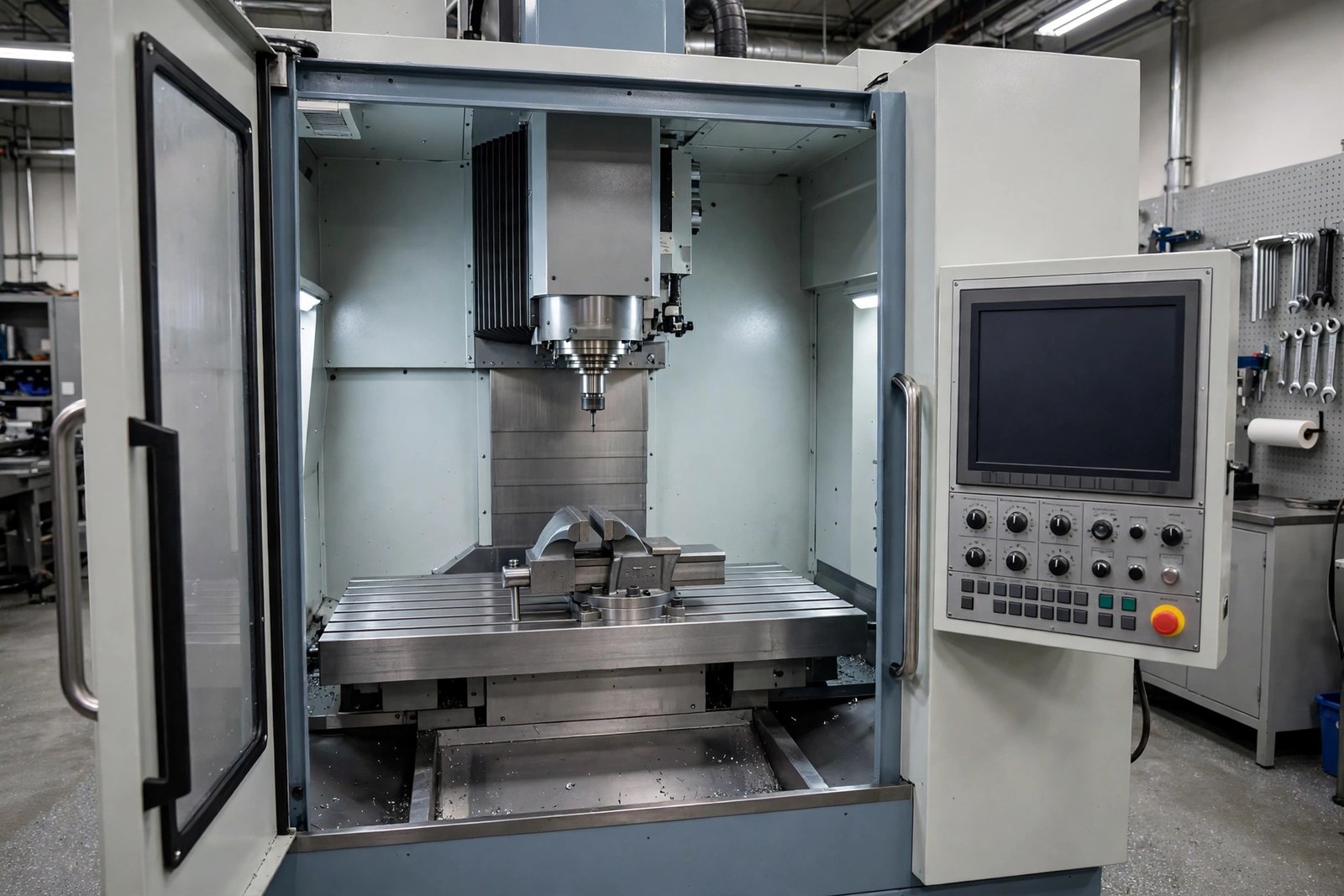
Figure 1.1 — A vertical machining center stands ready in a clean shop with its doors open and its control screen blank.
Figure 1.1 shows the machine at the center of Meridian's milling work and of Part VI of this book: a vertical machining center, the CNC mill in its most common shop form. The spindle stands vertical above the table, the enclosure doors are open on an empty, clean work area, and the control screen is blank — the machine as a setup machinist first meets it in the morning, before vise, tools, stock, or program give it a job. Notice what the photograph does not show: no person, no hands, no brand. That is deliberate throughout this book's Class P plates. The subject is the equipment itself, presented realistically, because a machinist must learn to recognize the machine before learning to direct it. Chapters 25 and 26 open those doors in words — axes, control, offsets, probing — but the recognition starts here: this box of iron, motors, and software is where the bracket will be born.
A machinist's day has a rhythm, and a beginner who knows the rhythm will not be lost in a first shop. The day starts before the first cut, with review: the schedule and the router — the document that travels with a job and lists its operations in order — tell you what runs today, on which machine, in what sequence. You check the machine itself: coolant level and condition, way lubrication, chip conveyors or pans emptied, the work area clear. A machine checked cold prevents the failure that would have announced itself hot, mid-run, at the cost of a part or a tool.
Setup, when the job changes, takes the next block of time, and it is unhurried by design. Tools are gathered and preset, holding is mounted and indicated, stock is verified — material, size, and count — against the router before a chip is made, because cutting the wrong material beautifully still makes scrap. The program is loaded, its tool list matched against the tools actually in the machine, and the first run is made with the caution Chapter 29 teaches: reduced rapid, single block, hand near the stop, eyes on the distance-to-go. The first article is measured fully. Only a measured-good first article releases the run.
Production itself is a cycle of attention rather than a single act. Load, run, unload, deburr, measure — and between cycles, the operator's real work: watching dimensions for drift as tools wear, listening for the change in sound that precedes trouble, keeping chips moving and coolant flowing, and recording what the inspection plan requires. Parts come off in trays or on pallets, identified by job, so that a question asked next week can be answered about this morning's work. When a dimension trends toward a limit, the competent operator adjusts or calls before parts cross it. Scrap made slowly and discovered early is a lesson; scrap made fast and discovered at final inspection is a loss.
The day ends the way it began, with the next shift — or tomorrow's self — in mind. Machines are cleaned of chips and coolant splash, tools that are worn are flagged rather than quietly returned, problems are written down where the next person will find them, and counts are reconciled: parts made, parts scrapped, parts remaining. Shops differ in every detail — a production shop running one part for months lives differently from a job shop like Meridian, where tomorrow's work may not have been quoted yet — but the rhythm of review, setup, proven first article, attentive production, and honest closeout is the trade's common day.
Every trade compresses its knowledge into words, and machining's words can wall a beginner out if they arrive all at once. This book introduces each term where it is first needed, defines it in place, and collects it again in the chapter's key terms and the book's glossary. A first handful belongs here, because the chapters ahead use them constantly.
Stock is the raw material a part is cut from — bar, plate, block, or casting. A print, also called a blueprint or engineering drawing, is the part's legal description: views, dimensions, tolerances, and notes that together define what counts as a good part. A tolerance is the allowed variation on a dimension — the band inside which a part is still the part ordered. A datum is a reference feature — a face, an edge, a hole — from which other locations are measured. Setup is everything done to ready a machine for a particular job; an operation is one step of work at one setup or station. An offset is a stored correction by which a CNC control accounts for a tool's real length or radius, or for the work's real position, so programmed coordinates land where the print intends. A first article is the first part off a setup, measured in full before production is released. Scrap is a part that cannot be used or economically repaired; rework is additional work that brings a part within the print without changing what the print requires. None of these words is difficult. Together they let a shop say in one sentence what would otherwise take a paragraph — and precision of language, in a trade built on precision of measurement, is not decoration. It is safety and money.
One more distinction repays learning early: CNC stands for computer numerical control — a machine whose motions are driven by a programmed control rather than by handwheels alone. CNC did not replace machining knowledge; it relocated it. The handwheel machinist feels the cut through his hands in real time. The CNC machinist must foresee the cut — in the program, the setup, and the offsets — because the machine will execute instructions at speeds no hand can interrupt thoughtfully. That is why this book teaches manual foundations (Part V) before CNC programming (Parts VI and VII): the judgment is the same, and it is easier to learn where the feedback is immediate.
It is tempting to treat tolerance as paperwork — a number after a dimension, someone else's worry. In practice tolerance is a promise about function. The bracket's four holes sit where they sit so bolts pass through them into a mating part; move one hole by more than its tolerance allows and the assembly fails on someone else's bench, in someone else's hands, possibly in a machine whose failure hurts people. The shaft's journals carry bearings; a journal a thousandth oversize will not accept its bearing, and a thousandth undersize will let it fret and fail early. Machinists rarely meet the end user of their parts. Tolerance is how strangers trust each other across that distance.
That is why this book returns so often to honest measurement. A dimension is not good because the machinist hopes so, or because the last ten were good, or because the schedule needs it to be good. It is good because a trustworthy instrument, correctly used, says so — and when the instrument says otherwise, the machinist's job is to believe it and act: adjust, rework, segregate, report. The NIMS system builds this ethic into credentialing itself. As Chapter 2 details, most NIMS machining credentials require not only a theory examination but a hands-on performance assessment judged against published specifications, with an affidavit attesting among other things that the candidate understood and practiced appropriate safety procedures (Source: NIMS, Machining Performance Affidavit, R5). Skill, in that system, is something you demonstrate on real metal and have judged — not something you claim.
Accuracy also explains the trade's conservatism about process. Machinists prove a setup with a first article before running production, measure at planned intervals instead of only at the end, and write down what they did so the next run can repeat what worked. These habits look slow only until they are compared with the alternative: a bin of finished parts, all wrong the same way, discovered after the material and hours are spent. The fastest shop is rarely the one that cuts fastest. It is the one that rarely makes scrap, rarely remakes parts, and can prove what it shipped.
This book teaches the machinist's body of knowledge whole — print reading, measurement, materials, the mathematics of the cut, tools and holding, manual foundations, CNC milling and turning, quality, and planning — and it prepares you, with 820 original explained practice items, for the theory examinations of the NIMS machining credentials it covers. Chapter 2 maps those credentials precisely: which ones this book owns, which it only names, what each validation demands, and what each published fee and question count actually is, sourced where it prints.
What this book will not do must be stated with equal clarity, here and again wherever a beginner might mistake study for credentialing. This book cannot administer, simulate for credit, or substitute for any NIMS performance assessment. It confers no credential, no eligibility, and no authorization of any kind. The hands-on validation — making a real part, on a real machine, judged under NIMS rules — can only happen inside the NIMS system, with its sponsors, proctors, and evaluators. What study can do, and what this book promises, is to make you ready: to teach the knowledge the theory examinations test and the method and reasoning behind the performance skills, so that when you stand at a machine with an evaluator's specifications in hand, the work itself holds no surprises. Read in order the first time. Work every chapter's exercises with the book closed after study, read every key — including for items you answered correctly — and let the repair sets and case batteries find the weak places before an examination does.
The trade's workplaces share the craft and differ in almost everything else, and a beginner choosing where to learn should know the variety exists. The job shop — Meridian's form — makes varied parts for many customers and teaches breadth fastest: new prints, new materials, new setups every week. The production plant runs long campaigns of identical parts, often in cells where one machinist tends several machines, and teaches depth in process control: tool life management, statistical checks, and the discipline of holding a process centered for months. Maintenance and repair machining serves a single plant's breakdowns and rebuilds — work that arrives broken, undocumented, and urgent, where the machinist measures the worn part itself because no print survives, and reverse-engineers a replacement. Tool and die work builds the molds, dies, and fixtures other production uses, at the trade's tightest customary tolerances. Prototype and research shops — in universities, laboratories, and product companies — make one of things that have never existed, in daily collaboration with the engineers designing them. Aerospace, medical, energy, automotive, and defense employers add their own documentation cultures on top of the same cutting core. None of these is the real trade to the others' imitation. They are one craft wearing different schedules, and machinists move among them across a career carrying the same fundamentals this book teaches: read, hold, cut, measure, tell the truth.
Two modern currents run through all of them. Automation keeps absorbing the repetitive middle of the work — bar feeders, pallet changers, robotic loading — which raises, rather than lowers, the value of the judgment at the ladder's upper rungs: the setup, the program, the diagnosis when the automated cell stops at 2 a.m. And documentation keeps thickening, as customers in regulated industries demand traceability from raw material to shipped part. The machinist who writes clearly, records honestly, and reads a print fluently is not doing paperwork beside the trade. In the modern shop, that is part of the trade, examined in the standards' own duty areas (Written and Oral Communications stands among the fourteen of Chapter 2) and practiced in Chapter 4's traveling documents.
The parts ahead follow the order in which competence actually grows. Part II builds the literacies — print, tolerance, geometric dimensioning, measurement, materials — without which machine time is guesswork. Part III teaches the mathematics of the cut, so speeds, feeds, tapers, and threads are computed rather than remembered as superstition. Part IV covers the tools and the holding. Part V returns to the manual machines, where the cut can be felt, before Parts VI and VII hand that judgment to CNC milling and turning. Part VIII widens to quality and the working shop, and Part IX returns to the credentials with test-day method and an honest map of a career built by stacking them. A reader new to the trade should read straight through; the foundations map in the front matter guarantees nothing is used before it is taught. A working machinist credentialing mid-career may enter at the diagnostic, let its five strands route him to the chapters his experience has not covered, and use the repair sets as targeted repair. Either way, work the exercises actively — answer before reading the key, and read every rationale, because the wrong options in this book are the trade's real misconceptions, named so you can retire them. The craft is learnable. It is learned the way parts are made: in sequence, to a standard, with every result measured.
Distilled, Chapter 1 leaves a new machinist with five standing orders that the remaining thirty-nine chapters exist to explain. First, respect the cut: metal removal is controlled shearing, and every variable you will learn — speed, feed, tool, holding, coolant — is a way of keeping it controlled. Second, climb the ladder in order: operate attentively, set up carefully, program thoughtfully, inspect honestly, and let each rung's trust be earned by the rung below it. Third, live by the specimen discipline: know which numbers are given, which are derived, and which are merely plausible, in parts and in credentials alike. Fourth, keep the honesty fences: no license exists, credentials are voluntary and specific, and this book prepares without conferring. Fifth, measure and tell the truth: the dimension is what the instrument says, the record is what actually happened, and the machinist's reputation — the only credential no institute issues — is built entirely from those two fidelities. Hold the five, and the trade's thousand details will each find the hook they hang on.
Key terms of this chapter. Machining — making shapes by controlled removal of material with a cutting tool; Forming — reshaping material without cutting it away; Chip — the thin layer of material sheared away by a cutting edge; Operator — the role that runs a proven setup, loads and unloads work, measures assigned features, and stops and reports when anything is wrong; Setup machinist — the role that readies a machine for a job, establishes holding, tools, and offsets, and proves the setup with a first article; Programmer — the role that writes the instructions a CNC control executes; Inspector — the role, dedicated or shared, that compares finished work with the print and records the verdict; First article — the first part off a setup, measured in full before production is released; Stock — raw material from which a part is cut; Print — the engineering drawing that legally describes the part; Tolerance — the allowed variation on a dimension; Datum — a reference feature from which locations are measured; Offset — a stored CNC correction for a tool's real size or the work's real position; CNC (computer numerical control) — machine motion driven by a programmed control; Specimen — a labeled fictional teaching example whose stated facts are its own; Meridian Precision Works — this book's fictional specimen job shop; Bracket MPW-2210 — the book's milled specimen part in 6061-T6 aluminum; Shaft MPW-1140 — the book's turned specimen part in 1018 cold-rolled steel; Credential — a voluntary industry-issued attestation of skill, distinct from a government license, of which this trade has none.
Q1. Machining is best defined as — A. reshaping material without removing any of it B. making shapes by controlled removal of material with a cutting tool C. joining separate pieces into a single assembly D. pouring liquid material into a cavity and letting it harden
Q2. Meridian Precision Works is — A. this book's fictional specimen job shop, invented for teaching and labeled as fiction B. a real company whose production records this book reprints C. the shop that administers NIMS performance assessments for this book D. the reader's own employer, described in general terms
Q3. The setup machinist's defining responsibility is to — A. watch a proven cycle run and unload finished parts B. write the control program and do nothing else C. ready the machine for a job — holding, tools, and offsets — and prove it with a measured first article D. sign the final inspection report for parts made by others
Q4. Which statement about licensing in this trade is correct? A. Each state licenses CNC machinists, and NIMS renews the license B. NIMS credentials are licenses issued by state boards C. A federal machining license is required before operating a CNC machine D. No state license exists for this trade; NIMS credentials are voluntary industry credentials
Q5. Using the chapter's stated rule, the face mill at 800 sfm with a diameter of 2.000 in runs at — A. 764 rpm B. 1,528 rpm C. 3,056 rpm D. 6,112 rpm
Q6. The operator's most important duty when a part measures wrong or a cut sounds wrong is to — A. stop and call for help rather than continuing to run suspect parts B. finish the full run so the count stays even, then report it C. adjust the program to a value that looks better D. set the suspect parts aside without telling anyone
Q7. Bracket MPW-2210's pocket measures — A. 4.000 × 3.000 in, cut 0.950 in deep B. 2.500 × 1.500 in, cut 0.950 in deep C. 2.500 × 1.500 in, cut 0.375 in deep D. 0.375 × 0.375 in, cut 1.500 in deep
Q8. A tolerance is — A. the nominal dimension printed on the title block B. a note telling the machinist to work carefully C. the machinist's personal standard of workmanship D. the allowed variation on a dimension, inside which the part is still the part ordered
Q9. This book's promise about NIMS performance assessments is that it — A. prepares the reader in knowledge, method, and reasoning, but cannot administer, simulate for credit, or substitute for any performance assessment B. administers the performance assessment when the reader finishes Chapter 40 C. substitutes for the performance assessment if the reader passes every exercise set D. confers the credential directly once all 820 items are completed
Q10. Shaft MPW-1140 is made from — A. 6061-T6 aluminum bar B. 1018 cold-rolled steel bar C. cast iron plate D. 303 stainless round bar
Q11. Cutting, as Chapter 1 describes it, fails into rubbing when — A. the chip shears away cleanly at the planned thickness B. the spindle runs and the feed advances together C. the work is held rigidly and the tool is sharp D. a dull edge or too-light cut presses and heats the surface without shearing a chip
Q12. The inspector's governing loyalty is to — A. the production schedule B. the machinist who made the part C. the print — a part outside tolerance is not the part ordered, however close it is D. the customer only when the customer visits the shop
Q13. CNC relocates machining judgment rather than replacing it because — A. the CNC machinist must foresee the cut in program, setup, and offsets, since the machine executes instructions too fast for thoughtful hand correction B. CNC machines need no measurement once programmed C. CNC controls choose their own tools and holding D. CNC parts require no tolerance checks
Q14. The four roles Chapter 1 names, in ladder order, are — A. programmer, inspector, operator, setup machinist B. operator, programmer, inspector, setup machinist C. setup machinist, operator, inspector, programmer D. operator, setup machinist, programmer, inspector
Q15. The feed rate for the chapter's face-mill example — 1,528 rpm, 5 inserts, 0.006 in chip load — is — A. 9.2 in/min B. 45.8 in/min C. 91.7 in/min D. 458 in/min
CNC Machinist Exams (NIMS)
Feras Alzubi
Exam Prep Series
2026 Edition
© 2026 Feras Alzubi. All rights reserved.
No part of this book may be reproduced, stored in a retrieval system, or transmitted in any form or by any means — electronic, mechanical, photocopying, recording, or otherwise — without the prior written permission of the author, except for brief quotations in reviews and other uses permitted by copyright law.
Every practice question, explanation, case file, and worked example in this book is original to this book. The practice questions are original, written against the published credential areas and duty areas of the NIMS Machining Level I and Machining Level II standards; they are not NIMS's actual examination items, and no item from any NIMS theory examination or performance assessment is reproduced, recalled, paraphrased, or adapted anywhere in these pages. No passage of any standard, handbook, or publisher's material is reproduced into usable form. The credential frameworks are NIMS's own published frameworks, named and cited as frameworks; the teaching built on them is this book's own.
Not-affiliated disclosure. This book is an independent study guide. It is not published by, affiliated with, endorsed by, or approved by the National Institute for Metalworking Skills (NIMS), and NIMS did not participate in its creation. Exam names and trademarks belong to their respective owners. Passing any exam also depends on the candidate's own preparation; no book can guarantee a result.
The performance fence, stated in full. Every NIMS machining credential except Measurement, Materials, and Safety is earned by two validations — a hands-on performance assessment and a theory exam. This book cannot administer or substitute for any performance assessment, and no exercise in it counts toward one. This book prepares readers for the theory examinations, and it teaches the performance skills as knowledge, method, and reasoning only. It confers no credential, no eligibility, and no authorization of any kind. The full statement is the section This Book Confers No Credential, below, and the fence is restated in Chapter 2 and Chapter 40.
Specimen notice. Meridian Precision Works is a fictional job shop invented for this book; it is not a real company. Its two specimen jobs — the milled Bracket MPW-2210 and the turned Shaft MPW-1140 — are fictional teaching specimens, labeled specimens on their faces at first use. Their dimensions, materials, speeds, feeds, and documents are this book's own stated facts, consistent from chapter to chapter and recomputed wherever they are used. No real shop, real part print, real program, or real person appears anywhere in this book.
Images in this book. Every document, print, and plate in this book is an original specimen made for this book's teaching and is labeled a specimen in its caption where it depicts a document or a specimen part. No graphic is, or is presented as, a real shop document, a real part print, or a real credential record for any real person or company.
Front Matter
Part I — The Trade and the Credentials
Part II — Print, Measurement, and Materials
Part III — The Mathematics of the Cut
Part IV — Cutting Tools and Holding the Work
Part V — Manual Foundations
Part VI — CNC Milling
Part VII — CNC Turning
Part VIII — Quality and the Working Shop
Part IX — The Credentials in Practice
Back Matter
This section states the credential system as NIMS itself publishes it. Every fact here is a sourced fact of this book, with its source named on its face. Standards, fees, and testing rules can change; verify the current text on NIMS's site before you register or test.
What NIMS is. NIMS is the National Institute for Metalworking Skills, Inc., a not-for-profit organization formed in 1995 by the nation's major metalworking trade associations to develop and manage skill standards for metalworking occupations. NIMS is certified by the American National Standards Institute (ANSI) as a developer of skill standards, and the standards themselves are ANSI-approved. (Source: NIMS institutional and CAR program documents.)
The three levels. The machining standards are organized in three levels: Machining Level I is designed to meet entry-level skills, Level II journey-level skills, and Level III master-level skills. (Source: NIMS credentialing flyer.) This book teaches the Level I body in full and the Level II CNC skills credentials as the ladder's next rung; the Level III credentials are mapped on the ladder in Chapter 2, not taught as a body — a scope boundary stated here on the book's face.
The twenty credential areas. The machining credential areas are: 1. CNC Milling: Operator · 2. CNC Milling: Programming, Setup & Operations · 3. CNC Milling Skills II · 4. CNC Turning: Operator · 5. CNC Turning: Programming, Setup & Operations · 6. CNC Turning Skills II · 7. Drill Press Skills I · 8. Drill Press Skills II · 9. EDM 2-Axis Wire · 10. EDM Plunge · 11. Grinding Skills I · 12. Grinding Skills II · 13. Job Planning, Benchwork & Layout · 14. Manual Milling Skills I · 15. Manual Milling Skills II · 16. Measurement, Materials & Safety · 17. Turning Operations: Turning Between Centers I · 18. Turning Operations: Turning Between Centers II · 19. Turning Operations: Turning Chucking Skills I · 20. Turning Operations: Turning Chucking Skills II. (Source: NIMS, Machining Level 1 & 2 standards overview.) Behind every area stand the standards' fourteen duty areas: Job Planning and Management; Job Execution; Quality Control and Inspection; Process Adjustment and Improvement; Industrial Safety and Environmental Protection; Career Management and Employment Relations; Written and Oral Communications; Mathematics; Decision Making and Problem Solving; Social Skills and Personal Qualities; Engineering Drawings and Sketches; Measurement; Metalworking Theory; and Introduction to CNC. (Source: NIMS, Machining Level 1 & 2 standards overview.) Crosswalk C in the back matter maps each duty area to the chapters that teach it.
Validation #1 — Performance. With one exception, stated below, each credential is earned first by a hands-on performance assessment: the candidate machines a part to a published specification, either as a CAR (Credentialing Achievement Record) project or as an industry-designed project. A Machining Performance Affidavit — one affidavit per credential — records the assessment: the sponsor attests that the candidate's project meets the published NIMS specifications and that the candidate understood and practiced appropriate safety procedures. The part is then inspected by the MET-TEC committee, whose evaluation is pass/fail — a pass means all specifications have been met — and a candidate must receive a passing score from no fewer than two MET-TEC inspectors. One credential is inspected differently: for Job Planning, Benchwork, and Layout, no MET-TEC part inspection is required, and the sponsor may inspect both projects. Machining Level II performance assessments are timed: the time limits are noted on the blueprints, and the final time must be included on the performance affidavit. (Sources: NIMS, Machining Performance Affidavit; NIMS, Credential Fact Sheets for Job Planning, Benchwork, and Layout and for EDM II; NIMS, Machining Level 1 & 2 standards overview.)
Validation #2 — Theory. Each credential is also earned by an online theory exam, taken with a proctor present, with a 90-minute time limit. NIMS does not offer online proctoring; the proctor is present in the room. (Sources: NIMS, Credential Fact Sheets; NIMS, Frequently Asked Questions.) This book prepares you for this validation — and only for this validation, together with the knowledge, method, and reasoning underneath the performance validation, which no book can administer.
The exception: Measurement, Materials, and Safety. Measurement, Materials, and Safety carries no performance assessment at all — no project, no affidavit, no MET-TEC inspection. It is earned by its theory exam alone: 60 questions, with the 90-minute time limit. (Source: NIMS, Credential Fact Sheet: Measurement, Materials, and Safety.)
Question counts, printed only where a fact sheet states them. This book prints a theory-exam question count only for the credentials whose own fact sheets it states from: Measurement, Materials, and Safety, 60 questions; Job Planning, Benchwork, and Layout, 65 questions; the Turning theory exam, 71 questions — one exam shared by Turning Between Centers and Turning Chucking, so a candidate who has passed it for one of those credentials is not required to take it a second time for the other; and EDM II (2-Axis Wire), a Level II credential, 82 questions. Every theory exam named here carries the 90-minute time limit. (Sources: NIMS, Credential Fact Sheets for Measurement, Materials, and Safety; Job Planning, Benchwork, and Layout; Turning I (Chucking); and EDM II (2-Axis Wire).)
Fees, printed only where a fact sheet states them. For Measurement, Materials, and Safety, for Job Planning, Benchwork, and Layout, and for the Turning theory exam, the online theory-exam fee is $35 for the public and $28 for an accredited program, and the paper version is $70 for the public and $56 for an accredited program. For EDM II, the online theory-exam fee is $50 for the public and $40 for an accredited program, and the paper version is $100 for the public and $80 for an accredited program. Candidate registration is $40, paid before attempting a first theory assessment. The study guide for the Level I credentials is carried in Cengage Learning's NIMS Machining Level I Study Guide at $27.95 retail. Fees are published per credential on NIMS's credentialing-fees page and vary by credential and by purchase structure — NIMS sells testing in two structures, a one-year subscription and a test pass — so verify the fee for your credential and your structure before you register. (Sources: NIMS, Credential Fact Sheets as above; NIMS, Machining Level 1 & 2 standards overview; NIMS, Frequently Asked Questions.)
Retakes, order, and eligibility. Retakes are included with a subscription purchase for one year. The second retake may be taken immediately; the third and each following retake carry a 30-day waiting period between them. Under the test-pass structure, only one retake is included, and no waiting period applies to it. Credentials may be earned in any order, as long as the candidate has access to the right equipment and personnel, and a candidate may begin with Level II credentials. People under eighteen can earn NIMS credentials. A training program does not need to be accredited by NIMS before it can test — accreditation is 100% optional — and instructors and trainers do not need to earn NIMS credentials first. (Source: NIMS, Frequently Asked Questions.)
The passing-score truth, stated plainly. NIMS publishes no single pass mark for its theory exams, and this book prints none. Passing scores vary by test and are set by Technical Work Groups that establish and pilot the theory assessments. Not all questions are weighted equally: the passing percentage is calculated by dividing the sum of the points for questions answered correctly by the sum of the total points possible. Any source that names one universal percentage as the NIMS pass mark is stating something NIMS does not publish. (Source: NIMS, Frequently Asked Questions, as reproduced in the North Carolina Department of Public Instruction's credential record for NIMS Milling I.)
A note on this book's apparatus, so two different things are never confused. The credential areas and duty areas above are NIMS's frameworks. This book's own study apparatus — the diagnostic strands and the Repair and Consolidation Sets — is sized by this book's own design, weighted by each strand's place in the book's teaching, not derived from, matched to, or claimed to reflect any examination's internal weights. No strand proportion in this book is NIMS's, and strand performance does not predict examination performance by area. The four printed crosswalks in the back matter map each framework, in the book's own words, to the chapters that teach it.
The headline honesty fence. Every NIMS machining credential except Measurement, Materials, and Safety is earned by two validations — a hands-on performance assessment and a theory exam. This book is neither validation. It confers no credential, no eligibility, and no authorization of any kind, and no exercise in it counts toward any performance assessment. It prepares readers for the theory examinations, and it teaches the performance skills as knowledge, method, and reasoning only. A reader who finishes this book knows the trade's examined body and knows how the work is done and judged; that reader still earns each credential the way every candidate earns it — by machining the performance part to specification, under the affidavit and inspection process, and by passing the theory exam, with a proctor present, in NIMS's own testing system.
What a credential is, and what it is not. A NIMS credential is NIMS's attestation that an individual demonstrated the standard's skills both ways the standard requires: by producing a part that met the published specifications under inspection, and by passing the credential's theory exam. It is an industry-issued attestation of demonstrated skill. It is not a job, not an employer's hiring decision, and not permission to run any particular machine in any particular shop — an employer trains, assigns, and authorizes work on its own equipment under its own safety program. And it is not a government permission of any kind, which the next paragraph states in full.
No license exists for this trade, and none is implied. Machining has no state license in this book's framing, and this book names none. NIMS credentials are voluntary, industry-issued credentials: candidates, schools, and employers choose them because the standards are industry-written and ANSI-approved, not because any government requires them. Wherever this book says credential, it means exactly that — a voluntary industry credential — and nothing in the title, the contents, or any chapter should be read as promising or implying a license of any kind.
The practical exercises in this book are simulations. The worked jobs in Parts VI and VII, the case batteries, and every planning, setup, and inspection exercise in this book are worked on fictional specimens — the specimen shop Meridian Precision Works, the specimen Bracket MPW-2210, and the specimen Shaft MPW-1140. A completed exercise authorizes nothing, certifies nothing, and is inspected by no one. It builds the knowledge and judgment that the theory examinations examine and that the performance assessments presuppose — which is exactly, and only, what a book can build. The performance part itself must be cut, in a real shop, on a real machine, under the real affidavit and inspection process, by the candidate.
What this book will not do. It will not credential you, make you eligible, or authorize you to hold yourself out as credentialed. It will not administer, simulate for credit, or substitute for any performance assessment. It will not substitute for a training program, a sponsor, a proctor, an evaluator, or the current text of the NIMS standards and fact sheets. It promises no examination result, no job, no income, and no advancement. NIMS credentials; sponsors, evaluators, and MET-TEC inspectors validate performance; proctors administer theory exams; employers hire and authorize work; this book prepares the knowledge underneath all of it.
The rhythm. This book teaches, then tests. Each of the 40 chapters teaches its body whole — every technical term defined at first use, every calculation shown in full, and every figure called out at its teaching point — and closes with 15 practice questions. A separate key explains the correct answer and every wrong option for every question, so a wrong answer teaches as much as a right one. Two case batteries then work whole shop jobs end to end as reasoning, and eight Repair and Consolidation Sets give focused extra practice by strand, last.
The apparatus, counted exactly. The apparatus totals 820 explained items: the 50-item CNC Machinist Readiness Diagnostic, 600 chapter items (40 chapters × 15), 50 case files (Case Battery A, The Job on the Mill, 25 files; Case Battery B, The Job on the Lathe, and the Bad Day, 25 files), and 120 Repair and Consolidation Set items (RS1–RS8 × 15). The repair sets are RS1 Measurement & Inspection, RS2 Print Reading & GD&T, RS3 Mathematics of the Cut, RS4 Materials & Heat Treatment, RS5 Tools & Holding, RS6 Mill Programming, RS7 Lathe Programming, and RS8 Quality, Planning & the Credentials. The Glossary carries exactly 350 entries, and four printed crosswalks map the chapters to the Machining Level I credential areas, the Machining Level II credential areas, the standards' fourteen duty areas, and this book's own foundations map of strands, repair sets, and chapters.
Start with the diagnostic, and score it by strand. Take the CNC Machinist Readiness Diagnostic before Chapter 1. It is this book's own readiness instrument — original to this book, in no examination's form — not a NIMS examination, not a replica of one, and not a prediction of its contents. Its 50 items run in five strands of ten, sized by this book's own design: MEAS (Q1–Q10), PRINT (Q11–Q20), MATH (Q21–Q30), MILL (Q31–Q40), and TURN (Q41–Q50). Score it by strand only, never as one combined number, and there is no pass score: nobody expects a beginner to score well before reading the book, and the diagnostic is a map, not a verdict. Enter each strand score in the Readiness Tracker, study the chapters that strand points to first — weakest strands first, their chapters in full — and return to its matching repair sets when the strand needs more work: MEAS routes to Chapters 9–11 and 35 and RS1; PRINT to Chapters 5–8 and RS2; MATH to Chapters 12–16 and RS3; MILL to Chapters 17–21 and 25–29 and RS6; TURN to Chapters 30–34 and RS7. Three repair sets repair across strands rather than inside one: RS4 Materials & Heat Treatment repairs Chapters 12–13, RS5 Tools & Holding repairs Chapters 17–21, and RS8 Quality, Planning & the Credentials repairs Chapters 2 and 35–40.
Then work in this order. After the diagnostic sets your order, work the whole book's teaching in part order — no framework in this volume is excerpted, and no part substitutes for another. Work Case Battery A after Part VI, whose milling job it carries end to end, and Case Battery B after Part VIII, whose turning job, inspection disputes, and process failures it carries; each battery works its cases in the family order — situation, evidence, reasoning chain, conclusion, why it matters. Use the repair sets last, after the chapters and batteries they repair: each set repairs one strand or one cross-strand body, and every wrong option in its key names the misconception it repairs. Close with Part IX — Chapter 39's test-day mechanics for both validations, and Chapter 40's working map of stacking credentials and growing in the trade — and re-verify every requirement, fee, and rule against the current NIMS fact sheet for your credential before you register, because those documents govern.
The figures. This book carries 46 figures. Twenty-three are Class P — photorealistic plates of the physical subject matter, generated for this book: the machines, the measuring instruments, the cutting tools, the workholding, and the finished specimen parts. Twenty-three are Class A — genuine diagrams drawn for this book: the print views, the tolerance frames, the coordinate frames, the compensation paths, and the quality charts. A figure's caption states its class and, for specimens, says so on its face. No figure depicts a real shop, a real part, or a real person.
A note on sources. Every NIMS fact in this book is stated from the NIMS document that publishes it, named where the fact prints, and the back matter's Sources and References lists every source relied on, with the version or date read. Trade facts — formulas, tool geometry, programming conventions — are taught as the industry teaches them; G-code and M-code functions are taught by their RS-274/ISO 6983 conventional meanings, with the standing caution that control builders vary dialect details and the machine's own programming manual governs. Where a number belongs to this book's specimen jobs, the text says so; where a number belongs to the real world, its source stands next to it. That discipline — knowing which numbers are teaching specimens and which are sourced facts — is itself a machinist's professional habit, and this book practices it from the first page.
End of the free sample. The complete book continues from here — the full A-to-Z course in book form, delivered as an EPUB you can read in Apple Books, Google Play Books, ReadEra, Thorium Reader, Adobe Digital Editions, or Send to Kindle.
Buy this ebook — $11.99 Back to the book page
Payments are securely processed by Payhip.