
Mastering Careers & Skills
Certified Nursing Assistant (CNA) · free sample from the book itself
At 6:45 in the morning, before most residents are awake, a nurse aide is already moving. She checks her assignment sheet: eight residents today, each with a care plan that says what help they need and how. She knocks on the first door, says her name and why she is there, and helps a man who cannot bear weight on one leg wash, dress — weak leg's clothing guided first where the plan directs — and transfer safely from bed to wheelchair with a transfer belt around his waist. In the next room she takes a woman's temperature, counts her pulse for a full minute, counts her breathing without announcing it, writes each value down with its unit, and — because the pulse feels different from yesterday's and the resident says she feels "fluttery" — reports it to the nurse before she does anything else. Down the hall: a bed bath given behind a closed curtain, one part of the body washed and covered at a time; a denture cleaned over a towel-lined sink so a drop cannot crack it, and set in its labeled cup; a breakfast tray set up for a resident who can feed herself if the food is opened and placed, and patient feeding — spoon by spoon, upright, unhurried — for the resident who cannot. A bedpan offered without embarrassment and emptied into a graduated container, measured at eye level, recorded. A resident turned onto her side with pillows placed to hold the position, because her care plan calls for turning every two hours and her skin is the reason why. A call light placed in a resident's hand — not on the bed, not on the wall, in the hand — every single time the aide leaves a room.
By evening she has been a washer, a dresser, a feeder, a mover, a measurer, an observer, and a reporter. Every one of those acts was bounded by the same rule, which this chapter will state in full and which the whole book never lifts: the aide measures, performs the delegated personal-care and restorative tasks, observes, and reports. The nurse assesses, decides, and treats. Hold that morning in mind. Everything in this book — the regulation, the examination, the 23 skills — is that morning, described carefully.
If you have never been inside a nursing facility, nothing in that paragraph should feel familiar yet, and that is expected. Part I of this book assumes exactly that reader. A nursing facility — most people say nursing home — is a building where people live, often for months or years, because they need nursing care and daily help around the clock. It is a workplace for its staff and a home for its residents, and both facts are true at once in every task: the bath you give is a clinical procedure and also something happening to a person in their own bedroom. The residents are mostly older adults, though not only older adults. Some are there for a short stay — recovering from a hip replacement, regaining strength after an illness, with therapy every day and a plan to go home. Some live there for the rest of their lives. Some live in a secured part of the building — often called memory care — because dementia makes an open building unsafe for them. Chapter 3 walks you through the building, its rooms, its people, and its team in full. This chapter's job is the map that holds the whole book: what the credential is, why it exists, who sets its rules, what its examination looks like, and exactly which facts belong to the nation and which belong to your state.
Before 1987, a person could be hired to give intimate daily care to nursing-home residents with no required training at all, and the quality of that care depended entirely on the building that hired them. The federal Nursing Home Reform Act, enacted as part of the Omnibus Budget Reconciliation Act of 1987 — OBRA '87 — changed the floor under the whole country. Its nurse aide provisions, carried today at 42 CFR Part 483, Subpart D (Sections 483.150 through 483.158), rest on sections 1819 and 1919 of the Social Security Act, and they say, in plain words: no one gives this care untrained and untested. A state must approve training programs that meet a federal minimum curriculum. A candidate must pass a competency evaluation with both a knowledge examination and a demonstration of skills. A state must keep a registry of everyone who has passed, must record findings of abuse, neglect, or misappropriation of a resident's property on that registry permanently, and must remove from the registry anyone who has gone 24 consecutive months without performing nursing or nursing-related services. (Source: 42 CFR Part 483, Subpart D.)
Notice what kind of law this is. It does not create a national license. There is no federal CNA card, no national registry you can look yourself up in, no single examination office in Washington that certifies anyone. Instead, the federal government sets a floor — a minimum below which no state may go — and each state builds its own program on top of that floor: its own training hours above the minimum, its own testing contractor, its own registry, its own renewal rules. That single design decision explains almost every confusing thing a new candidate meets. It is why your cousin in another state took a different number of training hours than you will. It is why one state's candidates test with one company and another state's with a different company. It is why a book like this one must teach two layers at once — a federal core that is true everywhere and never hedged, and a state shell that is named honestly as yours to confirm — and why any book or website that prints one tidy national table of hours, fees, and renewal rules for all fifty states is printing numbers it cannot keep true. Section 1.4 gives you this book's convention for handling the shell, and Chapter 27 gives you the step-by-step method for confirming your own state's facts. Learn to love the distinction. The examination respects it, employers respect it, and your registry listing depends on it.
Here is the floor, complete. Every figure carries its source at the rule, in this book's standing style, because on the examination and in your working life these numbers are testable, quotable facts.
Training. A state-approved Nurse Aide Training and Competency Evaluation Program (NATCEP) must consist of no less than 75 clock hours of training, must include at least 16 hours of supervised practical training — training in a laboratory or other setting in which the trainee demonstrates knowledge while performing tasks on an individual, under the direct supervision of a registered nurse (RN) or a licensed practical nurse (LPN) — and must ensure that students perform no services for which they have not been trained and found proficient, with students who provide services to residents under the general supervision of a licensed nurse or RN (42 CFR Section 483.152(a)). Training is performed by or under the general supervision of an RN with a minimum of 2 years of nursing experience, at least 1 year of it in the provision of long-term care facility services, and instructors must have completed a course in teaching adults or have experience teaching adults or supervising nurse aides (42 CFR Section 483.152(a)(5)).
The 16 hours that come before everything. At least 16 hours of training in five areas must precede any direct contact with a resident: (i) communication and interpersonal skills; (ii) infection control; (iii) safety and emergency procedures, including the Heimlich maneuver; (iv) promoting residents' independence; and (v) respecting residents' rights (42 CFR Section 483.152(b)(1)). Read that list slowly, because it is the federal government's own answer to the question what must a caregiver know before touching another human being? — how to talk to people, how not to spread infection, how to respond in an emergency, how to help without taking over, and what rights the person in the bed holds. Part I of this book is built on exactly that logic.
The curriculum floor. Beyond the pre-contact block, an approved program must teach six areas (42 CFR Section 483.152(b)(2)–(7)), and this book's chapters are built on the same six:
The evaluation. The competency evaluation has two parts, and both must be passed (42 CFR Section 483.154). The knowledge part is the candidate's choice between a written and an oral examination; it must address each course requirement in the curriculum floor; it is developed from a pool of test questions of which only a portion is used in any one examination, under a system that prevents disclosure of the pool and of individual evaluations; an oral examination, if chosen, is read from a prepared text in a neutral manner. The second part is a demonstration of skills: randomly selected tasks drawn from a pool of the tasks generally performed by nurse aides, and the pool must include all of the personal care skills listed above. The evaluation may be administered only by the State directly, or by a State-approved entity that is neither a Medicare skilled nursing facility nor a Medicaid nursing facility, and the skills demonstration must be performed in a facility or laboratory setting comparable to the setting in which the aide will function, administered and evaluated by an RN with at least one year's experience providing care for the elderly or the chronically ill of any age. The State establishes the standard for satisfactory completion; to complete successfully, an individual must pass both the written or oral examination and the skills demonstration, and a record of successful completion must be included in the State's registry within 30 days. A candidate who does not pass must be advised of the areas not passed and that they have at least three opportunities to take the evaluation; a State may impose a maximum number of attempts, but the maximum may be no less than three (42 CFR Section 483.154(e)–(f)).
The registry. Each State must establish and maintain a registry of individuals found competent (42 CFR Section 483.156). For a person found to have abused or neglected a resident or misappropriated a resident's property, the registry carries the investigation documentation and the finding; such findings are included within 10 working days and remain permanently, unless the finding was made in error, the individual was found not guilty in court, or the State is notified of the individual's death. The State must determine which listed individuals performed no nursing or nursing-related services for a period of 24 consecutive months and remove those entries (entries carrying findings excepted). The State may not impose any charges related to registration. Only the State survey and certification agency may place findings on the registry.
The money protection. No nurse aide who is employed by, or who holds an offer of employment from, a facility on the date training or evaluation begins may be charged for any portion of the program, including textbooks and materials; and an individual who becomes employed, or receives an offer, not later than 12 months after completing the program must be reimbursed by the State for program costs on a pro rata basis during employment (42 CFR Sections 483.152(c) and 483.154(c)). This book prints no fees for any state — fees are state-set and change — but it prints this protection in full, because it is federal law, not a price.
That is the whole floor. Chapter 2 walks the road through it step by step — training, testing, listing, staying listed. What matters for this chapter is that you can now say, precisely, what no state may go below.
Exam trap — the floor is a floor, not the building. An item that says a program "meets federal requirements" with 75 total hours but only 10 hours of supervised practical training is describing a program that fails the floor: the 16 practical hours are a separate minimum inside the 75, not a suggestion within it. Items test the two numbers separately because the regulation states them separately.
Everything above the floor belongs to your state: training hours above 75; which administrator runs the testing and through which portal you apply; fees; the attempt maximum above three and the retraining rule that follows exhausting it; the window after training in which testing must occur; the renewal cycle and any in-service hours; the registry's name and contact route; which variant skills your state draws; and any state-added requirements. This book handles that shell with a fixed convention, introduced here and used identically in every chapter, so you learn to see the fence on sight:
Your state decides — a shaded box listing exactly what to confirm with your state program: the fact, and where your state publishes it. When you meet the box, the text beside it is the federal core, true everywhere; the box is the shell, true only where your state says so.
The dated State Variation Table below carries only rows verified from a state's own official publication, each dated October 30, 2026. It is deliberately short. A short true table serves you; a long stale one betrays you. Chapter 27 carries the full table and the verification method that lets you extend it for your own state — and only your own state, from its own sources.
| Fact | Federal floor | Texas | California | Washington |
|---|---|---|---|---|
| Training hours | 75 total, at least 16 supervised practical (42 CFR Section 483.152) | 100 hours: 60 classroom + 40 clinical (Texas Health and Human Services Commission; the 60 classroom hours are also offered as free computer-based training) | 160 hours: 60 theory + 100 supervised clinical, in 16 state modules (California Department of Public Health) | State-approved program; hours not asserted in this book — not read from a Washington source |
| Testing administrator | State, or a State-approved entity that is not a Medicare/Medicaid facility; skills evaluated by an RN with at least 1 year of elderly or chronically ill care experience | Prometric; applications through the HHSC TULIP system | Headmaster (D&S Diversified Technologies), through its TMU system; certification stays with CDPH | Credentia (NNAAP), under contract with the Department of Social and Health Services |
| Attempts | At least 3; state maximum no less than 3 | Not asserted — not read | Not asserted — not read | 4 attempts at both portions; failing 4 times means retraining and retaking both parts; no time limit on the 4 |
| Renewal / registry life | Registry removal after 24 consecutive months with no nursing-related services; no registration charges | Not asserted — not read | Not asserted — not read | Registry (OBRA) status active 24 months under the work-for-compensation rule; Department of Health certification renewed annually before the holder's birthday |
Louisiana appears in this book for one verified fact only: the Louisiana Department of Health has contracted with Prometric to develop and administer Louisiana's CNA Competency Evaluation Program, and Prometric publishes the exact clinical skills checklist its evaluators use (Prometric, Louisiana Nurse Aide program page). Every "not asserted" cell in the table above is deliberate: an unopened fact is a fence, not a gap to fill from memory. Finally, Washington carries one more lesson in its own history: its 2020 candidate handbook named Pearson VUE as the contracted administrator, with Credentia working alongside; Washington has since moved to Credentia directly. Administrators change. That is why Chapter 27 begins with get the current handbook — and why this book never prints a 50-state table of anything.
Your state decides: your exact credential title; your training hours and approved-program list; your administrator and candidate handbook; your fees; your attempt maximum and retraining rule; your testing window after training; your renewal cycle and in-service hours; your registry's name and contact route. Chapter 27 gives the method, state source by state source.
Because this credential's examination is performed as well as answered, learn its silhouette now; Chapters 26 and 28 teach it in full.
The knowledge half. In NNAAP form — the model this book is built against — the written examination is 70 multiple-choice items in two (2) hours: 60 scored plus 10 pretest items that are indistinguishable from scored items and do not affect your score. The oral examination, which must be requested at application, is 60 multiple-choice items plus 10 reading comprehension items, in English or Spanish. The scored 60 follow the published outline: Physical Care Skills 64% (38 items — Activities of Daily Living 13, Basic Nursing Skills 21, Self Care/Independence 4); Psychosocial Care Skills 10% (6 items — Emotional and Mental Health Needs 5, Spiritual and Cultural Needs 1); Role of the Nurse Aide 26% (16 items — Communication 4, Client Rights 5, Legal and Ethical Behavior 3, Member of the Health Care Team 4). (Source: 2024 NNAAP Written (or Oral) Examination Content Outline, © NCSBN, as published in Credentia's Colorado Nurse Aide Candidate Handbook, October 2024.) Read the weights as a study map: more than one of every three scored items lives in Basic Nursing Skills — infection control, safety, procedures, and data collection and reporting — and Activities of Daily Living, the daily-care core, is the second-largest subdomain, which is why Parts II and III of this book carry the weight they do.
The performed half. The Skills Evaluation is five skills in thirty minutes, rated by a Nurse Aide Evaluator in a setting that resembles an actual caregiving situation, with a candidate volunteer playing the client. Handwashing is always one of the five; exactly one is always a measurement skill — blood pressure, pulse, respiration, urinary output, or weight; the remaining three are randomly chosen from the published list of 23 skills. You must successfully complete five out of five skills to pass. Each skill is scored against its own cut score, and each has Critical Element Steps: omit one or perform it improperly and that skill fails, however well the rest went — while performing only the critical steps does not by itself pass the skill either. Every candidate records at least one measurement on the Recording Sheet for Measurement Skills, scored against the tolerances the skills list publishes (Chapter 26 teaches all six recording standards in full). (Source: NNAAP Candidate Handbook; Credentia, Skills Listing for the 2018 NNAAP.)
Hold the two halves together in your mind from the start. A candidate who studies only for the written half has prepared for three-fifths of an examination.
Federal regulation says resident. The NNAAP outline and skills list say client. They mean the same person — the individual receiving care — and this book uses resident as its default because that is the workplace word, using client where it names the outline's domains or a skill's published name (for example, Measures and Records Weight of Ambulatory Client). You will meet both words on the real examination; neither should cost you a second's confusion.
Your state's title for the credential itself varies in the same way: CNA is the searched national name and this book's title, but states also title the same federal-floor credential with their own names and abbreviations. That variation is state shell, and Chapter 27's method has you confirm your state's exact title from your state's own program page before you apply anywhere. What does not vary is the floor beneath every title: the same curriculum, the same two-part evaluation shape, the same registry logic.
Beginners routinely confuse five roles that share hallways, uniforms, and even patients. They are not interchangeable, their examinations are not interchangeable, and preparation for one does not prepare for another. This book prepares for the CNA / state nurse aide competency evaluation only. The table below is the one place its neighbors appear, and it gives settings and credentialing bodies only — no content from their examinations is imported, and no comparison of difficulty, pay, or prospects is made or implied.
| Role | Setting | Credentialing frame |
|---|---|---|
| Nurse aide (CNA) — this book | Nursing facilities and long-term care; the resident's daily hands-on care | Federal floor at 42 CFR Part 483; state training, state competency evaluation (NNAAP in a large bloc of states), state registry |
| Certified Clinical Medical Assistant (CCMA) | Outpatient clinics — the provider's office, not the nursing facility | National Healthcareer Association (NHA) certification examination |
| Certified Patient Care Technician/Assistant (CPCT/A) | Hospitals — acute-care patient care | National Healthcareer Association (NHA) certification examination |
| Paid feeding assistant | Nursing facilities — feeding and hydration assistance only, a narrower role than the aide's | A State-approved course of a minimum of 8 hours: feeding techniques; assistance with feeding and hydration; communication; responses to resident behavior; safety and emergency procedures including the Heimlich maneuver; infection control; resident rights; recognizing and reporting changes (42 CFR Section 483.160). Feeding assistants are not nurse aides |
| Home health aide | The client's home, through a home health agency | A distinct role with its own federal and agency frame, named here only so the beginner does not confuse home-based work with the facility credential this book teaches |
Two of these distinctions deserve a sentence each. The paid feeding assistant exists because federal regulation deliberately carved feeding — and only feeding — into an 8-hour course, so that trained dining assistants could help at meals without holding the aide credential; a feeding assistant who bathes, transfers, or measures is working outside that narrow role just as surely as an aide who diagnoses works outside theirs. And the medical assistant and patient care technician, however similar their mornings may look from a doorway, sit national certification examinations for different settings — clinic and hospital — while the nurse aide sits a state competency evaluation for the nursing facility. Three settings, three examinations, three books. This is the nursing-facility one.
The scope fence, in full. The nurse aide works under the supervision of a licensed nurse, performing delegated tasks within the federal curriculum: measure, perform the personal-care and restorative tasks taught, observe, and report. The aide does not diagnose, does not independently assess or interpret findings, does not give treatments or therapies outside the delegated task list, and does not perform any service for which they have not been trained and found proficient (42 CFR Section 483.152(a)(4)). The curriculum's own reporting duty is this book's recurring line: recognize abnormal changes in body functioning and report them to a supervisor (42 CFR Section 483.152(b)(2)(iv)). In every chapter, abnormal findings are reported, never managed, by the aide — and in every practice item, an option that has the aide diagnosing, interpreting and acting independently, administering medication, or sitting on a change is wrong for that reason, and the key will say so in those words.
The medication fence, in full. In the CNA role, the nurse aide does not administer medications — medication administration appears nowhere in the federal curriculum floor, and this book teaches no medication administration as aide practice. Two adjacent facts are taught precisely so you are not confused by them. First, a resident's right to self-administer medications exists only where the interdisciplinary team has determined that practice is clinically appropriate (42 CFR Section 483.10(c)(7)) — it is the resident's act, never an aide task; your part is to report what you observe, as with any change. Second, where a state permits aides to give medications, it does so under a separate medication-aide credential with its own training, permit, and examination. The one verified example in this book, labeled Texas-only wherever it appears: the Texas Medication Aide permit (Title 26, Texas Administrative Code, Chapter 557), which requires its own training program and permit examinations, with eligibility that includes employment as a nurse aide or nonlicensed direct care staff — at least 90 days of such employment in the preceding 12 months — on the first day of medication aide training. No other state's medication-aide rules are stated in this book. The standing line is simple: medication duties require a different credential, obtained from your state.
The hands-on fence, in full — the passage from the front matter, printed here because Chapter 1 is where skills preparation is first introduced:
This book teaches the knowledge and the sequences the skills evaluation grades — what each of the 23 skills is for, the order its steps run in, the steps that must never be missed, and how to record a measurement so it scores. It cannot teach your hands to transfer, bathe, feed, or measure a real resident, and no book can certify a care skill. Skill is built in training — in the laboratory and in supervised practical training, on real people, under a nurse instructor. What this book gives you is the understanding that makes that training learnable, and a complete map of what to go and practice.
Return to the morning in Section 1.1 and label it, because labeling care correctly is the examination's core skill. The transfer with the belt: a personal care skill (transfers, positioning, and turning) and a published skills-list skill, performed under delegation from the nurse, inside the resident's care plan. The pulse counted for a full minute and reported when it felt changed: basic nursing skills (taking and recording vital signs) spent exactly as the curriculum orders — measure, record, and recognize the abnormal change and report it. The denture over the lined sink: grooming including mouth care, plus the workspace discipline the skills list scores. The graduated container read at eye level: assisting with eating and hydration's other half — measuring and recording what leaves the body as carefully as what enters it — and a measurement skill's recording standard in daily dress. The two-hour turn: skin care and restorative positioning at once, which is why the outline files repositioning under daily care and prevention alike. The call light in the hand: caring for the resident's environment and the safety habit the evaluator scores in skill after skill. Nothing in the morning was nursing judgment exercised independently, nothing was medication, and nothing was kept unreported. That is not a limited job. It is a defined one — and defined jobs can be taught completely, tested fairly, and done excellently. The rest of this book teaches it completely.
Your task before Chapter 2. Open your state's nurse aide program page — Chapter 27 shows you how to find the official one — and find, for your state alone: its credential title, its training hours, and its testing administrator's name. Write the three facts, with the page's name and today's date, at the head of your notes. You have just built the first row of your own variation table, from the only kind of source this book trusts: the state's own.
The six curriculum areas can look abstract as a list. At the bedside each one is a recognizable kind of moment, and the examination samples all six. Learn to recognize the moments now; the chapters named are where each is taught in full.
Basic nursing skills (Chapters 11–16) feel like noticing with instruments and without them. The thermometer, the stethoscope and cuff, the scale, and the watch with a second hand extend your senses, but the area's heart is its fourth item: recognizing abnormal changes in body functioning and reporting them. A resident who ate everything yesterday and pushes food away today, whose urine has darkened, whose speech is suddenly slurred, whose skin has a new red patch over the hip — each is a datum, and the aide who collects data carelessly, or collects it and keeps it, has failed the area even if every technique was smooth. Its fifth item — caring for residents when death is imminent — belongs here deliberately: comfort, presence, and family support at the end of life are nursing skills, not sentiments, and Chapter 20 teaches them beside their spiritual frame.
Personal care skills (Chapters 6–10) feel like another person's morning in your hands. Bathing is inspection disguised as washing: every bath is a skin survey, a dignity exercise, and a safety procedure (water temperature, privacy, never leaving a frail resident alone in water) at once. Grooming including mouth care reaches places beginners underestimate — a denture mishandled is a resident who cannot eat comfortably and may not smile for visitors; mouth care for a resident who cannot do it herself is infection prevention, not cosmetics. Dressing is applied anatomy: the weak side dictates the order. Toileting is the most trust-laden task in the building; the aide who makes it unembarrassing preserves a resident's willingness to ask in time, which is a fall-prevention measure in disguise. Assisting with eating and hydration and proper feeding techniques carry the curriculum's most dangerous failure mode — aspiration, food or fluid entering the airway — which is why the feeding skill scores the resident's upright position before a single spoonful. Skin care is surveillance of the body's largest organ. Transfers, positioning, and turning are where aides and residents are both injured when technique fails — and where technique, learned properly, makes the work sustainable for a career.
Mental health and social service needs (Chapter 19) feel like adjusting yourself, not the resident. The curriculum's first item in this area is modifying the aide's behavior in response to residents' behavior — the regulation puts the change on your side of the interaction. Developmental tasks of aging give you the frame: an older adult is reviewing a life, managing losses, and holding onto roles and routines that carry identity, and behavior that looks like stubbornness at 7 a.m. is often grief, fear, pain, or an unmet need wearing work clothes. Allowing personal choices and reinforcing behavior consistent with dignity, and using the family as a source of emotional support, complete the area: the family is not an audience to your care but a resource for the resident's.
Care of cognitively impaired residents (Chapters 19–20) is its own area because dementia changes every other area's rules. Communication shortens to one idea at a time, delivered facing the resident, without arguing facts the disease has made unholdable. Behavior — wandering, resistance to care, accusations, late-day agitation — is read as communication and as a possible sign of a physical change, and methods of reducing the effects of impairment (routine, validation, redirection, a calm environment) replace correction. The aide who masters this area discovers that most of the building's hardest moments live here, and so does most of its tenderness.
Basic restorative services (Chapters 17–18) feel like refusing to do for a resident what the resident can still do — kindly, patiently, and on purpose. Training the resident in self-care according to ability means the slow buttoning you watch and encourage is therapy, while the fast buttoning you perform is decline. Assistive devices — the transfer belt, the walker, the adaptive utensil, the prosthetic and orthotic devices the curriculum names — extend ability; maintenance of range of motion defends joints against contracture; proper turning and positioning in bed and chair defend skin and lungs and comfort together; bowel and bladder training defend continence, which defends dignity. Restorative care is the curriculum's philosophy made visible: the goal is the most life the resident can still live, not the smoothest shift the aide can run.
Residents' rights (Chapters 21–23) feel like the building belonging to the people who live in it. Privacy and confidentiality in every task; personal choices promoted, not merely tolerated; help reaching resident and family groups and activities; possessions handled as property, because they are; grievances assisted, never punished; freedom from abuse, mistreatment, and neglect promoted — and any instance of them reported to appropriate facility staff; restraints avoided in accordance with current professional standards. Rights are not a poster in the lobby. They are the knock on the door, the curtain pulled, the choice offered, the complaint carried upward without a flicker of reprisal.
Texas — the floor plus a third. Texas requires 100 hours: 60 classroom and 40 clinical, through a state-approved NATCEP — or, for the classroom portion, through HHSC's free computer-based training, with the 40 clinical hours still completed with an approved program (Texas Health and Human Services Commission). Work the arithmetic the way Chapter 5 will teach you to work all numbers: 100 total against the federal 75 is 25 hours above the floor; 40 clinical against the federal 16 practical is 24 hours above that floor. Texas's administrator is Prometric, applications run through HHSC's TULIP system, and HHSC issues the certificate. A Texas candidate who studied only this book's federal core would know everything Texas is required to test — and would still need TULIP, the current Texas handbook, and the Texas rules this book deliberately does not print.
California — the floor more than doubled. California requires 160 hours: a minimum of 60 hours of classroom theory and 100 hours of supervised clinical training, organized in 16 state modules (California Department of Public Health). California also shows the federal pre-contact block in state dress: the same 16 hours — communication and interpersonal skills, infection control, safety and emergency including the Heimlich maneuver, promoting independence, respecting rights — taught before any direct contact with a resident. California's clinical hours are served under the instructor's immediate supervision, with demonstration and supervised return demonstration in the clinical setting with residents, and laboratory hours do not count toward the 160. Its examination runs through Headmaster's TMU system while certification stays with CDPH — a clean example of the administrator/state split: the company schedules and tests; the state certifies.
Washington — the attempt and renewal layer, exercised. Washington tests through Credentia (NNAAP). Its candidates are allowed four attempts at both portions — one more than the federal guarantee of three — and a candidate who fails either part four times completes a state-approved training program again and retakes both parts, with no time limit within which the four attempts must fall. Registry status stays active for 24 months under the work-for-compensation rule — the federal 24-month removal logic in state form — while the Department of Health certification itself is renewed annually, before the holder's birthday: two clocks, one federal-shaped and one purely Washington's, running on the same career. And Washington carries the consequence in its plainest form: loss of certification for abuse, neglect, or misappropriation makes the aide permanently ineligible to work in nursing facilities and with vulnerable adults. (Sources: Credentia, Washington NNAAP Handbook — Introduction and Frequently Asked Questions.)
Three states, three different buildings on the same foundation — and a fourth data point in Louisiana, where Prometric administers a state competency evaluation program of Louisiana's own design. That is the whole lesson of this section: the core is portable, the shell is local, and a professional knows which is which before they need to.
Part I (Chapters 1–5) finishes the foundations: the road to the registry (Chapter 2), the facility and its team (Chapter 3), the language of care (Chapter 4), and the numbers of care — the Measure, Record, Report method you will use for the rest of the book (Chapter 5). Part II (Chapters 6–10) teaches daily personal care. Part III (Chapters 11–16) teaches safety, infection control, measurement, observation, and procedures at aide scope — the outline's heaviest ground. Part IV (Chapters 17–21) teaches restorative care, moving residents, the mind and spirit of the resident, and rights in daily practice. Part V (Chapters 22–25) completes rights, abuse recognition and reporting, communication, and professional practice. Part VI (Chapters 26–28) is exam mastery: all 23 skills as knowledge, your state's verification method, and the craft of sitting both halves. After the chapters come two full practice tests at the written examination's exact shape, four domain-focused sets, the twelve skills-sequencing simulations, study plans, cheat sheets, a glossary, references, and the outline crosswalk that maps every item in the book to the outline address and curriculum area it tests.
One habit to start today: whenever any source — a classmate, a video, a website, another book — states a nurse aide fact, ask floor or shell? If it is a floor fact, it should trace to the regulation or the published outline and skills list, and this book will have it with its source named. If it is a shell fact, it is true at most in one state, on one date — and now you know how this book treats those, and how Chapter 27 will teach you to verify your own.
This book cites regulation constantly, and you should know how to read the citation itself, because your instructors, your handbook, and your employer's policies will cite the same way. "42 CFR Section 483.152(a)(3)" reads like an address. Title 42 of the Code of Federal Regulations covers public health. Part 483 covers the requirements for long-term care facilities. Subpart D is the nurse aide subpart. Section 483.152 is the training rule; (a) is its first paragraph, on program minimums; (3) is the third numbered item inside it — the supervised practical training requirement. When this book writes "(42 CFR Section 483.152(b)(2)(iv))," it is pointing at the fourth item of the second curriculum area: recognizing abnormal changes in body functioning and the importance of reporting them. You do not need to memorize addresses. You need the habit: a claim with an address can be checked, and professionals check claims that matter — above all, claims about what you may and may not do to another person.
The same habit applies to the examination's documents. The candidate handbook is your sitting's constitution: it states your eligibility route, your examination's shape, your skills evaluation's rules, and your results process, and it is reissued as programs change — which is why Washington's 2020 handbook and its current handbook pages name different administrators for the same state's examination. The skills list is the performed half's syllabus: 23 named skills, their steps, their critical elements, and their recording tolerances. The written outline is the knowledge half's syllabus: three domains, nine subdomains, and the exact share of your scored items each one owns. A candidate who can say which document governs a question — regulation, handbook, outline, or skills list — is already thinking the way this book teaches, and the way the team you join will expect.
Two features of the knowledge half deserve a beginner's full attention now. The first is the oral option. Federal law gives the choice of a written or an oral examination to the candidate — not to the state, not to the testing center (42 CFR Section 483.154(b)(1)). In NNAAP form the oral examination, in English or Spanish, replaces the written items with 60 multiple-choice items plus 10 reading comprehension items, and it must be requested when you apply; the handbook's Self-Assessment Reading Test exists to help a candidate choose honestly between the forms. Choosing the oral examination is not an easier route and carries no stigma in the regulation's design: it is the same standard met through a different channel, built for candidates whose reading in English should not be the thing being measured when the job being measured is care.
The second feature is the secure pool. The examination is developed from a pool of test questions of which only a portion is used in any one examination, under a system that prevents disclosure of the pool and of individual evaluations (42 CFR Section 483.154(b)(1)). That is why this book — like every honest book — contains no real examination questions, no recalled questions, and nothing paraphrased from a real form, and why you should distrust any source that claims otherwise: recalled-item banks are both unreliable as study material and built on exactly the disclosure the regulation forbids. What a book can legitimately give you, this one does: the published outline taught completely, the published skills taught completely, and original items written to the outline's addresses so your practice measures the same knowledge the real items sample. On test day the questions will be new to you. The knowledge will not be.
Sorting claims is a skill, and skills are learned on examples. Take six claims a new candidate might hear in a first week of class, and sort each one.
Claim 1: "Your program has to include at least 16 hours of practice on real people under a nurse before you finish." Floor. Supervised practical training — at least 16 hours, tasks performed on an individual, direct RN or LPN supervision (42 CFR Section 483.152(a)(3)). True in every state, in every approved program.
Claim 2: "Training takes 100 hours." Shell. True in Texas, from HHSC's own page; false as a national statement. California's building on the same floor takes 160. The claim is not wrong — it is unaddressed, and unaddressed shell claims are how candidates mislead each other across state lines.
Claim 3: "You get at least three chances at the test." Floor. At least three opportunities, guaranteed federally; a state maximum no lower than three (42 CFR Section 483.154(f)). What the claim does not tell you — how many chances your state actually allows (Washington allows four), and what retraining follows exhausting them — is shell, and it is in your handbook.
Claim 4: "The skills test is five skills, and one of them is always handwashing." NNAAP shape — true for NNAAP sittings, labeled as such. The five-skill draw, the always-handwashing rule, the always-one-measurement rule, and the 30-minute limit are the NNAAP evaluation's published design (NNAAP Candidate Handbook). A state running a different administrator's program publishes its own skills design in its own materials; the federal requirement beneath all of them is a demonstration of randomly selected tasks whose pool includes all the personal care skills (42 CFR Section 483.154(b)(2)). Learn to hear the difference between "the federal evaluation requires a skills demonstration" (floor) and "your sitting draws five skills in 30 minutes" (one program's published shape).
Claim 5: "If you fail, you'll find out which areas you missed." Floor. A candidate who does not complete the evaluation satisfactorily must be advised of the areas not passed (42 CFR Section 483.154(f)). Your score report's form is your administrator's; the right to know your weak areas is federal.
Claim 6: "Once you're on the registry, you're on for life." Half a claim — and the false half is the dangerous one. Listing follows passing within 30 days (floor). But the registry is a living record: findings of abuse, neglect, or misappropriation are permanent (floor), and 24 consecutive months without nursing-related services ends your listing (floor), while your state's renewal cycle — Washington's is annual, by birthday — runs on its own clock (shell). "For life" survives exactly none of those checks.
Six claims, four different kinds of truth: floor, shell, one program's shape, and a half-truth. The examination's distractors are built from the same confusions, which is why this sorting exercise opens the book rather than closing it.
One more piece of the floor protects you before you ever enroll: the program you attend must itself be approved, and approval is neither automatic nor permanent. The State specifies and approves programs that meet the federal standards, and approval may not exceed 2 years (42 CFR Section 483.151). Facilities with specified enforcement histories in the previous two years may not offer or be approved for programs — a building in serious trouble with its own care is not permitted to train the next generation of caregivers while that history stands. For a prospective student the practical translation is short: an approved-program list exists, your state publishes it, and a program not on it does not lead to the registry however good its teaching feels. Verifying that your program is on your state's current approved list is step zero of the road in Chapter 2, and it costs you one visit to your state program's page.
The same protective logic runs through the evaluation's administration rules you met in Section 1.3: the evaluator of your skills must be an RN with at least a year of experience caring for the elderly or chronically ill; the entity administering your evaluation may not be a Medicare or Medicaid facility itself; and your skills demonstration happens in a setting comparable to the one you will work in — a laboratory dressed as a care setting, not a classroom with a multiple-choice sheet. The system is designed, at every joint, so that the people who judge your competence are independent of the people who employed or trained you, and experienced in the care you are being judged on. When Chapter 26 describes the evaluation room — the bed, the wheelchair, the scale, the sink, the dirty-supply area — you will recognize this rule wearing furniture: comparable setting, real equipment, a nurse watching who has done the work herself.
Figure A-01 — The federal floor / state shell map.
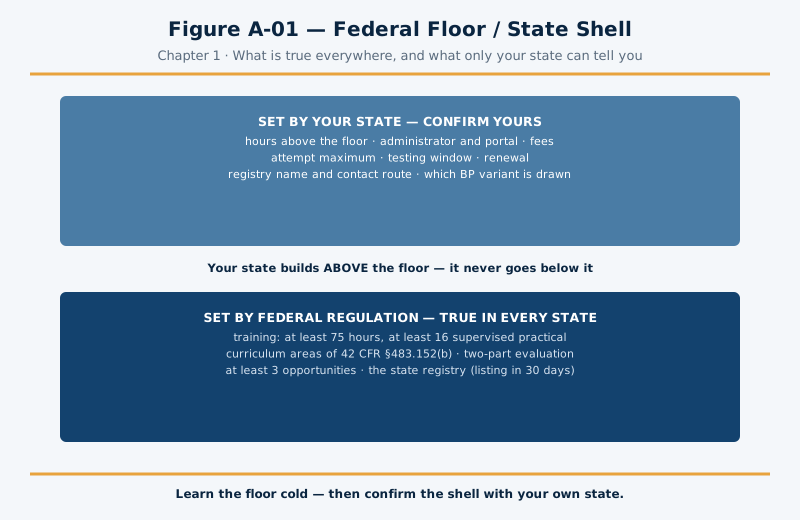
two stacked bands. The lower band, labeled "Set by federal regulation — true in every state," lists training minimums, curriculum areas, the two-part evaluation, at least three attempts, and the registry. The upper band, labeled "Set by your state — confirm yours," lists hours above the floor, administrator and portal, fees, attempt maximum, testing window, renewal, and registry contact.
Figure P-02 — The resident's room, arranged.
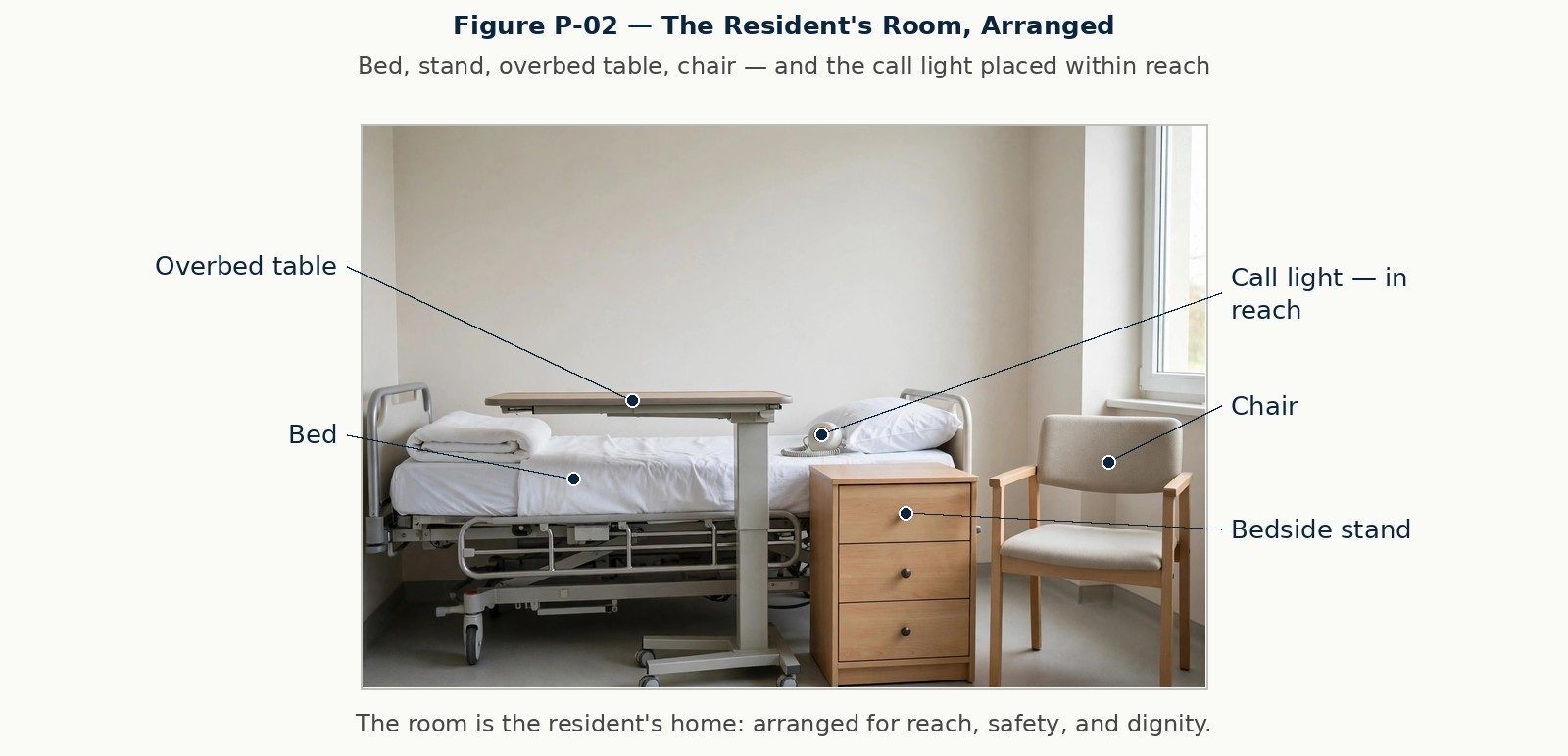
a resident's room drawn in plan view — bed with controls, bedside stand, overbed table, chair, and the call light placed at the bedside within the resident's reach — each element labeled.
Work all 16 items, then score with the companion key. (This book's guidance: 16 items, untimed.)
1. The federal training floor for a NATCEP is:
A. 60 clock hours, all classroom B. No less than 75 clock hours, including at least 16 hours of supervised practical training C. 120 clock hours in every state D. Whatever hours an employer prefers
2. The 16-hour pre-contact block must be completed:
A. Within the first year of employment B. Only by aides who work nights C. Before any direct contact with a resident D. After the skills evaluation
3. Which set lists only areas in the federal pre-contact block?
A. Communication; infection control; safety/emergency including the Heimlich maneuver; promoting independence; respecting residents' rights B. Medications; diagnosis; treatment planning; billing; staffing C. Vital signs; dentures; stockings; lifts; charting software D. Cooking; driving; housekeeping; laundry; maintenance
4. Both parts of the competency evaluation must be passed. The two parts are:
A. A drug test and a background check B. An interview and a physical examination C. A driving test and a first-aid card D. A written or oral examination, at the candidate's choice, and a demonstration of skills
5. A candidate who fails the evaluation must be advised that they have:
A. At least three opportunities to take the evaluation, and any state maximum may be no less than three B. Exactly one retake, nationally C. Unlimited attempts in every state D. No right to know which areas were not passed
6. A registry finding of abuse, neglect, or misappropriation:
A. Expires after one year B. Is kept private from all employers C. Remains permanently, unless it was made in error, the individual was found not guilty in court, or the State is notified of the individual's death D. Can be removed for a fee
7. The State must remove a registry entry (findings excepted) when the individual has:
A. Changed employers twice B. Performed no nursing or nursing-related services for 24 consecutive months C. Moved to another county D. Turned 65
8. Texas's verified training requirement, used in this book as a labeled example, is:
A. 75 hours exactly, like the floor B. 160 hours C. 40 hours D. 100 hours — 60 classroom and 40 clinical
9. In the NNAAP Skills Evaluation, the five skills always include:
A. Handwashing and exactly one measurement skill, with three randomly chosen from the published list B. Five measurement skills C. Whichever five the candidate prefers D. Medication administration and one transfer
10. The nurse aide's scope, stated correctly, is:
A. Diagnose, treat, measure, and report B. Measure, perform delegated personal-care and restorative tasks, observe, and report — under a licensed nurse's supervision C. Interpret findings and act on the interpretation D. Perform any task an employer assigns, trained or not
11. A resident's self-administration of her own medications is:
A. An aide task the aide performs for her B. Forbidden in all circumstances C. The resident's act, available only where the interdisciplinary team has determined it clinically appropriate — never an aide task D. Decided by the aide on each shift
12. Where a state permits aides to administer medications, the federal-floor lesson of this book is that it happens:
A. As part of ordinary CNA duties everywhere B. Under a separate medication-aide credential with its own training, permit, and examination C. Whenever a nurse is busy D. After 30 days of aide experience
13. The words resident and client in this field:
A. Name two different kinds of patients in the same building B. Name the same person — regulation says resident; the NNAAP outline and skills list say client C. Must never both appear in a candidate's hearing D. Differ because a client pays and a resident does not
14. A paid feeding assistant differs from a nurse aide in that the feeding assistant:
A. Holds the full aide credential plus a feeding endorsement B. May bathe and transfer residents but not feed them C. Completed a State-approved course of at least 8 hours covering feeding and related safety and rights topics, and is not a nurse aide D. Is a nurse aide who works only at meals
15. Your state's testing administrator, fees, and renewal cycle are facts you should take from:
A. A national table in any prep book B. Another state's handbook, since all states match C. Memory of what a classmate reported last year D. Your own state's program and your administrator's current candidate handbook, confirmed by the method in Chapter 27
16. A training program advertises 88 total clock hours, of which 14 hours are supervised practical training. Measured against the federal floor — no less than 75 clock hours in total, including at least 16 hours of supervised practical training — the program:
A. Fails the floor: the total clears 75 hours, but the 14 practical hours fall 2 hours short of the 16-hour practical minimum, and both floors must be met B. Meets the floor, because its 88 total hours exceed the 75-hour total C. Fails the floor, because its total exceeds the permitted maximum by 13 hours D. Meets the floor, because supervised practical hours count double toward the total
© 2026 Feras Alzubi
All rights reserved.
Mastering Careers & Skills
Built against the 2024 NNAAP Written (or Oral) Examination Content Outline (2019–2020 Job Analysis, NCSBN) and the federal nurse aide standard at 42 CFR Part 483.
This book is an independent study guide. It is not published by, affiliated with, endorsed by, or approved by the National Council of State Boards of Nursing (NCSBN), Credentia, Prometric, D&S Diversified Technologies (Headmaster), Pearson VUE, the Centers for Medicare & Medicaid Services (CMS), or any state nurse aide registry, licensing board, or agency, and none of them participated in its creation. NNAAP and exam names and trademarks belong to their respective owners. Nurse aide training, testing, and registry requirements are set by federal regulation and by your state, and change over time — always confirm your training program, your administrator's current candidate handbook, fees, and renewal rules with your state nurse aide program before you test. Passing any exam also depends on the candidate's own preparation; no book can guarantee a result, and no book is a training program: hands-on care skill is built in supervised training, on real people, under a nurse instructor.
Four consequences of those sentences are stated here at the front, not buried at the back.
First, this book teaches one credential, and names its basis everywhere. The credential is the state nurse aide credential — searched nationally as Certified Nursing Assistant (CNA) — earned by completing a state-approved training program and passing your state's competency evaluation. The book's exam spine is the National Nurse Aide Assessment Program (NNAAP), developed by the National Council of State Boards of Nursing (NCSBN) to meet the nurse aide evaluation requirement of federal and state laws. The written teaching is built against the 2024 NNAAP Written (or Oral) Examination Content Outline (based on the 2019–2020 Job Analysis and Knowledge, Skill, and Ability Study of Nurse Aides published by NCSBN in 2023, effective April 2024), and the skills teaching is built against the published NNAAP skills list of 23 skills, as published by Credentia. The wider teaching floor is federal: the nurse aide training and competency standards at 42 CFR Part 483, Subpart D, together with the resident rights regulation at 42 CFR Section 483.10, the freedom-from-abuse regulation at 42 CFR Section 483.12, and the Centers for Disease Control and Prevention (CDC) Standard Precautions. If NCSBN or your state publishes a successor outline, skills list, or handbook, this book's basis line will show its age on its face, which is exactly why the line is printed. Before you test, confirm in your administrator's current candidate handbook that the outline named here is still the outline of record.
Second, one federal floor, fifty state front doors — and this book never blurs the two. Federal regulation sets the floor every state must meet: at least 75 clock hours of training, at least 16 hours of supervised practical training, a 16-hour block before any direct resident contact, the curriculum areas, an evaluation with both a knowledge part and a skills demonstration, at least three opportunities to take the evaluation, and a state registry (42 CFR Sections 483.152, 483.154, and 483.156). Your state sets everything above that floor: its own training hours, its testing administrator and portal, its fees, its attempt maximum above three, its testing window, its renewal cycle, and its registry contact. Wherever this book touches something your state decides, you will find a shaded "Your state decides" box naming exactly what to confirm. This book prints no fee for any state, because fees are set by each state and administrator and change; it prints no percentage pass mark for the written examination, because the State establishes the standard for satisfactory completion (42 CFR Section 483.154(e)) and no state's cut score is stated in this book. A book that prints a number it cannot keep true becomes a wrong answer on a delay. This one teaches you where each state number lives and how to get the current one — Chapter 27 gives you the full method.
Third, the nurse aide's scope of practice is this book's first fence, and it is never lifted. The nurse aide works under the supervision of a licensed nurse, performing delegated tasks: measure, perform the personal-care and restorative tasks taught in this book, observe, and report. The aide does not diagnose, does not independently assess or interpret findings, does not give treatments or therapies outside the delegated task list, and does not perform any service for which they have not been trained and found proficient (42 CFR Section 483.152(a)(4)). In the federal curriculum's own words, the aide's clinical habit is to recognize abnormal changes in body functioning and report them to a supervisor (42 CFR Section 483.152(b)(2)(iv)). That is not cautious wording. It is the job, described accurately, and the examination tests it: options that ask the aide to diagnose, to interpret a finding and act on the interpretation, to administer medication, or to keep an abnormal change unreported are the examination's built-in wrong answers. Closely related: in the CNA role, the nurse aide does not administer medications. Medication administration appears nowhere in the federal curriculum floor. Where a state permits aides to give medications, it does so under a separate medication-aide credential with its own training, permit, and examination — Chapter 1 names the one verified example in this book, labeled Texas-only, and Chapter 25 restates the fence in professional terms.
Fourth, an honest word about hands-on skill, printed here in full because it governs the whole skills strand of this book.
This book teaches the knowledge and the sequences the skills evaluation grades — what each of the 23 skills is for, the order its steps run in, the steps that must never be missed, and how to record a measurement so it scores. It cannot teach your hands to transfer, bathe, feed, or measure a real resident, and no book can certify a care skill. Skill is built in training — in the laboratory and in supervised practical training, on real people, under a nurse instructor. What this book gives you is the understanding that makes that training learnable, and a complete map of what to go and practice.
You will meet that passage again at the head of Part VI and in Chapter 28. It is not fine print. It is the boundary of what any book can do, stated where a beginner needs it.
This book does not promise that you will pass any exam, earn any credential, get any job, or earn any income. It teaches nursing-facility care from zero — the facility, its residents, its team, and its language first, for the reader who has never been inside one — then teaches the complete federal curriculum floor and the full NNAAP written outline at depth, teaches all 23 published skills as knowledge and sequence, and drills you with original practice: a 50-item diagnostic with a skills self-inventory, a quiz at the end of every chapter — fifteen items in most chapters and more in the chapters whose calculation families required them (434 items), four 30-item domain-focused sets (120 items), two full practice tests at the real written examination's shape (140 items), and a separately counted layer of 12 skills-sequencing simulations (60 scored parts) — 744 multiple-choice items in all, every item explained right and wrong. That is what a study book can honestly do. You will find no pass rate, no salary figure, and no job-outlook figure for this credential anywhere in this book.
Provenance note. Every practice question and every simulation in this book is original. The questions were written fresh for this book, against the 2024 NNAAP Written (or Oral) Examination Content Outline (2019–2020 Job Analysis, NCSBN), the published NNAAP Skills List, 42 CFR Part 483, and CDC Standard Precautions. They are not the examination's questions. No real exam item is reproduced, recalled, paraphrased, or adapted anywhere in this book, and no skills-list step text or handbook prose is copied: skill names, counts, tolerances, and standards are stated as published facts with their sources named, and all step teaching is in this book's own words. Federal law requires the evaluation to be developed from a pool of test questions protected against disclosure (42 CFR Section 483.154(b)(1)); this book respects that design by teaching the published outline and the published skills, not by imitating protected material. Every item in this book was written to test something named, and the Outline Crosswalk appendix can show you, item by item, what each question was built to test.
A note on labels, because labels carry the facts in this subject. Every exam or program fact in this book carries its source in words where it appears: the regulation section, the NNAAP candidate handbook, the skills list, the CDC guideline, or the named state's own publication, dated. Guidance this book itself invented — practice sitting times beyond the real examination's, readiness thresholds, diagnostic bands, simulation scoring, and study plans — is labeled this book's guidance at every appearance. No blanket note substitutes for the label at the point of use.
A note on clinical numbers, because honesty about them is this book's discipline. The written outline tests data collection and reporting, and the skills list prints the tolerances a recorded measurement is scored against — for example, a radial pulse recorded within plus or minus 4 beats of the evaluator's reading. Neither the outline nor the skills list prints normal reference ranges for temperature, pulse, respirations, or blood pressure, and this book prints no normal-range table for them. Instead, the vital-signs chapters teach method, the errors that corrupt a measurement, the skills list's tolerances and rounding rules, and the duty that never changes: measure accurately, record exactly with its unit, compare the value with the resident's usual values as your assignment and care context give them, and report an abnormal change to the nurse. Where a practice item in this book turns on a range, the range is carried in the item's stem, so the item tests the duty — not a memorized table this book has not sourced. A book that guesses at clinical numbers teaches you to trust guesses. This one teaches you where the numbers live.
Two words for the same person. Federal regulation says resident; the NNAAP outline and skills list say client. This book uses resident as its default — it is the workplace word — and uses client where it is naming the outline's domains or a skill's published name. Chapter 1 names the equivalence once, so you meet both words on the real examination without surprise. Your state's exact title for the credential itself also varies; Chapter 27's method has you confirm it.
The author's name. The copyright holder's name appears on this page, on the cover, and in the store metadata, and nowhere else inside this book. The book stands on its sources, which are named wherever they are used and listed in full in the References.
Copyright © 2026 Feras Alzubi. All rights reserved. No part of this book may be reproduced, distributed, or transmitted in any form or by any means without the prior written permission of the copyright holder, except as permitted by law.
Everything on these pages traces to sources read on October 30, 2026: 42 CFR Part 483, Subpart D; 42 CFR Sections 483.10 and 483.12; Credentia's Colorado Nurse Aide Candidate Handbook (October 2024), carrying the 2024 NCSBN content outline; the Washington NNAAP Candidate Handbook; Credentia's published NNAAP Skills List; Credentia's current Washington handbook pages; the Texas Health and Human Services Commission (HHSC) nurse aide page; the California Department of Public Health (CDPH) training program page; Prometric's Louisiana nurse aide page; Headmaster's California page; and the CDC Guideline for Isolation Precautions, Appendix A, Table 4. Each figure carries its source. Where a figure could not be verified from such a source, these pages print no figure at all — and say so, because the silence is itself information.
| Element | Federal floor |
|---|---|
| Training total | No less than 75 clock hours |
| Supervised practical training | At least 16 hours, performing tasks on an individual under direct supervision of a registered nurse (RN) or licensed practical nurse (LPN) |
| Pre-contact block | 16 hours before any direct contact with a resident: communication and interpersonal skills; infection control; safety and emergency procedures, including the Heimlich maneuver; promoting residents' independence; respecting residents' rights |
| Curriculum areas | Basic nursing skills; personal care skills; mental health and social service needs; care of cognitively impaired residents; basic restorative services; residents' rights — plus the pre-contact block |
| Instructor frame | Training performed by or under the general supervision of an RN with at least 2 years of nursing experience, at least 1 year of it in long-term care facility services |
| Evaluation shape | The candidate's choice of a written or an oral examination, drawn from a secure question pool and addressing every curriculum requirement, plus a skills demonstration of randomly selected tasks; the task pool must include all the personal care skills |
| Passing | Both parts must be passed; the State sets the completion standard |
| Attempts | At least 3 opportunities; a state maximum may be no less than 3 |
| Registry | Listing within 30 days of passing; findings of abuse, neglect, or misappropriation remain permanently; removal after 24 consecutive months with no nursing or nursing-related services; no registration charges |
| Training charges | No charge to an aide employed by, or holding an offer from, a facility when training begins; pro-rata State reimbursement if employment follows within 12 months after completing |
(Source for every row: 42 CFR Sections 483.152, 483.154, and 483.156.)
The outline below is the 2024 outline, based on the 2019–2020 Job Analysis published by NCSBN in 2023, effective April 2024. Counts are of the 60 scored items. (Source: 2024 NNAAP Written (or Oral) Examination Content Outline, © NCSBN, as published in Credentia's Colorado Nurse Aide Candidate Handbook, October 2024.)
| Domain and subdomain | Share | Scored items | Taught in |
|---|---|---|---|
| I. Physical Care Skills — A. Activities of Daily Living (hygiene, dressing and grooming; nutrition and hydration; elimination; rest, sleep, and comfort) | 22% | 13 | Chapters 6–10 |
| I. Physical Care Skills — B. Basic Nursing Skills (infection control; safety/prevention/emergency; technical procedures; data collection and reporting) | 35% | 21 | Chapters 11–16 |
| I. Physical Care Skills — C. Self Care/Independence | 7% | 4 | Chapters 17–18 |
| II. Psychosocial Care Skills — A. Emotional and Mental Health Needs | 8% | 5 | Chapter 19 |
| II. Psychosocial Care Skills — B. Spiritual and Cultural Needs | 2% | 1 | Chapter 20 |
| III. Role of the Nurse Aide — A. Communication | 7% | 4 | Chapter 24 |
| III. Role of the Nurse Aide — B. Client Rights | 8% | 5 | Chapters 22–23 |
| III. Role of the Nurse Aide — C. Legal and Ethical Behavior | 5% | 3 | Chapter 25 |
| III. Role of the Nurse Aide — D. Member of the Health Care Team | 6% | 4 | Chapters 3 and 25 |
| Total | 100% | 60 | Domain totals: Physical Care Skills 64% (38 items); Psychosocial Care Skills 10% (6 items); Role of the Nurse Aide 26% (16 items) |
States contract their evaluations to different administrators, and assignments change. Verified for this book, each from that administrator's or state's own official source, dated October 30, 2026: Washington — Credentia (NNAAP), under contract with the Washington State Department of Social and Health Services; Texas — Prometric, with applications through the Texas Health and Human Services Commission's TULIP system; Louisiana — Prometric, under contract with the Louisiana Department of Health to develop and administer Louisiana's CNA Competency Evaluation Program; California — Headmaster (D&S Diversified Technologies), administering the examination through its TMU system, while certification itself stays with the California Department of Public Health. Washington's own history is the standing warning: its 2020 handbook named Pearson VUE as the contracted administrator, with Credentia working alongside; Washington has since moved to Credentia directly. Last year's handbook is not this year's.
This book therefore prints no 50-state table — not of administrators, not of fees, not of hours, not of renewal rules. A table this book cannot keep true becomes a lie on a delay. Instead, the dated State Variation Table (summary in Chapter 1; full table in Chapter 27) carries only rows verified from a state's own official source — at this edition, the federal floor, the Texas and California training anchors (Texas 100 hours; California 160 hours), the administrator assignments above, and Washington's attempt and renewal rows — and Chapter 27 teaches the method for confirming every remaining fact with your own state. Examination shapes for Prometric and Headmaster programs are not stated in this book: their candidate materials state their own shapes, and Chapter 27 sends you to the current handbook for your sitting's exact shape. The practice tests in this book rehearse the NNAAP shape and the shared federal core every state evaluation must address — federal law requires every evaluation to address each curriculum requirement (42 CFR Section 483.154(b)(1)) — and no practice test in this book wears another administrator's name.
This book follows a teach-then-test rhythm in every chapter: the idea in plain words; why it exists; the full teaching with its source named; a worked example inside a real caregiving situation; a task to do yourself; and a chapter quiz — fifteen items in most chapters and more in the chapters whose calculation families required them — whose key explains every right and wrong answer. Care chapters teach situation-first: you meet each concept inside a resident's morning — a bath to give, a meal to assist, a change to notice — and only then learn its formal name and rule, because the examination's items test duties performed in situations, not definitions in the abstract.
Figures. Wherever a chapter teaches a piece of equipment, an instrument, a document, or a physical process, a labeled figure stands at that teaching point, numbered P- for the physical subjects and A- for diagrams, each with a caption and a full text description. A reader who has never stood in a resident's room should be able to recognize the real bed, belt, bedpan, scale, or kit from its figure and find it in the room. Abstract diagrams are additional apparatus; they never substitute for the picture of the physical thing itself.
Abbreviations. Every abbreviation is expanded at its first use in every chapter. One discipline runs through the whole book: when in doubt, write it out — Chapter 4 teaches the safety discipline around abbreviations, and the chapters honor it.
Measurement: this book's signature method. Every measurement worked example, every measurement-skill treatment, and every designated measurement item in this book follows one visible method, without exception — Measure, Record, Report. Measure: the method in words, with the instrument named and shown. Record: the value written as the skills list requires — unit always, the rounding rule where the list states one, and the tolerance the recording is scored against. Report: a closing line stating what you do with the value — record it, compare it with the resident's usual values as given in your assignment or in the item's stem, and report an abnormal change to the nurse. Chapter 5 teaches the method in full; Chapters 13 and 14 spend it on every vital sign. An example that prints a bare value, drops its unit, or skips the report line has failed this book's own standard, and you will not find one.
The skills-sequencing simulations — how to work them. The skills evaluation is performed, not answered, so this book rehearses it in the closest form print allows. Twelve multi-part simulations (60 scored parts) stand in the back matter as their own section, counted separately from the multiple-choice items everywhere counts print. Each simulation presents itself the same way, so you learn the form once and then spend your attention on the skill: (1) a task brief naming the skill exactly as the published list names it and the resident situation it answers; (2) a workspace figure or exhibit — the room, the kit, the tray, or the measurement container, drawn or described so that every fact the scored parts need is printed on the page; (3) your answer on the page — for each scored part you order steps, select the action the situation requires, or record a measurement value with its unit, working in pencil as you would think aloud for an evaluator; and (4) a scored key that scores each part separately, explains why the keyed order, action, or recording scores, and explains why each wrong order, omission, or recording is unsafe or unscored — including, for measurement parts, the published tolerance the recording is scored against. Work a simulation cold before reading its key; then rework it after the related chapter. The simulations rehearse knowledge, sequence, and judgment. They do not rehearse your hands — the hands-on fence printed above governs every one of them, and it is repeated at the head of the simulation section itself.
Three paths, one book. If you have never been inside a nursing facility, read in order from Chapter 1 and do not skip Part I: it builds the facility, the credential's machinery, the team, the language, and the numbers from zero, because the federal curriculum itself starts exactly there — communication, infection control, safety, independence, and rights before any resident contact. If you are a student in a nurse aide training program, move at reading speed through what your classes have already made familiar, linger where this book's framing differs, and live in Parts II through V — daily care, safety and measurement, restorative care, and the rights, communication, and team chapters. If you are already booked to test, take the diagnostic first, score it by domain and subdomain, and let your weakest areas set your order — then finish in Part VI, the skills chapter and exam mastery, before the full practice tests.
The diagnostic and its tracker. The diagnostic test follows this front matter: 50 original items in one sitting of no more than 60 minutes — that sitting length is this book's guidance. Its items are proportioned to the outline's scored weights, with the rounding disclosed in the test's own headnote, and it is accompanied by a printed skills self-inventory: all 23 published skills, which you rate as seen, practiced, or never seen, so the skills strand gets a cold baseline just as the written strand does. Score the diagnostic with its companion key and record your results in the Diagnostic Results Tracker printed with the key: each domain and subdomain is reported as a count and a share, and the tracker points each weak area at the exact chapters to study and at the study plan that fits it. The diagnostic measures your starting point. It does not measure readiness, and no score on it is a prediction of any result.
Study plans — a two-week intensive plan, a four-week standard plan, and an eight-week from-zero plan for the reader starting in Part I — are printed in the back matter, each labeled this book's guidance. They are routes, not promises.
A word about the free sample. The free sample of this book is Chapter 1 plus the diagnostic test, so a buyer can judge the teaching quality and see their own starting point — scored by domain, with the chapters each score points to — before paying.
Edition line. This edition is built against the 2024 NNAAP Written (or Oral) Examination Content Outline (2019–2020 Job Analysis, NCSBN) and the NNAAP Skills List as published by Credentia, on the federal nurse aide floor at 42 CFR Part 483. Confirm your state's current candidate handbook before test day: outlines, skills lists, administrators, and state rules change, and your handbook — not any book, including this one — is your sitting's constitution.
End of the free sample. The complete book continues from here — the full A-to-Z course in book form, delivered as an EPUB you can read in Apple Books, Google Play Books, ReadEra, Thorium Reader, Adobe Digital Editions, or Send to Kindle.
Buy this ebook — $11.99 Back to the book page
Payments are securely processed by Payhip.