
Mastering Careers & Skills
CISSP Security Certificate (ISC2) · free sample from the book itself
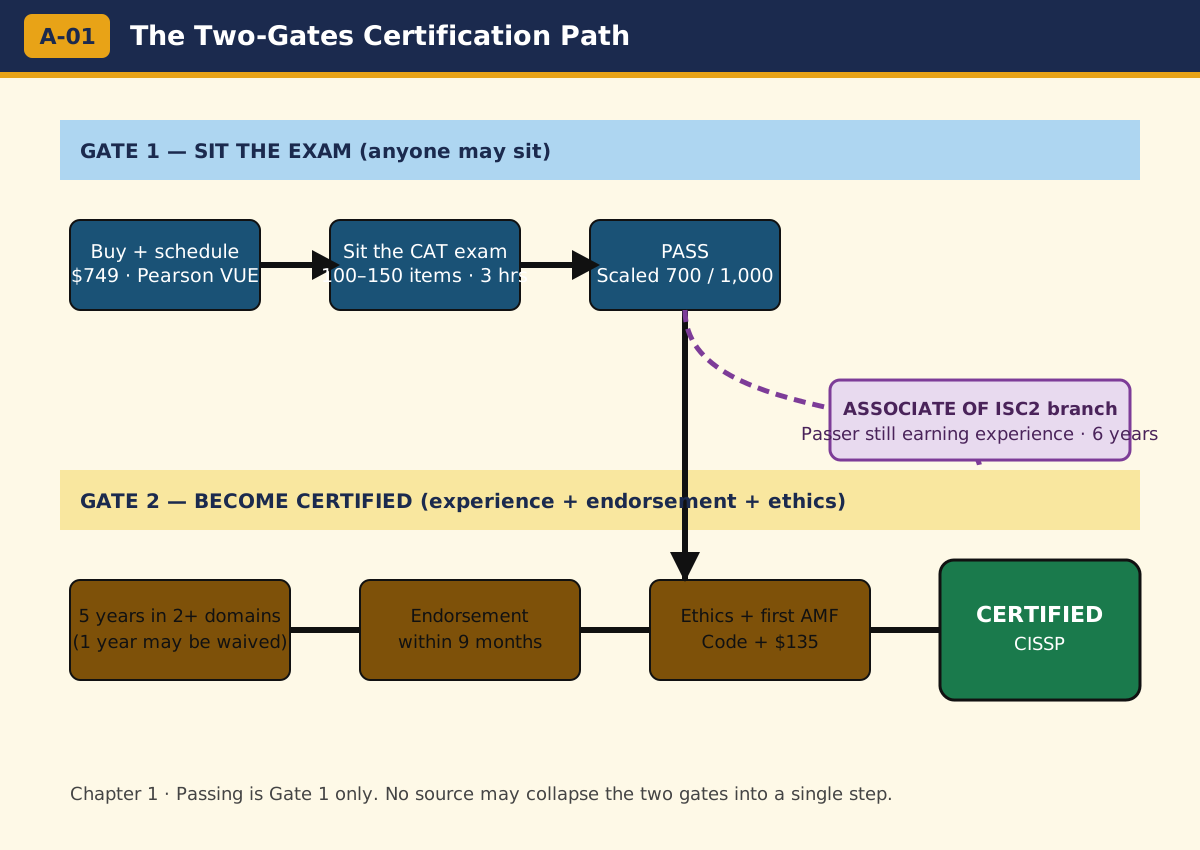
Everything in this book hangs on one distinction, so it stands on the first pages where it cannot be missed. Earning the CISSP credential involves two separate gates, and they are not the same gate described twice.
Gate 1 is sitting the exam. Any person may sit the CISSP examination. ISC2 publishes no requirement that a candidate hold work experience, a degree, or a sponsor's permission before testing. To sit, you create an ISC2 account, buy the examination, schedule it through Pearson VUE — ISC2's exclusive global exam administrator — inside your purchase window, meet the test-day rules (you must be 16 or older, and you must present identification that exactly matches your registration), and take the test. That is the whole of Gate 1. A neighbor who has never held a security job may lawfully buy a seat, sit the same adaptive examination as a twenty-year practitioner, and pass it. Nothing in that sentence is a loophole. It is the architecture ISC2 itself publishes, and this book teaches it exactly as published.
Gate 2 is certification. Passing the examination does not, by itself, make anyone a CISSP. After passing, a candidate must also demonstrate five years of cumulative, full-time work experience in two or more of the eight CISSP domains, complete an endorsement application — endorsed and digitally signed by an ISC2 certified professional in good standing, or, for candidates who know no such professional, endorsed by ISC2 itself on proof of employment — within nine months of the exam date, agree to the ISC2 Code of Ethics, and pay the first Annual Maintenance Fee (AMF) of U.S. $135. Only when all of that is complete is the certification awarded.
The passer who cannot yet show the experience is not turned away and is not in limbo. That passer becomes an Associate of ISC2, a real designation with its own rules: it may be held for up to six years, it costs U.S. $50 per year in AMF, it requires 15 continuing professional education (CPE) credits annually, and its digital badge deliberately does not name which examination was passed. When the Associate completes the experience requirement, applies for endorsement before the last day of the sixth year, and pays an upgrade AMF of U.S. $85, full certification begins on a fresh three-year cycle. This book never calls an Associate a CISSP, because ISC2 does not. If you remember nothing else from this chapter, remember the shape: sit, pass, prove, be endorsed, agree, pay — and only then, certified. Every later chapter, every form in this book, and every study plan in Chapter 1's closing pages keeps the two gates apart, because confusing them is the single most common misunderstanding new candidates carry into this credential — and the most expensive one, since a candidate who believes experience is required before testing may postpone a lawful exam sitting by years.
CISSP stands for Certified Information Systems Security Professional. It is ISC2's senior certification for experienced security practitioners, managers, and executives, and it validates deep technical and managerial knowledge and experience to design, engineer, and manage an organization's overall security posture. Read that last phrase slowly, because it explains the examination's character. The CISSP is not a test of whether you can configure a particular firewall — many excellent certifications test exactly that, and Chapter 32 explains how they fit together. The CISSP tests whether you can decide: which risk matters most, which control belongs first, which law constrains the design, which failure the organization can survive and which it cannot. Its questions reward the judgment of a security leader who understands the technology well enough to govern it. That is why experienced hands-on practitioners sometimes find this examination surprisingly hard, and why this book teaches both layers — the complete field of information security, from zero, and the managerial judgment the examination samples — rather than assuming either one implies the other.
The credential carries institutional weight that this book states only at the grain ISC2 publishes. CISSP was the first credential in the field of information security to meet the ANAB ISO/IEC Standard 17024, the international standard for personnel-certification bodies. ISC2 also lists CISSP as approved by the U.S. Department of Defense under DoDM 8140.03; this book prints that approval exactly in that form and no further, because role-level mapping detail belongs to ISC2's and the Department's own publications. ISC2 names the roles its CISSP holders occupy — Chief Information Security Officer, Chief Information Officer, Director of Security, IT Director or Manager, Security Systems Engineer, Security Analyst, Security Manager, Security Auditor, Security Architect, Security Consultant, and Network Architect among them. This book prints no salary figure, salary range, or pay premium for any of these roles, here or anywhere else. ISC2 publishes no such figure in its candidate materials, and a study guide that invents one would be teaching you to trust numbers nobody verified. Chapter 32 builds the career discussion from the roles themselves — what each role actually does, and how the credential supports it — which is the part a reader can act on.
ISC2 maintains the examination through a Job Task Analysis process: practicing professionals periodically re-examine what the work actually consists of, and the published outline is refreshed to match. The outline this book is built on is the CISSP Exam Outline effective April 15, 2024. Section 1.7 of this chapter carries an important notice about the outline that follows it; read that notice before you book anything, and then put it out of your study mind, because this edition teaches one outline only — the current one.
Figure A-01 (Chapter 1): The two-gates certification path. A flow diagram drawn for this book: buy and schedule → sit the CAT exam → pass → experience proof and endorsement within nine months → ethics agreement and first AMF → certified, with the Associate of ISC2 branch shown for passers still earning experience. Keep this picture in mind whenever any source — including careless ones — collapses the path into a single step.
Because Gate 1 is genuinely open, its requirements are procedural rather than professional, and each one is a place where an unprepared candidate can lose a fee. Walk them in order.
Buying the exam. You buy the CISSP examination in your ISC2 account. The standard registration fee is U.S. $749 for the Americas, Asia Pacific, the Middle East, Africa, and all other regions not separately listed; ISC2's pricing page lists EUR 719.04 for the EMEA region and GBP 606.69 for the United Kingdom, with taxes based on the location where the exam is administered and the currency details shown by Pearson VUE at registration. Those figures were read from ISC2's pricing page on November 3, 2026, for this book; fees are ISC2's to change, and the standing rule of this book — stated here once and repeated in Chapter 29 — is to re-check the live pricing page before you pay. A standard exam-only purchase gives you 365 days to schedule and sit, for one attempt; if you do not sit within that window, the fee is not refunded. ISC2 also offers a purchase with Peace of Mind Protection, which carries a 180-day window and two attempts; this book prints the window and the attempts — the facts ISC2 publishes on its certification page — and routes you to ISC2's store for that product's current price rather than printing a price this book did not verify. Rescheduling a confirmed appointment costs U.S. $50 and cancelling costs U.S. $100; under ISC2's current scheduling rules an appointment cannot be rescheduled once it is within 24 hours of its start.
Where you may sit. The examination is delivered only at ISC2 Authorized PPC and PVTC Select Pearson VUE testing centers. There is no at-home, online-proctored, training-event, or mobile-facility route in anything ISC2 publishes. Anyone selling you a "take CISSP from your couch" arrangement is selling something ISC2 does not offer.
Test-day gates. Arrive at least 30 minutes early; arriving within 15 minutes of the start risks being recorded late and losing the seat. You must be 16 years old or older to sit for an ISC2 examination; candidates aged 16 and 17 test with a parent or guardian under ISC2's Minor-Guardian Log Sheet procedure. Bring two forms of identification: a primary ID bearing your photo and signature, unexpired and in its original form, and a secondary ID bearing your signature. Your first and last names must exactly match the name on your Pearson VUE registration — a mismatch means no testing and no reimbursement, corrections run through ISC2, web updates are possible up to 48 hours before the appointment, and no changes can be made on test day. At check-in your photograph is taken and a palm-vein scan is enrolled; you will be scanned again before and after any break. You will complete a self pat-down and screening under the center's Zero Tolerance Electronic Policy — phones, recording devices, and all electronic devices are prohibited, and Pearson VUE screening includes infrared and metal-detection wands under its June 2026 Exam Agreement update. You are issued an erasable note board. Then, seated, you will be given three minutes to review and accept the nondisclosure agreement. Declining it ends the day: no examination and no refund. The NDA is not a formality. Violating the Examination Agreement — for example by releasing Pearson VUE credentials to unauthorized third parties or disclosing examination content — can result in immediate and permanent termination of an exam result or of certifications. This book stands entirely on the lawful side of that line: it teaches ISC2's published outline, and it contains no ISC2 examination questions — not actual ones, not recalled ones, not paraphrased ones. Every question in these pages was written for this book.
Accommodations exist and are arranged the opposite way from what many candidates assume: you contact ISC2 first, before registering, submitting the Examination Accommodation Form with an explanation, supporting documentation, the exam, and the location. Decisions are individualized and case by case; approved accommodations are forwarded to Pearson VUE Accommodations, after which scheduling happens by phone. Accommodations provide access; ISC2 is explicit that they do not guarantee performance or completion.
The CISSP examination is a Computerized Adaptive Test — a CAT — for every candidate, in every language, worldwide. There is no linear, fixed-form version of this examination anymore; older material describing a 250-question, six-hour linear exam, or non-English linear exams, describes a retired arrangement, and this book mentions those numbers only here, once, labeled retired, so that you can recognize stale sources when you meet them. The current facts, as ISC2 publishes them, are these.
The examination presents between 100 and 150 items and allows 3 hours maximum, with no minimum time. Inside the minimum length sit 25 pretest items — unscored questions ISC2 is trialing for future use. They are indistinguishable from the scored, operational items around them, so the only workable strategy is the one ISC2 itself gives: answer every item as if it counted, because you cannot tell which ones do not. Items are multiple choice and advanced item types: ISC2 lists calculation items, ordered response, drag and drop, hot spots, scenario-based items, and video-based items, and any type may carry multimedia such as charts and tables. A single scenario may carry more than one item — a pattern this book's scenario practice deliberately rehearses. Chapter 30 teaches each published type in turn.
Adaptivity works as ISC2 describes it, and this book describes it no deeper than ISC2 does. Your first item is well below the passing standard — deliberately easy, so do not be rattled by an easy opener, and do not be flattered either. After every answer, the algorithm re-estimates your ability from the difficulty of everything presented and everything you answered, and selects the next item at roughly the difficulty where you have about a 50 percent chance of answering correctly. Two consequences follow. First, a well-run CAT feels relentlessly borderline: if the examination feels like a string of coin flips, the algorithm is doing its job, not failing you. Second, content arrives in no sections and no domain order — a cryptography item may follow a personnel-policy item — while every examination is nonetheless constructed to honor the published domain weights whatever its final length. There is no item review: once an answer is finalized it cannot be revisited or changed, so each item gets your best judgment the one time you see it. Breaks are unlimited in number and duration, but every minute of break time counts inside the three hours. The examination is offered in Chinese, English, German, Japanese, and Spanish, all in CAT form; Chinese-language CISSP examinations are available only in the windows of March, June, September, and December each year.
Scoring. The passing standard is a scaled score of 700 out of 1,000. That sentence is the most misread sentence in this field, so this book states it in ISC2's own framing every time: 700 is a scaled score, produced by a standard-setting process in which CISSP subject-matter experts, guided by a psychometrician, applied the Modified Angoff method against a definition of the minimally competent candidate. It is not 70 percent correct, it does not correspond to any fixed count of right answers, and ISC2 states expressly that there is no predetermined fixed percentage of candidates who pass or fail. ISC2 publishes no pass rate for this examination; any pass-rate number you encounter elsewhere is, by that fact alone, not ISC2's. The examination is compensatory: a single pass-or-fail result is calculated across all operational items, so strength in one domain can offset weakness in another, and a candidate is not required to be above proficiency in every domain. You receive an unofficial result from the proctor at checkout and the official result by email. No numerical score is ever provided — not to those who pass, not to those who fail. A candidate who fails additionally receives, at the test center, a proficiency level for each domain — Below, Near, or Above proficiency — plus a rank ordering of the domains, which is diagnostic guidance for the next attempt, not a score report. Results can occasionally be delayed six to eight weeks for psychometric analysis, and results are never released by phone.
How an adaptive exam ends. ISC2 publishes three decision rules, and Chapter 29 teaches them at full depth; the glance version belongs here. Under the 95% Confidence Interval Rule, once you have answered the 100-item minimum, the exam ends as soon as your ability estimate excludes the passing point with 95 percent statistical confidence — clearly above, and you pass; clearly below, and you do not. Under the Maximum-Length Rule, if the first rule has not fired by 150 items, your final ability estimate is compared with the standard. Under the Run-Out-of-Time Rule, if the three hours expire first, you pass only if your ability estimate was consistently above the passing standard across the last 75 operational items you answered — a single dip below the standard inside those 75 items makes the result a fail, the confidence interval plays no part, and a candidate who answered fewer than 75 operational items in three hours automatically fails. Hold on to the practical moral, because ISC2 states it plainly: rapid guessing on a CAT examination can be disastrous — guessed-wrong answers draw easier items and drag the ability estimate down — so the doctrine is a steady pace of roughly one to two minutes per item, every item answered deliberately, with no end-of-exam sprint. There is likewise no meaning to read into where your exam ended: finishing at 100 items tells you nothing by itself, whatever forum folklore claims.
If you must retake, the waiting rules are 30 test-free days after a first attempt, 60 after a second, and 90 after a third and any later attempt, with a maximum of four attempts in any 12 months, each at the standard fee. Chapter 31 and the study plans in §1.9 build retake sprints around ISC2's own proficiency report, because that report — Below and Near domains, in ISC2's bands — is the most honest diagnostic a retake candidate owns.
The examination samples eight domains of professional practice, weighted as ISC2 publishes them in the outline effective April 15, 2024. These are average examination weights: every CAT examination is built to comply with them, at whatever length it runs. The proportions also organize this book — Part II teaches the domains in nineteen chapters, and the diagnostic, quizzes, and practice forms follow the same weights with their rounding disclosed where they appear. No finer proportions exist: ISC2 publishes exactly one per-task annotation in the entire outline (Domain 1's ethics task is annotated at two to four items), and this book invents no sub-weights beyond ISC2's grain.
Domain 1, Security and Risk Management, carries 16 percent — the largest share — and spans professional ethics, the core security concepts, governance principles, legal and compliance issues, investigation types, the policy framework, business continuity requirements, personnel security, risk management, threat modeling, supply-chain risk, and security awareness programs. Chapters 6 through 8 teach it. Domain 2, Asset Security, carries 10 percent: classifying and owning information and assets, handling requirements, provisioning, the data life cycle, retention, and data security controls; Chapters 9 and 10. Domain 3, Security Architecture and Engineering, carries 13 percent: secure design principles, security models, control selection, system security capabilities, architectural vulnerabilities, cryptography and cryptanalysis, site and facility design and controls, and the system life cycle; Chapters 11 through 13. Domain 4, Communication and Network Security, carries 13 percent across only three broad tasks — network architecture design principles, secure network components, and secure communication channels — which makes it the most concentrated domain on the outline; Chapters 14 and 15. Domain 5, Identity and Access Management, carries 13 percent: physical and logical access control, identification and authentication strategy, federated identity, authorization mechanisms, the identity life cycle, and authentication systems; Chapters 16 and 17. Domain 6, Security Assessment and Testing, carries 12 percent: assessment strategies, control testing, collecting security process data, analyzing test output, and audits; Chapters 18 and 19. Domain 7, Security Operations, carries 13 percent across fifteen tasks — the broadest domain, running from investigations, logging, and configuration management through incident management, patching, change, recovery, disaster recovery, continuity exercises, physical security, and personnel safety; Chapters 20 through 22. Domain 8, Software Development Security, carries 10 percent: security in the development life cycle and development ecosystems, assessing software security effectiveness, acquired software, and secure coding; Chapters 23 and 24.
One cross-cutting fact deserves its own sentence. ISC2 states that artificial-intelligence security is interwoven across all eight domains rather than isolated in a ninth — algorithmic bias, data poisoning, adversarial attacks, and defensive automation appear wherever they naturally belong. This book teaches them the same way: inside the domain chapters where the outline places the surrounding material, never as a bolted-on afterthought and never as a separate syllabus ISC2 did not publish.
Two hundred published subtasks sit beneath the 62 tasks, and Appendix A maps every task, paraphrased in this book's own words, to the chapters that teach it. That crosswalk is the book's completeness contract for the exam layer: if a task is on ISC2's outline, it is taught here, and the crosswalk shows where.
Gate 2's arithmetic matters enough that this book works it rather than summarizing it, and Chapter 31 works it again with full examples. Experience means five years, cumulative, full-time, in work related to two or more of the eight domains — the domains need not be the two you feel strongest in, and the years need not be consecutive. ISC2 accounts time monthly: a full-time month is at least 35 hours per week for four weeks. Part-time work between 20 and 34 hours per week converts at 1,040 hours equals six months and 2,080 hours equals twelve months. Internships, paid or unpaid, may count, supported by documentation on the organization's letterhead (a school internship uses the registrar's stationery). One year — and only one year — may be waived, satisfied either by a bachelor's or master's degree in computer science, information technology, or a related field, or by holding one credential from ISC2's Approved List as ISC2 publishes it. The two routes never stack: a candidate with both the degree and a listed credential still waives exactly one year and owes four. This book prints the Approved List as ISC2 published it on November 3, 2026 — among its entries are credentials from AWS, Cisco, CompTIA, GIAC, Microsoft, and Zscaler, and ISC2's own CCSP, CGRC, CSSLP, HCISPP, SSCP, and the ISSAP, ISSEP, and ISSMP concentrations — but the list is ISC2's to change, so the book's instruction is to confirm your credential on the live experience-requirements page before relying on the waiver, and Chapter 31 prints the full dated snapshot with that instruction attached.
Endorsement is the verification step. Within nine months of your exam date, you submit the certification application, and an ISC2 certified professional in good standing — someone who can attest to your professional experience and standing in the industry — endorses and digitally signs it; the application asks for that endorser's Member ID and surname. If you know no such professional, you may ask ISC2 itself to endorse you, which requires proof of employment. A percentage of applications are randomly selected for audit and must supply additional verification, with notification by email — one more reason Chapter 31 urges preparing documentation before test day rather than after it. On approval you agree to the ISC2 Code of Ethics — whose four canons Chapter 6 teaches in full: protect society, the common good, necessary public trust and confidence, and the infrastructure; act honorably, honestly, justly, responsibly, and legally; provide diligent and competent service to principals; and advance and protect the profession — and you pay the first AMF of U.S. $135, which is a single annual fee covering all ISC2 certifications you hold, however many that becomes.
Maintenance thereafter runs in three-year cycles: 120 CPE credits per cycle — 90 Group A credits in domain-related activity plus 30 further credits that may be Group A or Group B — with ISC2 suggesting a pace of about 40 per year. Suggested means suggested: for certified members there is no annual CPE requirement, and any source insisting you must earn 40 every year is adding a rule ISC2 does not impose. (Associates are the exception — their 15 credits per year are a hard annual requirement, which is one of several places where the Associate's rules are stricter than the member's, not looser.) Excess Group A credits earned in a cycle's last six months may roll over, capped at 40; Group B credits never roll over. The AMF of $135 falls due on each certification anniversary. After a cycle ends there is a 90-day grace period; suspension can last up to two years; after that comes termination, and reinstatement then requires retaking and passing the examination — a sentence worth reading twice before letting a cycle lapse casually.
ISC2 has announced that effective April 15, 2027, the CISSP examination will be based on a new exam outline. In that outline, Domain 1 is renamed Security Governance and Risk Management, and the domain weights become 13.6, 12, 12.8, 12.8, 13.6, 11.2, 12.8, and 11.2 percent respectively; the examination's CAT form, length, time, and scaled passing standard are unchanged in the announcement. Here is the discipline this edition applies, and the only thing you need to do with this information. This book is built entirely on the outline effective April 15, 2024, which governs every examination taken before April 15, 2027. The 2027 weights, the renamed domain, and its task changes are never blended into this edition's teaching, crosswalk, quizzes, or forms — mixing two outlines would corrupt both. If your test date falls on or after April 15, 2027, obtain the new outline from ISC2 and prepare against it; an edition built on that outline is a separate book, not a patch to this one. If your test date falls before it, the notice has done its job the moment you have confirmed which side of the line you sit on. The Errata and Edition Note at the back of this book repeats the notice and records this edition's pre-release re-verification of ISC2's outline page, as series discipline requires.
This is an independent study guide by Feras Alzubi. It is not published, endorsed, sponsored, or approved by ISC2, and CISSP and ISC2 are registered trademarks of the International Information System Security Certification Consortium, Inc., used in this book nominatively — to identify the credential the book prepares you for — and in no other way. The book contains no ISC2 examination questions, reproduces no ISC2 text, and claims no ISC2 review of any page.
Because honesty about sources cuts both ways, Chapter 1 also names the official ecosystem you should know exists. ISC2 publishes the Exam Outline and Detailed Content Outline themselves, with a Supplementary References list; it sells official training in online self-paced form (90-day and 180-day access) and online instructor-led form, with and without exam bundles; and its official book line, published by Wiley's Sybex imprint, currently offers the Official Study Guide, 10th Edition, updated for the 2024 outline, and the Official Practice Tests, 4th Edition. Those practice questions are ISC2 and Wiley's copyrighted items; this book never reproduces, paraphrases, or adapts them, and refers you to the originals precisely because they are the originals. A serious candidate uses the outline directly — it is free, it is authoritative, and Appendix A is built to be read alongside it.
What this book adds is the layer the outline presupposes. An outline can list "risk management concepts" in three words; it cannot teach a reader who has never computed an annualized loss expectancy, never seen a subnet divided, and never worked inside an organization's policy hierarchy. This book's promise is dual, and it is the promise of its series: complete knowledge of information security for the reader who starts from zero, and complete mastery of the CISSP examination and certification path as ISC2 publishes them — both, in one volume, with neither thinned to make room for the other.
Start with the diagnostic. Immediately after this chapter sits a 60-item diagnostic, proportioned to the published domain weights, untimed by design. Its report shows your correct count per domain family, names your three weakest families, and routes you to chapters. It issues no readiness verdict and no pass probability, deliberately: ISC2's standard is a scaled 700 on an adaptive examination, and a fixed diagnostic measures knowledge coverage only. Anyone who converts your diagnostic percentage into a prediction about the CAT is inventing a relationship ISC2 does not publish and this book will not fake.
Choose your path by experience, not by pride. Part I — Chapters 2 through 5 — builds the foundations from zero: computing and networking, security thinking, the mathematics of security, and how organizations work. The Experienced Practitioner profile (five or more qualifying years) may move through Part I at reading speed, but should not skip Chapter 4's worked arithmetic or Chapter 5's governance vocabulary, because the examination tests both in its own idiom. The Mid-Career Adjacent Professional — two to five years in IT, networking, development, audit, or operations — works Part I in full, then Part II's nineteen domain chapters in order, then Part III's scenario and quantitative studios, sitting this book's three full-length forms at spaced intervals. The Associate-Path Candidate — little or no qualifying experience yet — takes the longest runway: all of Part I, all of Part II, all of Part III, the forms benchmarked below, then the examination, then Associate status and Chapter 31's six-year experience-tracking method, which turns the waiting years into a documented accrual plan instead of a delay. The Retake Candidate starts from ISC2's own proficiency report: Below and Near domains map through Appendix A to chapters, families, and this book's targeted repair sets, on a sprint matched to ISC2's test-free windows — 30, 60, or 90 days — with one full form per sprint.
About the practice forms, honestly. A book cannot adapt, so this book does not pretend to. Its three full-length forms are fixed linear forms of 150 items — the CAT maximum — taken in three hours and proportioned to the published weights, labeled everywhere as linear knowledge-check forms, not CAT simulations. Each form quietly includes 25 items that are flagged only in its answer key as rehearsal-pretest items: you sit them unidentified, exactly as ISC2 describes the real mechanism, and the form's report scores the remaining 125. The book's study benchmark — 75 percent or better on the operational items of two consecutive forms, with no domain below 65 percent — is printed wherever the forms are introduced with its label attached: a study discipline set by this book; ISC2 publishes no equivalent percentage and none is implied. Chapter quizzes close Chapters 2 through 31 at twenty items each; scenario capstone sets and five repair sets complete a program of 1,385 original questions, every one fully explained — the key, and why each wrong answer is wrong, and what misconception that wrong answer encodes.
Figures. Sixty figures support the teaching: thirty-one photographs of the physical subject matter of this field — the inside of a computer, a hardware security module, a mantrap, biometric readers, media-destruction equipment — made for this book with their parts labeled at the teaching point, plus twenty-nine diagrams of structures and flows. Where a physical subject exists, this book shows the physical subject; a flowchart is never offered in its place.
A last word before the foundations. The CISSP rewards a particular posture: risk before technology, people and process before products, the organization's mission before the security team's preferences. You will meet that posture as the Manager's Lens in Chapter 28, but it is seeded from Chapter 3 onward, because it cannot be crammed in the final week — it is a way of reading every fact in Part II. Begin with Chapter 2 if computing itself is new to you; begin with the diagnostic either way. The two gates are clear, the outline is public, and the path from wherever you stand to certified is longer than a weekend and shorter than a mystery. This book walks all of it.
Chapter 1 carries no quiz. The 60-item Diagnostic follows this chapter; Chapter 2 begins Part I's foundations teaching and carries the first chapter quiz.
Credentials are moving targets, and a responsible study guide says plainly what it is built on and what it will do when the ground shifts. This edition's statement is short. This book is built on the CISSP Exam Outline effective April 15, 2024. Its framework facts — weights, format, fees, eligibility rules, and procedures — were verified against ISC2's own pages and publications on November 3, 2026, and the register of those sources stands behind every factual claim in Part IV. Before release, the production process re-reads ISC2's outline page, CAT page, pricing page, experience page including the Approved List, endorsement and Associate pages, the current Candidate Information Bulletin, and Pearson VUE's ISC2 page, and prints the re-read date in the Errata and Edition Note. The stop rule attached to that re-verification is absolute: if any load-bearing fact has changed, the affected chapters, form compositions, appendices, and listing copy are conformed before release, or the book does not ship. Fees illustrate why the rule exists. A fee is a fact with a date attached, not a permanent property of the universe; the $749 in §1.3 is the fee ISC2 published on the day this book's sources were read, and the instruction printed beside it — re-check the live page before paying — is part of the fact, not a disclaimer pasted over it. The same discipline explains several deliberate silences in this book. Where ISC2 publishes no figure — no pass rate, no salary data, no per-task weights beyond the one annotation — the book prints the absence rather than filling it with a plausible number, because a candidate who learns to distrust invented precision in a study guide carries that distrust into risk registers, audit findings, and board papers, where it is worth considerably more than it is here.
Readers holding this book after April 15, 2027 should reread §1.7 before anything else: the outline governing their examination will be the new one, and this edition's proper use for them is as a field textbook whose exam layer must be re-pointed at ISC2's current outline. Readers testing before that date need no such caution. Either way, the two gates, the CAT mechanics, and the certification path described in this chapter are the stable skeleton: outlines refresh on Job Task Analysis cycles, but the architecture of sit, pass, prove, certify is the credential's design, not one edition's accident.
It helps to end the orientation chapter with the whole journey in view, in the order you will actually live it. You will spend most of your hours in Parts I and II, learning a field — some of it (Chapter 2's networks, Chapter 4's arithmetic) entirely new, some of it a formalization of things your hands already know. Part III will then change the question from do you know it to can you judge with it, in scenario studios and a quantitative workshop that stretch the same material under time and ambiguity. Part IV turns outward: Chapter 29 walks the CAT mechanics and test day at full procedural grain, Chapter 30 teaches the craft of reading this examination's items — scenario stems, qualifiers such as BEST, MOST, and FIRST used with discipline, and the published advanced item types — Chapter 31 works endorsement, the Associate path, ethics in practice, and maintenance end to end, and Chapter 32 places the credential in a career without mythology. Four cheat sheets, a glossary of roughly five hundred terms in this book's own words, and three appendices — the outline crosswalk, the certification-path map, and an orientation to ISC2's adjacent credentials, which this book maps but does not teach toward — close the volume. Nothing in that journey requires you to have been a security professional before page one. It requires only that you refuse to skip the foundations, answer every practice item as if it counted, and keep the two gates separate in your mind from this page forward. Turn to the diagnostic, take it cold, and let its report — not your hopes — choose your first study profile.
A word about ISC2 itself, because candidates who understand the certifying body read its rules more sensibly. ISC2 — the International Information System Security Certification Consortium, Inc. — is the professional body that owns and maintains the CISSP and a family of related certifications, from the entry-level Certified in Cybersecurity through specialist credentials in cloud security, governance and risk, secure software, health-care security, and the advanced architecture, engineering, and management concentrations. Appendix C orients you to each of those at one-paragraph grain; this book prepares you for CISSP alone and says so, because a guide that quietly teaches toward six credentials teaches toward none of them properly. ISC2's role in your journey is threefold, and keeping the three roles separate prevents most administrative confusion. ISC2 is the rule-maker: it publishes the outline, the experience and endorsement rules, the Code of Ethics, and the maintenance requirements, and it alone can change them — which is why this book routes you to ISC2's live pages for every fact that can expire. ISC2 is the examiner: it owns the item pool, sets the passing standard through its standard-setting process, and decides results, while Pearson VUE acts as its exclusive delivery administrator — the centers, the check-in, the proctors, and the scheduling machinery are Pearson's, but the examination, the standard, and the result are ISC2's. And ISC2 is the community of record after you certify: your endorser is drawn from its certified membership, your AMF and CPE records live with it, and the Associate designation — for readers on that path — is membership in that community while experience accrues. When a question arises that this book cannot answer because the answer is a live ISC2 decision — a changed fee, a revised list, an accommodation ruling — the correct move is never to guess from a forum. It is to read the answer on the page of the body that owns the decision, which is the habit this chapter has tried to model from its first paragraph.
The Complete Information Security Course — 1,385 Practice Questions, Diagnostic & 3 Linear Forms, Every Answer Explained
The Complete Information Security Course — 1,385 Practice Questions, Diagnostic & 3 Linear Forms, Every Answer Explained
Google Play Books Exam Prep Series — Book 50
Feras Alzubi
Front matter — Copyright Page and disclosure · Exam Blueprint Page · How to Use This Book
Part I — Foundations from Zero
Entry Diagnostic — 60 items, untimed, with per-domain routing (presented after Chapter 1)
Part II — The Eight Domains in Full
Part III — The Advanced and Scenario Layer
Part IV — The Exam and the Certification Path
Practice layer — Chapter quizzes (Chapters 2–31, 20 items each, every answer explained) · Three full-length linear practice forms (150 items each) · Three scenario capstone sets (50 items each) · Five repair sets (25 items each)
Back matter — Appendix A: Outline Crosswalk · Appendix B: Certification-Path Map · Appendix C: Adjacent ISC2 Credentials · Glossary · Cheat Sheets 1–4 · Study Plans · References · Errata & Edition Note
What this book is. A complete study guide with two purposes, held simultaneously and never traded against each other: complete knowledge of information security for the reader who starts from zero — computing, networking, risk mathematics, and organizational literacy taught from the ground up in Part I — and complete mastery of the CISSP examination and certification path as ISC2 publishes them: all eight domains at their published weights, the adaptive (CAT) mechanics and decision rules, endorsement, the Associate of ISC2 path, ethics, and maintenance.
Two gates, never merged. Anyone may sit the examination: Gate 1 is purchase, scheduling, age 16 or older, and the test-day identification rules — no experience, degree, or sponsorship is required before testing. Certification — Gate 2 — additionally requires five years of cumulative full-time experience in two or more of the eight domains (up to one year waivable, never stacked), endorsement completed within nine months of the exam date, agreement to the ISC2 Code of Ethics, and the first Annual Maintenance Fee. A passer who cannot yet show the experience holds the Associate of ISC2 designation, with up to six years to complete the requirement. Every chapter, form, and appendix in this book keeps the two gates distinct, and so must every statement you make about your own status.
The honesty passages — read these before the practice layer. (1) This book's forms are not the exam. The real CISSP examination is an adaptive test that ends between 100 and 150 items under ISC2's decision rules. A book cannot adapt, so this book's full-length forms are fixed linear forms of 150 items, honestly labeled everywhere they appear as linear knowledge-check forms built by this book — not CAT simulations, claiming no adaptive equivalence. Each form flags 25 items in its answer key only as rehearsal-pretest items: sat unidentified, excluded from the form's report, exactly as ISC2 describes pretest mechanics. (2) No percentage in this book is ISC2's standard. ISC2's passing standard is a scaled score of 700 out of 1,000 on an adaptive exam; no linear-form percentage equals it or predicts it. This book's study benchmark — 75% or better on the operational items of two consecutive forms, with no domain below 65% — is a study discipline set by this book, labeled as book design wherever it appears. ISC2 publishes no equivalent percentage and none is implied. (3) No statistics are invented. ISC2 publishes no pass rate, and this book prints none; ISC2's own standard-setting statement — there is no predetermined percentage of candidates who pass or fail — is the book's printed answer to every pass-rate claim. No salary figure appears anywhere in this book.
How to study. Take the 60-item diagnostic after Chapter 1 and let its per-domain report set your emphasis; it carries no readiness verdict and no pass probability. Beginners read Part I in full, in order — the examination assumes the foundations even where a job did not teach them. Experienced practitioners may read Part II in domain order and use Part I as targeted repair. Work every worked example with pencil in hand, take each chapter quiz untimed, and read every explanation — including for items you answered correctly. Close your preparation with the three linear forms under timed conditions, the repair sets your form reports name, and Chapters 29–31 in the final fortnight. Choose the study plan in the back matter that matches your experience profile — experienced practitioner, mid-career adjacent professional, Associate-path candidate, or retake candidate — and re-check every fee, window, and outline edition on ISC2's live pages before booking.
Free sample boundary. The free sample of this book comprises the front matter, Chapter 1 entire, and the 60-item entry diagnostic with its key and routing.
The framework. CISSP — Certified Information Systems Security Professional — is ISC2's senior information-security certification: one adaptive (CAT) exam of 100–150 questions in up to 3 hours across eight domains, built on ISC2's exam outline effective April 15, 2024, with a scaled passing standard of 700 out of 1,000. Passing the exam is the first of two gates: certification also requires five years of verified experience, endorsement, and the ISC2 Code of Ethics — this book teaches both gates exactly as ISC2 publishes them, including the Associate of ISC2 path for passers still earning experience.
The eight domains and their average examination weights (ISC2's CISSP Exam Outline, effective April 15, 2024):
| # | Domain | Weight |
|---|---|---|
| 1 | Security and Risk Management | 16% |
| 2 | Asset Security | 10% |
| 3 | Security Architecture and Engineering | 13% |
| 4 | Communication and Network Security | 13% |
| 5 | Identity and Access Management (IAM) | 13% |
| 6 | Security Assessment and Testing | 12% |
| 7 | Security Operations | 13% |
| 8 | Software Development Security | 10% |
The CAT examination, as ISC2 publishes it. Every candidate, in every language, tests in Computerized Adaptive Testing form at ISC2 Authorized PPC and PVTC Select Pearson VUE centers only; there is no home-testing route. The exam runs 100–150 items in a maximum of 3 hours with no minimum time; 25 of the items are unscored pretest items, unidentified, inside the minimum length. Items are multiple choice and advanced types — calculation, ordered response, drag and drop, hot spots, scenario-based, and video-based. The first item is well below the passing standard; ability is re-estimated after every answer and the next item is targeted near a 50% chance of success; content is not sectioned or domain-ordered; a finalized answer cannot be reviewed or changed; breaks are unlimited but all break time counts. Three decision rules end the exam: the 95% Confidence Interval Rule (from 100 items), the Maximum-Length Rule (at 150 items), and the Run-Out-of-Time Rule (on time expiry, the ability estimate must have been consistently above the standard across the last 75 operational items answered; fewer than 75 operational items answered is an automatic fail). The exam is compensatory: one result over all operational items. No numerical score is ever provided; candidates who fail receive per-domain proficiency levels (Below, Near, Above) and a domain ranking. Retakes wait 30, then 60, then 90 test-free days, at most four attempts in twelve months, at the standard fee each time.
Fees, as published by ISC2 and verified for this book on November 3, 2026 — re-check ISC2's live pricing page before booking: CISSP exam, standard registration, U.S. $749 (EMEA EUR 719.04; United Kingdom GBP 606.69); reschedule U.S. $50; cancel U.S. $100; exam-only purchase carries a 365-day window and one attempt; the Peace of Mind purchase carries a 180-day window and two attempts. First and annual AMF for certified members: U.S. $135 per year, a single fee covering all ISC2 certifications held. Associate of ISC2: AMF U.S. $50 per year and 15 CPE credits annually; conversion to certification on endorsement approval carries a one-time upgrade AMF of U.S. $85.
Gate 2, in one paragraph. Five years of cumulative, full-time experience in two or more of the eight domains; a full-time month is at least 35 hours per week for four weeks; part-time work at 20–34 hours per week converts at 1,040 hours = 6 months and 2,080 hours = 12 months; paid or unpaid internships count with documentation. Up to one year may be waived — by a bachelor's or master's degree in computer science, information technology, or a related field, or by one credential from ISC2's Approved List — never both, never more than one year. The application must be endorsed and digitally signed by an ISC2 certified professional in good standing (or by ISC2 itself, on proof of employment) and completed within nine months of the exam date; a percentage of applications are randomly audited. Certified members maintain 120 CPE credits per three-year cycle (90 Group A, plus 30 in Group A or Group B) and the $135 AMF.
The 2027-outline notice. ISC2 has announced that, effective April 15, 2027, the CISSP exam will be based on a new exam outline (Domain 1 renamed; revised weights). This book is built entirely against the outline effective April 15, 2024, which governs every examination taken before April 15, 2027; the two outlines are never blended in this book's teaching, crosswalk, or item proportions. A reader testing on or after April 15, 2027 should work from ISC2's new outline. The Errata & Edition Note in the back matter carries this notice in full, with the production re-verification record.
Edition basis. Built on the CISSP Exam Outline effective April 15, 2024; framework facts verified November 3, 2026, from ISC2's own publications and pages and Pearson VUE's ISC2 page, and re-verified at production as the Errata & Edition Note records.
Certified Information Systems Security Professional (CISSP) — © 2026 Feras Alzubi. All rights reserved. No part of this book may be reproduced or transmitted in any form or by any means without the prior written permission of the publisher, except for brief quotations in reviews and for the reader's own study notes.
Counts for this edition (measured counts of the shipped book): 32 chapters · 240,043 words of chapter prose · 1,385 fully explained original four-option items — a 60-item diagnostic, 600 chapter-quiz items, three full-length 150-item linear practice forms, 150 scenario capstone items in 45 cases, and 125 repair items · 60 figures (32 Class P plates of physical subjects, parts labeled, + 28 Class A diagrams) · a 598-entry glossary (507 definitions + 91 see-references) · four cheat sheets · three appendices.
Not-affiliated disclosure (naming ISC2). This is an independent study guide by Feras Alzubi. It is not published, endorsed, sponsored, or approved by ISC2, and it contains no ISC2 exam questions. CISSP and ISC2 are registered trademarks of the International Information System Security Certification Consortium, Inc., used in this book nominatively, in text, to identify the credential and the body this guide prepares the reader for. No ISC2 logo, certification mark, or badge artwork is reproduced anywhere in this book, and the word "official" is never used of this book. No pass guarantee is made or implied anywhere in this book.
Originality statement. Every question in this book was written for this book. No actual, recalled, paraphrased, or adapted ISC2 examination item — and no item from ISC2's official practice materials — appears anywhere in it. ISC2's published outline is paraphrased and mapped in the crosswalk appendix, never reprinted as this book's content; ISC2's official training and official study publications are named in Chapter 1 and the References as resources the reader should also use.
Edition and verification note. This edition is built against ISC2's CISSP Exam Outline effective April 15, 2024. Specifications, fees, windows, and requirements change; ISC2's current publications govern, and the Errata & Edition Note in the back matter records the pre-release re-verification, including the April 15, 2027 outline notice.
The Complete Information Security Course — 1,385 Practice Questions, Diagnostic & 3 Linear Forms, Every Answer Explained
Feras Alzubi
Google Play Books Exam Prep Series
End of the free sample. The complete book continues from here — the full A-to-Z course in book form, delivered as an EPUB you can read in Apple Books, Google Play Books, ReadEra, Thorium Reader, Adobe Digital Editions, or Send to Kindle.
Buy this ebook — $11.99 Back to the book page
Payments are securely processed by Payhip.