
Mastering Careers & Skills
Certified Information Systems Auditor (CISA) · free sample from the book itself
Q1 — Key: B. Tag: The Field of Information Systems Auditing Rationale: An independent examination of information systems, their controls, and their management, performed to express a conclusion on whether controls are suitably designed and operating effectively. In practice: Auditors frame every engagement around risk: what could go wrong, what control addresses it, and what evidence proves the control works. Wrong A: That statement describes audit charter, which defines purpose, authority, and responsibility and is approved at board or audit-committee level; it does not state what information systems audit is. Wrong C: That statement describes itaf, which organizes the mandatory IS Auditing Standards with supporting guidelines; it does not state what information systems audit is. Wrong D: That statement describes retake limit, which is four attempts in a rolling twelve months, with the full fee due each time; it does not state what information systems audit is. Q2 — Key: D. Tag: The Field of Information Systems Auditing Rationale: The confidence an auditor provides to stakeholders that a subject matter conforms to suitable criteria, based on sufficient and appropriate evidence. In practice: Assurance is never absolute. The auditor reduces audit risk to an acceptably low level and says exactly that, no more. Wrong A: That statement describes application window, which is five years from the passing date to apply for certification; it does not state what assurance is. Wrong B: That statement describes scaled score, which runs from 200 to 800, and 450 or higher passes; it does not state what assurance is. Wrong C: That statement describes code of professional ethics, which is a condition of certification, and breaching it can cost the credential; it does not state what assurance is. Q3 — Key: A. Tag: The Field of Information Systems Auditing Rationale: A policy, procedure, practice, or organizational structure designed to provide reasonable assurance that business objectives will be achieved and undesired events prevented, detected, or corrected. In practice: Controls are classified by timing and by nature, and every audit finding traces back to a control that was missing, badly designed, or not operating. Wrong B: Audit charter defines purpose, authority, and responsibility and is approved at board or audit-committee level — a different concept from the one the documented description states. Wrong C: Competency duty requires undertaking only work the auditor is competent to perform — a different concept from the one the documented description states. Wrong D: Experience requirement is five years of relevant experience within the ten years before applying — a different concept from the one the documented description states. Q4 — Key: C. Tag: The Field of Information Systems Auditing Rationale: An independent, objective assurance and consulting activity designed to add value and improve an organization's operations. In practice: The internal audit function reports functionally to the highest appropriate level so its work cannot be quietly suppressed by the management it examines. Wrong A: That statement describes is auditing standards, which are mandatory requirements with which CISA holders must comply; it does not state what internal audit function is. Wrong B: That statement describes assurance, which is reasonable, never absolute, and rests on sufficient appropriate evidence; it does not state what internal audit function is. Wrong D: That statement describes pretest items, which are unscored, unidentified, and do not affect the result; it does not state what internal audit function is. Q5 — Key: C. Tag: The Field of Information Systems Auditing Rationale: The complete population of auditable areas — systems, processes, locations, and units — from which the audit plan is drawn. In practice: A risk-based plan starts from the whole audit universe, ranks it by risk, and only then schedules engagements. Wrong A: That statement describes pretest items, which are unscored, unidentified, and do not affect the result; it does not state what audit universe is. Wrong B: That statement describes scaled score, which runs from 200 to 800, and 450 or higher passes; it does not state what audit universe is. Wrong D: That statement describes engagement, which has defined objectives, scope, criteria, and period, agreed before fieldwork begins; it does not state what audit universe is. Q6 — Key: A. Tag: The Field of Information Systems Auditing Rationale: A single audit assignment with defined objectives, scope, criteria, and a defined period under review. In practice: Scope discipline matters: work outside the agreed scope is either formally added or reported as a limitation, never silently absorbed. Wrong B: That statement describes control, which provides reasonable assurance that objectives are achieved and undesired events are prevented, detected, or corrected; it does not state what engagement is. Wrong C: That statement describes competency duty, which requires undertaking only work the auditor is competent to perform; it does not state what engagement is. Wrong D: That statement describes itaf, which organizes the mandatory IS Auditing Standards with supporting guidelines; it does not state what engagement is. Q7 — Key: D. Tag: The Field of Information Systems Auditing Rationale: An independent examination of information systems, their controls, and their management, performed to express a conclusion on whether controls are suitably designed and operating effectively. In practice: Auditors frame every engagement around risk: what could go wrong, what control addresses it, and what evidence proves the control works. Wrong A: That statement describes independence, which must exist in fact and in appearance; auditing one's own work destroys it; it does not state what information systems audit is. Wrong B: That statement describes professional skepticism, which requires corroborating explanations rather than accepting the first plausible account; it does not state what information systems audit is. Wrong C: That statement describes scaled score, which runs from 200 to 800, and 450 or higher passes; it does not state what information systems audit is. Q8 — Key: B. Tag: The Field of Information Systems Auditing Rationale: The confidence an auditor provides to stakeholders that a subject matter conforms to suitable criteria, based on sufficient and appropriate evidence. In practice: Assurance is never absolute. The auditor reduces audit risk to an acceptably low level and says exactly that, no more. Wrong A: Objectivity requires judgments based on evidence, free of personal interest and undue influence — a different concept from the one the documented description states. Wrong C: Conflict of interest is handled by disclosure and removal from the engagement — a different concept from the one the documented description states. Wrong D: Domain weight guides study allocation; the total score, not per-domain results, decides passing — a different concept from the one the documented description states. Q9 — Key: D. Tag: The Field of Information Systems Auditing Rationale: A policy, procedure, practice, or organizational structure designed to provide reasonable assurance that business objectives will be achieved and undesired events prevented, detected, or corrected. In practice: Controls are classified by timing and by nature, and every audit finding traces back to a control that was missing, badly designed, or not operating. Wrong A: That statement describes itaf, which organizes the mandatory IS Auditing Standards with supporting guidelines; it does not state what control is. Wrong B: That statement describes audit charter, which defines purpose, authority, and responsibility and is approved at board or audit-committee level; it does not state what control is. Wrong C: That statement describes code of professional ethics, which is a condition of certification, and breaching it can cost the credential; it does not state what control is. Q10 — Key: B. Tag: The Field of Information Systems Auditing Rationale: An independent, objective assurance and consulting activity designed to add value and improve an organization's operations. In practice: The internal audit function reports functionally to the highest appropriate level so its work cannot be quietly suppressed by the management it examines. Wrong A: That statement describes control, which provides reasonable assurance that objectives are achieved and undesired events are prevented, detected, or corrected; it does not state what internal audit function is. Wrong C: That statement describes professional skepticism, which requires corroborating explanations rather than accepting the first plausible account; it does not state what internal audit function is. Wrong D: That statement describes competency duty, which requires undertaking only work the auditor is competent to perform; it does not state what internal audit function is. Q11 — Key: C. Tag: The Field of Information Systems Auditing Rationale: The complete population of auditable areas — systems, processes, locations, and units — from which the audit plan is drawn. In practice: A risk-based plan starts from the whole audit universe, ranks it by risk, and only then schedules engagements. Wrong A: That statement describes pretest items, which are unscored, unidentified, and do not affect the result; it does not state what audit universe is. Wrong B: That statement describes competency duty, which requires undertaking only work the auditor is competent to perform; it does not state what audit universe is. Wrong D: That statement describes experience requirement, which is five years of relevant experience within the ten years before applying; it does not state what audit universe is. Q12 — Key: A. Tag: The Field of Information Systems Auditing Rationale: A single audit assignment with defined objectives, scope, criteria, and a defined period under review. In practice: Scope discipline matters: work outside the agreed scope is either formally added or reported as a limitation, never silently absorbed. Wrong B: That statement describes information systems audit, which expresses an independent conclusion on control design and operating effectiveness; it does not state what engagement is. Wrong C: That statement describes domain weight, which guides study allocation; the total score, not per-domain results, decides passing; it does not state what engagement is. Wrong D: That statement describes application window, which is five years from the passing date to apply for certification; it does not state what engagement is. Q13 — Key: A. Tag: The Field of Information Systems Auditing Rationale: An independent examination of information systems, their controls, and their management, performed to express a conclusion on whether controls are suitably designed and operating effectively. In practice: Auditors frame every engagement around risk: what could go wrong, what control addresses it, and what evidence proves the control works. Wrong B: Internal audit function must be independent and objective, reporting to a level that protects its work — a different concept from the one the documented description states. Wrong C: Professional skepticism requires corroborating explanations rather than accepting the first plausible account — a different concept from the one the documented description states. Wrong D: Conflict of interest is handled by disclosure and removal from the engagement — a different concept from the one the documented description states. Q14 — Key: D. Tag: The Field of Information Systems Auditing Rationale: The confidence an auditor provides to stakeholders that a subject matter conforms to suitable criteria, based on sufficient and appropriate evidence. In practice: Assurance is never absolute. The auditor reduces audit risk to an acceptably low level and says exactly that, no more. Wrong A: That statement describes experience requirement, which is five years of relevant experience within the ten years before applying; it does not state what assurance is. Wrong B: That statement describes independence, which must exist in fact and in appearance; auditing one's own work destroys it; it does not state what assurance is. Wrong C: That statement describes objectivity, which requires judgments based on evidence, free of personal interest and undue influence; it does not state what assurance is. Q15 — Key: C. Tag: The Field of Information Systems Auditing Rationale: A policy, procedure, practice, or organizational structure designed to provide reasonable assurance that business objectives will be achieved and undesired events prevented, detected, or corrected. In practice: Controls are classified by timing and by nature, and every audit finding traces back to a control that was missing, badly designed, or not operating. Wrong A: That statement describes application window, which is five years from the passing date to apply for certification; it does not state what control is. Wrong B: That statement describes conflict of interest, which is handled by disclosure and removal from the engagement; it does not state what control is. Wrong D: That statement describes fraud reporting duty, which requires material irregularities to reach the appropriate level of management; it does not state what control is.
This chapter teaches the field of information systems auditing as working auditors practise it and as the CISA examination tests it. It belongs to Part One — Foundations and the Exam, and it builds only on verified material: the published examination outline, ISACA's published certification rules, and the frameworks named in the chapter, each taught in this book's own words.
By the end of this chapter you will be able to apply the chapter's core concepts to a live engagement, recognize the examination's favorite confusions about them, and explain each concept accurately enough to teach it.
Every CISA domain rests on a small set of load-bearing ideas, and this chapter carries 6 of them. The examination rarely asks for a definition in isolation; it places the idea inside an engagement — a sample that misbehaves, a control that looks strong on paper, a manager asking the auditor to cross a line — and asks what the auditor does. Learn the ideas here as decisions, not as vocabulary, and both the engagement and the examination become easier.
Meridian Distribution Group, the fictional logistics company carried through this book, appears throughout the chapter. Meridian runs an ERP platform, warehouse management systems at three distribution centers, and an e-commerce portal. Its facts never change from chapter to chapter, so the numbers you meet here are the numbers the later chapters audit.
An independent examination of information systems, their controls, and their management, performed to express a conclusion on whether controls are suitably designed and operating effectively.
In practice: Auditors frame every engagement around risk: what could go wrong, what control addresses it, and what evidence proves the control works.
The confidence an auditor provides to stakeholders that a subject matter conforms to suitable criteria, based on sufficient and appropriate evidence.
In practice: Assurance is never absolute. The auditor reduces audit risk to an acceptably low level and says exactly that, no more.
Figure 1.1 (Class A) — The audit landscape: assurance, control, and risk in one view.
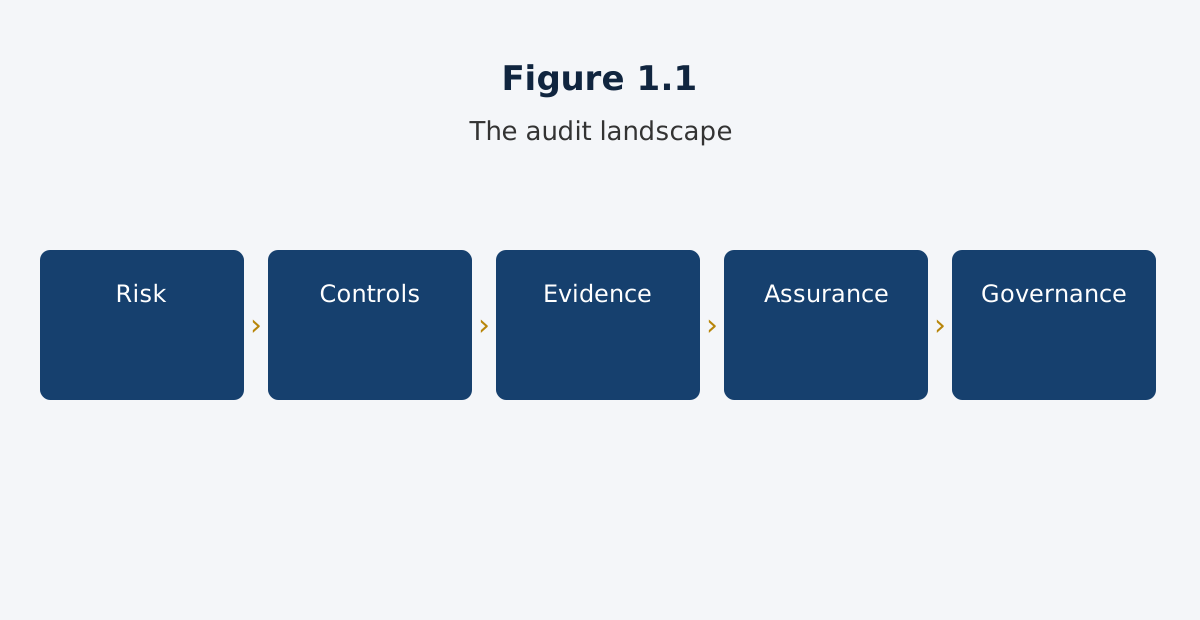
Figure 1.1 — The audit landscape: assurance, control, and risk in one view.
Read the figure as the chapter in miniature. Each element on it is named in the sections around it, and the examination's diagram-free questions still test exactly these relationships in words.
A policy, procedure, practice, or organizational structure designed to provide reasonable assurance that business objectives will be achieved and undesired events prevented, detected, or corrected.
In practice: Controls are classified by timing and by nature, and every audit finding traces back to a control that was missing, badly designed, or not operating.
An independent, objective assurance and consulting activity designed to add value and improve an organization's operations.
In practice: The internal audit function reports functionally to the highest appropriate level so its work cannot be quietly suppressed by the management it examines.
The complete population of auditable areas — systems, processes, locations, and units — from which the audit plan is drawn.
In practice: A risk-based plan starts from the whole audit universe, ranks it by risk, and only then schedules engagements.
A single audit assignment with defined objectives, scope, criteria, and a defined period under review.
In practice: Scope discipline matters: work outside the agreed scope is either formally added or reported as a limitation, never silently absorbed.
Meridian Distribution Group closed 1,240 production change tickets in the audit year. The auditor sets a tolerable deviation rate of 5 percent and draws a statistical sample of 60 tickets. Three tickets lack evidence of testing approval. The deviation rate is 3 ÷ 60 = 0.05, exactly 5.0 percent. Because the sample result sits exactly at the tolerable rate, sampling risk means the true population rate may exceed it, so the auditor extends testing rather than concluding the control is effective. The worked lesson: a result at the threshold is not a pass; it is a signal to gather more evidence.
A 150-question practice test in the published proportions carries 18 percent Domain 1 items: 150 × 0.18 = 27 questions. Domain 4 carries 26 percent: 150 × 0.26 = 39 questions. A candidate scoring 20 of 27 in Domain 1 (74 percent) and 24 of 39 in Domain 4 (62 percent) reads the profile correctly: the larger domain is the weaker one, and it also carries more questions, so study time moves to Domain 4 first.
On a real engagement, the field of information systems auditing shows up as evidence and as behavior. The auditor asks for the records this chapter names, samples them against the criteria the chapter states, and watches whether the people involved can explain their own process without reading it aloud. Where practice and paper agree, the control earns reliance. Where they part company, the gap — not the paper — is the finding, and it is written in criteria, condition, cause, and effect form.
The examination's traps in this area are consistent: information systems audit confused with a neighboring idea; assurance confused with a neighboring idea; control confused with a neighboring idea; the auditor asked to implement rather than assess; and the option that is true in general but does not answer the stem's constraint word — first, most, greatest, primary. Eliminate by role first (management implements, audit assesses), then by risk (the greatest risk to objectives wins), then by evidence strength (reperformance and independent evidence beat inquiry).
Information systems audit expresses an independent conclusion on control design and operating effectiveness. Assurance is reasonable, never absolute, and rests on sufficient appropriate evidence. Control provides reasonable assurance that objectives are achieved and undesired events are prevented, detected, or corrected. Internal audit function must be independent and objective, reporting to a level that protects its work. Audit universe is the full population of auditable areas from which risk-based plans are drawn. Engagement has defined objectives, scope, criteria, and period, agreed before fieldwork begins.
Q1. Which statement best defines information systems audit? A. Audit charter defines purpose, authority, and responsibility and is approved at board or audit-committee level. B. Information systems audit expresses an independent conclusion on control design and operating effectiveness. C. ITAF organizes the mandatory IS Auditing Standards with supporting guidelines. D. Retake limit is four attempts in a rolling twelve months, with the full fee due each time.
Q2. What is the PRIMARY purpose of assurance? A. Application window is five years from the passing date to apply for certification. B. Scaled score runs from 200 to 800, and 450 or higher passes. C. Code of Professional Ethics is a condition of certification, and breaching it can cost the credential. D. Assurance is reasonable, never absolute, and rests on sufficient appropriate evidence.
Q3. During an engagement at Meridian Distribution Group, the auditor documents the following: "A policy, procedure, practice, or organizational structure designed to provide reasonable assurance that business objectives will be achieved and undesired events prevented, detected, or corrected." Which concept is MOST directly described? A. Control B. Audit charter C. Competency duty D. Experience requirement
Q4. Which of the following statements about internal audit function is correct? A. IS Auditing Standards are mandatory requirements with which CISA holders must comply. B. Assurance is reasonable, never absolute, and rests on sufficient appropriate evidence. C. Internal audit function must be independent and objective, reporting to a level that protects its work. D. Pretest items are unscored, unidentified, and do not affect the result.
Q5. An IS auditor is asked to explain audit universe to a new team member. Which explanation is correct? A. Pretest items are unscored, unidentified, and do not affect the result. B. Scaled score runs from 200 to 800, and 450 or higher passes. C. Audit universe is the full population of auditable areas from which risk-based plans are drawn. D. Engagement has defined objectives, scope, criteria, and period, agreed before fieldwork begins.
Q6. Which statement best defines engagement? A. Engagement has defined objectives, scope, criteria, and period, agreed before fieldwork begins. B. Control provides reasonable assurance that objectives are achieved and undesired events are prevented, detected, or corrected. C. Competency duty requires undertaking only work the auditor is competent to perform. D. ITAF organizes the mandatory IS Auditing Standards with supporting guidelines.
Q7. What is the PRIMARY purpose of information systems audit? A. Independence must exist in fact and in appearance; auditing one's own work destroys it. B. Professional skepticism requires corroborating explanations rather than accepting the first plausible account. C. Scaled score runs from 200 to 800, and 450 or higher passes. D. Information systems audit expresses an independent conclusion on control design and operating effectiveness.
Q8. During an engagement at Meridian Distribution Group, the auditor documents the following: "The confidence an auditor provides to stakeholders that a subject matter conforms to suitable criteria, based on sufficient and appropriate evidence." Which concept is MOST directly described? A. Objectivity B. Assurance C. Conflict of interest D. Domain weight
Q9. Which of the following statements about control is correct? A. ITAF organizes the mandatory IS Auditing Standards with supporting guidelines. B. Audit charter defines purpose, authority, and responsibility and is approved at board or audit-committee level. C. Code of Professional Ethics is a condition of certification, and breaching it can cost the credential. D. Control provides reasonable assurance that objectives are achieved and undesired events are prevented, detected, or corrected.
Q10. An IS auditor is asked to explain internal audit function to a new team member. Which explanation is correct? A. Control provides reasonable assurance that objectives are achieved and undesired events are prevented, detected, or corrected. B. Internal audit function must be independent and objective, reporting to a level that protects its work. C. Professional skepticism requires corroborating explanations rather than accepting the first plausible account. D. Competency duty requires undertaking only work the auditor is competent to perform.
Q11. Which statement best defines audit universe? A. Pretest items are unscored, unidentified, and do not affect the result. B. Competency duty requires undertaking only work the auditor is competent to perform. C. Audit universe is the full population of auditable areas from which risk-based plans are drawn. D. Experience requirement is five years of relevant experience within the ten years before applying.
Q12. What is the PRIMARY purpose of engagement? A. Engagement has defined objectives, scope, criteria, and period, agreed before fieldwork begins. B. Information systems audit expresses an independent conclusion on control design and operating effectiveness. C. Domain weight guides study allocation; the total score, not per-domain results, decides passing. D. Application window is five years from the passing date to apply for certification.
Q13. During an engagement at Meridian Distribution Group, the auditor documents the following: "An independent examination of information systems, their controls, and their management, performed to express a conclusion on whether controls are suitably designed and operating effectively." Which concept is MOST directly described? A. Information systems audit B. Internal audit function C. Professional skepticism D. Conflict of interest
Q14. Which of the following statements about assurance is correct? A. Experience requirement is five years of relevant experience within the ten years before applying. B. Independence must exist in fact and in appearance; auditing one's own work destroys it. C. Objectivity requires judgments based on evidence, free of personal interest and undue influence. D. Assurance is reasonable, never absolute, and rests on sufficient appropriate evidence.
Q15. An IS auditor is asked to explain control to a new team member. Which explanation is correct? A. Application window is five years from the passing date to apply for certification. B. Conflict of interest is handled by disclosure and removal from the engagement. C. Control provides reasonable assurance that objectives are achieved and undesired events are prevented, detected, or corrected. D. Fraud reporting duty requires material irregularities to reach the appropriate level of management.
Feras Alzubi
Exam Prep Series
© 2026 Feras Alzubi. All rights reserved.
No part of this book may be reproduced, stored in a retrieval system, or transmitted in any form or by any means — electronic, mechanical, photocopying, recording, or otherwise — without the prior written permission of the author, except for brief quotations in reviews and other fair use permitted by law.
Trademark acknowledgment. CISA and Certified Information Systems Auditor are trademarks of ISACA. The CISA name is used in this book in a nominative sense only, to identify the credential and the examination that this study aid prepares the reader for. COBIT is likewise a trademark of ISACA. All other trademarks, service marks, and product names mentioned in this book are the property of their respective owners, and their use does not imply endorsement. Note on names: this book concerns ISACA's CISA credential. It has no connection with the United States Cybersecurity and Infrastructure Security Agency, which is also abbreviated CISA.
Not-affiliated disclosure. This book is an independent study guide. It is not published by, affiliated with, endorsed by, or approved by ISACA, and ISACA did not participate in its creation. Exam names and trademarks belong to their respective owners. Passing any exam also depends on the candidate's own preparation; no book can guarantee a result. This book confers exam readiness only. It does not confer the CISA credential, does not satisfy any part of the experience requirement, and does not award continuing professional education hours.
About the teaching in this book. This book teaches information systems auditing in its own words, from ISACA's published examination content outline and candidate guidance and from the published frameworks it names. It does not reproduce ISACA's review materials, its question databases, or any proprietary examination material. Every practice question in this book is original to this book. The fictional organization used throughout, Meridian Distribution Group, is invented for teaching; any resemblance to a real organization is coincidental.
First published 2026.
Contents placeholder — the full contents list is inserted at production from the final manuscript.
This book is a complete course in information systems auditing built around one examination: the Certified Information Systems Auditor (CISA) examination administered by ISACA. It teaches the field first — what an audit is, how evidence works, how governance differs from management, how systems are built, run, protected, and recovered — and it trains the examination inside that teaching, so the credential rests on competence rather than on memorized fragments.
Work in this order. First, sit the diagnostic test at the front of the book under time, score it by domain with the tracker printed with it, and let the result set your study order. Second, read the chapters in order; the parts follow the examination's five domains, and the concepts build. Do the fifteen exercises at the end of every chapter before reading their key — the explanations teach as much as the chapters do. Third, when a domain's diagnostic strand or chapter exercises expose a pattern — control types confused, governance and management swapped, sampling rules misapplied — work the matching repair set. Finally, in the last month, sit the two timed practice tests in full 240-minute sittings, exactly as the real examination is shaped, and study every explanation, including for the questions you answered correctly.
One fictional company, Meridian Distribution Group, runs through the whole book: a mid-size logistics and distribution group with an ERP platform, warehouse management systems at three distribution centers, and an e-commerce portal. Its audit year is planned, sampled, tested, reported, and followed up across the chapters, so each domain's ideas are seen doing their work on the same facts. Every Meridian number is fixed in advance and never changes: 1,240 production change tickets in the audit year, a sample of 60 with 3 deviations, a warehouse recovery time objective of 4 hours and a recovery point objective of 1 hour, met in test at 3 hours 20 minutes and 40 minutes respectively.
The facts below are stated exactly as ISACA publishes them (CISA Exam Content Outline, effective August 2024, and the Certification Exam Candidate Guide). Confirm them again at registration, because ISACA sets the arrangements and may change them.
End of the free sample. The complete book continues from here — the full A-to-Z course in book form, delivered as an EPUB you can read in Apple Books, Google Play Books, ReadEra, Thorium Reader, Adobe Digital Editions, or Send to Kindle.
Buy this ebook — $11.99 Back to the book page
Payments are securely processed by Payhip.