
Mastering Careers & Skills
Level 3 Foundation Certificate in People Practice (CIPD) · free sample from the book itself
Feras Alzubi
Exam Prep Series
Copyright © 2026 Feras Alzubi. All rights reserved. No part of this book may be reproduced, stored in a retrieval system, or transmitted in any form or by any means — electronic, mechanical, photocopying, recording, or otherwise — without the prior written permission of the author, except for brief quotations in reviews and other uses permitted by copyright law.
Originality statement. Every knowledge check, worked assignment task, model answer, and item of assessor-style commentary in this book is original material, written for this book against CIPD's published qualification specification. Nothing in this book reproduces CIPD's assignments or Learner Assessment Briefs, and nothing in it is presented as CIPD's own material. Where this book states a fact about the qualification — its title, units, assessment criteria, or assessment arrangements — it states that fact as CIPD publishes it, and CIPD's published wording is printed as published.
Fictional workplaces. The worked examples in this book are built on a fictional employer, the Larkspur Group, created for teaching purposes. Larkspur does not exist. Its workforce figures, people data, and programs are invented teaching numbers, labeled as the specimen's own wherever they appear. Any resemblance between Larkspur, or any one-off example workplace in this book, and a real organization is coincidental. No real organization is named in this book as an example employer.
This book is an independent study companion. It is not published by, affiliated with, or endorsed by CIPD — the Chartered Institute of Personnel and Development. CIPD did not participate in the creation of this book, did not review its contents, and does not approve or recommend it. The book teaches toward the qualification named on its cover because that qualification's specification is published by CIPD and is the public standard for the study; naming the qualification is a statement of fact about what the book teaches toward, and nothing more.
No book can guarantee a result. Whether a learner achieves the qualification depends on the learner's own submitted work, assessed through the arrangements described in this book. This companion can teach the knowledge, build the skills, and show you — in fully worked, explained examples — what meeting each published assessment criterion looks like. It cannot do the assessed work for you, and it makes no promise about any individual reader's outcome.
Read this page before anything else in the book, because it corrects the assumption most readers bring with them.
There is no examination. The CIPD Level 3 Foundation Certificate in People Practice is assessed entirely by assignment. CIPD sets one assignment for each of the qualification's four units. Each assignment answers that unit's published assessment criteria, usually as a set of written questions or tasks. There is no examination hall, no examination paper, and no pass mark. Everything in this book — its knowledge checks, its worked assignments, its self-assessments — is built for that reality. The knowledge checks exist to confirm that you have learned each chapter before you write about it; the worked assignments exist to show you, criterion by criterion, how strong assignment writing is done.
You study through a CIPD-approved study centre. CIPD delivers this qualification through approved study centers. Your center enrolls you, teaches or supports your study, issues CIPD's assignment briefs to you, receives your submitted assignments, and arranges their marking. This book cannot enroll you. It cannot mark your work, moderate your work, or award you the qualification. It is a companion to study that runs through a center — a complete one, but a companion.
CIPD membership is required throughout your study. CIPD's qualification specification states that learners undertaking a CIPD qualification must be a CIPD member throughout the duration of their studies. This is a mandatory requirement, in place so that assessment can be moderated. Membership carries a fee set by CIPD; consult CIPD for the current amount. Your center will confirm the membership step when you enroll.
Your submitted work must be your own. The assignments you submit must be your own work, in your own words, drawing on your own organization or an organization you know. The worked assignments and model answers in this book are teaching examples built on a fictional employer. They show you the standard; they are never work you may submit. Work written by another person, bought, or generated and passed off as your own is academic malpractice, and achievement obtained improperly can be voided. Your center's academic-integrity rules are the operative documents for your study, and Chapter 3 and Chapter 44 of this book teach the standard in full.
How assessment is decided, in one paragraph. Your center marks your assignments and internally moderates the marks. CIPD then conducts moderation sampling and validates center marking before results are released. The qualification is not graded: you receive either a Pass or a Fail, and you pass a unit only when every one of its assessment criteria is met. Assessors mark each criterion on a band from 1 to 4, and a criterion is met when it achieves band 2 — the Low Pass band — or above. The Qualification Blueprint panels that follow set out these mechanics in full.
The full name of the qualification this book teaches toward is the CIPD Level 3 Foundation Certificate in People Practice, awarded by the Chartered Institute of Personnel and Development — CIPD. It is built on the CIPD Profession Map, CIPD's international standard for the people profession, launched in 2018. The facts in these panels are stated exactly as CIPD's qualification specification (version 2.3, February 2026) publishes them.
The qualification is made of four units. Every unit must be achieved for the full certificate. TUT is total unit time; GLH is guided learning hours.
3CO01 — Title: Business, culture and change in context · Credits: 5 · TUT: 50 · GLH: 25
3CO02 — Title: Principles of analytics · Credits: 4 · TUT: 40 · GLH: 20
3CO03 — Title: Core behaviours for people professionals · Credits: 4 · TUT: 40 · GLH: 20
3CO04 — Title: Essentials of people practice · Credits: 11 · TUT: 110 · GLH: 55
Total — Credits: 24 · TUT: 240 · GLH: 120
Unit titles are printed exactly as CIPD publishes them. Across the four units there are 13 learning outcomes and 47 assessment criteria: nine criteria in 3CO01, eight in 3CO02, five in 3CO03, and twenty-five in 3CO04. This book teaches every one of them and works an assignment task for every one of them.
This book is a complete course of study in companion form. It is built to be worked through in a set order, and each part of its apparatus has one job.
Step 1 — Take the Starting-Point Check. Before you study anything, take the Starting-Point Check at the front of the book: 40 knowledge checks in four strands of ten, one strand per unit. It is untimed and self-taken. Score it by strand, never as one combined number. A weak strand tells you where to spend your early effort; the routing table after the check points you to the chapters, unit self-assessments, and repair sets that answer to that strand.
Step 2 — Study the chapters. Work through the 44 chapters in order. The order follows the specification's own logic: the qualification and the profession first, then business, culture, and change; then analytics; then core behaviors; then the essentials of people practice; and finally the craft of writing the assignments themselves. Each chapter teaches its subject from its foundations, works it on examples — many of them built on Larkspur, the book's fictional specimen employer — and closes with 15 knowledge checks. Every answer, right and wrong, is explained in the chapter's key. Do not move on from a chapter with unexplained misses: reread the section the key points you to, then retake the missed items.
Step 3 — Take the unit self-assessments. When you finish the chapters for a unit, take that unit's self-assessment: 20 untimed knowledge checks mapped to the unit's assessment criteria. Each set closes with a self-scoring table that routes every miss back to the chapters and worked tasks that repair it.
Step 4 — Study the worked assignments. For every one of the 47 assessment criteria, this book provides a worked assignment task in the form of a CIPD brief, a model answer, and assessor-style commentary in two parts: what meets the criterion, and where answers fall short. Study these after the chapters, not instead of them. They teach the standard of writing your own assignments must reach — in your own words, on your own organization.
Step 5 — Repair with the repair sets. Eight repair sets of 15 knowledge checks each target the areas learners most commonly find difficult, from the business environment to performance, reward, and learning. Use them whenever a self-assessment or a piece of center feedback shows you a gap, and use them again before you submit each assignment.
Study plans. The back of this book carries two study plans keyed to the qualification's published size — 240 hours of total qualification time, including 120 guided learning hours: a 12-month plan for studying alongside work, and a 9-month plan for a faster pace. Each plan sequences the chapters, checks, self-assessments, and worked assignments in this book against the hours the qualification itself allows. Turn to the plans once you have taken the Starting-Point Check, and choose the pace that fits the time you genuinely have.
One discipline runs through the whole book, and it is worth stating here at the start: learn first, check second, write last — and write in your own words. That is the order this book is built in, and it is the order that assignment-assessed study rewards.
This book teaches toward one qualification, and this chapter names it in full, takes it apart, and shows you exactly how it is assessed before any of its subject matter begins. The qualification is the CIPD Level 3 Foundation Certificate in People Practice, awarded by the Chartered Institute of Personnel and Development. Everything in this chapter is stated as CIPD's qualification specification (version 2.3, February 2026) publishes it. Where later chapters teach you the profession itself, this chapter teaches you the shape of the study you are undertaking — its size, its four units, its entry rules, its membership requirement, and the assignment-based assessment that decides it. Read it carefully: most of the mistakes new learners make with this qualification are not knowledge mistakes. They are shape mistakes — studying for an examination that does not exist, expecting a grade that is never given, or waiting for a pass mark that was never set.
Begin with the name, because every word in it carries information. CIPD is the awarding body: the Chartered Institute of Personnel and Development, the professional body for the people profession, whose qualifications are built on its Profession Map — the international standard for the profession, launched in 2018 and the subject of Chapter 2. Level 3 places the qualification on the Regulated Qualifications Framework, the RQF, which is regulated by Ofqual and CCEA. Foundation marks the level of professional practice the certificate addresses: the foundation level of the Profession Map, at which practitioners carry out tactical, well-defined tasks under the frame the Map sets. Certificate marks its size — a certificate is a substantial, complete qualification, larger than an award and smaller than a diploma. People practice is the field: the work of the people profession — the hiring, developing, supporting, rewarding, and fair treatment of the people an organization employs.
The qualification has a formal identifier. Its qualification number on the RQF is 603/5958/4. On the Credit and Qualifications Framework for Wales, the CQFW, its number is C00/4145/2. These numbers matter more than they may appear to. They are how regulators, centers, and employers confirm that the certificate a learner holds is the regulated qualification and not a short course borrowing similar words. If you ever need to prove what you studied — to an employer, to a center, or to CIPD itself — the title and the qualification number together identify it exactly.
Level 3 also needs placing, because "level" means different things in different frameworks and this qualification is studied internationally. CIPD publishes the comparators directly: RQF Level 3 is comparable to Level 5 on Ireland's National Framework of Qualifications, Level 6 on the Scottish Credit and Qualifications Framework, and Level 4 on the European Qualifications Framework. The practical meaning of Level 3, wherever you study, is the demand it makes of you. The work is more than recall. You will be asked to examine, discuss, explain, and review — to take a real organizational situation, apply what you know to it, and write a reasoned answer about it. Chapter 3 takes those demand words apart one by one, because they are the verbs your assignments will use.
What is the certificate for? CIPD's specification states its purpose in substance as follows: it develops learners' knowledge and skills to undertake tactical tasks that deliver value — contributing to immediate colleagues, customers, and the organization, supporting change and driving impact, and creating immediate and short-term value. Unpack that sentence, because it predicts the whole syllabus. Tactical tasks are the concrete, day-to-day tasks of a working people team: preparing recruitment information, shortlisting applications, keeping selection records, presenting people data, supporting a change that is already decided. Immediate and short-term value is the horizon: this certificate qualifies you to make a real difference to the team and the organization in front of you, now — not to set corporate strategy, which belongs to higher levels of the profession and to the Level 5 diplomas this certificate can lead to. A learner who keeps that purpose in view will find the specification coherent. Every unit in it is one face of tactical people practice done properly.
A qualification's size is published in three numbers, and you should be able to read all three fluently. The certificate carries 24 credits. Its total qualification time, TQT, is 240 hours: the total amount of time a typical learner is expected to spend on the qualification, including study directed by a tutor and study done independently. Within that total, guided learning hours, GLH, are estimated at 120 hours: the portion of the time spent under the guidance of a tutor or center — taught sessions, directed activities, and supervised work. The arithmetic connecting the numbers is simple and worth fixing in memory: one credit represents ten hours of total qualification time, so 24 credits × 10 hours = 240 hours of TQT. When the back of this book offers study plans, they are keyed to these published figures — 240 hours in total, 120 of them guided — because a plan that ignores the qualification's own size is a plan built on air.
The 24 credits are divided among four units, and the division is uneven in an informative way.
Figure 1.1 (Class A) — The qualification at a glance: four units, 24 credits, 240 hours.
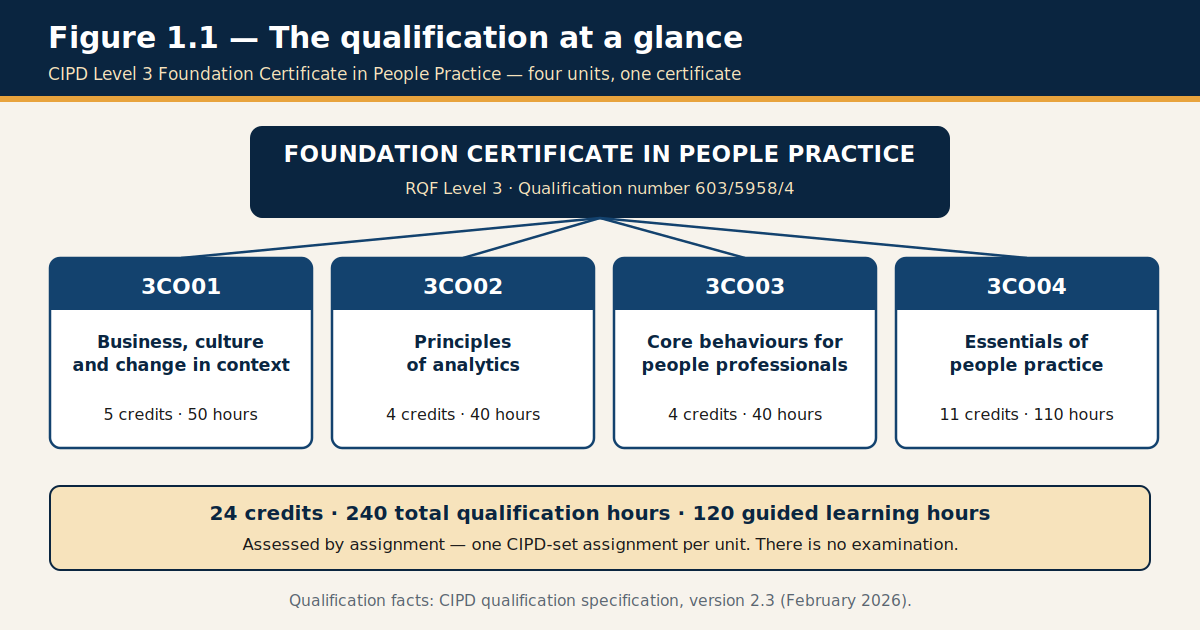
Figure 1.1 — The qualification at a glance: four units, 24 credits, 240 hours.
Figure 1.1 sets the four units around the certificate so you can see the shape at once. 3CO01, Business, culture and change in context, carries 5 credits, 50 hours of total unit time, and 25 guided learning hours. It teaches the world the people profession operates in: the business environment, organizational goals, products and customers, workplace culture, and change. 3CO02, Principles of analytics, carries 4 credits, 40 hours, and 20 guided hours. It teaches evidence-based practice and people data: what data is, how to calculate with it, how to present it, and how people practice creates value. 3CO03, Core behaviours for people professionals — the unit title prints exactly as CIPD publishes it — carries 4 credits, 40 hours, and 20 guided hours. It teaches the professional conduct the Map requires: ethics, lawful and respectful practice, inclusive working, curiosity, and continuing professional development. 3CO04, Essentials of people practice, carries 11 credits, 110 hours, and 55 guided hours — nearly half the qualification by itself. It teaches the operational core: the employee lifecycle, recruitment and selection, employment relationships, performance management, reward, and learning and development.
Add the units up and check the totals as an analyst should: 5 + 4 + 4 + 11 = 24 credits; 50 + 40 + 40 + 110 = 240 hours; 25 + 20 + 20 + 55 = 120 guided hours. The shape tells a story about the profession. The certificate gives real weight to context, evidence, and behavior — twelve credits of it — because a practitioner who can run a process but cannot read a business environment, handle data honestly, or behave ethically is not yet a professional. But the center of gravity is practice itself: 3CO04's eleven credits of lifecycle work are what most graduates of this certificate will spend most of their working week doing. This book follows the same shape. Parts II, III, and IV teach the three smaller units in full; Part V gives 3CO04 the sixteen chapters its size earns.
The two time figures deserve one practical translation before you move on, because learners consistently misread them. TQT of 240 hours is the whole effort the qualification expects — reading, taught sessions, assignment writing, revision of drafts, all of it — spread across the months of your enrollment. It is not 240 hours of classroom time, and it is not a minimum you must log; it is the regulator's honest estimate of the qualification's weight, published so that learners and employers can plan. GLH of 120 hours is the guided share of that weight: the half of your effort that happens with a tutor's direction, in sessions and through set activities. The other half is yours to organize — which is precisely the half this companion exists to structure. When the study plans at the back of this book divide 240 hours across twelve months or nine, they are dividing this published weight, not inventing one.
Across the four units, CIPD publishes 13 learning outcomes and 47 assessment criteria — nine criteria in 3CO01, eight in 3CO02, five in 3CO03, and twenty-five in 3CO04. A learning outcome states what you will know or be able to do by the end of a unit. An assessment criterion breaks an outcome into the specific, markable statements your assignment must satisfy. Those 47 criteria are, in the most literal sense, the qualification: pass all of them and you have passed. Chapter 3 is devoted to them.
CIPD describes the intended learners in three groups, and between them they cover almost everyone who opens this book. The certificate is for learners studying for, aspiring to, or embarking on a career in people practice — the career-changer, the student, the administrator who has watched the people team work and wants to join it. It is for people already in a people practice support role — the people coordinator, the human resources assistant, the administrator inside the team — who do the work daily and want the knowledge, the standard, and the credential that organize it. And it is for anyone who wishes to develop the specialist knowledge, skills, and understanding required to be a people professional, including people whose roles touch people practice from outside the team: the line manager, the small-business owner, the operations supervisor.
Entry is deliberately open. The qualification is designed for learners aged 16 and over, and it has no formal entry requirements: CIPD does not demand prior qualifications, prior people-team employment, or prior study as a condition of starting. Open entry is not the same as no preparation, and two qualifications on that point matter. First, centers conduct their own diagnostic checks with applicants, including checks of literacy and numeracy, because the qualification is assessed through sustained written assignments and a learner who cannot yet write at the required standard needs support identified early, not failure discovered late. Second, CIPD maintains an English-language policy for students whose first language is not English, and centers confirm the current requirements under it. Both checks belong to the center's enrollment process, and a good center explains them before you commit, not after.
Notice what open entry implies for how you should use this book. Because no prior knowledge is assumed by the qualification, none is assumed by this companion either. The foundations are taught from zero — what an organization is, what data is, what an assignment criterion demands — before anything is built on them. If you are the experienced support practitioner, you will meet familiar work in unfamiliar language in the early chapters; that language is the profession's own, and your assignments will be marked on your command of it. If you are the total beginner, nothing in the chapters ahead requires experience you do not have: the book's worked world, introduced in section 1.6, supplies the workplace until your own experience catches up.
This is the most important section in the chapter, and for many readers it overturns an assumption. There is no examination for this qualification. CIPD's specification states it directly: CIPD will set assignments for all core units. Assessment is by assignment for every one of the four units. There is no examination paper, no examination day, and — because an assignment is not marked out of a total — no pass mark. If you have studied for examination-based qualifications before, set that mental model aside completely. The skill this qualification rewards is not performing under time pressure in a hall. It is producing, over a realistic working period, a piece of written professional work that satisfies published criteria.
The mechanics run in a chain with three links, and you should know who does what at each link. CIPD sets the assignments. Each unit's assignment is issued as a Learner Assessment Brief: a formal document, carrying an assessment identity and version for its cycle, that sets the questions or tasks through which you answer the unit's assessment criteria. Briefs are refreshed on CIPD's cycle of assessment change, and the brief your center issues to you is the one that governs your work — a point Chapter 3 develops, because briefs from earlier cycles circulate and mislead. Centers mark and internally moderate. Your center's assessors mark your submitted assignment against CIPD's published marking descriptors, and the center then internally moderates those marks — a second professional check inside the center that its marking is consistent and at the standard. CIPD validates before results are released. CIPD conducts moderation sampling across centers and validates center marking before results are released to learners. Your result, when it reaches you, has therefore passed through your assessor, your center's internal moderation, and CIPD's external validation. No part of that chain belongs to this book, and section 1.5 states the book's limits plainly.
The grading model is as simple as the mechanics are careful. CIPD's specification states that this qualification is not graded: learners receive either a Pass or a Fail. There is no merit band, no distinction, and no percentage. In its place stands a single, strict rule: all assessment criteria must be met in order to achieve a Pass. Assessment is criterion-referenced — your work is judged against the published criteria, never ranked against other learners. Within that model, assessors mark each individual criterion on a band from 1 to 4 against CIPD's published marking descriptors, and a criterion counts as met when it achieves band 2, the Low Pass band, or above. Hold the two levels of the model apart in your mind, because learners routinely fuse them and confuse themselves. The bands describe how well one criterion has been answered. The Pass describes the unit as a whole, and it requires every criterion at band 2 or above. An assignment with eight strong criteria and one criterion below band 2 has not passed its unit — not because the work was weak overall, but because the rule is every criterion, without exception. Chapter 3 works this marking model in full, with the ladder drawn as Figure 3.1.
Two further mechanics complete the picture. First, the assignments are aimed at real practice: CIPD designs assessment around real scenarios learners may encounter in their future career, so your assignments will ask you to work on organizational situations — a recruitment round, a set of absence figures, a change program — rather than to recite definitions into a void. Second, partial achievement is recognized. If the complete qualification is not achieved, credit can be issued as a statement of standalone unit credit for a unit that has been achieved, subject to currency and CIPD quality assurance, with CIPD's decision final. A unit you have passed is a banked, certified achievement in its own right, not an all-or-nothing wager on all four.
One feature of the brief deserves an early warning, because it generates more confusion than any other. Each cycle's brief states its own expected length for the assignment it sets. As a dated example of one cycle's brief: the Learner Assessment Brief for Unit 3CO01 released in June 2024 set nine written questions — one for each of that unit's nine assessment criteria — with written answers of approximately 2,500 words in total, under CIPD's word count policy. That example teaches the form a brief takes: numbered questions answering numbered criteria, with a stated length. It does not set your length. Briefs are refreshed on CIPD's Assessment Change Cycle, the brief your center issues for your cycle governs your work, and Chapter 3 returns to briefs in full. A learner who writes to an old brief's word count, or answers an old brief's questions, has done real work against the wrong target. Your center's issued brief is the only brief that counts.
The specification also protects the qualification's integrity from the center side, and the rule is worth knowing because it explains why your center will sometimes refuse a reasonable-sounding request. No part of the qualification may be altered by centers: a center may not amend the learning outcomes, the assessment criteria, the assessment approach, the assessment briefs, or the titling. When your center tells you a criterion cannot be reinterpreted, a brief cannot be extended by local agreement, or a question cannot be swapped for an easier one, it is not being inflexible. It is operating under CIPD's compliance rule, and the same rule protects you: the certificate you earn is the certificate every other center's learners earn, word for word and criterion for criterion.
One consequence of criterion-referenced assessment deserves its own paragraph, because it changes how you will experience your results. When your assignment is returned, its feedback is organized by criterion: for each criterion, the band achieved and the assessor's reasoning against the descriptors. Read such feedback as a map, not a verdict. A criterion at band 2 is met — the feedback beside it is coaching for your future practice, not a warning. A criterion below band 2 identifies, with unusual precision, exactly what your further work must repair: not "the assignment was weak," but "this criterion, on this demand, fell short in this way." Few assessment systems in professional education tell a learner so exactly where they stand. The repair sets and worked assignments in this book are built to the same grain — every check and every task answers to a named criterion — so that the habit of thinking criterion by criterion is formed long before your first real feedback arrives. Learners who acquire that habit early rarely fear results day. They already know, criterion by criterion, roughly what it will say.
Three facts about the route around the qualification belong in this opening chapter, because each one shapes decisions you will make before or during your study.
The first is membership. CIPD's specification requires that learners undertaking a CIPD qualification must be a CIPD member throughout the duration of their studies. This is a mandatory requirement, and CIPD states its reason: to ensure that assessment can be moderated. Membership is therefore not an optional extra you may add when you feel established, nor a reward that arrives only at the end. It runs alongside the whole of your study, from enrollment to result. Membership carries a fee set by CIPD; this book prints no fee amounts for the qualification, for courses, or for membership, because amounts are CIPD's and centers' to state and they change — your center will walk you through the membership step when you enroll, and CIPD publishes its current amounts.
The second fact is progression — where the certificate leads, stated as CIPD publishes the route and never as a promise to any individual reader. On completion, learners may progress to the CIPD Level 5 Associate Diploma in People Management or the CIPD Level 5 Associate Diploma in Organisational Learning and Development — the title of the second diploma prints as CIPD publishes it. Completion of the Level 3 Foundation Certificate also leads to Foundation membership of CIPD. Read those two sentences as what they are: a map of the published route. They tell you the road continues and where it goes. Whether any individual learner travels it depends on that learner's own work and choices, and this book promises no outcome — no pass, no job, no salary, no promotion, and no membership grade — to anyone.
The third fact concerns recognition of prior learning, taught here in outline because its details are always personal. CIPD operates recognition of prior learning for this qualification: learning and experience you already hold may be recognized against parts of it. Predetermined transition exemptions — for learners moving between CIPD qualification versions — are mapped in the specification's appendix, and exemptions based on non-CIPD qualifications are capped at 50 percent of the qualification. The operative advice is short: if you believe prior learning should count, raise it with your center before you enroll, because the center administers the process and CIPD's quality assurance governs it.
Now the limits of the book in your hands, stated as plainly as the front matter states them. This book cannot enroll you: enrollment happens through a CIPD-approved study center. It cannot mark or moderate your work: marking belongs to your center's assessors under CIPD's validation. It cannot award the qualification: the certificate is CIPD's to award. What it can do — and what it is built to do completely — is teach you the whole of the specification's subject matter from zero, train you in the craft of criterion-referenced assignment writing, and show you fully worked assignment answers with the marking reasoning spelled out, so that when you write your own assignments, in your own words, on your own organization, you know exactly what standard you are writing to. A companion that claimed more than that would be claiming authority it does not hold. This one claims teaching, and delivers it in full.
Close the chapter by looking outward, at the field the certificate opens. People practice is the professional work concerned with how an organization employs, organizes, develops, rewards, and treats its people. It is carried out by people teams — still called human resources departments in many organizations, and the two names describe the same function — working alongside line managers, who remain responsible for the day-to-day management of their own teams. At foundation level, the work is tactical and concrete. A people coordinator prepares the information from which a job description is written. A people assistant sifts applications against agreed criteria and keeps the selection records straight. A payroll and people data officer produces the absence and turnover figures on which managers act. A people partner supports a team through a shift-pattern change, session by session. None of that work is glamorous in description and all of it is consequential in fact: done badly, it produces unfair hiring, unlawful decisions, unreliable data, and change that damages the people it was meant to help. Done to the standard this qualification teaches, it is how organizations treat people properly at scale. That is the field. The Profession Map that defines its standards is Chapter 2's subject; the assignment craft that will assess you on it is Chapter 3's.
Because assignment writing is learned on real-seeming material, this book works in one fictional workplace throughout: the Larkspur Group, a regional services employer invented for this book and labeled fictional wherever it appears. Larkspur employs 486 people across four areas — Head Office with 92, the Contact Centre with 168, Field Services with 186, and Warehouse & Logistics with 40 — and its people team numbers six: a People Director, two People Partners, two People Coordinators, and a Payroll & People Data Officer. That one employer was designed to carry the whole specification honestly: commercial and digital pressure in its contact center, shift working and culture questions in field services, volume recruitment across the year, people data worth analyzing, and a live change program, Project Atlas, which will introduce a new people system and redesign contact center shift patterns. You will meet Larkspur's figures, decisions, and difficulties in chapter after chapter, and the worked assignments later in this book are built on it. Two disciplines govern it. No number is ever stated about Larkspur that is not part of its published specimen record in this book, and Larkspur is never you: when your own assignments come, they must be written on your own organization or one you know, in your own words. Larkspur teaches the standard. Your workplace supplies your evidence.
It helps to see, before you study further, how the companion you are holding is organized around the qualification it serves — because the book's structure is the specification's structure, and learning to navigate one teaches you the other. Part I, this part, gives you the qualification itself (this chapter), the profession and its Profession Map (Chapter 2), and the craft of assignment assessment (Chapter 3). Those three chapters are foundations: nothing later in the book makes sense without them. Part II then teaches Unit 3CO01 across ten chapters, from the business environment through culture to change. Part III teaches Unit 3CO02 across nine chapters, from evidence-based practice through the analyst's arithmetic to value and standards. Part IV teaches Unit 3CO03 across five chapters, on ethics, law, inclusive working, curiosity, and reflective development. Part V teaches Unit 3CO04 across sixteen chapters, following the employee lifecycle from defining a job to supporting learning. Part VI closes the book with Chapter 44, a full treatment of writing the assignments themselves: structure, referencing, and the final check before submission.
Around the chapters sits the checking and working apparatus, and each piece answers to a named part of the specification. The Starting-Point Check samples all four units before you study, in four strands of ten, so your starting profile is a profile by unit and never a single blurred score. Each chapter's fifteen knowledge checks confirm that chapter's teaching before you build on it. The four unit self-assessments gather each unit's criteria together once its chapters are done. The worked assignments — one task for each of the 47 assessment criteria, each with a model answer and assessor-style commentary — show the assessment standard in action on Larkspur. The eight repair sets return to the areas where learners most commonly fall short. And the specimen assignment works one complete resourcing assignment end to end, from job description to appointment letters, so you can watch a whole assignment hold together before you write your own. Used in the order the front matter sets out — starting-point check, chapters, self-assessments, worked assignments, repair sets — the apparatus leaves no criterion untaught, unchecked, and unworked. That completeness is deliberate. A criterion-referenced qualification is passed by covering every criterion; a companion for it is built the same way.
Because entry is open, the learners on this qualification arrive from very different starting points, and it is worth seeing how the certificate's shape serves each of them — because you will recognize yourself in one of these profiles, and your study plan should be built from your profile, not from a generic one.
The first reader is the career-changer: an administrator, a retail supervisor, a customer-service team leader — someone whose work has brushed against people practice for years without ever being named as part of it. This reader's strength is organizational experience: they have sat through restructures, watched good and bad recruitment, and felt the effects of both. Their gap is the profession's language and standards — they know more practice than they can yet say, in the terms the criteria use. For this reader, the specification's demand is translation: Chapters 4 through 13 will repeatedly take situations they have lived and give those situations their professional names. Their assignments, when they come, will be strong precisely because the experience is real; the study task is to discipline it with evidence and criteria.
The second reader is the new people-team assistant, recently appointed to a support role and studying in parallel with the job. This reader's strength is immediacy: every chapter describes something on their desk this week. Their risk is the opposite of the career-changer's — mistaking their own employer's habits for the profession's standards. A center's local way of shortlisting is not necessarily the criterion's way, and an assignment that merely describes "how we do it at work" without examining it against the published standard will underperform, however accurate the description. For this reader, Larkspur matters most: it is a second workplace, deliberately different from their own, against which their employer's practice can be compared rather than assumed.
The third reader is the returner and the student: someone studying before or between roles, perhaps straight from other education, with little workplace experience to draw on. This reader's worry is usually evidence — "the criteria ask about organizations, and I have not worked in one." The worry is understandable and overstated. The qualification is designed for learners aspiring to and embarking on the profession, not only for those already inside it; the assignments are aimed at real scenarios learners may encounter in their future career, and a well-constructed answer built on a studied organization — including this book's specimen, studied properly and then set aside in favor of an organization the learner knows or researches — can meet criteria fully. What this reader must not do is invent experience they do not have. Assessors reward honest, well-evidenced analysis of a real situation at foundation depth; they are practiced at recognizing borrowed biographies.
Three profiles, one standard. The criteria do not adjust to the reader; the reader's route to the criteria adjusts. That is the deepest sense in which this qualification is criterion-referenced, and it is why a single companion can serve all three readers at once: the teaching is common, the worked examples are common, and only the application is personal — as, in the end, your assignments will be.
You now hold the qualification's shape: a 24-credit, 240-hour, four-unit certificate at RQF Level 3, open to learners aged 16 and over with no formal entry requirements, studied through an approved center with CIPD membership held throughout, assessed by CIPD-set assignments marked criterion by criterion, and decided by a single rule — every criterion met, or the unit is not yet passed. Chapter 2 turns from the qualification to the profession it certifies, and to the Profession Map on which the whole specification stands.
Key terms: assessment criterion, CIPD, guided learning hours (GLH), learning outcome, moderation, people practice, Profession Map, qualification number (QN), Regulated Qualifications Framework (RQF), standalone unit credit, total qualification time (TQT)
Q1. What is the full name of the qualification this book teaches toward? A. CIPD Level 3 Foundation Diploma in People Practice B. CIPD Level 3 Foundation Certificate in People Practice C. CIPD Level 5 Foundation Certificate in People Practice D. Level 3 Certificate in Human Resource Practice (CIPD)
Q2. What is the qualification's number on the Regulated Qualifications Framework? A. 603/5958/3 B. 600/5958/4 C. 603/5958/4 D. C00/4145/2
Q3. CIPD publishes RQF Level 3 as comparable to which level on the Scottish Credit and Qualifications Framework? A. Level 6 B. Level 3 C. Level 9 D. Level 5
Q4. Which pairing correctly states the qualification's size? A. 24 credits and 120 hours of total qualification time B. 36 credits and 240 hours of total qualification time C. 24 credits and 200 hours of total qualification time D. 24 credits and 240 hours of total qualification time
Q5. How many of the qualification's hours are guided learning hours? A. 240 B. 120 C. 60 D. 110
Q6. Which unit carries the largest share of the qualification? A. 3CO01, with 5 credits B. 3CO02, with 4 credits C. 3CO04, with 11 credits D. 3CO03, with 4 credits
Q7. Which statement about entry to the qualification is correct? A. It is designed for learners aged 16 and over, with no formal entry requirements B. Applicants must be 18 and hold specified school qualifications C. Applicants must already hold a degree D. Applicants must already be employed in a people team
Q8. What do study centers check diagnostically with applicants, as part of their own enrollment process? A. Evidence of two years' service in a people role B. A degree certificate from a recognized university C. Two employment references D. Literacy and numeracy
Q9. How is each unit of this qualification assessed? A. By an examination set by CIPD for each unit B. By an assignment set by CIPD for each unit C. By an examination combined with coursework D. By an examination set by the study center
Q10. Which statement correctly describes the marking chain? A. Centers mark assignments and internally moderate the marks; CIPD then conducts moderation sampling and validates center marking before results are released B. CIPD marks every assignment itself and returns results directly to learners C. Centers release results to learners first, and CIPD samples the marking afterward D. Employers moderate the assignments of their own staff
Q11. How is the qualification graded? A. It is graded from A to F B. It is graded Pass, Merit, or Distinction C. It is not graded: learners receive a Pass or a Fail, and every assessment criterion must be met for a Pass D. It is graded by percentage, with a pass mark of 40 percent
Q12. What must happen at criterion level for a unit to be passed? A. Each criterion must reach band 1 B. Each criterion must reach band 3 C. The criteria must average band 2 across the unit D. Every criterion must achieve band 2 (Low Pass) or above
Q13. A learner passes three units but does not achieve the fourth. What does CIPD's published arrangement allow? A. All credit is lost, because the qualification is all or nothing B. Credit may be issued as a statement of standalone unit credit for a unit that has been achieved, subject to currency and CIPD quality assurance C. The learner is automatically awarded a Level 2 qualification instead D. The learner's credits transfer automatically to any other awarding body
Q14. Which statement about CIPD membership during study is correct? A. Learners must be CIPD members throughout the duration of their studies B. Membership is optional while studying C. Membership begins only after the qualification is completed D. Membership is required only for Unit 3CO04
Q15. A reader asks this book to enroll her and to mark her draft assignment. Which reply is correct? A. The book can mark the draft but cannot enroll her B. Her center can enroll her, and this book moderates her center's marking C. Study runs through a CIPD-approved study center, which enrolls and arranges marking; this book can teach her but cannot enroll, mark, moderate, or award D. CIPD marks all draft assignments sent to it by readers
Use this key actively, not as a score sheet. For every item you missed, read the full entry — the explanation of the correct answer and of each wrong option — because the wrong options in this chapter are the standard misunderstandings of the qualification's shape: invented grades, invented entry conditions, examination assumptions carried over from other qualifications. Then return to the section of Chapter 1 the entry draws on and reread it before retaking the item. A correct guess is not knowledge; an explained miss, repaired, is worth more than a lucky hit. When every entry in this key reads as obvious to you, the qualification's frame — its name, size, units, entry, membership, marking chain, and pass rule — is secure, and you are ready for the profession itself in Chapter 2.
Q1. Key: B. The qualification's full published name is the CIPD Level 3 Foundation Certificate in People Practice, and every element of the name carries information: CIPD awards it, Level 3 places it, Foundation marks the practice level, Certificate marks its size, and People Practice names the field. A is wrong because the qualification is a certificate, not a diploma — in this route, diplomas are the larger Level 5 qualifications that follow it. C is wrong because it moves the certificate to Level 5, where CIPD offers associate diplomas rather than this foundation certificate. D is wrong because it uses a human-resources title that is not this qualification's published name and drops both the level and the foundation designation, so it cannot identify the regulated qualification. [FIELD]
Q2. Key: C. The qualification number on the Regulated Qualifications Framework is 603/5958/4 — the identifier regulators, centers, and employers use to confirm that a certificate is the regulated qualification and not a similarly titled course. A is wrong because it alters the final digit of the published number, and a near-miss number identifies nothing. B is wrong because it alters the opening digits of the published number. D is wrong because C00/4145/2 is a real number but the wrong framework's: it is the qualification's number on the Credit and Qualifications Framework for Wales, not its RQF number. One qualification can carry different identifiers on different frameworks, and the question asked for the RQF. [FIELD]
Q3. Key: A. CIPD publishes RQF Level 3 as comparable to Level 6 on the Scottish Credit and Qualifications Framework, and the chapter states the comparator set together: SCQF Level 6, Level 5 on Ireland's framework, and Level 4 on the European Qualifications Framework. B is wrong because framework levels are not interchangeable numbers — Level 3 on the RQF does not convert to Level 3 on the SCQF, since each framework numbers its own ladder. C is wrong because SCQF Level 9 sits at degree-level demand, far above a foundation certificate. D is wrong because Level 5 is the published comparator for Ireland's National Framework of Qualifications, not for Scotland's framework. [FIELD]
Q4. Key: D. The qualification carries 24 credits with a total qualification time of 240 hours, and the two figures lock together arithmetically: one credit represents ten hours of total qualification time, so 24 × 10 = 240. A is wrong because 120 hours is the guided learning hours figure — the tutored portion inside the total — not the total qualification time itself. B is wrong because the credit total is 24, not 36; 36 credits at ten hours would give 360 hours, a different and larger qualification. C is wrong because 200 hours matches neither the published TQT nor the credit arithmetic, and a size statement for a regulated qualification is exact or it is wrong. [FIELD]
Q5. Key: B. Guided learning hours are estimated at 120: half of the 240 total hours, representing the portion of study spent under the guidance of a tutor or center — taught sessions, directed activities, and supervised work. A is wrong because 240 is the total qualification time, which includes the learner's independent study as well as guided time. C is wrong because no published figure of 60 guided hours exists for this qualification. D is wrong because 110 is the total unit time of Unit 3CO04 alone — the largest unit's full time budget, not the whole qualification's guided portion. Keeping TQT and GLH apart matters practically, because the study plans in this book are keyed to both figures. [FIELD]
Q6. Key: C. Unit 3CO04, Essentials of people practice, carries 11 of the 24 credits — nearly half the qualification — with 110 hours of total unit time and 55 guided learning hours, which is why this book gives it sixteen chapters. A is wrong because 3CO01 carries 5 credits: the second-largest unit, but less than half of 3CO04's weight. B is wrong because 3CO02 carries 4 credits. D is wrong because 3CO03 also carries 4 credits; the analytics and core behaviors units are the two smallest in the certificate, equal in size and together still smaller than 3CO04 alone. [FIELD]
Q7. Key: A. The qualification is designed for learners aged 16 and over and has no formal entry requirements: CIPD demands no prior qualifications, no prior people-team employment, and no prior study as a condition of starting, which is why career-changers and aspiring practitioners are named among its intended learners. B is wrong because it invents an age threshold of 18 and school-qualification conditions that CIPD does not set. C is wrong because no degree is required at entry or anywhere else in the entry guidance. D is wrong because current employment in a people team is one route in — the support-role learner — but it is not a condition imposed on the others. [FIELD]
Q8. Key: D. Centers conduct their own diagnostic checks with applicants, including literacy and numeracy, because the qualification is assessed through sustained written assignments and includes calculation work — a learner who needs support with writing or numbers needs it identified at enrollment, not discovered at a failed assignment. A is wrong because length of service in a people role is not an entry condition, so it is not what the diagnostics measure. B is wrong because no degree is required for this qualification, so no degree certificate is checked. C is wrong because employment references play no part in the published entry arrangements; the diagnostics concern the applicant's readiness to study, not their employment history. [FIELD]
Q9. Key: B. Every unit is assessed by an assignment set by CIPD — there is no examination for this qualification at all, and the assignments answer the units' assessment criteria as written questions or tasks. A is wrong because it describes the examination model CIPD does not use for this qualification. C is wrong because no part of the assessment is an examination, so there is nothing for coursework to combine with. D is wrong twice over: centers do not set the assessment — CIPD sets the assignments — and the center's role is marking and internal moderation, not examination-setting. This is the fact the whole book is built around, and it is stated at every disclosure point in it. [FIELD]
Q10. Key: A. The marking chain runs in that order: centers mark assignments and internally moderate the marks, then CIPD conducts moderation sampling and validates center marking before results are released to learners — so a result has passed an assessor, a center-level consistency check, and CIPD's external validation. B is wrong because CIPD does not mark every assignment itself; marking belongs to centers and validation to CIPD, and confusing the two misstates both roles. C is wrong because it reverses the sequence: CIPD's validation happens before results are released, not after learners already hold them. D is wrong because employers have no role in marking or moderating their own staff's assessed work. [FIELD]
Q11. Key: C. CIPD's specification states that this qualification is not graded: learners receive either a Pass or a Fail, and all assessment criteria must be met in order to achieve a Pass, with assessment criterion-referenced throughout — judged against the published criteria, never ranked against other learners. A is wrong because no letter grades exist anywhere in this qualification's model. B is wrong because merit and distinction bands belong to graded qualifications, which this is not. D is wrong because there is no percentage score and no pass mark: an assignment is judged criterion by criterion, and no total is ever calculated from which a percentage could be taken. [FIELD]
Q12. Key: D. Assessors award each assessment criterion a band from 1 to 4 against CIPD's published marking descriptors, and the unit passes only when every criterion achieves band 2 — the Low Pass band — or above; one criterion below the line leaves the unit not yet passed, however strong the rest of the assignment is. A is wrong because band 1 falls below the published threshold and leaves its criterion unmet. B is wrong because band 3 on every criterion exceeds what the rule requires; the threshold is 2, and bands 3 and 4 describe strength beyond it. C is wrong because bands are never averaged across a unit — the rule is every criterion at the threshold, with no compensating strong criterion. [FIELD]
Q13. Key: B. CIPD's published arrangement allows credit to be issued as a statement of standalone unit credit for a unit that has been achieved, subject to currency and CIPD quality assurance, with CIPD's decision final — achievement is banked unit by unit. A is wrong because the qualification is not an all-or-nothing wager: passed units stand as certified achievement in their own right. C is wrong because no automatic lower-level award follows from partial achievement at Level 3; the statement of unit credit is the recognition mechanism CIPD publishes. D is wrong because credit does not transfer automatically between awarding bodies — the statement is CIPD's own record of what was achieved under its own qualification. [FIELD]
Q14. Key: A. CIPD requires learners undertaking a CIPD qualification to be CIPD members throughout the duration of their studies — a mandatory requirement, stated in the specification as existing to ensure that assessment can be moderated. B is wrong because membership is not optional at any stage of the study period. C is wrong because it reverses the arrangement: membership runs during study, while Foundation membership is the separate published outcome that completion of the certificate leads to. D is wrong because the requirement covers the whole qualification and the whole study period, not a single unit — including units a learner might otherwise imagine stand apart. [FIELD]
Q15. Key: C. Enrollment, marking, and award all sit outside any book: study runs through a CIPD-approved study center, which enrolls the learner and arranges marking under CIPD's validation, and the certificate is CIPD's to award — a study companion can teach the specification and the assignment craft completely, but it cannot enroll, mark, moderate, or award. A is wrong because the book holds no marking role of any kind, for drafts or for anything else. B is wrong because moderation belongs to the center internally and to CIPD through its sampling — never to a book. D is wrong because CIPD does not receive or mark individual readers' drafts; its assessment roles are setting the assignments and validating center marking. [FIELD]
End of the free sample. The complete book continues from here — the full A-to-Z course in book form, delivered as an EPUB you can read in Apple Books, Google Play Books, ReadEra, Thorium Reader, Adobe Digital Editions, or Send to Kindle.
Buy this ebook — $11.99 Back to the book page
Payments are securely processed by Payhip.