
Mastering Careers & Skills
Childcare Center: Mastering the Craft · free sample from the book itself
Feras Alzubi
The Complete Course Series
Copyright © 2026 Feras Alzubi. All rights reserved.
No part of this book may be reproduced, stored in a retrieval system, or transmitted in any form or by any means — electronic, mechanical, photocopying, recording, or otherwise — without the prior written permission of the copyright holder, except for brief quotations in reviews and other fair use permitted by copyright law.
This book is an original work. It was researched and written for this series; its text, structure, examples, exercises, and figures were created for this book and are not reproduced from any other publication.
This book is an independent educational work. It is not published, endorsed, sponsored, or affiliated with the U.S. Department of Health and Human Services or its Administration for Children and Families, the U.S. Department of Agriculture, the U.S. Bureau of Labor Statistics, the U.S. Consumer Product Safety Commission, the U.S. Department of Justice, the U.S. Small Business Administration, the Federal Trade Commission, the U.S. Food and Drug Administration, the Center for American Progress, or any state or local licensing agency. Names of agencies and programs appear because the book teaches the public systems an operator works inside; every statement about a program is drawn from that program's own published material, and the program's own publications govern.
The specimen center in this book, Willow Lane Children's Center, is fictional. Its license, tuition, wages, costs, and enrollment are invented to teach with, and no figure in this book is a market rate, an average, a promise, or a recommendation. The photographs in this book are photorealistic generated images of unoccupied rooms, equipment, and documents. No child, parent, or staff member is depicted in any figure in this book, and no real business is shown.
This book teaches the business of opening and running a licensed childcare center — the license, the rooms, the roster, the billing, the food program, the files, and the money — as one connected operation, carried end to end on one fictional center. Read it in order the first time: each chapter uses the numbers, the license, and the decisions of the chapters before it. After that first pass, the book works as a reference — the cheat sheet at the end of every chapter, and the collected worksheets and cheat sheets in the back matter, are built for the desk, not the armchair.
Three kinds of apparatus do the teaching, and every item is explained. Scenario exercises (120, six at the end of each chapter) put a concrete situation in front of you and ask for the operator's move; the key at the back of each chapter explains the method, the computation where there is one, and the considerations — it teaches how to think, and it never certifies a decision as right for your center. Repair drills (12, in Chapters 3, 9, 13, and 16) hand you a broken artifact — a schedule with a hole, a stack that does not sum, a file that fails audit — and ask you to find the fault; the key explains the fault and the repair. The Open-or-Not Check (24 checks, next in this front matter) routes you before you begin: four domains, six checks each, every answer explained, pointing you at the chapters your answers say you need first. It gives no score and no verdict, because readiness is not a number. The capstone (12 plan steps) assembles the whole book into the specimen's opening plan, from lease signing to the first licensed day.
The specimen. Willow Lane Children's Center is a fictional licensed center: 80 licensed places in five classrooms (8 infants, 12 toddlers, 60 preschoolers in three rooms of 20), in a leased 5,200-square-foot building, open 6:30 a.m. to 6:00 p.m., run by 15 employees, enrolling 64 children in its stabilized teaching month. Its license — ratios of 1:4, 1:6, and 1:10, group caps of 8, 12, and 20, 35 square feet of classroom space per child — is a fictional document this book defines, with terms chosen inside the common national range. Wherever Willow Lane's numbers stand in this book, they are the specimen's own. Yours will differ; the method — read your license, build your capacity from it, run your money on your own figures — is the part that transfers.
One book, deliberately. A childcare center is one licensed place, opened once and run daily: one license, one facility, one enrollment system, one staff, one set of accounts. Splitting the license from the money, or the money from the roster, would teach fragments of a business that only works whole — so the whole operation is here, in the order an operator meets it. The family child care home — the second door into this field — is taught inside Chapter 1 as the alternative form and inside Chapter 19 as a growth path, because its operations body is the same body at a different scale, and a separate book would have halved both.
The fences. Twelve fences govern everything in this book. They are printed here in full because they are part of the teaching.
What this book cannot give you. Your license, or anyone's approval of your site. Your state's ratios, rates, or forms. An education in the practice of caring for children (F8). A credential of any kind. A prediction about your center. A substitute for your licensing agency, your attorney, your accountant, or your insurer.
The survival figures, printed once and plainly. The U.S. Bureau of Labor Statistics follows business establishments over time (Business Employment Dynamics, Table 7, published January 12, 2024). Child day care services sit inside the sector BLS publishes as health care and social assistance; BLS does not publish childcare centers separately. Of that sector's establishments born in the year ended March 2013, 82.7% were still operating after one year, 55.1% after five years, and 35.7% after ten years. An establishment is a location, not a company, and a location that closed was not necessarily a business that failed — owners retire, move, and merge. Those are facts about a population of other people's centers, in a sector wider than this one. They are not your odds, and Chapter 18 teaches what to do with them: build a center whose break-even you can state, at an occupancy you can defend, with a reserve that survives a thin month.
Front matter — How to Use This Book · The Open-or-Not Check and its key
Part I — Choose the Place — 1. The Childcare Center as a Licensed Place: The Two Doors and the Capacity Decision · 2. The License as the Founding Document · 3. The Numbers Before Signing · 4. Site, Space, and the Lease
Part II — Build and Fill It — 5. Facility and Classroom Layout Under the License · 6. Equipment and Materials Systems · 7. The Opening Capital Stack · 8. Enrollment Before Opening: The Funnel and the Waitlist
Part III — Run the Days — 9. The Day as a Staffed System: Ratios in Practice · 10. Tuition, Subsidy, and Billing Operations · 11. Food Service Operations · 12. Safeguarding and Incident Discipline · 13. The Compliance Calendar and the Audit-Ready File · 14. Family Communication as a System · 15. People: Hiring, Credential Files, and Retention · 16. The Weekly Numbers
Part IV — Survive and Grow — 17. Quality as an Operating System · 18. Failure Modes and the Honest Curve · 19. Growth: The Second Classroom, the Second Site, the Home-to-Center Ladder · 20. Buying an Existing Center and the Franchise Question
Capstone — The Opening Plan (12 steps) and its key
Back matter — References and further reading · Action paths · The worksheets collected · The cheat sheets collected · Glossary · Errata and corrections · Coverage statement
A childcare center is not a service that happens to rent a room. It is a licensed place — premises the state has examined, counted, and authorized to receive a stated number of children of stated ages during stated hours — and the craft of this business is operating that place. That sentence is the boundary of this whole book. The work that happens inside the rooms is done by qualified people under their own professional preparation, and this book does not teach it. What this book teaches, end to end, is the operator's work around it: the license, the capacity, the enrollment system, the staffing system, the billing system, the facility, and the file. An operator who understands the place can hold it open, staffed, documented, and solvent. An operator who understands only the daily program runs out of place.
This chapter makes the two decisions every later chapter inherits. First, which door you enter through — a center or a family child care home — because the two forms share an operations body but differ in scale, setting, and what the license attaches to. Second, what capacity you seek, because capacity is not a hope about enrollment. It is the founding economic decision: it fixes your rooms, your staffing floor, your rent, and your break-even before the first family ever inquires.
Licensing is the process by which a state or territory government sets minimum health and safety requirements a program must meet to legally operate, and then monitors the program on an ongoing basis against those requirements. (ChildCare.gov, the Office of Child Care's consumer-education site, states the structure this way.) Three parts of that definition do real work for an operator, and each deserves slow reading.
First, licensing sets a minimum. It is a floor of health and safety, not a judgment that a program is excellent, well-run, or a good business. ChildCare.gov states the point directly: licensing does not guarantee quality. An operator who treats the license as a quality award misunderstands what was granted. The license says the place may open. Everything that makes the place worth opening — stable staffing, honest billing, a file that survives inspection without scrambling — is built by the operator on top of the floor.
Second, licensing attaches to a place and a program together. The authorization names premises, rooms, ages served, hours, and a maximum number of children. Move the premises, change the rooms, extend the hours, or serve a different age band, and you are no longer describing the licensed place you were granted. Chapter 2 treats the license as the founding document for exactly this reason: every later system — the floor plan in Chapter 5, the roster in Chapter 9, the enrollment count in Chapter 8 — is a way of staying inside what the license names.
Third, licensing is ongoing. The grant is not the end of oversight. Licensed programs are monitored, inspected, and required to keep meeting the requirements, including requirements families most often name first: criminal background checks for staff, ongoing training that includes first aid and CPR certification and safe sleep as a policy matter for infant rooms, sanitation systems, emergency planning, building safety, and child and caregiver health provisions. (ChildCare.gov lists those requirement families as the common structure; each state and territory adds its own requirements, which vary.) The operator's translation of that sentence is a calendar and a file system, built in Chapter 13. If a duty recurs, it belongs on the calendar before it belongs in memory.
A related term needs precision at the start. A program may be license-exempt when the law places it outside the licensing requirement — ChildCare.gov names examples such as certain school-operated programs, certain faith-based part-day programs, certain military programs, and small or related in-home care. Exempt does not mean unregulated in every respect. Exempt programs may still owe background checks, fire safety, and sanitation duties under other provisions. This book teaches the licensed path. If you believe your planned program is exempt, that belief itself is a licensing question for your agency, in writing, before you sign anything that assumes it.
Notice what this section has not done. It has not stated any state's ratio, fee, timeline, or room requirement as fact, because no such statement would survive the state line. The structure above — minimum requirements, state-set, monitored — is the general structure. Every concrete number in this book that looks like a licensing number belongs to one fictional document, Willow Lane's license, introduced in Section 1.3 and labeled as the specimen's wherever it prints. Your agency's document will carry different numbers. The method for working with them is the same.
Two legal forms carry nearly every licensed childcare business in this country. They share the operations body — license, capacity, enrollment, billing, records, staffing duties — and differ in where care is licensed to happen, how large the licensed group may be, and what the business is built around. Choosing between them is not choosing a size of the same thing. It is choosing a different founding shape.
The first door is the child care center: a program licensed in nonresidential premises — a leased or owned building or part of a building that is not someone's home — serving groups organized by classroom and age band. The center's defining operations facts are separation and scale. The place is separate from the operator's residence, so the lease, the build-out, the zoning, and the facility systems stand on their own as business commitments (Chapters 4 and 5). The scale is counted in classrooms: each room carries its own licensed capacity, its own staffing requirement, and its own enrollment count, and the center's total is the sum of its rooms. Willow Lane, the specimen center carried through this book, is this door: a leased single-story building, five classrooms, licensed capacity 80.
The second door is the family child care home: a program licensed in the provider's own residence, serving a smaller mixed-age group in a home setting, where the license attaches to the home and to the household as well as to the provider. Its defining operations facts are residence and limit. Because the premises are a home, the capital question is different — adaptation of a residence rather than a commercial lease and build-out — and the household itself enters the compliance picture: background-check duties, for example, reach all adults living in a family child care home, a scope Chapter 2 states in full. Because the group is small by license, the economics are those of a small fixed group: the staffing is largely the provider, the capacity ceiling is low, and the business stands or falls on holding a small number of enrollments steadily rather than on filling rooms.
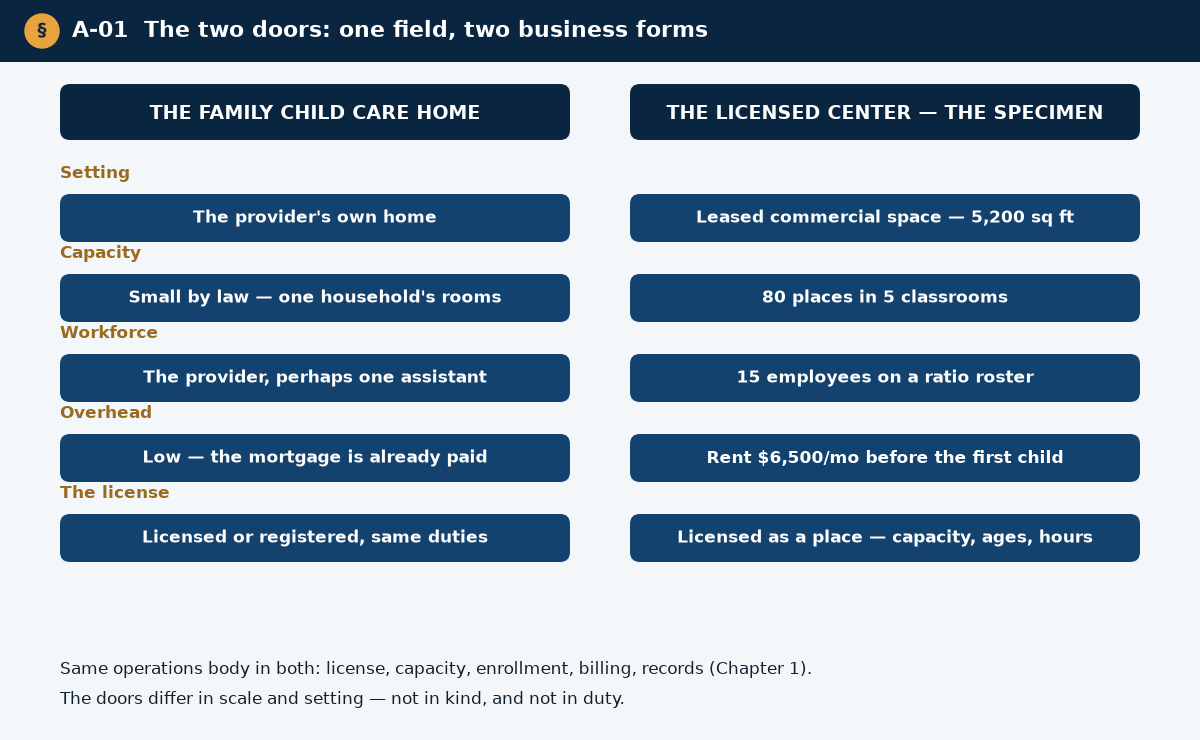
Figure A-01. The two doors compared
Read the comparison as an operator, not as a preference poll. Ask four questions of each door. What does the license attach to? A building you lease, or a home you live in — and what happens to the business if you must leave those premises. What is the capacity ceiling, and who sets it? In both doors the agency sets it, but the center's ceiling is built room by room from space and staffing, while the home's ceiling is a single small number for the whole program. What is the staffing shape? The center is an employer from the first day, with a roster, substitutes, and payroll as systems; the home may operate with the provider and limited help, which concentrates both the work and the absence risk in one person. What is the growth shape? A center grows by adding licensed rooms or a second site (Chapter 19); a home grows, if it grows, by crossing to the center door — the ladder Chapter 19 teaches — which is a new license and a new place, not an enlargement of the old one.
This book takes the center door as its main line because its seat in the catalog is the center, and because the center's systems — multi-room capacity, a staff of fifteen, three payers, a food program — contain the home's systems at larger scale. The home door is taught here as a genuine alternative with its own logic, and again in Chapter 19 as the starting point of the growth ladder. Neither door is a smaller or larger version of the other, and neither changes what this book teaches: in both forms the operator's job is the systems around the work in the rooms. The choice is a business-form and licensing decision — not one this book makes for you, and not settled by enthusiasm. It is settled, provisionally, by the capacity arithmetic of the next section, done with your agency's numbers.
Licensed capacity is the maximum number of children the license authorizes the place to serve at one time, as the sum of the capacities of its licensed rooms for their licensed age bands. Distinguish three numbers that new operators routinely merge into one, at their cost.
Enrollment is the number of children with a current enrollment agreement — names on the roster, whether present today or not. Attendance is the number actually present on a given day, always lower than enrollment by absences, illness, and family schedules. Occupancy, as this book uses the term, is enrollment divided by licensed capacity, expressed as a percentage. A center licensed for 80 with 64 enrolled stands at 80.0% occupancy even on a day when 58 attend. Tuition follows enrollment. Food counts follow attendance. Staffing follows attendance held against ratio duties for the children present, planned from enrollment. Confusing the three numbers corrupts every later calculation, beginning with the break-even in Chapter 3.
Willow Lane's license — a fictional document this book defines and labels — authorizes capacity 80, in five classrooms: infants 8 in one room, toddlers 12 in one room, and preschool 60 in three rooms of 20. The specimen's license terms, chosen inside the common national range and used for all worked arithmetic in this book, set staff-child ratios at 1:4 for infants, 1:6 for toddlers, and 1:10 for preschool, with group-size caps of 8, 12, and 20, an indoor space standard of 35 square feet per child of classroom space, and an outdoor standard of 75 square feet per child outside at once. Wherever those terms print, they are the specimen's license terms. Your license will state its own ratios, caps, and space figures, and you substitute them by the same method. The building that holds the specimen totals 5,200 square feet, with 2,930 square feet in the five classrooms and a 2,600-square-foot outdoor play yard, open 6:30 a.m. to 6:00 p.m., Monday through Friday.
Why call capacity founding? Because capacity is the one decision that prices all the others before any of them is negotiated. Licensed capacity, worked backward, tells you the classroom square footage you must lease (Chapter 4), the classroom staff you must be able to field at full rooms (ten classroom staff at Willow Lane's full capacity, before floaters, cook, and leadership are counted), the maximum tuition base the place can ever carry at a given tuition schedule, and the enrollment level at which the place covers its costs. Worked forward from a lease or a building you happen to like, the same arithmetic arrives too late: the rent is signed, and capacity becomes whatever the signed rooms allow. The order in this book is deliberate — capacity first, then the license sequence (Chapter 2), then the numbers (Chapter 3), then the site (Chapter 4) — because each step constrains the next, and reversing the order is how operators sign for places their license arithmetic never approved.
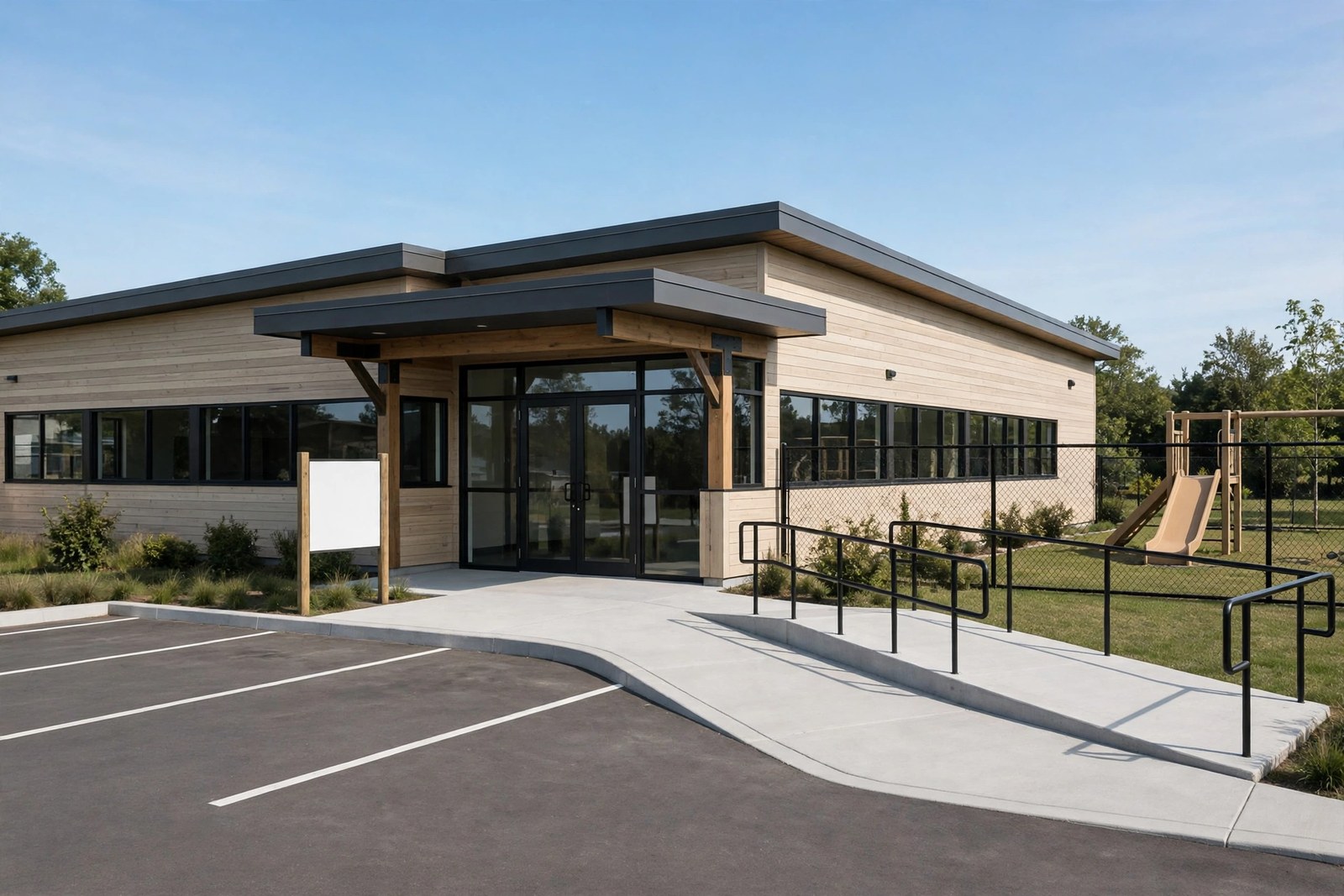
Figure P-01. The center's entrance and exterior
Capacity also disciplines hope. A license for 80 is not 80 enrollments, and the specimen is never presented in this book as full: its stabilized teaching month, introduced in Chapter 3 and held constant thereafter, stands at 64 enrolled of 80. The gap is not a failure to be hidden. It is the normal operating condition the break-even calculation exists to measure — Chapter 3 answers 60 for the specimen. This chapter's job is prior to that answer: the denominator of that fraction, 80, was a decision made on paper before a lease, and a different denominator would have produced a different business, with a different break-even, staff, and rent.
Add the rooms as the specimen's license states them. Infants: 1 room × 8 = 8. Toddlers: 1 room × 12 = 12. Preschool: 3 rooms × 20 = 60. Total licensed capacity: 8 + 12 + 60 = 80. Now check the space term of the same license: 80 children × 35 square feet per child = 2,800 square feet of classroom space required. Willow Lane's classrooms total 2,930 square feet, so 2,800 ≤ 2,930 and the space term is satisfied with 130 square feet to spare. The lesson is the order: capacity is not asserted and then housed. It is the smaller of what the rooms' licensed counts allow and what the space standard allows, and both checks must be run.
Use the specimen's stabilized teaching month. Enrollment is 64 (infants 7, toddlers 10, preschool 47; check: 7 + 10 + 47 = 64). Occupancy: 64 ÷ 80 = 0.800 = 80.0%. Average daily attendance is 58 over 21 service days, so child-days for the month: 58 × 21 = 1,218. Attendance as a share of enrollment: 58 ÷ 64 = 90.6% on an average day. Three different numbers, three different jobs: occupancy (80.0%) measures the enrollment system against the license; enrollment (64) drives tuition; child-days (1,218) drive food counts and food-program claims. An operator who reports "we had 58" when asked about occupancy has answered a food question to a capacity question.
Apply the specimen's license ratios at full rooms. Infants: 8 children ÷ 4 per staff member = 2 staff. Toddlers: 12 ÷ 6 = 2 staff. Preschool: 60 ÷ 10 = 6 staff. Total classroom staff at full capacity: 2 + 2 + 6 = 10. Willow Lane employs 15 people in all — owner-director, assistant director, 5 lead teachers, 5 assistant teachers, 2 floaters, and 1 cook — so the 10 classroom positions sit inside a 15-person establishment, and the other 5 are not surplus: they are leadership, coverage, and food service, without which the 10 cannot hold ratio through breaks, absences, and the ends of the day (Chapter 9 builds that roster in full). Capacity decided the 10 before any hiring began.
New operators often meet one statistic before they meet any other: the shortage statistic. It deserves to print here, attributed, dated, and fenced, because both errors about it are expensive — ignoring it, and building a business plan on it.
A licensed child care desert is an area with more than three children under age 6 per licensed child care slot. In 2025, 46% of America's children under age 6 lived in a licensed child care desert (Center for American Progress, with the W.E. Upjohn Institute and Stanford University, "America's Licensed Child Care Deserts," 2025; the figure was 51% in the 2018 analysis). The measure counts licensed supply only, not informal care.
What the figure establishes is a fact about supply geography: in much of the country, licensed slots are scarce relative to young children. What it does not establish is anything about your center. It is not a finding that families in your neighborhood can pay your tuition, that your rooms will fill, that a subsidy mix will hold, or that a new center at your rent and your wage structure covers its costs. A desert can contain a center that fails at 60% occupancy for reasons the desert map cannot see — price, hours, reputation, a lease signed above the arithmetic — and a well-supplied area can contain a center that holds its enrollment on steadiness alone. The book's fence on all population figures is absolute: they are facts about populations, never the reader's odds, demand, or future.
Used correctly, the desert figure does one job in this chapter. It explains why the capacity decision matters beyond your own walls: licensed capacity is genuinely scarce infrastructure, and adding a licensed place, honestly counted and honestly run, is a real contribution to supply. That is a reason to do the arithmetic carefully. It is not a substitute for the arithmetic. Chapter 3's break-even, Chapter 8's funnel (40 inquiries becoming 5 enrollments in the specimen's growth month), and Chapter 18's survival discussion all exist because supply scarcity and business survival are different subjects, and only the second one pays the rent.
The chapter's worksheet, WS-1 Capacity Canvas, holds the founding decision on one page, in the order this chapter taught it. Fill it with your agency's numbers where the specimen's numbers stood in the examples; a canvas filled with the specimen's numbers describes Willow Lane, not your project. The canvas asks for: the door chosen and the reason in business-form terms; the proposed licensed capacity by room and age band, with the ratio, group-size cap, and space standard your agency states for each band; the classroom square footage the capacity requires and the square footage a candidate building actually offers in classrooms; the classroom staff the capacity implies at full rooms; the hours the license would carry; and the three counts — capacity, a first-year enrollment planning figure you label as a planning figure and nothing more, and the attendance share you will assume for food planning — held in separate boxes so they cannot merge. Leave any box you cannot yet fill blank and named: that blank is your next agency question, and Chapter 2 shows you how to ask it and what to write down.
An intending operator, Priya, calls her state licensing agency's inquiry line before she has premises. Read for what she asks: structure and sequence, not permission to succeed.
Priya: I'm deciding between opening a center and a family child care home. Can you tell me what your office licenses in each case, and where the written requirements for each are published?
Licensing staff: Both are licensed through this agency. The center license is for nonresidential premises and is issued by classroom and age band. The home license is for your residence, and the household is part of the application picture. The requirement documents for both are on our published licensing pages, and there's an orientation for each path.
Priya: If I pursue the center path, what fixes my capacity — the building, or your office?
Licensing staff: Both have to agree. We license rooms for stated age bands up to stated group sizes, and the space standards have to be met in those rooms. Bring us a floor plan and we work from the rooms.
Priya: And background checks — who do they cover on each path?
Licensing staff: In a center, all staff, including non-teaching staff and volunteers with unsupervised access. In a home, that includes the adults living in the home. The orientation covers the components and the timing.
Priya: Last thing — if I write down your answers today, what should I check again before I sign a lease?
Licensing staff: The current published requirements at the time you apply. Requirements change, and the application is judged on the rules in effect then.
The dialogue teaches by its restraint. Priya does not ask which door is better, whether her town needs a center, or whether her plan will work — the agency cannot answer those, and an answer would not bind anyone. She asks what is licensed, what fixes capacity, who the duties reach, and what to re-verify. Those four questions, with the answers dated and kept, are the working product of a first agency call in any state.
End of the free sample. The complete book continues from here — the full A-to-Z course in book form, delivered as an EPUB you can read in Apple Books, Google Play Books, ReadEra, Thorium Reader, Adobe Digital Editions, or Send to Kindle.
Buy this ebook — $12.99 Back to the book page
Payments are securely processed by Payhip.