
Mastering Careers & Skills
Chartered Financial Analyst Exam Level I (CFA®) · free sample from the book itself
The Complete Investment Analysis Course — 1,220 Practice Questions, Diagnostic & 2 Full Timed Tests, Every Answer Explained
Feras Alzubi
Google Play Books Exam Prep Series
The Complete Investment Analysis Course — 1,220 Practice Questions, Diagnostic & 2 Full Timed Tests, Every Answer Explained
Feras Alzubi
Google Play Books Exam Prep Series
Built on the 2026 Level I topic structure and weight ranges published by CFA Institute, with the published 2027 weights and topic names printed in full in Chapter 1, in Chapter 30, and on the Exam Blueprint page of this front matter — Level I only.
© 2026 Feras Alzubi. All rights reserved.
No part of this book may be reproduced, distributed, or transmitted in any form or by any means without the prior written permission of the copyright holder, except as permitted by law and except for brief quotations in a review.
Originality statement. This is an original work, written for this book. It teaches the knowledge the Level I examination examines in its own words, with its own examples, companies, scenarios, and numbers. The practice questions are original, written against CFA Institute's published topic structure and weight ranges, and are not CFA Institute's actual, recalled, paraphrased, or adapted examination items; no curriculum reading, learning outcome statement, Code of Ethics, Standards of Professional Conduct, or GIPS Standards text is reproduced beyond short, attributed, fair-use reference. Every figure is original artwork drawn for this book; no CFA Institute artwork, logo, or certification mark is reproduced, redrawn, or imitated.
Not affiliated — the standard disclosure, naming CFA Institute. This book is an independent study guide. It is not published by, affiliated with, endorsed by, approved by, or recommended by CFA Institute, and CFA Institute did not participate in its creation. It is not a substitute for the Institute's curriculum or its Learning Ecosystem, to which every registered candidate has access and to which this book routes you at the points where only the Institute's own materials will do. CFA® and Chartered Financial Analyst® are registered trademarks of CFA Institute; they are used in this book nominatively and adjectivally, to name the program and the examination it prepares you for, with the ® symbol on the first and most prominent use in each part of the book. The author, Feras Alzubi, holds no charter and claims none, and is never styled with the designation.
No guarantee. This book makes no promise of passing, of any score, of the charter, of membership, of employment, or of income — on this page or anywhere else in it. It prepares you for the Level I examination; the examination, the passing standard, and the charter are CFA Institute's.
Front matter — Copyright page · How to use this book (and the book's fences, stated plainly) · The Exam Blueprint page — the examination at a glance; topic weights, 2026 and 2027 · The Diagnostic: instructions and score-by-topic tracker · Errata & Currency block (placeholder — production executes before publication)
Opening matter — Entry Diagnostic (50 items, with explained key)
Part I — Foundations and the Exam Itself
Part II — Quantitative Methods
Part III — Economics
Part IV — Financial Statement Analysis
Part V — Corporate Issuers
Part VI — Equity Investments
Part VII — Fixed Income
Part VIII — Derivatives
Part IX — Alternative Investments
Part X — Portfolio Management
Part XI — Ethical and Professional Standards
Part XII — The Exam Layer
Practice apparatus (back matter, in order) — Full Timed Form 1 (180 items: two sessions of 90 × 135 minutes, with explained key) · Full Timed Form 2 (180 items, with explained key) · Topic Repair Sets R-ETH · R-QM · R-ECO · R-FSA · R-CI · R-EI · R-FI · R-DER · R-AI · R-PM (25 items each, with explained keys) · Chapter quizzes stand at the end of Chapters 2–29 (20 items each, with explained keys in the companion key files); Chapter 1 carries the Diagnostic instead of a quiz, and Chapter 30 carries the forms
Back matter — Study Plans (Standard · Intensive · 2027 Variant) · Cheat Sheets (Numbers · Formula · Calculator · Ethics Architecture) · Glossary · Errata & Updates · References · Outline Crosswalk Appendix · Index
This book was built, under the series' dual-purpose standard, for two readers at once — and its first instruction is to know which one you are today.
Reader one: the total beginner to finance. You may be an engineer, a nurse, a teacher, a final-year undergraduate in any field — Level I's eligibility routes admit any bachelor's field, final-phase undergraduates, and a work-experience route, and the examination assumes no finance degree (Chapter 1, §1.4, works the eligibility self-check in full). You have never read a financial statement and never touched a financial calculator. Your path is the book in order: Part I builds the ground floor — the field, its language, its mathematics, and both approved calculators key by key — inside this cover, before any topic chapter asks anything of it. Do not skip Part I. Every later chapter rests on it, by design and by the book's foundations map, and the gates checked that no procedure in Parts II–XI rests on a foundation not already taught above it.
Reader two: the exam candidate. Your sitting is booked or bookable; the examination's shape is your horizon. Your path starts with the Diagnostic (instructions below), whose topic report routes you: weak topics at chapter depth first, strong topics verified through their chapter quizzes rather than re-read. Then the plans in the back matter, and — in your final weeks — Chapter 30's re-sort: stop studying in the book's learning order and rehearse in the examination's session order, with both full forms taken as sittings, timed, in strict order.
Both readers, three standing rules. (1) Work every worked example with your own calculator in hand. Reading a computation is not working it; this is a computation-heavy examination, and every calculation class in the book is worked end-to-end, on both approved calculators, before it is tested. (2) The keys are teaching. Every item in this book — diagnostic, quiz, form, repair set — carries a full explanation of why the key is right and why each distractor is wrong. An item bank taken without reading its explanations is half taken. (3) Nothing here outranks the Institute. Where this book and CFA Institute's current pages ever disagree at the time you use it, the Institute's current page governs your candidacy; the Errata & Updates page in the back matter tells you what edition you hold and how corrections reach you.
Thirty chapters in twelve parts (see Contents). Parts II–XI teach the ten published topics in a learning order — tools before statements, statements before issuers and assets, assets before portfolios, ethics last as teaching so it is freshest at the sitting, though woven in as conduct from Chapter 1, because candidacy rules bind you from registration, not from Chapter 28. Part XII (Chapter 30 alone) is the exam layer: it re-sorts everything into the examination's session order and teaches the sitting itself. Chapter anatomy is uniform: an opening scenario (invented) · exposition taught from foundations, with figures at their teaching points · worked examples (givens → named method → steps → answer → sanity check) · Exam trap and Remember the number apparatus, every number sourced · a chapter quiz (Chapters 2–29) · a one-page summary · key terms · source notes citing the book's verified source register in its own numbering.
| Component | Count | Shape |
|---|---|---|
| Entry diagnostic | 50 items | Untimed in presentation, designed for ≤ 60 minutes; composed inside every published 2026 range, scored by topic; routes you to chapters and repair sets; Chapter 1 carries it instead of a quiz |
| Chapter quizzes | 560 items | 28 quizzes × 20 (Chapters 2–29); each samples its chapter only; Chapter 29's quiz is scenario-pure (Ethics application) |
| Full timed forms | 360 items | 2 forms × 180, each in the examination's own published shape: two sessions of 90 items × 135 minutes, topics assigned to sessions as the Institute publishes, the break rehearsed between sessions; construction inside the 2026 ranges, disclosed on each form's face |
| Topic repair sets | 250 items | 10 sets × 25, one per topic: assigned after a weak diagnostic topic, a weak form topic, or a real score report's second page (Chapter 30's method); each closes with its re-test instruction |
| Total | 1,220 items | Every item original; three choices (A/B/C) in the Institute's published format conventions; every option explained |
Scoring honesty — printed here, and on the face of every instrument in the book. Your result in this book is a raw count, reported by topic, for your own readiness judgment. CFA Institute scores the real examination on a scale and compares your scale score to the Minimum Passing Score it sets (published for Level I as 1600 on a 1000–1900 scale); it publishes no percentage-correct passing mark, and no result in this book converts to a scale score or predicts one. CFA Institute's own practice guidance — aim for consistent topic scores above 70% of the available points when taking practice problems, which it calls a reasonable signal of topic mastery — is quoted in Chapter 30 with its source; it is guidance, not a passing standard. A form's front note states one further published fact: the real sitting may include unidentified unscored items that do not affect your score; the Institute publishes no count, and this book prints none.
Hold the whole book to these. They are stated in Chapter 1, kept in every chapter, and gathered here so you can check the book against them yourself.
Take the Diagnostic before you study — before Chapter 2 — calculator beside you, in about an hour, untimed in presentation. Answer every item: the real examination has no penalty for a wrong answer, and this is where that rule becomes a habit. Score it by topic, not as a single total, from its explained key, and record the result in the tracker below. Its composition, disclosed on its face: Ethics 9 · Quantitative Methods 4 · Economics 4 · Financial Statement Analysis 6 · Corporate Issuers 4 · Equity Investments 6 · Fixed Income 6 · Derivatives 3 · Alternative Investments 4 · Portfolio Management 4 = 50, each share inside its published 2026 range, rounding disclosed. Its output is a route, not a verdict: each topic score points at the chapters and the repair set deserving your earliest attention. A low score in a field you have never studied measures your biography, not your ability; a low score in a field you have studied is the Diagnostic's real catch. Retake it only as a routing check after a full repair cycle — its items appear nowhere else in the book, and memorizing them teaches nothing the examination tests.
Diagnostic (50) — Total (count): / 50 · ETH /20-scale topics → record per topic: ETH · QM · ECO · FSA · CI · EI · FI · DER · AI · PM: /9 · /4 · /4 · /6 · /4 · /6 · /6 · /3 · /4 · /4
Chapter quizzes (20 each) — Total (count): / 20 per chapter · ETH /20-scale topics → record per topic: ETH · QM · ECO · FSA · CI · EI · FI · DER · AI · PM: — (chapter topic)
Full Form 1 (180) — Total (count): / 180 · ETH /20-scale topics → record per topic: ETH · QM · ECO · FSA · CI · EI · FI · DER · AI · PM: per the form's topic table
Repair sets (25 each) — Total (count): / 25 per topic · ETH /20-scale topics → record per topic: ETH · QM · ECO · FSA · CI · EI · FI · DER · AI · PM: per set
Full Form 2 (180) — Total (count): / 180 · ETH /20-scale topics → record per topic: ETH · QM · ECO · FSA · CI · EI · FI · DER · AI · PM: per the form's topic table
Every total in this tracker is a count of this book's items, reported by topic for your readiness judgment. The tracker deliberately has no column that converts a count into a scale score or a pass prediction, because no such conversion exists for anyone outside the Institute's equating process.
Every figure on this page is a published fact, primary-sourced to the book's source register (gate/SOURCES.md, verified 2026-11-03) and cited by the register's own numbering; Chapter 1 teaches every line, and Chapter 30 returns to all of it as craft.
| Feature | As published | Source |
|---|---|---|
| Examination | Level I of the CFA® Program — "learn and describe": knowledge of foundational terms, concepts, and formulas | C-01 |
| Format | Computer-based, at test centers; 180 multiple-choice questions | C-02 |
| Sessions | Two sessions × 90 questions × 135 minutes (4.5 hours of content sessions); a tutorial, a break, and an end survey are also allocated; session times approximate | C-02 |
| Item anatomy | Stem + three choices (A/B/C); sentence-completion and question formats; qualifiers of the most likely / least likely / best described family; no "except/true/false" items; no "all/none of the above" options | C-03 |
| Scoring | All questions equally weighted; no penalty for an incorrect answer — never leave an item blank | C-04 |
| Pacing | ≈ 90 seconds per question on average (Institute guidance) | C-05 |
| Unscored items | The examination may include unidentified unscored items that do not affect the score; no count is published | C-22 |
| Curriculum | 10 topics, each of learning modules, each module opening with learning outcome statements (existence noted; wording is the Institute's text and is not reproduced) | C-06 |
| Study load | Successful candidates report over 300 hours on average per level | C-11 |
| Calculators | Texas Instruments BA II Plus (including BA II Plus Professional) · Hewlett Packard 12C (including 12C Platinum, 12C Platinum 25th anniversary edition, 12C 30th anniversary edition, HP 12C Prestige) — bring your own; inspected before the examination; an unauthorized calculator voids results | C-12 |
| Identification | Valid international travel passport — no passport, no sitting; arrive at least 30 minutes early; water only in a clear bottle with no labels, images, or writing | C-13, C-26 |
| Eligibility | One of: a bachelor's degree or equivalent · undergraduate status with the selected window 23 months or less before the graduation month · 4,000 hours of professional work experience and/or higher education over a minimum of three sequential years by registration (1,000 hours per year of higher education; no overlap). Examination in English only. Chapter 1's self-check worksheet governs your reading of your own route; this book never certifies eligibility | C-13 |
| Fees (Level I) | Early USD 1,140 · Standard USD 1,490; the one-time enrollment fee is eliminated (examinations from February 2026 onward); all three levels by examination fees: USD 3,520–4,570 | C-14 |
| Windows | Four windows a year — usually February, May, August, November. No per-window dates print in this book: read deadlines from the Institute's dates-and-fees tool when you act | C-15 |
| Rescheduling | Within your window, through Prometric, USD 250, subject to availability; missed appointments forfeit fees — nonrefundable, non-deferrable, non-transferable | C-16 |
| Retakes | Maximum 6 attempts per level; at most 2 per calendar year; never in consecutive windows or windows 6 months or less apart | C-17 |
| Results | Email notice within 5–9 weeks after the close of the examination window (the controlling framing; Chapter 1 notes the Level I page's 5–7-week framing); pass/fail + topic performance + overall scale score; Practical Skills Module completion required first; retabulation is not available | C-18, C-23 |
| Passing standard | The Minimum Passing Score (MPS): set by the Board of Governors through modified-Angoff standard setting, maintained across administrations by equating — a criterion-referenced absolute standard; published as a scale score: Level I 1600 on a 1000–1900 scale. No raw percentage-correct passing mark is published; no per-topic passing score exists | C-19, C-20 |
| Ethics adjustment | For candidates on the borderline of passing or failing, performance on the Code and Standards may move the overall outcome to either side of the MPS — stated exactly so; no mechanics are published and none are added | C-21 |
| Practical Skills Module | One per level, required to receive the result. Level I: Financial Modeling or Python Programming Fundamentals; 10–20 hours each; start any time after registration; must be complete by results release or the result is voided; content not examination-tested; a same-level retake needs no new module | C-24 |
| The charter path (orientation only) | Pass all three levels → 4,000 hours of qualifying work experience over at least 36 months → regular membership with professional references (two if one is an active regular member of the society applied to, otherwise three) → only then use the designation. This book prepares you for the first rung | C-25 |
A weight is a range: the share of the examination a topic is expected to occupy. Ranges are the published frame within which forms are assembled; the Institute does not publish its form assembly, and no range is a promise about your particular form.
2026 cycle — this book's spine.
| Session | Topic | Weight |
|---|---|---|
| 1 | Ethical and Professional Standards | 15–20% |
| 1 | Quantitative Methods | 6–9% |
| 1 | Economics | 6–9% |
| 1 | Financial Statement Analysis | 11–14% |
| 1 | Corporate Issuers | 6–9% |
| 2 | Equity Investments | 11–14% |
| 2 | Fixed Income | 11–14% |
| 2 | Derivatives | 5–8% |
| 2 | Alternative Investments | 7–10% |
| 2 | Portfolio Management | 8–12% |
2027 cycle — published in full beside the spine. Four ranges change (Ethics 15–20% → 10–15% · Quantitative Methods 6–9% → 11–14% · Derivatives 5–8% → 6–9% under its new name · Alternative Investments 7–10% → 6–9%) and three topics are renamed (Corporate Issuers → Corporate Finance · Equity Investments → Equities · Portfolio Management → Portfolio Construction). The Quantitative Methods ranges do not overlap between cycles, which is why no single practice form can sit inside both cycles at once — this book's forms are built inside the 2026 ranges with their construction disclosed, and 2027 sitters are served by the enlarged Quantitative Methods and Derivatives repair sets and the 2027 study-plan variant in the back matter.
| Session | Topic | Weight |
|---|---|---|
| 1 | Ethical and Professional Standards | 10–15% |
| 1 | Quantitative Methods | 11–14% |
| 1 | Economics | 6–9% |
| 1 | Financial Statement Analysis | 11–14% |
| 1 | Corporate Finance | 6–9% |
| 2 | Equities | 11–14% |
| 2 | Fixed Income | 11–14% |
| 2 | Derivatives and Risk Management | 6–9% |
| 2 | Alternative Investments | 6–9% |
| 2 | Portfolio Construction | 8–12% |
Financial Statement Analysis questions are based on International Financial Reporting Standards (IFRS) unless otherwise noted; where a question rests on U.S. GAAP, it states so explicitly. This book follows the same discipline throughout Part IV and everywhere else the distinction bites.
Currency verification (executed). On the production date, 4 November 2026, every document named in this block was re-read in full at cfainstitute.org: (1) the Level I examination page — format, session shape, pacing guidance, both topic-weight tables, the Practical Skills Module menu; (2) the CFA Exam Calculator Policy — the exact model enumeration; (3) the CFA Program Policies page — eligibility routes and retake limits; (4) the exam results page and the current Understanding Your Exam Results guide — results timing, the published scale Minimum Passing Score, the reference-line framing; (5) the dates-and-fees tool and the Institute's pricing announcement — Level I early/standard fees, the enrollment-fee posture, the rescheduling fee; (6) the Practical Skills Modules page — the Level I menu and the voiding consequence; (7) the Institute's exam-day and deferral policy pages — the break's posture (register item V-02) and deferral terms (V-08); (8) the published 2027 topic table (V-03, V-04 at topic level); (9) scholarship terms and (10) membership dues — neither is mentioned or figured anywhere in this book, and both fences stand.
Result (recorded at execution). No material change. The 2026-cycle state this book prints — format, both topic-weight tables, fees USD 1,140 early / USD 1,490 standard with no enrollment fee, the calculator policy's exact model enumeration, eligibility, retakes, results framing, and the scale Minimum Passing Score — stands exactly as verified in the book's source register on 3 November 2026. Item V-08 (deferral terms) was closed from the Institute's current policy pages: this book prints no deferral terms and routes deferral questions to those pages, and that posture was verified unchanged; Chapter 30's register-premise clause was conformed to the closed state without printing any deferral term. Items V-02, V-03, and V-04 remain fenced exactly as printed: no scheduled-break duration is stated by the Institute and none is printed; the GIPS Standards are taught as 2026-cycle content with their printed cycle note; no 2027 module-level claim is printed. The 2027 cycle takes effect from the February 2027 window, which had not opened on the production date, so the cycle ruling (blueprint D-01) stands untriggered and the 2026 spine stands as built.
Errata at first printing: none known. Examination facts in this book are dated facts about dated documents — the 2026 cycle, register verified 3 November 2026, production re-verification 4 November 2026. If CFA Institute publishes a successor document, the successor governs your candidacy from its effective date, whether or not a later printing of this book has yet recorded it.
End of front matter. The entry Diagnostic follows; Chapters 1–30 follow it.
A note on names before anything else. CFA® and Chartered Financial Analyst® are registered trademarks of CFA Institute. This book uses those marks only to name, accurately and without any claim of affiliation, the program and the examination it prepares you for. This book is an independent study guide. It is not written, endorsed, approved, or recommended by CFA Institute, and it is not a substitute for the Institute's curriculum or its Learning Ecosystem, to which every registered candidate has access and to which this book will route you at the points where only the Institute's own materials will do. The author of this book, Feras Alzubi, holds no charter and claims none; the designation belongs to those who have earned it under the rules described in this chapter.
Marta is a mechanical engineer. She designs pump housings, she is good at mathematics, and until last spring she had never read a financial statement. Yet the interesting decisions in her industry — which product line to fund, which competitor to acquire — are argued in a language of yields, margins, cash flows, and discount rates that she was never taught. A colleague mentioned that there is an examination program built for exactly that language, open to people from any bachelor's field, whose first level assumes no finance degree at all.
Daniel is a final-year biology undergraduate. A summer internship shadowing a hospital administrator taught him that he cared less about the medicine than about the budget meetings: how a health system decides what it can afford to do. He has no finance network, no sponsoring employer, and a graduation date close enough to make examination windows a real planning problem.
These two readers — invented for this book, as every person in it is invented — stand at the same doorway for different reasons, and this book was built for both. Chapter 1's job is not to teach you finance. Its job is to show you what the doorway is: what the CFA® Program is, what the Level I examination consists of, who may sit it, what it costs, when it is offered, what else you must complete besides the examination itself, how results are reported, what the passing standard honestly is, and how this book is organized so a reader starting from zero can walk the whole road inside one cover. Your study plan, budget, calendar, and expectations depend on it entirely. Read it once, carefully, before anything else.
One promise governs this chapter. Every load-bearing fact in it — every fee, weight, deadline rule, and eligibility route — comes from CFA Institute's own published pages and documents, read directly, and each claim carries a source note at the chapter's end so you can check it yourself. Where the Institute's pages state a matter in more than one way, this book says so and names the framing it follows. Where a widely repeated claim has no support in the Institute's documents, this book does not repeat it as fact. You are preparing for a profession whose first topic is ethics; your study book should practice what its final chapters preach.
The CFA® Program is a three-examination professional program administered by CFA Institute, the global association of investment professionals that owns the curriculum, sets the examinations, and awards the charter. The three examinations are called Level I, Level II, and Level III, and they must be passed in order. Each level's curriculum builds on the one before it and grows more complex: the first level tests knowledge of the foundational terms, concepts, and formulas of the investment industry — the Institute's own summary of Level I's cognitive level is "learn and describe" — while the later levels move into analysis of situations and then into integrating concepts in portfolio-shaped, real-world scenarios. This book teaches Level I only. That sentence is a scope fence, not a marketing hedge, and you will find it repeated on the cover, in the listing, and here: nothing in this volume teaches, summarizes, or rehearses Level II or Level III content, and a reader who masters this book owns one complete preparation for one examination — the first one.
Why does the Program exist? Because investment work runs on shared concepts no single employer's training covers completely. A bond's price and its yield are two views of the same fact; a company's reported profit and its cash generation can tell opposite stories in the same year; a portfolio's risk is not the sum of its holdings' risks. The curriculum is organized, at every level, into ten topics — the ten topics that structure this entire book — each divided into learning modules. At the head of each module the Institute publishes learning outcome statements describing what a candidate should be able to do after studying it. This book tells you those statements exist, because that matters for using the Institute's own materials after registration. It does not reproduce their wording: the curriculum is the Institute's copyrighted text, and this book teaches the same knowledge in its own words, with its own examples, companies, and numbers, its crosswalk drawn at topic level in its own descriptions.
The curriculum is shaped through practice analysis — systematic study of what investment professionals actually do — which feeds the published Candidate Body of Knowledge framework. The implication for you: the ten topics are not an academic syllabus but a map of a working field, drawn from the field itself. That is why this book teaches the field and the examination together. Technique-only knowledge is fragile — it passes a familiar question and fails a reworded one. A candidate who understands what a market maker does, why a cash flow statement exists, and what a portfolio manager is deciding finds that examination questions become descriptions of things they understand, asked from different angles.
Level I is the first rung of a longer ladder, and you deserve to see the whole ladder once, accurately, before you climb. Here it is, stated exactly as the Institute publishes it, and then set aside — this book's business is the first rung.
Step 1 — Pass the three examinations. Register, enroll, and pass Level I, Level II, and Level III in order. At each level you must also complete a Practical Skills Module, described in Section 1.6 of this chapter, before your result for that level is released.
Step 2 — Complete qualifying work experience. At least 4,000 hours of work experience, completed over a minimum of 36 months, earned before, during, or after the Program. The experience must be directly involved with the investment decision-making process, or must produce a work product that informs or adds value to that process. Note the design: experience earned before enrollment can count, and the clock is hours accumulated over at least three years — a structure built for people who work while they study, which is nearly everyone on this road.
Step 3 — Become a regular member of CFA Institute. Regular membership is required before the designation may be used. The application requires professional references: two references if one of them is an active regular member of the local society to which you apply, three otherwise.
Only after all three steps may a person use the CFA designation after their name. There is no partial designation and no candidate version of the letters. Candidacy is described factually — "Passed Level I of the CFA Program" is the shape of an honest statement — never implying a partial award, a future award, or Institute endorsement. Chapter 28 teaches the underlying standard as examinable ethics content, because the rule about the marks is itself part of the Standards of Professional Conduct that Level I tests.
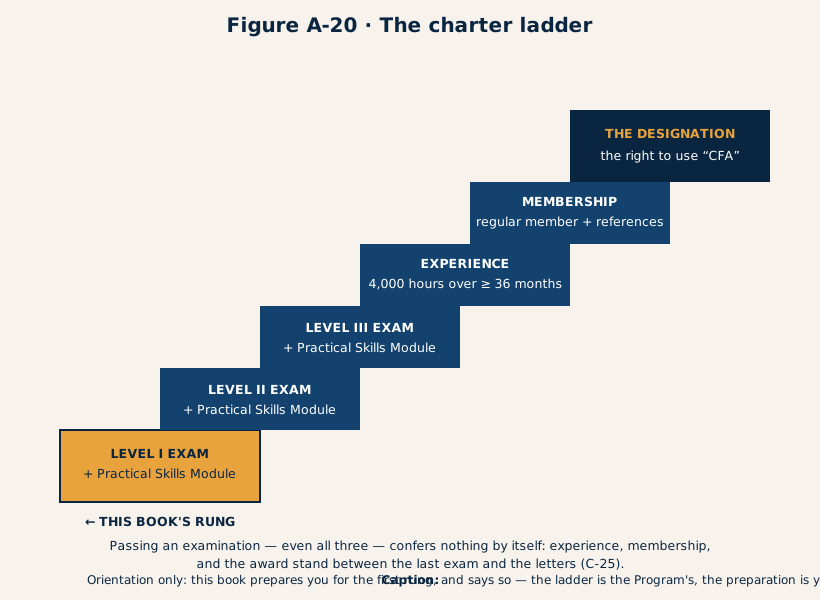
The charter ladder — three examinations with a Practical Skills Module at each level, then 4,000 hours of qualifying experience over at least 36 months, then regular membership with professional references, then the right to use the designation. This book prepares the reader for the first rung only.
Hold the ladder's shape in mind for one practical reason: time. A candidate who passes one level per cycle, studies while working, and accumulates qualifying hours along the way measures the road in years, not months. That is a planning fact, and it is why Section 1.9 treats your candidacy as a managed project with a schedule and a budget.
Everything in this section is a published fact about the examination's mechanics. Chapter 30 returns to all of it as craft — how to sit the thing, pace it, and recover from a bad sitting — but you need the facts now, because they shape how you will study from the first week.
Format. The Level I examination is computer-based, delivered at test centers, and consists of 180 multiple-choice questions. It is administered in two sessions of 90 questions each, and each session is allocated 135 minutes — four and a half hours of content sessions in total. Time is also allocated on the day for a tutorial on the examination software before the first session, a break between the sessions, and a survey at the end. The Institute describes the session times as approximate; treat 135 minutes per session as the planning figure and the day's other elements as additional time around it, not carved out of it.
Item anatomy. Every question has the same skeleton: a stem — a question, a statement to be completed, and/or a table — followed by three answer choices labeled A, B, and C, in sentence-completion or question format. The Institute publishes its item-writing conventions, and knowing them removes whole families of test-taking superstition. The examination does not use "except," "true," or "false" in its items, and avoids "not" whenever possible. Its stems use a known family of qualifiers — most likely, least likely, best described, most appropriate, most accurate, least appropriate, least accurate — and those qualifiers are part of the question: "least likely" reverses the direction of the answer, and Chapter 30 drills you on reading the qualifier before the content. Options familiar from other examinations never appear: no "all of the above," no "none of the above," no "A and B only," no "cannot determine" escape hatches. Every item has three substantive choices, one correct. Word choices are typically ordered shortest to longest; quantitative choices smallest to largest — a small fact that matters when you sanity-check a computed answer against the spacing of the choices.
Scoring. All questions are equally weighted, and there is no penalty for an incorrect answer — a clause with one behavioral consequence this book repeats until it is reflex: never leave an item blank. A blank scores zero with certainty; a guess scores zero with probability less than one. The examination may include unscored items — questions gathering statistical information for future examinations, unidentified and without effect on your score. The Institute publishes no count, and this book prints none; the only operational consequence is that every item deserves your full, ordinary effort, and no item — however strange it feels — deserves panic.
Pacing. The Institute's guidance is approximately 90 seconds per question on average. That word average carries the whole pacing doctrine: ninety seconds is a budget rate, not a per-item deadline. A definition may take forty seconds; a computation may take three minutes and earn it. The rate gives you check-in arithmetic — at a session's halfway point you should be near the items' halfway point — and Chapter 30 converts it into a rehearsed routine using the back matter's two full forms, built at exactly this shape.
Language and identification. The examination is offered only in English. Every candidate must present a valid international travel passport — not a driver's license, not a national identity card, a passport meeting the Institute's published description — and without one the candidate cannot sit. Arrive at least 30 minutes before your appointment. The only drink permitted is water in a clear bottle with no labels, images, or writing. These details sound administrative until you price their failure mode: a candidate who arrives with the wrong identification document does not sit, and as Section 1.5 explains, a missed appointment generally means forfeited fees. Chapter 30 prints the full exam-day timeline; the kit itself is simple enough to memorize now.
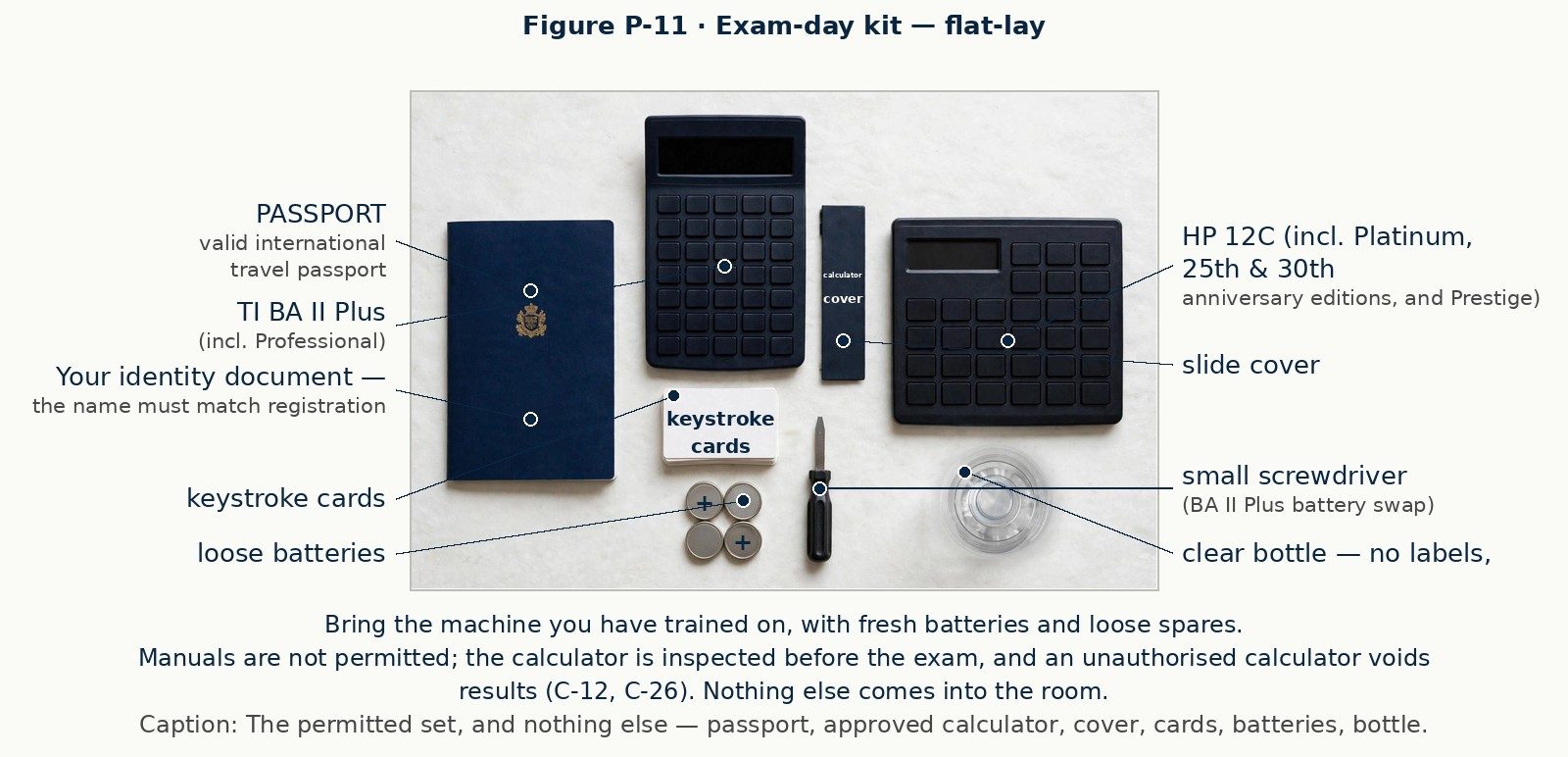
Exam-day kit flat-lay — valid international travel passport; both approved calculators with their covers and loose batteries; a clear, unlabeled water bottle. The permitted set, and nothing else.
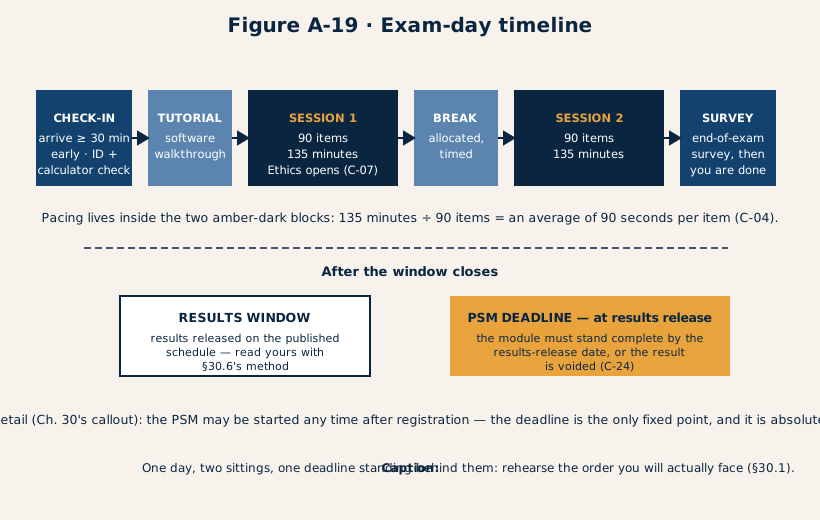
Exam-day timeline — check-in, software tutorial, Session 1 (90 items, 135 minutes), allocated break, Session 2 (90 items, 135 minutes), end survey — followed, after the window closes, by the results window and the Practical Skills Module deadline that precedes it.
What registration includes. Registered candidates receive the Institute's Learning Ecosystem: digital curriculum, practice questions, mock examinations, and study tools. A print curriculum — six volumes — may be purchased after registration, and an optional Practice Pack adds further Institute-authored practice. This book states those facts as honest routing: the Institute's materials are the curriculum's authority, every candidate has the Learning Ecosystem by virtue of registration, and this book's role is different — it teaches the field from zero, in a learning order, with its own items and computations, for readers whose starting point the curriculum does not assume. The two are complements. Any book that tells you to ignore the Institute's own materials is selling you something at the expense of your preparation.
Study load. The Institute reports that successful candidates spend over 300 hours on average preparing for each level. Read that average as an analyst does: a center, not a guarantee — finance graduates report less, candidates starting from zero should expect more. As a planning anchor it is the best published figure there is, and the standard study plan (Section 1.9) is built on it: roughly twenty-four weeks at a sustainable weekly rate, with the two full timed forms placed late, where they measure readiness rather than consume it. If your life allows only six focused hours a week, the honest arithmetic says your plan is a year, not a season — and a plan that admits that in week one beats an ambitious plan abandoned in week nine.
Remember the number: 180 questions · 2 × 90 · 2 × 135 minutes · ~90 seconds each · 3 choices · no penalty · over 300 hours. Every element of that line is sourced at the end of this chapter, and every element of it returns as craft in Chapter 30.
The examination is built from ten topics. The Institute publishes, for each topic, a weight range: the share of the examination that topic is expected to occupy. A range is not a promise about your particular form — it is the published frame within which forms are assembled — and the Institute does not publish its form assembly. Read ranges the way you will later read a confidence interval in Chapter 6: as honest bounds that tell you where the mass of the examination lies, not as a contract about any single question.
Table 1.1 — Level I topic weights, 2026 cycle (the spine of this book).
| Session | Topic | Weight |
|---|---|---|
| 1 | Ethical and Professional Standards | 15–20% |
| 1 | Quantitative Methods | 6–9% |
| 1 | Economics | 6–9% |
| 1 | Financial Statement Analysis | 11–14% |
| 1 | Corporate Issuers | 6–9% |
| 2 | Equity Investments | 11–14% |
| 2 | Fixed Income | 11–14% |
| 2 | Derivatives | 5–8% |
| 2 | Alternative Investments | 7–10% |
| 2 | Portfolio Management | 8–12% |
Two structural facts deserve attention. First, the sessions are fixed: Session 1's five topics are always examined together, and Session 2's five together; this book's full forms reproduce that assignment exactly, because pacing stamina is topic-shaped and you should rehearse the real sequence, not a shuffled one. Second, Ethical and Professional Standards is, in the 2026 cycle, the single heaviest topic on the examination. Candidates from quantitative backgrounds routinely underweight it, assuming ethics is the soft part. It is neither soft nor small, and it has one further property no other topic has (Section 1.7): for borderline candidates, ethics performance can move the outcome. This book therefore teaches ethics twice over — as professional conduct woven in from Chapter 1 (you are bound by candidacy rules from registration, not from Chapter 28) and as examinable doctrine at full depth in Chapters 28–29, placed last so it is freshest when you sit.
Table 1.2 — Level I topic weights, 2027 cycle (published in full, as published).
| Session | Topic | Weight |
|---|---|---|
| 1 | Ethical and Professional Standards | 10–15% |
| 1 | Quantitative Methods | 11–14% |
| 1 | Economics | 6–9% |
| 1 | Financial Statement Analysis | 11–14% |
| 1 | Corporate Finance | 6–9% |
| 2 | Equities | 11–14% |
| 2 | Fixed Income | 11–14% |
| 2 | Derivatives and Risk Management | 6–9% |
| 2 | Alternative Investments | 6–9% |
| 2 | Portfolio Construction | 8–12% |
The Institute publishes both tables side by side; this book prints both, in full, here and again in Chapter 30. Its spine is the 2026 cycle — the cycle in force when its source register was verified on 3 November 2026: 2026 names and ranges govern chapter space, item construction, and crosswalk. Comparing the tables: exactly four ranges change and three topics are renamed. Ethics falls 15–20% → 10–15%; Quantitative Methods rises 6–9% → 11–14% — a range that does not overlap its predecessor, which is why no single practice form can honestly sit inside both cycles at once; Derivatives, renamed Derivatives and Risk Management, rises 5–8% → 6–9%; Alternative Investments falls 7–10% → 6–9%. The renames: Corporate Issuers → Corporate Finance, Equity Investments → Equities, Portfolio Management → Portfolio Construction. Sitting in 2027? Both tables are printed so you can see your examination's shape; the Quantitative Methods and Derivatives repair sets are built deeper, where your cycle demands volume; and the 2027 study-plan variant rebalances toward your ranges. No figure belonging to a superseded cycle is ever taught as current — superseded figures are labeled with their dates, here and everywhere.
How should a range steer your studying? Proportionally, but not mechanically. A topic at 11–14% occupies roughly twice the examination of one at 5–8%, and your hours should roughly honor that — which is why Financial Statement Analysis is this book's largest part, and why the quantitative and fixed-income parts are sized generously beyond their raw weights: computation-dense topics cost more learning time per examination point, because each technique must be worked, not just recognized. But never convert a weight into permission to skip: a neglected small topic is a block of questions on which you are reduced to guessing. The diagnostic (Section 1.10) exists to find your distribution of weakness, which never matches the examination's published distribution — your real plan is built from both.
One more published grain matters from the start. Financial Statement Analysis questions are based on International Financial Reporting Standards (IFRS) unless otherwise noted; where a question rests on U.S. GAAP, the question states so explicitly. This book follows the same discipline (IFRS basis, U.S. GAAP differences flagged where they bite), because a candidate trained on blended, unflagged standards learns answers that are right nowhere. Each topic's published identity also tells you its center of gravity: Derivatives spans forward commitments (forwards, futures, swaps), contingent claims, and arbitrage; Alternative Investments spans hedge funds, private equity, real estate, commodities, and infrastructure. The back-matter crosswalk maps every topic to its chapters in this book's own descriptions, so you can audit completeness against the Institute's published topic list yourself.
Exam trap: the qualifier and the cycle. A study resource that quotes a single percentage for a topic — "Ethics is 15% of the exam" — has already misled you twice: the published figure is a range, and the range belongs to a named cycle. Whenever you meet a weight, a fee, or a format claim about this examination anywhere, ask the analyst's question: as of when, and according to whom?
Level I assumes no finance degree, and the eligibility rules are built to admit the Martas and Daniels of the world — but they are rules, with edges, and the edges are checked. Enrollment requires one of three routes. Work through the worksheet honestly; this book cannot certify your eligibility — the Institute's policies page is the authority, and the Institute may request proof, with consequences up to cancelled registration and voided results where proof cannot be provided. The worksheet tells you, before you pay anything, which route is yours and what evidence it rests on.
Route 1 — Bachelor's degree. You have completed a bachelor's degree program or an equivalent program and received the degree from the college or university. If this is you, the worksheet is finished: route one, evidence the degree itself.
Route 2 — Undergraduate student. You are still an undergraduate, and the Level I examination window you select falls 23 months or less before your graduation month — the month in which you earn the bachelor's degree or equivalent. Daniel's planning turns on this number: his graduation month fixes the earliest window he may select, and selecting an earlier window is not a gray area but a rule breach. Note the asymmetry the Institute publishes for later levels (named here only so your long-range planning is accurate): the window constraint tightens at Level II and the degree itself is required by Level III. For Level I, the figure to remember is 23 months.
Route 3 — Professional work experience and/or higher education. You hold a combination totaling 4,000 hours, acquired over a minimum of three sequential years and achieved by the date of your Level I registration. The counting rules are specific: count 1,000 hours for each year of higher education; education and work dates cannot overlap; work experience need not be investment-related; paid internships and articleships count; work in your own or a family business counts only if professional and paid; and qualifying experience draws on specialized knowledge and higher-level judgment and business skills — the Institute's list names leadership and teamwork, business communications, critical thinking, time management, professional judgment, analytical skills, and adaptability. Note the floor's design: 4,000 hours over at least three sequential years cannot be compressed into one intense year, because the rule measures seasoned exposure, not a sprint.
For every route, two further requirements. You must hold a valid international travel passport — the same document Section 1.2 requires at the test center door — and you must be ready to take the examination in English, the only language offered. Neither requirement is waivable by this book, by a test center, or by circumstance on the day.
Self-check worksheet (complete in pencil; keep with your study plan): ☐ My route is 1 / 2 / 3 (circle one). ☐ If route 2: my graduation month is ______; my selected window opens no earlier than 23 months before it. ☐ If route 3: my hours total ______ (≥ 4,000), spanning ______ sequential years (≥ 3), with no education/work overlap, achieved by my registration date. ☐ My passport is valid, is an international travel passport, and will remain valid on my examination date. ☐ I will sit the examination in English. If any box cannot be ticked truthfully, your next step is the Institute's policies page — by name, CFA Program Policies on cfainstitute.org — not a forum, not a prep provider, and not hope.
The examination is offered four times a year, usually in February, May, August, and November. This book prints that shape and no per-window calendar dates: the Institute's dates-and-fees tool is interactive, its deadlines move, and a printed date in a book is a stale date waiting to cost someone a registration. Your discipline, from this chapter forward, is that window dates, registration deadlines, and scheduling deadlines are read from the Institute's own tool at the moment you act on them — a habit Chapter 30 builds into its exam-craft checklist.
Fees. For examinations administered from February 2026 onward, Level I registration costs USD 1,140 at the early registration price or USD 1,490 at the standard price. All fees are paid in U.S. dollars. There is no enrollment fee: the Institute eliminated its former one-time enrollment fee for registrations under the current pricing — a change effective for the February 2026 examination cycle onward. Because you will meet the old figures across older materials and secondary writing, this book names them once, here, explicitly as history: before the current pricing, Level I cost USD 990 early and USD 1,290 standard, plus a one-time enrollment fee of USD 350. Those are pre-February-2026 predecessor prices. They are not a cheaper route you have missed, not a price you can ask for, and not current under any window you can still select; they are printed so that a reader who meets them elsewhere is informed rather than confused. For scale, the Institute publishes that completing all three levels by examination fees alone costs between USD 3,520 (registering early at every level) and USD 4,570 (registering standard at every level) — arithmetic this book verified tier by tier against the Institute's published per-level prices, because a total you cannot recompute is a total you should not repeat.
Budget honestly: the fee is not the whole cost of a sitting. Your real budget also holds a calculator you do not yet own (Section 1.8 — buy it in week one, not week twenty), travel to a test center, optional Institute purchases beyond the included digital curriculum, and the contingency nobody plans for: a reschedule or a retake, priced below.
Rescheduling. Within your examination window, you may reschedule your appointment through Prometric, subject to availability, for a fee of USD 250. The qualifiers matter as much as the price: within the window — a reschedule moves your appointment inside the same window, it does not carry your registration to a later window; subject to availability — seats are finite, and late in a window they may not exist at your center. Missed appointments forfeit the fees: the Institute's published posture is that examination fees for a missed appointment are nonrefundable, non-deferrable, and non-transferable. Print those three adjectives on your study plan. A candidate who treats the sitting casually is risking the full registration price on a morning's alarm clock, an expired passport, or a traffic jam — which is why Chapter 30's exam-day timeline starts the evening before.
Retakes. If a sitting goes badly, the road narrows in published ways. A candidate may attempt each level a maximum of six times, limited to at most two per calendar year, and a retake may not be scheduled in consecutive windows or in windows six months or less apart. Read together, the rules permit persistence while forbidding brute-force re-sitting. They force the only strategy that works anyway: sit, diagnose by topic (Chapter 30 converts a real score report's second page into a repair plan, using the back matter's topic repair sets), rebuild, and sit again when the diagnosis says ready. File the retake rules not as a plan, but as the reason your first plan deserves to be a serious one.
Remember the numbers: USD 1,140 early · USD 1,490 standard · no enrollment fee · USD 250 reschedule (within window) · four windows (usually Feb/May/Aug/Nov) · six attempts per level maximum · two per calendar year · never consecutive windows.
Alongside the examination, every level carries a second requirement — the one most often mishandled because it is not an examination at all. At each level you must complete one Practical Skills Module (PSM) — a guided, applied module of videos, questions, guided practice, and case studies — in order to receive your examination result. The linkage is mechanical: the module must be complete by the results-release date, and if it is not, your examination result is voided — you receive neither a pass nor a fail for a sitting you actually took. Schedule the module the way you schedule the examination itself.
At Level I the menu has exactly two choices, and it is the same menu in the Institute's published 2026 and 2027 tables:
Each module takes 10–20 hours. You may begin at any time after registration; a started module may be abandoned and switched for the other; the content is not itself examination-tested; and a same-level retake needs no second module — the requirement attaches to the level, not the attempt. This book teaches the PSM as mechanics only; it does not teach the modules' content as a substitute, because the module's value lies in doing the Institute's guided practice, not reading about it. Choose Financial Modeling if your target work is statement-driven (the natural companion to Part IV), Python Programming Fundamentals if your target work is data-driven. The study plans place the PSM immediately after the sitting, while the results window (next section) is still wide open: ten to twenty hours across six weeks is an evening a week; the same hours in the final week, against a voiding consequence, is a self-inflicted emergency.
When results arrive. You will receive an email notifying you that your official results are available within 5–9 weeks after the close of your examination window, provided your PSM is complete. This book prints that results-page framing as controlling, noting once that the Institute's Level I page frames Level I results at five to seven weeks from the examination — a difference of reference points, and the safe planning posture is the wider window. No honest source can promise a single week. Results are released only to the candidate, as a published summary: a pass / did-not-pass result, performance by topic area, and an overall scale score, on a two-page report Chapter 30 teaches you to read line by line — page one with your result, scale score, the passing-standard line, a confidence interval, and the administration average; page two with your percentage-correct performance per topic against its weight range, the group average, and per-topic confidence intervals. Results remain available for about a year; after that, a verification letter confirms pass or fail only. One further rule, short enough to memorize: retabulation is not available. The report you receive is the result.
The passing standard — this book's discipline, stated once and kept everywhere. The passing standard for this examination is called the Minimum Passing Score (MPS): the score a candidate needs to reach in order to pass. Three statements describe it completely, and this book makes no fourth:
Statement 3 is where this book parts company with a shelf of folklore, on the record. You will encounter confident percentage claims about what it takes to pass this examination. They are not the Institute's published standard, because the Institute publishes no such percentage; Chapter 30 names the folklore once, inside a clearly marked fence, beside what the Institute's documents actually say. What the Institute does publish about percentages is different in kind: on the score report's topic chart, reference lines are drawn at fixed shares of each topic's available points, which the Institute itself calls somewhat arbitrary as levels — while adding, as practice guidance, that consistent topic scores above the higher reference level on practice problems are a reasonable signal of topic mastery. This book adopts that guidance as guidance, labeled as guidance, in Chapter 30; a passing standard it is not. The same honesty governs this book's own apparatus: every result here — diagnostic, quiz, form, repair set — is a raw count and topic percentages, for your own readiness judgment only. Nothing in this book converts to a scale score or predicts a pass. Any book that converts your practice percentage into a pass prediction is selling you a number it cannot possess.
The ethics adjustment. One published refinement completes the picture. The Code of Ethics and Standards of Professional Conduct are tested at every level of the Program, and for candidates whose overall result sits on the borderline — on the edge of passing or failing — performance on that material may move the overall outcome to one side of the MPS or the other. This book states the adjustment exactly that way and builds nothing further on it: no threshold, no mechanics, no strategy of the "ethics will save you" variety, because the Institute publishes none. Its honest implication is already in Section 1.3: the heaviest topic in the 2026 cycle is also the topic with a borderline voice in your result. Study it like it matters twice, because on the published record, it can.
Only two calculator models are authorized in the examination room. The policy's exact enumeration — printed everywhere this book states the policy, because the short form conceals variants that matter at the inspection table — is:
You bring your own; you may not borrow one from the test center or from another candidate. Your calculator is inspected before the examination, and use or possession of an unauthorized calculator results in examination results being voided — the most expensive possible outcome of a stationery decision. Calculator covers, keystroke cards, and loose batteries are permitted in the testing room; instruction manuals are not. A small screwdriver may be kept for replacing batteries in the BA II Plus. The Institute states that it does not profit from calculator sales and does not endorse, warrant, or guarantee either machine — the policy is a standardization rule, not a recommendation, and Chapter 3 will teach you to choose between the two families on the only grounds that matter: which one your hands will be fluent on after three hundred hours of practice. Chapter 3 then teaches both machines key by key, from the first key, and establishes the dual-keystroke convention — every worked computation in this book shown on both machines, in paired boxes — that the remaining twenty-seven chapters obey. Buy your calculator in week one. A calculator bought in week twenty is a stranger you are taking into the most important examination of your year.
The back matter carries three complete plans; this section gives you their shape so the chapters ahead can be read in plan order from the start.
The Standard Plan — about 24 weeks. Built on the Institute's published study-load figure (over 300 hours reported by successful candidates), the standard plan runs the chapters in this book's learning order — foundations first, then Quantitative Methods, Economics, Financial Statement Analysis, Corporate Issuers, Equity, Fixed Income, Derivatives, Alternatives, Portfolio Management, and Ethics last, freshest — at a sustainable weekly rate. The entry diagnostic is taken in week 1, before Chapter 2, because its job is routing: it scores your starting position by topic and tells you where your personal distribution of weakness already sits. The first full timed form is taken at week 20, the second at week 23, each followed by a repair week driven by the topic repair sets. The PSM is scheduled immediately after the sitting, inside the results window, per Section 1.6.
The Intensive Plan — about 12 weeks. For readers with a finance degree or prior market work. The foundations chapters become a self-test fast lane: take each chapter's quiz first; the plan names the performance that certifies the skip — a skipped chapter is a tested chapter, never an assumed one. Everything else compresses by hours, not by topics.
The 2027 Variant. The standard plan rebalanced for the 2027 table of Section 1.3: the same spine and the same chapters, with Quantitative Methods and Derivatives repair volume raised to match those topics' enlarged 2027 ranges and Ethics rehearsal volume trimmed toward its reduced range. It is labeled, here and in the back matter, as this book's rebalance of its own apparatus against the Institute's published 2027 weights — the book's construction, disclosed as such.
Whichever plan you follow, its weekly unit is the chapter's own apparatus: read the chapter, work every worked example with your own calculator in hand (reading a computation is not working it), take the chapter quiz, and log the result by topic. The log is the raw material of your repair weeks; Chapter 30's score-report method is the same method applied to better data.
This chapter carries no quiz. In its place stands the entry diagnostic: 50 items in the book's opening matter, topic-proportioned inside the published 2026 ranges, designed for about an hour, untimed in presentation. Take it before Chapter 2, calculator beside you, answering every item (no penalty — practice that rule here first), and score it by topic, not as a single total. Its output is a route, not a verdict: each topic score points at the chapters and repair sets deserving your earliest attention. A low score in a field you have never studied measures your biography, not your ability. A low score in a field you have studied is the diagnostic's real catch, and deserves respect precisely because it surprises you.
Finally, this book's fences, gathered in one place so you can hold the whole book to them:
You now know what the doorway is. Chapter 2 opens the room beyond it: the field itself, taught from zero — what a security is, who issues and who buys, what a market is for, and why interest is the price of time. Pick up your calculator on the way; Chapter 3 is waiting just behind it.
Candidate Body of Knowledge (CBOK) — The Institute's published framework of the knowledge the Program examines, shaped by practice analysis of the investment profession. Charter — The award conferred when a person has passed all three examinations, completed qualifying work experience, and become a regular member of CFA Institute; only then may the CFA designation be used. Computer-based testing (CBT) — Delivery of the examination on computer at a test center, in scheduled windows. Criterion-referenced standard — A passing standard defined by a level of performance (what a candidate must demonstrate), not by comparison with other candidates; the MPS is of this kind. Curriculum — CFA Institute's copyrighted study text for each level, organized into ten topics and learning modules. Equating — The statistical process by which a standard's meaning is maintained across examination administrations whose versions differ slightly in difficulty. Ethics adjustment — The published provision under which a borderline candidate's outcome may be moved to either side of the passing standard by performance on the Code and Standards material. Examination window — One of the four annual periods (usually February, May, August, November) in which examinations are administered. Learning Ecosystem (LES) — The Institute's digital study environment included in registration: digital curriculum, practice questions, mock examinations, and study tools. Learning module — A subdivision of a curriculum topic; each module opens with learning outcome statements. Learning outcome statement — A published statement at the head of a module describing what the candidate should be able to do after studying it; its existence is a fact, its wording is the Institute's text. Minimum Passing Score (MPS) — The score needed to pass an examination, set by the Board of Governors through standard setting and maintained by equating; published only in scale-score form. Modified Angoff method — The standard-setting method the Institute uses (since 1996) to recommend the MPS: judges estimate, item by item, the performance of a minimally competent candidate. Practical Skills Module (PSM) — A guided applied module (10–20 hours) of which one must be completed at each level before that level's result is released. Practice analysis — The Institute's systematic study of professional practice from which the curriculum and the Candidate Body of Knowledge are derived. Practice Pack — The Institute's optional add-on of additional practice questions and mock examinations, purchasable by registered candidates. Qualifier — A direction word in an item stem (e.g., most likely, least likely, most appropriate) that forms part of the question being asked. Regular membership — The CFA Institute membership class required, with examinations and experience complete, before the designation may be used. Rescheduling — Moving an examination appointment within the same window through Prometric for a published fee, subject to availability. Retabulation — A recount of an examination result; published as not available for this Program. Scale score — A mathematical transformation of the raw number-correct score onto a standardized scale, reported since the February 2025 administration; a raw score cannot be recovered from it. Session — One of the examination's two sittings: 90 questions in 135 minutes, with a fixed assignment of five topics. Stem — The question, statement, and/or table that opens an examination item, followed by three choices. Topic weight range — The Institute's published range for the share of the examination a topic is expected to occupy in a named cycle. Unscored item — An item included in an examination to gather statistical information, unidentified to candidates and without effect on the score; no count is published.
All citations use the source register for this book (gate/SOURCES.md, verified 2026-11-03); C-numbers are verified facts, S-numbers the Institute documents they rest on, K-numbers rulings where the Institute's pages differ, X-numbers fences this book observes.
End of Chapter 1. This chapter carries no quiz by design: the 50-item entry diagnostic in the book's opening matter is its assessment instrument.
End of the free sample. The complete book continues from here — the full A-to-Z course in book form, delivered as an EPUB you can read in Apple Books, Google Play Books, ReadEra, Thorium Reader, Adobe Digital Editions, or Send to Kindle.
Buy this ebook — $11.99 Back to the book page
Payments are securely processed by Payhip.