
Mastering Careers & Skills
Truck Driver License (CDL) · free sample from the book itself
Every entry explains why the key is correct and why each wrong option is wrong, and points to what to study next.
1-1. Key: C. Part 383 fixes content, pool-based construction, and the pass standard; fees and scheduling are state matters.
1-2. Key: C. Attempt limits are set by the state; the other three are fixed federally.
1-3. Key: B. The model manual runs Sections 1 through 13, from Introduction to On-Road Driving.
1-4. Key: D. The manual's own stated limit, plus the federal knowledge standard's reach into Parts 391, 380, and 395, requires the second layer.
1-5. Key: A. Part 383 requires the pool, the content, and 80 percent; the lengths are the model/state-published standard, labeled as modeled.
1-6. Key: A. 0.80 x 50 = 40. Thirty-nine correct is 78 percent and does not meet the per-test standard.
1-7. Key: B. Both Class A conditions hold: GCWR 28,000 is at least 26,001, and the towed GVWR of 11,000 is more than 10,000.
1-8. Key: D. Failing air brakes attaches the restriction; failing combination bars Group A.
1-9. Key: A. The 14-day permit hold is the federal floor before skills testing.
1-10. Key: B. Texas tests its state commercial rules first — a state fact, printed only in the dated table.
1-11. Key: B. California's page states three attempts per test; a third failure voids the application.
1-12. Key: C. Dated, attributed, primary-sourced rows only — the table's silences are deliberate.
1-13. Key: A. A book teaches knowledge; hands are trained in a vehicle with a qualified instructor.
1-14. Key: D. Classes attach to vehicle groups and endorsed uses, as Chapter 2 details.
1-15. Key: C. Earning and keeping the license are one federal system; conduct and credential are linked.
What this chapter does. This chapter is the front door of the book, and it assumes nothing — not that you have sat in a cab, not that you know what a fifth wheel is when it is not on a wagon, not that you know which test you will take first. By the end you will be able to explain what commercial driving is, why its license exists, how a single federal core of knowledge is administered through fifty state systems, what the model manual is and where its authority ends, and how the knowledge and skills tests are shaped. Learn to tell a federal fact from a state fact on sight: that one skill protects every other fact in the book.
A commercial motor vehicle is, in plain terms, a large or specialized vehicle used in commerce: a tractor pulling a semitrailer of freight, a straight truck delivering building materials, a coach carrying passengers for hire, a school bus carrying children. Driving one is not simply driving, only bigger. The vehicle's weight changes how it stops, turns, and fails; its cargo or passengers change what a mistake costs; and the public therefore asks more of its driver than it asks of a car driver. That extra ask is the Commercial Driver's License — the CDL — and this book exists to prepare you for it, from zero.
Think of commercial driving as licensed work as part of the margin between a routine trip and a bad one. Margins in trucking are rarely dramatic; they are built from small correct choices made early, while there is still time and room to make them. The driver who has thought about this subject in advance does not have to invent a response under pressure. The response is already rehearsed, the numbers are already familiar, and attention is free for the part of the situation that is genuinely new. Examiners test for exactly that preparedness, because the road will test for it less kindly.
Now put the idea under load, literally. Add weight, weather, a tired driver, a tight schedule, and traffic that does not cooperate. Ideas that only work on a calm practice yard fail exactly here. The teaching in this section is written for the loaded case: conservative margins, early decisions, and checks that still get done when the day is running late. If a method in these pages ever seems slower than a shortcut you have seen elsewhere, that is deliberate. Shortcuts in this trade are usually margins being spent invisibly, and the bill arrives without warning.
Do this before you move on. Close the book and state, out loud or in writing, the main point of this section in two sentences, in your own words, without looking back. Then name one situation from an ordinary driving day where the point would change what you do. If either half is hard, re-read the section once, slowly — being unable to restate an idea is information, not failure, and it is far cheaper to learn it here than from a missed test item. This restate-and-apply habit, repeated through the book, is the single most reliable study method this book asks of you.
Licensing exists because the consequences of a heavy vehicle's failure are not private. A fatigued truck driver, a brake system nobody inspected, or a load that shifts in a curve endangers everyone sharing the road, not only the driver. The license is the public's evidence, obtained in advance, that the driver knows the vehicle, the rules, and the limits. It is granted by examination: written knowledge tests first, then a skills test in a real vehicle. Everything in this book is aimed at those two examinations and at the working knowledge behind them — because the examinations sample the job itself.
There is also a professional reason to learn the public purpose of licensing properly. Commercial driving is a credentialed occupation: other road users, employers, insurers, and licensing agencies all rely on the license as evidence that the holder knows this material and can be trusted with a vehicle whose size and weight forgive very little. When a driver treats a rule as paperwork, that evidence weakens. When a driver can say what the rule is, why it exists, and what happens when it is ignored, the credential means what it claims to mean — and the knowledge test, which samples precisely those three things, becomes much easier to sit.
Picture a working morning. The vehicle is fueled, the paperwork is in order, and the driver is walking toward the cab with a few minutes in hand. This is the moment the public purpose of licensing earns its keep: not at highway speed, but in the quiet check, the second look, the question asked before departure rather than after the first problem appears. A trainer watching that morning would not be looking for speed. The trainer would be looking for sequence — the right things checked in an order that misses nothing — and for the habit of treating anything doubtful as a reason to stop and resolve it, not as a detail to remember later. Build that sequence now, on paper, while building it costs nothing.
A useful check is to teach the point backward: start from the harm. What goes wrong, and to whom, when the public purpose of licensing is ignored, misunderstood, or left until too late? Work backward from that harm to the rule that prevents it, and then forward again to the driver's action. If you can travel that chain in both directions without notes, you own the material at the depth the knowledge test samples. If the chain breaks somewhere, that break is your study assignment for this section, and the chapter quiz at the end will find it if you do not.
The content of CDL testing is set nationally. Federal regulation — Title 49 of the Code of Federal Regulations, Part 383 — states what a driver must know, what a driver must be able to do, how tests are built, and the standard for passing them: at least 80 percent correct on each knowledge test. States build their knowledge tests from a pool of questions approved by the Federal Motor Carrier Safety Administration, comparable to the test system of the American Association of Motor Vehicle Administrators. That is the federal core, and this book teaches it completely and without hedging, because it is genuinely the same in every state.
Why it matters can be stated plainly. the federal core of CDL knowledge sits underneath decisions a driver makes every working day, often before the wheels turn at all. A driver who understands it as a living rule, rather than as a line memorized for a test, can explain it to an examiner, apply it to a vehicle that is not quite like the training vehicle, and recognize the moment on the road when it stops being theory. That three-way ability — say it, apply it, notice it — is what this book is building, section by section, and it is why each idea here is taught first in ordinary words, then in its precise form, and then inside a situation you could actually meet.
Consider how the same fact looks from the examiner's chair. The examiner cannot watch you drive for a year; the examiner can only sample. So the sampling is deliberate: the questions and demonstrations cluster on the points where misunderstanding is dangerous, not merely incorrect. When you meet the federal core of CDL knowledge in a question later in this book, read it as that kind of sample. Ask yourself what danger the question is really guarding against. Candidates who learn to see the danger behind the item stop being surprised by new wordings, because the danger, unlike the wording, does not change.
Write the number, term, or sequence from this section on a card — paper is fine — with its source label beside it: whether it is a federal rule, a figure from the model manual, or a fact your own state decides. Keeping the label attached to the fact is not pedantry. Most expensive mistakes in this subject come from true facts filed under the wrong authority: a state fee remembered as a national rule, a manual figure remembered as a law of physics. The card habit prevents that filing error at the moment it would otherwise be made.
The same license is issued through fifty different front doors. Your state driver licensing agency takes your application, collects its fees, schedules your tests, and issues your credential. Along the way it makes decisions the federal core leaves to it: what the application costs, how long an application stays valid, how many attempts at a test are allowed, in what languages tests are offered in practice, and when newer test methods are adopted. Two candidates in two states study the same core and walk through different doors. Neither is being treated unfairly; the system is federal in content and state-run in process, by design.
Think of state administration of a federal standard as part of the margin between a routine trip and a bad one. Margins in trucking are rarely dramatic; they are built from small correct choices made early, while there is still time and room to make them. The driver who has thought about this subject in advance does not have to invent a response under pressure. The response is already rehearsed, the numbers are already familiar, and attention is free for the part of the situation that is genuinely new. Examiners test for exactly that preparedness, because the road will test for it less kindly.
Now put the idea under load, literally. Add weight, weather, a tired driver, a tight schedule, and traffic that does not cooperate. Ideas that only work on a calm practice yard fail exactly here. The teaching in this section is written for the loaded case: conservative margins, early decisions, and checks that still get done when the day is running late. If a method in these pages ever seems slower than a shortcut you have seen elsewhere, that is deliberate. Shortcuts in this trade are usually margins being spent invisibly, and the bill arrives without warning.
Do this before you move on. Close the book and state, out loud or in writing, the main point of this section in two sentences, in your own words, without looking back. Then name one situation from an ordinary driving day where the point would change what you do. If either half is hard, re-read the section once, slowly — being unable to restate an idea is information, not failure, and it is far cheaper to learn it here than from a missed test item. This restate-and-apply habit, repeated through the book, is the single most reliable study method this book asks of you.
Because that split runs through the whole subject, this book marks it wherever it appears. Whenever teaching touches administration, you will meet a short box with a fixed heading:
There is also a professional reason to learn the state-decides convention used in this book properly. Commercial driving is a credentialed occupation: other road users, employers, insurers, and licensing agencies all rely on the license as evidence that the holder knows this material and can be trusted with a vehicle whose size and weight forgive very little. When a driver treats a rule as paperwork, that evidence weakens. When a driver can say what the rule is, why it exists, and what happens when it is ignored, the credential means what it claims to mean — and the knowledge test, which samples precisely those three things, becomes much easier to sit.
Picture a working morning. The vehicle is fueled, the paperwork is in order, and the driver is walking toward the cab with a few minutes in hand. This is the moment the state-decides convention used in this book earns its keep: not at highway speed, but in the quiet check, the second look, the question asked before departure rather than after the first problem appears. A trainer watching that morning would not be looking for speed. The trainer would be looking for sequence — the right things checked in an order that misses nothing — and for the habit of treating anything doubtful as a reason to stop and resolve it, not as a detail to remember later. Build that sequence now, on paper, while building it costs nothing.
A useful check is to teach the point backward: start from the harm. What goes wrong, and to whom, when the state-decides convention used in this book is ignored, misunderstood, or left until too late? Work backward from that harm to the rule that prevents it, and then forward again to the driver's action. If you can travel that chain in both directions without notes, you own the material at the depth the knowledge test samples. If the chain breaks somewhere, that break is your study assignment for this section, and the chapter quiz at the end will find it if you do not.
Your state decides. Confirm with your own state licensing agency: your application and test fees; how long your application stays valid; how many attempts at each test are allowed and what a further attempt costs; the languages in which knowledge tests are actually offered; how tests are scheduled; and which skills-test method your testing sites use. Nothing in that list is set by the federal core, and no figure for any of it prints in this book except in the dated variation table, sourced to a state's own publication.
Every state's CDL manual descends from one model: the model Commercial Driver License manual produced by the American Association of Motor Vehicle Administrators under a cooperative agreement with the Federal Motor Carrier Safety Administration. The model has thirteen sections, running from an introduction through driving safely, cargo, passengers, air brakes, combination vehicles, doubles and triples, tank vehicles, hazardous materials, and school buses, and closing with three sections on the skills test itself: vehicle inspection, basic vehicle control, and on-road driving. Learn the model's map and every state's manual becomes familiar on first opening, because the family resemblance is structural, not accidental.
Why it matters can be stated plainly. the model CDL manual behind every state manual sits underneath decisions a driver makes every working day, often before the wheels turn at all. A driver who understands it as a living rule, rather than as a line memorized for a test, can explain it to an examiner, apply it to a vehicle that is not quite like the training vehicle, and recognize the moment on the road when it stops being theory. That three-way ability — say it, apply it, notice it — is what this book is building, section by section, and it is why each idea here is taught first in ordinary words, then in its precise form, and then inside a situation you could actually meet.
Consider how the same fact looks from the examiner's chair. The examiner cannot watch you drive for a year; the examiner can only sample. So the sampling is deliberate: the questions and demonstrations cluster on the points where misunderstanding is dangerous, not merely incorrect. When you meet the model CDL manual behind every state manual in a question later in this book, read it as that kind of sample. Ask yourself what danger the question is really guarding against. Candidates who learn to see the danger behind the item stop being surprised by new wordings, because the danger, unlike the wording, does not change.
Write the number, term, or sequence from this section on a card — paper is fine — with its source label beside it: whether it is a federal rule, a figure from the model manual, or a fact your own state decides. Keeping the label attached to the fact is not pedantry. Most expensive mistakes in this subject come from true facts filed under the wrong authority: a state fee remembered as a national rule, a manual figure remembered as a law of physics. The card habit prevents that filing error at the moment it would otherwise be made.
The model manual says of itself, honestly, that it does not contain all federal and state requirements for driving a commercial motor vehicle. That sentence matters. The federal knowledge standard reaches beyond the manual into the regulations it points to — driver qualifications, medical certification, entry-level training, and hours of service among them. This book follows those pointers and teaches that regulatory layer too, in plain language, at the depth the knowledge test samples. Where the manual ends is therefore not where your preparation ends; it is where this book's second layer begins.
Think of the limits of the manual itself as part of the margin between a routine trip and a bad one. Margins in trucking are rarely dramatic; they are built from small correct choices made early, while there is still time and room to make them. The driver who has thought about this subject in advance does not have to invent a response under pressure. The response is already rehearsed, the numbers are already familiar, and attention is free for the part of the situation that is genuinely new. Examiners test for exactly that preparedness, because the road will test for it less kindly.
Now put the idea under load, literally. Add weight, weather, a tired driver, a tight schedule, and traffic that does not cooperate. Ideas that only work on a calm practice yard fail exactly here. The teaching in this section is written for the loaded case: conservative margins, early decisions, and checks that still get done when the day is running late. If a method in these pages ever seems slower than a shortcut you have seen elsewhere, that is deliberate. Shortcuts in this trade are usually margins being spent invisibly, and the bill arrives without warning.
Do this before you move on. Close the book and state, out loud or in writing, the main point of this section in two sentences, in your own words, without looking back. Then name one situation from an ordinary driving day where the point would change what you do. If either half is hard, re-read the section once, slowly — being unable to restate an idea is information, not failure, and it is far cheaper to learn it here than from a missed test item. This restate-and-apply habit, repeated through the book, is the single most reliable study method this book asks of you.
Every applicant takes a General Knowledge test. Applicants add further tests as their vehicle and work require: an air brakes test if the vehicle has air brakes, including air-over-hydraulic systems; a combination vehicles test for the heaviest combination class; and one test for each endorsement sought. The modeled lengths of these tests — the lengths published in the model test system and state handbooks — are 50 items for General Knowledge, 25 for Air Brakes, 20 for Combination Vehicles, 30 for Hazardous Materials, and 20 each for Tank, Doubles and Triples, Passenger, and School Bus. This book's practice tests are built at exactly those lengths, and each one prints that basis on its face.
There is also a professional reason to learn the shape of the knowledge tests properly. Commercial driving is a credentialed occupation: other road users, employers, insurers, and licensing agencies all rely on the license as evidence that the holder knows this material and can be trusted with a vehicle whose size and weight forgive very little. When a driver treats a rule as paperwork, that evidence weakens. When a driver can say what the rule is, why it exists, and what happens when it is ignored, the credential means what it claims to mean — and the knowledge test, which samples precisely those three things, becomes much easier to sit.
Picture a working morning. The vehicle is fueled, the paperwork is in order, and the driver is walking toward the cab with a few minutes in hand. This is the moment the shape of the knowledge tests earns its keep: not at highway speed, but in the quiet check, the second look, the question asked before departure rather than after the first problem appears. A trainer watching that morning would not be looking for speed. The trainer would be looking for sequence — the right things checked in an order that misses nothing — and for the habit of treating anything doubtful as a reason to stop and resolve it, not as a detail to remember later. Build that sequence now, on paper, while building it costs nothing.
A useful check is to teach the point backward: start from the harm. What goes wrong, and to whom, when the shape of the knowledge tests is ignored, misunderstood, or left until too late? Work backward from that harm to the rule that prevents it, and then forward again to the driver's action. If you can travel that chain in both directions without notes, you own the material at the depth the knowledge test samples. If the chain breaks somewhere, that break is your study assignment for this section, and the chapter quiz at the end will find it if you do not.
Figure A-16 — License-Path Timeline.
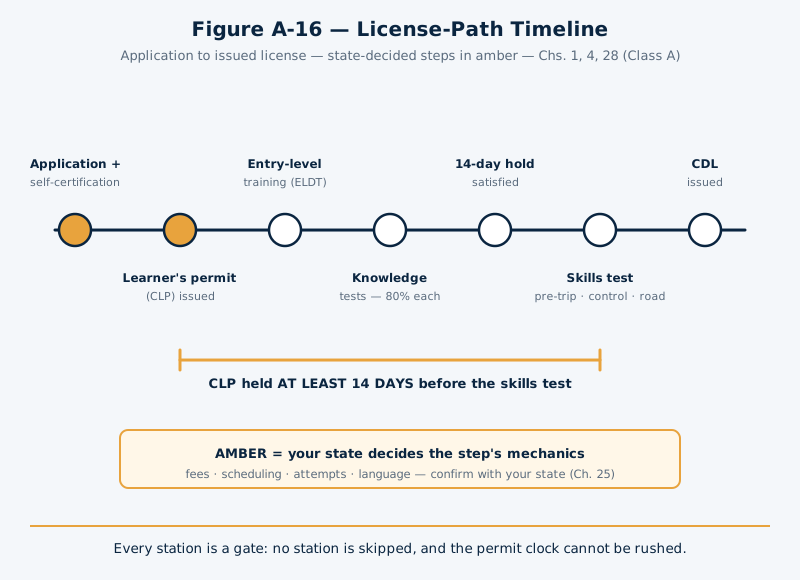
The road from first application to an issued license, drawn as one timeline: application and self-certification, the learner permit, entry-level driver training where it applies, the knowledge tests, the minimum holding period for the permit, the skills test in its three parts, and issuance — with the state-decided steps marked as state-decided.
The federal passing standard is at least 80 percent correct on each knowledge test — each test separately. That word 'each' carries the whole strategy of preparation. There is no averaging across tests: a brilliant General Knowledge score does not rescue a weak Air Brakes score. A candidate who falls short on the air brake portion may still be issued a credential, but with a restriction against driving vehicles with air brakes; a candidate who falls short on the combination portion cannot be issued the combination class at all. Study, therefore, test by test, and judge your readiness test by test — never by a blended average.
Why it matters can be stated plainly. the per-test passing standard sits underneath decisions a driver makes every working day, often before the wheels turn at all. A driver who understands it as a living rule, rather than as a line memorized for a test, can explain it to an examiner, apply it to a vehicle that is not quite like the training vehicle, and recognize the moment on the road when it stops being theory. That three-way ability — say it, apply it, notice it — is what this book is building, section by section, and it is why each idea here is taught first in ordinary words, then in its precise form, and then inside a situation you could actually meet.
Consider how the same fact looks from the examiner's chair. The examiner cannot watch you drive for a year; the examiner can only sample. So the sampling is deliberate: the questions and demonstrations cluster on the points where misunderstanding is dangerous, not merely incorrect. When you meet the per-test passing standard in a question later in this book, read it as that kind of sample. Ask yourself what danger the question is really guarding against. Candidates who learn to see the danger behind the item stop being surprised by new wordings, because the danger, unlike the wording, does not change.
Write the number, term, or sequence from this section on a card — paper is fine — with its source label beside it: whether it is a federal rule, a figure from the model manual, or a fact your own state decides. Keeping the label attached to the fact is not pedantry. Most expensive mistakes in this subject come from true facts filed under the wrong authority: a state fee remembered as a national rule, a manual figure remembered as a law of physics. The card habit prevents that filing error at the moment it would otherwise be made.
After the knowledge tests comes the skills test, taken in a vehicle representative of the class you seek, and always in the same order: first the pre-trip vehicle inspection, then basic vehicle control skills, then on-road driving. Examiners administer and score it from the official driver and examiner manuals for the skills test. Two behaviors end it outright: disobeying a traffic law, or causing an accident. Before you may take it, you must have held your learner permit for at least 14 days, and, where entry-level driver training applies to you, you must have completed that training first. Chapter by chapter, Part Five of this book teaches the knowledge this test examines.
Think of the three-part skills test as part of the margin between a routine trip and a bad one. Margins in trucking are rarely dramatic; they are built from small correct choices made early, while there is still time and room to make them. The driver who has thought about this subject in advance does not have to invent a response under pressure. The response is already rehearsed, the numbers are already familiar, and attention is free for the part of the situation that is genuinely new. Examiners test for exactly that preparedness, because the road will test for it less kindly.
Now put the idea under load, literally. Add weight, weather, a tired driver, a tight schedule, and traffic that does not cooperate. Ideas that only work on a calm practice yard fail exactly here. The teaching in this section is written for the loaded case: conservative margins, early decisions, and checks that still get done when the day is running late. If a method in these pages ever seems slower than a shortcut you have seen elsewhere, that is deliberate. Shortcuts in this trade are usually margins being spent invisibly, and the bill arrives without warning.
Do this before you move on. Close the book and state, out loud or in writing, the main point of this section in two sentences, in your own words, without looking back. Then name one situation from an ordinary driving day where the point would change what you do. If either half is hard, re-read the section once, slowly — being unable to restate an idea is information, not failure, and it is far cheaper to learn it here than from a missed test item. This restate-and-apply habit, repeated through the book, is the single most reliable study method this book asks of you.
This book teaches the knowledge the skills test examines — what to inspect, what the maneuvers require, how the test is sequenced and scored. It cannot teach your hands to drive, and no book can certify driving skill. Skill is built behind the wheel, with a qualified instructor, in the vehicle class you will test in. You will meet that sentence again at the head of the skills-preparation part and near the end of the book, word for word, because it is not a disclaimer to be buried. It is the honest boundary of the product you are holding, stated where a beginner needs it: at the start.
There is also a professional reason to learn the limit of what a book can teach properly. Commercial driving is a credentialed occupation: other road users, employers, insurers, and licensing agencies all rely on the license as evidence that the holder knows this material and can be trusted with a vehicle whose size and weight forgive very little. When a driver treats a rule as paperwork, that evidence weakens. When a driver can say what the rule is, why it exists, and what happens when it is ignored, the credential means what it claims to mean — and the knowledge test, which samples precisely those three things, becomes much easier to sit.
Picture a working morning. The vehicle is fueled, the paperwork is in order, and the driver is walking toward the cab with a few minutes in hand. This is the moment the limit of what a book can teach earns its keep: not at highway speed, but in the quiet check, the second look, the question asked before departure rather than after the first problem appears. A trainer watching that morning would not be looking for speed. The trainer would be looking for sequence — the right things checked in an order that misses nothing — and for the habit of treating anything doubtful as a reason to stop and resolve it, not as a detail to remember later. Build that sequence now, on paper, while building it costs nothing.
A useful check is to teach the point backward: start from the harm. What goes wrong, and to whom, when the limit of what a book can teach is ignored, misunderstood, or left until too late? Work backward from that harm to the rule that prevents it, and then forward again to the driver's action. If you can travel that chain in both directions without notes, you own the material at the depth the knowledge test samples. If the chain breaks somewhere, that break is your study assignment for this section, and the chapter quiz at the end will find it if you do not.
The road runs through a permit first. The commercial learner permit — the CLP — is issued after you pass the General Knowledge test and meet your state's application requirements, and it lets you practice on public roads with a qualified CDL holder beside you. Only three endorsements may appear on a permit: passenger, school bus, and tank vehicle, and each requires passing that endorsement's knowledge test. The permit must be held at least 14 days before the skills test. Treat those 14 days as a floor, not a plan: the permit period is when behind-the-wheel training happens, and its federal minimum is not a promise that two weeks is enough.
Why it matters can be stated plainly. the commercial learner permit sits underneath decisions a driver makes every working day, often before the wheels turn at all. A driver who understands it as a living rule, rather than as a line memorized for a test, can explain it to an examiner, apply it to a vehicle that is not quite like the training vehicle, and recognize the moment on the road when it stops being theory. That three-way ability — say it, apply it, notice it — is what this book is building, section by section, and it is why each idea here is taught first in ordinary words, then in its precise form, and then inside a situation you could actually meet.
Consider how the same fact looks from the examiner's chair. The examiner cannot watch you drive for a year; the examiner can only sample. So the sampling is deliberate: the questions and demonstrations cluster on the points where misunderstanding is dangerous, not merely incorrect. When you meet the commercial learner permit in a question later in this book, read it as that kind of sample. Ask yourself what danger the question is really guarding against. Candidates who learn to see the danger behind the item stop being surprised by new wordings, because the danger, unlike the wording, does not change.
Write the number, term, or sequence from this section on a card — paper is fine — with its source label beside it: whether it is a federal rule, a figure from the model manual, or a fact your own state decides. Keeping the label attached to the fact is not pedantry. Most expensive mistakes in this subject come from true facts filed under the wrong authority: a state fee remembered as a national rule, a manual figure remembered as a law of physics. The card habit prevents that filing error at the moment it would otherwise be made.
The CDL requirement follows the vehicle and its use: the heavy combinations and heavy single vehicles of the next chapter, vehicles designed to carry many passengers, and vehicles carrying placarded hazardous materials are the core cases. Around that core sit exceptions the federal rules name — certain farm, military, emergency, and recreational uses among them — whose exact conditions are stated in federal regulation and applied, and sometimes adopted differently, by the states. This book teaches the structure of those exceptions and the method for checking your own case. It does not promise any individual reader that an exception covers them; that determination belongs to the regulation's text and your state.
Think of the boundaries of the CDL requirement as part of the margin between a routine trip and a bad one. Margins in trucking are rarely dramatic; they are built from small correct choices made early, while there is still time and room to make them. The driver who has thought about this subject in advance does not have to invent a response under pressure. The response is already rehearsed, the numbers are already familiar, and attention is free for the part of the situation that is genuinely new. Examiners test for exactly that preparedness, because the road will test for it less kindly.
Now put the idea under load, literally. Add weight, weather, a tired driver, a tight schedule, and traffic that does not cooperate. Ideas that only work on a calm practice yard fail exactly here. The teaching in this section is written for the loaded case: conservative margins, early decisions, and checks that still get done when the day is running late. If a method in these pages ever seems slower than a shortcut you have seen elsewhere, that is deliberate. Shortcuts in this trade are usually margins being spent invisibly, and the bill arrives without warning.
Do this before you move on. Close the book and state, out loud or in writing, the main point of this section in two sentences, in your own words, without looking back. Then name one situation from an ordinary driving day where the point would change what you do. If either half is hard, re-read the section once, slowly — being unable to restate an idea is information, not failure, and it is far cheaper to learn it here than from a missed test item. This restate-and-apply habit, repeated through the book, is the single most reliable study method this book asks of you.
A CDL is not a possession; it is a standing that must be kept. Federal regulation provides for drivers to be disqualified from operating commercial vehicles for specified serious offenses and violations, for defined periods. The detail belongs to a later chapter, but the idea belongs here, on day one: the same federal core that defines how the license is earned defines how it is lost. Professional drivers organize their whole conduct — on duty and, for some offenses, off duty — around that fact. A beginner who understands it early understands what kind of occupation this is: one where the credential and the conduct are the same thing.
There is also a professional reason to learn disqualification as part of the license's meaning properly. Commercial driving is a credentialed occupation: other road users, employers, insurers, and licensing agencies all rely on the license as evidence that the holder knows this material and can be trusted with a vehicle whose size and weight forgive very little. When a driver treats a rule as paperwork, that evidence weakens. When a driver can say what the rule is, why it exists, and what happens when it is ignored, the credential means what it claims to mean — and the knowledge test, which samples precisely those three things, becomes much easier to sit.
Picture a working morning. The vehicle is fueled, the paperwork is in order, and the driver is walking toward the cab with a few minutes in hand. This is the moment disqualification as part of the license's meaning earns its keep: not at highway speed, but in the quiet check, the second look, the question asked before departure rather than after the first problem appears. A trainer watching that morning would not be looking for speed. The trainer would be looking for sequence — the right things checked in an order that misses nothing — and for the habit of treating anything doubtful as a reason to stop and resolve it, not as a detail to remember later. Build that sequence now, on paper, while building it costs nothing.
A useful check is to teach the point backward: start from the harm. What goes wrong, and to whom, when disqualification as part of the license's meaning is ignored, misunderstood, or left until too late? Work backward from that harm to the rule that prevents it, and then forward again to the driver's action. If you can travel that chain in both directions without notes, you own the material at the depth the knowledge test samples. If the chain breaks somewhere, that break is your study assignment for this section, and the chapter quiz at the end will find it if you do not.
The table that follows this section is the only kind of place in this book where state facts print, and its rules are the point. Every row names the state, the fact, and the publication it came from, with the date it was read: October 30, 2026. Rows exist only where an official state publication was actually opened and read. Where a fact was not established — a fee page that could not be opened, a page that does not state a rule — the table says so rather than filling the silence, because an unopened fact is a boundary, not a gap to be filled from memory. The full table, with the method for extending it to your own state, appears later in this book.
Why it matters can be stated plainly. reading the dated variation table sits underneath decisions a driver makes every working day, often before the wheels turn at all. A driver who understands it as a living rule, rather than as a line memorized for a test, can explain it to an examiner, apply it to a vehicle that is not quite like the training vehicle, and recognize the moment on the road when it stops being theory. That three-way ability — say it, apply it, notice it — is what this book is building, section by section, and it is why each idea here is taught first in ordinary words, then in its precise form, and then inside a situation you could actually meet.
Consider how the same fact looks from the examiner's chair. The examiner cannot watch you drive for a year; the examiner can only sample. So the sampling is deliberate: the questions and demonstrations cluster on the points where misunderstanding is dangerous, not merely incorrect. When you meet reading the dated variation table in a question later in this book, read it as that kind of sample. Ask yourself what danger the question is really guarding against. Candidates who learn to see the danger behind the item stop being surprised by new wordings, because the danger, unlike the wording, does not change.
Write the number, term, or sequence from this section on a card — paper is fine — with its source label beside it: whether it is a federal rule, a figure from the model manual, or a fact your own state decides. Keeping the label attached to the fact is not pedantry. Most expensive mistakes in this subject come from true facts filed under the wrong authority: a state fee remembered as a national rule, a manual figure remembered as a law of physics. The card habit prevents that filing error at the moment it would otherwise be made.
| Fact | Texas (Department of Public Safety) | California (Department of Motor Vehicles) |
|---|---|---|
| Knowledge-test order | Texas Commercial Rules first, then General Knowledge, Combination, Air Brake, Endorsements | Not stated as a fixed order on the page read — not asserted |
| Test language | English only from June 1, 2026 (Spanish discontinued) | Not stated as a language list on the page read — not asserted |
| Knowledge attempts | Not stated on the page read — not asserted | 3 attempts per test; a third failure voids the application |
| Application validity | Not stated on the page read — not asserted | 12 months, fee included; expiring means reapplying |
| Learner permit validity | 180 days; renewable once without retesting knowledge | Maximum 180 days; one 180-day renewal within 1 year of application |
| Skills retest | Not stated on the page read — not asserted | 3 tries; $46 retest fee each retake |
| Fees | None printed — no Texas fee was verified for this book | Class A or B original $100; renewal $59; add passenger $100; add tank, doubles/triples, or hazardous materials $59; Class C $59 |
| Skills-test system | AAMVA modernization adopted (all sites except Del Rio and Wichita Falls) | Not named on the page read — not asserted |
Read the table's silences as carefully as its rows: a cell that says not asserted means the fact was not established from that state's own publication, and this book does not fill such silences from memory or from other states' practice.
Two states were read in full for this book, and their contrast proves the table's point better than any warning could. Texas administers its own commercial rules test first, before General Knowledge; California states no such order on the page read. Texas moved its knowledge examinations to English only effective June 1, 2026; California's page states a three-attempt limit per knowledge test, after which the application itself fails, and gives its application a 12-month life. Neither set of facts says anything at all about the other forty-eight states. That is exactly the lesson: variation is real, specific, and local, and the only safe source for your state's version is your state.
Think of two states, honestly contrasted as part of the margin between a routine trip and a bad one. Margins in trucking are rarely dramatic; they are built from small correct choices made early, while there is still time and room to make them. The driver who has thought about this subject in advance does not have to invent a response under pressure. The response is already rehearsed, the numbers are already familiar, and attention is free for the part of the situation that is genuinely new. Examiners test for exactly that preparedness, because the road will test for it less kindly.
Now put the idea under load, literally. Add weight, weather, a tired driver, a tight schedule, and traffic that does not cooperate. Ideas that only work on a calm practice yard fail exactly here. The teaching in this section is written for the loaded case: conservative margins, early decisions, and checks that still get done when the day is running late. If a method in these pages ever seems slower than a shortcut you have seen elsewhere, that is deliberate. Shortcuts in this trade are usually margins being spent invisibly, and the bill arrives without warning.
Do this before you move on. Close the book and state, out loud or in writing, the main point of this section in two sentences, in your own words, without looking back. Then name one situation from an ordinary driving day where the point would change what you do. If either half is hard, re-read the section once, slowly — being unable to restate an idea is information, not failure, and it is far cheaper to learn it here than from a missed test item. This restate-and-apply habit, repeated through the book, is the single most reliable study method this book asks of you.
The book you are holding is built in the order a beginner can learn. Part One, this part, is foundations: this chapter's map, then classes and endorsements, then the vehicle itself, then the road to becoming a driver, then the mathematics of weight, space, and time. Part Two teaches general knowledge — driving safely in full. Part Three goes deep on air brakes and combination vehicles. Part Four takes the five endorsements one by one, in a repeating pattern so a second endorsement is easier to learn than the first. Part Five prepares you, as knowledge, for the skills test. Part Six covers your state's verification method, keeping the license, and exam mastery. A diagnostic stands before all of it, and eight full practice tests stand behind it.
There is also a professional reason to learn the architecture of the book properly. Commercial driving is a credentialed occupation: other road users, employers, insurers, and licensing agencies all rely on the license as evidence that the holder knows this material and can be trusted with a vehicle whose size and weight forgive very little. When a driver treats a rule as paperwork, that evidence weakens. When a driver can say what the rule is, why it exists, and what happens when it is ignored, the credential means what it claims to mean — and the knowledge test, which samples precisely those three things, becomes much easier to sit.
Picture a working morning. The vehicle is fueled, the paperwork is in order, and the driver is walking toward the cab with a few minutes in hand. This is the moment the architecture of the book earns its keep: not at highway speed, but in the quiet check, the second look, the question asked before departure rather than after the first problem appears. A trainer watching that morning would not be looking for speed. The trainer would be looking for sequence — the right things checked in an order that misses nothing — and for the habit of treating anything doubtful as a reason to stop and resolve it, not as a detail to remember later. Build that sequence now, on paper, while building it costs nothing.
A useful check is to teach the point backward: start from the harm. What goes wrong, and to whom, when the architecture of the book is ignored, misunderstood, or left until too late? Work backward from that harm to the rule that prevents it, and then forward again to the driver's action. If you can travel that chain in both directions without notes, you own the material at the depth the knowledge test samples. If the chain breaks somewhere, that break is your study assignment for this section, and the chapter quiz at the end will find it if you do not.
Figure A-17 — Endorsement Decision Tree.
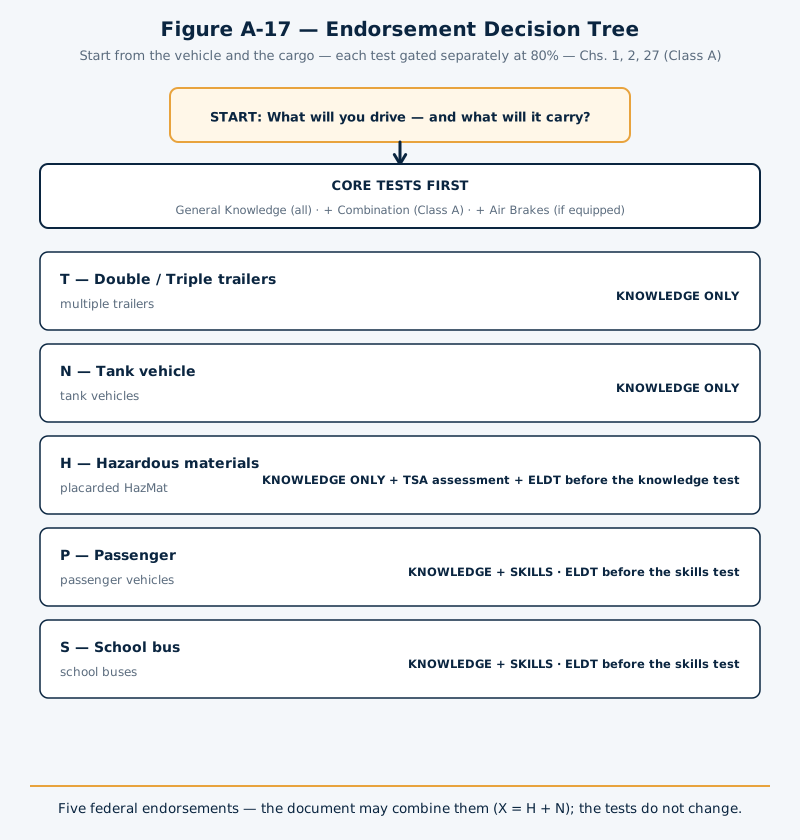
A decision tree that starts from the vehicle and the cargo — what will you drive, and what will it carry — and leads to the endorsements required and the kind of test each one demands.
If you are a total beginner, read in order and do not skip. Every term is defined where it first appears, every physical thing is shown in a labeled figure where it is taught, and the early chapters assume nothing — not that you have sat in a cab, and not that you know what a fifth wheel is when it is not on a wagon. If you are an experienced driver preparing to test, take the diagnostic first, cold, and let its part scores choose your chapters; then return to the foundations for whatever the diagnostic exposes. Both paths end at the same place: the practice tests, taken whole, timed, and scored test by test against the 80 percent standard.
Why it matters can be stated plainly. the beginner path and the candidate path sits underneath decisions a driver makes every working day, often before the wheels turn at all. A driver who understands it as a living rule, rather than as a line memorized for a test, can explain it to an examiner, apply it to a vehicle that is not quite like the training vehicle, and recognize the moment on the road when it stops being theory. That three-way ability — say it, apply it, notice it — is what this book is building, section by section, and it is why each idea here is taught first in ordinary words, then in its precise form, and then inside a situation you could actually meet.
Consider how the same fact looks from the examiner's chair. The examiner cannot watch you drive for a year; the examiner can only sample. So the sampling is deliberate: the questions and demonstrations cluster on the points where misunderstanding is dangerous, not merely incorrect. When you meet the beginner path and the candidate path in a question later in this book, read it as that kind of sample. Ask yourself what danger the question is really guarding against. Candidates who learn to see the danger behind the item stop being surprised by new wordings, because the danger, unlike the wording, does not change.
Write the number, term, or sequence from this section on a card — paper is fine — with its source label beside it: whether it is a federal rule, a figure from the model manual, or a fact your own state decides. Keeping the label attached to the fact is not pedantry. Most expensive mistakes in this subject come from true facts filed under the wrong authority: a state fee remembered as a national rule, a manual figure remembered as a law of physics. The card habit prevents that filing error at the moment it would otherwise be made.
Take the subject of commercial driving as licensed work and walk it slowly, the way an instructor would on a first day. First, name what you are looking at or deciding, out loud, in plain words. Second, state the rule that governs it, with its label — federal rule, model-manual figure, or state decision — attached. Third, do the check or the arithmetic the rule calls for, in full, writing each step rather than trusting your head. Fourth, compare the result with the limit, the standard, or the safe choice, and say the comparison out loud. Fifth, act on the comparison before moving to anything else. This five-step rhythm — name, state, work, compare, act — is deliberately unglamorous. It is also the rhythm that survives nerves, noise, weather, and a watching examiner, because it does not depend on inspiration. Practice it on easy material now so that it is available on hard material later.
Candidates rarely miss questions on the public purpose of licensing because the material is beyond them. They miss because of one of four habits. The first is blending: mixing a figure from one rule with the conditions of another, until the answer is a confident average of two different facts. The second is dropping the label: remembering a number but forgetting whether it was federal, a manual figure, or one state's practice. The third is answering the question they expected instead of the question printed, especially when a familiar phrase appears early in the stem. The fourth is rushing arithmetic that was designed to be done slowly. Every one of these habits is trainable out of existence, and the training is unglamorous: read the whole stem, keep labels attached, write the steps, and let the chapter quizzes catch the habit while catching it is still free.
Strip away the classroom and the federal core of CDL knowledge becomes a moment you will recognize. It is the moment a gauge reads slightly wrong and the schedule says go anyway. It is the question at a scale, a dock, or a roadside inspection where the honest answer has to be produced, not performed. It is the decision made at a rest area, in rain, with hours left to run and a delivery waiting. Drivers who have only memorized this material discover, in that moment, that memorized material is hard to reach under pressure. Drivers who have walked it, worked examples of it, and explained it aloud find it where they left it. That difference — not cleverness, not test-taking tricks — is what the chapters of this book are engineered to produce, one subject at a time.
Sources for this chapter: the model Commercial Driver License manual (American Association of Motor Vehicle Administrators, produced under a cooperative agreement with the Federal Motor Carrier Safety Administration), table of contents and Section 1, Introduction; Title 49 of the Code of Federal Regulations, Part 383 — including section 383.71 (driver application and certification), section 383.133 (test methods), and section 383.135 (passing knowledge and skills tests); Texas Department of Public Safety, 'How do I apply for a Commercial Driver License?', and California Department of Motor Vehicles, commercial driver license and licensing fee pages — state facts from those two pages print only in this chapter's dated variation table. All sources read October 30, 2026. See References.
Fifteen items. The answer key with full explanations is in the companion key file for this chapter.
1-1. What does the federal core of CDL testing fix nationally?
A. Each state's fees and scheduling B. The price of training courses C. The knowledge content, test construction from the approved pool, and the 80 percent per-test pass standard D. Which vehicles each employer buys
1-2. Which of these is a state-decided fact, not a federal one?
A. What a driver must know under Part 383 B. The 80 percent pass standard C. How many attempts at a knowledge test an application allows D. The order of the skills test's three parts
1-3. How many sections does the model CDL manual have?
A. Five B. Thirteen C. Twenty-eight D. Three
1-4. Why does this book teach regulation beyond the model manual?
A. The manual is out of print B. State manuals have no content of their own C. The manual covers only school buses D. The manual itself does not contain all federal and state requirements, and the knowledge standard reaches into the regulations it points to
1-5. The 50-item length of the General Knowledge practice test in this book is:
A. The AAMVA-model, state-published standard length, printed as modeled — not a number stated in Part 383 B. A requirement printed in Part 383 C. A length this book invented without a basis D. The length in every state by federal law
1-6. A practice General Knowledge test has 50 items and the federal standard is at least 80 percent correct. The fewest correct answers that meet the standard are:
A. 40 — 0.80 times 50 B. 39 — close enough to round up C. 45 — 80 percent means 45 of 50 D. 25 — half plus a margin
1-7. A combination has a GCWR of 28,000 pounds and tows a unit with a GVWR of 11,000 pounds. The class it requires is:
A. Class B — combinations under 30,000 pounds are Class B B. Class A — the combined rating is at least 26,001 and the towed unit is over 10,000 pounds C. Class C — the towed unit is under 26,001 pounds D. No CDL — the power unit alone decides the class
1-8. An applicant passes overall but scores under 80 percent on the air brake portion. The result is:
A. No credential of any kind may be issued B. A full unrestricted credential C. Automatic Class A issuance D. A credential may be issued with the air brake restriction
1-9. The learner permit must be held at least how long before the skills test?
A. 14 days B. 24 hours C. 6 months D. No minimum exists
1-10. In the dated variation table, Texas administers which test first?
A. Air Brakes, before everything B. Its own Texas Commercial Rules test, before General Knowledge C. The skills test, before all knowledge tests D. Hazardous Materials, before General Knowledge
1-11. In the dated variation table, California allows how many attempts per knowledge test before the application fails?
A. Unlimited B. Three C. One D. Ten
1-12. A state fact may print in this book only when it:
A. Appears on two prep websites B. Is true of a neighboring state C. Comes from that state's own publication, opened and read, and prints dated and attributed in the variation table D. Sounds typical of most states
1-13. What can this book honestly do for the skills test?
A. Teach the knowledge it examines — inspection content, maneuver requirements, sequence, and scoring — while skill itself is built behind the wheel B. Certify driving skill by post C. Replace behind-the-wheel training D. Guarantee a skills-test pass
1-14. The CDL requirement follows mainly:
A. The driver's years of experience B. The employer's preference C. The length of the trip only D. The vehicle and its use — heavy vehicles, many-passenger vehicles, and placarded hazardous materials
1-15. Disqualification rules matter to a beginner on day one because they show that:
A. The license, once issued, can never be lost B. Only employers need to know the rules C. The license is a standing that must be kept, defined by the same federal core that grants it D. Testing ends all federal involvement
Copyright © 2026 Feras Alzubi. All rights reserved.
No part of this book may be reproduced, distributed, or transmitted in any form or by any means without the prior written permission of the copyright holder, except as permitted by law.
Originality statement. This is an original work, written for this book. Every practice question in this book is original. The questions were written fresh for this book, against the FMCSA/AAMVA model Commercial Driver License manual and 49 CFR Parts 380, 383, 391, and 395, and the knowledge they test is taught in this book's own words. They are not any agency's questions, and no real test item — actual, recalled, paraphrased, or adapted — appears anywhere in this book.
Not-affiliated disclosure. This book is an independent study guide. It is not published by, affiliated with, endorsed by, or approved by the Federal Motor Carrier Safety Administration (FMCSA), the American Association of Motor Vehicle Administrators (AAMVA), the Transportation Security Administration (TSA), or any state driver licensing agency, and none of them participated in its creation. Exam names and trademarks belong to their respective owners. Passing any exam also depends on the candidate's own preparation; no book can guarantee a result.
The author's name. The copyright holder's name appears on this page and in the store metadata, and nowhere else inside this book. The book stands on its sources, which are named wherever they are used and listed in full in the References.
This book is an independent study guide. It is not published by, affiliated with, endorsed by, or approved by the Federal Motor Carrier Safety Administration (FMCSA), the American Association of Motor Vehicle Administrators (AAMVA), the Transportation Security Administration (TSA), or any state department of motor vehicles, department of public safety, or other state driver licensing agency, and none of them participated in its creation. Commercial Driver's License, CDL, and related exam and endorsement names belong to their respective owners and issuing authorities. Licensing requirements are set by federal regulation and by your state licensing agency and change over time — always confirm your class, endorsements, fees, and test rules with your state agency before you test. Passing any exam also depends on the candidate's own preparation; no book can guarantee a result, and no book can certify driving skill.
Four consequences of those sentences are stated here at the front, not buried at the back.
First, CDL testing has one federal core and fifty administrations. What a driver must know, what a driver must be able to do, how knowledge tests are built, and the standard for passing them — at least 80 percent correct on each knowledge test — are set nationally, in Title 49 of the Code of Federal Regulations, Part 383. The tests themselves are given by your state, which sets its own fees, application windows, attempt rules, scheduling, and test-language practice. This book teaches the federal core completely, and it fences the state shell explicitly and by name. Wherever teaching touches administration, a short box headed "Your state decides" lists what to confirm with your own state. Learn to see that box and you have learned the book's most protective habit.
Second, this book does not promise that you will pass any test, earn a license, get work, or earn any particular income. It teaches commercial driving from zero — the license's structure, the vehicle, the road to qualification, and the mathematics — then teaches the full federal core at depth: general knowledge, air brakes, combination vehicles, and all five endorsements. It drills you with original practice questions whose answers are explained in full: a 50-item diagnostic, a 15-item quiz at the end of every one of the 28 review chapters, and eight full practice tests built at the modeled lengths of the real tests, each with its basis printed on its face. That is what a study book can honestly do, and it is what this one does. You will find no pass rate for any test anywhere in this book, and no score in this book is ever converted into a prediction about a real test. What your practice results give you is a map of what you know and what you do not know yet. The map is the product.
Third, an honest word about skill, printed here in full because it governs a whole part of this book. This book teaches the knowledge the skills test examines — what to inspect, what the maneuvers require, how the test is sequenced and scored. It cannot teach your hands to drive, and no book can certify driving skill. Skill is built behind the wheel, with a qualified instructor, in the vehicle class you will test in. You will meet that passage again at the head of the skills-preparation part and near the end of the book. It is not fine print. It is the boundary of what any book can do, stated where a beginner needs it.
Fourth, the facts this book cannot print are as deliberate as the facts it can. Fees, attempt and retest rules, application validity, scheduling, and test languages in practice are set state by state and change over time. This book never states them as general facts and never invents a national figure for any of them. The only state facts printed anywhere in this book appear in a dated State Variation Table (a summary in Chapter 1, and in full in Chapter 25), where every row names the state publication it came from and the date it was read. Everything else about your state's process must come from your state licensing agency — and Chapters 1 and 25 teach you, step by step, how to get it and verify it.
Provenance note. Every practice question in this book is original. The questions were written fresh for this book, against the FMCSA/AAMVA model Commercial Driver License manual and 49 CFR Parts 380, 383, 391, and 395. They are not any agency's questions; states build their knowledge tests from an FMCSA-approved pool of secure test questions, and no real test item is reproduced, recalled, paraphrased, or adapted anywhere in this book. This book teaches the model manual's content in its own words, with its own figures and its own items. Individual values that preparation legitimately teaches — a leakage maximum, a passing percentage — are stated as facts with their source named, never as copied pages.
A note on labels, because labels carry the facts in this subject. Every value in this book carries its authority where it appears. A federal rule is printed with its home in Title 49 of the Code of Federal Regulations. A figure from the model manual is labeled as the model manual's figure — the air-system test figures are the standing example: governor cut-out around 125 psi, a low-pressure warning above 55 psi, spring brakes in the 20-to-45 psi range, leakage maxima of 3 psi in a minute for a single vehicle and 4 psi for a combination — and wherever such a figure appears, this book also prints the standing instruction that the vehicle manufacturer's specification and the examiner's instruction govern where they differ. A state fact is printed with its state and its date. Guidance this book itself invented — practice-test sitting times, readiness bands, study plans — is labeled this book's guidance at every appearance. No blanket note substitutes for the label at the point of use.
Everything on these pages was checked against primary sources: the model CDL manual, the text of Title 49 of the Code of Federal Regulations, the Federal Motor Carrier Safety Administration's own pages, the Transportation Security Administration's HAZMAT Endorsement page, and the official pages of two state licensing agencies, all read on October 30, 2026. Each figure carries its source. Where a figure could not be verified from such a source, these pages print no figure at all — and say so, because the silence is itself information.
Every applicant takes a General Knowledge test. Applicants add an Air Brakes test if their vehicle has air brakes (including air-over-hydraulic), a Combination Vehicles test for the combination class, and one test for each endorsement sought. The standard lengths of these tests, as published in the AAMVA model test system and state handbooks, are: General Knowledge 50 · Air Brakes 25 · Combination Vehicles 20 · Hazardous Materials 30 · Tank 20 · Doubles and Triples 20 · Passenger 20 · School Bus 20. Those lengths are modeled lengths — Part 383 fixes the pool, the content, and the 80 percent standard, not an item count — and this book prints them with that basis everywhere they appear, including on the face of each of its eight practice tests, which are built at exactly those lengths so that you rehearse the real sitting's shape. No federal knowledge-test time limit was found in Part 383; the sitting times printed on this book's practice tests are this book's guidance, labeled as such on each test.
| Endorsement | Federal test or tests |
|---|---|
| Double and triple trailers (T) | Knowledge test only |
| Tank vehicle (N) | Knowledge test only |
| Hazardous materials (H) | Knowledge test only, plus a TSA security threat assessment; entry-level training before the knowledge test for a first endorsement |
| Passenger (P) | Knowledge test and skills test |
| School bus (S) | Knowledge test and skills test |
Only the passenger, school bus, and tank endorsements may be placed on a commercial learner permit. The combined credential some licenses show as X is a state document's combination of the H and N endorsements, not a sixth federal endorsement. (Source: Title 49, Code of Federal Regulations, section 383.93.)
Entry-level driver training, under Part 380, Subpart F of Title 49, has been required since February 7, 2022, before testing for a first Class A or Class B license, for a Class B to Class A upgrade, and for a first hazardous materials, passenger, or school bus endorsement — from a provider listed on the federal Training Provider Registry. It is not required for a first Class C license by itself, for the tank or doubles endorsements, for renewals or transfers, or for removing a restriction. The federal agency lists providers who certify themselves that they meet the requirements; it does not approve or certify providers. Chapter 4 teaches the full frame and the verification method.
Medical certification rests on the federal physical qualification standards at section 391.41 of Title 49 — thirteen standards, including distant vision of at least 20/40 in each eye and a hearing standard stated as a forced whisper perceived at not less than five feet in the better ear, or an audiometric loss no greater than 40 decibels at the stated frequencies. Since June 23, 2025, a licensed driver or permit holder with a current medical examiner's certificate no longer needs to carry the paper certificate; examiners submit results electronically through the National Registry. How a given state posts and acts on medical status is state mechanics, and Chapter 4 fences it as such.
The free sample of this book is Chapter 1 plus the diagnostic test, so a buyer can judge the teaching quality and see their own starting point — scored by part — before paying. If you are reading the sample: the diagnostic's instructions, its answer key, and its results tracker are complete in the front matter, and the summary of how to use this book, below, is enough to take the diagnostic honestly and read its tracker. The full book then teaches every topic the tracker points to.
This book serves two readers at the same time, and both of them may be you.
If you have never driven a commercial vehicle — if you have never sat in a cab or stood beside a trailer — you are the reader Part One was built for. Start at Chapter 1 and read in order. Part One assumes nothing: it explains what the license is and how its federal core and state shell fit together (Chapter 1), how classes, endorsements, and restrictions work (Chapter 2), what every major part of the vehicle is and where it lives (Chapter 3), how a person actually becomes a driver, gate by gate (Chapter 4), and the mathematics of weight, space, and time that every later chapter spends (Chapter 5). No chapter uses a term before it defines it, and every physical thing the text names is shown in a labeled figure at the point where it is taught. Do not skip Part One to "get to the test material." The test material assumes exactly what Part One teaches — and so does the vehicle.
If you are already driving, training, or testing soon, take the diagnostic first, cold, in one sitting of no more than 60 minutes — that sitting length is this book's guidance. Score it with its key and fill in its results tracker, which reports your score by part: Foundations, Driving Safely, Air Brakes and Combination Vehicles, and Endorsements Awareness. Then study the chapters the tracker names, in order, taking each chapter's 15-item quiz before moving on. Finish with the eight practice tests, on separate days, each in one sitting under its printed time, and score each test against its own 80 percent line — never against a blended average, because the real standard is per test. Chapter 25, the state verification method, is not optional reading for candidates; do it before you test, not after.
Every load-bearing value in this book carries its label where it appears. The labels look like this:
Front matter — this note; the Exam Blueprint pages; How to Use This Book; the Diagnostic Test (50 items) with its answer key and results tracker.
Part One — Foundations from Zero
Part Two — General Knowledge: Driving Safely
Part Three — Air Brakes and Combination Vehicles, in Depth
Part Four — Endorsements
Part Five — Skills-Test Preparation (knowledge, honestly framed)
Part Six — Professional Practice and Exam Mastery
Back matter — eight full practice tests (General Knowledge, Air Brakes, Combination Vehicles, Hazardous Materials, Tank Vehicles, Doubles and Triples, Passenger, and School Bus), each built at its modeled length with its basis and its 80 percent pass line printed on its face, and each with a full answer key; the 2-week and 4-week study plans, each in Class A, Class B, and endorsement-add-on variants; cheat sheets — a numbers sheet with federal figures and their regulatory homes and manual figures labeled as manual figures, the endorsement and test matrix, and an hours-of-service clock sheet; a glossary of 150 or more terms; the errata and updates page; the References; and the Assessment Crosswalk appendix — every assessment item in the book mapped to its chapter, its concept, and its source basis, checked against both the federal knowledge floor and this book's field knowledge map, so you can verify for yourself that everything has a home chapter.
Every test fact in this book traces to a primary source named on the Exam Blueprint pages and listed in the References: the model CDL manual published by the American Association of Motor Vehicle Administrators under a cooperative agreement with the Federal Motor Carrier Safety Administration; the text of Title 49 of the Code of Federal Regulations — Parts 380, 383, 391, and 395 among them; the Federal Motor Carrier Safety Administration's Training Provider Registry and training guidance; the Transportation Security Administration's HAZMAT Endorsement page; and, for the dated variation table only, the official pages of the Texas Department of Public Safety and the California Department of Motor Vehicles. No fact in this book is carried by a prep-company blog, a course seller, or an aggregator site.
Facts that could not be verified from such a source are not printed as facts. You will therefore not find in this book: any state's fee, attempt rule, or application window stated as a general fact, or any state's figures at all outside the dated State Variation Table; any fee for Texas, whose fee page was not verified for this edition; any federal minimum number of hours for entry-level behind-the-wheel training, because none was established in the sources this book is built on; any pass rate for any test; any salary, pay, or employment figure; or any promise about passing, licensing, or income.
Silence, in those places, is deliberate. A study book that guesses at numbers teaches you to guess — and guessing, on tests built from a federal standard you are expected to know and calculations you are expected to run, is the habit this book exists to replace.
End of the free sample. The complete book continues from here — the full A-to-Z course in book form, delivered as an EPUB you can read in Apple Books, Google Play Books, ReadEra, Thorium Reader, Adobe Digital Editions, or Send to Kindle.
Buy this ebook — $11.99 Back to the book page
Payments are securely processed by Payhip.