
Mastering Careers & Skills
Medical Assistant Certificate (CCMA) · free sample from the book itself
Every abbreviation used in this chapter is expanded here, at its first appearance, and the chapter closes with a drill that tests them both directions.
At 7:40 in the morning, before the first patient arrives, a medical assistant (MA) is already working. The examination rooms are checked and stocked: the exam table paper is fresh, the instruments the day's visits will need are laid out, the refrigerator temperature log is read and recorded, and the schedule on the screen is reviewed — who is coming, for what, and which visits will need blood drawn, an electrocardiogram (EKG), or extra time. At 8:00 the first patient checks in. The MA verifies insurance at the desk, then calls the patient back, confirms identity with two identifiers, walks them to the scale, measures height and weight, takes blood pressure, pulse, temperature, and breathing rate, asks the questions that open the visit — what brought you in, what medications are you taking, any allergies — and documents every answer and every reading in the electronic health record (EHR). When the provider enters, the chart already tells the story of the visit so far, in order, with nothing guessed and nothing missing.
The provider examines, decides, and orders. The MA carries the orders out: a blood draw, performed carefully and labeled at the patient's side; an injection, prepared under the provider's order, checked against the chart's allergy record, given by the route ordered, and logged; instructions reviewed with the patient in plain words; a follow-up visit scheduled at checkout; a claim prepared so the visit can be billed. By evening the MA has been, in a single shift, a greeter, a measurer, a phlebotomist, a medication administrator working under direction, a scribe, an educator, a scheduler, and a biller — and every one of those acts was bounded by the same rule, which this chapter will state in full and which the whole book never lifts: the MA measures, performs, documents, and reports. The provider diagnoses, prescribes, and interprets.
That morning is the job this book teaches, and the exam this book prepares you for — the Certified Clinical Medical Assistant (CCMA) exam of the National Healthcareer Association (NHA) — is built from mornings exactly like it. This chapter maps the whole territory before any part of it is taught in depth: what an MA actually does, what the CCMA credential is and is not, how the exam is shaped, who may sit for it, how this book is organized, and how to walk through it on the path that fits you. If you have never been inside a clinic except as a patient, nothing in this chapter assumes otherwise. Every term is defined where it first appears, and the clinic itself — its rooms, its people, its day — is the first thing taught.
Figure A-20 — The clinic-day flow.
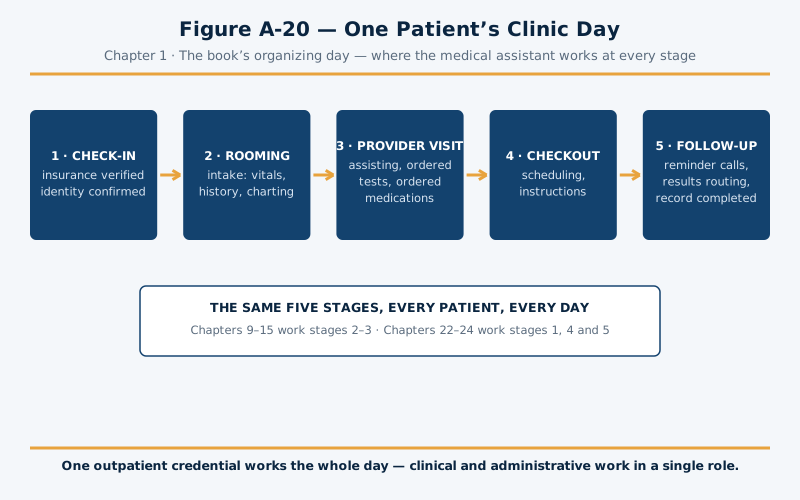
A horizontal flow in five labeled stages — check-in → rooming and intake → the provider visit → checkout → follow-up — with the MA's tasks named under each stage: insurance verification and identity confirmation at check-in; vitals, history, and documentation at rooming; assisting, ordered tests, and ordered medications during the visit; scheduling and instructions at checkout; reminder calls, results routing, and record completion in follow-up.
Start with the plain picture. A medical assistant is the outpatient clinic's multi-skilled team member: the person trained to work on both sides of the visit — the clinical side (rooming patients, measuring vital signs, drawing blood, running EKGs, assisting with examinations and minor procedures, administering medications and injections under a provider's direction) and the administrative side (scheduling, verifying insurance, documenting in the EHR, preparing billing) — in physician offices and clinics. That sentence is the whole idea in one breath, and everything else in this section is the sentence unfolded.
The clinical side, as work. The MA's clinical tasks, stated as the duties they are: prepare examination and procedure rooms; identify patients and take comprehensive clinical intakes — the purpose of the visit, medical, surgical, family, and social history; measure vital signs and body measurements accurately; prepare and maintain sterile fields; prepare patients for examinations and procedures, including the instructions patients need before and after; administer medications by nonparenteral routes and by parenteral routes excluding intravenous — always under a provider's order; manage injection and medication logs; remove staples and sutures; irrigate ears and eyes; give first aid and basic wound care; recognize urgent and emergency situations and respond within role; assist with minor surgical interventions; collect specimens — blood and nonblood; perform point-of-care tests, the simple laboratory tests clinics run on site; perform EKGs and assist with ambulatory heart monitoring; and document all of it. Notice the shape of the list: it is long, it is skilled, and every item on it ends, explicitly or implicitly, at the provider's desk — a result reported, a finding handed over, a record completed for the provider to act on.
The administrative side, as work. The MA schedules and monitors appointments; screens requests to determine what kind of appointment is needed and how urgent it is; verifies insurance coverage and financial eligibility; checks patients in and out; confirms diagnostic and procedural codes; obtains prior authorizations; prepares billing and performs charge reconciliation — entering charges, posting payments and adjustments; resolves billing problems, appeals, and denials; manages electronic and paper records; processes referrals; maintains supply inventory; helps patients activate and use the patient portal; and supports telehealth visits, including teaching patients the technology. A beginner sometimes imagines the administrative half is the lesser half. It is not. A visit that is clinically excellent and administratively broken — wrong code, missed authorization, lost referral — is a visit the patient may pay for twice, once in money and once in delayed care.
Where the work happens. The CCMA's world is the outpatient setting: care delivered without an overnight stay — physician offices, specialty clinics, and similar ambulatory settings. Chapter 2 maps the full landscape of health care settings and the team that staffs them. What matters in this chapter is the contrast that defines this credential: the outpatient clinic is not the hospital ward and not the nursing facility, and the credentials built for those settings are different credentials, examined in §"One credential among several" below.
In the workplace. Picture two MAs on the same morning. The first works in a family practice, rooming a stream of patients of every age, drawing blood between visits, and closing the day by reconciling the day sheet. The second works in a cardiology practice, spending the day on EKGs, ambulatory monitors, and the intake measurements that practice lives by. Same credential, same scope fence, different emphasis — which is why the exam samples the whole job rather than any one clinic's version of it, and why this book teaches the whole job too.
This is the most important section in the book, and it is short enough to memorize. Learn it now, because every clinical chapter assumes it and the exam enforces it.
The medical assistant does not diagnose, does not prescribe, and does not independently interpret test results, EKG tracings, or findings. That is the fence. Inside it, the MA's authority is real and broad: the MA measures (vital signs, heights, weights, specimens, tracings), performs (draws, injections under order, tests, preparations, assistance), documents (exactly, contemporaneously, in the record), and reports (abnormal signs, symptoms, values, and findings go to the provider, promptly and accurately). The test plan frames the role in exactly these terms. The MA's intake task includes identifying abnormal signs and symptoms and reporting them. The MA's laboratory tasks include recognizing and reporting out-of-range values. The MA's EKG tasks include recognizing abnormal or emergent tracings versus artifact — telling a genuine problem from a recording error — and transmitting and reporting them to the provider. In every case the plan's verb for the MA is report; the verbs diagnose, prescribe, and interpret belong to the provider.
Three consequences follow, and each one is examined somewhere in this book.
First, language. Because the MA does not diagnose, this book's language about readings is always category language, never patient language: a blood-pressure reading falls in the range the American Heart Association calls a given category — the MA never writes or says that a patient has the condition the category names. Chapter 10 teaches the adult categories with their authority named, because recognizing that a reading falls outside the expected range is exactly the trigger for the MA's reporting duty. The category is a reporting frame. The diagnosis is the provider's.
Second, medications. Medications are prepared and administered under provider direction and order, by the routes the test plan names — nonparenteral routes, and parenteral routes excluding intravenous (intravenous is never an MA route in this plan). The MA's examined skills around medication are real: checking allergies and contraindications before anything is given, calculating the dose from the order and the supply, applying the rights of medication administration, administering by the correct technique, and keeping the logs. The decision of what drug, what dose, and whether to give it is the provider's order. Chapter 6 builds the pharmacology foundation and Chapter 12 the administration craft, both inside this fence.
Third, exam craft. On the exam, this fence is an elimination tool. Any answer option that has the MA diagnosing a condition, choosing or changing a medication, or interpreting a result independently and acting on the interpretation is the plan's built-in wrong answer — however kind, efficient, or confident it sounds. The right answers, again and again, are the ones where the MA measures accurately, documents exactly, and reports promptly. Chapter 27 develops this into a full method for reading CCMA items. It is introduced here because it is not a test trick; it is the job, and the test is built from the job.
Exam trap. The trap form to recognize early: an option that has the MA reassure a patient with a diagnostic judgment ("that pain is most likely muscular") or act on an independent interpretation ("the tracing shows a problem, so begin treatment"). Both cross the fence. The in-scope version of each is always available in the option set: document the report, take the measurements, and get both to the provider.
The Certified Clinical Medical Assistant (CCMA) is a professional certification awarded by the National Healthcareer Association (NHA) to candidates who meet NHA's eligibility rules and pass the CCMA examination. NHA's certification programs are accredited by the National Commission for Certifying Agencies (NCCA). (Source: NHA Candidate Handbook, updated October 5, 2026.) Accreditation matters because it is the independent check that the exam is built and run to professional testing standards — that its questions are written against a documented analysis of the job, reviewed, and scored by a defensible method. You do not need to take accreditation on faith as a compliment; it is a structural fact about how the exam behind this book was made.
How the exam itself was built is worth understanding, because it explains how to study for it. Every question on an NHA exam must address a task on the exam's test plan — the published document that lists the domains, the task statements (the duties a candidate must know how to perform), and the knowledge statements (the information a candidate must know in support of those tasks). The current CCMA test plan is based on the Job Analysis completed in 2022 — a study of what MAs actually do — and it is the plan for the exam NHA calls CCMA 3.0, available since January 10, 2024, launched, in NHA's words, with minimal impact to exam topics and content areas. (Sources: NHA CCMA Test Plan based on the 2022 Job Analysis; NHA, "Now Available: CCMA 3.0 Certification Exam & Study Materials.") This book's edition line names that basis — "Built against the NHA CCMA Test Plan based on the 2022 Job Analysis" — so that if NHA ever publishes a successor plan, this book's basis shows its age on its own face rather than silently going stale. Before you book a sitting, confirm on NHA's site that the plan named here is still the plan of record.
What certification states, and what it does not. A certification is a portable, independently tested statement that its holder demonstrated a defined body of knowledge at a point in time. It is not a degree. It is not experience — eligibility routes may require training or experience, but the credential itself certifies the examination result and the eligibility showing, kept current through recertification. And — the subject of its own section below — it is not a license. Hold those three negatives; employers and patients will test all of them.
A book is not a clinic. This book teaches the knowledge the exam examines, thoroughly. It cannot certify a clinical skill, and neither can any book. The fence itself is printed here in full, as it is printed in the front matter, again at the head of Part III, and again in Chapter 27 — because Chapter 1 is where a beginner forms their plan, and the plan must be honest from its first page:
This book teaches the knowledge the CCMA exam examines — what each skill is for, the order its steps run in, the errors that make it unsafe, and how to recognize the result that must be reported. It cannot teach your hands to draw blood, give an injection, or place electrodes, and no book can certify a clinical skill. Skill is built in training, under supervision, on real equipment. What this book gives you is the understanding that makes that training learnable — and an honest map of what to go and practice.
A reader who finishes this book knowing exactly what a venipuncture is for, the order its steps run in, the errors that make it unsafe, and the results that must be reported — and who knows just as exactly that their hands still need supervised practice — has gotten from a book everything a book can honestly give.
Beginners lose money and months to a simple confusion: several credentials have similar names, similar initials, and entirely different exams, settings, and issuing bodies. This book prepares you for CCMA only. The table below exists once, here, to keep you from buying the wrong preparation — it states settings and bodies only, imports no content from any sibling plan, and makes no comparison of difficulty, pay, or prospects, because none of those comparisons would be this book's to make on the evidence it holds.
| Credential | Body / route | Setting it is built for |
|---|---|---|
| CCMA — Certified Clinical Medical Assistant | NHA certification exam | Outpatient clinics and physician offices — this book |
| CPCT/A — Certified Patient Care Technician/Assistant | NHA certification exam | Hospital patient care |
| CNA — Certified Nursing Assistant | State-administered credentialing (state/NNAAP route) | Nursing facilities |
| CMAA — Certified Medical Administrative Assistant | NHA certification exam | Medical administrative (front-office) work |
| CMA — Certified Medical Assistant | AAMA (a different certifying body) | Medical assisting, under that body's own exam and rules |
| RMA — Registered Medical Assistant | AMT (a different certifying body) | Medical assisting, under that body's own exam and rules |
Three distinct NHA-and-state worlds sit in the first three rows alone: the hospital technician, the outpatient clinic assistant, and the nursing-facility assistant do overlapping-looking tasks under different plans, different employers, and different rules. Adjacency is not duplication, and preparation is not transferable by resemblance: a book, a course, or a question bank built for one of these exams is not preparation for another. If your goal is the outpatient clinic credential, every page after this one is aimed at it; if your goal turns out to be a different row of this table, the honest advice of this book is to get preparation built for that row.
Everything in this section is a published fact about the exam, with its source named at the fact. Learn these numbers cold; Chapter 27 builds your test-day method on them.
Questions and time. The exam contains 180 multiple-choice questions: 150 scored items and 30 pretest items, in 3 hours. (Source: NHA CCMA Test Plan based on the 2022 Job Analysis.) Pretest items are trial questions being evaluated for future forms. They are indistinguishable from scored items and do not affect your score. (Source: NHA Candidate Handbook.) Two study consequences follow. You cannot identify pretest items in the room, so no strategy may depend on finding them — every item gets your real effort. And the arithmetic of the sitting is 180 items in 180 minutes: one minute per item on average, which is workable for items written against duties you know, and punishing for items you must reason out from nothing. Chapter 27 teaches the pacing discipline in full; this book's practice tests rehearse it at the real shape, 180 items in 180 minutes.
Domains and counts. The 150 scored items divide across seven domains. (Source: NHA CCMA Test Plan based on the 2022 Job Analysis. The plan publishes counts; percentages below are arithmetic on those counts.)
| Domain | Scored items | Share of 150 |
|---|---|---|
| 1. Foundational Knowledge and Basic Science | 15 | 10% |
| 2. Anatomy and Physiology | 8 | ≈5% |
| 3. Clinical Patient Care | 84 | 56% |
| 4. Patient Care Coordination and Education | 12 | 8% |
| 5. Administrative Assisting | 12 | 8% |
| 6. Communication and Customer Service | 12 | 8% |
| 7. Medical Law and Ethics | 7 | ≈5% |
Read the table the way the book is built. Clinical Patient Care is more than half the exam — 84 of 150 items — and inside it, General Patient Care alone carries 28 items, the largest single subdomain in the plan. The subdomain split is: Patient Intake and Vitals 14 · General Patient Care 28 · Infection Control and Safety 15 · Point of Care Testing and Laboratory Procedures 9 · Phlebotomy 12 · EKG and Cardiovascular Testing 6. (Source: NHA CCMA Test Plan.) This book's chapter space tracks those counts: Parts III and IV, the clinical core, are its largest parts, and the diagnostic at the front of this book is proportioned to the same counts so that your first score already shows you the exam's true center of gravity.
The passing standard. A scaled score of 390 or higher, on a scale of 200–500, passes. (Source: NHA Candidate Handbook.) Scaled scoring weights questions by difficulty across the exam's multiple forms so that 390 expresses the same standard on every form; the cut score itself is criterion-referenced, set by a modified Angoff method in which expert panels judge the minimally qualified candidate. One sentence in this paragraph is worth underlining, because candidates get it wrong in both directions: 390 is not a percentage of questions correct, and nothing in this book — no chapter, no practice test, no readiness line — converts it into one. This book's practice thresholds are percentages of this book's own items, labeled this book's guidance wherever they appear. They are study instruments, not score predictions.
Delivery and rules of the room. The exam is computer-based and proctored, and can be taken at your school or authorized institution, at a PSI testing center, or by Live Remote Proctoring (LRP). (Sources: NHA Candidate Handbook; NHA CCMA certification page.) It is administered in English only; no reference books are permitted; scratch provision varies by venue — scratch paper at an institution, a whiteboard and marker at a PSI center, a digital whiteboard under LRP — and personal calculators are prohibited while the exam's built-in calculator is allowed. (Source: NHA Candidate Handbook.) That last rule shapes this book: every calculation chapter is written to be worked with a basic on-screen calculator, by a method — units carried, formula written first — that does not depend on anything fancier. Results arrive as a preliminary report immediately for institution sittings and within 48 hours for PSI and LRP sittings, with performance by domain reported as Above, Near, or Below the passing standard. (Source: NHA Candidate Handbook.) This book's diagnostic tracker uses the same three words, labeled this book's guidance, so the shape of a real report is familiar before you ever see one.
Remember the numbers — the exam's shape. 180 questions (150 scored + 30 pretest) · 3 hours · passing scaled score 390 on a 200–500 scale · Clinical Patient Care 84 of 150, with General Patient Care 28 the largest subdomain. (Sources: NHA CCMA Test Plan; NHA Candidate Handbook.)
NHA's eligibility structure has two steps, and both must be met. (Sources: NHA Candidate Handbook; NHA CCMA certification page. Chapter 28 returns to the credential's rules in full; confirm your own eligibility with NHA before you apply, because NHA — not this book — decides it.)
The baseline is education: a high school diploma or GED/high school equivalency — or being scheduled to earn one in the next 18 months, in which case the candidate tests under Provisional Certification, which converts on graduation.
Pathway 1 — training program. Completion, within the last 5 years, of a medical assistant training or education program from an accredited or state-recognized institution or provider. The handbook carries variants of this pathway — a registered apprenticeship, formal United States military medical training, the Employer Training Program route, and the Pre-Externship route — and the employer and externship variants carry completion-notice deadlines (180 days and 90 days respectively) after which an uncompleted showing voids the score. A program completion five or more years old does not meet this pathway.
Pathway 2 — work experience. One year of supervised work experience in a medical assisting field within the last 3 years, or two years within the last 5 years. One labeled exception rides on this pathway, printed here exactly as NHA prints it and labeled every time it appears in this book: California only — a California resident using Pathway 2 for CCMA needs a minimum of 2 years of work experience as a medical assistant within the last 5 years. That is a California rule about a California resident's eligibility showing. It is not a national rule, and this book never presents it as one.
What CCMA eligibility does not contain is as important as what it does: no program-specific performance counts. If you have encountered requirements such as completing a set number of venipunctures or a set number of EKGs before sitting, those belong to other NHA credentials — the venipuncture and capillary counts to the Certified Phlebotomy Technician (CPT), the EKG count to the Certified EKG Technician (CET) — not to CCMA. (Source: NHA Candidate Handbook.) Training programs set their own externship and skills requirements for their own students, and those are real requirements of the program; they are not NHA eligibility requirements for this exam, and this book never dresses them as such.
The application in outline runs in five steps on NHA's own telling: create a free NHA account and submit the exam application; select a date and location, online or in person (the exam fee is paid at this step); prepare — NHA sells study materials, and states itself that purchasing them is not required to sit for an NCCA-accredited exam and does not guarantee a passing score; take the exam at your school, a PSI center, or by LRP; and receive results, posted to your NHA account — for online CCMA exams, within two days of scoring on NHA's certification page's account. (Source: NHA CCMA certification page.) Fees are not printed in this book. The handbook prints no CCMA fee and directs candidates to NHA's website Shop, and corroborated figures show the fee moving between cycles — so the standing instruction, here and in Chapter 28, is to confirm the current fee at NHA before you apply. A dated number from NHA's own store, read when you book, is worth more than any number a book could freeze into print.
Retakes and the credential's life, in outline. A candidate who does not pass waits 30 days before retaking; three attempts are allowed with a minimum of 30 days between each; after a third failure, the wait is one (1) year; every retake is re-registered at the full examination price. The credential itself is valid for two (2) years; recertification each cycle requires 10 continuing education (CE) credits — two hours of qualified attendance equals one credit, and excess credits do not carry over — plus the recertification fee, submitted before expiration, with a one-month grace period. An expired credential can be reinstated within one (1) year with 15 CE credits plus the applicable fees; after one year, the route back is re-registration, re-examination, and the full examination price. (Source: NHA Candidate Handbook.) One more labeled California fact completes the set: California only — a CCMA holder who works in California and trains other MAs completes 60 CE hours every 5 years. (Source: NHA Candidate Handbook.) Chapter 28 teaches all of these rules at full depth.
This short section carries a distinction your career will test repeatedly, so it is stated without decoration.
NHA's eligibility requirements pertain only to NHA certifications and are separate and distinct from any state-law eligibility to practice. Practice laws vary by state. The candidate is solely responsible for knowing their own state's requirements, and NHA certification does not guarantee the ability to meet any state's regulatory requirements. (Source: NHA Candidate Handbook.)
Unfolded: a license is a state's permission to practice, issued by the state under the state's law. A certification is a credentialing body's tested statement about its holder, issued by the body under the body's rules. CCMA is the second of these. Holding it does not license you in any state; lacking a state requirement it does not supply does not diminish what it certifies. What an MA may do in a given workplace is governed by that state's law and the employer's policies within it — which is why this book teaches state practice law as structure (states govern practice; certification is not licensure; know your state's rules from your state's sources) and prints, as labeled examples, only the two California facts NHA's own handbook carries. No chapter of this book states any other state's MA law, scope rule, fee, or requirement, and no chapter generalizes a California fact into a national one. Chapter 2 returns to licensing versus certification as a general distinction across the care team; Chapter 26 teaches the legal frame — consent, directives, privacy, reporting — that the exam's law domain tests.
The book is built in the order a beginner can climb, and weighted the way the exam is weighted.
Part I — Foundations from Zero (Chapters 1–5) assumes you have never worked in a clinic: this chapter's map; the health care system, its settings, and the care team (Chapter 2); medical terminology — building and reading medical words, including the dangerous-abbreviation discipline (Chapter 3); the body from zero — cells, systems, and homeostasis (Chapter 4); and clinic mathematics — measurements, conversions, and the dosage method every later calculation uses (Chapter 5).
Part II — Foundational Knowledge in Depth (Chapters 6–7) completes the plan's first domain: basic pharmacology at the MA's level, and nutrition, psychology, and the whole patient.
Part III — Clinical Patient Care I (Chapters 8–15) opens with what goes wrong in the body, system by system, then teaches intake and vital signs, room and patient preparation, medications and injections, assisting with examinations and minor surgery, first aid and emergencies, and the record systems — EHR, computerized provider order entry (CPOE), and telehealth — that carry the orders.
Part IV — Clinical Patient Care II (Chapters 16–20) teaches infection control and safety, cleaning and sterilization, point-of-care testing and laboratory procedures, phlebotomy, and EKG and cardiovascular testing.
Part V — Coordination, Administration, Communication, and Law (Chapters 21–26) covers care coordination and patient education; scheduling and the front-office day; insurance, coding, and billing; records and practice operations; communication and customer service; and medical law and ethics.
Part VI — Exam Mastery and the Credential (Chapters 27–28) teaches how to read CCMA items and manage three hours, then the credential's full life: recertification, reinstatement, and professional standing.
Around the chapters stands the exam layer: the diagnostic at the front (taken cold, scored by domain and by clinical subdomain); a quiz at the end of every chapter — fifteen items in most chapters, and more in the chapters whose calculation families required them (the chapter quizzes total 471 items) — with a key that explains every right and wrong answer; eight domain-focused sets; two full practice tests at the real exam's exact shape — 180 items in 180 minutes each, their scored cores proportioned to the plan's counts; and a separately counted layer of ten skills-sequencing simulations, in which you order, place, and select your way through the plan's performed tasks on the page, under the hands-on fence, with scored keys. Back matter adds study plans, cheat sheets, a glossary built by Chapter 3's word-building method, an errata page, the References, and the outline crosswalk appendix that, in the assembled edition, maps every item to its chapter and its test-plan address.
Three paths. The from-zero reader reads in order, Part I first, without skipping: the foundations are not a preamble to the real book, they are the ground the clinical chapters stand on. The student or working MA moves quickly through Part I, lingers where it surprises, and lives in Parts III–V. The booked candidate takes the diagnostic first, lets its tracker set the order, and finishes in Part VI before the full practice tests. Whichever path is yours, keep the scope fence from this chapter in front of you the whole way: it is the single idea that organizes the most exam items, and it is the truest sentence in the book about the job itself — the MA measures, performs, documents, and reports; the provider diagnoses, prescribes, and interprets; and a clinic runs well precisely because both halves of that sentence are honored, every patient, every day.
It is worth learning the shape of the result while there is nothing at stake, because candidates who meet the report for the first time on results day misread it in predictable ways. NHA's final report is posted to your NHA account and shows three things: your scaled score, your pass/fail result against the 390 standard, and your performance by domain, expressed in the categories Above, Near, and Below the passing standard — with one refinement worth knowing: a domain with five or fewer questions on a given form is reported as N/A rather than banded, because five answers cannot support a fair judgment of a domain. (Source: NHA Candidate Handbook.) Preliminary results — immediate at an institution sitting, within 48 hours at PSI and LRP sittings — are explicitly not final; the posted report is the result.
Three reading disciplines follow. First, the domain bands are information for growth, not a second verdict: a pass with a weak domain tells a new MA exactly where the first year of practice deserves care and study, and a fail with strong domains tells a candidate exactly where the retake preparation belongs — this book's diagnostic tracker is built to produce the same map before the exam does. Second, a band is a range judgment on a sample of items, not a percentage and not a prophecy; small domains swing on single questions. Third, the report is a private professional document: it belongs to the candidate, and what an employer may see is the credential's standing — held, current, verifiable — which is why keeping it current (below) is a professional duty and not a bureaucratic one.
A fair question from a beginner deserves a straight answer: what does this credential actually do in a working life? On the evidence this book is permitted to print — NHA's own program structure, not outcome statistics, of which this book prints none — the answer has four honest parts.
It standardizes your knowledge claim. Without a credential, "I know medical assisting" is an assertion each employer must test from zero. With one, a defined body of knowledge — this book's seven domains, set by a job analysis and accredited in its testing — stands behind the claim, verified by an independent body on a known date. That portability is the credential's core economic fact: it travels between clinics, cities, and employers in a way that one clinic's internal training cannot.
It disciplines your preparation. Preparing for a published test plan forces coverage of the whole job — including the parts a particular workplace happens not to use. The MA who trained in one specialty and certified against the whole map is measurably harder to surprise, and clinics run on not being surprised.
It starts a maintenance clock, and the clock is the point. The two-year cycle with its 10 continuing education credits (Chapter 28) means the credential asserts not only was competent on a date but remains engaged now. Holders who treat recertification as a fee miss its function; holders who treat it as scheduled professional upkeep get the function and the credential both.
It does not do three things candidates sometimes expect. It does not license practice — the state section above governs that, permanently. It does not certify your hands — the hands-on fence governs that: supervised training builds skill, and employers will assess it directly. And it does not guarantee an outcome — not the exam result before you sit, not a job after you pass, not any income ever; any book, school, or seller who promises those is telling you something about themselves, and Chapter 27's advice is to price the promise accordingly. What the credential honestly offers is what this book honestly offers: a verified map, a real standard, and preparation thorough enough that the standard is reachable. The reaching is yours.
Close the chapter by converting its fences into the contract you will study under, because every later chapter assumes you have signed it.
One. The exam you are preparing for is the 150-scored-item CCMA of the 2022 Job Analysis test plan — 180 questions with pretest items in the room, 3 hours, scaled passing standard 390 of 200–500 — and every practice instrument in this book is shaped to those published facts and labeled where it adds guidance of its own.
Two. Your role throughout is the MA's role as the plan frames it: measure, perform, document, report — never diagnose, prescribe, or independently interpret — and every clinical chapter will test your answers against that fence, because the exam does.
Three. Clinical numbers in this book appear only where a registered authority stands behind them — the American Heart Association's adult blood-pressure categories and the Centers for Disease Control and Prevention's adult BMI categories, both in Chapter 10 — and where no such authority stands, the book teaches method, error, and the reporting duty instead of a number. When you meet a range in any other preparation material, ask it the question this book asks of itself: whose number is this, and where did they publish it?
Four. Your hands will be trained elsewhere, under supervision, and this book will keep telling you so at exactly the points where a less honest book would let you mistake reading for doing.
Five. The facts of the credential — eligibility, fees, dates, rules — live at NHA, change on NHA's schedule, and are confirmed at NHA before you act on them. This book teaches their structure and their last-verified form, with sources named; it does not freeze them into promises.
That is the whole map: one credential, one exam, one scope, one standard of honesty about numbers and skill. The next chapter widens the lens from the credential to the system it works in — the settings, the team, and the models — before Chapter 3 hands you the language, Chapter 4 the body, and Chapter 5 the numbers, and the clinical core begins.
One eligibility detail deserves its own paragraph because candidates build plans on it. A candidate who is scheduled to earn a high school diploma or equivalency within the next 18 months may sit for the exam and receive Provisional Certification. (Source: NHA Candidate Handbook; NHA CCMA certification page.) The provisional credential converts to full certification on graduation, on the holder's showing of it. On the provisional credential's expiry, the handbook's Provisional Certification and Converting sections state that it expires eighteen (18) months after the examination date; because a candidate's plans can turn on that figure, this book states it with its section named and gives its standing instruction with it: confirm the figure in the then-current Candidate Handbook before you rely on it. That instruction is not hedging — it is the same discipline this book applies to fees and plan versions, taught here on a small fact so the habit is formed before a large one tests it. If you test provisionally, calendar three dates the day you book: your expected graduation, the conversion showing it requires, and the provisional expiry as the current handbook states it. A credential lost to a missed administrative date is the most preventable loss in this entire field, and Chapter 28's treatment of the credential's calendar exists to make sure it never happens to a reader of this book.
Because Pathway 1 runs through training programs, beginners meet a thicket of requirements early — program admissions rules, externship hours, skills check-offs, attendance rules — and the thicket confuses candidates about what NHA requires. Sort it once, here. NHA's eligibility requirements for CCMA are exactly the ones this chapter stated: the education baseline plus one pathway (with its handbook variants and deadlines), and no program-specific performance counts. A training program's requirements — its curriculum, its externship, its internal skills sign-offs — are the program's own academic requirements for completing the program, which is the event Pathway 1 certifies. Both sets of requirements are real. They are simply owed to different authorities: the program's to the program, as a condition of the completion that Pathway 1 then recognizes; NHA's to NHA, as a condition of sitting. When a requirement puzzles you, ask whose it is before asking whether it is fair — the answer routes the question to the office that can actually change or waive it, and it keeps you from attributing to the exam a hurdle the exam does not set, or to your program a flexibility it does not have. The externship itself deserves one warm sentence in this orientation chapter: supervised practice in a real clinic is where the hands-on fence of this book gets its positive answer — where skills are actually built, on real equipment, under supervision — and a candidate choosing between programs should weigh the externship's quality as heavily as any classroom feature, for exactly the reasons the fence gives.
The front matter named three reader paths; this section prices them in behavior, because a path is a schedule, not a label. Whatever your path, four study mechanics apply to every chapter, and they are stated here once rather than repeated twenty-eight times.
First, read actively with the parts you own. In terminology-bearing chapters, decode new words aloud by the suffix-backward method of Chapter 3. In clinical chapters, name the figure's parts before reading its caption — the figures are teaching instruments, not illustrations, and the exam's scenarios presume you can see the tray, the tube, the electrode.
Second, work every calculation by the idiom, on paper, before checking the key. Chapter 5 formalizes the idiom — order and supply in words, formula in full, units carried, sanity check spoken. Calculation items are the most learnable items on the exam precisely because their method never changes; the candidates who lose them lose them to skipped steps, not to hard arithmetic.
Third, take every chapter quiz closed-book, then read the whole key — including the explanations of the items you got right. A right answer reached by a wrong route is a debt the exam will collect; the key's wrong-option explanations exist to audit your route, not only your destination. Where the key names a section to study next, study it before moving on; the book's cross-references are a repair system, and repairs skipped compound.
Fourth, keep a running error log. One page, three columns: the item, the deciding fact or step you missed, and the fence or rule it belongs to. By the practice tests, your log will show a personal pattern — a domain, a calculation step, a scope boundary — and a pattern is a study plan. This is, not incidentally, the same instrument the diagnostic tracker applies at book scale: score by area, band honestly, aim the next hours at the weakest band. Studying for a criterion-referenced exam is an engineering problem — measure, locate, repair, re-measure — and the candidates who treat it as one rarely need the retake rules this chapter taught. The rules are there in Chapter 28 if you do; the ambition of the whole apparatus is that you will read them as a professional maintaining a credential, not as a candidate repeating an exam.
It may help, before the foundations begin, to see the opening morning re-sorted into the domains that will examine it — because the test plan is not an abstraction laid over the job; it is the job, inventoried. The insurance verification at check-in and the scheduling at checkout are Administrative Assisting (Domain 5). The intake, the identifiers, the vital signs are Clinical Patient Care, Patient Intake and Vitals (Domain 3A). The blood draw is Phlebotomy (Domain 3E); the hand hygiene before it, the precautions around it, and the sharps disposal after it are Infection Control and Safety (Domain 3C). The injection — allergy check, calculation, rights, technique, log — is General Patient Care (Domain 3B) standing on Basic Pharmacology (Domain 1C) and on the mathematics of Domain 1C and 3A alike. The rooming conversation — open-ended, unhurried, exact — is Communication and Customer Service (Domain 6). The privacy kept throughout, the consent honored, the record protected, are Medical Law and Ethics (Domain 7). The follow-up coordination is Domain 4. And underneath everything, the reason any of it can be done at all: Foundational Knowledge (Domain 1) and the Anatomy and Physiology (Domain 2) that tell the hands where to go. A candidate who can sort a real morning this way has already begun to study the way the exam thinks — and a working MA who can sort it sees, in the sort itself, where a morning went wrong when one does: the missed loop closure, the undocumented report, the unlabeled tube. The domains are a diagnostic instrument for the work, not only for the test. Keep them.
Sources for this chapter: NHA CCMA Test Plan based on the 2022 Job Analysis (exam shape, domain and subdomain counts, task and knowledge structure); NHA Candidate Handbook, updated October 5, 2026 (NCCA accreditation, eligibility pathways and variants, provisional certification, state-licensing separation, delivery and room rules, pretest items, scaled scoring and the 390 standard, results reporting, retakes, validity, recertification, reinstatement, the California Pathway 2 exception and California trainer rule, and the CPT/CET program-specific requirements identified as not CCMA's); NHA, "Now Available: CCMA 3.0 Certification Exam & Study Materials" (the January 10, 2024 availability of the current exam); NHA CCMA certification page (eligibility summary, the five application steps, delivery options, results timing). All sources read October 30, 2026. See References.
Fifteen items. The answer key with full explanations is in the companion key file for this chapter.
1-1. A patient asks the MA whether a new symptom "sounds serious." Which response stays inside the MA's scope of practice?
A. "That symptom is usually harmless, so there is nothing to worry about." B. "I can tell you which conditions cause that, and which one fits you best." C. "It sounds like the early stage of the condition we discussed last visit." D. "I will document exactly what you are describing, take your vital signs, and make sure the provider has your report right away."
1-2. Which statement correctly describes the CCMA exam's composition?
A. 150 questions in total, all of them scored, in 2 hours B. 180 questions, of which 30 are scored and 150 are pretest, in 3 hours C. 180 multiple-choice questions — 150 scored and 30 pretest — in 3 hours D. 150 scored questions and 30 unscored pretest questions are mixed together in a practical examination
1-3. What is NHA's published passing standard for the CCMA exam?
A. A scaled score of 390 or higher on a scale of 200–500 B. 78 percent of questions answered correctly C. A scaled score of 390 out of 500 questions correct D. 390 points earned from correct answers, at one point per question
1-4. Which domain carries the largest share of the CCMA exam, and how many scored items does it carry?
A. Clinical Patient Care — 84 items B. Anatomy and Physiology — 84 items C. Foundational Knowledge and Basic Science — 84 items D. Administrative Assisting — 84 items
1-5. Under the test plan's framing, which medication action belongs to the MA?
A. Choosing which medication a patient should start B. Changing a dose when the MA judges the ordered dose too strong C. Preparing and administering a medication under a provider's order, by a named route excluding intravenous D. Prescribing a refill when the provider is unavailable
1-6. A candidate completed an accredited medical assistant training program four years ago and holds a high school diploma. Which statement is correct?
A. The candidate must use Pathway 2, because Pathway 1 requires completion within the last year B. The candidate meets the education baseline and Pathway 1, the training-program pathway (completion within the last 5 years) C. The candidate is ineligible until they complete a second program D. The candidate needs one year of work experience in addition to the program
1-7. A California resident plans to qualify by work experience alone. What does NHA's handbook require of that candidate?
A. A minimum of 2 years of work experience as a medical assistant within the last 5 years — a California-only rule B. One year of experience within the last 3 years is sufficient in California C. California residents may not use the work-experience pathway D. The national Pathway 2 minimums apply unchanged in California
1-8. Which statement about CCMA certification is correct?
A. Passing the CCMA exam licenses the holder to practice in any state B. Certification and licensure are two names for the same state permission C. A certified MA may perform any task an employer assigns, regardless of state law D. NHA certification is separate from state practice law; states govern practice, and certification does not guarantee meeting any state's requirements
1-9. A candidate is told they must complete a set number of venipunctures and capillary sticks before sitting for "their NHA exam." The candidate is preparing for CCMA. What is correct?
A. The counts are a study recommendation this book endorses as an NHA requirement B. The counts are correct, and CCMA candidates must document them C. The counts apply to CCMA only in California D. Those performance counts belong to NHA's Certified Phlebotomy Technician credential, not to CCMA; CCMA eligibility carries no such counts
1-10. This book's basis line reads "Built against the NHA CCMA Test Plan based on the 2022 Job Analysis." Why is the basis printed on the book's face?
A. To guarantee that the plan will never change B. So that if NHA publishes a successor plan, the book's basis is visible and checkable rather than silently stale C. Because NHA requires the line as a condition of using its name D. To state that this book is NHA's official study guide
1-11. During the exam, a candidate meets a question that seems unusually odd and suspects it is a pretest item. What is the correct approach?
A. Skip it; pretest items can be identified by their oddness B. Answer it carelessly to save time for scored items C. Complain to the proctor and request a different form D. Answer it with full effort; pretest items are indistinguishable from scored items and cannot be identified in the room
1-12. A candidate has failed the CCMA exam for the third time. What do NHA's published retake rules provide?
A. An immediate fourth attempt at a reduced fee B. A wait of one (1) year before attempting again C. Three further attempts, each 30 days apart D. A permanent bar after three failures
1-13. Which statement correctly states the CCMA recertification requirement?
A. 10 continuing education units once, at any point in the holder's career B. 10 continuing education credits each two-year cycle, submitted before expiration, with excess credits not carrying over C. 15 continuing education credits each cycle, because reinstatement and recertification require the same number D. Recertification requires retaking the exam every two years
1-14. NHA's certification programs, including CCMA, are accredited by which body?
A. The National Commission for Certifying Agencies (NCCA) B. The candidate's state licensing board C. The training program the candidate attended D. PSI, the testing company
1-15. Which set of exam-room rules is correct for the CCMA exam?
A. Reference books are allowed; a personal calculator is required B. The exam may be taken in any language with an interpreter C. No reference books; personal calculators prohibited, with the exam's built-in calculator allowed; scratch provision varies by venue D. Scratch provision is identical at every venue, and breaks are scheduled hourly
Apparatus, additional to the fifteen quiz items. Work both directions: first cover the expansion and say it from the abbreviation; then cover the abbreviation and name it from the meaning.
© 2026 Feras Alzubi
All rights reserved.
Mastering Careers & Skills
Built against the NHA CCMA Test Plan based on the 2022 Job Analysis.
This book is an independent study guide. It is not published by, affiliated with, endorsed by, or approved by the National Healthcareer Association (NHA), and NHA did not participate in its creation. NHA, Certified Clinical Medical Assistant, and CCMA are trademarks of the National Healthcareer Association; exam names and trademarks belong to their respective owners. Exam content, eligibility rules, pricing, and program rules are set by NHA and change over time — always confirm your eligibility, the current test plan, and current fees with NHA before you apply. Certification is not a state license: states govern the practice of medical assisting, and NHA certification does not guarantee that you meet any state's requirements. Passing any exam also depends on the candidate's own preparation; no book can guarantee a result, and no book is a clinic: hands-on clinical skill is built in training, under supervision, on real equipment.
Four consequences of those sentences are stated here at the front, not buried at the back.
First, this book teaches one exam, and names its basis everywhere. The exam is the National Healthcareer Association (NHA) Certified Clinical Medical Assistant (CCMA) exam, and this book is built against the NHA CCMA Test Plan based on the 2022 Job Analysis — the plan for the exam NHA calls CCMA 3.0, available since January 10, 2024. If NHA publishes a successor plan, this book's basis line will show its age on its face, which is exactly why the line is printed. Before you book a sitting, confirm on NHA's site that the plan named here is still the plan of record.
Second, certification is not licensure, and this book never lets the two blur. NHA's eligibility rules are separate from any state's practice requirements. States govern the practice of medical assisting, requirements vary by state, and NHA certification does not guarantee that you meet any state's requirements. Chapter 1 teaches that separation as structure, and the book prints exactly two state-specific facts — both about California, both labeled California-only wherever they appear — because NHA's own handbook prints them. No other state's rules are stated anywhere in this book.
Third, the medical assistant's scope of practice is this book's first fence, and it is never lifted. The medical assistant (MA) measures, performs, documents, and reports. The MA does not diagnose, does not prescribe, and does not independently interpret test results, electrocardiogram (EKG) tracings, or findings. Medications are prepared and administered under a provider's direction and order. When this book teaches you to read a blood pressure, its language is always that a reading falls in the range an authority calls a given category — never that a patient has a condition. That is not cautious wording. It is the job, described accurately, and the exam tests it: options that ask the MA to diagnose, prescribe, or interpret independently are the test plan's built-in wrong answers.
Fourth, an honest word about hands-on skill, printed here in full because it governs the whole clinical core of this book. This book teaches the knowledge the CCMA exam examines — what each skill is for, the order its steps run in, the errors that make it unsafe, and how to recognize the result that must be reported. It cannot teach your hands to draw blood, give an injection, or place electrodes, and no book can certify a clinical skill. Skill is built in training, under supervision, on real equipment. What this book gives you is the understanding that makes that training learnable — and an honest map of what to go and practice. You will meet that passage again at the head of Part III and in Chapter 27. It is not fine print. It is the boundary of what any book can do, stated where a beginner needs it.
This book does not promise that you will pass any exam, earn any credential, get any job, or earn any income. It teaches medical assisting from zero — the clinic, its team, its language, and its body science first, for the reader who has never worked in one — then teaches all seven domains of the test plan at depth, and drills you with original practice: a 50-item diagnostic, a quiz at the end of every chapter — fifteen items in most chapters, and more in the chapters whose calculation families required them (the chapter quizzes total 471 items) — eight domain-focused sets, two full practice tests at the real exam's shape, and a separately counted set of skills-sequencing simulations, every item explained right and wrong. That is what a study book can honestly do. You will find no pass rate and no salary figure for this credential anywhere in this book, because no figure of either kind is printed in this book without a primary statistical source behind it, and none was verified for this edition.
Provenance note. Every practice question in this book is original. The questions were written fresh for this book, against the NHA CCMA Test Plan based on the 2022 Job Analysis and the primary sources named in this book's References. They are not NHA's questions. No real exam item is reproduced, recalled, paraphrased, or adapted anywhere in this book. NHA's Candidate Handbook makes retaining exam content a breach of confidentiality and a theft of NHA's intellectual property; this book teaches the test plan's content in its own words, with its own figures and its own items. Every item in this book was written to test something named. The great majority carry their test-plan address — the domain, task statement, and/or knowledge statement they test, cited by the plan's own numbering. The remainder test the exam's own program rules — its shape, scoring, eligibility, retakes, and recertification, as the Candidate Handbook publishes them — or this book's study guidance, and are recorded as program-rule items in the book's build record. Either way, the crosswalk appendix can show you, item by item, what each question was built to test.
A note on labels, because labels carry the facts in this subject. Every exam fact in this book carries its source in words where it appears: the test plan, the Candidate Handbook, the Centers for Disease Control and Prevention (CDC), the Occupational Safety and Health Administration (OSHA), the American Heart Association (AHA). Guidance this book itself invented — practice sitting times beyond the real exam's, readiness thresholds, diagnostic bands, and study plans — is labeled this book's guidance at every appearance. No blanket note substitutes for the label at the point of use.
A note on clinical numbers, because honesty about them is this book's discipline. The test plan requires you to know when a measurement is in range and when it is out of range — but the plan itself prints almost no numeric ranges. This book therefore prints a range only where it traces to an authoritative source this build actually opened and read: the AHA's adult blood-pressure categories and the CDC's adult body mass index (BMI) categories are printed, with their authorities named, in Chapter 10. Where no such source stands behind a range, the chapters teach the method, the common errors, and the duty that never changes — measure accurately, document exactly, and report promptly any value outside the reference your clinic uses — rather than printing a number from memory. A book that guesses at clinical numbers teaches you to trust guesses. This one teaches you where the numbers live.
The author's name. The copyright holder's name appears on this page, on the cover, and in the store metadata, and nowhere else inside this book. The book stands on its sources, which are named wherever they are used and listed in full in the References.
Copyright © 2026 Feras Alzubi. All rights reserved. No part of this book may be reproduced, distributed, or transmitted in any form or by any means without the prior written permission of the copyright holder, except as permitted by law.
Everything on these pages traces to sources read on October 30, 2026: the NHA CCMA Test Plan based on the 2022 Job Analysis; the NHA Candidate Handbook (updated October 5, 2026); NHA's CCMA 3.0 announcement; and NHA's CCMA certification page. Each figure carries its source. Where a figure could not be verified from such a source, these pages print no figure at all — and say so, because the silence is itself information.
Every candidate must meet the education baseline and one pathway. (NHA Candidate Handbook; NHA CCMA certification page. Chapter 1 and Chapter 28 teach these rules in full; confirm your own eligibility with NHA before you apply.)
This book follows a teach-then-test rhythm in every chapter: the idea in plain words, why it exists, the full teaching with its source named, a worked clinic example, a task to do yourself, and a quiz — fifteen items in most chapters, and more in the chapters whose calculation families required them — whose key explains every right and wrong answer. Clinical chapters teach scenario-first: you meet each concept inside a clinic situation — a patient at the desk, a tray being set, a tube in hand — and only then learn its formal name and rule, because the test plan's items test duties performed in situations, not definitions in the abstract.
Figures. Wherever a chapter teaches a piece of equipment, an instrument, a document, or a physical process, a labeled figure stands at that teaching point, numbered P- for the physical subjects and A- for diagrams, each with a caption and a full text description. A reader who has never stood in an exam room should be able to recognize the real device, tube, or instrument from its figure and find it on the tray, the wall, or the patient. Abstract diagrams are additional apparatus; they never substitute for the picture of the physical thing itself.
Abbreviations. Every abbreviation is expanded at its first use in every chapter, and each chapter opens with its terms listed and closes with an acronym drill worked in both directions, so you can start mid-book without being stranded. One discipline runs through the whole book: The Joint Commission's "Do Not Use" List of dangerous abbreviations is taught as a safety rule in Chapter 3 and honored in every chapter after it — this book never uses a banned abbreviation as if it were safe shorthand.
Calculations. Clinic mathematics is taught as one visible method. Every dosage worked example and every designated dosage item in this book follows the same idiom: the order and the supply stated in words with units; the formula written in full — Dose to give = (Dose ordered ÷ Dose on hand) × Quantity — before any number is substituted; the computation step by step, with units carried through every line and canceled visibly; and a closing sanity check that restates the answer in administration terms and tests it against ordinary magnitude. Chapter 5 teaches the idiom; Chapter 12 spends it. On the real exam you will work with the built-in calculator, and this book's calculation items are written to be worked the same way.
Three paths, one book. If you have never worked in a clinic, read in order from Chapter 1 and do not skip Part I: it builds the clinic, its language, and its body science from zero, because the test plan's own first knowledge statements start exactly there. If you are a training-program student or a working MA, move quickly through Part I, linger where it surprises you, and live in Parts III through V — the clinical core and the coordination, administrative, communication, and law chapters. If you are already booked, take the diagnostic first, score it by domain and by Clinical Patient Care subdomain, and let your weakest areas set your order — then finish in Part VI, exam mastery and the credential, before the full practice tests.
The diagnostic and its tracker. The diagnostic test follows this front matter: 50 original items in one sitting of no more than 60 minutes — that sitting length is this book's guidance. Its items are proportioned to the test plan's counts, with the rounding disclosed in the test's own headnote. Score it with its companion key and record your results in the Diagnostic Results Tracker printed with the key: each domain — and each Clinical Patient Care subdomain — is banded Above, Near, or Below your target line. Those bands are this book's guidance, echoing the Above / Near / Below categories of NHA's own score reports so the real report's shape is familiar. The tracker points each weak area at the exact chapters to study and at the study plan that fits it. The diagnostic measures your starting point. It does not measure readiness, and no score on it is a prediction of any result.
Study plans — a two-week intensive plan, a four-week standard plan, and an eight-week from-zero plan for the reader starting in Part I — are printed in the back matter, each labeled this book's guidance. They are routes, not promises.
A word about the free sample
The free sample of this book is Chapter 1 plus the diagnostic test, so a buyer can judge the teaching quality and see their own starting point — scored by domain, with the chapters each score points to — before paying.
End of the free sample. The complete book continues from here — the full A-to-Z course in book form, delivered as an EPUB you can read in Apple Books, Google Play Books, ReadEra, Thorium Reader, Adobe Digital Editions, or Send to Kindle.
Buy this ebook — $11.99 Back to the book page
Payments are securely processed by Payhip.