
Mastering Careers & Skills
Project Associate Certificate (CAPM) · free sample from the book itself
Tags: [Credential / Topic — Ch. 1] · Class per the blueprint §2.3 register (CALC-05 where marked; KI otherwise). All items original. Sources: PMI, CAPM Examination Content Outline — 2023 Exam Update (S-01); PMI, CAPM Certification Handbook, revised 24 May 2022 (S-02); PMI, CCR Handbook (S-03); PMI, CAPM certification page, as read 2026-11-01 (S-04).
1. Key: D — PMI's entry credential at associate level. The CAPM offers recognition to practitioners interested in or just starting a career in project management, and to project team members demonstrating their knowledge; it indicates knowledge of common practices used by an associate-level project manager as outlined in the ECO. (§1.1; S-01, S-04.) [Credential / The credential — Ch. 1] · KI - A — Wrong. The 23 hours are an eligibility input, not the credential; the credential is granted on passing the examination. - B — Wrong. The CAPM is a separate credential with its own examination, not a module of another exam (§1.13). - C — Wrong. A certification is not a license, and PMI — not a state — grants it.
2. Key: A — Secondary degree plus 23 hours of education. Eligibility is exactly two requirements: a secondary degree (high school diploma, GED, or global equivalent) and 23 hours of project management education completed before the exam. (§1.3; S-01, S-02, S-04.) [Credential / Eligibility — Ch. 1] · KI - B — Wrong. No bachelor's degree and no experience requirement are published for the CAPM. - C — Wrong. The education figure is 23 hours, not 35; the 35-hour figure belongs to a different credential's training requirement (§1.13). - D — Wrong. Experience is neither required nor a substitute for the education hours.
3. Key: A — Experience cannot substitute, and none is required. PMI publishes no experience requirement for the CAPM and no substitution of experience for education; the candidate must complete the 23 hours through qualifying providers before sitting. (§§1.3–1.4; S-01, S-02.) [Credential / Eligibility rules — Ch. 1] · KI - B — Wrong. Experience is not an eligibility requirement at all, primary or otherwise. - C — Wrong. No substitution mechanism is published. - D — Wrong. Employer endorsement plays no part in CAPM eligibility.
4. Key: B — All hours recorded; coursework complete by the examination. The ECO requires recording all education hours regardless of when they were accrued, with the coursework completed at the time of the examination; 10 + 13 = 23 hours meets the requirement. (§1.3; S-01.) [Credential / Eligibility rules — Ch. 1] · KI - A — Wrong. No recency window is published; older hours count when recorded. - C — Wrong. Hours may come from more than one listed provider type. - D — Wrong. Both courses count; hours accumulate across courses.
5. Key: C — Distance learning with an end-of-course assessment. PMI's provider types include distance-learning companies including an end-of-course assessment, alongside ATPs, chapters, employer programs, training companies, and universities. (§1.4; S-01, S-02.) [Credential / The 23 hours — Ch. 1] · KI - A — Wrong. Chapter meetings do not count except for hours (at least 1) spent in an actual learning activity. - B — Wrong. Watching instructional videos is the Handbook's own example of excluded self-directed learning. - D — Wrong. Reading books is self-directed learning, which the Handbook expressly excludes.
6. Key: B — Study support, not the 23 hours. PMI excludes self-directed learning — reading books, watching videos, sessions with coaches or mentors — from the education requirement, so this book prepares the candidate alongside qualifying education and satisfies none of it. (§1.4; S-02.) [Credential / The education fence — Ch. 1] · KI - A — Wrong. No partial credit for a book exists in PMI's published rules. - C — Wrong. That claim is exactly the fence this book refuses (blueprint X-11). - D — Wrong. Membership status does not convert self-study into qualifying education.
7. Key: D — 90 days; the Code and the Agreement. A started online application remains open 90 days, and before submitting the applicant agrees to the PMI Code of Ethics and Professional Conduct and the Certification Application/Renewal Agreement. (§1.5; S-02.) [Credential / Application — Ch. 1] · KI - A — Wrong. The one-year figure is the eligibility period, not the application window; no CCR contract is signed at application. - B — Wrong. Membership is never required for the CAPM. - C — Wrong. The window is 90 days, and the two named agreements are the Code and the Application/Renewal Agreement.
8. Key: C — Documents, 90 days, eligibility year from audit completion. An audited candidate submits copies of the diploma/global equivalent and certificates or registration letters for each recorded course, has 90 days to submit, the audit takes about 5–7 business days on complete documentation, and the one-year eligibility period begins the day the audit is successfully completed. (§1.5; S-02.) [Credential / Audit — Ch. 1] · KI - A — Wrong. The audit is documentary, not an interview, and the eligibility year does not begin at application for an audited candidate. - B — Wrong. Copies are submitted, within 90 days — not originals within 10. - D — Wrong. Audit selection is random at application; it is unrelated to examination results.
9. Key: C — $225/$300, membership in good standing at payment. The current certification page publishes $225 member / $300 non-member, and the membership rate applies only to a member in good standing at the time payment is submitted. (§1.6; S-04; S-01.) [Credential / Fees — Ch. 1] · KI - A — Wrong. PMI refunds no difference when membership is obtained after payment. - B — Wrong. The member/non-member distinction is published and worth $75. - D — Wrong. Pearson VUE delivers and schedules the exam; PMI sets the certification fee.
10. Key: D — $70 inside 30 days; the 48-hour wall; no-show forfeits. Rescheduling or canceling within 30 days of the appointment costs $70 (charged by Pearson VUE); within 48 hours the appointment cannot be changed and a no-show forfeits the entire exam fee. (§1.6; S-02.) [Credential / Fees — Ch. 1] · KI - A — Wrong. Free rescheduling ends at the 30-day boundary. - B — Wrong. The $70 figure is the reschedule fee; a no-show forfeits the entire fee. - C — Wrong. Moves inside 30 days are permitted — at the $70 fee — until the 48-hour boundary.
11. Key: A — No amount prints. The ECO and Handbook publish a discounted re-examination fee for attempts two and three, subject to regional and membership pricing, and print no dollar amount; circulating amounts trace to an older handbook generation and are fenced in this book until a current primary records one (V-01). (§1.6; S-01, S-02.) [Credential / Fees — Ch. 1] · KI - B — Wrong. "Half the fee" is invented arithmetic; PMI publishes a discount, not a fraction. - C — Wrong. No member amount is published either; the whole amount is unpublished. - D — Wrong. Agreement among websites is not a PMI primary source.
12. Key: B — 150 presented = 135 scored + 15 pretest. The examination presents 150 questions, of which 135 are scored and 15 are pretest questions that do not affect the score, placed randomly throughout and unmarked. (§1.7; S-01, S-02.) [Credential / The sitting — Ch. 1] · KI - A — Wrong. The 170/150/20 composition belongs to a different examination's published form, not the CAPM's. - C — Wrong. "150 scored" is the fenced form; 15 of the 150 are unscored pretest items. - D — Wrong. The presented total is 150, and pretest items are embedded, not an optional section.
13. Key: A — Break after 75 with the section locked; tutorial outside the clock. The ECO publishes a 10-minute break after completion of questions 1–75 and review of that section, after which the section cannot be re-entered, and an optional tutorial and survey taking 5–15 minutes outside the 3 examination hours. (§1.7; S-01.) [Credential / The sitting — Ch. 1] · KI - B — Wrong. The break is fixed at the section boundary, not floating, and the first section locks. - C — Wrong. The break point is question 75, and the tutorial is optional and untimed against the exam. - D — Wrong. "No scheduled breaks" is the superseded handbook layer (C-02), and the tutorial is outside the clock (C-07).
14. Key: C — Comic strips only, in place of animation, online. Candidates taking the CAPM by online proctored testing view comic strip questions only, to avoid sound issues; animation items, with audio and closed captioning, are a test-center form. (§1.7; S-01.) [Credential / The sitting — Ch. 1] · KI - A — Wrong. Animation items do not appear in online delivery. - B — Wrong. The form set is not multiple-choice-only in any delivery (C-03). - D — Wrong. Sound is precisely what online delivery avoids; no animation plays.
15. Key: B — Psychometric standard; one point per scored question; no published numeric cut. PMI determines the passing score by sound psychometric analysis, using subject matter experts to determine how many questions must be answered correctly; each scored question is worth one point; no percentage or number-correct threshold is published. (§1.8; S-02; S-01.) [Credential / Scoring — Ch. 1] · KI - A — Wrong. PMI announces no grade boundary or threshold of any kind; inventing one is the named error of §1.8. - C — Wrong. Test centers administer the examination; they do not set its passing standard (blueprint X-03). - D — Wrong. PMI publishes no CAPM scaled score of any kind in the primaries.
16. Key: D — Four domains, eighteen tasks, 36/17/20/27. The 2023 ECO publishes Fundamentals and Core Concepts 36% (5 tasks), Predictive, Plan-Based 17% (3 tasks), Agile Frameworks/Methodologies 20% (5 tasks), and Business Analysis Frameworks 27% (6 tasks), each examination including all tasks for a domain at the published domain coverage. (§1.9; S-01.) [Credential / Domains and weights — Ch. 1] · KI - A — Wrong. The chapter-percentage blueprint is the retired architecture (C-01), still printed in the older handbook layer. - B — Wrong. There are four domains, not three, and their weights are fixed by the ECO, not chosen by the candidate. - C — Wrong. No five-process-group architecture or equal weighting is published for the current exam (C-01).
17. Key: D — 22 minutes behind a 90-minute checkpoint. Steady pace is 180 minutes ÷ 150 items = 1.2 minutes per item, so question 75 falls at 75 × 1.2 = 90 elapsed minutes; 112 − 90 = 22 minutes behind. Section one locks at the break, so the recovery must happen inside section two's own time. (§1.7, worked example; S-01 figures.) [Designated / Candidacy and session arithmetic — Ch. 1] · CALC-05 - A — Wrong. Unmarked pretest items do not change the presented total: all 150 items consume time at the same pace. - B — Wrong. The checkpoint is computed from the published totals (150 items, 180 minutes), not taken from the candidate's actual time. - C — Wrong. 112 minutes at question 75 is behind, not ahead: the checkpoint is 90.
18. Key: A — 9 Education + 6 Giving Back = 15, every floor and cap met. Education: 2 + 2 + 2 across the Talent Triangle legs plus 3 more = 9, meeting the Education floor and each leg minimum of 2. Giving Back: 6, exactly at its cap, with practitioner PDUs at 2, exactly at their cap. Total 9 + 6 = 15 PDUs, the published CAPM requirement for the 3-year cycle. (§1.11; S-03.) [Designated / Candidacy and session arithmetic — Ch. 1] · CALC-05 - B — Wrong. The floors and caps are the requirement: 9 Education minimum with leg minimums, 6 Giving Back maximum. - C — Wrong. Giving Back is an optional category with a 6-PDU maximum, not an excluded one. - D — Wrong. 9 is the Education minimum, not a cap; Education PDUs may exceed it without limit.
19. Key: B — Wait one year from the last examination to reapply. After three failed attempts within the eligibility period, the candidate must wait one year from the date of the last examination before reapplying for the certification — a policy PMI states upholds exam security and reduces question overexposure — and may apply for any other PMI certification during that year. (§1.10; S-01, S-02.) [Credential / Retakes — Ch. 1] · KI - A — Wrong. The bar is one year, not permanent. - C — Wrong. Eligibility does not restart automatically; reapplication after the wait is required. - D — Wrong. Three attempts exhaust the eligibility period; no fourth attempt exists inside it.
20. Key: C — The 35-hour training credit; separate credentials otherwise. PMI publishes that earning the CAPM automatically meets the 35 hours of project management education and training required to sit for the PMP exam — a training-hours credit only — while the two credentials keep separate examinations, outlines, eligibility models, and audiences. (§1.13; S-04.) [Credential / CAPM–PMP separation — Ch. 1] · KI - A — Wrong. The CAPM is not a sitting of the senior exam, and the credit waives no experience requirement. - B — Wrong. PDUs maintain the CAPM; they confer no other designation. - D — Wrong. This book prepares candidates for the CAPM only (blueprint X-13).
Part I — Foundations: the Credential, the Organization, the Project. This chapter is the credential map: it teaches no project technique yet, because it teaches the frame every later chapter stands inside. Every examination figure in it is printed in the form the Project Management Institute (PMI) itself currently publishes, and named to its source at the point of use.
Imagine a student in the last term of a business program. She has done everything a careful person would do. She has bought two study guides, joined a study group, and filled the first page of a notebook with the numbers she intends to plan around: how many questions the examination has, how the examination is organized, what it costs, how long she has to sit it, and what she must do to keep the credential after she earns it.
There is one problem, and it is not effort. Almost every number in her notebook came from websites and older books that describe an examination PMI no longer gives in that form. Her notebook organizes the test by textbook chapters, because an older outline did. It tells her there is no scheduled break, because an older handbook said so. It lists more examination languages than PMI currently offers. And it plans her credential on a five-year cycle ending in a second examination, because that is how the credential worked before PMI moved it into its continuing-certification program. She has been studying hard — inside a frame that has already changed underneath her study materials.
This chapter exists so that your notebook holds the current numbers, in PMI's own published form, before you study a single fact of project content. It gives you the whole road first: what the Certified Associate in Project Management (CAPM)® credential is and who it is for, who may sit for its examination and on what education, how the sitting is shaped and timed, how it is scored in the only form PMI publishes, what it costs in the figures PMI currently prints, what happens after a pass and after a failure, and how the credential is kept. It also draws three lines this book will hold for eighteen chapters: the line between this book and the education requirement it cannot satisfy, the line between the CAPM and PMI's senior credential, and the line between what PMI publishes now and what older sources still say.
A word about how this book handles every number you are about to meet. Every examination figure in this chapter comes from PMI's own publications: the Certified Associate in Project Management (CAPM)® Examination Content Outline — 2023 Exam Update (© 2023), which this book calls the ECO; the Certified Associate in Project Management (CAPM)® Certification Handbook (revised 24 May 2022); the Continuing Certification Requirements (CCR) Handbook (© 2022); and PMI's current CAPM certification page — each read in full for this book, with the reading recorded in this book's source register. Where a number belongs to this book rather than to PMI — a pacing checkpoint, a study suggestion, a count composed from PMI's percentages — the text says so plainly. And where PMI's own documents disagree with each other, because the older handbook still circulates beside the newer outline, this chapter follows the newer, examination-specific document and names the disagreement directly, in Section 1.12, because you will meet the older forms everywhere else you look. One more discipline belongs here at the start: if PMI publishes a newer examination outline in the future, that newer outline will govern the examination in force when it takes effect — a future outline is a scheduled change to plan around when PMI announces one, never a fact about the examination you are preparing for today. Today, the 2023 ECO governs, and this book is built to it.
The Certified Associate in Project Management — CAPM — is PMI's entry credential in project management. PMI describes it as recognition for practitioners who are interested in, or just starting, a career in project management, and for project team members who wish to demonstrate their project management knowledge [per PMI's CAPM ECO — S-01]. The credential indicates knowledge of the common practices used by an associate-level project manager, as outlined in the CAPM Examination Content Outline [per PMI's CAPM ECO — S-01]. PMI names the entry and associate roles the credential supports — project coordinator and junior project manager among them [per PMI's CAPM certification page — S-04].
Hold the simple version first, because every later chapter builds on it. A certification is a credential an independent body grants after a candidate meets published requirements and passes a standardized examination. It is not a degree, not a course certificate, and not a license. PMI is the granting body here: the Project Management Institute, the professional association that publishes the examination outline, takes the application, and maintains the credential. The examination is the gate in the middle of the road — the subject of most of this book. The credential is what you hold after the gate, and holding it carries a maintenance duty, taught in Section 1.11, that begins the day you pass.
Who is the CAPM for, concretely? Four readers recur throughout this book. The first is a student or recent graduate aiming at a first project role, who has classroom knowledge but no project job yet. The second is a project team member, coordinator, or junior project manager who already does project work informally and wants the vocabulary, the methods, and the credential that formalize it. The third is a career-changer building toward project work from another field — operations, customer service, health care administration, retail management — who needs a credential with no experience gate standing in front of it. The fourth is a retaker: a candidate already inside the eligibility structure this chapter teaches, rebuilding after an unsuccessful attempt. If you are a complete beginner — you have never worked on a project team and words like stakeholder and baseline are new — you are also a named reader of this book. The foundations part (Chapters 1–4) is written for you first. No chapter assumes a workplace, a methodology course, or the education hours already taken.
One clarification protects beginners from the most common misunderstanding about this credential. The CAPM tests knowledge: what a project is, how approaches differ, what the working artifacts are for, how a team member reads a register, a schedule, a board, or a backlog. It does not test years of practice, and PMI requires none. That is the credential's design, not a loophole. PMI also says plainly that individuals who do not have project experience but are interested in project management can benefit from this certification [per PMI's CAPM ECO — S-01]. The examination meets you at the level of an associate — someone learning to work on projects well — and Chapters 2 through 17 teach to exactly that level.
Before the details, the whole road in one pass. Figure 1.1, the credential timeline, draws this road as one dated line; learn to walk it in words first.
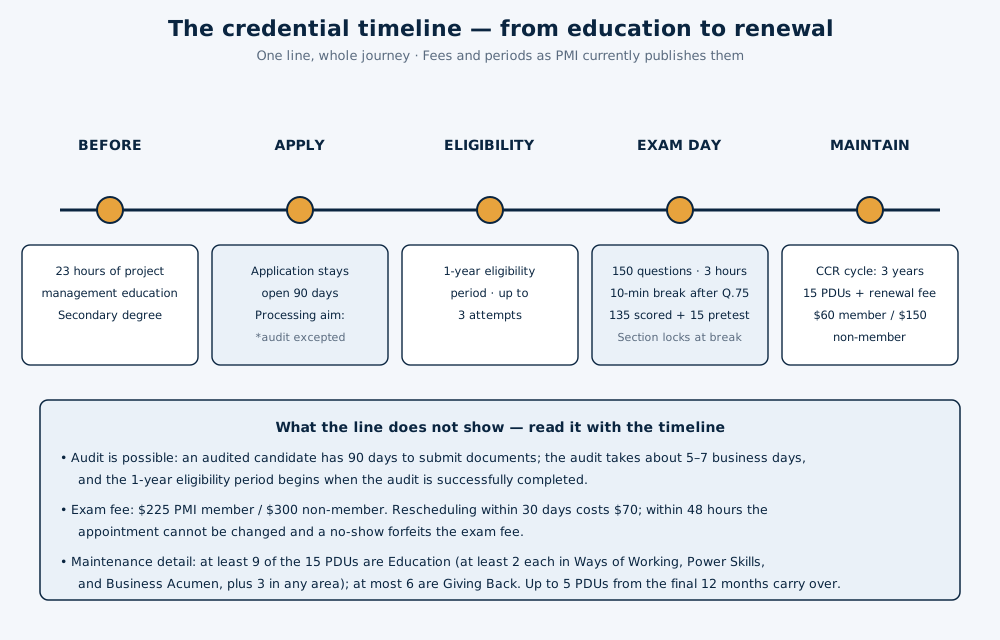
Figure 1.1 — Credential timeline: 23 hours education, 90-day application window, 1-year eligibility with 3 attempts, exam day, and 3-year CCR cycle with 15 PDUs (Plate A-10)
You begin with eligibility: a secondary degree and 23 hours of project management education, both complete before you sit the examination (Section 1.3). You apply through PMI's online certification system; the application, once started, stays open for 90 days (Section 1.5). PMI aims to process applications in 24 hours or less, unless yours is selected for audit — a random check, taught in Section 1.5, that every applicant should be prepared for. You pay the examination fee — $225 if you are a PMI member, $300 if you are not, in PMI's currently published figures (Section 1.6) — and PMI sends you an eligibility ID and scheduling instructions. From approval (or from successful completion of an audit, if you are audited), a one-year eligibility period runs: your window to pass, with up to three attempts inside it (Section 1.10).
You schedule with Pearson VUE, PMI's testing partner, at a test center or online under a proctor, and you sit a single examination: 150 questions presented in three hours, with one scheduled 10-minute break after question 75 (Section 1.7). Your result — pass or fail — is shown when you complete the examination, and no published number converts your answers into that result in advance (Section 1.8). If you pass, you are a CAPM holder from that day, and a three-year maintenance cycle starts on the same day: 15 Professional Development Units, called PDUs, plus a renewal fee keep the credential active (Section 1.11). If you do not pass, the retake structure of Section 1.10 governs what happens next — and it is a structure to plan with, not a disaster to fear.
Notice what this road does not contain. There is no experience requirement to document, no employer endorsement to obtain, no interview. There is also no point at which this book, or any book, is submitted to PMI as evidence of anything. The road runs between you and PMI; this book walks beside you on it as study support. That distinction becomes a formal rule in Section 1.4, and it is stated on this book's copyright page where a buyer will see it before purchase decisions rest on it.
To be eligible for the CAPM certification, a candidate needs both of the following, in PMI's published form [per PMI's CAPM ECO — S-01; PMI's CAPM Certification Handbook — S-02; PMI's CAPM certification page — S-04]:
Read the second requirement with its recording rules attached, because candidates trip on the rules more often than on the hours. You must record all education hours regardless of when they were accrued — hours earned years ago count, provided they are recorded — and the coursework must be completed at the time of your examination [per PMI's CAPM ECO — S-01]. One hour of classroom instruction equals one contact hour. Where only part of a course dealt with project management, only those hours count toward the 23 [per PMI's CAPM Certification Handbook — S-02]. The course content the hours may cover, as the ECO lists it, spans project quality, scope, time, cost, resources, communications, risk, procurement, and integration management, together with agile and business analysis [per PMI's CAPM ECO — S-01] — a list worth noticing, because it previews the examination's own territory in Chapters 5 through 16.
Then the fact that separates this credential from almost every other credential a beginner meets: no project management experience is required. PMI publishes no experience requirement for the CAPM — not a reduced one, not a preferred one, none. The absence is itself the published fact. Do not let any website, forum post, or well-meaning adviser import an experience rule into this credential from a senior one; Section 1.13 shows where that imported rule comes from and why it does not apply to you. A student with a secondary degree and 23 qualifying education hours is eligible, full stop. A coordinator with ten years of project work and neither the degree nor the hours is not yet eligible. Eligibility is a checklist, not a judgment of worth, and PMI's checklist has exactly two boxes.
Worked example — two candidates, one checklist. Daniel finished high school six years ago and has coordinated volunteer event projects ever since — dozens of projects, hundreds of hours, no coursework. Priya graduated from high school last spring, has never held a project job, and completed a 23-hour project management course at a community college last month, with a certificate in her files. Run the checklist. Daniel holds the degree but has recorded zero of the 23 education hours: not yet eligible, and his experience — real as it is — cannot be substituted for the hours, because PMI publishes no such substitution. Priya holds the degree and 23 completed, recorded hours: eligible, and her lack of experience is not a defect in her application, because no experience requirement exists for her to fail. The checklist, applied evenly, is the whole analysis. Every eligibility item in this book's quizzes reduces to this same discipline: name which box is checked, name which is not, and never invent a third box.
Because the education requirement is the one eligibility box a beginner must actively build, it deserves its own section — including an honest account of what does not fill it.
PMI lists the types of education providers whose courses, workshops, and training sessions can satisfy the requirement [per PMI's CAPM ECO — S-01; PMI's CAPM Certification Handbook — S-02]: PMI Authorized Training Partners (ATPs); PMI chapters; employer- or company-sponsored programs; training companies or consultants; distance-learning companies, including an end-of-course assessment; and university or college academic and continuing education programs. PMI's own on-demand CAPM Exam Prep Course is named by PMI as one way to help fulfill the requirement [per PMI's CAPM certification page — S-04]. Two boundary rules complete the picture. PMI chapter meetings do not count — except that where at least one hour of a chapter meeting is spent in an actual learning activity, the hours spent in that activity can be counted [per PMI's CAPM ECO — S-01; PMI's CAPM Certification Handbook — S-02]. And a degree program cannot be recorded whole: only its applicable project management classes supply hours [per PMI's CAPM Certification Handbook — S-02].
Now the exclusion, stated in PMI's own handbook words because this book's honesty depends on it: self-directed learning — "reading books, watching instructional videos or sessions with coaches or mentors" — does not satisfy the education requirements [per PMI's CAPM Certification Handbook — S-02]. The ECO's provider sentence opens with a phrase mentioning self-study guides among the materials offered by listed providers, and the two documents therefore do not line up word for word; this book builds no eligibility claim on that phrase. The safe, published ground is the ground both documents share: formal education from the listed provider types, with distance learning carrying an end-of-course assessment.
So here is the fence, in so many words, because this book's rules require it wherever the requirement is taught: reading this book does not satisfy any part of the 23-hour eligibility requirement. Neither does finishing its quizzes, its practice tests, or its study plans. This book is study support you add to qualifying education — the place where you learn the content deeply, rehearse the examination's shape, and repair weak domains — not a substitute for the education itself. If a seller, a listing, or another book ever tells you a prep book is the 23 hours, that claim fails PMI's published exclusion, and you should plan your eligibility without it. Plan the two tracks in parallel instead: enroll in a qualifying course for the hours, and study this book for the knowledge. Many candidates find the course goes faster and sticks better when the book runs alongside it; that is a study tip, not an eligibility claim, and the difference matters.
A practical note on records closes the section. Keep the certificate or registration letter from every course you record. If your application is selected for audit — Section 1.5 — those documents are exactly what PMI will ask for, and the time to discover a missing certificate is the day you finish the course, not the day the audit notice arrives.
You apply through PMI's online certification system. Once you start an online application, it remains open for 90 days — your window to complete and submit it [per PMI's CAPM Certification Handbook — S-02]. Before submitting, you read and agree to two documents: the PMI Code of Ethics and Professional Conduct and the Certification Application/Renewal Agreement [per PMI's CAPM Certification Handbook — S-02]. Neither is a formality. The Code is examined content — Domain 1 of the ECO asks you to apply it to scenarios, and Chapter 6 teaches it — and the Agreement carries the examination-security duty every candidate accepts: the examination and its materials are PMI's sole and exclusive property, confidential, and you agree not to discuss, debrief, or disclose the specific content of examination questions and answers to anyone [per PMI's CAPM Certification Handbook — S-02]. That duty is also why this book contains no recalled or reconstructed examination items: every item in it is original, written to the published outline. A candidate who has seen a site advertising "real exam questions" has seen material no candidate may lawfully supply and no honest book may print.
PMI strives to process applications in 24 hours or less — with one exception that changes the timeline: the audit [per PMI's CAPM ECO — S-01; PMI's CAPM Certification Handbook — S-02]. All applications are subject to audit, and selection is random. Treat audit as weather, not accusation: any application can be selected, including yours, for no reason beyond the draw. An audited candidate submits copies of the diploma or global equivalent, and copies of certificates or registration letters from the training institute for each course recorded. You have 90 days to submit the documentation, and a complete audit takes about five to seven business days once documentation is received. One date consequence matters for planning: for an audited candidate, the one-year eligibility period begins the day the audit is successfully completed, not the day of the original application [per PMI's CAPM Certification Handbook — S-02]. Failure to comply with an audit is an audit failure and carries a one-year suspension from applying for any PMI certification — the audit is optional to draw, never optional to answer.
After approval and payment, PMI emails you your PMI eligibility ID and scheduling instructions, and scheduling happens with Pearson VUE [per PMI's CAPM Certification Handbook — S-02]. PMI recommends scheduling early — at least three months before your eligibility period expires — rather than letting the year run down to its final weeks. Chapter 18 works this calendar end to end, with dates; for now, hold the shape: 90 days to apply, about a day to process unless audited, 90 days to answer an audit if drawn, and one year to pass once eligible.
Fees are the facts candidates most often carry stale, so this book prints them dated, in the form PMI currently publishes, and directs you — as PMI's own handbook does — to PMI.org for up-to-date prices before you pay [per PMI's CAPM Certification Handbook — S-02]. All CAPM fees are subject to membership and regional pricing [per PMI's CAPM ECO — S-01].
The examination fee is $225 for PMI members and $300 for non-members [per PMI's CAPM certification page — S-04, as read 2026-11-01]. One timing rule governs which figure applies to you: the membership rate applies only if you are a member in good standing at the time you submit payment. If you pay the non-member fee and join PMI afterward, PMI does not refund the difference [per PMI's CAPM ECO — S-01; PMI's CAPM Certification Handbook — S-02]. Decide membership before payment, on your own arithmetic; this book prints no membership dues and no "total cost of certification" figure, because PMI's published examination facts do not compose one and invented totals help no one.
The remaining published fees are smaller and specific. Rescheduling or canceling within 30 days of your scheduled appointment costs $70, charged by Pearson VUE; outside that window, rescheduling is free up to the final boundary — within 48 hours of the appointment, it cannot be changed at all, and a no-show forfeits the entire examination fee [per PMI's CAPM Certification Handbook — S-02]. A manual rescore costs $45, and exists only for paper-based administrations: you may request one if your original test was delivered on paper instead of online [per PMI's CAPM ECO — S-01]. A refund of the examination purchase may be requested within 30 days of purchase, provided you do not schedule or take the exam in that timeframe; after a refund, the application closes and the eligibility period ends [per PMI's CAPM Certification Handbook — S-02]. The renewal fee, paid at the end of each maintenance cycle, is $60 for members and $150 for non-members [per PMI's CCR Handbook — S-03].
One fee is deliberately missing from this list, and its absence is a rule of this book, not an oversight. Attempts two and three inside your eligibility year are re-examinations, and PMI publishes that a discounted re-examination fee applies — subject to regional and membership pricing [per PMI's CAPM ECO — S-01; PMI's CAPM Certification Handbook — S-02]. Neither current primary document read for this book prints a dollar amount for it. Dollar figures for the re-examination fee circulate widely online; they trace to an older handbook generation's fee table, and this book prints none of them until a current PMI primary supplies the amount. When a fact is unpublished, the honest sentence is the one PMI itself prints: a discount applies, the amount is set by PMI's current pricing, and you check it at PMI.org when you need it. Silence beats a guessed number — here, and everywhere in this book.
Worked example — the cost of a late change. Marcus holds a test-center appointment three weeks from Saturday. A work emergency makes that date impossible. Because three weeks is within 30 days of the appointment, rescheduling costs him $70 — annoying, and vastly cheaper than the alternative his friend suggests, simply not appearing: a no-show forfeits the entire examination fee he paid and requires the full re-examination fee to schedule again [per PMI's CAPM Certification Handbook — S-02]. If the emergency had arrived inside the last 48 hours, no reschedule would have been possible at all. The lesson the numbers teach is a calendar habit: treat 30 days as the last cheap decision point and 48 hours as the wall. Chapter 18 builds a full candidacy calendar on these boundaries.
Here is the examination as PMI currently publishes it, whole and only whole [per PMI's CAPM ECO — S-01; PMI's CAPM Certification Handbook — S-02; PMI's CAPM certification page — S-04]. The sitting presents 150 questions. Of those, 135 are scored and 15 are pretest questions — unscored questions placed randomly throughout the examination, unmarked, which do not affect your score. PMI uses pretest questions, in its own words, "as an effective and legitimate way to test the validity of future examination questions" [per PMI's CAPM ECO — S-01]. You cannot tell a pretest question from a scored one, and you are not meant to: answer all 150 with the same effort. Any source that describes the sitting as "150 scored questions" has the composition wrong, and any strategy built on identifying and skipping pretest items is built on a distinction the examination deliberately hides.
The allotted examination time is three hours. Inside those three hours sits the examination's one scheduled pause: a 10-minute break appears after you complete questions 1–75 and review all your answers to that section. The rule attached to the break is absolute — once you review your responses and start the break, you cannot return to the questions from the previous section [per PMI's CAPM ECO — S-01]. Plan for the sitting as two locked halves of 75 questions with a breath between them, not as one pool of 150 you can roam. Before and after the timed examination come an optional tutorial and an optional survey, together taking 5 to 15 minutes — and that time is not included in the three hours [per PMI's CAPM ECO — S-01]. Take the tutorial. It costs you nothing from your examination clock, and it teaches you the screen's tools — including the built-in calculator — before the questions that count begin.
The questions come in more forms than multiple choice. PMI publishes multiple-choice questions, drag-and-drop-style questions, and animations/comic strips, and warns that you may also see hot spot questions — items where you click the correct area of an image [per PMI's CAPM ECO — S-01]. Delivery changes one part of that set: candidates taking the exam by online proctored testing see comic strip questions only, because animation items carry audio; at a test center, animation items play with headphones provided, with closed captioning [per PMI's CAPM ECO — S-01]. The exact number of items of each type may vary by form [per PMI's CAPM ECO — S-01]. Chapter 18 teaches item-form literacy — how to reason through a matching item, a hot spot, an animation — in detail; a print book cannot simulate a video item, and this one says so rather than pretending otherwise. What a book can rehearse is the reasoning those forms test, and that is what this book's matching, ordering, and artifact-reading items do.
Delivery itself is by Pearson VUE, either center-based or online proctored [per PMI's CAPM Certification Handbook — S-02]. At a center: arrive 15 minutes early; bring valid, non-expired, government-issued identification with English characters or translation, a photograph, and a signature, in a name that matches your scheduling notification exactly — a mismatch means no admission. Personal items, including your own calculator, go into a provided locker. The center gives you an erasable note board and marker (one board at a time), and a calculator is built into the computer-based exam; you may also ask the administrator for a handheld calculator [per PMI's CAPM Certification Handbook — S-02]. That built-in calculator sets this book's arithmetic ceiling: every calculation item in this book is solvable with a basic calculator and note-board working. Online, check-in runs through a system test and photo/identification capture, with the Begin Exam window opening 30 minutes before and closing 15 minutes after your appointment [per PMI's CAPM Certification Handbook — S-02]. Test accommodations for disability, handicap, or medical condition are requested during the payment process at no additional cost, with supporting medical documentation — and accommodated candidates test at a center, not online [per PMI's CAPM Certification Handbook — S-02].
The examination is offered in eleven languages as PMI's current certification page publishes them: English, Spanish, Arabic, Italian, French, Portuguese (Brazilian), German, Japanese, Korean, Chinese (Simplified), and Chinese (Traditional) [per PMI's CAPM certification page — S-04]. You choose your language at scheduling; the chosen language fills all screens, and an on-screen exhibit button shows each question's English text if you want it [per PMI's CAPM Certification Handbook — S-02]. Section 1.12 explains why your older handbook lists fourteen languages and why this book prints eight.
Worked example — pacing the sitting (this book's arithmetic on PMI's figures). PMI publishes 150 presented questions and 180 minutes. A steady pace is therefore 180 ÷ 150 = 1.2 minutes per question — 72 seconds. At that pace, the 75-question break point arrives at 75 × 1.2 = 90 minutes elapsed: halfway through the questions at halfway through the clock, which is exactly where a steady candidate should meet the break. A candidate who reaches question 75 at 110 elapsed minutes is running 20 minutes behind a steady pace and should tighten the second half — answer, mark the genuinely hard ones within the section, and keep moving, remembering that section two cannot borrow time from section one once the break locks it. These checkpoints are this book's composition arithmetic on PMI's published figures, offered as pacing tools; PMI publishes no pacing rule, and no checkpoint converts into any prediction about your result.
Candidates ask one question about scoring more than any other — how many questions do I need right? — and PMI's published answer is the only one this book prints, because it is the only one that exists.
The passing score for all PMI exams is determined by sound psychometric analysis. PMI uses subject matter experts — project professionals from around the world and many different disciplines — to determine how many questions you must answer correctly to pass the exam. Each scored question on the exam is worth one point, and your final score is calculated by totaling the points you have earned on the exam [per PMI's CAPM Certification Handbook — S-02]. The ECO adds only that the scoring model is periodically reviewed by scoring experts to ensure valid assessment [per PMI's CAPM ECO — S-01]. PMI publishes no numeric cut score, no percentage, and no number-correct threshold for the CAPM. Not in the ECO, not in the Handbook, not on the certification page. Any book, course, forum, or video that tells you the CAPM requires a specific percentage is inventing the number; there is no polite version of that sentence, and you should discount everything else that source tells you accordingly.
What you receive is this: the overall pass/fail result is shown on completion of the examination. Center-based candidates receive a printed examination report at the test center the day they sit; the report is also available in PMI's online certification system [per PMI's CAPM Certification Handbook — S-02]. The report carries diagnostic information about your performance, which this book teaches you to read at the grain of the examination's four domains — the grain at which a candidate can actually act, by re-reading the matching chapters and working the matching repair set. This book prints no finer report categories, because the current primaries do not name them, and it imports no other PMI examination's rating labels as if they were the CAPM's.
The scoring form disciplines this book's own practice materials, and you should hold every prep source to the same discipline. Your results on this book's diagnostic, quizzes, and practice tests print as raw counts with study guidance — "below this count on Business Analysis, re-read Chapters 13–16, then work the Business Analysis repair set" — and never as a percentage-of-passing, a converted score, or a predicted result. A raw count on our items tells you where your knowledge stands against our questions. It cannot tell you where you stand against PMI's psychometric standard, because nobody outside PMI can compute that, and anyone who claims to is selling you a number PMI has not published. Study the domains, repair the weak ones, and let the standard be PMI's.
What does the examination actually test? The ECO answers with an architecture, and the architecture — not any textbook's table of contents — is this book's organizing law. The examination is built of four domains — a domain being, in the ECO's definition, a high-level knowledge area essential to the practice of project management — carrying eighteen tasks between them, a task being an underlying responsibility of the project team member within a domain. Under each task sit enablers: illustrative examples of the work associated with the task, expressly not an exhaustive list [per PMI's CAPM ECO — S-01]. The structure was defined by a job task analysis inside a global practice analysis — extensive market research into what entry- and associate-level project work actually consists of — developed with Alpine Testing Solutions [per PMI's CAPM ECO — S-01]. Two consequences follow. First, the outline describes a job, not a syllabus: it was drawn from practice, by practitioners, which is why its verbs are workplace verbs — distinguish, determine, apply, match, explain. Second, each CAPM examination includes all tasks for a domain, and PMI adheres to the percentage of coverage at the domain level [per PMI's CAPM ECO — S-01]. There is no lucky form that skips your weak task.
The four domains, with their published shares, are:
[All four domain names, task counts, and percentages per PMI's CAPM ECO — S-01.]
PMI publishes percentages only — no per-domain item counts. When this book tells you that a 135-item scored set at these percentages composes to roughly 49 Fundamentals items, 23 Predictive, 27 Agile, and 36 Business Analysis items, that is this book's composition arithmetic (percent × 135, rounded, and disclosed as such wherever it prints), used to build practice forms at the published shape — not a figure PMI publishes. The weighting itself teaches a study lesson before any content chapter begins: Fundamentals and Business Analysis together are nearly two-thirds of the examination. A candidate who studies only scheduling and Scrum boards has prepared for a minority of the test. This book's shape honors the weights: Business Analysis carries four full chapters (13–16), Fundamentals is built across the foundations and Chapters 5–6, and Predictive — the smallest domain at 17% — is deliberately the leanest part, with its real weight carried by the calculation core of Chapter 9 rather than by prose bulk.
One ECO note governs how those domains behave on the actual test, and Chapter 17 is built around it: predictive, adaptive, and business analysis approaches "will be found throughout the four domain areas… and are not isolated to any particular domain or task," and the exact number of items for each question type and approach may vary by form [per PMI's CAPM ECO — S-01]. Do not expect the examination to respect the book's part boundaries. A Fundamentals question can wear an agile scenario; a Business Analysis question can sit inside a predictive project. The domains name knowledge areas, not sealed compartments, and the examination mixes approaches the way real projects do.
What is the examination built from? Every examination question, PMI states, was written and reviewed by subject matter experts and can be found in a minimum of two references from the ECO's published reference list [per PMI's CAPM ECO — S-01]. The list, exactly as the ECO publishes it, holds seven titles: A Guide to the Project Management Body of Knowledge (PMBOK® Guide) — Seventh Edition; Process Groups: A Practice Guide (2022); The PMI Guide to Business Analysis (2017); Business Analysis for Practitioners: A Practice Guide — Second Edition (2024); Agile Practice Guide (2017); The Project Management Answer Book (Second Edition); and Effective Project Management: Traditional, Agile, Extreme, Hybrid (8th Edition). PMI provides the list as a courtesy only, states that reading each book on it is not a requirement, and does not endorse the non-PMI publications on it [per PMI's CAPM ECO — S-01]. Two disciplines follow for this book, and both are binding. First, this book teaches the ECO's published domains, tasks, and enablers, in its own words, at the depth the ECO assigns them — it never reproduces the text, tables, figures, or process charts of the PMBOK® Guide or any other reference-list title, and never paraphrases closely enough to substitute for an original. Second, the ECO — not any single text — is the examination's outline: PMI records that the taskforce behind the global practice analysis was not bound by the PMBOK® Guide [per PMI's CAPM ECO — S-01]. A candidate who memorizes a reference book's structure instead of the ECO's tasks has aimed at the wrong target; the outline is the target, and the crosswalk appendix of this book maps every task and enabler to the chapters that teach it.
The retake structure is published whole, and learning it now converts a possible failure from an ending into a planning constraint. You are granted a one-year eligibility period in which to pass the examination. During that period, you may take the examination up to three times [per PMI's CAPM ECO — S-01; PMI's CAPM Certification Handbook — S-02]. The period runs from application approval — or, for an audited candidate, from successful audit completion. Attempts two and three are re-examinations inside the same year, each carrying the discounted re-examination fee discussed in Section 1.6, whose amount this book leaves in PMI's published form.
Two boundaries close the structure. After three failed attempts, you must wait one year from the date of your last examination before you can reapply for the certification — a policy PMI states is designed to uphold exam security and reduce overexposure of examination questions. During that waiting year, you may apply for any other PMI certification; the wait attaches to the CAPM, not to you [per PMI's CAPM ECO — S-01; PMI's CAPM Certification Handbook — S-02]. And if the one-year eligibility period expires without a pass — even with attempts unused — you must reapply for the certification [per PMI's CAPM ECO — S-01]. Unused attempts do not bank. A candidate who sits once in month two, fails, and then waits out the year in discouragement has spent the eligibility exactly as surely as a candidate who sat three times.
Plan like it. The strongest retake posture is the one Chapter 18 formalizes: sit the first attempt early enough in the year to leave room for a studied second attempt, read the domain-level result as a repair map rather than a verdict, and rebuild the weak domains — this book's repair sets exist for precisely that work — before spending the next attempt. Three attempts and one year is a generous structure for a candidate who treats each attempt as information. It is a short structure for a candidate who treats each attempt as a lottery ticket.
Passing is not the end of the road; it is the start of a cycle, and the cycle's rules changed within living memory — which is why older holders will give you outdated advice with complete confidence. PMI moved the CAPM onto the same Continuing Certification Requirements (CCR) model as its other certifications: everyone who earns a PMI certification must actively maintain it through the CCR Program and renew it every three years [per PMI's CAPM ECO — S-01; PMI's CAPM Certification Handbook — S-02]. The CAPM's published requirement, from the CCR Handbook [per PMI's CCR Handbook — S-03], is:
The arithmetic is deliberately gentle — 15 hours across three years, most of it learning — and it composes in several honest ways. A holder who earns 3 Education PDUs in each Talent Triangle leg holds 9 Education PDUs, meets every leg minimum (3 ≥ 2 in each), and still needs 6 more PDUs, which Giving Back can supply up to its cap — say 2 as a practitioner and 4 volunteering or mentoring — for exactly 15. A holder who prefers pure learning can earn all 15 as Education, since Education has no maximum; the 9-PDU figure is a floor, not a target. What cannot work is the reverse shape: Giving Back alone caps at 6, so no amount of volunteering substitutes for the 9-PDU Education floor. That composition — floors, caps, and the leg minimums inside them — is the whole maintenance calculation, and Chapter 18 rehearses it once more at the point where a new holder needs it.
The lapse ladder is equally published, and worth knowing before you need it. If requirements are unmet when the cycle ends, the credential enters suspended status for one year: during suspension you may not use the CAPM designation, but you may earn the PDUs and complete renewal inside that year. If requirements are still unmet after suspension, the credential reaches expired status — you are no longer a certification holder, and regaining it requires a new application, the associated fees, and retaking the examination [per PMI's CCR Handbook — S-03]. Suspension is a grace year with the designation switched off; expiry is the credential gone. The defense is trivially calendared: PDUs recorded in PMI's Continuing Certification Requirements System as you earn them, well before the cycle ends, with documentation kept at least 18 months after the cycle ends against a PDU audit [per PMI's CCR Handbook — S-03].
One note on currencies, printed here because the confusion is common and costly: the 23 contact hours that admit you to the examination and the 15 PDUs that maintain the credential are different currencies for different stages of the road — contact hours before, PDUs after. Hours from your eligibility education cannot be spent again as PDUs (activities completed before earning the certification do not count toward PDUs [per PMI's CCR Handbook — S-03]), and PDUs cannot be spent backward as eligibility hours. Two wallets, two stages, no exchange rate. This book never lets one stand for the other, and neither should your records.
Everything in this section exists because of one unusual fact: PMI's own publications currently disagree with each other, in layers. The Handbook PMI still circulates was revised in May 2022 — before the 2023 ECO — and it still carries the retired layers inside its own pages. The prep shelf built on those layers carries them further. When the documents conflict, this book's ruling — stated once here and applied everywhere — is: the newer, examination-specific document controls. The ECO controls content, item forms, the break, and the tutorial; the current certification page controls the language list and the fee figures it publishes; the Handbook controls candidacy mechanics the ECO does not reach, except where the ECO has visibly superseded it; the CCR Handbook controls maintenance.
The turnovers you are most likely to meet, each in its current published form beside its superseded form:
Why teach the stale forms at all? Because you will meet them — in the handbook PMI hands you, in a colleague's older course, in the first search result you open at midnight. A candidate who has never seen the turnover reads the contradiction as chaos and trusts whichever source they met last. A candidate who has seen this section reads it as a dated layer, checks the publication date, and follows the newer examination-specific document. Chapter 18 reprises this note at the end of the book, where a candidate about to sit needs it most; by then it should read as a reminder, not a revelation. And hold the forward half of the discipline as well: documents will turn over again after this book prints. When they do, the same rule — newer examination-specific document controls, facts dated, nothing guessed — tells you how to read the change, and this book's errata page is the channel through which its own currency corrections travel.
One section of orientation, kept deliberately short, because the confusion it prevents is expensive. PMI offers a senior credential, the Project Management Professional (PMP)®, and the CAPM sits below it on PMI's ladder as the entry step: PMI positions the CAPM as a path toward its major certifications, including the PMP [per PMI's CAPM certification page — S-04]. They are separate credentials with separate examinations, separate outlines, separate eligibility models, and separate audiences — the CAPM for students, team members, and junior practitioners; the senior credential for experienced managers. This book is a CAPM book. It borrows nothing from any senior-credential material, teaches nothing at senior depth, and prepares you for no examination but this one.
Exactly two facts about the senior credential belong in a CAPM book, because both are facts about the CAPM itself as PMI publishes them. First, the ladder position just stated: earning the CAPM positions you to pursue PMI's major certifications [per PMI's CAPM certification page — S-04]. Second, and concretely: earning the CAPM automatically meets the 35 hours of project management education and training required to sit for the PMP examination [per PMI's CAPM certification page — S-04]. Hold that second fact precisely. It is a training-hours credit. It does not waive any experience requirement the senior credential may carry, it does not shorten its examination, and it does not make this book senior-credential preparation. It means the hours you bank for the CAPM are not spent if you later climb — a genuine, published benefit, printed here in exactly the form PMI publishes it, in this chapter and in Chapter 18, and nowhere inflated beyond it.
Everything else you may have absorbed about the senior examination — its size, its domains, its eligibility paths, its fees — is not CAPM content, and this book prints none of it as a CAPM fact. When a study source blurs the two credentials, it is usually the source's outline that is wrong for your test, not your memory. Aim at the ECO in Section 1.9. It is the whole target.
This book is organized the way the ECO is weighted and the way a beginner learns. Part I (Chapters 1–4) builds the foundations from zero: this credential map; projects, programs, portfolios, and the organizations that run them; life cycles, processes, and the people in roles; and the judgment at the heart of the whole field — choosing between a predictive approach, an adaptive approach, or something in between. Part II (Chapters 5–6) teaches Fundamentals and Core Concepts whole: planning, the registers, executing the plan, the Code of Ethics applied to scenarios, and problem-solving craft. Part III (Chapters 7–9) teaches predictive, plan-based work, ending in the calculation core — networks, earned value, and the supporting methods — taught once, as one method, before any later chapter exercises it. Part IV (Chapters 10–12) teaches adaptive work: iterations, the named frameworks at component depth, and adaptive controls. Part V (Chapters 13–16) teaches business analysis whole: roles, stakeholder communication, requirements gathering, roadmaps, and validation through delivery. Part VI (Chapters 17–18) integrates one project across all three lenses and then walks the candidacy calendar and the sitting end to end.
Around the chapters stands the practice architecture, composed to the ECO's published weights: a 50-item diagnostic in the front matter; a 20-item quiz closing every chapter, with a full answer key in which every wrong option is explained; two full timed practice tests of 150 presented items each, with the 75-question break point marked and 15 pretest-position items identified only in the key, exactly as the real sitting hides them; and four 25-item domain repair sets, one per domain, for rebuilding after a quiz, a practice form, or a real attempt points at a weak area. Every result in that architecture is a raw count with study guidance — never a prediction — for the reasons Section 1.8 gives.
Three working rules will get the most out of the book. First, read the foundations before you drill: the diagnostic can wait until Chapter 4 is behind you if you are a true beginner, because its job is to route your study, not to grade your starting point. Second, work every worked example with a pencil before reading its solution — in the calculation chapters above all, where the method is the content. Third, keep two notebooks: one for content, and one — the notebook from this chapter's opening scene — for the credential facts in Sections 1.3 through 1.12, in their current published forms, with their dates. The second notebook is short. It is also the one whose errors are entirely preventable.
20 items. Every item is original, written to PMI's published CAPM facts (S-01…S-04). Tags and the category map follow the quiz; full explanations are in the Chapter 1 Answer Key.
1. Which statement correctly describes the CAPM credential? A. A degree-equivalent awarded on completing 23 hours of coursework B. The first module of the PMP examination, scored separately C. A license to practice project management, granted by the candidate's state D. PMI's entry credential: recognition of associate-level project management knowledge for people starting in, or interested in, project management and for project team members demonstrating their knowledge
2. Which pair states the CAPM eligibility requirements in their published form? A. A secondary degree (high school diploma, GED, or global equivalent) and 23 hours of project management education completed before the exam B. A bachelor's degree and two years of project experience C. A secondary degree and 35 hours of project management education D. Five years of project experience, with education optional
3. A candidate has six years of project coordination experience but has completed no project management coursework. Which statement is correct? A. The candidate is not yet eligible: no experience substitutes for the 23 education hours, and PMI publishes no experience requirement for the CAPM at all B. The candidate is eligible, because experience is the primary requirement C. The experience satisfies the education requirement by substitution D. The candidate is eligible if an employer endorses the experience
4. A candidate took a 10-hour project management course four years ago and a 13-hour course last month. How are the hours treated? A. Only hours from the last two years may be recorded B. All education hours must be recorded regardless of when they were accrued, and the coursework must be completed at the time of the examination — 23 hours in total here C. Hours count only if the same provider delivered both courses D. Only the most recent course counts
5. Which education offering can satisfy the 23-hour requirement, as PMI publishes the provider types? A. Chapter meetings, in full, whether or not any learning activity occurs B. Watching instructional videos on a self-directed basis C. A distance-learning company's course that includes an end-of-course assessment D. Reading this study guide from cover to cover
6. Which statement correctly states this book's relationship to the 23-hour requirement? A. This book satisfies half the hours, and a course must supply the rest B. This book is study support added to qualifying education; reading it does not satisfy any part of the 23-hour requirement, because PMI excludes self-directed learning C. Completing this book and its quizzes satisfies the 23 hours D. This book satisfies the requirement for PMI members only
7. Once a candidate starts an online CAPM application, how long does it remain open, and what must the applicant agree to before submitting? A. One year; the CCR maintenance contract B. 90 days; a promise to join PMI within the eligibility year C. 30 days; the examination-security policy only D. 90 days; the PMI Code of Ethics and Professional Conduct and the Certification Application/Renewal Agreement
8. A candidate's application is selected for audit. Which statement matches PMI's published audit mechanics? A. The candidate is interviewed by PMI staff, and the eligibility period began at application B. The candidate submits original documents by mail within 10 days C. The candidate submits copies of the diploma and of certificates or registration letters for each recorded course, has 90 days to submit, and the one-year eligibility period begins when the audit is successfully completed D. Audit applies only to candidates who fail the examination
9. Which statement about the examination fee is correct? A. A candidate who pays as a non-member and joins later is refunded the $75 difference B. The fee is $300 for everyone; membership affects dues only C. The fee is $225 member / $300 non-member, and the membership rate applies only if the candidate is a member in good standing at the time of payment D. The fee is set by Pearson VUE at scheduling
10. A candidate must move an appointment that is now 20 days away. What does PMI's published policy provide? A. Rescheduling is free at any point before the appointment B. A no-show costs $70 and the fee is otherwise protected C. The appointment cannot be moved inside 30 days under any circumstances D. Rescheduling within 30 days costs $70; inside 48 hours the appointment cannot be changed, and a no-show forfeits the entire exam fee
11. A website states the CAPM re-examination fee as a specific dollar amount. How does this book treat that figure? A. It prints no amount: PMI's current documents publish a discounted re-examination fee subject to regional and membership pricing, with no dollar amount, and the circulating figures trace to an older handbook generation B. It prints a discounted fee of half the examination fee, computed from the published examination fee C. It prints the figure for members only D. It prints the figure, because websites agree on it
12. Which statement gives the composition of the CAPM sitting in its published form? A. 170 questions presented: 150 scored plus 20 pretest B. 150 questions presented: 135 scored plus 15 pretest (unscored) questions placed randomly and unmarked C. 150 questions, all scored D. 135 questions presented, with 15 more offered as an optional pretest section
13. Which statement about the break and the tutorial is correct? A. A 10-minute break appears after questions 1–75 and review of that section, after which the section cannot be re-entered; the optional tutorial and survey take 5–15 minutes outside the 3 hours B. A 10-minute break is available at any point, and sections remain open after it C. The break appears after question 100, and the tutorial is mandatory and timed D. There are no scheduled breaks, and the tutorial runs on the examination clock
14. A candidate will take the exam by online proctored testing. Which statement about item forms is correct for that delivery? A. The candidate may see multiple-choice, drag-and-drop, animation, and hot spot items B. Online delivery is multiple-choice only in all respects C. The candidate sees comic strip questions only in place of animation items, to avoid sound issues; multiple-choice, drag-and-drop, and hot spot forms remain possible as PMI publishes the form set D. Animation items play online with the candidate's own speakers
15. Which statement gives the CAPM passing standard in its published form? A. A grade boundary PMI announces to candidates before each examination window B. The passing score is determined by sound psychometric analysis, with subject matter experts determining how many questions must be answered correctly; each scored question is worth one point, and PMI publishes no numeric cut C. A passing standard set by the test center that administers the examination D. A scaled score published by PMI each year
16. Which statement about the examination's content architecture is correct? A. Thirteen chapters of the PMBOK® Guide, each with its own percentage B. Three domains: predictive, agile, and business analysis, weighted by the candidate's application C. Five process groups weighted equally D. Four domains and eighteen tasks — Fundamentals and Core Concepts 36%, Predictive, Plan-Based 17%, Agile Frameworks/Methodologies 20%, Business Analysis Frameworks 27% — with each examination including all tasks for a domain at the published domain percentages
17. At this book's published steady pace — 150 presented items in 180 minutes — a candidate finishes question 75 and reviews the section at 112 elapsed minutes. Which reading is correct? A. Pacing cannot be computed because pretest items are unmarked B. The checkpoint is 112 minutes, so the candidate is exactly on pace C. The candidate is ahead of pace and can slow down in section two D. The steady-pace checkpoint for question 75 is 90 minutes, so the candidate is 22 minutes behind pace and must tighten section two, which cannot borrow reviewed time from the locked first section
18. A new CAPM holder plans a maintenance cycle: 2 Education PDUs in each Talent Triangle leg (6 total), 3 further Education PDUs, and 6 Giving Back PDUs including 2 as a practitioner. Does the plan meet the published requirement? A. Yes — Education totals 9 (meeting the floor and each leg minimum of 2), Giving Back totals 6 (at its cap, practitioner PDUs at their cap of 2), and 9 + 6 = 15 PDUs B. Yes — but only because any 15 hours of activity qualify, with no floors or caps C. No — Giving Back PDUs cannot be used at all D. No — Education PDUs are capped at 9, so 15 cannot be reached this way
19. A candidate fails a first attempt in month 2 of the eligibility year, fails a second in month 7, and fails a third in month 11. What does PMI's published structure provide? A. The candidate is permanently barred from the CAPM B. The candidate must wait one year from the date of the last examination before reapplying for the CAPM, and may meanwhile apply for another PMI certification C. The eligibility year restarts automatically for a further three attempts D. A fourth attempt is available in month 12 at the re-examination fee
20. Which statement about the CAPM and the PMP is correct, in the form PMI publishes? A. The CAPM examination is the first sitting of the PMP examination, and passing it waives the PMP experience requirement B. CAPM holders may use the PMP designation once they complete 15 PDUs C. Earning the CAPM automatically meets the 35 hours of project management education and training required to sit for the PMP exam; the credentials otherwise remain separate, with separate examinations, outlines, and eligibility models D. This book prepares candidates for both examinations
Google Play Books Exam Prep Series
Feras Alzubi
Built on the Project Management Institute's Certified Associate in Project Management (CAPM)® Examination Content Outline — 2023 Exam Update (© 2023), the examination outline in force for this credential, as read in full on November 1, 2026, together with PMI's CAPM® Certification Handbook (revised May 24, 2022), PMI's Continuing Certification Requirements (CCR) Handbook (© 2022), and PMI's current Certified Associate in Project Management certification page, each as recorded in the References at the back of this book. Confirm the current outline, handbook, fees, languages, and maintenance rules at pmi.org before you apply — PMI's own CAPM publications currently disagree with each other in layers, and the Copyright and Version Page and the currency note below name each disagreement and state which document this book follows, and why.
A note on counts. Every count printed in this front matter is an as-built count for this edition — 890 practice items (810 examination-layer + 80 field-practice), 100 designated calculation exercises (plus 26 field-calculation items in the supplement, counted separately), 30 labeled figures, and a 644-term glossary — except where a figure is expressly labeled as designed: there the design record is printed for transparency and the as-built figure supersedes it, with the restatement recorded in Appendix C.1. No other extent, item, designated-exercise, or figure count is printed in this front matter unless it is a published examination fact with its source named. ---
Certified Associate in Project Management (CAPM)® — 2026–2027 Edition. This edition is built entirely on the CAPM Examination Content Outline — 2023 Exam Update, the outline in force when this edition was produced (see the Copyright and Version Page)..
Copyright © 2026 by Feras Alzubi. All rights reserved. First edition, published November 1, 2026..
All rights reserved. No part of this book may be reproduced or transmitted in any form or by any means without the publisher's prior written permission, except for brief quotations in a review.
Edition bases — the ECO-edition statement. Read this page before you rely on any figure in this book.
This edition is built on PMI's current published CAPM documents, in the editions named here, under one currency ruling that governs the whole book: where PMI's documents conflict, the newer, examination-specific document controls. The 2023 Examination Content Outline (ECO) controls content, item forms, the break, and the tutorial; PMI's current certification page controls the language list and the fee figures it publishes; the Certification Handbook controls candidacy mechanics the ECO does not reach (audit, scheduling, identification, rescheduling), except where the ECO has visibly superseded it; and the CCR Handbook controls maintenance.
Version: 1.0 · Imprint: Exam Prep Series (Google Play Books) · Currency basis: the CAPM Examination Content Outline — 2023 Exam Update, and PMI's CAPM certification page and Certification Handbook, re-verified at production on November 1, 2026 (see the Errata and Edition Note at the back of this book).
Marks. CAPM®, PMP®, and PMBOK® are registered marks of the Project Management Institute, Inc. SAFe® is a registered mark of Scaled Agile, Inc. Exam names and trademarks belong to their respective owners and are used in this book only to identify the examination, its published structure, and the frameworks the ECO names.
This book is an independent study guide. It is not published by, affiliated with, endorsed by, or approved by the Project Management Institute (PMI), and it is not a PMI Authorized Training Partner publication. PMI alone owns and administers the CAPM examination and awards the certification. Passing any examination also depends on the candidate's own preparation; no book can guarantee a result, and this book makes no pass guarantee of any kind. PMI publishes no CAPM pass rate in any primary this book rests on, and no pass rate is printed anywhere in this book.
Every practice question in this book is original, written to the 2023 CAPM ECO. No item is an actual examination question, and none is a recalled or reconstructed one. PMI's examination and its materials are PMI's sole and exclusive property and are confidential; the Certification Application/Renewal Agreement every applicant agrees to bars discussing, debriefing, or disclosing the specific content of PMI examination questions and answers to any individual. This book neither solicits nor prints real items, and material from question-dump sites is never a source for its content, its keys, or its "representative" items.
Every examination figure in this book traces to one of the four PMI publications named on the Copyright and Version Page, checked on November 1, 2026. The full source register, entry by entry, is printed as the References at the back of this book, and the register's numbered entries (S-01 through S-04) are the authority behind every examination fact printed here. Where PMI's own publications disagree with each other — and, on this credential, they do — the currency ruling on the Copyright and Version Page governs, and the superseded forms appear in this book only inside the dated currency notes in Chapters 1 and 18 and in the table below, never as live facts.
PMI's CAPM publications have turned over in layers, and the superseded layers sit inside PMI's own Handbook as well as across the prep shelf. This book prints the current form of each fact, and names the turnover here so a reader arriving from an older source is not misled:
| Fact | What PMI currently publishes — what this book prints | The superseded form still in circulation |
|---|---|---|
| Content architecture | 4 domains / the ECO's task statements at 36/17/20/27% (2023 ECO) | A blueprint by PMBOK® Guide chapter percentages (13 chapters), printed in the Handbook PMI still circulates; older five-process-group and domain lists on the shelf |
| Breaks | One 10-minute break after questions 1–75, after that section is reviewed; the section cannot be re-entered (2023 ECO) | "There are no scheduled breaks during the exam" (the Handbook's earlier layer) |
| Item forms | Multiple-choice, drag-and-drop-style, and animation/comic strip questions; candidates may also see hot spot questions (2023 ECO) | "150 multiple-choice questions" as the whole form (the Handbook's examination-information wording) |
| Languages | 11 languages, as PMI's current certification page publishes them (re-verified at production) | A 14-language list (the Handbook's earlier layer) |
| Maintenance | 3-year CCR cycle, 15 PDUs, renewal fee | A 5-year cycle ending in re-examination, with no PDUs (the pre-October 2020 model in older handbook generations) |
| Reference frame | ***PMBOK® Guide* — Seventh Edition**, with the ECO's seven-title reference list | The PMBOK® Guide — Sixth Edition as the exam's reference (the Handbook's item-development note); the Eighth Edition, which belongs to the PMP line, imported as CAPM content |
| Tutorial clock | The tutorial and survey are optional, take 5 to 15 minutes, and are not included in the 3 hours (2023 ECO) | A center-based narrative in which the examination countdown begins as the tutorial begins (the Handbook's earlier layer) |
If a source you own states any form in the right-hand column as a current fact, study its project content if you wish; take none of its candidacy facts.
"The passing score for all PMI exams is determined by sound psychometric analysis. PMI uses subject matter experts — project professionals from around the world and many different disciplines — to determine how many questions you must answer correctly to pass the exam. Each scored question on the exam is worth one point and your final score is calculated by totaling the points you have earned on the exam." (PMI, CAPM® Certification Handbook.)
PMI publishes no numeric cut score, no percentage, and no number-correct threshold for the CAPM, and this book therefore prints the passing standard in exactly that form — determined by psychometric analysis, set by subject matter experts, one point per scored question — and invents none. Practice results in this book print as raw counts with study guidance attached to the count, explicitly not as pass predictions, and no practice score is ever converted into a predicted result.
This book prints fees only in the forms PMI currently publishes them, each with its source named at the point of use:
No PMI membership dues figure, no training-course price, no price for PMI's own prep course or practice products, and no "total cost of certification" figure built by adding amounts together is printed in this book.
The CAPM — the Certified Associate in Project Management — is PMI's entry credential. In the ECO's words, it "offers recognition to practitioners who are interested in, or just starting, a career in project management, as well as project team members who wish to demonstrate their project management knowledge," and it indicates knowledge of the common practices used by an associate-level project manager as outlined in the CAPM ECO. PMI names the entry and associate roles it supports — project coordinator and junior project manager among them. Individuals who do not have project experience but are interested in project management can also benefit from this certification.
Eligibility — both requirements, in PMI's published form. To be eligible for the CAPM certification, a candidate needs both:
No project management experience is required. PMI publishes no experience requirement for the CAPM; that absence is itself the published fact, and this book states it plainly rather than letting any other credential's experience rule be imported here.
What counts as the 23 hours. PMI's published provider types: PMI Authorized Training Partners (ATPs), PMI chapters, employer/company-sponsored programs, training companies or consultants, distance-learning companies including an end-of-course assessment, and university/college academic and continuing education programs. (The Handbook's provider list agrees in substance and adds PMI Registered Education Providers.) PMI chapter meetings do not count, except for hours — at least 1 hour — spent in an actual learning activity. Self-directed learning does not satisfy the requirement (see the education fence under "What this book is not" above). Course content the hours may cover, as the ECO lists it: project quality, scope, time, cost, resources, communications, risk, procurement, and integration management, agile, and business analysis. PMI's own on-demand CAPM Exam Prep Course is named on PMI's certification page as one published way to help fulfill the requirement. This book is not the 23 hours, under any reading of the lists above.
Application mechanics. Apply through PMI's online certification system. Once started, the application remains open 90 days. PMI strives to process applications and registrations in 24 hours or less, except applications selected for audit. Audit selection is random and all applications are subject to it: an audited candidate submits copies of the diploma or global equivalent and certificates or registration letters for each recorded course, has 90 days to submit the documentation, and the audit takes about 5–7 business days once documentation is received; the one-year eligibility period begins the day the audit is successfully completed. Before submitting, the applicant agrees to the PMI Code of Ethics and Professional Conduct and the Certification Application/Renewal Agreement — the same Code the ECO's first domain examines in scenarios.
The sitting, as PMI publishes it (PMI, 2023 CAPM ECO; PMI, CAPM® Certification Handbook; PMI, CAPM certification page):
| Fact | Published form |
|---|---|
| Presented items | 150 |
| Scored / pretest | 135 scored + 15 pretest (unscored), placed randomly throughout the examination, unmarked, and not affecting the score; pretest questions test the validity of future examination questions |
| Examination time | 3 hours |
| Break | One 10-minute break after completion of questions 1–75, after the candidate has reviewed all answers to that section; once the break starts, the candidate cannot return to that section's questions |
| Tutorial / survey | Optional, 5–15 minutes, before and after the examination; that time is not included in the 3 hours |
| Item forms | Multiple-choice · drag-and-drop-style (enhanced matching) · animation / comic strip · hot spot; the exact number of items for each question type may vary by form. Candidates who test by online proctored testing see comic strip questions only, to avoid sound issues; animation items, which carry audio and closed captioning at a test center (headphones provided), do not appear in that delivery |
| Delivery | Computer-based testing at Pearson VUE test centers or online proctored |
| Languages | 11: English, Spanish, Arabic, Italian, French, Portuguese (Brazilian), German, Japanese, Korean, Chinese (Simplified), and Chinese (Traditional) — chosen at scheduling; the chosen language fills all screens, and an on-screen exhibit button shows the English question text |
| Calculator | Built into the computer-based exam; a handheld calculator may be requested from the test-center administrator; personal calculators are prohibited |
| Materials | An erasable note board and marker at test centers (one board at a time); a locker for personal items |
| Identification | Valid, non-expired government-issued identification with English characters/translation, photograph, and signature; the name must match the scheduling notification exactly; arrive 15 minutes early — late arrival means no admission |
| Scoring | No published numeric cut; the passing score is determined by sound psychometric analysis with subject matter experts; each scored question is worth one point |
| Results | The overall pass/fail result is shown on completion; center-based candidates receive a printed exam report at the test center that day, and the report is also available in the online certification system |
| Examination fee | $225 member / $300 non-member (dated; membership and regional pricing apply) |
| Eligibility period | 1 year from approval (or from successful audit completion); up to 3 attempts inside it |
| Retakes | A discounted re-examination fee applies to attempts 2–3 (amount not published in PMI's current CAPM primaries; no amount is printed in this book); after three failed attempts, wait 1 year from the date of the last examination before reapplying — during that year the candidate may apply for any other PMI certification; if the eligibility period expires without a pass, the candidate must reapply |
| Rescheduling | Free outside 30 days; $70 within 30 days; no change within 48 hours; a no-show forfeits the entire exam fee |
| Maintenance | 3-year CCR cycle: 15 PDUs (minimum 9 Education, maximum 6 Giving Back) + renewal fee $60 member / $150 non-member |
The content weights, exactly as the ECO publishes them (PMI, 2023 CAPM ECO). PMI publishes percentages only — no per-domain item counts. The counts in the right-hand column are this book's own composition arithmetic for its practice forms (percentage × 135 scored-shape items, rounded), disclosed as such wherever they print:
#: 1 · Domain (exact published name): Project Management Fundamentals and Core Concepts · Share: 36% · Scored-shape items in a 135-item scored set*: ≈ 49
#: 2 · Domain (exact published name): Predictive, Plan-Based Methodologies · Share: 17% · Scored-shape items in a 135-item scored set*: ≈ 23
#: 3 · Domain (exact published name): Agile Frameworks/Methodologies · Share: 20% · Scored-shape items in a 135-item scored set*: 27
#: 4 · Domain (exact published name): Business Analysis Frameworks · Share: 27% · Scored-shape items in a 135-item scored set*: ≈ 36
Domain (exact published name): Total · Share: 100% · Scored-shape items in a 135-item scored set*: 135
\This book's composition arithmetic on PMI's percentages, as designed; PMI publishes no counts.*
The ECO's architecture around the domains, as the ECO publishes it: the domains carry task statements, and each task carries enablers — "illustrative examples of the work associated with the task… not meant to be an exhaustive list." Each CAPM examination includes all tasks for a domain, and PMI adheres to the percentage of coverage at the domain level. Predictive, adaptive, and business analysis approaches "will be found throughout the four domain areas… and are not isolated to any particular domain or task," and "the exact number of items for each question type and approach may vary by form." Every examination question was written and reviewed by subject matter experts and can be found in a minimum of two references from the ECO's published reference list (printed in the References).
Maintenance, in its current form. Everyone who earns a PMI certification must actively maintain it through the CCR Program and renew it every 3 years. For the CAPM: the cycle begins the day the candidate passes the exam and requires 15 PDUs (1 PDU = 1 hour of qualifying activity; fractions are reportable in 0.25 increments) — minimum 9 Education PDUs, aligned to the PMI Talent Triangle with a minimum of 2 PDUs in each of Ways of Working, Power Skills, and Business Acumen and the remaining 3 Education PDUs in any Talent Triangle area, and maximum 6 Giving Back PDUs (optional), within which Working as a Practitioner is capped at 2 PDUs per cycle. Up to 5 PDUs earned in the cycle's final 12 months may transfer to the next cycle. The renewal fee is $60 member / $150 non-member. Requirements unmet at cycle end put the holder in suspended status for 1 year, during which the designation may not be used; requirements still unmet after suspension mean expired status — no longer a certification holder — and regaining the credential requires a new application, the associated fees, and retaking the examination. One distinction this book never blurs: the 23 contact hours that admit a candidate to the exam and the 15 PDUs that maintain the credential are different currencies for different stages — contact hours before, PDUs after.
Before Chapter 1, answer two questions, because they select everything that follows.
First: where do you stand on eligibility? You need a secondary degree (a high school diploma, GED, or global equivalent) and 23 hours of project management education completed before the exam — and no experience at all. If your 23 hours are not yet complete, this book's foundations part is written for you, but read Chapter 1's education teaching before you plan a sitting date, because no amount of study in this book substitutes for qualifying education from a published provider type (see the education fence in the Disclosure above).
Second: where are you in your preparation? A complete beginner who has never worked on a project team, a student or team member whose project work is under way, or a retaker rebuilding inside the one-year eligibility structure. The three reader paths below are keyed to that answer, and the study plans after them are keyed to your time and to the eligibility calendar.
This book is built under a dual-purpose promise: complete knowledge from zero, and the full examination layer on top of it, in the same book. No chapter assumes a workplace, a methodology course, or the 23 hours already taken.
Path 1 — From zero. You are a student or recent graduate aiming at a first project role, or a career-changer building a credential with no experience gate. Start at Chapter 1 and read Part I (Chapters 1–4) in order: the examination and the credential, the project and the organizations that run projects, life cycles and roles, and how an approach is chosen. Take the diagnostic after Part I, not before it — a diagnostic taken before the foundations measures unfamiliarity, not readiness — then follow the study plan below that matches your time.
Path 2 — The team member, coordinator, or junior project manager. You work on projects now — or have completed your 23 hours — and are formalizing what the job has taught informally. Take the diagnostic first. Where it routes you into Part I, read those chapters; where it does not, skim Part I for this book's conventions — the education fence, the currency notes, and the addresses below — and begin at the part your scores point to.
Path 3 — The retaker. You hold a result and a domain-level picture of where it was lost, inside a one-year eligibility period with at most three attempts in it. Read Chapter 18's retake teaching first, then work the retake track in the study plans below before you re-read anything else. Plan inside the published structure from the first day: three attempts in one eligibility year, a discounted re-examination fee on attempts two and three, and — after a third failure — a full year from the date of the last examination before you may reapply. A retake spent without a repair cycle is an attempt spent, not a repair made; Chapter 18 and the retake track are built around that arithmetic.
Whichever path you are on: every reader is assumed able to learn a system when it is shown, named, and worked, and no reader is assumed to have directed a project. Where a chapter teaches a topic that also appears in more advanced practice, it teaches it at the CAPM ECO's grain — knowledge and comprehension for an associate-level team member — and stops there.
Designed structure, labeled as designed: the book as designed comprises eighteen chapters in six parts, with a prose target of 150,000 words stated in its design — chapter-file prose only, excluding quiz blocks, item banks, figure captions, tables' cell text, and front and back matter. No prose extent is asserted here as an as-built count.
Inside each chapter the architecture is the same, so you can navigate by habit: the content in plain words first, then at examination depth; the working artifact shown in its labeled plate before it is used in prose; worked examples, with designated exercises derived step by step; and a chapter quiz, keyed to the chapter, at the chapter's end. Every term in the glossary at the back of this book is also defined at its first use in the text.
Every practice item in this book carries an address in the item bank: its domain in the ECO's published name, its task statement, its enabler or enablers, its chapter, and — for designated exercises — its CALC family, its derivation, and its named or supporting-method status. An item that cannot name its ECO line is not in this book.
Designed figures, labeled as designed: the practice architecture as designed comprises a 50-item diagnostic, a 20-item quiz at the end of each of the eighteen chapters (360 quiz items as designed), two full timed practice tests of 150 presented items each (300 presented items as designed, of which 270 are scored-shape and 30 occupy pretest positions — see the forms statement below), and one 25-item repair set for each of the four published domains (100 repair items as designed) — 810 items as designed in total, of which, as designed, 780 are scored-shape items and 30 occupy pretest positions, and 124 as designed are designated exercises across the five CALC families (CALC-01 45 · CALC-02 41 · CALC-03 15 · CALC-04 15 · CALC-05 8, as designed). As built (this edition). Prose: 162,193 words in 22 chapters (Chapters 1-18 as gated: 150,348; the Part VII field supplement, Chapters 19-22: 11,845). Practice: 890 items (810 examination-layer items as gated, plus 80 field-practice items in the Part VII supplement, Chapters 19-22, of which 26 are field-calculation items counted separately from the designated census) — a 50-question diagnostic (18/8/10/14 across the four domains), eighteen 20-question chapter quizzes (360), two 150-question practice examinations presented in the examination's form (each 135 scored at 49/23/27/36 plus 15 in pretest position, exactly as the real sitting presents them), and four 25-question repair sets (100) — of which 100 are designated calculation exercises (CALC-01 33 · CALC-02 32 · CALC-03 13 · CALC-04 13 · CALC-05 9; CALC-03 and CALC-04 are supporting methods, labeled as such wherever they are keyed). 30 labeled figures and a 644-term glossary complete the apparatus. Appendix C.1 is this book's own authority for its practice shape.
Designed figures, labeled as designed: the figure plan as designed comprises 26 figures — 16 labeled plates of the working artifacts themselves (the project charter, the work breakdown structure, the network diagram board, the product backlog, the Kanban board, the risk register, the Scrum board, the burndown wall, the requirements traceability matrix, the RACI responsibility chart, the user story card and use case form, the product roadmap, the stakeholder register, the project management plan set, the Gantt schedule board, and the stakeholder engagement and communications board) and 10 abstract teaching diagrams (the project/program/portfolio nesting, the value-delivery spectrum, life cycles compared, the process rhythm of a predictive project, the critical path, earned value, and channels-and-EMV calculation frames, the earned value S-curves, the iteration loop, and the credential timeline) — each an original drawing made for this book. No figure reproduces a PMBOK® Guide figure, an Agile Practice Guide figure, a framework owner's template, a software screenshot, or any PMI document's layout, and no item in this book requires recognizing one.
As designed, each full form is a 150-item, 3-hour sitting rehearsal: 135 scored-shape items composed at the ECO's percentages, composed to counts with the rounding disclosed on the form's face — Fundamentals and Core Concepts 49 · Predictive, Plan-Based 23 · Agile Frameworks/Methodologies 27 · Business Analysis Frameworks 36 — plus 15 pretest-position items distributed through the form, unmarked in the sitting pages and identified only in the answer key, where the key tells you they were excluded from your score, exactly as PMI's pretest items are excluded from the real score. The form's instructions mark the 75-question point and the 10-minute break, and state the locked-section rule, so you rehearse the real sitting's shape instead of discovering it.
Item-form honesty: this book's items are print forms — multiple-choice items, matching and ordering sets that rehearse drag-and-drop reasoning, and artifact-reading items that rehearse hot spot reasoning. The real examination also uses drag-and-drop, hot spot, and animation/comic items whose reasoning these rehearse but whose mechanics a book cannot simulate, and the form's introduction says so plainly. Online proctored candidates see comic strips only on the real exam; Chapter 18 teaches that delivery difference in words.
A form is not a prediction. Its items are original; its result is a raw count of this book's items; and no surface in this book converts that count into a pass claim of any kind.
As designed, the diagnostic is a 50-item form composed at the ECO's proportions, with its rounding disclosed on its face: Fundamentals and Core Concepts 18 · Predictive, Plan-Based 8 · Agile Frameworks/Methodologies 10 · Business Analysis Frameworks 14 — the published proportions (36/17/20/27 of 50 → 18.0/8.5/10.0/13.5) carried to 50 items, with Predictive, Plan-Based carrying the round-down (8.5 → 8) and Business Analysis the round-up (13.5 → 14), disclosed here rather than hidden. It is sat in 60 minutes, with an untimed option stated on its face. Score it by domain — never as a single blended verdict — then route by this table:
| If this domain is weak, re-read | Then work |
|---|---|
| Project Management Fundamentals and Core Concepts — Chapters 5–6 (with Chapters 2–3) | The Fundamentals and Core Concepts repair set |
| Predictive, Plan-Based Methodologies — Chapters 7–9 | The Predictive, Plan-Based repair set |
| Agile Frameworks/Methodologies — Chapters 10–12 (with Chapter 4) | The Agile Frameworks/Methodologies repair set |
| Business Analysis Frameworks — Chapters 13–16 | The Business Analysis Frameworks repair set |
This diagnostic as built: 50 items in one sitting — 18 Domain 1 · 8 Domain 2 · 10 Domain 3 · 14 Domain 4 (not the examination's own weights: the diagnostic over-samples the methodology domains you must not leave empty, §1.12) — of which 7 are designated calculation exercises (CALC-01 2 · CALC-02 2 · CALC-03 1 · CALC-04 1 · CALC-05 1), at a suggested 75 minutes under examination conditions. Score it by domain from the key's scoring grid: your routing band is a raw count per domain, and the repair sets in the back of this book are the next step it names.
Keep one page for the whole candidacy, current by domain. A second set of rows on the same page makes it a candidacy ledger — the administrative half of the CALC-05 arithmetic, practiced on your real dates:
| Ledger row | Your entry |
|---|---|
| Secondary degree held (high school diploma, GED, or global equivalent), and the copy you would submit if audited | |
| The 23 hours: provider and provider type for each course, hours recorded for each (all hours, regardless of when accrued), and the completion date of the last hour — before your exam date | |
| Application begun in PMI's online certification system (date), and the 90-day date by which it must be submitted | |
| Application submitted, the PMI Code of Ethics and Professional Conduct and the Certification Application/Renewal Agreement agreed to (date) | |
| Audit, if selected: documentation submitted within its 90 days (date), and the audit's completion (date) — your one-year eligibility period begins that day | |
| Examination fee paid (date and amount, in the published form: $225 member / $300 non-member), and the membership status you paid under | |
| Eligibility period: its start date and its end date one year later; the latest sitting date it allows | |
| Pearson VUE appointment scheduled (date, time, and test center — or online proctored), in one of the 11 published languages, and the identification you will bring (name matching the scheduling notification exactly) | |
| Rescheduling, if used: free outside 30 days; the $70 fee if inside 30 days (date); no change inside 48 hours | |
| Sitting date, and your 15-minute-early arrival plan; the break plan for question 75 | |
| Result as shown on completion (pass/fail); the printed report collected at the center, or the report located in the online certification system | |
| If retaking: attempts used, of the three your eligibility period allows (count and dates); the remaining attempts and the period's end date; if a third attempt fails, the date one year after that examination, before which you may not reapply | |
| After passing: your CCR cycle's start date (the day you passed) and end date three years later; PDUs earned and recorded, against the 9 Education / 6 Giving Back frame and the Talent Triangle minimums; the renewal fee paid ($60 member / $150 non-member) and the renewal completed before the cycle ends |
This book does not replace its sources, and it tells you what they are:
Every plan in this section is this book's guidance — book apparatus, labeled as such wherever a plan is reprinted. Three plans follow, as designed: a 2-week intensive plan and a 4-week standard plan, each day by day and referenced to chapters and tests, and a retake track keyed to the one-year eligibility calendar and the three-attempt structure. Every content plan ends, by design, at a full timed form: 150 presented items in 3 hours, sat as one sitting with the 75-question break taken as the real sitting takes it, scored as a raw count by domain, pretest-position items excluded as the form's key directs. No plan's completion is a prediction of any examination outcome, and no practice result in any plan converts to one. Administrative tasks — confirming your eligibility position, recording your 23 hours, entering your application, eligibility-period, and appointment dates in the candidacy ledger — are placed first in every plan, on purpose: with a 90-day application window and a one-year eligibility period, an administrative task discovered mid-plan can cost you the sitting itself; the same task done first costs none. Chapter and component references below are to this book's designed structure: eighteen chapters, a 50-item diagnostic, a 20-item quiz per chapter, four 25-item domain repair sets, and two full 150-item forms, all as designed.
For a candidate whose 23 hours are complete and whose coursework is recent — a team member or coordinator whose project work is current, or a student whose program has just ended — and whose sitting is close. This plan assumes full study days; if your days are working days, use the 4-week standard plan instead — it covers the same ground at half the daily load. Path 1 (from-zero) readers do not start here.
The default plan: for students in their final term, team members and coordinators building alongside work, retakers who prefer pace to pressure, and from-zero readers who have completed Part I. One chapter cluster per day at reading pace, quizzes untimed, repair woven in weekly.
Week 1 — Administration, foundations, and the diagnostic
Week 2 — Fundamentals and predictive work
Week 3 — The calculation core, agile work, and adaptive controls
Week 4 — Business analysis, integration, and the forms
For a candidate rebuilding after an unsuccessful attempt. This track is paced by the published structure, not by preference, and it begins with the calendar, not with a chapter.
End of the free sample. The complete book continues from here — the full A-to-Z course in book form, delivered as an EPUB you can read in Apple Books, Google Play Books, ReadEra, Thorium Reader, Adobe Digital Editions, or Send to Kindle.
Buy this ebook — $9.99 Back to the book page
Payments are securely processed by Payhip.