
Mastering Careers & Skills
Cambridge C1 Advanced Certificate in English (CAE) · free sample from the book itself
Q1 — Key: C. Tag: EXAM-MAP. Rationale: C1 Advanced has four papers — Reading and Use of English, Writing, Listening and Speaking. Wrong A: three papers would omit one skill area entirely. Wrong B: five is the number of component scores, not papers; Reading and Use of English produces two scores from one paper. Wrong D: eight is the number of parts in Reading and Use of English, not the number of papers.
Q2 — Key: A. Tag: EXAM-MAP. Rationale: Reading and Use of English lasts 1 hour 30 minutes, the same as Writing. Wrong B: about 40 minutes is the Listening paper. Wrong C: 1 hour 20 minutes is the B2 First Writing timing, not a C1 timing. Wrong D: 15 minutes is the Speaking test per pair of candidates.
Q3 — Key: B. Tag: RUE-MAP. Rationale: Reading and Use of English contains 56 questions worth 78 marks in total. Wrong A: 30 is the number of Listening questions. Wrong C: 52 is the B2 First question count for the equivalent paper, which has seven parts, not eight. Wrong D: 78 is the number of marks, not the number of questions; Parts 5, 6 and 7 carry two marks per question, which is why the two figures differ.
Q4 — Key: C. Tag: RUE-PART4. Rationale: A C1 transformation answer must contain between three and six words in total, including the given key word, which must be used unchanged. Wrong A: two to five words is the B2 First limit; importing it into C1 loses marks at both ends. Wrong B: there is no fixed length of three words; longer completions within the limit are equally valid. Wrong D: eight words exceeds the published limit and earns no mark.
Q5 — Key: D. Tag: RUE-PART6. Rationale: Cross-text multiple matching, in which four short texts on one theme are compared for agreement and disagreement of opinion and attitude, exists only at C1. Wrong A: the multiple-choice cloze appears at both levels as Part 1. Wrong B: the gapped text appears at both levels, as Part 6 at B2 and Part 7 at C1. Wrong C: multiple matching appears at both levels, as Part 7 at B2 and Part 8 at C1.
Q6 — Key: A. Tag: WRT-PART1. Rationale: In the compulsory essay you select two of the three bullet points, develop both, and explain which of the two is more important. Wrong B: writing about all three points is not required and usually leaves each point underdeveloped within 220–260 words. Wrong C: one point alone leaves the task half unfulfilled and gives nothing to judge against. Wrong D: discussing none of the given points fails the Content requirement entirely.
Q7 — Key: B. Tag: SPK-PART2. Rationale: In Speaking Part 2 you are given three photographs and talk about any two of them for one minute. Wrong A: two photographs is the B2 First arrangement. Wrong C: one photograph would leave nothing to compare, and comparison is central to the long turn. Wrong D: four photographs are never given in this part.
Q8 — Key: C. Tag: SPK-SCALES. Rationale: Speaking is marked out of 75 marks: five assessor scales doubled give 50 marks, and Global Achievement multiplied by five gives 25 marks. Wrong A: 60 is the B2 First Speaking total, where there are four scales and Global Achievement is multiplied by four. Wrong B: 40 is the Writing paper total, not the Speaking total. Wrong D: 100 is not a total used by any paper in this examination.
Q9 — Key: A. Tag: LST-PART4. Rationale: Listening Part 4 presents five short themed monologues, each about 30 seconds long, with two parallel matching tasks. Wrong B: three is the number of extracts in Listening Part 1. Wrong C: eight is the number of options in each Part 4 matching list, not the number of speakers. Wrong D: two speakers is the pattern of the Part 1 extracts and of many Part 3 conversations, not of Part 4.
Q10 — Key: D. Tag: WRT-PART2. Rationale: There is no set-text question at C1; Part 2 offers a choice of one task from three, drawn from letter/email, proposal, report and review. Wrong A: the report is a genuine C1 Part 2 task type. Wrong B: the review is a genuine C1 Part 2 task type. Wrong C: the proposal is a genuine C1 Part 2 task type, and one that does not appear at B2.
Q11 — Key: B. Tag: EXAM-MAP. Rationale: Reading and Use of English produces two component scores — Reading and Use of English — which is why the paper carries 40 per cent of the overall result. Wrong A: one score would give the paper only 20 per cent, the same as each other paper. Wrong C: three scores from one paper would leave too few for the remaining papers. Wrong D: five is the total number of components across all four papers.
Q12 — Key: D. Tag: WRT-LENGTH. Rationale: Both Writing tasks require 220–260 words. Wrong A: 140–190 is the B2 First Writing length. Wrong B: 200–240 starts below the C1 minimum and risks an underdeveloped task. Wrong C: there is no single exact word count; any length inside the range can fulfil the task.
Q13 — Key: "4". Tag: RUE-MAP. Rationale: The Use of English component is built from Parts 2, 3 and 4 — open cloze, word formation and key word transformations — totalling 28 marks. Wrong form: naming Part 1 confuses the component split, because Part 1 feeds the Reading component despite testing vocabulary; naming Part 5, 6, 7 or 8 places a long-text reading part in the wrong component.
Q14 — Key: "5". Tag: LST-MAP. Rationale: Paper-based candidates receive five minutes at the end of the Listening paper to transfer answers to the answer sheet. Wrong form: any other figure confuses this allowance with another paper; Reading and Use of English, by contrast, allows no separate transfer time at all.
Q15 — Key: "decision". Tag: SPK-PART3. Rationale: In Speaking Part 3, candidates discuss for two minutes and then have one minute to reach a decision, but they are not penalised if they fail to reach a negotiated decision; the interaction itself is what is marked. Wrong form: agreement names a possible outcome in ordinary language, but the published formulation tested here is the negotiated decision, and the mark scheme rewards the quality of the discussion whether or not that decision is reached.
This chapter gives you the complete map of C1 Advanced: what the qualification is, who it is for, and exactly how the examination is built. It sets out the four papers part by part — their timings, questions, marks and assessment — and explains how five component scores combine into one overall score and one grade, so that every later chapter can be studied with a clear purpose.
When you understand the examination before you prepare for it, you stop wasting effort. You will know where marks come from, how much time each paper allows, which skills carry the most weight, and what each grade actually certifies. That knowledge turns preparation from guesswork into a plan, and it helps you direct your strongest effort at the papers and parts where improvement will move your average most.
C1 Advanced is an English examination from Cambridge. It was originally introduced in 1991, and it remains a high-level qualification officially recognised by universities, employers and governments around the world. It proves a high level of English for academic or professional settings. Many learners and employers still know it by its older familiar name, the Certificate in Advanced English, often shortened to CAE. Both names refer to the same qualification. If an employer asks for the CAE, or a university lists C1 Advanced among its requirements, they mean this examination.
C1 Advanced is a qualification, not a course. A course teaches you; an examination measures you. This book prepares you for the measurement. The certificate itself is awarded by Cambridge on the basis of your examination result. No book, school or teacher can award it for you, and completing this book does not by itself give you the qualification. That distinction matters, because it keeps your preparation honest: everything in these pages is aimed at helping you demonstrate, on the day, English that you genuinely control at an advanced level.
The examination is targeted at Level C1 of the Common European Framework of Reference for Languages, usually shortened to the CEFR. The CEFR is the international framework that describes language ability from A1, the beginner level, through to C2, the level of a highly proficient user. C1 is the lower of the two proficient-user levels: the level at which a learner can follow demanding texts, express ideas fluently and precisely, and use the language flexibly for social, academic and professional purposes. Chapter 3 explores what C1 means in detail. For now, hold on to the central idea: C1 is about effective, precise operation in English, not merely about survival or general independence.
Cambridge states that the examination is aimed at learners who need to do four things: follow an academic course at university level; communicate effectively at managerial and professional level; participate with confidence in workplace meetings or academic tutorials and seminars; and carry out complex and challenging research. Read those four purposes carefully, because they explain the examination's character. The texts are long and demanding. The writing tasks assume a reader who needs clear, well-organised argument or information. The listening includes interviews, discussions and monologues on serious topics. The speaking test moves from personal questions to abstract discussion. Your preparation should therefore always join two things together — accurate, wide-ranging language and purposeful communication for a real audience. A grammatically perfect answer that does not address the task earns little; a lively answer full of serious errors earns little either. C1 Advanced rewards the candidate who manages both, under time pressure, across four separate papers.
There is only one version of this qualification. There is no schools variant and no separate skills certificate at this level: a single four-paper examination reports five component scores, and that is the whole instrument. If you meet material labelled for a different Cambridge qualification, check it against the map in this chapter before you use it, because several parts that look familiar from B2 First work differently at C1, and one entire part — Reading and Use of English Part 6 — exists only at this level.
Figure 1.1 (Class A) — The examination map, showing the four papers with their parts, timings and weightings, and the five component scores they produce.
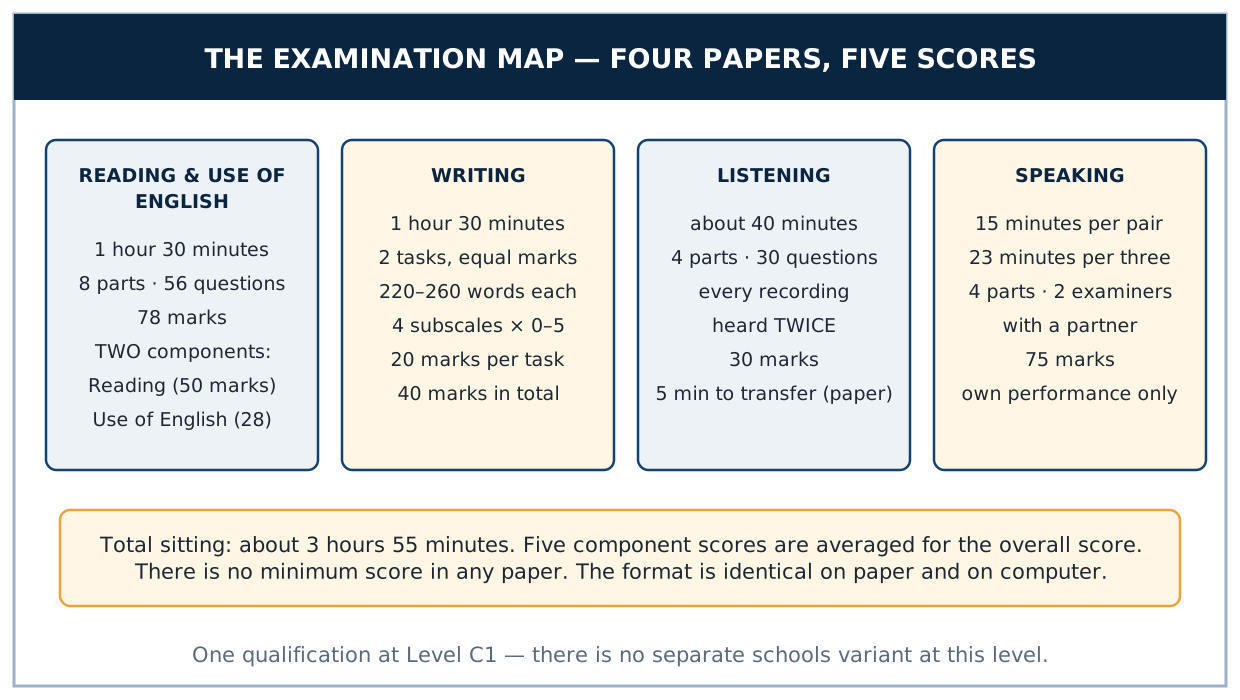
Figure 1.1 — The examination map, showing the four papers with their parts, timings and weightings, and the five component scores they produce.
To see where C1 sits, picture a ladder with six main rungs. At the bottom, A1 and A2 describe basic users: people who can handle simple, routine exchanges and familiar phrases. In the middle, B1 and B2 describe independent users: people who can deal with most situations they meet while travelling, working or studying, and who can produce connected text and sustain conversation. At the top, C1 and C2 describe proficient users: people who can understand demanding, longer texts, recognise implicit meaning, and express themselves fluently and precisely without much obvious searching for expressions.
In the Cambridge ladder, C1 Advanced sits between two neighbours. Below it is B2 First, the upper-intermediate qualification. Above it is C2 Proficiency, the qualification that assesses the full range of skills at Level C2. If you are reading this book, you are probably working at solid B2 level now and building towards C1, or you are already operating at C1 in some skills and want the certificate that proves it. Both starting points are normal. What matters is not where you begin but whether, by examination day, you can do the things the examination asks, under the conditions it sets.
Figure 1.2 (Class A) — The CEFR ladder from A1 to C2, with B2 First below C1 Advanced and C2 Proficiency above it, showing C1 as the lower proficient-user level.
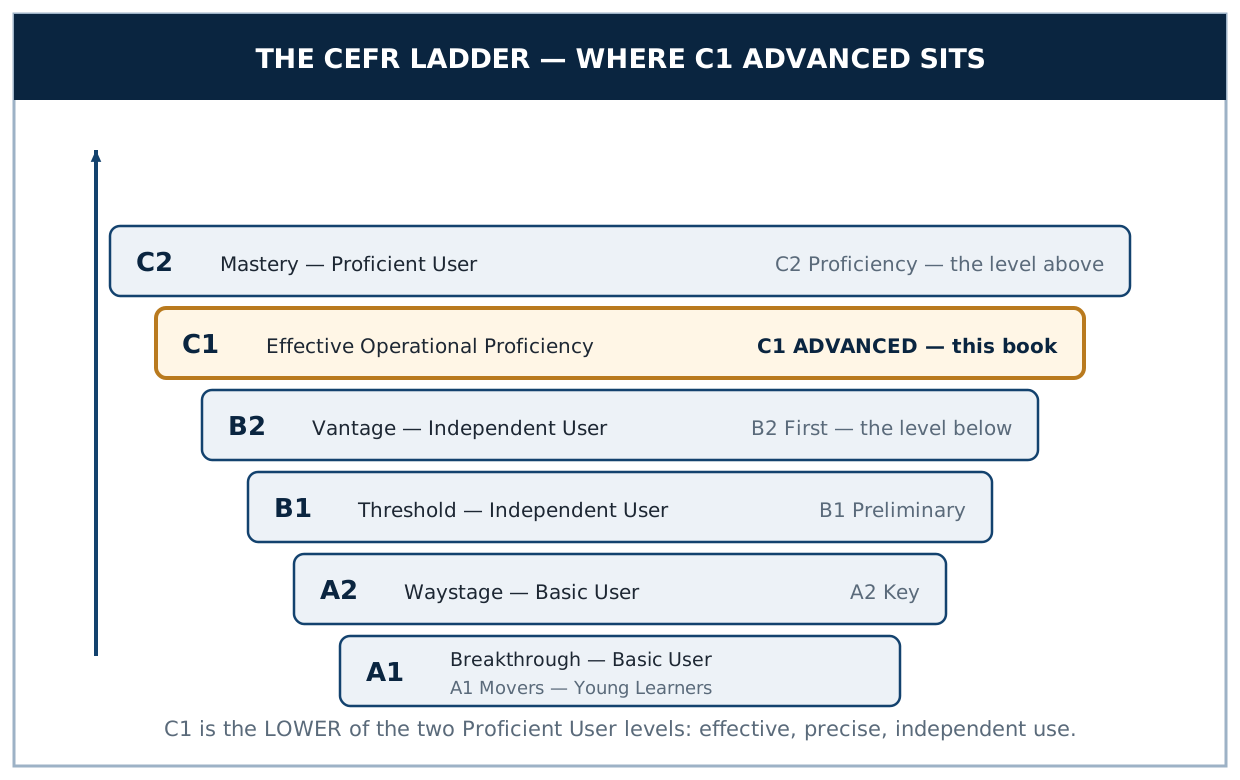
Figure 1.2 — The CEFR ladder from A1 to C2, with B2 First below C1 Advanced and C2 Proficiency above it, showing C1 as the lower proficient-user level.
One warning belongs here, and it matters more at C1 than at any lower level. Levels are guides, not walls. A real learner is rarely exactly level across all skills. You may read at C1, write at strong B2, and listen somewhere between the two. That uneven profile is normal, and it is precisely why C1 Advanced reports five separate component scores rather than a single undifferentiated mark. Your preparation should strengthen the weaker skills without neglecting the stronger ones, because the overall score is an average of all five, as Section 1.6 explains. A candidate who polishes an already strong skill while ignoring a weak one is usually spending effort in the least efficient place: every extra point in any component adds exactly the same amount — one fifth of a point — to the average.
Assumed knowledge, briefly: if you have studied for or taken B2 First, you already know the broad shape of a Cambridge examination — four papers, component scores, a Statement of Results. Keep that orientation, but do not import B2 numbers into C1. Timings, word counts, part counts and grade bands all change at this level, and the differences are examined in this chapter and tested in its exercises. If B2 First is new to you, nothing in this chapter depends on it; the map below is complete in itself.
C1 Advanced has four papers: Reading and Use of English, Writing, Listening, and Speaking. Together they take approximately 3 hours 55 minutes, not counting registration, instructions and breaks, so think of examination day as a substantial commitment rather than a single short sitting. The examination can be taken paper-based or digital (computer-based), and the four components are the same in both formats; only the way you record your answers differs, and Section 1.5 deals with those mechanics.
Reading and Use of English lasts 1 hour 30 minutes. Writing lasts 1 hour 30 minutes. Listening lasts about 40 minutes. Speaking lasts 15 minutes per pair of candidates, or 23 minutes for a group of three. Those timings are fixed. In the paper-based Listening paper you receive five minutes at the end to transfer answers to the answer sheet; in Reading and Use of English there is no separate transfer allowance, so time management is part of the skill being tested.
Each paper contributes to your result, but not in the simple way beginners expect. Reading and Use of English produces two of the five component scores — one for Reading and one for Use of English — so that single paper accounts for 40 per cent of the overall result. Writing, Listening and Speaking each produce one component score and account for 20 per cent each. All five components are equally weighted in the overall average. Sections 1.4 to 1.7 now take each paper in turn, part by part. Learn this map thoroughly. It is the map you will use for the whole book: Part Two of the book builds the grammar the Use of English parts test, Part Three builds the vocabulary, Part Four teaches Reading and Use of English part by part, and Parts Five, Six and Seven teach Writing, Listening and Speaking in the same order.
Before the detail, notice the balance the map reveals. Two papers — Reading and Use of English and Writing — take three hours between them and reward sustained, careful work with texts. Two papers — Listening and Speaking — take under an hour between them and reward real-time performance that cannot be revised. A preparation plan that consists only of quiet written study therefore covers only half the examination's character. From the start, build listening under timed, twice-heard conditions and speaking aloud, recorded and reviewed, into your weekly routine. The front matter of this book explains the two study protocols this book uses throughout: listening is practised in two passes, and speaking is practised as Plan, Record, Review.
This is the longest and most varied paper. It contains eight parts and 56 questions worth 78 marks in total, and the texts in it add up to between 3,000 and 3,500 words. That word total is itself a C1 signal: at B2 the equivalent paper carries roughly a thousand fewer words, and the C1 texts are drawn from demanding sources — newspaper and magazine articles, journals, books, reports and promotional and informational material — written for educated adult readers. You are not expected to know specialist subjects in advance; every answer is in, or can be worked out from, the text and the language in front of you. What you are expected to bring is range: a wide vocabulary, secure grammar, and the ability to follow opinion, implication and text structure across long passages.
The paper divides into two families. The Use of English parts test your control of grammar and vocabulary inside short texts and sentences. The Reading parts test your understanding of longer texts. The division matters because the two families feed different component scores: the Reading component score is built from Parts 1, 5, 6, 7 and 8, totalling 50 marks, while the Use of English component score is built from Parts 2, 3 and 4, totalling 28 marks. Part 1 therefore belongs to the Reading component even though it tests vocabulary in depth — a detail candidates regularly get wrong, and one worth fixing in your mind now, because it affects how you interpret a practice-test profile. A weak Part 1 performance lowers your Reading score, not your Use of English score.
Part 1 is a multiple-choice cloze: a text with eight gaps, each with four options, worth one mark each. It tests vocabulary in depth: idioms, collocations, fixed phrases, complementation, phrasal verbs and semantic precision — the fine differences between words that look similar in meaning. Part 2 is an open cloze: a text with eight gaps, where you supply one word for each gap yourself, worth one mark each. The answer is always a single word. It tests grammar with some vocabulary: articles, prepositions, auxiliary verbs, pronouns, conjunctions and linkers. More than one answer may sometimes be permissible in the mark scheme, but you give one answer only: if you write two answers and one is wrong, you earn no mark. Part 3 is word formation: a text with eight gaps, where a stem word printed beside the text must be changed to fit each gap, worth one mark each. The changes involve affixation, internal changes and compounding, and at C1 the formations are often less predictable than at B2 — negative prefixes, less common suffixes and words whose formed version is not the first one that comes to mind. Part 4 is key word transformations: six items, where you complete a second sentence so that it means the same as the first, using a given key word exactly as printed and writing between three and six words in total including that key word. Note the C1 word count carefully: at B2 the limit is two to five words; at C1 it is three to six. Each transformation is worth up to two marks, because the mark scheme splits the answer into two halves worth one mark each, so a small slip need not cost you both marks if the rest of the completion is right. Correct spelling is essential in Parts 2, 3 and 4: a correctly chosen word spelled wrongly earns no mark.
Part 5 is multiple-choice reading: one longer text followed by six questions with four options each, worth two marks each. The questions test detail, opinion, attitude, tone, purpose, main idea, meaning from context, implication and text organisation. Part 6 is cross-text multiple matching, the part that exists only at C1: four short texts on a related theme, written from different positions, with four questions worth two marks each. You must identify where writers agree or disagree with each other, and where one writer's attitude differs from, or echoes, another's. It is not enough to understand each text separately; you must hold four positions in mind and compare them. Part 7 is a gapped text: a text with six paragraphs removed, which you restore from a set of jumbled paragraphs printed after the text, with a seventh paragraph that does not fit anywhere, worth two marks each. It tests cohesion, coherence and text structure — whether you can follow how a text is built, not just what it says sentence by sentence. Part 8 is multiple matching: ten questions worth one mark each, matched to a text divided into four to six sections or presented as several short texts. It tests your ability to find detail, opinion, specific information and implied meaning quickly and accurately across a lot of material, and it rewards a disciplined scanning method rather than full re-reading.
In the paper-based examination you may attempt the parts in any order, although most candidates work through them in order and return to difficult items at the end if time remains. Whatever order you choose, keep moving. The mark values differ — a Part 5, 6 or 7 question is worth two marks, a Part 8 question one — so an unfinished two-mark part costs more than its question count suggests. Chapter 20 builds the whole-paper timing method; for now, fix the principle: set a latest-leaving time for each part before you begin, and obey it.
The Writing paper lasts 1 hour 30 minutes and contains two tasks. In each task you write between 220 and 260 words, and the two tasks carry equal marks. Part 1 is compulsory: everyone answers it. Part 2 offers a choice: you choose one task from three. That structure — one compulsory task, one chosen task — rewards two different disciplines: in Part 1, complete coverage of a set task; in Part 2, a wise choice followed by complete coverage of the task you chose.
Part 1 is always an essay. The input presents notes from an academic activity, such as a panel discussion or a documentary, giving three bullet points together with three short opinions, one on each point. You select two of the three bullet points to write about. That selection is the first C1 difference to fix: at B2 you discuss two given ideas and add a third of your own; at C1 you choose two of three given points, and you add no point of your own. You must explain which of your two chosen points is more important, and give reasons for your opinions. The judgement is part of the task, not an optional decoration: an essay that discusses two points beautifully but never weighs them against each other has not fully answered the question, and the Content score reflects that. The register is appropriately formal or neutral for an academic essay, and planning — choosing the two points you can develop most fully, deciding your judgement, and ordering your reasons — is where the task is won or lost.
Part 2 is drawn from four task types: letter or email, proposal, report, and review. You choose one question from three, so on the day you will see three of those four types, never all four. A letter or email answers a real correspondent for a clear purpose, in a register that fits the relationship. A proposal is written for a superior or a committee: it sets out a course of action and persuades the reader to adopt it, usually with clear headings and a closing recommendation. A report presents information under headings, based on material supplied in the task, and usually closes with recommendations. A review describes and evaluates something such as a book, film, place, event or experience, and usually ends with a recommendation. One distinction protects you from a common and expensive confusion: there is no set-text question at C1. At B2 First, Writing Part 2 includes a question on a set text; at C1 Advanced it does not, and no preparation time should be spent on one.
Every Writing answer is marked on four subscales, each scored from 0 to 5 in whole marks only: Content, Communicative Achievement, Organisation, and Language. That gives 20 marks per task and 40 marks for the paper. Content asks whether you fulfilled the task and fully informed the target reader. Communicative Achievement asks whether your register and conventions fit the task — a proposal should sound like a proposal, a friendly email should sound friendly. Organisation asks whether your ideas are logically ordered, well linked and appropriately paragraphed. Language asks about the range and accuracy of your vocabulary and grammar: at C1, examiners expect a wide range of structures and lexis used with precision, alongside errors that are minor and do not impede communication. Length is part of task achievement: writing significantly fewer than 220 words usually means the task is not fully developed, while writing far beyond 260 words risks irrelevance, repetition and errors made in haste. Two further rules are worth memorising now. Cambridge states that American and other varieties of English usage and spelling are acceptable in Writing, provided the usage is consistent; this book nevertheless teaches British spelling as the norm, and Chapter 31 teaches the consistency rule in full. And dictionaries are not allowed in any part of the examination.
The Listening paper has four parts and 30 questions worth 30 marks, and lasts about 40 minutes. Every recording is heard twice. That second hearing is not a luxury; it is part of the method. Use the first hearing to follow the gist and settle the answers you are confident about, and the second hearing to check details, resolve doubts, and answer anything you missed. Part Six of this book builds your whole listening method around those two hearings, using the two-pass protocol explained in the front matter: Pass 1 is under listening conditions, with the transcript read aloud twice; Pass 2 is study, in which you read the annotated transcript and find where each answer was decided.
Part 1 contains three short extracts, each about a minute long and each involving two speakers, with two three-option multiple-choice questions per extract — six questions in total. Note the C1 shape carefully, because it differs from B2, where Part 1 offers eight extracts with one question each. At C1 you stay with each extract longer and answer two questions on it, which tests whether you can follow a short exchange as it develops — feeling, attitude, opinion, purpose, agreement, gist and detail — rather than catching a single point. Part 2 is sentence completion: you hear a monologue of about three minutes and complete eight sentences with a single word or short phrase taken from the recording. Correct spelling is expected at this level, and both US and British English spellings are accepted. Part 3 is multiple choice: a conversation between two or more speakers lasting about four minutes, with six four-option questions testing opinion, attitude, implication and detail. Part 4 is multiple matching in its C1 form — dual-task matching: five short themed monologues of about 30 seconds each, with two parallel matching tasks running at the same time. For each task you select from a list of eight options, giving ten questions in total. You must therefore track two things about every speaker at once — for example, the reason each speaker gives and the feeling each speaker expresses — which is why Chapter 35 teaches a two-column tracking grid. Note the position: at C1, matching of this kind sits in Part 4, not Part 3.
Listening unsettles many candidates because the text disappears. Remember two things. First, the examination is designed for two hearings, and the questions are ordered to follow the recording, so the structure helps you if you let it. Secondly, listening at C1 is a learnable skill: predicting before you listen, listening for paraphrase and implication rather than identical words, and keeping both Part 4 tasks in view at once will raise your score more reliably than any trick. In the paper-based examination, you receive five minutes at the end of the paper to transfer your answers to the answer sheet; use them for transfer and checking only, never for first-time answering.
The Speaking test has four parts and lasts 15 minutes for a pair of candidates. You normally take it with one other candidate; occasionally three candidates are tested together, in which case the test lasts 23 minutes. There are two examiners. The interlocutor conducts the test, asks the questions and manages the timing. The assessor listens and marks, taking little or no part in the conversation. In some sessions one examiner may be present online. You are assessed on your own individual performance throughout — never against your partner. A strong partner cannot raise your marks and a weak partner cannot lower them, provided you keep communicating; what the examiners mark is what you do.
Part 1, the interview, lasts 2 minutes. The interlocutor asks you questions about yourself: personal information, past experiences, present circumstances and future plans. Treat it as a warm-up in which you settle, listen carefully, and give extended answers rather than single sentences. Part 2, the long turn, totals 4 minutes and works as follows. You are given three photographs and asked to talk about any two of them for one minute, without interruption. Note both C1 features: there are three photographs, not two, and you choose which two to discuss. Your partner then comments on your photographs for about 30 seconds, and the procedure reverses with a fresh set of three photographs for your partner. Candidates are always asked to speculate, never merely to describe: the questions printed with the photographs ask what the people might be feeling, why they might be doing something, or what might happen next, and strong answers compare the two photographs, speculate about them, and react to them. Because a printed book cannot show you the examination's actual photographs, this book teaches Part 2 through photograph briefs — the photographs described in words — and says so plainly wherever the method is used.
Part 3, the collaborative task, totals 4 minutes. You have about 15 seconds to read the task, then 2 minutes to discuss the written prompts with your partner, and then 1 minute to reach a decision together. The discussion and the decision are separate phases with separate timings, and candidates are not penalised if they fail to reach a negotiated decision — the examiners mark the quality of the interaction, not whether agreement was achieved. Part 4, the discussion, lasts 5 minutes: the interlocutor leads a discussion between you and your partner on topics related to the Part 3 theme, moving towards more abstract issues. At C1 this is where abstract discussion is tested most directly: causes, consequences, values and hypotheticals, developed and justified, not merely stated.
Speaking is marked out of 75 marks — a total worth fixing now, because it feeds the Speaking component score and the conversion anchors in Chapter 2. The assessor awards marks from 0 to 5, with half marks allowed, on five analytical scales — Grammatical Resource, Lexical Resource, Discourse Management, Pronunciation, and Interactive Communication — and each of those marks is doubled, giving 50 marks. The interlocutor awards a Global Achievement mark from 0 to 5, which is multiplied by five, giving 25 marks. Note the C1 differences from B2: there are five analytical scales, not four — Grammatical Resource and Lexical Resource are marked separately at C1 — and the total is 75 marks, not 60. Assessment is based on your performance across all four parts, not on any single answer, so one difficult moment does not decide your result. Part Seven of this book teaches each part and each scale in detail, using the Plan, Record, Review protocol: plan your answer, record yourself, then review the recording against the model transcript and the five scales.
Examination technique includes the humble business of recording answers correctly, and marks are lost every session by candidates who knew the answer but recorded it wrongly. In the paper-based examination, objective answers for Reading and Use of English go on a separate answer sheet in pencil: you shade a lozenge for multiple-choice and matching items and write your words for completion items. There is no extra time in that paper for completing the answer sheet, so transfer answers as you go or in short, planned pauses — never in a panic at the end. In Listening, by contrast, the five transfer minutes at the end are provided, and answers are transferred then. Writing answers go in a separate lined answer booklet. Whether you use upper or lower case and whether your handwriting is joined up do not matter; what matters is that your writing is legible and that any corrections are clear.
In the digital examination, you type your answers directly on screen. An on-screen timer shows the time remaining. You may make notes on paper during the examination, but you must leave those notes on the desk when you finish. In both formats, nothing electronic is taken into the room, and dictionaries are not allowed in any part of the examination. Two further rules protect you from yourself. In open-cloze and transformation items, more than one answer may sometimes be permissible in the language, but you must give one answer only: if you write two answers and one is wrong, you earn no mark. And in transformations, the key word must be used exactly as printed, unchanged, within the three-to-six-word limit.
Your result is built from five component scores — Reading, Use of English, Writing, Listening and Speaking — each placed on the Cambridge English Scale. For C1 Advanced, reported scores run from 142 to 210. Your overall score is the average of the five component scores, rounded to the nearest whole number. The five components are equally weighted. There is no minimum score required in any paper or component. A weaker component can therefore be balanced by stronger components, although the sensible preparation goal is balanced strength: the average rewards the candidate with no neglected skill. Grades follow from the overall score: 200 to 210 earns Grade A, 193 to 199 earns Grade B, and 180 to 192 earns Grade C; a score of 160 to 179 earns a certificate at Level B2. Chapter 2 teaches the full scoring system, including the reporting floor, what happens below it, and Cambridge's own conversion anchors for official practice tests, with Cambridge's cautions attached.
Entry is practical, and it is deliberately kept brief here because Chapter 4 covers it in full. You enter through an authorised Cambridge English examination centre — Cambridge has more than 2,800 centres in over 130 countries, and its qualifications are accepted and trusted by thousands of organisations worldwide. Centre staff provide the entry procedures, the available dates and the current fees. Fees are set by centres and Cambridge publishes no fee figure, so no fee is printed in this book: confirm the current fee with your centre before you enter. Digital sessions are available through centres on many dates across the year. If your first sitting does not give you the result you need, you enter again through a centre in the ordinary way; each sitting produces its own Statement of Results.
A learner tells you: "My Reading and Use of English is weak, so my Use of English score will suffer most from Part 1." Work through the map and correct the reasoning step by step. Step one: locate Part 1. Part 1 is the multiple-choice cloze — eight gaps, four options each, testing idioms, collocations, fixed phrases, complementation, phrasal verbs and semantic precision. Step two: locate its component. The Reading component is built from Parts 1, 5, 6, 7 and 8, totalling 50 marks; the Use of English component is built from Parts 2, 3 and 4 only, totalling 28 marks. Step three: draw the conclusion. Weakness in Part 1 lowers the Reading component score, even though the skill it tests feels like vocabulary knowledge. The remedy follows from the diagnosis: Part 1 is improved by the vocabulary work in Part Three of this book — collocation systems, fixed phrases and semantic precision — but its effect appears in the Reading column of the Statement of Results. Step four: check the weighting. Because Reading and Use of English supplies two of the five components, improvement across this paper as a whole moves two fifths of the overall average, which is why this book gives the paper seven chapters. The lesson generalises: never plan from how a part feels; plan from which component it feeds.
A candidate opens the Writing paper. In Part 1, the notes offer three points about the value of university education — gaining specialist knowledge, developing independence, and improving employment prospects — each with a short opinion. In Part 2, the choice is between a review of a restaurant, a report on facilities at a sports centre, and a proposal for reducing traffic in a town centre. Work the choices as the examiners intend. In Part 1 there is no free choice of task, only a choice within it: select the two points you can develop most fully with reasons and examples. Suppose the candidate can argue specialist knowledge and employment prospects in depth but has little to say about independence. The correct move is to choose those two points, develop each in its own section, and then judge explicitly which matters more — for example, that specialist knowledge matters more because employment prospects often depend upon it — with reasons. An essay that touches all three points thinly, or that never makes the judgement, leaves the task partly unfulfilled however polished its sentences are. In Part 2, choose by control, not by taste: the candidate who has recently eaten somewhere memorable and can describe, evaluate and recommend with precise vocabulary should take the review; the candidate who writes best in formal, headed prose should take the report or the proposal. Whichever task is chosen, the same four subscales apply — Content, Communicative Achievement, Organisation and Language, each 0 to 5 — and the same length applies: 220 to 260 words. The worked principle is that choice in this paper is a marks decision: you are choosing the task in which your existing language will score highest, not the task that sounds most interesting.
Q1. How many papers does C1 Advanced have? A) Three B) Five C) Four D) Eight
Q2. How long does the Reading and Use of English paper last? A) 1 hour 30 minutes B) About 40 minutes C) 1 hour 20 minutes D) 15 minutes
Q3. How many questions are there in Reading and Use of English in total? A) 30 questions B) 56 questions C) 52 questions D) 78 questions
Q4. In key word transformations (Part 4), how many words must your answer contain, including the key word? A) Two to five words B) Exactly three words C) Three to six words D) Up to eight words
Q5. Which part of Reading and Use of English exists at C1 but not at B2 First? A) Multiple-choice cloze B) Gapped text C) Multiple matching D) Cross-text multiple matching
Q6. In Writing Part 1, you must write about ______ of the three bullet points. A) Two B) All three C) One D) None
Q7. How many photographs are you given in Speaking Part 2? A) Two B) Three C) One D) Four
Q8. The Speaking test is marked out of ______ marks in total. A) 60 B) 40 C) 75 D) 100
Q9. In Listening Part 4, how many speakers do you hear? A) Five B) Three C) Eight D) Two
Q10. Which Writing Part 2 task type does NOT appear at C1 Advanced? A) Report B) Review C) Proposal D) Set-text question
Q11. Reading and Use of English supplies ______ of the five component scores. A) One B) Two C) Three D) Five
Q12. Each Writing answer must contain ______ words. A) 140–190 B) 200–240 C) Exactly 250 D) 220–260
Q13. The Use of English component score is built from Parts 2, 3 and ______. (a number)
Q14. The Listening paper gives paper-based candidates ______ minutes at the end to transfer answers. (a number)
Q15. In Speaking Part 3, candidates are not penalised if they fail to reach a negotiated ______. (one word)
The Complete English Course — 1,028 Practice Questions, Diagnostic & 2 Full Timed Practice Tests, Every Answer Explained
Feras Alzubi
Exam Prep Series
© 2026 Feras Alzubi. All rights reserved.
No part of this book may be reproduced, stored in a retrieval system, or transmitted in any form or by any means — electronic, mechanical, photocopying, recording, or otherwise — without the prior written permission of the author, except for short quotations in a review.
Every text, transcript, task, question, explanation, and worked example in this book is original to this book. The reading passages, listening transcripts, writing tasks, and speaking scripts were written for this book to teach the English and the examination skills that C1 Advanced measures. They follow the examination's published formats, but they are not copied from, and they do not reproduce, any actual examination paper.
This book is not published by, affiliated with, or endorsed by Cambridge Assessment English, part of Cambridge University Press & Assessment. C1 Advanced and the Certificate in Advanced English are qualifications of Cambridge Assessment English. This book is an independent study guide, written to help you prepare for an examination that Cambridge owns and administers.
Read these limits plainly, because they matter. This book prepares you for an examination. It confers no qualification, no certificate, and no eligibility to sit the examination. The certificate, if it is awarded, is Cambridge's act, awarded on your examination result. Entry for the examination is made through an authorized Cambridge exam center; center staff provide the entry procedures, the examination dates, and the current fees, which are set locally and are confirmed with the center before you enter. No result — no pass, grade, or score — is promised or guaranteed by this book, by its practice tests, or by any score guidance in its pages. Practice results show readiness at the moment you take them; the examination itself decides the rest.
One more limit belongs to the medium itself, and this book states it rather than hiding it. A printed book cannot play audio, and it cannot sit beside you as a partner in the speaking test. Listening practice in this book therefore runs in two passes, set out in How to Use This Book below: a partner or a text-to-speech voice reads each transcript aloud so that you hear it, twice, under listening conditions, and only afterward do you study the printed transcript. Speaking practice runs in three steps — Plan, Record, Review — against model transcripts, with your own phone as the recorder. In Speaking Part 2, where the examination gives you three photographs and asks you to talk about any two of them, this book teaches through photograph briefs: written descriptions of the three photographs in each task, because a printed page cannot show you the examination's actual photographs. These methods are honest substitutes for study. They are not the examination room, and the chapters that use them say so again at the point of use.
Front Matter
Part One — The Exam and the C1 Standard
Part Two — Grammar at C1
Part Three — Vocabulary at C1
Part Four — Reading & Use of English
Part Five — Writing
Part Six — Listening
Part Seven — Speaking
Part Eight — The Final Month
Practice Apparatus
Back Matter
This book is a course, not a question bank to graze in. It teaches the complete English you need at CEFR Level C1 and, on top of that English, the examination itself — its four papers, part by part, in their real shapes. The examination has four papers and takes about 3 hours 55 minutes in total: Reading and Use of English (1 hour 30 minutes, eight parts, 56 questions), Writing (1 hour 30 minutes, two tasks of 220–260 words each), Listening (about 40 minutes, four parts, 30 questions), and Speaking (15 minutes per pair of candidates, 23 minutes per group of three). It reports five component scores — Reading, Use of English, Writing, Listening, and Speaking — because the first paper feeds two scores. Used in the order below, each stage of this book does a different job, and the jobs build on one another.
Step 1: Take the Diagnostic first, cold. Before you study a single chapter, take the 50-question Diagnostic Test in one sitting, without notes and without looking anything up. Its key scores you by strand — Use of English, Reading, Listening, and writing and speaking readiness — and routes each weak strand to the chapters that repair it. The Diagnostic is not a verdict on you; it is a map. Keep the scored sheet. Everything that follows is measured against it.
Step 2: Study the chapters in order. Work through Chapters 1 to 40 in sequence. The order is the course: the examination and the Scale come first, then the grammar and vocabulary systems at C1, then each paper taught part by part, and the final-month chapter last. This book assumes you already control the B2 system; where a C1 point stands on B2 knowledge, a short orientation passage says so and moves on — the teaching, the worked examples, and the exercises are all at C1. Read the teaching text fully, and work the examples as you meet them rather than reading past them.
A note on spelling, because you will notice it. The teaching chapters of this book, all exercise material, and every model answer use British spelling and British usage — organise, centre, favourite — because C1 Advanced is a British examination and British English is the norm it models. Cambridge accepts American spelling in the Writing paper provided it is consistent, and in Listening Part 2 both British and American spellings are accepted; Chapters 27 and 34 teach those acceptance rules in full, where they belong. This front matter and parts of the back matter, which are the publisher's apparatus rather than teaching text, use American spelling. No model answer in this book is ever presented in American spelling as the examination model: every model is British, so that what you copy is what the examination rewards most safely.
Step 3: Study the keys, do not just check them. At the end of each chapter, answer all 15 exercises before you open the key. Then read the key the way you read the chapter — as teaching. Every key explains why the correct answer is right and why each wrong answer is wrong: the broken collocation, the wrong word class, the cohesion signal you missed, the attitude the speaker stated and then qualified. The wrong-answer explanations are where much of the learning lives, because the examination's wrong options are built from the same confusions. When a key surprises you, reread the section of the chapter it points back to before you move on.
Step 4: Take the two Skills Batteries. When the chapters through Part Seven are done, take Skills Battery A, a complete Reading and Use of English paper in the real shape — eight parts, 56 questions, 78 marks — and Skills Battery B, a complete Listening paper of 30 questions with full transcripts. These batteries train the whole-paper skills no single chapter can: moving between part types, holding your pace across 90 minutes of reading work, and hearing a full listening paper without stopping. Score them, and note which parts, not just which questions, cost you marks.
Step 5: Repair before you test again. Work the Repair Sets that match your battery pattern. The six sets rebuild the six error classes that cost C1 candidates the most marks, 20 questions at a time. Do the sets your results name, restudy the chapter sections behind every repeated error, and redo the missed chapter exercises. A timed test taken over unrepaired gaps only measures the same gaps again.
Step 6: Take the Practice Tests under real conditions. Practice Test 1, then — after further repair — Practice Test 2. Sit each test whole: the Reading and Use of English paper in 1 hour 30 minutes, the Writing tasks in 1 hour 30 minutes, the Listening paper in about 40 minutes, and the speaking test worked through with a partner or a recorder, for a total of about 3 hours 55 minutes with breaks between papers. No phone, no notes, no dictionary — dictionaries are not allowed in the examination, so they are not allowed here. Score each test by paper and by part, read the full key for every item you missed and every item you guessed, and use the conversion guidance in Chapter 2 for what it is: an indication of readiness from Cambridge's own published anchors for official practice tests, with Cambridge's own cautions attached — never a prediction of your live result.
Listening, in two passes — every time. Listening in this book is practiced in two passes. Pass 1 is under listening conditions: a partner or a text-to-speech voice reads the transcript aloud, and you hear it twice, as in the exam, answering as you listen and never pausing to read. Pass 2 is study: read the annotated transcript and find where each answer was decided — the phrase that carried it, the qualification that reversed an early impression, the distractor you were offered and why it fails. Hearing, answering, then studying — in that order — is what turns a transcript into training. Reading the transcript first and calling it listening practice teaches reading, not listening.
Speaking, in three steps — Plan, Record, Review. Speaking is practiced as Plan → Record → Review: plan your answer, record yourself, then review the recording against the model transcript and the five scales — Grammatical Resource, Lexical Resource, Discourse Management, Pronunciation, and Interactive Communication. For every speaking task, first plan briefly, as you would in the test: note the points you will cover and the language you will use. Then record yourself on your phone, speaking for the full time the part allows — a minute for the Part 2 long turn, two minutes of discussion work plus a one-minute decision for Part 3 — without stopping to restart. Then review: listen for range, for organization, for pronunciation that carries your meaning, and for whether you kept the interaction moving. For Parts 3 and 4, work with a partner whenever you can; where you cannot, record both sides of the exchange in two passes. In Part 2, the tasks in this book give you photograph briefs — written descriptions of three photographs — in place of printed photographs. Talk about any two of the three, compare them, and speculate about the situations they show, exactly as the examination requires; the examination's candidates are always asked to speculate, never merely to describe.
The specimen candidate. Throughout this book, worked examples of scores and results use one specimen candidate: Sofia Lindqvist. Sofia is fictional, and she is labeled fictional wherever she appears. Her component scores are Reading 197, Use of English 190, Writing 194, Listening 199, and Speaking 192. Her overall score is the average of the five — (197 + 190 + 194 + 199 + 192) ÷ 5 = 194.4, rounded to 194 — which is Grade B, and her certificate is at Level C1. Her specimen Statement of Results appears in Chapter 2, where the average-of-five rule, the rounding, and the grade bands from 142 to 210 are taught in full. No component of hers blocked her result, because there is no minimum score in any paper; a weaker component can be balanced by stronger ones. Learn to read her statement now, and you will be able to read your own when it arrives.
Choose a Study Plan from the back of the book — 12 weeks standard or 4 weeks intensive — and fit the steps above into it. Whatever your timeline, keep the order: diagnostic first, chapters in order, keys studied, batteries, repair, and timed tests taken whole and honestly. The book carries 1,028 keyed practice questions in all — 50 in the Diagnostic, 600 in the chapter exercises, 56 in Skills Battery A, 30 in Skills Battery B, 120 in the Repair Sets, and 86 in each Practice Test — and every one of them is explained. Work them in order, and let the keys teach you.
End of the free sample. The complete book continues from here — the full A-to-Z course in book form, delivered as an EPUB you can read in Apple Books, Google Play Books, ReadEra, Thorium Reader, Adobe Digital Editions, or Send to Kindle.
Buy this ebook — $11.99 Back to the book page
Payments are securely processed by Payhip.