
Mastering Careers & Skills
Cambridge B2 First Certificate in English (FCE) · free sample from the book itself
Q1 — Key: B. Tag: SCALE. Rationale: B2 First has four papers — Reading and Use of English, Writing, Listening and Speaking. Wrong A: three papers would omit one skill area entirely. Wrong C: five is the number of component scores, not papers; Reading and Use of English produces two scores from one paper. Wrong D: seven is the number of parts in Reading and Use of English, not the number of papers.
Q2 — Key: D. Tag: SCALE. Rationale: Reading and Use of English lasts 1 hour 15 minutes. Wrong A: about 40 minutes is the Listening paper. Wrong B: 1 hour 20 minutes is the Writing paper. Wrong C: 14 minutes is the Speaking test per pair of candidates.
Q3 — Key: C. Tag: SCALE. Rationale: Reading and Use of English contains 52 questions worth 70 marks in total. Wrong A: 30 is the number of Listening questions. Wrong B: 40 is neither a question count nor a mark total in this paper. Wrong D: 70 is the number of marks, not the number of questions; Parts 5 and 6 carry two marks per question, which is why the two figures differ.
Q4 — Key: A. Tag: RUE-PART4. Rationale: A transformation answer must contain between two and five words in total, including the given key word, which must be used unchanged. Wrong B: one word is too few and three is not the maximum. Wrong C: there is no fixed length of four words; shorter and longer completions within the limit are equally valid. Wrong D: eight words exceeds the published limit and earns no mark.
Q5 — Key: C. Tag: WRT-PART2. Rationale: The report appears in Writing Part 2 only in B2 First; the story, by contrast, appears only in B2 First for Schools. Wrong A: the article is available in both versions. Wrong B: the letter or email is available in both versions. Wrong D: the review is available in both versions.
Q6 — Key: D. Tag: LST-PART1. Rationale: Every recording in the Listening paper is heard twice, and your method should use the first hearing for gist and confident answers and the second for checking and detail. Wrong A: once would describe a single-hearing test, which B2 First is not. Wrong B: three hearings are never given. Wrong C: four hearings are never given; Part 4 has four in its name only as a part number, not a hearing count.
Q7 — Key: B. Tag: SPK-PART1. Rationale: Each candidate is assessed on their own individual performance across all four parts. Wrong A: assessment covers the whole test, not Part 2 alone. Wrong C: candidates are never marked against their partner; a partner's strength or weakness does not transfer. Wrong D: both examiners contribute — the assessor marks the four analytical scales and the interlocutor awards Global Achievement.
Q8 — Key: C. Tag: SCALE. Rationale: An overall score of 175 falls in the 173–179 band, which is Grade B at Level B2. Wrong A: Grade A requires 180–190. Wrong B: Grade C covers 160–172, so 175 is above that band. Wrong D: Level B1 covers 140–159, well below 175.
Q9 — Key: D. Tag: SCALE. Rationale: The overall score is the average of the five equally weighted component scores, rounded to the nearest whole number. Wrong A: the highest component alone would ignore the other four skills. Wrong B: the total would run to several hundred and is never reported as the overall score. Wrong C: the lowest component alone would ignore stronger performance elsewhere.
Q10 — Key: A. Tag: SCALE. Rationale: Cambridge publishes no single fee for B2 First; fees are set locally, and your authorised centre confirms the current fee before you enter. Wrong B: no worldwide fee is published. Wrong C: because fees are set locally, they vary between centres and countries. Wrong D: centres are precisely the people who provide fee information; discussing fees with candidates is part of the entry process.
Q11 — Key: C. Tag: SCALE. Rationale: Reading and Use of English produces two component scores — Reading and Use of English — which is why the paper carries 40 per cent of the overall result. Wrong A: one score would give the paper only 20 per cent, the same as each other paper. Wrong B: three scores from one paper would leave too few for the remaining papers. Wrong D: five is the total number of components across all four papers.
Q12 — Key: A. Tag: WRT-PART1. Rationale: Both Writing parts require 140–190 words. Wrong B: 100–150 falls short at the top end and risks an incomplete task. Wrong C: 190–250 starts above the limit and risks irrelevance and repetition. Wrong D: there is no single exact word count; any length inside the range can fulfil the task.
Q13 — Key: "an idea of your own" (accept: "your own idea" / "a third idea"). Tag: WRT-PART1. Rationale: The compulsory essay gives two ideas and requires a third idea of your own; omitting any of the three leaves the target reader not fully informed and penalises Content. Wrong form: writing only the two given ideas, however well, leaves the task incomplete.
Q14 — Key: "14". Tag: SPK-PART1. Rationale: The Speaking test lasts 14 minutes per pair of candidates (20 minutes for a group of three). Wrong form: any other figure confuses the Speaking timing with another paper or with the three-candidate timing without its condition.
Q15 — Key: "certificate". Tag: SCALE. Rationale: Scores from 122 to 139 appear on the Statement of Results with no result, no CEFR level and no certificate. Wrong form: grade is not the missing word in this published formulation, because no grade is awarded in this band at all; the three withheld items are the result, the level and the certificate.
This chapter explains what B2 First is, who it is for, and exactly how the examination is built. It gives you the complete map of the four papers — their parts, timings, marks and weightings — and explains what a B2 result means in the wider world, so that every later chapter can be studied with a clear purpose.
When you understand the examination before you start preparing for it, you stop wasting effort. You will know where marks come from, how much time each paper allows, how your five component scores combine into one overall score, and what each grade actually certifies. That knowledge turns revision from guesswork into a plan, and it helps you use English with confidence outside the examination room as well: at work, in study, and in everyday life in an English-speaking environment.
Let us start simply. B2 First is an English examination from Cambridge. Its full current name is B2 First. Many learners, teachers and employers still know it by its older, familiar name, the First Certificate in English, often shortened to FCE. Both names refer to the same qualification. If an employer asks for the First Certificate, or a university lists FCE among its requirements, they mean this examination.
B2 First is a qualification, not a course. A course teaches you; an examination measures you. This book prepares you for the measurement. The certificate itself is awarded by Cambridge on the basis of your examination result. No book, school or teacher can award it for you, and completing this book does not by itself give you the qualification. That distinction matters, because it keeps your preparation honest: everything in these pages is aimed at helping you demonstrate, on the day, English that you genuinely control.
The qualification was first offered in 1939 and has been taken by generations of learners since then. It is targeted at Level B2 of the Common European Framework of Reference for Languages, usually shortened to the CEFR. The CEFR is the international framework that describes language ability from A1, the beginner level, through to C2, the level of a highly proficient user. B2 is the upper-intermediate level: the level at which a learner stops merely surviving in English and starts operating in it — following complex arguments, joining discussions without constant strain, and writing clear, detailed text on a wide range of subjects.
In the Cambridge ladder, B2 First sits between two neighbours. Below it is B1 Preliminary, the intermediate qualification. Above it is C1 Advanced, the advanced qualification. If you are reading this book, you are probably working at strong B1 level now and building towards solid B2, or you are already at B2 and want the certificate that proves it. Both starting points are normal. What matters is not where you begin but whether, by examination day, you can do the things the examination asks, under the conditions it sets.
Figure 1.1 (Class A) — The examination map, showing the four papers with their parts, timings and weightings, and the five component scores they produce.
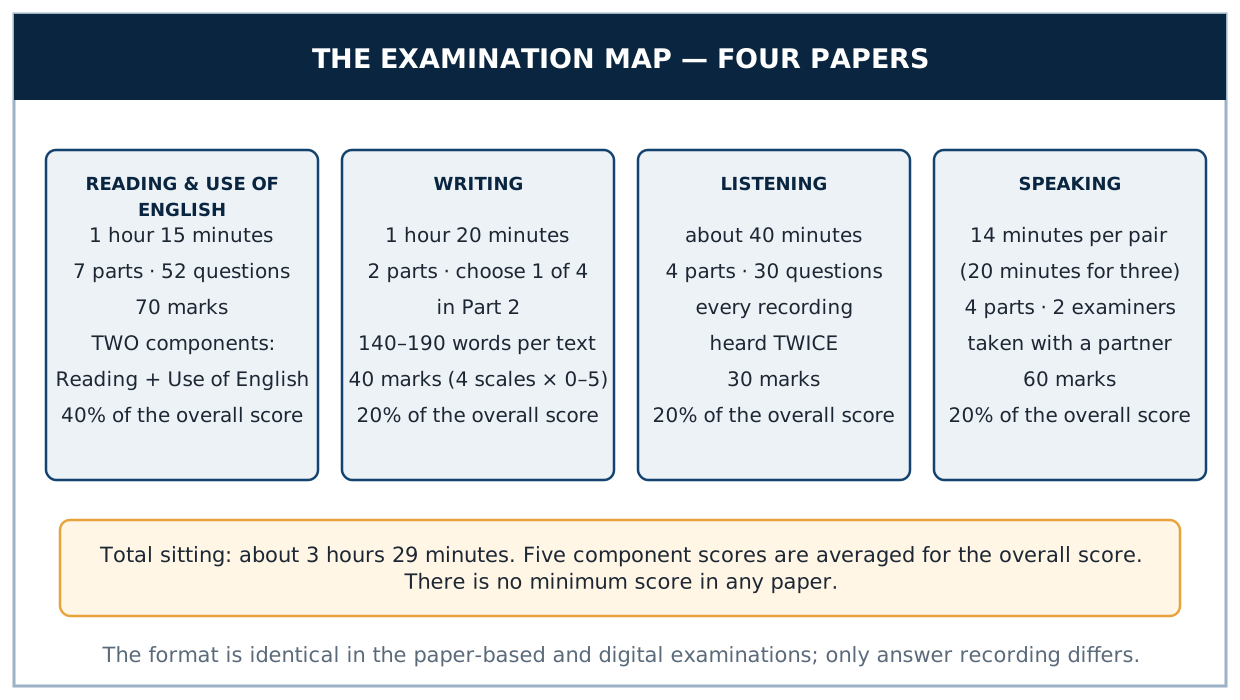
Figure 1.1 — The examination map, showing the four papers with their parts, timings and weightings, and the five component scores they produce.
Cambridge describes B2 First as showing that learners have the skills to live and work in an English-speaking country or to study on courses taught in English. That sentence is worth pausing over, because it tells you the examination's character. This is not a test of classroom English alone. It tests the English of real life: understanding articles and reports, writing letters and reviews that a real reader could act on, following conversations and interviews, and speaking with another person about photographs, plans and opinions. Your preparation should therefore always join two things together — accurate language and purposeful communication. A grammatically perfect sentence that does not answer the question earns little; a lively answer full of serious errors earns little either. B2 First rewards the candidate who manages both.
To see where B2 sits, picture a ladder with six main rungs. At the bottom, A1 and A2 describe basic users: people who can handle simple, routine exchanges and familiar phrases. In the middle, B1 and B2 describe independent users: people who can deal with most situations they meet while travelling, work or study, and who can produce connected text and sustain conversation. At the top, C1 and C2 describe proficient users: people who can understand demanding texts, express themselves fluently and precisely, and use the language flexibly for social, academic and professional purposes.
B2 is the higher of the two independent-user levels. The Council of Europe's global description of B2, in its own words, is that a B2 user "can understand the main ideas of complex text on both concrete and abstract topics, including technical discussions in his/her field of specialisation", "can interact with a degree of fluency and spontaneity that makes regular interaction with native speakers quite possible without strain for either party", and "can produce clear, detailed text on a wide range of subjects and explain a viewpoint on a topical issue giving the advantages and disadvantages of various options". Read those three sentences carefully. They are, in effect, the examination's job description. Every paper in B2 First exists to test one or more parts of that description.
Cambridge also publishes a practical summary of what B2 candidates can typically do, organised by context: general ability, social and tourist use, work, and study. In the book's own words, a B2 learner can generally understand the main points of a straightforward text and follow the main points of a discussion, can deal with most travel situations and explain a problem, can take part in routine meetings and write straightforward reports and emails, and can follow lectures on familiar topics and write essays that develop an argument. Later chapters return to these abilities skill by skill. For now, hold on to the central idea: B2 is about independence. The examiner is asking, in paper after paper, "Can this person manage in English without rescue?"
Figure 1.2 (Class A) — The CEFR ladder from A1 to C2, with B1 Preliminary below B2 First and C1 Advanced above it, showing B2 as the higher independent-user level.
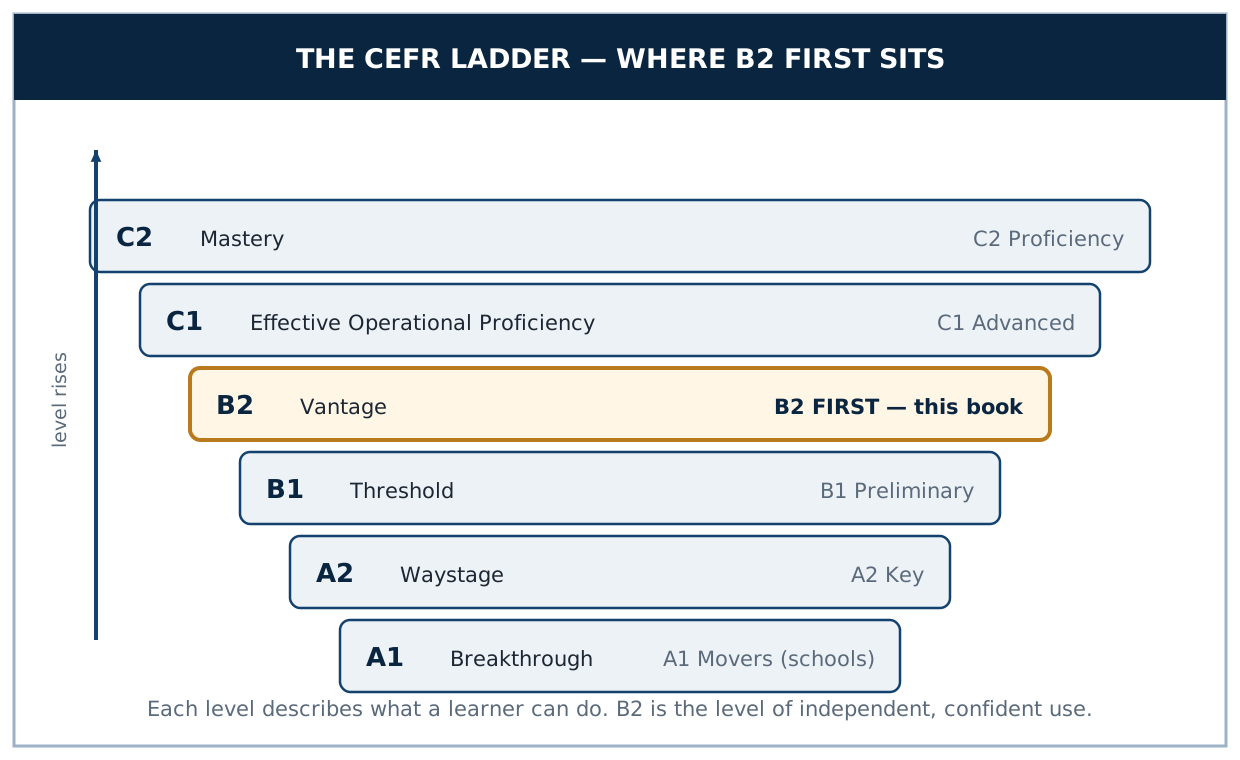
Figure 1.2 — The CEFR ladder from A1 to C2, with B1 Preliminary below B2 First and C1 Advanced above it, showing B2 as the higher independent-user level.
One warning belongs here. Levels are guides, not walls. A real learner is rarely exactly level across all skills. You may read at B2, listen at B1, and speak somewhere between the two. That uneven profile is normal, and it is precisely why B2 First reports five separate component scores rather than a single undifferentiated mark. Your preparation should strengthen the weaker skills without neglecting the stronger ones, because the overall score is an average of all five, as Section 1.5 explains.
B2 First has four papers: Reading and Use of English, Writing, Listening, and Speaking. Together they take about three and a half hours. The handbook gives the total as approximately 3 hours 29 minutes, not counting registration, instructions and breaks, so think of examination day as a half-day commitment rather than a single short sitting. The format is identical whether you take the digital examination on a computer or the paper-based examination; only the way you record your answers differs, and Chapter 38 deals with those mechanics in full.
Reading and Use of English lasts 1 hour 15 minutes. Writing lasts 1 hour 20 minutes. Listening lasts about 40 minutes. Speaking lasts 14 minutes per pair of candidates, or 20 minutes for a group of three. Those timings are fixed. There is no extra time in the paper-based examination for transferring answers to the answer sheet, so time management is part of the skill being tested, especially in Reading and Use of English.
Each paper contributes to your result, but not in the simple way beginners expect. Reading and Use of English is worth 40 per cent of the total score, because that single paper produces two of the five component scores: one for Reading and one for Use of English. Writing, Listening and Speaking each contribute one component score. All five components are equally weighted in the overall average. Section 1.4 now takes each paper in turn, part by part. Learn this section thoroughly. It is the map you will use for the whole book: Chapters 13 to 16 cover Use of English, Chapters 19 to 21 cover Reading, Chapters 23 to 26 cover Writing, Chapters 29 to 31 cover Listening, and Chapters 33 and 34 cover Speaking.
This is the longest and most varied paper. It contains seven parts and 52 questions worth 70 marks in total, and the texts in it add up to between 2,200 and 2,500 words. The texts come from the kinds of sources adults meet in real life: newspaper and magazine articles, reports, fiction, advertisements, letters, messages and informational material such as leaflets and guides. You are not expected to know specialist subjects in advance; every answer is in, or can be worked out from, the text and the language in front of you.
The paper divides into two sections. The Use of English section — Parts 2, 3 and 4, together with Part 1 — tests your control of grammar and vocabulary inside short texts and sentences. The Reading section — Parts 1, 5, 6 and 7 — tests your understanding of longer texts. Part 1 belongs to both descriptions in different accounts because it is a vocabulary cloze inside a text; what matters for you is what each part asks you to do.
Part 1 is a multiple-choice cloze: a text with eight gaps, each with four options, worth one mark each. It tests vocabulary in depth — idioms, collocations, fixed phrases, phrasal verbs, and the fine differences between words that look similar in meaning. Part 2 is an open cloze: a text with eight gaps, where you supply one word for each gap yourself, worth one mark each. It tests mainly grammar — articles, prepositions, auxiliary verbs, pronouns, linkers — with some vocabulary. Correct spelling is essential in Parts 2, 3 and 4: a correctly chosen word spelled wrongly earns no mark. Part 3 is word formation: a text with eight gaps, where a prompt word printed beside the text must be changed to fit each gap, by adding prefixes or suffixes, making internal changes, or forming a compound, worth one mark each. Part 4 is key word transformations: six items, where you complete a second sentence so that it means the same as the first, using a given key word exactly as printed and writing between two and five words in total including that key word. Each transformation is worth up to two marks, with one mark for a partly correct answer, so a small slip need not cost you both marks if the rest of the completion is right.
Part 5 is multiple-choice reading: one longer text followed by six questions with four options each, worth two marks each. The questions test detail, opinion, attitude, tone, purpose, main idea, gist, meaning from context, implication and text organisation. Part 6 is a gapped text: a text with six sentences removed, which you restore from a set of jumbled sentences printed after the text, with one extra sentence that does not fit anywhere, worth two marks each. It tests cohesion, coherence and text structure — whether you can follow how a text is built, not just what it says sentence by sentence. Part 7 is multiple matching: ten prompts matched to a long text divided into sections or to several short texts, worth one mark each. It tests your ability to find detail, opinion, specific information and implied meaning quickly and accurately across a lot of material.
In the paper-based examination you may attempt the parts of Reading and Use of English in any order, although most candidates work through them in order and return to difficult items at the end if time remains. Whatever order you choose, keep moving. Eight marks lost by running out of time at the end cost exactly the same as eight marks lost on hard questions at the start, and the last part is no harder than the first.
The Writing paper has two parts and is worth 20 per cent of the total score. In each part you write between 140 and 190 words. Each question carries equal marks. Part 1 is compulsory: everyone answers it. Part 2 offers a choice: you choose one question from four, including one question on a set text. The set-text question is taught in this book as a mechanism only — how the question works and how to answer it — because the prescribed texts change over time and the current list is published by Cambridge. Your centre and Cambridge's website hold the current list; this book names no title as current, and you should not rely on any list printed in any preparation book without checking it.
Part 1 is always an essay. You are given an essay title and two ideas connected with it, in an input of up to 120 words including the instructions. You must discuss both given ideas and add a third idea of your own. The register is neutral or formal, and you are writing for your teacher. Missing one of the three ideas matters: the target reader is then not fully informed, and the Content score suffers. The essay is therefore an exercise in completeness as well as style. Plan before you write, cover all three points, and give your own opinion where the title asks for it.
Part 2, in B2 First, is drawn from four task types: article, letter or email, review, and report. Each task's input is no more than 70 words. An article is written for a magazine or website and should engage its readers; a letter or email answers a real correspondent for a clear purpose, in a register that fits the relationship; a review describes and evaluates something such as a book, film, place or event and usually ends with a recommendation; a report presents information under headings and usually closes with recommendations. Note one distinction that candidates regularly confuse: a story task appears in Writing Part 2 only in B2 First for Schools, not in B2 First, and a report task appears only in B2 First, not in the Schools version. If you are preparing with materials for the Schools examination, check every task type against this book's map.
Every Writing answer is marked on four scales, each scored from 0 to 5 in whole marks: Content, Communicative Achievement, Organisation, and Language. That gives 20 marks per task and 40 marks for the paper. Content asks whether you fulfilled the task and fully informed the target reader. Communicative Achievement asks whether your register and conventions fit the task — a friendly email should sound friendly, a report should sound like a report. Organisation asks whether your ideas are logically ordered and well linked. Language asks about the range and accuracy of your vocabulary and grammar. Length is part of task achievement: writing significantly fewer than 140 words usually means the task is not completed, while writing far beyond 190 words risks irrelevance and repetition. Spelling and punctuation errors are not penalised as a separate category, but they can impede communication and so affect your marks. One rule surprises many learners and is worth memorising: Cambridge states that American usage and spelling are acceptable in the Writing paper, provided the usage is consistent. This book nevertheless teaches British spelling as the norm, because B2 First is a British examination, and Chapter 11 teaches the consistency rule in full. Whichever variety you use in the examination, use it consistently throughout an answer.
The Listening paper has four parts and 30 questions and lasts about 40 minutes. Every recording is heard twice. That second hearing is not a luxury; it is part of the method. Use the first hearing to follow the gist and settle the answers you are confident about, and the second hearing to check details, resolve doubts, and answer anything you missed. Chapter 28 builds your whole listening method around those two hearings.
Part 1 contains eight short, unrelated recordings of about 30 seconds each, each with one multiple-choice question offering three options. The questions test feeling, attitude, opinion, purpose, function, agreement, gist and detail. Part 2 is sentence completion: you hear one monologue lasting three to four minutes and complete ten sentences with information from the recording, testing detail, specific information and stated opinion. In this part, minor spelling errors are not penalised where your intention is clear — a small mercy that does not apply to the spelling-sensitive parts of Reading and Use of English. Part 3 is multiple matching: five short related monologues of about 30 seconds each, where you match each speaker to one of eight statements, with three statements not used, giving five questions. It tests gist, purpose, feeling, main points and detail. Part 4 is a multiple-choice interview or exchange between two speakers lasting three to four minutes, with seven questions offering three options each, testing opinion, attitude, gist, main idea and specific information.
Listening frightens many candidates because the text disappears. Remember two things. First, the examination is designed for two hearings, and the questions are ordered to follow the recording, so the structure helps you if you let it. Secondly, listening at B2 is a learnable skill: predicting before you listen, listening for paraphrase rather than identical words, and staying calm when you miss a word will raise your score more reliably than any trick. Parts VI of this book teaches those habits step by step, using the two-pass method explained in the front matter: first you listen under examination conditions, then you study the annotated transcript.
The Speaking test has four parts and lasts 14 minutes for a pair of candidates. You normally take it with one other candidate; occasionally three candidates are tested together, in which case the test lasts 20 minutes. There are two examiners. The interlocutor conducts the test, asks the questions and manages the timing. The assessor listens and marks, taking little or no part in the conversation. In some sessions one examiner may be present online, examining remotely. You are assessed on your own individual performance throughout — never against your partner. A strong partner cannot raise your marks and a weak partner cannot lower them, provided you keep communicating; what the examiners mark is what you do.
Part 1, the interview, lasts 2 minutes. The interlocutor asks you questions about yourself: personal information, past experiences, present circumstances and future plans. Part 2, the long turn, asks you to compare two photographs and answer the question printed above them, speaking for one minute without interruption. Your partner then answers a short question about your photographs, speaking for about 30 seconds, and the procedure reverses with a second pair of photographs. Because a printed book cannot show you the examination's actual photographs, this book teaches Part 2 through photograph briefs — the two photographs described in words — and says so plainly wherever the method is used. Part 3, the collaborative task, gives you and your partner a question with written prompts to discuss together for 2 minutes, followed by 1 minute to reach a decision together. Part 4, the discussion, lasts 4 minutes: the interlocutor leads a discussion between you and your partner on topics related to the Part 3 theme.
Speaking is marked out of 60 marks. The assessor awards marks from 0 to 5, with half marks allowed, on four scales — Grammar and Vocabulary, Discourse Management, Pronunciation, and Interactive Communication — and each of those marks is doubled, giving 40 marks. The interlocutor awards a Global Achievement mark from 0 to 5, which is multiplied by four, giving 20 marks. Assessment is based on your performance across all four parts, not on any single answer, so one difficult moment does not decide your result. Chapters 32 to 36 teach each part and each scale in detail. For now, note the shape of good B2 speaking: accurate enough grammar and vocabulary to be clear, extended answers rather than single sentences, pronunciation that is easy to follow, and genuine interaction — listening to your partner, responding, asking, agreeing and disagreeing politely.
Examination technique includes the humble business of recording answers correctly, and marks are lost every session by candidates who knew the answer but recorded it wrongly. In the paper-based examination, objective answers go on a separate answer sheet in pencil: you shade a lozenge for multiple-choice and matching items and write your words for completion items. No extra time is given for completing the answer sheet, so transfer answers as you go or in short, planned pauses — never in a panic at the end. Writing answers go in a separate lined answer booklet. Whether you use upper or lower case and whether your handwriting is joined up do not matter; what matters is that your writing is legible and that any corrections are clear.
In the digital examination, you type your answers directly on screen. An on-screen timer shows the time remaining. You may make notes on paper during the examination, but you must leave those notes on the desk when you finish. In both formats, you may take pens or pencils and water in a clear bottle into the room, and nothing else — nothing electronic. Dictionaries are not allowed in any part of the examination. Two further rules protect you from yourself. In open-cloze and transformation items, more than one answer may sometimes be permissible in the language, but you must give one answer only: if you write two answers and one is wrong, you earn no mark. And in transformations, the key word must be used exactly as printed, unchanged, within the two-to-five-word limit.
B2 First reports five component scores — Reading, Use of English, Writing, Listening and Speaking — each placed on the Cambridge English Scale. The Cambridge English Scale is a single scale of scores used across Cambridge qualifications, so that a score means the same thing whichever examination produced it, and so that progress from one level to the next can be seen on one line. For B2 First, reported scores run from 122 to 190.
Your overall score is the average of the five component scores, rounded to the nearest whole number. The five components are equally weighted. Because Reading and Use of English supplies two of the five components, that paper accounts for 40 per cent of the overall result; Writing, Listening and Speaking account for 20 per cent each. There is no minimum score required in any paper. A weak paper can therefore be balanced by stronger papers, although the sensible preparation goal is balanced strength: the average rewards the candidate with no neglected skill.
Grades follow from the overall score. An overall score of 180 to 190 earns Grade A, and the certificate states ability at Level C1 — that is, the candidate has demonstrated English above the B2 target. A score of 173 to 179 earns Grade B, and a score of 160 to 172 earns Grade C; both grades are at Level B2. Any score from 160 to 190 earns the First Certificate in English. A score of 140 to 159 earns a certificate at Level B1: the candidate has not reached B2, but has demonstrated B1 ability and receives a certificate recording that level. Scores from 122 to 139 are reported on the Statement of Results with no result, no CEFR level and no certificate. Scores below 122 are not reported at all.
Two consequences follow. First, Grade C is a full pass at B2, not a consolation prize. Employers and institutions that require B2 First normally require the B2 certificate, which Grades A, B and C all provide. Secondly, the borderlines matter for study planning. The distance between 159 and 160 is the distance between a B1 certificate and a B2 certificate, so candidates scoring near a boundary in practice need care, not despair: small, specific improvements — a handful of marks in a weak paper — can move an average across a line. Chapter 37 teaches the full scoring system, including Cambridge's own conversion anchors for official practice tests, with Cambridge's cautions attached: those tables give an indication of readiness, must not be used to predict a precise live-examination score, and need particular care within about three Scale points of a boundary.
Your results arrive as a Statement of Results showing the five component scores, the overall score and the grade, with a graph placing each score on the Scale. Digital examination results are available five to ten working days after the session; paper-based results normally take four to six weeks. You access them through the free Online Results Service, using the registration details your centre supplies; your Candidate ID Number and Secret Number are printed on your Confirmation of Entry, so keep that document safe. Paper certificates follow to your centre — within three to four weeks after the examination for digital candidates and seven to ten weeks for paper-based candidates — and organisations can verify a result online through the Results Verification Service using the verification number. The certificate itself does not expire, although each recognising organisation decides for itself how long it will accept a result for its own purposes. On the day, a test-day photograph is taken for B2 First, as part of the identity and verification system. If a component is missing from a Statement of Results, absence codes explain why: X means absent from that part, Z means absent from all parts, and you may also see Pending, Withheld or Exempt. Chapter 39 covers results and certificates in full.
A qualification is only useful if other people trust it. Cambridge English Qualifications are taken in large numbers worldwide — 5.5 million assessments are taken every year across all Cambridge English Qualifications, not for B2 First alone — and they are accepted by over 25,000 organisations worldwide, including employers, universities and governments. Note the scope of both figures carefully, because honest numbers matter: the 5.5 million covers every Cambridge qualification together, and this book makes no claim about a B2 First pass rate, because Cambridge does not publish one in the candidate-facing sources. B2 First itself is recognised as proof of upper-intermediate English for industrial, administrative and service-based employment, and it is accepted by a wide range of educational institutions for study purposes. Always check the exact requirement of the employer or institution you are applying to: some ask for B2 First by name, some ask for a grade, and some set their own additional conditions.
Entry is practical. You enter through an authorised Cambridge examination centre — there are more than 2,800 centres in over 130 countries, and over 50,000 preparation centres worldwide — and the centre's staff provide the entry procedure, the examination regulations, the available dates and the current fees. Fees are set locally, so no fee figure is printed in this book: confirm the current fee with your centre before you enter. If you need special arrangements because of a disability or another circumstance, start with your centre as early as you can; Cambridge publishes guidance on special requirements, and your centre will guide you through what applies in your case. If your first sitting does not give you the result you need, you enter again through a centre in the ordinary way; each sitting produces its own Statement of Results.
Finally, keep the neighbouring tests distinct, because choosing the wrong examination wastes months. B2 First for Schools is at the same CEFR level and follows the same overall format, but its topics are aimed at school-age candidates; this book prepares for B2 First, the adult version. C1 Advanced is the next qualification up the ladder, a separate book in this series, for candidates who already hold B2 securely and need to prove C1. IELTS, TOEFL, PTE and Duolingo are different tests from different issuers, with different formats and score systems; Cambridge is a co-owner of IELTS, but B2 First remains a distinct qualification with its own certificate, and a score in one system does not convert neatly into another. Choose the test your employer or institution actually asks for.
Consider a fictional candidate, Marta K., whose Statement of Results shows these component scores: Reading 168, Use of English 162, Writing 171, Listening 158, Speaking 175. Work through the method exactly as you will for your own practice results. Step one: add the five components. 168 + 162 = 330; 330 + 171 = 501; 501 + 158 = 659; 659 + 175 = 834. Step two: divide by five to find the average. 834 ÷ 5 = 166.8. Step three: round to the nearest whole number. 166.8 rounds to 167, so the overall score is 167. Step four: find the grade. 167 falls inside 160–172, so the grade is Grade C at Level B2, and Marta receives the First Certificate in English. Step five: read the profile, not just the headline. Her strongest component is Speaking at 175 and her weakest is Listening at 158. If she were preparing again, listening work would offer her the cheapest gains, because every extra Scale point in any component adds exactly the same amount — one fifth of a point — to the average. Marta K. is fictional; her figures are used throughout this book as the single specimen result, so that you meet the same example wherever scores are discussed.
A candidate asks: "I have 75 minutes for 52 questions. How should I pace myself?" Work the arithmetic first, then turn it into behaviour. Seventy-five minutes divided by 52 questions gives roughly one minute and twenty-six seconds per question — but that raw average misleads, because the parts carry different marks and demand different work. Parts 5 and 6 carry two marks per question and involve longer texts, so they deserve more time per item; Parts 2 and 3 are shorter and can often be answered more quickly. A sensible plan is to reserve about five minutes at the end for checking and transferring answers, leaving about 70 working minutes: roughly 10 minutes for Part 1, 8 minutes for Part 2, 8 minutes for Part 3, 10 minutes for Part 4, 14 minutes for Part 5, 12 minutes for Part 6 and 13 minutes for Part 7, adjusted as you work. The method matters more than the exact numbers: set a latest-leaving time for each part before you begin, move on when you reach it, mark the items you have left, and return only if the reserved checking time survives. Candidates lose more marks to unfinished papers than to difficult questions.
Q1. How many papers does B2 First have? A) Three B) Four C) Five D) Seven
Q2. How long does the Reading and Use of English paper last? A) About 40 minutes B) 1 hour 20 minutes C) 14 minutes D) 1 hour 15 minutes
Q3. How many questions are there in Reading and Use of English in total? A) 30 questions B) 40 questions C) 52 questions D) 70 questions
Q4. In key word transformations (Part 4), how many words must your answer contain, including the key word? A) Two to five words B) One to three words C) Exactly four words D) Up to eight words
Q5. Which Writing Part 2 task type appears in B2 First but NOT in B2 First for Schools? A) Article B) Letter C) Report D) Review
Q6. How many times is each Listening recording heard? A) Once B) Three times C) Four times D) Twice
Q7. In the Speaking test, candidates are assessed ______. A) Only on Part 2 B) On their own individual performance C) Against their partner's performance D) Only by the interlocutor
Q8. A candidate scores an overall 175. Which grade does she receive? A) Grade A B) Grade C C) Grade B D) Level B1
Q9. The overall score is calculated as ______ of the five component scores. A) The highest B) The total C) The lowest D) The rounded average
Q10. Which statement about fees is correct? A) Fees are set locally, so you confirm the current fee with your centre B) Cambridge publishes one worldwide fee for B2 First C) The fee is the same in every country D) Centres are not allowed to discuss fees
Q11. Reading and Use of English supplies ______ of the five component scores. A) One B) Three C) Two D) Five
Q12. Each Writing answer must contain ______ words. A) 140–190 B) 100–150 C) 190–250 D) Exactly 160
Q13. In Writing Part 1, as well as the two given ideas, you must add ______. (one or two words)
Q14. The Speaking test lasts ______ minutes per pair of candidates. (a number)
Q15. Scores from 122 to 139 are reported on the Statement of Results with no result, no CEFR level and no ______. (one word)
The Complete English Course — 1,016 Practice Questions, Diagnostic & 2 Full Timed Practice Tests, Every Answer Explained
Feras Alzubi
Exam Prep Series
© 2026 Feras Alzubi. All rights reserved.
No part of this book may be reproduced, stored in a retrieval system, or transmitted in any form or by any means — electronic, mechanical, photocopying, recording, or otherwise — without the prior written permission of the author, except for short quotations in a review.
Every text, transcript, task, question, explanation, and worked example in this book is original to this book. The reading passages, listening transcripts, writing tasks, and speaking scripts were written for this book to teach the English and the examination skills that B2 First measures. They follow the examination's published formats, but they are not copied from, and they do not reproduce, any actual examination paper.
This book is not published by, affiliated with, or endorsed by Cambridge Assessment English, part of Cambridge University Press & Assessment. B2 First and the First Certificate in English are qualifications of Cambridge Assessment English. This book is an independent study guide, written to help you prepare for an examination that Cambridge owns and administers.
Read these limits plainly, because they matter. This book prepares you for an examination. It confers no qualification, no certificate, and no eligibility to sit the examination. The certificate, if it is awarded, is Cambridge's act, awarded on your examination result. Entry for the examination is made through an authorized Cambridge exam center; center staff provide the entry procedures, the examination dates, and the current fees, which are set locally and are confirmed with the center before you enter. No result — no pass, grade, or score — is promised or guaranteed by this book, by its practice tests, or by any score guidance in its pages. Practice results show readiness at the moment you take them; the examination itself decides the rest.
One more limit belongs to the medium itself, and this book states it rather than hiding it. A printed book cannot play audio, and it cannot sit beside you as a partner in the speaking test. Listening practice in this book therefore runs in two passes, set out in How to Use This Book below: a partner or a text-to-speech voice reads each transcript aloud so that you hear it, twice, under listening conditions, and only afterward do you study the printed transcript. Speaking practice runs in three steps — Plan, Record, Review — against model transcripts, with your own phone as the recorder. In Speaking Part 2, where the examination gives you two photographs to compare, this book teaches through photograph briefs: the two photographs described in words, because a printed page cannot show you the examination's actual photographs. These methods are honest substitutes for study. They are not the examination room, and the chapters that use them say so again at the point of use.
Front Matter
Part I — The Exam and the Language
Part II — Grammar in Control
Part III — Vocabulary and Use of English
Part IV — Reading
Part V — Writing
Part VI — Listening
Part VII — Speaking
Part VIII — The Sitting and After
Practice Apparatus
Back Matter
This book is a course, not a question bank to graze in. It teaches the complete English you need at CEFR Level B2 and, on top of that English, the examination itself — its four papers, part by part, in their real shapes. Used in the order below, each stage does a different job, and the jobs build on one another.
Step 1: Take the Diagnostic first, cold. Before you study a single chapter, take the 50-question Diagnostic Test in one sitting, without notes and without looking anything up. Its key scores you by strand — Reading and Use of English skills, listening, writing judgment, and speaking judgment — and routes each weak strand to the chapters that repair it. The Diagnostic is not a verdict on you; it is a map. Keep the scored sheet. Everything that follows is measured against it.
Step 2: Study the chapters in order. Work through Chapters 1 to 40 in sequence. The order is the course: sentence control comes before clause work, the tense system comes before conditionals and reported speech, the four writing scales come before every writing genre, and the listening and speaking methods come before the chapters that drill each part. Read the teaching text fully. Every rule is shown in example sentences before you are asked to use it, so work the examples as you meet them rather than reading past them.
A note on spelling, because you will notice it. The teaching chapters of this book use British spelling and British usage — organise, centre, favourite — because B2 First is a British examination and British English is the norm it models. Cambridge accepts American usage and spelling in the Writing paper provided it is consistent, and Chapter 11 teaches that rule in full. This front matter and parts of the back matter, which are the publisher's apparatus rather than teaching text, use American spelling. No model answer in this book is ever presented in American spelling as the examination model: every model is British, so that what you copy is what the examination rewards most safely.
Step 3: Study the keys, do not just check them. At the end of each chapter, answer all 15 exercises before you open the key. Then read the key the way you read the chapter — as teaching. Every key explains why the correct answer is right and why each wrong answer is wrong: the broken collocation, the wrong word class, the wrong register, the tense signal you missed. The wrong-answer explanations are where much of the learning lives, because the examination's wrong options are built from the same confusions. When a key surprises you, reread the section of the chapter it points back to before you move on.
Step 4: Take the two Skills Batteries. When the chapters through Part VII are done, take Skills Battery A, a complete Reading and Use of English paper in the real shape — seven parts, 52 questions — and Skills Battery B, a complete Listening paper of 30 questions. These batteries train the whole-paper skills no single chapter can: moving between part types, holding your pace across 75 minutes of reading work, and hearing a full listening paper without stopping. Score them, and note which parts, not just which questions, cost you marks.
Step 5: Repair before you test again. Work the Repair Sets that match your battery pattern. The six sets rebuild the six error classes that cost B2 candidates the most marks: RS1 Articles and Determiners, RS2 Verb Forms — Tense, Aspect, and Conditionals, RS3 Prepositions and Phrasal Verbs, RS4 Word Formation and Spelling, RS5 Cohesion, Linking, and Register, and RS6 Transformation Traps. Do the sets your results name, restudy the chapter sections behind every repeated error, and redo the missed chapter exercises. A timed test taken over unrepaired gaps only measures the same gaps again.
Step 6: Take the Timed Practice Tests under real conditions. Timed Practice Test 1, then — after further repair — Timed Practice Test 2. Sit each test whole: the Reading and Use of English paper in 1 hour 15 minutes, the Writing tasks in 1 hour 20 minutes, the Listening paper in about 40 minutes, and the speaking script worked through with a partner or a recorder, for a total of about three and a half hours with breaks between papers. No phone, no notes, no dictionary — dictionaries are not allowed in the examination, so they are not allowed here. Score each test by paper and by part, read the full key for every item you missed and every item you guessed, and use the conversion guidance in Chapter 37 for what it is: an indication of readiness from Cambridge's own published anchors for practice tests, with Cambridge's own cautions attached — never a prediction of your live result.
Listening, in two passes — every time. Each listening transcript in this book is used twice, in two different ways. In Pass 1, you listen under examination conditions: a study partner reads the transcript aloud, or a text-to-speech voice on your phone or computer reads it, and you hear it twice through, exactly as every recording is heard twice in the examination, answering as you listen and never pausing to read. In Pass 2, you open the printed transcript and study it: check each answer against the words that carried it, mark the phrases that misled you, and note the vocabulary you heard but did not recognize in print. Hearing, answering, then studying — in that order — is what turns a transcript into training. Reading the transcript first and calling it listening practice teaches reading, not listening.
Speaking, in three steps — Plan, Record, Review. For every speaking task, first plan briefly, as you would in the test: note the points you will cover and the language you will use. Then record yourself on your phone, speaking for the full time the part allows — a minute for the Part 2 long turn, two minutes of discussion work for Part 3 — without stopping to restart. Then review the recording against the model transcript and the assessment teaching in Chapter 36: listen for range, for organization, for pronunciation that carries your meaning, and for whether you kept the interaction moving. For Parts 3 and 4, work with a partner whenever you can; where you cannot, record both sides of the exchange in two passes. In Part 2, the tasks in this book give you photograph briefs — written descriptions of the two photographs to compare — in place of printed photographs. Compare what the briefs describe, speculate about the people and places they name, and answer the question printed with them, exactly as the examination requires.
Choose a Study Plan from the back of the book — two weeks intensive or four weeks standard — and fit the steps above into it. Whatever your timeline, keep the order: diagnostic first, chapters in order, keys studied, batteries, repair, and timed tests taken whole and honestly.
This page states what the examination is, as Cambridge publishes it. Learn these facts early, because your preparation — and test day itself — runs on them.
What the qualification is. B2 First is a Cambridge English Qualification targeted at CEFR Level B2, the upper-intermediate level. It was originally offered in 1939, and it sits on the Cambridge ladder after B1 Preliminary and before C1 Advanced. It shows that you have the language skills to live and work in an English-speaking country or to study on courses taught in English. At B2, in the Council of Europe's own summary of the level, you can understand the main ideas of complex text on concrete and abstract topics, interact with a degree of fluency and spontaneity that makes regular conversation possible without strain for either side, and produce clear, detailed text on a wide range of subjects, explaining a viewpoint and giving the advantages and disadvantages of different options. Chapter 1 teaches the level in full; Chapter 37 teaches the scores.
One distinction matters before anything else. B2 First is not B2 First for Schools. The two qualifications sit at the same CEFR level and follow the same overall format, but the Schools version is aimed at school-age candidates and their topics, while B2 First is designed for adults. The task types differ in one place: in Writing Part 2, the story task exists only in B2 First for Schools, and the report task only in B2 First. This book prepares you for B2 First.
Shape of the sitting. The examination has four papers, taken in a total of about three and a half hours. The formats are identical for the digital and the paper-based examination.
Reading and Use of English — Time: 1 hour 15 minutes · Shape: 7 parts, 52 questions, 70 marks · Weighting: 40 percent of the total score
Writing — Time: 1 hour 20 minutes · Shape: 2 parts, two pieces of writing of 140–190 words each · Weighting: 20 percent of the total score
Listening — Time: About 40 minutes · Shape: 4 parts, 30 questions · Weighting: 20 percent of the total score
Speaking — Time: 14 minutes per pair of candidates (20 minutes per group of three) · Shape: 4 parts, taken with another candidate · Weighting: 20 percent of the total score
Cambridge English Qualifications are taken as 5.5 million assessments every year across all of Cambridge's qualifications together, and they are accepted by more than 25,000 organizations worldwide — employers, universities, and governments among them. There are more than 2,800 authorized exam centers in over 130 countries, and over 50,000 preparation centers. Those figures describe the whole Cambridge family of qualifications, not B2 First alone, and this book prints them only with that scope stated.
Reading and Use of English. One paper, two sections. The Reading section is Parts 1, 5, 6, and 7; the Use of English section is Parts 2, 3, and 4. The texts across the paper total 2,200 to 2,500 words, drawn from newspaper and magazine articles, reports, fiction, advertisements, letters, messages, and informational material. You may attempt the parts in any order.
The parts sum to 52 questions and 70 marks. In Parts 2 and 4, more than one answer may in principle be acceptable, but you give one answer only: two answers with one wrong earn no mark.
Writing. Two parts, and each question carries equal marks. Every piece you write is 140 to 190 words. Writing the right number of words is part of completing the task: significantly fewer words usually means the task is not fully done, and writing far beyond the limit risks irrelevance and repetition.
Your writing is marked on four scales, each scored from 0 to 5 in whole marks, giving 20 marks per task and 40 for the paper:
Spelling and punctuation errors are not penalized as a separate matter, but they can impede communication and so cost marks under the scales. Cambridge's own note on the point is that American usage and spelling are acceptable in the examination — provided, as Chapter 11 teaches, that your usage is consistent. This book's models are British throughout, which remains the safest pattern to copy.
Listening. Four parts, 30 questions, about 40 minutes. Every recording is heard twice.
Speaking. Four parts, taken with another candidate — or, where numbers require it, in a group of three. Two examiners are present: the interlocutor, who conducts the test and asks the questions, and the assessor, who listens and marks. One examiner may be online, examining remotely. You are assessed on your own individual performance, never against your partner.
Speaking is marked on five scales. The assessor awards marks from 0 to 5, with half marks allowed, on four analytical scales — Grammar and Vocabulary, Discourse Management, Pronunciation, and Interactive Communication — and each of those marks is doubled, giving 40 marks. The interlocutor awards one Global Achievement mark from 0 to 5, which is multiplied by four, giving 20 marks. The paper's total is 60 marks. Assessment is based on your performance across all four parts, not on any single part. Chapter 36 teaches what performance at this level looks like on each scale, in this book's own words.
Scores and grades. You receive five component scores — Reading, Use of English, Writing, Listening, and Speaking — each reported on the Cambridge English Scale. Note what that means: the single Reading and Use of English paper supplies two of the five scores, which is why it carries 40 percent of the total. The five components are equally weighted, and your overall score is the average of the five, rounded to the nearest whole number. No minimum score is required in any paper: a weaker paper can be balanced by stronger ones. B2 First reports scores from 122 to 190, and the grades are these:
| Overall score | Result |
|---|---|
| 180–190 | Grade A — the certificate states ability at Level C1 |
| 173–179 | Grade B — Level B2 |
| 160–172 | Grade C — Level B2 |
| 140–159 | Level B1 — a certificate at Level B1 |
| 122–139 | Reported on the Statement of Results, with no result, CEFR level, or certificate |
| Below 122 | Not reported |
An overall score of 160 to 190 earns the First Certificate in English. A worked example makes the arithmetic concrete. Marta K., a fictional candidate whose specimen Statement of Results appears in Chapter 39, scored Reading 168, Use of English 162, Writing 171, Listening 158, and Speaking 175. Her overall score is the average — (168 + 162 + 171 + 158 + 175) ÷ 5 = 166.8, rounded to 167 — which is Grade C. Her Listening score of 158 did not block her certificate, because there is no minimum score per paper; it was balanced by her stronger Speaking and Writing. Her specimen is fictional and is labeled as such wherever it appears; it is in this book so that you can learn to read a real Statement of Results when your own arrives.
Answer mechanics. On paper, answers to the objective papers go on a separate answer sheet in pencil — you shade a lozenge for each multiple-choice answer — and no extra time is given for completing the answer sheet, so transfer answers as you work through each part, not at the end. Writing answers on paper go in a separate lined answer booklet; upper and lower case and joined-up writing do not matter, but corrections must be clear. In the digital examination, answers are typed directly on screen, an on-screen timer shows the time left, and you may make notes on paper during the examination, leaving the notes on the desk afterward. In either format, pens and pencils and water in a clear bottle may be taken in, and nothing else — including anything electronic. Dictionaries are not allowed in the examination.
Results and certificates, in brief. Results for the digital examination are available 5 to 10 working days after your session; results for the paper-based examination normally arrive in 4 to 6 weeks. You receive your results through the Online Results Service, using the registration details your center supplies; your Candidate ID Number and Candidate Secret Number are printed on your Confirmation of Entry. Paper certificates are sent to your exam center within 3 to 4 weeks after the exam date for the digital examination, or 7 to 10 weeks for the paper-based examination. A test-day photograph is required for B2 First. The certificate does not expire, although each organization that recognizes it chooses for itself how long it will accept results. Organizations can verify a result online through Cambridge's Results Verification Service, using the verification number on your documents. Chapter 39 covers results, the Statement of Results, and certificates in full.
The fences, repeated where they belong. This page describes an examination; it does not change what this book is. This book is an independent study guide. It is not a Cambridge publication, it confers no qualification, and it guarantees no result. It prepares you — thoroughly, and in the examination's real shapes — and the examination itself does the rest.
End of the free sample. The complete book continues from here — the full A-to-Z course in book form, delivered as an EPUB you can read in Apple Books, Google Play Books, ReadEra, Thorium Reader, Adobe Digital Editions, or Send to Kindle.
Buy this ebook — $11.99 Back to the book page
Payments are securely processed by Payhip.