
Mastering Careers & Skills
Building Automation Systems: Mastering the Craft · free sample from the book itself
Feras Alzubi
The Complete Course Series
2026 Edition
This book teaches the whole craft of building automation from absolute zero to working depth: what a building automation system is and who works on it; the physics underneath it — heat, air, water, humidity, and electricity — at controls depth; the control loop and how a loop holds a value; the field devices — sensors, actuators, valves, dampers, and drives — shown and labeled; calibration and the honest reading; the controller family and how controllers are programmed; the networks that carry control and the field's published languages for carrying it; the front end and the operator's day; the sequences that are the building's behavior — air handlers, terminal units, plants, ventilation, and lighting; and the working craft that keeps a building true — alarms, trends, energy management, optimization, commissioning, retro-commissioning, troubleshooting, and maintenance — with cybersecurity hygiene, documentation, and the road into the field laid over the whole body.
One honesty fact stands at the front, because the whole book stands on it: there is no license and no governing credential exam for building automation work. No national test, no national license, and no single certificate makes a person a building automation technician. The work is done by heating, ventilation, air conditioning, and refrigeration mechanics and installers, by electricians, and by the technicians of controls manufacturers and independent integrators, trained through postsecondary programs, apprenticeships, employer training, and vendor platform training. Adjacent credentials exist and are taught as landscape in Chapter 37; they are voluntary, they are not licenses, and they are not this field's gate. This book prepares field knowledge and readiness, honestly and completely; employers hire, vendors train and certify on their own platforms, and authorities having jurisdiction regulate their own ground.
Copyright © 2026 Feras Alzubi. All rights reserved.
First edition, 2026. Published by Feras Alzubi.
No part of this book may be reproduced, stored in a retrieval system, or transmitted in any form or by any means — electronic, mechanical, photocopying, recording, or otherwise — without the prior written permission of the author, except for brief quotations in reviews and for the reader's own study use of the exercises and skills checks printed here.
Originality statement. This book is an original work, written from scratch for this series. Every chapter, exercise, skills check, worked example, case file, figure, and practice question in it is original to this book. The exercises, skills checks, and case files are original items written for this book against the taught body of knowledge; they are not any body's actual, recalled, paraphrased, or adapted examination items — not copied, not paraphrased, not adapted — and no governing examination exists for this field for them to copy. No other book's text, items, or teaching material appears in it in any form. The facts it teaches about occupations, protocols, sequences, commissioning, and security are drawn from the issuing bodies' own publications, which are named in the chapters and collected in the References; those publications' own text is never reproduced here beyond the short scope statements the chapters identify as such. The frameworks named — the Bureau of Labor Statistics' duty list, the published protocol models, the commissioning process documents — are the bodies' own published frameworks, named and cited as frameworks; the teaching built on them is this book's own.
Not-affiliated disclosure. This is an independent course book. It is not published by, affiliated with, endorsed by, or approved by ASHRAE, the BACnet Committee, BACnet International, the Modbus Organization, LonMark International, NIST, or the U.S. Department of Energy, and none of those bodies participated in its creation. Each is an independent body. Their documents — the protocol standards and specifications, the sequence and commissioning guidance, and the security guidance this book teaches from — are taught from, not reproduced, in this book: the book teaches what those documents say at face level and how a controls technician reasons with them, and it never reprints their text, tables, sequences, or frame formats. Their names are used nominatively only — to name the bodies whose published work is among the subjects taught.
Scope note. This book teaches the knowledge of building automation — its principles, vocabulary, documents, arithmetic, and reasoning order — for learning and for entry-path readiness. It is knowledge only: energized electrical work, refrigerant handling, work at height, confined-space entry, and equipment start-up are hands-on acts that belong to qualified parties, trained and assessed in person, under the employer's program, and this book never presents itself as instruction to perform them. Controls circuits themselves are largely low-voltage, and the book says where that world ends. It is not a substitute for a manufacturer's literature for any product, for a certifying body's own published requirements, for the standard or guideline edition adopted by your authority, or for your jurisdiction's own publications. Nothing in this book promises a job, a certification, a score, or income; it teaches the field and its doors as they verifiably are, and it says so wherever a reader might be tempted to forget it. This book is not any body's official course. It satisfies no vendor's training requirement, no ASHRAE requirement, and no employer program, and it says so where those doors are taught.
Front matter — Title Page · Copyright Page · Contents · The Field and Its Doors · How to Use This Book · Automation-Readiness Diagnostic (50 items) with key and Readiness Tracker
Part I — The Field and Its Doors
Part II — Foundations: The Physics and Logic Underneath
Part III — The Field Devices
Part IV — Controllers and Networks
Part V — Sequences: The Building's Behavior
Part VI — The Working Craft
Part VII — Trust, Security, and the Road
Apparatus — Automation-Readiness Diagnostic (50 items) with key and Readiness Tracker · Chapter Exercises & Skills Checks (40 chapters × 15 = 600 items) with keys · Controls Case Battery A (25 guided case files) with key · Controls Case Battery B (25 guided case files) with key · Strand Repair Sets RS1–RS8 (8 × 15 = 120 items) with key · 820 items in total
Back matter — Study Plans (4-week / 8-week / 12-week) · Cheat Sheets · Figure Program · Errata & Verification Notes · References & Further Reading · Coverage Crosswalks (field map to chapters; BLS duty list to chapters) · Glossary
This section states, in one place, the facts the whole book stands on — what building automation work is, how a person actually enters the field, and exactly what permission the field does and does not require. Everything here traces to the issuing bodies' own publications; the chapters carry the full account, and the verification notes in the back matter record the discipline.
The field: automating a building. A building automation system is the network of sensors, controllers, actuators, and supervisory software that senses conditions in a building, decides what the building's systems should do, and acts to do it — holding temperature, humidity, pressure, ventilation, and lighting at their intended values, in their intended modes, on their intended schedules, and recording what happened so the next decision is better than the last. The controls technician is the person who installs, programs, commissions, troubleshoots, and maintains that system: proving that a sensor tells the truth, that a controller's logic does what its sequence says, that a valve or damper actually moves when it is commanded, and that the building's recorded memory — its trends, histories, and alarms — can be trusted. The work sits inside a larger cast — owners, operators, engineers, integrators, and authorities — mapped whole in Chapter 3, and it is taught in this book from the technician's seat: every worked episode is written from that seat.
The Bureau of Labor Statistics describes the duties of the occupation inside which much of this work is done — heating, air conditioning, and refrigeration mechanics and installers — as: install, maintain, and repair heating, ventilation, air conditioning, and refrigeration systems; install electrical components and wiring; inspect and test systems and components; discuss system malfunctions with customers; repair or replace worn or defective parts; recommend maintenance to improve system performance; and keep records of work performed. The Bureau also names technology skills as an important quality for the occupation, noting that modern systems contain computerized components and networking features, and notes the growing number of sophisticated climate-control systems driving demand — the sentence in the handbook that points most directly at this book's subject. (Source: BLS, Occupational Outlook Handbook, Heating, Air Conditioning, and Refrigeration Mechanics and Installers.)
The pay and outlook figures, fenced. This book prints exactly one pay-and-outlook set — the Bureau of Labor Statistics' whole-occupation figures for Heating, Air Conditioning, and Refrigeration Mechanics and Installers, the closest published occupation, because BLS publishes no "building automation technician" occupation entry — and prints them only where they belong: here, in Chapters 1 and 2, where the work and the doors are introduced, and in Chapter 40, where the road from here is mapped. They are printed as labeled whole-occupation figures, edition-stamped, with the growth figure always paired with the openings figure beside it, as projections, never as promises. They are never a starting wage, an offer, a graduate outcome, or a promise to any reader. No other pay figure appears anywhere in this book.
Read the pairing as it is printed: growth and openings together describe the doors the occupation's own handbook projects — not a wage any reader is promised, and not a forecast this book guarantees.
The doors in. There is no single door, because there is no single gate. A person enters this field through a postsecondary program that teaches the underlying trades and controls, through an apprenticeship, through an employer's own training ladder — starting as a helper, an installer, or an operator and growing into controls work — or through vendor platform training taken after the underlying knowledge is in place. Building operators move into controls from the operating seat; heating, ventilation, and air conditioning mechanics move in from the mechanical side; electricians move in from the wiring side. In every case the craft is finished on live work, under experienced technicians, not from a page alone. Chapter 2 maps the routes, the employers, and the shape of the career whole.
The no-governing-exam panel, stated plainly. No license and no governing credential exam exists for this field. No national license authorizes building automation work, no governing examination must be passed before a person may do it, and any course or advertisement that implies one should be read with suspicion. What exists instead is a landscape of separate authorities doing separate jobs, and this book's first discipline is never confusing them:
The shape of the work, honestly. A building automation system is a promise repeated thousands of times a day: this sensor is honest, this decision is the one the sequence intended, this actuator obeyed. When the promise breaks, the building heats and cools at the same time, alarms faster than anyone can answer them, or holds a setpoint nobody chose. The technician's value is proof — knowing what a reading means, what evidence would settle a question, and what must be verified before the next step is trusted. Chapter 4 teaches the hazard map whole, because the field's hazards — electricity above all — are the first thing a controls technician must see clearly. A book that hid those facts would not be preparing you for the field; it would be selling you a picture of it.
What this book is, and is not. This book prepares field knowledge and readiness: the physics underneath the system, the devices that sense and act, the networks and published languages that carry control, the sequences that are the building's behavior, and the craft — alarms, trends, energy, commissioning, troubleshooting, and maintenance — that keeps all of it true. It is not a certifying organization, it satisfies no certification, training, or experience requirement, and it promises no job, credential, score, or income. Employers hire; vendors train and certify on their own platforms; authorities having jurisdiction regulate their own ground. A book that told you otherwise would be selling you something; this one is teaching you something.
The rhythm: teach, then test. Every chapter follows the same rhythm per concept: simplify → explain → detail → show → do → check. A plain statement first, then the explanation, then the working detail, then a worked example with real numbers computed step by step in the text, then your turn in the chapter's exercises, then the check against a key that explains every option. Read the chapter, work its examples with a pencil — every calculation in this book is shown end to end, with no skipped arithmetic — then take its 15-item exercises & skills checks from memory, with the chapter closed, then read the key. Every key explains the right answer and why each wrong answer is wrong, because the wrong answers are where the field's traps live. Items you miss name the strand to repair, and the back matter's Strand Repair Sets drill exactly the strands your scores flag.
The diagnostic comes first. Before Chapter 1, take the Automation-Readiness Diagnostic that follows this front matter: 50 items in five strands. It is this book's own instrument, disclosed as such on its face — an original readiness diagnostic written for this book, in no other test's form, because no governing examination exists for this field for it to imitate. It is a map, not a verdict: nobody expects a beginner to score well before reading the book, there is no pass score, and its job is to tell the book where to work hardest for you. Answer all 50, work its calculations with a pencil, and score yourself by strand — never as one combined number — because the strands route you to different parts of the book. Where an item uses the book's specimen building, the Calloway Center, it says so and labels the numbers as the specimen's own; the chapters introduce the specimen in its place.
The Readiness Tracker. The tracker printed with the diagnostic has one row per strand: Foundations (12 items), Devices (10 items), Networks & Protocols (12 items), Sequences (8 items), and Craft & Commissioning (8 items). Enter your first score in the first column. Each strand's row names the chapters that teach it and the repair set that rebuilds it: a weak Foundations strand sends you to Parts I–II first; a weak Devices strand sends you to Part III; Networks & Protocols to Part IV; Sequences to Part V; Craft & Commissioning to Part VI. After you work the repair sets that serve a strand, re-score that strand and enter the new score in the tracker's after-repair column. Raw counts only: no score in this book — diagnostic, exercises, repair set, or case battery — converts to any other test's score, predicts any credential result, or promises a job, a credential, or a license.
The two study rhythms.
Study plans. The back matter carries 4-week, 8-week, and 12-week study plans that pace the two rhythms above. Whichever you choose, keep the rhythm: chapter, exercises, key, repair.
The case batteries. The back matter carries Controls Case Battery A and Controls Case Battery B — 25 guided case files each: sequence cases, device cases, network cases, energy cases, commissioning and judgment cases. Every case file runs in the same order, in full: situation → evidence → reasoning chain → conclusion → why. Work them on paper, as reasoning: a conclusion in this book is a reasoned judgment with its why, never a set of instructions for performing a fix. Every case runs on the Calloway Center specimen, with canon numbers only.
The repair sets. The back matter's Strand Repair Sets RS1–RS8 — eight sets of 15 items, each miss routing back to its tagged chapters — rebuild the strands the diagnostic and the chapter checks expose: RS1 foundations, RS2 devices, RS3 networks & protocols, RS4 sequences, RS5 alarms, trends & energy, RS6 commissioning & troubleshooting, RS7 security & documentation, RS8 whole-craft mixed.
The specimen. Every worked example, case, and building-specific item in this book runs on one building: the Calloway Center, a fictional 12-story office building invented for this book. It is labeled as fictional wherever it is introduced, and every one of its numbers — its air handlers, its plants, its points count, its network, its schedules, its recorded energy and alarm history, and its one costed corrective action — is labeled as the specimen's own record, stated one way only, everywhere it appears. No real building's figures are used, and no manufacturer's figure is ever a teaching anchor, in text or in figure.
Worked numbers. Every worked example in the chapters uses the book's taught canons — the heat, signal, loop, reset, and energy arithmetic — or the specimen's labeled numbers, or round numbers labeled illustrative on their faces, so the arithmetic teaches the method without borrowing any manufacturer's figures. No brand's nameplate is ever a teaching anchor in this book, and no brand is ever named.
The safety frame. This book teaches knowledge and reasoning. Energized electrical work, refrigerant handling, work at height, confined-space entry, and equipment start-up are taught as what the qualified parties do and in what order of reasoning, what the controls technician verifies, schedules, and documents, what qualifications and permits must exist before the act, what readings mean, and where the supervised, in-person act begins — never as step-by-step procedures a reader performs from the page. Line-voltage terminations, refrigerant circuits, and energized testing belong to qualified electrical workers and certified refrigerant technicians, trained and assessed in person, under the employer's program; the controls technician's craft is to make their work possible, sequenced, documented, and verified. That boundary is stated inside the teaching wherever it bites — above all in Chapters 4, 7, 14, 15, 31, and 33 — briefly and professionally, as part of the craft itself: knowing where the supervised door stands is part of knowing the field.
A note on numbers. Where this book prints a number — a median, a growth projection, a protocol's port, a tonnage, a figure in the specimen's own record — the number traces to the publication named beside it, edition-stamped, or is labeled as the specimen's own, and the back matter's verification notes say what was checked and when. Where a number belongs to someone else — a body's current fee at registration, a product's rated values in its manufacturer's literature, a value in a standard's own tables — the book teaches the concept and routes the figure to its owner. That discipline is itself part of the field: buildings run on verified numbers, and so does this book.
At half past five on a weekday morning, before the first tenants arrive, a large office building is already awake. In the control room, an operator watches air handlers starting in sequence, chilled-water valves easing open, and zone temperatures drifting toward the values the day will need. Out on the floors, dampers move a few degrees. None of this happens by hand at each machine. It happens because the building has a nervous system, and because people whose craft is that nervous system have programmed it, proved it, and kept it honest.
That nervous system is this book's subject. A building automation system, often shortened to BAS, is the connected system of sensors, controllers, actuators, networks, and supervisory software that monitors and controls a building's mechanical and electrical systems — above all its heating, ventilation, and air conditioning, and often its lighting, metering, and other systems besides. The worker who installs, programs, commissions, services, and reasons about that system is the controls technician — sometimes called a building automation technician — and this chapter maps the field whole before any part of it is taught in depth.
Figure 1.1 (Class P) — The Calloway Center's control room: the operator console, a wall of abstract trend displays, and the server rack that hosts the front end.
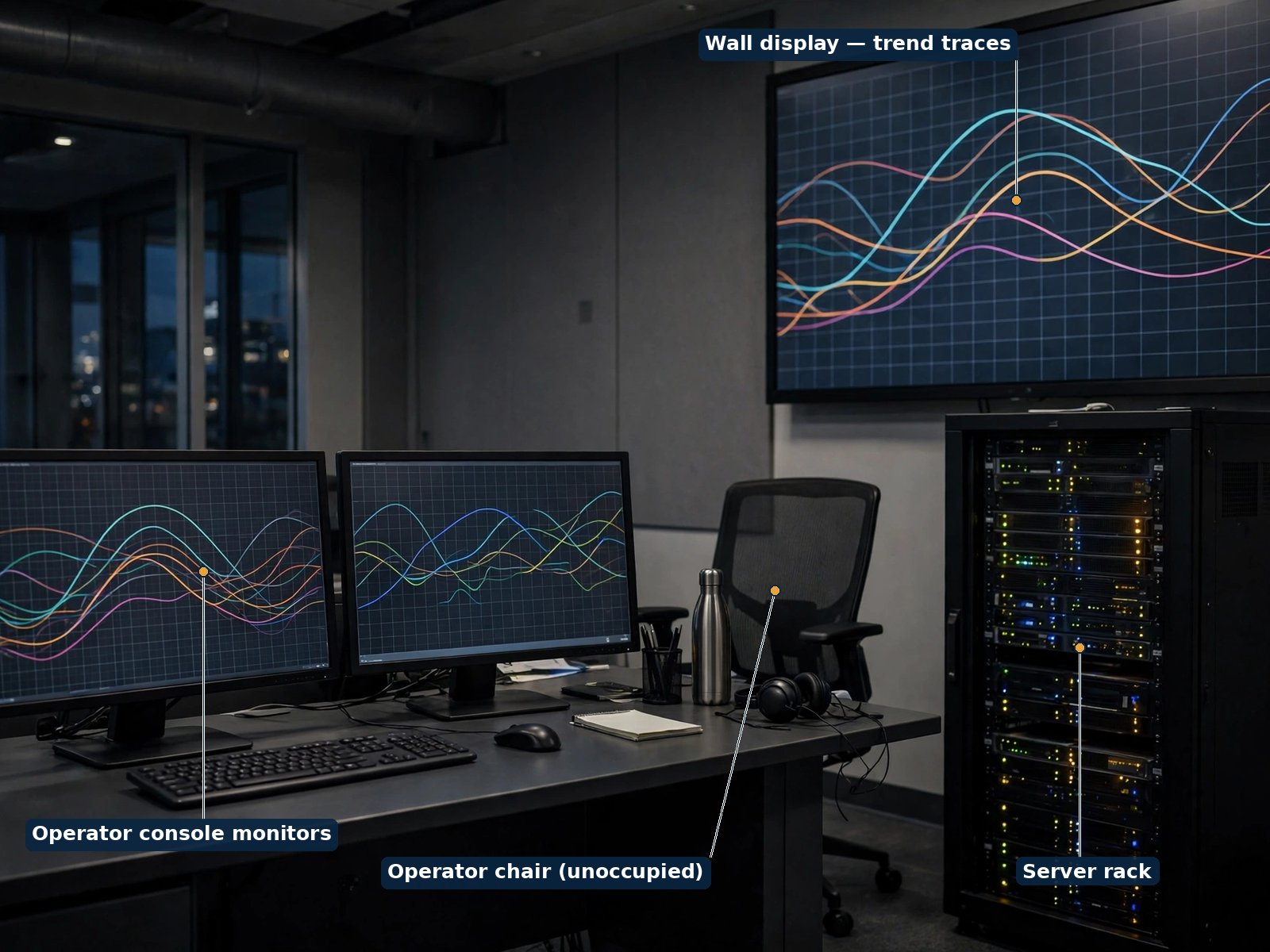
Figure 1.1 — The Calloway Center's control room: the operator console, a wall of abstract trend displays, and the server rack that hosts the front end.
Look at that figure until its parts make sense together. The console is where a human watches and commands. The displays show the building's recent history as abstract trends. The rack holds the computing that ties the room to the rest of the system. Everything else in this book exists to explain how a room like that can truthfully know and usefully steer a building of twelve stories.
Read this chapter as a map, not a sales pitch. It states what the system is, what the technician does, what building this book teaches on, and what the national numbers honestly say — including the plain fact that no single credential governs this field. The map comes first, so every later detail has a place to sit.
Strip a building automation system to its simplest idea and three verbs remain: sense, decide, act. A sensor measures a condition — a temperature, a pressure, a humidity, a flow — and reports it as a value. A controller, a programmable computing device that holds control logic, compares that value with what the building is supposed to be doing and decides what should change. An actuator, the device that moves a valve, a damper, or another final element in response to a controller's command, carries the decision into the physical world. Then the sensor measures again, and the cycle continues. That repeating cycle — sense, decide, act, sense again — is the control loop, and Chapter 8 teaches it from zero. Almost everything in building automation is a variation on it.
The unit the whole system is built from is the point — a single measured value, commanded output, or calculated value that the system knows by name. A discharge-air temperature is a point. A valve command expressed as a percent open is a point. A large building knows thousands of points at once, and the technician's daily reasoning is largely reasoning about points: Is this value true? Should that command have changed? Why did these two points move together?
The modern form of the controller is direct digital control, or DDC — control performed by programmable digital controllers executing stored logic, as distinct from older pneumatic or purely electrical control. DDC makes possible schedules that change by the clock, setpoints that reset as conditions change, alarms that announce themselves, and histories that remember. When this book says "the system" without qualification, it means a DDC system of the kind the specimen in §1.4 carries.
At the top sits the front end — the supervisory software, its graphics, alarms, schedules, and histories, through which operators and technicians see and direct the whole building. The front end does not replace the controllers beneath it: they keep controlling even if the front end is closed. The front end supervises — it gathers, displays, records, and lets a human change intentions, which the controllers then carry out. Keeping that division straight prevents the beginner's most common confusion, which is to mistake the screen for the system.
Building automation is conventionally described in three levels, and the description earns its keep because almost every fault, drawing, and conversation in the field locates itself on one of them. The field level is the level of sensors and actuators in direct contact with the physical building: the temperature sensor in a duct, the pressure sensor across a filter, the actuator on a damper shaft. The automation level is the level of controllers: the devices that read the field level, run the control logic, and command the field level. The management level is the level of supervision: the front end, its workstation, its histories and alarms, where the building is watched as a whole.
Figure 1.2 (Class A) — The three levels of a building automation system: field level, automation level, and management level, drawn on the Calloway Center.
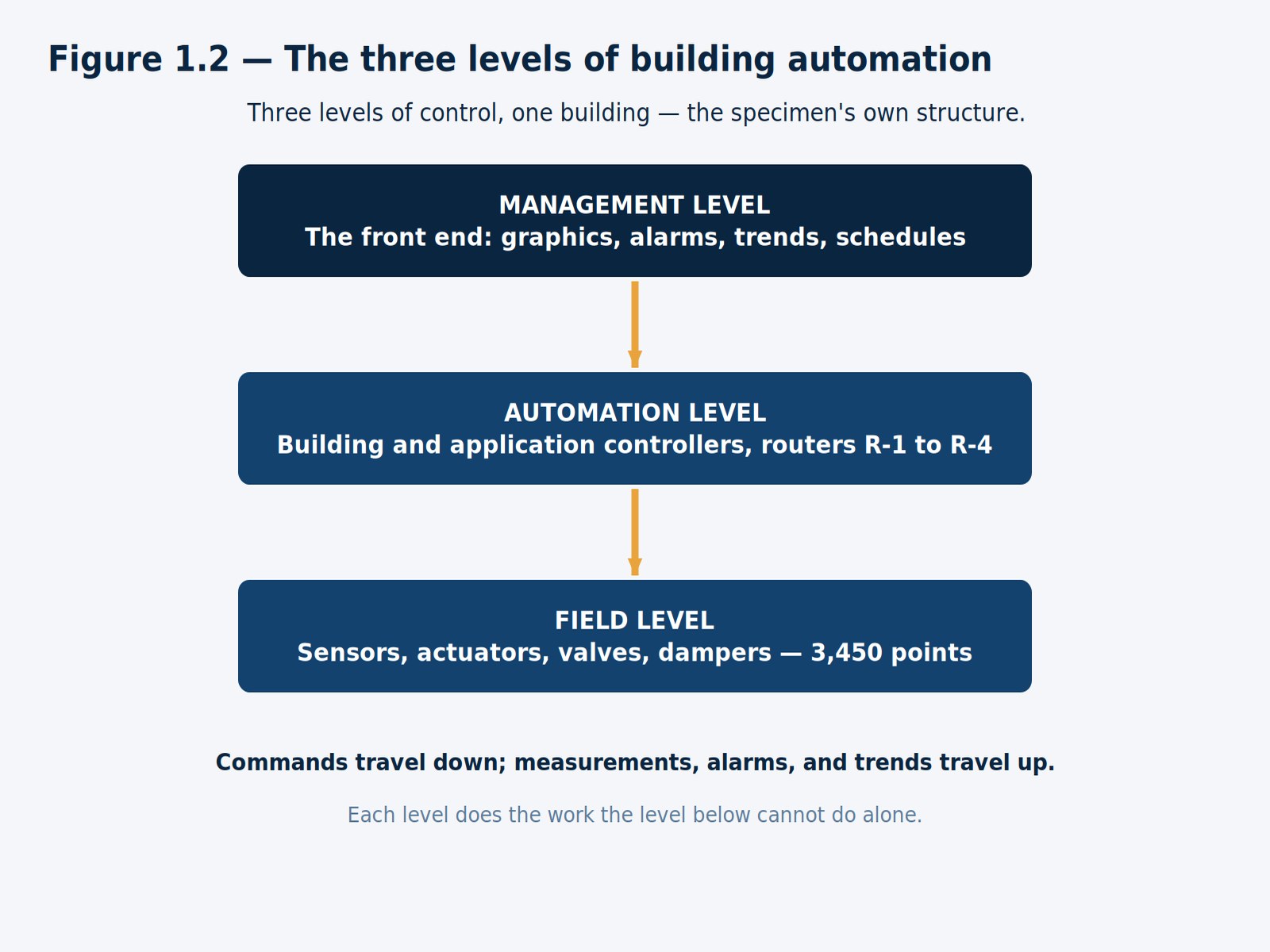
Figure 1.2 — The three levels of a building automation system: field level, automation level, and management level, drawn on the Calloway Center.
Follow the figure from the bottom up. At the field level, a variable-air-volume box above a ceiling carries a damper actuator and a discharge-air sensor. At the automation level, that box's controller decides how far the damper should open and commands the actuator. At the management level, the front end displays the zone's temperature, records its history, and would alarm if the zone stayed far from its setpoint. One zone, three levels, no step skipped — multiplied by every zone, air handler, and plant in the building.
The levels also explain how information travels. Values rise: field devices report to controllers, controllers report to the front end. Intentions descend: a schedule changed at the front end travels to the affected controllers, which translate it into actuator movements. A network, in this book's plain sense, is the connected path — wiring, addressing, and rules of exchange — over which controllers and the front end share values and commands. Hold the shape: many field devices, fewer controllers, one supervisory view, networks joining them.
The levels are not three separate systems. Remove the field level and the controllers decide blind. Remove the automation level and the front end becomes a display with nothing to direct. Remove the management level and the building still controls itself, loop by loop, but no one can see it whole or learn from its history. The craft lives in keeping all three levels truthful to each other.
A craft is learned faster on one building followed whole than on a hundred disconnected fragments, so this book teaches on a single specimen. The Calloway Center is a fictional 12-story office building of 288,000 square feet, completed in 2009, whose original controls were replaced in stages by the modern DDC system this book teaches on. A two-story annex carries 24 fan-coil units. Its arrangement is typical of real office-building work, and every number attached to it is its own specimen number, labeled as such. The owner is Calloway Partners, a fictional owner; the building's people are introduced in Chapter 3.
Walk the specimen once now; its systems return in depth in later parts. Three air handlers divide the tower: AHU-1 serves floors 1–4, AHU-2 serves floors 5–8, and AHU-3 serves floors 9–12. An air handler is the equipment assembly that conditions and moves supply air for a group of zones — fans, coils, filters, and dampers under control. Each air handler serves its floors through variable-air-volume terminal units, usually shortened to VAV terminal units — zone-level boxes that vary the volume of air delivered to one zone. The specimen carries 96 of them, 8 per floor, each with a damper actuator, a discharge-air sensor, and a hot-water reheat coil.
The plants are sized with deliberate clarity. Chilled water comes from three chillers of 250 tons each — 750 tons installed — against a design cooling load of 480 tons. With one chiller out, two remain: 2 × 250 tons = 500 tons. That 500 tons is the specimen's firm capacity on the cooling side — the capacity remaining with the largest single unit unavailable — and it still covers the 480-ton design load. Hot water mirrors the pattern: three boilers of 2,700 MBH each — 8,100 MBH installed — against a design heating load of 5,400 MBH. With one boiler out, 2 × 2,700 MBH = 5,400 MBH remains, exactly the design load. Redundancy here is not a slogan; it is arithmetic the reader can check.
The points count states the system's scale in one number. The specimen carries 3,450 points in total. The count is built from its parts, and the book shows it once in full so the method is plain: plant 640, plus the three air handlers at 215 each, 3 × 215 = 645, plus the VAV units at 14 points each, 96 × 14 = 1,344, plus the annex fan-coils at 8 points each, 24 × 8 = 192, plus lighting 456, plus electrical metering 64, plus elevator interfaces 12, plus miscellaneous interfaces 97. Adding in order: 640 + 645 = 1,285; 1,285 + 1,344 = 2,629; 2,629 + 192 = 2,821; 2,821 + 456 = 3,277; 3,277 + 64 = 3,341; 3,341 + 12 = 3,353; 3,353 + 97 = 3,450. Every worked example in this book runs on this specimen and these numbers, or on round numbers explicitly labeled as illustrative on their faces. No worked number comes from a manufacturer's product.
The network shape, taught in Part IV, can be stated briefly here. A BACnet/IP backbone joins the supervisory level and the plant and air-handler controllers. Six MS/TP trunks carry the 96 VAV controllers, 16 per trunk, at the specimen's own trunk setting of 76,800 baud. Two further MS/TP trunks carry the annex fan-coils, and four BACnet routers, R-1 through R-4, join the trunks to the backbone. Occupied hours are 6:00 a.m. to 6:00 p.m. on weekdays. Nothing about the specimen is exotic — and that is the point.
When a beginner asks what the work actually consists of, the most honest starting answer is the occupation's own published duty list. There is no Bureau of Labor Statistics occupation entry for building automation technicians as such — the book says so wherever its figures print — so the closest published occupation is the one whose duties cover this work: heating, air conditioning, and refrigeration mechanics and installers. The Bureau of Labor Statistics lists that occupation's duties as follows: install, maintain, and repair heating, ventilation, air conditioning, and refrigeration systems; install electrical components and wiring; inspect and test systems and components; discuss system malfunctions with customers; repair or replace worn or defective parts; recommend maintenance to improve system performance; and keep records of work performed. (Source: BLS, Occupational Outlook Handbook, Heating, Air Conditioning, and Refrigeration Mechanics and Installers.)
Controls work lives inside that list, weighted toward its reasoning end. Installing means mounting and landing field devices, building and checking networks, loading and proving controller logic, and demonstrating that each point tells the truth. Inspecting and testing means calibration checks, loop checks, functional tests, and trend review. Keeping records is not paperwork after the work; in controls it is a large part of the work itself, because the next technician — who may be you, two years later, at midnight — can only reason from what was written down.
A working week therefore mixes planned work — a retrofit landing in stages, a commissioning test witnessed point by point, a preventive round proving sensors against references — with responsive work: an alarm triaged, a zone complaint reasoned from symptom to cause, a trunk fault narrowed by halves. The Bureau's account also names technology skills an important quality for the occupation, in its own emphasis: modern systems contain computerized components and networking features. (Source: BLS, Occupational Outlook Handbook, Heating, Air Conditioning, and Refrigeration Mechanics and Installers.) For the controls technician, those components and features are not a specialty at the edge of the work. They are its center.
One boundary belongs in this first map, honored in every chapter. Controls work is largely low-voltage work, and Chapter 7 shows where that world ends. Line-voltage terminations, refrigerant circuits, and energized testing belong to qualified electrical workers and EPA-certified refrigerant technicians, trained and assessed in person under the employer's program. The controls technician's craft is to make their work possible, sequenced, documented, and verified. Chapter 4 maps the hazards in full.
One set of national figures belongs in this first map, stated exactly as its source states it and never as anything else. The Bureau of Labor Statistics reports, for the whole occupation of heating, air conditioning, and refrigeration mechanics and installers — the closest published occupation to this field, there being no published building automation technician entry — a median annual wage of $61,010 per year, or $29.33 per hour, in May 2025, and counts 440,900 jobs in 2025. The same source reports the lowest 10 percent earning under $40,050 and the highest 10 percent earning over $95,210. (Source: BLS, Occupational Outlook Handbook, Heating, Air Conditioning, and Refrigeration Mechanics and Installers.)
Read those sentences with discipline. A median is the middle of everyone in the whole occupation — veterans and beginners, every region, every employer type — not a starting wage, not an offer, and not a promise about any one reader. The job count is the occupation's national size, not a count of vacancies. The same source's outlook is projected growth of 11 percent from 2025 to 2035, much faster than average, paired — as this book always pairs it — with about 40,600 openings per year on average, many from replacement needs, and an employment change of 48,200 jobs. (Source: BLS, Occupational Outlook Handbook, Heating, Air Conditioning, and Refrigeration Mechanics and Installers.) Both halves are projections in the source's name, never forecasts about any reader. No other pay figure appears anywhere in this book.
Behind the outlook, the Bureau notes the growing number of sophisticated climate-control systems as a driver of demand. That observation fits the specimen exactly: the building its owners actually operate — reset schedules, demand-controlled ventilation, trended everything — requires the craft this book teaches. Sophistication does not eliminate the technician; it changes what the technician must know.
Every beginner asks some version of the same question — what do I need to be allowed to do this work? — and the honest answer has a shape that surprises people, so this book states it in Chapter 1 and proves it across Chapters 2, 3, and 37. There is no governing credential exam and no national license for building automation work in the United States. No one test, taken once, authorizes a person to do this work, and any advertisement that implies one should be read with suspicion. The work is done by HVAC mechanics and installers, by electricians, and by the technicians of controls manufacturers and independent integrators, trained through postsecondary programs, apprenticeships, employer training, and vendor platform training. Adjacent credentials exist — Chapter 37 examines them as landscape — and they are voluntary, never the field's gate.
What exists instead is a set of distinct doors, each owned by a different party. Employers hire and train. Schools teach. Vendors train and certify skill on their own platforms. Authorities having jurisdiction regulate their own ground. Skill itself is built in training and supervised field work and is examined daily by the building itself: a sensor either reports the true temperature or it does not.
This book's promise is sized to that truth. It prepares field knowledge and readiness — the physics, the devices, the loop, the networks and their published languages, the sequences, and the working craft — taught as knowledge and reasoning, with hazardous acts reserved to trained, qualified parties in person. It is not any body's official course, satisfies no vendor's, ASHRAE, or employer requirement, and promises no job, credential, score, or income. Holding those roles apart is the first professional habit this book teaches.
Part I finishes the entry map: the doors in (Chapter 2), the building cast (Chapter 3), and safety as the first skill (Chapter 4). Part II builds the foundations — heat, humidity, electricity, the loop, PID, and the documents — before any device or sequence rests on them. Part III teaches the field devices; Part IV, the controllers and networks; Part V, the sequences that are the building's behavior; Part VI, the working craft of alarms, trends, energy, commissioning, and troubleshooting; Part VII, security, documentation, the certification landscape, and the road from here.
Read in order the first time. Every term is defined where it first appears, bolded so you can watch it arrive. The building you have just met — three air handlers, ninety-six boxes, two plants, 3,450 points — will still be the building in Chapter 40. By then it will be a place whose behavior you can predict, question, and improve, which is the whole definition of the craft.
Key terms of this chapter. Building automation system (BAS) — the connected system of sensors, controllers, actuators, networks, and supervisory software that monitors and controls a building's systems; Controls technician — the worker who installs, programs, commissions, and services a building automation system; Sensor — a device that measures a condition and reports it as a value; Controller — a programmable device that holds control logic and decides actions from measured values; Actuator — the device that moves a valve, damper, or other final element on a controller's command; Control loop — the repeating cycle of sense, decide, act, and sense again; Point — a single measured value, commanded output, or calculated value known to the system by name; Direct digital control (DDC) — control by programmable digital controllers executing stored logic; Front end — the supervisory software through which the whole building is seen and directed; Field level — the level of sensors and actuators in contact with the physical building; Automation level — the level of controllers that run control logic; Management level — the level of supervision where the building is watched as a whole; Network — the connected path over which controllers and the front end share values and commands; Calloway Center — this book's fictional 12-story, 288,000-square-foot specimen building; Air handler — the assembly that conditions and moves supply air for a group of zones; Variable-air-volume (VAV) terminal unit — a zone box that varies the air delivered to one zone; Firm capacity — the capacity remaining with the largest single unit unavailable; Median — the middle value of a whole set, never a starting figure or a promise.
Tags: FIELD — the field, its doors, and the shared foundations. The key, with every option explained, is in this chapter's key file.
Q1. A building automation system is best described as — A. a single thermostat enlarged to serve a whole building B. the connected system of sensors, controllers, actuators, networks, and supervisory software that monitors and controls a building's systems C. the building's electrical service and lighting fixtures alone D. a maintenance logbook kept at the front desk
Q2. In the sense–decide–act cycle, the controller's role is to — A. measure a condition and report it as a value B. move a valve or damper in response to a command C. compare measured values with what the building should be doing and decide what should change D. display histories for the morning meeting only
Q3. A point, in building automation, is — A. a single measured value, commanded output, or calculated value known to the system by name B. the sharp end of a temperature probe C. a decimal place in a setpoint D. a location marked on a floor plan
Q4. The front end's correct relationship to the controllers is that — A. the controllers stop controlling whenever the front end is closed B. the front end supervises — gathering, displaying, and recording — while the controllers keep controlling C. the front end replaces the controllers in a DDC system D. the front end is a field-level sensor
Q5. Which pairing of level and content is correct? A. Field level — the supervisory workstation and its histories B. Automation level — the dampers and valves themselves C. Management level — the duct temperature sensors D. Field level — sensors and actuators in direct contact with the physical building
Q6. In the Calloway Center specimen, AHU-2 serves — A. floors 1–4 B. floors 5–8 C. floors 9–12 D. the two-story annex only
Q7. The Calloway Center's cooling firm capacity, with one of its three 250-ton chillers out, is — A. 250 tons B. 480 tons C. 500 tons, computed as 2 × 250 tons, which still covers the 480-ton design load D. 750 tons
Q8. The Calloway Center's total points count, built from its parts, is — A. 1,344 points B. 2,629 points C. 3,277 points D. 3,450 points, the sum of plant, air-handler, VAV, annex, lighting, metering, elevator, and miscellaneous points
Q9. Which duty appears in the BLS duty list for heating, air conditioning, and refrigeration mechanics and installers? A. Keeping records of work performed B. Setting national energy policy C. Manufacturing control valves D. Issuing building permits
Q10. The BLS median of $61,010 per year (May 2025) is printed in this book only as — A. the starting wage a new controls technician should expect B. a guaranteed outcome for readers who finish the book C. the whole-occupation median for the closest published occupation — the middle of everyone in that occupation — not a starting wage, an offer, or a promise D. a wage figure for building automation technicians published as their own occupation
Q11. The BLS outlook for the occupation is stated in this book as — A. rapid growth stated with no openings figure attached B. projected growth of 11 percent from 2025 to 2035, paired with about 40,600 openings per year on average C. a promise of employment for every entrant D. a projected decline with no replacement openings
Q12. Which statement about permission to do building automation work is true? A. One national exam licenses controls technicians B. This book itself authorizes a reader to perform the work C. A voluntary adjacent credential is the field's gate D. There is no governing credential exam and no national license for this field; skill is built through programs, apprenticeships, employer training, and vendor platform training
Q13. In the Calloway Center specimen, the 96 VAV controllers ride — A. six MS/TP trunks, 16 controllers per trunk B. a single trunk carrying all 96 controllers C. the lighting network only D. no network; each box is standalone
Q14. The boundary this book states for controls work is that — A. controls technicians routinely perform refrigerant handling after reading about it B. line-voltage terminations, refrigerant circuits, and energized testing belong to qualified electrical workers and EPA-certified refrigerant technicians, with the controls craft making their work possible, sequenced, documented, and verified C. low-voltage controls work has no boundary with line-voltage work D. this book teaches energized work as performable procedures
Q15. Technology skills are described in the BLS account of the occupation as — A. unnecessary for modern systems B. belonging only to office staff C. an important quality, in an account that notes modern systems contain computerized components and networking features D. a substitute for all mechanical skill
End of the free sample. The complete book continues from here — the full A-to-Z course in book form, delivered as an EPUB you can read in Apple Books, Google Play Books, ReadEra, Thorium Reader, Adobe Digital Editions, or Send to Kindle.
Buy this ebook — $12.99 Back to the book page
Payments are securely processed by Payhip.