
Mastering Careers & Skills
Battery Energy Storage Systems: Mastering the Craft · free sample from the book itself
Start with the simplest picture the field offers. On a hot afternoon, a warehouse draws more electrical power than its service was sized to deliver cheaply. Somewhere on the site stands a cabinet or a container full of batteries. For two hours that equipment quietly supplies part of the building's load, the building's draw from the grid falls, and when the peak passes the batteries recharge in the cheap hours of the night. Nothing was generated on that site. No fuel was burned. What the batteries sold the building was time: energy bought or made at one hour, delivered at another.
That is the whole field in one scene, and this book teaches it from zero to advanced practice. A battery energy storage system (BESS) is an assembled system — batteries together with the equipment that converts, controls, protects, and houses them — that stores electrical energy for use at a future time and returns it as electrical energy when called on. The shortened word storage in this book always means that system, never a bare battery alone. The field's people are battery energy storage technicians: the workers who install, commission, operate, monitor, and maintain those systems. There is no single doorway into the work, and Chapter 2 maps the real doors honestly; this chapter builds the map the doors open onto — what storage does, where it lives, what a plant is made of, and who works there.
Hold one distinction from the first page, because everything else hangs on it. Generation makes energy. Storage does not. A storage system is a net consumer over any full cycle — it returns less energy than it takes in, because conversion and the battery itself spend some of what passes through — and it is valuable anyway, because when energy arrives can matter as much as how much arrives. A technician who grasps that storage is a time machine with losses, not a power plant, will reason correctly about every mode, schedule, and fault in Parts III and IV.
Every storage service in this book is the same physical act wearing a different purpose: charge — take electrical energy in and hold it as stored chemical energy — wait, and then discharge — release that energy back as electricity on command. The system that performs both directions is bidirectional: energy flows in during charging and out during discharging through much of the same equipment. Chapter 4 teaches what charge and discharge are inside the cell; this chapter teaches what the world uses them for.
The first use, and the oldest, is backup power: stored energy held in reserve so that a load keeps running when its normal supply fails or sags. The load might be a home's essential circuits, a business's servers, or a facility whose processes cannot stop mid-cycle. Backup values readiness over everything: the system spends most of its life waiting at a high state of readiness, and its success is measured on the one bad day, not on ordinary ones. The second use is peak shaving: discharging during a site's highest-demand hours to cut the peak the site draws from the grid, and recharging when demand is low. Many commercial electricity bills punish the peak as well as the total, so shaving the peak is storage working as an economic tool — the warehouse of §1.1. The third use is renewables firming, taught in this book strictly from the storage side: a variable generation source produces when the weather says, not when the load asks, and storage standing beside it absorbs surplus production and releases energy when production dips, so the combined output behaves more firmly. This book teaches what the battery does in that pairing — absorb, hold, release, and report its limits honestly. It does not teach the generation side itself: no array sizing, no production modelling, no generation design method appears anywhere in these pages, because that body belongs to a companion field and Chapter 32 returns to the boundary from the storage side.
Two further uses belong to the grid itself. Grid services is the umbrella name for the ways a storage plant supports the network it connects to: responding very quickly when grid frequency drifts, holding capacity in reserve against a generator's sudden loss, absorbing energy when the network has too much and releasing it when it has too little. A storage system is prized for these services because it can move from standby to full output, or absorb at full rate, far faster than a machine that must spin up — its response lives in electronics and chemistry, not in a turning shaft. The last use is islanding support: an island is a portion of an electrical system that keeps operating, deliberately separated from the wider grid, and storage is often the element that makes an island possible — holding the island's voltage and frequency steady while its local sources and loads balance. Chapter 32 teaches microgrids from the storage side; here, note only that islanding is backup power grown up from a building to a small network, and it asks the battery to be not just a reservoir but a stabilizer.
Five uses, one act. A given plant may perform several of them in a single day — firming in the morning, shaving a peak at noon, standing ready as backup overnight — and the energy management system (EMS), the plant's dispatching brain introduced in §1.4 and taught whole in Chapter 12, decides hour by hour which use the stored energy serves. The technician's craft is not in choosing those services; it is in keeping the system able to perform whichever service is called, and in knowing — from readings, trends, and alarms — when it no longer can.
Storage systems live at three scales, and the field's first lesson about scale is that the craft does not change when the size does. The architecture, the control hierarchy, the safety law, and the commissioning and maintenance method of this book are the same at every scale; what changes is the count of cabinets, the weight of the consequences, and the number of people on the crew.
At residential scale, a system typically stands in or beside a home — a cabinet on a wall or a floor-standing unit — storing energy for backup and for shifting the home's own consumption across the day. The work is intimate: one system, one household, premises wiring close at hand, and an owner who will ask the installer direct questions and live beside the equipment. At commercial and industrial scale — the field shortens this to C&I — systems serve businesses, warehouses, schools, hospitals, and factories: cabinets or containers on a pad behind the building, sized against the site's demand profile, dispatched for peak shaving, backup, or both. The crew is larger, the documentation heavier, and the site's operations constrain when work can happen. At utility scale, storage becomes a plant in its own right: rows of containers on a prepared site, their own transformers and switchgear, a control position, and dispatch instructions arriving from the network the plant serves. A utility-scale plant's output is measured in the same units a small power station's would be — yet walk its aisle and you will find the same modules, racks, converters, and controllers as in the commercial cabinet, multiplied and organized, not reinvented.
The scale lesson cuts both ways, and a beginner should hear both. Upward: do not imagine that residential work is a lesser craft whose habits can be loose because the system is small; the stored energy in a home system commands exactly the same respect, recognition, and rule-following as a container's, and the habits formed at small scale are the habits a technician carries to a plant. Downward: do not imagine that a utility plant is a different trade; a technician who has truly learned the cabinet — its strings, its converter, its controller, its thermal system — already knows the plant's grammar and needs mainly its vocabulary of scale: more strings in parallel, a transformer between the converters and the network, and dispatch that arrives from further away. This book is written to that grammar. Its examples move between scales deliberately, and Chapter 9 teaches the enclosures — cabinet, container, walk-in — as one family of built forms.
One more place-name belongs on the map. Storage increasingly stands behind the meter and in front of the meter, two phrases the field uses constantly. Behind the meter means on the customer's side of the utility's measuring point: the system serves that site's loads and economics first, as in the warehouse and the home. In front of the meter means on the network's side: the system serves the grid itself, dispatched as a grid asset, as at utility scale. The phrases matter to a technician because they predict who dispatches the system, whose outage it rides through, and which paperwork its commissioning produces — not because the equipment differs. The battery does not know which side of a meter it stands on; the organization around it does.
Now assemble the system whole, in the one view every later chapter zooms into. The field's public handbook landscape frames a complete grid-connected storage system as two major subcomponents — storage and power conversion electronics — a framing this book adopts at that scope level and then expands into the working anatomy a technician actually maintains. (Source: DOE/EPRI Electricity Storage Handbook in Collaboration with NRECA, Sandia National Laboratories SAND2015-1002 — a planning reference for utility engineers, planners, and decision makers, cited here for its system framing at scope level only.)
At the bottom of the anatomy stands the battery proper: cells — the individual chemical devices of Chapter 4 — assembled into modules, modules into racks and strings, and racks into the cabinet or container. Chapter 3 builds the electrical language for that climb and Chapter 8 builds the climb itself. Beside the battery stands the conversion subcomponent: the power conversion system (PCS) — the bidirectional inverter equipment that turns the battery's direct current into the alternating current the premises and grid use, and back again during charging. Chapter 10 teaches conversion and the transformer that, at larger scales, steps the PCS output to the voltage of the network it serves. Figure 1.1 draws the whole path in one line — the one-line map the field uses as its shorthand portrait of a plant.
Figure 1.1 (Class A) — The BESS one-line map: battery, PCS, transformer, and the premises/grid they serve, in one line.
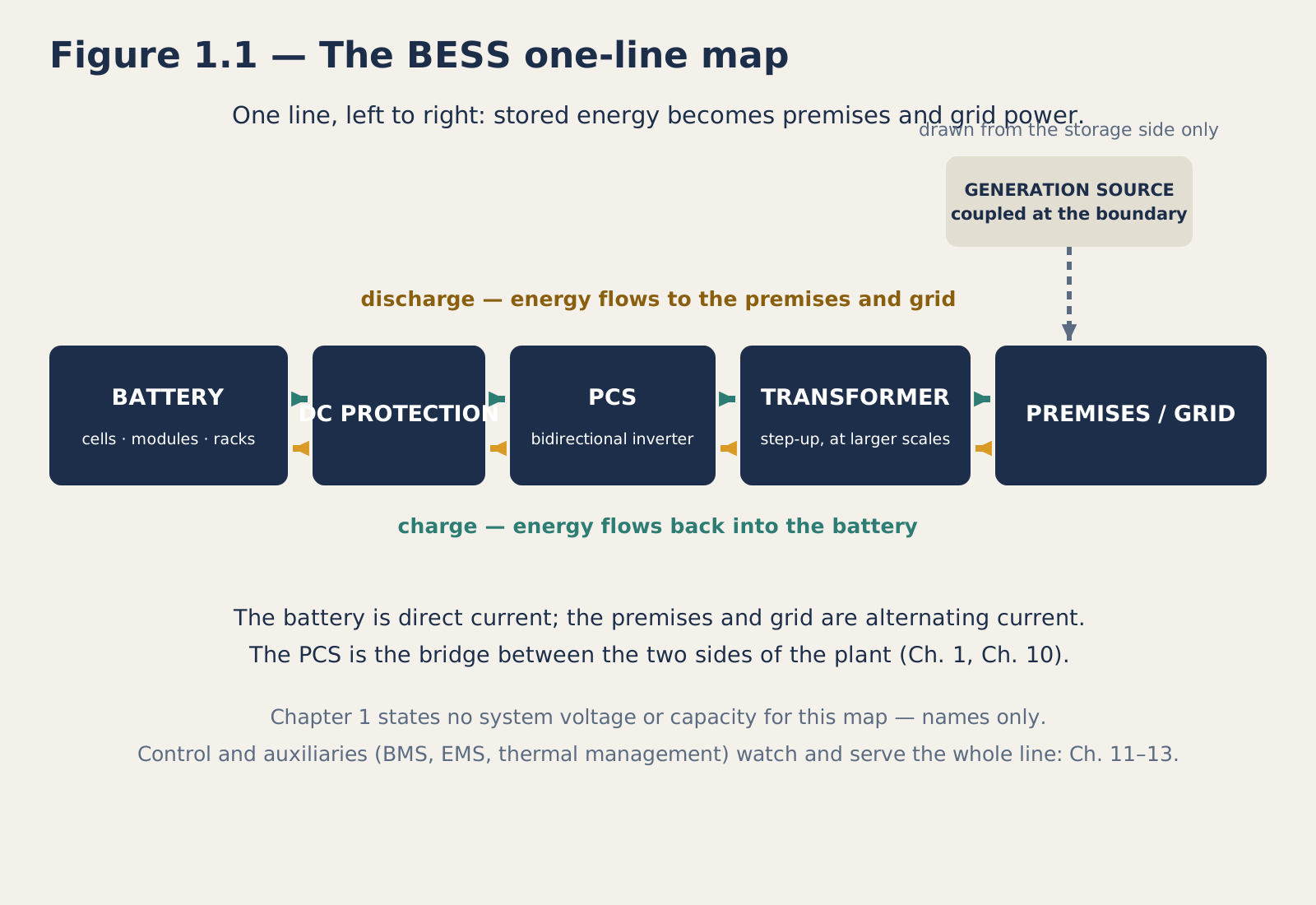
Figure 1.1 — The BESS one-line map: battery, PCS, transformer, and the premises/grid they serve, in one line.
Above the hardware stands a hierarchy of watchers. At the battery itself, the battery management system (BMS) — taught whole in Chapter 11 — watches the battery's own measurements, protects it against operation outside its safe envelope, and reports its state upward. Above the BMS, the EMS of §1.2 watches the whole plant and the world outside it — loads, prices where they apply, dispatch instructions, schedules — and tells the PCS when to charge, when to discharge, and how hard. Supporting all of it are the auxiliary systems, shortened in the field to auxiliaries: thermal management that removes the heat every cycle makes (Chapter 13), fire detection, ventilation where the chemistry requires awareness of it, lighting, communications, and the control power that keeps the watchers awake when the plant itself is dark. A storage plant is therefore four things at once: a reservoir, a converter, a hierarchy of watchers, and a small building's worth of life-support for the other three. Technicians who see only the reservoir misunderstand most faults, because most faults announce themselves in the watchers and auxiliaries first.
Two words complete the portrait. Commissioning is the disciplined proving of a built system — inspection, testing, and functional verification that it does what its documents say — before it is handed over to operate; Chapters 19 and 20 teach it as the field's hinge between building and running. Operations and maintenance, shortened to O&M, is the whole life after handover: operating, monitoring, preventive maintenance, troubleshooting, and the long management of the battery's slow ageing that Chapters 21 to 28 teach. Installation, commissioning, O&M: the book's Parts III and IV follow that life order because the field does.
Four roles recur through this book, named here in outline and taught whole in Chapter 2. Installers set and interconnect the system: enclosures on their pads, racks and cabling, the conversion and switchgear equipment, under the site's documents and the governing rules. Commissioning technicians prove the built system — inspection, testing, functional verification, acceptance documentation, and handover. O&M technicians keep the proved system alive across its years: inspections, preventive maintenance, monitoring, troubleshooting, and repair at the level the employer's program authorizes. Operators run the plant day to day — watching its state through its screens, executing and logging its dispatch, and recognizing the alarm that means stop and escalate rather than watch and wait. In a small company one person may wear three of these hats in a week; at a utility plant they are separate desks. What does not differ is the shared ground — electrical literacy, stored-energy respect, measurement honesty, and written records — that this book teaches as one craft.
Employers hire these roles from two established occupational pools, and Chapter 2 prints those two occupations' own published figures, separately and whole, as the book's only pay and employment anchors. The installation anchor is the occupation of electricians: the workforce that installs, maintains, and repairs electrical power, communications, lighting, and control systems, and from which storage installation crews are drawn — including, where a jurisdiction's licensing covers the work, its licensed scope. The operations-and-maintenance anchor is the detailed occupation of electrical and electronics repairers of commercial and industrial equipment: the workforce that adjusts, tests, repairs, and installs electronic equipment such as industrial controls, and from which storage operations and maintenance crews are drawn. Neither occupation is "storage technician" — no published occupation carries that name — and this book never pretends otherwise. It names the pools honestly, in Chapter 2's fenced form, and teaches the storage-specific craft that a worker from either pool must add to their trade to stand in front of a container with authority.
Around the four roles stand the people a technician works with and answers to: engineers who design and disposition, the authority having jurisdiction (AHJ) — the organization or official responsible for approving equipment, installations, and procedures in a place — whose adopted documents govern any real installation, supervisors and site owners, and the manufacturer's support organization behind a listed system. A technician's craft includes working with all of them: escalating with evidence, writing records another shift can act on, and knowing which decisions are a technician's to make and which are not. Chapter 34 is devoted to that judgment. For Chapter 1, hold the simpler truth: nobody tends a storage plant alone. The installer who sets a rack straight, the commissioning technician who proves a protection function rather than assuming it, and the operator who logs an odd trend at 3 a.m. are one relay, and the baton is information.
Walk the map once in motion, because the field is easier to learn moving than listed. A commercial site — a cold-storage warehouse — runs a behind-the-meter plant: two containers, a transformer, and a dispatch schedule the EMS holds. The day begins unremarkably. Through the morning the system stands at its scheduled readiness, having charged in the low-demand hours; the operator's first screen check confirms the state the night shift logged — charge held as planned, no active alarms, the thermal system cycling as the warming day requires. Nothing to fix is the plant's normal report, and a good operator reads it with the same attention as a fault: readiness verified is the product a backup-capable plant sells all day.
Figure 1.2 shows that plant as the field first meets it — the stationary system on its pad, before any door is opened.
Figure 1.2 (Class P) — A containerized battery energy storage system on its concrete pad, the stationary plant as the field first meets it.
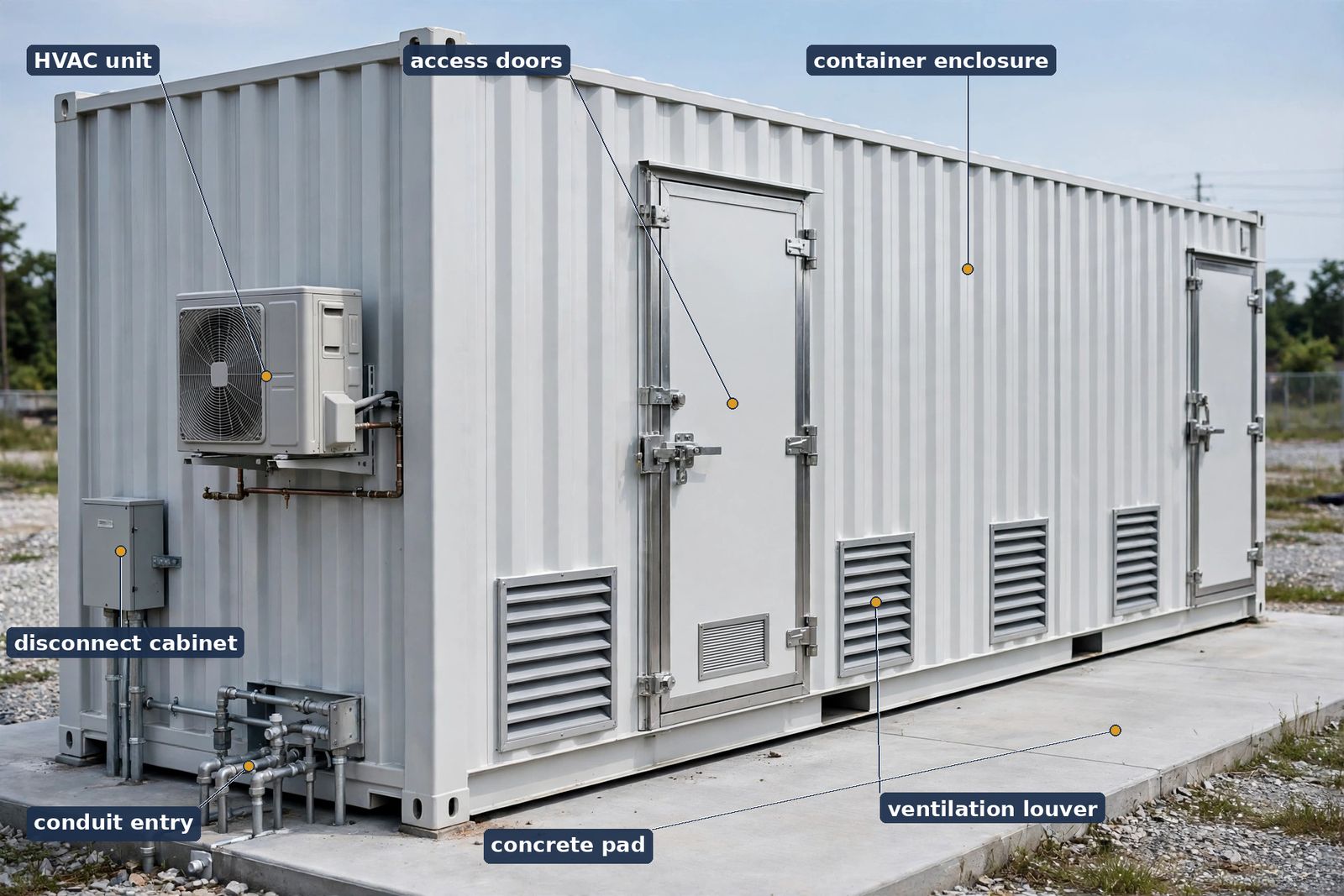
Figure 1.2 — A containerized battery energy storage system on its concrete pad, the stationary plant as the field first meets it.
Early afternoon is the site's peak: refrigeration, loading equipment, and office load stack together. The EMS, watching the site's draw approach the threshold in its schedule, dispatches the plant to discharge, and the site's grid draw flattens under the threshold the way Chapter 21's worked peak-shaving profile will draw it. Inside the containers, the event is undramatic by design: strings share the output, the PCS holds its side of the exchange, the BMS watches the battery work inside its envelope, and the cooling plant works harder, because discharge makes heat and the afternoon is already hot. The operator watches margins, not excitement — how much stored energy remains against the schedule's promise that, peak or no peak, a reserve stays held back for an outage that has not happened.
The peak passes. The plant recharges in the evening shoulder hours, the reserve is restored, and the log for the day closes with the facts Part IV will teach you to treasure: energy in, energy out, the peak as drawn and as shaved, temperatures in their pattern, no alarms, one trend worth a sentence. Multiply that day by years and you have the plant's biography — and its slow plot, because every cycle spends a little of the battery's life, a cost Chapter 27 teaches you to measure honestly rather than fear. The drama of storage work is almost never a single day. It is a trend caught early or a trend caught late, and the whole apparatus of this book — monitoring, maintenance, cause chains — exists to make it early.
One idea stands apart from the map because it governs how a technician may move inside it. A disconnected electrical feed can be isolated and rendered safe by the program that governs hazardous energy. A battery cannot be emptied by opening a switch. Stranded energy — the field also says stored energy — is the energy that remains inside the battery after every disconnect is opened: isolation strands the energy in the equipment, where it waits, invisible and silent, for as long as the chemistry holds it. There is no hum, no spin-down, no cooling tick of a machine at rest. A storage system at standstill is not at rest in the way other electrical equipment is at rest; it is a held breath.
That single fact shapes the safety law of this whole book, stated here and taught whole in Chapters 29 and 30. Battery hazards — arc flash, the explosive release of energy through the air between conductors; thermal runaway, a self-heating failure inside a cell that can spread to its neighbours; hydrogen off-gassing in flooded lead-acid installations; and electrolyte — are taught in this book at recognition, rules, and response-method level only: how to recognize the condition, what rules bind the work, and what the crew's response method is. No step-by-step hazardous procedure prints anywhere in these pages — no energized-work procedure, no opening of cells or modules, no firefighting procedure. The employer's program and the governing documents are the gate for hands, and hands-on qualification happens inside that program, on that employer's equipment. A beginner sometimes reads that fence as the book withholding something. Read it instead as the field's own shape: the knowledge that keeps a technician safe for a career is recognition and judgment, and those this book teaches without limit.
Close the map with the standing honesty this book keeps on its face. No license exam and no single certification gates this occupation as a whole. The field names one voluntary board credential — taught whole, with its experience gate stated plainly, in Chapter 2 — and it is voluntary: never a gate to the work itself, never a license, and this book is not preparation for it and confers no eligibility toward it. Where installation work falls within a jurisdiction's licensed electrical-work scope, the license is that jurisdiction's, its requirements vary by place, and neither this book nor any voluntary credential confers or replaces it. Employers hire on background, aptitude, and their own training and qualification programs.
This book therefore promises readiness and knowledge only. What it does do — if you work it whole, exercises included — is give you the field entire: the physics and chemistry underneath the systems, the system piece by piece, the work in its life order from site survey to end of life, the safety law of stored energy, the codes landscape by scope, and the judgment to know what you do not yet know. In a field whose employers train, the applicant who arrives already speaking the plant's language — string, state of charge, dispatch, cause chain, handover — starts that training far ahead. That is a book's honest promise, and it is enough. Chapter 2 now walks through the door this chapter has mapped: the roles, the employers, and the credential landscape exactly as it stands.
A new technician standing in front of a storage plant for the first time tends to look at the batteries and stop there. Train the eye wider, in the order this chapter built the plant. First, the reservoir: how many enclosures, how they are arranged, what the arrangement says about scale and about which strings a fault could touch. Second, the conversion path: where the PCS stands, where the transformer and switchgear stand beyond it, and whether the one-line map in your head matches the iron in front of you — when it does not, the documents, not your assumption, are wrong or out of date, and that mismatch itself is a finding worth reporting. Third, the watchers: where the operator's screens live, what state they report, and whether the plant's reported state agrees with its physical state — a plant reporting readiness while its thermal system sits silent on a hot day is telling two stories, and a technician believes the worse one until evidence reconciles them. Fourth, the auxiliaries and the room itself: cooling equipment running in its pattern, detection in place, aisles and access as the installation left them, nothing stored against equipment that was built to stand clear.
That four-part look — reservoir, conversion, watchers, auxiliaries — is not a procedure and performs no work. It is the habit of seeing a system instead of a battery, and every later part of this book assumes it. Installation chapters will ask you to build what you are looking at, in that order. Commissioning will ask you to prove it, in that order. Troubleshooting will ask you to reason from a symptom back through it, in reverse. The technician who learned in Chapter 1 to see four things where a visitor sees one box of batteries has already begun the craft; the chapters that follow give that sight its language, its numbers, and its method.
Tags: FIELD — the field and its services; SYSTEM — the plant in one view; ROLES — who works there. The key, with every option explained, is in this chapter's key file.
Q1. A battery energy storage system is best described as: A. A generator that makes electrical energy from stored fuel B. An assembled system that stores electrical energy for use at a future time and returns it as electrical energy C. A single battery cell sold for stationary use D. A device that creates energy whenever the grid is short
Q2. Over a full cycle, a storage system is a net: A. Producer of energy, because it discharges at high power B. Consumer of energy, returning less than it takes in — valuable because it shifts energy in time C. Perfect transfer, returning exactly what it takes in D. Consumer only when it is used for backup
Q3. Peak shaving means: A. Discharging during a site's highest-demand hours to cut the peak drawn from the grid, then recharging when demand is low B. Shaving insulation from conductors at peak times C. Charging as fast as possible at noon every day D. Disconnecting a site's largest load permanently
Q4. In this book, renewables firming is taught: A. As a complete course in designing generation arrays B. With production modelling for variable sources C. From the storage side only — absorb surplus, hold, release when production dips D. As a service only fossil-fuel plants can use
Q5. An island, in storage work, is: A. A site where no storage may be installed B. A portion of an electrical system that keeps operating deliberately separated from the wider grid C. A single battery rack standing alone in a container D. The concrete pad a container stands on
Q6. The craft across residential, commercial, and utility scales is best stated as: A. Three different trades that share only a name B. Utility work, which alone uses real storage systems C. Residential work first, with plant work learned as a separate career D. One craft on one architecture at different scales — what changes is count, consequence weight, and crew size
Q7. "Behind the meter" describes a system that: A. Stands physically behind a meter reader's office B. Is hidden from its owner's screens C. Cannot be dispatched at all D. Stands on the customer's side of the utility's measuring point and serves that site's loads first
Q8. In the plant's anatomy, the PCS is: A. The bidirectional conversion equipment that turns the battery's direct current into alternating current and back during charging B. The crew's scheduling software C. The concrete pad and its anchors D. The fire detection panel
Q9. The BMS's place in the hierarchy is to: A. Dispatch the plant against market schedules B. Set the site's peak-shaving threshold C. Watch the battery's own measurements, protect it against operation outside its safe envelope, and report upward D. Replace the energy management system
Q10. Commissioning is: A. The first year of a plant's operation B. A ceremony performed after the first fault C. The sale of a system to its owner D. The disciplined proving of a built system — inspection, testing, and functional verification — before handover to operate
Q11. Stranded (stored) energy means: A. Energy lost permanently during conversion B. Energy billed but never delivered C. A battery shipped to the wrong site D. The energy that remains inside the battery after every disconnect is opened — isolation strands it in the equipment
Q12. This book teaches battery hazards at the level of: A. Step-by-step hazardous procedures to perform B. Recognition, rules, and response method only — the employer's program and the governing documents gate hands-on work C. Theory with no safety content D. Procedures copied from governing documents
Q13. Storage crews are hired from the two anchor occupations of: A. Electricians, and electrical and electronics repairers of commercial and industrial equipment B. Plumbers, and carpenters C. Truck drivers, and warehouse pickers D. Software developers, and data analysts
Q14. Grid services prize storage chiefly because a storage system: A. Can move from standby to full output, or absorb at full rate, very quickly — its response lives in electronics and chemistry B. Burns no fuel on site C. Never needs maintenance D. Is cheaper than every other grid asset
Q15. The EMS's job in the plant is to: A. Watch individual cells and balance them B. Physically interconnect racks and strings C. Decide hour by hour which service the stored energy serves, telling the PCS when to charge and discharge and how hard D. Approve installations on behalf of the jurisdiction
Battery energy storage system (BESS) — an assembled system that stores electrical energy for use at a future time and returns it as electrical energy. Charge — taking electrical energy in and holding it as stored chemical energy. Discharge — releasing stored energy back as electricity on command. Backup power — stored energy held in reserve so a load keeps running when its normal supply fails. Peak shaving — discharging during a site's highest-demand hours to cut the peak drawn from the grid. Renewables firming — from the storage side, absorbing surplus production and releasing energy when production dips so combined output behaves more firmly. Grid services — the ways a storage plant supports the network: fast response, reserve, and absorbing or releasing energy as the grid needs. Energy management system (EMS) — the plant-level controller that decides which service stored energy serves and dispatches the PCS. Power conversion system (PCS) — the bidirectional inverter equipment between the battery's direct current and the alternating current of premises and grid. Battery management system (BMS) — the battery's own watcher: it measures, protects against operation outside the safe envelope, and reports upward. Auxiliary systems (auxiliaries) — the supporting plant: thermal management, detection, ventilation, lighting, communications, and control power. Commissioning — the disciplined proving of a built system by inspection, testing, and functional verification before handover. Operations and maintenance (O&M) — the whole life after handover: operating, monitoring, preventive maintenance, and troubleshooting. Stranded (stored) energy — the energy remaining inside a battery after every disconnect is opened; isolation strands it in the equipment.
Feras Alzubi
2026 Edition
© 2026 Feras Alzubi. All rights reserved.
No part of this book may be reproduced, stored in a retrieval system, or transmitted in any form or by any means — electronic, mechanical, photocopying, recording, or otherwise — without the prior written permission of the author, except for brief quotations in a review or other fair use permitted by law.
Originality statement. This book is an original work written for this publication. Its text, explanations, worked examples, exercises, skills checks, and case material were created fresh from the field's primary and authoritative sources. No part of this book is copied, recalled, or adapted from any other book, course, or question bank, and its practice items are original items written for this book — not any body's actual, recalled, paraphrased, or adapted items.
Not-affiliated disclosure. This book is an independent study guide. It is not affiliated with, endorsed by, sponsored by, or approved by the National Board of Certified Energy Practitioners (NABCEP), the National Fire Protection Association (NFPA), or UL, and none of those bodies participated in its creation. NABCEP, NFPA, and UL are named in this book only as the bodies behind a credential and standards that storage technicians work alongside; naming them does not imply any relationship between them and this book or its author. No license exam and no single certification gates this occupation as a whole, and this book confers no license, certificate, credential, eligibility, or qualification of any kind. In particular, this book is not ESIP preparation and confers no eligibility for the Energy Storage Installation Professional (ESIP) credential. It promises readiness and knowledge only.
This book teaches the whole battery energy storage field from zero to advanced practice, in the order the field itself depends on. Read it in order the first time. Part I builds the foundations — the field and where it works, the honest entry path, the electricity every later chapter uses, the cell from the inside, the chemistry families, and the numbers of storage. Part II walks the system piece by piece, from cells to the controls that dispatch them. Part III covers installation and commissioning. Part IV covers operations, maintenance, and troubleshooting. Part V covers the safety law of stored energy, the codes landscape by scope, solar-plus-storage and microgrids from the storage side only, end of life, and the technician's judgment.
Every technical term is bolded and defined where it first appears. A term is defined once, at its first use; later chapters use it without re-defining it. Each chapter ends with a Key Terms list collecting that chapter's new terms in one-line definitions, and the glossary at the back of the book is compiled from those lists.
Each chapter follows the same rhythm: a plain opening, why the subject exists, the full working detail, a worked example or realistic scenario, and then a check. The check is the chapter's Exercises & Skills Checks — 15 items in every chapter, with a key that explains the correct answer and why each wrong option is wrong. Calculation items are worked step by step in the key. Do the exercises before you read the key; a wrong answer you have reasoned about teaches more than a right answer you have guessed.
The book also carries a 50-item diagnostic, divided into five strands of ten items each — Battery Fundamentals & Chemistries; System Architecture & Controls; Installation & Commissioning; Operations, Maintenance & Troubleshooting; and Safety, Codes & Judgment — with a strand tracker so you can see which part of the field needs your next study hour. Two batteries of guided storage case files and eight strand repair sets complete the practice apparatus. The diagnostic and the rest of the apparatus are this book's own design, disclosed as such; they are not presented as, or modelled on, any certification examination, because no examination gates this field.
A note on hands. Storage work is hands-on work, and hands-on qualification happens in an employer's own training and qualification program, on that employer's equipment, under that employer's procedures and the governing documents. This book teaches method, judgment, recognition, and reasoning — how a system works, what a good reading looks like, how to reason from a symptom to a cause, and when to stop and escalate. It does not teach step-by-step performance of hazardous procedures, and where a topic touches hands it says plainly that the employer's program is the gate. That is not a gap in the book. It is the honest shape of the field.
A note on numbers. System values that vary by manufacturer and design are taught in this book as method and as reasoning, never as one product's specification. Where a worked example needs a specific number, the example states that number as its own given. The values that do not vary — unit definitions and conversions, and the occupation figures on the next page, printed exactly as their source states them — are printed exactly, with their source named.
Finally, a note on safety. Battery hazards are taught in this book at recognition, rules, and response-method level only. Chapters 29 and 30 are not chapters to skim, and the safety reasoning begins in Part I: stored energy does not behave like a disconnected feed, and a technician who understands that early reads every later chapter differently. Read the safety chapters before you need them, and return to them whenever a later chapter names a hazard family.
The figures on this page are the only pay and employment figures this book prints. Battery energy storage work is hired from two established occupations, so this page prints two separate anchor sets — one for each occupation employers actually hire storage crews from. The two sets are printed in separate labelled boxes, exactly as their sources state them. They are never averaged, never blended, and never labelled "BESS technician pay," because the U.S. Bureau of Labor Statistics publishes no such occupation. Each set describes a whole occupation — everyone in that occupation, at every level of experience, in every region and every kind of employer. A median is the middle of the whole occupation. It is not a starting wage, not an offer, and not a promise about any one reader, employer, or place.
Box 1 — Installation anchor. Source named on its face: U.S. Bureau of Labor Statistics, Occupational Outlook Handbook, "Electricians" (SOC 47-2111), read 2026-11-08: median $63,190/yr, $30.38/hr (May 2025); 821,000 jobs (2025); outlook +9% (2025–35); employment change +75,900; ≈72,700 openings/yr; typical entry education: high-school diploma or equivalent; on-the-job training: apprenticeship; "most states require electricians to be licensed."
Box 2 — Operations-and-maintenance anchor. Sources named on its face: U.S. Bureau of Labor Statistics, Occupational Outlook Handbook, "Electrical and Electronics Installers and Repairers" detailed row, and BLS Employment Projections data, for "Electrical and Electronics Repairers, Commercial and Industrial Equipment" (SOC 49-2094), read 2026-11-08: median $74,090/yr (May 2025, annual only — no hourly figure prints for this occupation); 65,500 jobs (2025) → 65,700 (2035); outlook +0.3% (2025–35); employment change +200; ≈4,700 openings/yr; typical entry education: postsecondary nondegree award; work experience: none; on-the-job training: long-term on-the-job training.
Read the two boxes as two different doors, not as one number. The first box describes the installation workforce — the electricians from whose ranks storage installation crews are drawn — and carries that occupation's licensing sentence, because installation work can fall inside a jurisdiction's licensed electrical-work scope. The second box describes the commercial and industrial repair workforce — the people who adjust, test, repair, and install electronic and electrical equipment for a living — from whose ranks operations and maintenance crews are drawn. Chapter 2 teaches both doors whole: the roles employers hire into, the kinds of employers who hire, the one voluntary board credential the field names and its experience gate stated plainly, and why neither this book nor any voluntary credential confers a license or a certification on anyone.
Diagnostic and strand tracker. Before Chapter 1, or after a first reading of Part I, work the book's 50-item diagnostic. Score it by its five strands, record the strand scores in the tracker that travels with the diagnostic key, and let the weakest strand set your next study hour. Return to the tracker after each part of the book; the repair sets at the back are keyed to the same strands, so a weak strand always has a named next step.
Front matter — Title page · Copyright page · How to Use This Book · The Field at a Glance · Contents
Diagnostic — 50 items in five strands of ten, with a strand readiness tracker and key
Part I — Foundations and the Field — Chapter 1: The Field: What Battery Storage Is and Where It Works · Chapter 2: Entering the Field: Roles, Employers, and the Honest Credential Landscape · Chapter 3: Electricity for Storage Work: Charge, Voltage, Current, Power, and Energy · Chapter 4: How a Battery Works: The Cell From the Inside · Chapter 5: Chemistries at Teaching Level: Lithium-Ion Families, Lead-Acid, and the Rest of the Shelf · Chapter 6: Numbers of Storage: Capacity, Rate, State of Charge, and Sizing Arithmetic
Part II — The System, Piece by Piece — Chapter 7: Cells: Formats, Construction, and Nameplates · Chapter 8: Modules, Racks, and Strings: Building Voltage and Capacity · Chapter 9: Cabinets, Containers, and Enclosures: The Stationary System as Built · Chapter 10: Power Conversion: PCS, Inverters, Converters, and Transformers · Chapter 11: The Battery Management System: Sensing, Protection, and Balancing · Chapter 12: Energy Management and Controls: EMS, SCADA, and Dispatch · Chapter 13: Thermal Management: Air, Liquid, and the Heat Every System Makes · Chapter 14: Protection, Grounding, and the Two Sides of the Plant
Part III — Installation and Commissioning — Chapter 15: Reading a Storage Job: Drawings, Submittals, Listings, and the Site Survey · Chapter 16: Site Preparation and Setting Equipment · Chapter 17: DC-Side Installation Method: Racks, Buswork, and Cabling Discipline · Chapter 18: AC Integration and Interconnection: Storage to Premises and Grid · Chapter 19: Commissioning I: Inspection, Testing, and Functional Verification · Chapter 20: Commissioning II: Acceptance, Documentation, and Handover
Part IV — Operations, Maintenance, and Troubleshooting — Chapter 21: Operating the Plant: Modes, Schedules, and Grid Services · Chapter 22: Monitoring and Alarms: What the Screens Are Telling You · Chapter 23: Preventive Maintenance: The Regime That Keeps Storage Alive · Chapter 24: Troubleshooting Method: Symptoms, Evidence, and Cause Chains · Chapter 25: Faults of the Battery Side: Cells, Modules, Racks, and the BMS · Chapter 26: Faults of the Power and Control Sides: PCS, EMS, Thermal, and Auxiliaries · Chapter 27: Degradation: Fade, Resistance Growth, and State of Health · Chapter 28: Augmentation, Repowering, and Life Extension
Part V — Safety, Codes, and the Career — Chapter 29: Hazards of Stored Energy: Recognition, Rules, and Response Method · Chapter 30: Fire Risk and Thermal Runaway: Prevention, Spread, and the Crew's Role · Chapter 31: The Codes Landscape by Scope: 706, 855, 9540, and 9540A · Chapter 32: Solar-Plus-Storage and Microgrids From the Storage Side · Chapter 33: End of Life: Removal, Second Life, and Recycling · Chapter 34: The Technician's Judgment and Growing in the Field
Every chapter closes with 15 Exercises & Skills Checks and a Key Terms list; every chapter's key explains the correct answer and why each wrong option is wrong (510 chapter items).
Back matter — Storage Case Battery A (25 guided case files) with key · Storage Case Battery B (25 guided case files) with key · Strand Repair Sets (8 × 15 = 120 items) with key · Study Plans (2-week intensive / 4-week standard) · Cheat Sheets · Figure Program (38 figures — 26 photorealistic plates, 12 diagrams) · Errata & Edition Notes · References · Coverage Crosswalk · Glossary (344 entries)
End of the free sample. The complete book continues from here — the full A-to-Z course in book form, delivered as an EPUB you can read in Apple Books, Google Play Books, ReadEra, Thorium Reader, Adobe Digital Editions, or Send to Kindle.
Buy this ebook — $12.99 Back to the book page
Payments are securely processed by Payhip.