
Mastering Careers & Skills
Armed Services Vocational Aptitude Battery (ASVAB) · free sample from the book itself
Every entry mirrors the production tag of its item in the chapter file. For each item, the key states the correct answer and why each wrong answer fails.
1. D — D is correct: the program publishes that there is only one exam — the ASVAB — and that scores from WK, PC, AR, and MK are combined to compute the AFQT (S-01). A invents an eleventh test; no such sitting exists. C inverts the design: the AFQT is computed for every examinee from the same sitting, not assigned as a remedy. B confuses a score with a delivery form; the AFQT is computed on both forms.
2. A — A is correct: Assembling Objects is given in the Enlistment Testing Program but not the Student (Career Exploration) Program (S-02). C, B, and D name subtests common to both programs; the contents are otherwise the same, which is exactly why the single exception must be learned precisely.
3. C — C is correct: on the CAT-ASVAB an answer cannot be reviewed or changed once submitted (S-01). B states the paper form's within-section rule, not the CAT's. A invents a one-change allowance that no published rule contains. D contradicts the CAT's subtest-by-subtest forward movement.
4. B — B is correct: the paper form has no penalty for guessing, so filling in every remaining item when time expires is to the examinee's advantage (S-01). A states the CAT's penalty logic on the wrong form. D wastes the published advantage: an answered item can earn a point, a blank cannot. C protects nothing; answers already recorded are not endangered by answering the rest.
5. A — A is correct: the program publishes that if time runs out on the CAT, it is better to keep answering than to fill in random guesses, because the CAT-ASVAB has a penalty for guessing (S-01). B prescribes exactly the random-guessing spree the guidance warns against. C overcorrects: the guidance is to keep working items honestly, not to abandon them. D describes no published option; forms are not switched mid-administration.
6. D — D is correct: most testing is conducted at a MEPS, with satellite MET sites for applicants who do not live near one (S-01). A describes where the school (CEP) program is typically given, not the Enlistment program's main site. B misplaces the administration: recruiters screen and schedule; MEPS and MET sites test. C names a setting the program does not publish for this battery.
7. B — B is correct: the recruiter-issued PiCAT access code expires 30 days after it is issued (S-03). A is the separate 48-hour window for completing the PiCAT once begun. C is the Vtest window, a different deadline in the same apparatus. D is the two-year score-validity period, unrelated to the code.
8. C — C is correct: the proctored Verification Test is taken at a MEPS or MET site within 45 days of taking the PiCAT, generally takes 25 to 30 minutes, and issues no score (S-03). A is the PiCAT completion window. B is the access-code expiry. D is score validity — and a "within two years" Vtest would defeat the apparatus's purpose of promptly confirming an unproctored score.
9. A — A is correct: the PiCAT can be taken only once and is available only to those who have never taken the ASVAB before (S-03). B fails both limits — it is neither repeatable nor a practice instrument. C reverses the audience: the PiCAT belongs to the applicant road, not the school program. D states the precise opposite of the never-tested rule.
10. B — B is correct: tryout items may appear in some CAT subtests, are unscored, are not identified to the examinee, and carry additional time — so treating every item as scored is the only workable and honest strategy. A fails on the stated fact: tryouts are not marked. C risks penalized random answers on items that may in fact be scored. D asks for information the design deliberately does not give examinees.
11. D — 76 minutes — D is correct, recomputed by hand: 12 + 55 = 67; 67 + 9 = 76 minutes. B (67) adds only the first two limits and stops. C (79) adds 12 to the subtotal a second time in place of 9. A (21) adds only GS and WK, omitting AR's 55 — the largest number in the stem.
12. C — C is correct: the program publishes that the ASVAB assesses whether examinees can apply principles to job-like problems, and that doing math without a calculator is itself assessed (S-02). A invents a speed rationale for a verbal subtest that involves no calculation. B invents a supply rationale the program does not publish. D is false in premise and conclusion: the battery is a current, maintained program (its Fact Sheet is an October 2026 version).
13. B — B is correct: AI and SI are separate tests on the CAT but combined into one test (AS) on the paper form, and a combined AS score is reported for both forms (S-01). A would erase two content areas the battery measures. C states the CAT's arrangement, not the paper form's. D invents a substitution no published table contains.
14. A — A is correct: the forms' scores are statistically linked (equated), so an examinee would be expected to receive a similar score on either form (S-01). C denies the linking the program publishes. B is false in its reason: the forms contain different item sets — the CAT's are adaptively selected — yet still yield comparable scores. D describes a candidate-facing conversion table that does not exist; equating is the program's internal apparatus (see fence X-5, Chapter 2).
15. C — C is correct: the program publishes that a recruiter may use a short pre-screening test to estimate AFQT performance in screening (S-02); an estimate is not a score of record. B promotes a screening estimate into an official score it cannot be. A promises a job outcome, which no screening instrument and no book can do (fence X-4). D contradicts the screening's purpose: it informs whether to send an applicant for the full testing, it does not replace that testing.
Chapter 1 census: 15 items, all multiple-choice. Key distribution: A ×4, B ×4, C ×4, D ×3. Designated calculations: 1 (Item 11 — CALC-1 · Arithmetic Reasoning word-problem arithmetic).
Part 0 — Foundations From Zero · Orientation for all ten subtests · Enlistment Testing Program spine
Picture a kitchen table on an ordinary weekday morning. On it sit a phone, a driver's license, a high school transcript someone has just dug out of a drawer, and a notebook page with one word written at the top and underlined twice: ASVAB. A recruiter has mentioned it. A friend who enlisted last year has mentioned it. A school counselor may have mentioned it months ago, in a sentence that slid past at the time. Now it matters, and the first honest problem is not mathematics, or vocabulary, or science. The first problem is simpler and more basic: nobody has yet explained, in one place and in plain order, what this test actually is.
That is this chapter's whole job. It assumes nothing. It does not assume you know what a subtest is, what MEPS stands for, why there seem to be two different tests with two different lengths, why people talk about an "AFQT score" as if it were a separate exam you also have to pass, or why a test you might take at home on a laptop still ends with a trip to a testing site. By the end of this chapter you will know all of that — the battery's identity, the two programs that deliver it, the two forms in which it is sat, the ten subtests that make it up, and the unproctored route called the PiCAT that leads, by design, back to a proctored room. Later chapters will decode the scores (Chapter 2), rebuild your number skills from zero (Chapter 3), rebuild your word skills from zero (Chapter 4), and lay a first map of the physical world the technical subtests measure (Chapter 5). This chapter draws the map those chapters live on.
One discipline starts here and runs through the whole book, so learn to recognize it on page one. Where a fact belongs to the United States Department of Defense ASVAB program — a count, a time limit, a rule, a window of days — the text says so at the point of statement: the program publishes…, the Fact Sheet states…. Where guidance is this book's own — a study habit, a pacing suggestion, a way of practicing — the text labels it as this book's guidance. A reader who can always tell whose voice is speaking is a reader who cannot be misled by a confident blog post, an old forum thread, or a well-meaning friend remembering a test from a different decade. Tests change hands, rules are republished, and services adjust their own standards. The program's current publications are the authority for the test. This book is a teacher, not an authority, and it will never dress itself as one.
The name expands to the Armed Services Vocational Aptitude Battery. Unpack that phrase slowly, because every word in it is information.
Armed Services — plural — tells you this is not one service's private entrance quiz. The battery serves the Army, the Navy, the Air Force, and the Marine Corps, and the program's own material describes AFQT scores as used to determine eligibility for enlistment in those services; other services draw on the same testing system under their own standards, which this book does not print, for reasons Chapter 2 explains in full. Vocational tells you the point is work: not school grades for their own sake, but aptitude for occupations — the jobs a service must fill and train people to do. Aptitude tells you the kind of measurement: developed abilities that help predict later success, not a personality inventory and not a test of worth. Battery is the oldest word in the name and the one beginners most often miss. A battery is a set of tests administered together as one instrument. The ASVAB is not one long test. It is ten shorter tests — subtests — sat in one battery, each measuring a different ability, each producing its own score, and those scores are then combined in different ways for different decisions.
The program publishes its own definition, and this book prints it because no paraphrase improves it: the ASVAB is "a multiple-aptitude battery that measures developed abilities and helps predict future academic and occupational success in the military" (the program's home page, S-07 in this book's source register). The same source states that it is administered annually to more than one million military applicants, high school students, and post-secondary students. Hold those two facts together. This is one of the most widely given aptitude batteries in the country, refined over decades, and it is given both to people actively trying to enlist and to students who may never speak to a recruiter. That double life explains the two programs in the next section — and it explains why advice aimed at one audience so often confuses the other.
The program's Fact Sheet for the Enlistment Testing Program states the battery's purpose in one practical sentence: ASVAB scores "are used to determine if you are qualified to enlist in the military and to assign you to an appropriate job in the military" (S-01). Two decisions, notice — not one. The first decision is eligibility: may this person enlist at all? The second decision is classification: given that this person may enlist, which jobs may this person be considered for, and which training pipelines do their scores open or close? Almost everything confusing about ASVAB scoring dissolves once you keep those two decisions separate, because they use the scores differently. Eligibility rests mainly on a combined score called the AFQT, built from four of the ten subtests. Classification uses scores from all of the subtests, combined by each service in its own way. Chapter 2 teaches both systems slowly. For now, fix only the shape: ten subtests, two decisions, no separate AFQT exam.
That last clause deserves its own paragraph, because the misconception is everywhere. There is, in the Fact Sheet's own words, "only one exam — the ASVAB" (S-01). The AFQT — the Armed Forces Qualification Test — is not a test you sit, a booklet you are handed, or a section announced over a loudspeaker. It is a score computed from four of the subtests you already sat as part of the battery. When someone says "I need to pass the AFQT," what they mean, translated into accurate language, is: "the combined score calculated from my Word Knowledge, Paragraph Comprehension, Arithmetic Reasoning, and Mathematics Knowledge results needs to reach the level my service currently requires for someone with my education credential." That sentence is longer. It is also true, and the short version has misled generations of applicants into studying as if four subtests were the whole battery — a mistake whose cost Chapter 29 counts in closed job doors. Study the whole battery. The four AFQT subtests decide whether the door opens; the other six help decide how many rooms lie behind it.
Two more ground rules belong in this first section because they shape every page of study that follows.
No calculator, ever. The program publishes this plainly (S-02): calculators are not permitted, and the reason is not cruelty or tradition. The ASVAB is an employment test. It assesses, in the program's own framing, whether an examinee can correctly apply principles to solve the kinds of problems that arise on a job — and the ability to do mathematics without a calculator is itself part of what is assessed. Every calculation in this book is therefore a hand calculation, worked the way you will have to work it in the testing room, with the carrying, borrowing, canceling, and estimating shown. Chapter 3 rebuilds that craft from zero. If your school years taught you to reach for a device before thinking, that habit — not your intelligence — is the first thing this book retrains.
English only. The program publishes that the ASVAB is given only in English, and publishes its reasons, including that all service members need to be able to work in English and that scores must remain comparable across examinees (S-02). This book is an English-language preparation for an English-language test, stated plainly and without apology or workaround. A reader still building English fluency is not excluded from this book — Chapter 4 in particular builds vocabulary methodically from zero — but no chapter will pretend the test exists in another form. It does not.
The same battery is delivered under two programs, and the program publishes the distinction (S-02). Confusing them is the second great beginner error, after the phantom AFQT exam.
The Enlistment Testing Program is the program this book targets. It is the battery as sat by applicants for military service, administered at Military Entrance Processing Stations — MEPS — and at satellite locations called Military Entrance Test sites, or MET sites. The Fact Sheet states that most ASVAB testing is conducted at a MEPS; that an applicant who does not live near a MEPS may test at a MET site; that the ASVAB "is administered by computer at all MEPS, and by paper and pencil at most MET sites"; and that roughly 70 percent of military applicants take the test via computer (S-01). The Enlistment program reports an AFQT score and service composite scores (S-02) — the two decision scores of §1.1.
The Career Exploration Program — the CEP, also called the Student Testing Program — is the battery as given in schools, as a free career-planning program (S-02). The population the program's ecosystem describes is students in grades 10, 11, and 12 and post-secondary students; participation is voluntary, and it creates no obligation to talk to a recruiter or to enlist (population details corroborated in this book's production register, printed here with that standing). A student who sits the ASVAB at school is doing career exploration: receiving information about their aptitudes and about occupations those aptitudes resemble. They are not enlisting by sitting down, they have not failed anything if they never enlist, and their sitting is not a lesser or easier version of the battery, as the next paragraph makes exact.
The contents are the same across the two programs, with exactly one published exception (S-02): the Assembling Objects subtest "is given in the Enlistment Testing Program but not the Student Testing Program." Every other subtest — same content areas, same measurement — is common to both. The scoring reports differ by program: where the Enlistment program reports the AFQT and service composites, the Student program reports three composite scores of its own — Verbal Skills, Math Skills, and Science and Technical Skills (S-02). Chapter 2 teaches those three alongside the AFQT, because a CEP reader deserves to understand the scores actually printed on their own report.
This book makes an honest choice and states it wherever it matters (fence X-12 in the blueprint that governs this book): the Enlistment battery is the spine. All ten subtests are taught here at full depth, including Assembling Objects, because the applicant reader sits all ten. Wherever Assembling Objects appears — chapter head, diagnostic, practice test — it is marked Enlistment program so a school reader is never misled about their own sitting. A CEP reader loses nothing by this choice: every subtest they sit is taught completely, their three composites are decoded in Chapter 2, and the one extra subtest in the book is simply a chapter they may read as enrichment or skip with a clear conscience, knowing exactly why it does not apply to them. What this book will never do is imply that a CEP sitting is shorter in the subtests it shares, easier, or differently scored in those shared subtests. The program publishes no such thing, and neither does this book.
Can school scores ever be used to enlist? The program publishes the frame (S-02): scores may be used for enlistment for up to two years from the date of testing, provided they can be verified as the examinee's own; and scores from a school administration run by school staff — School Staff Testing, or SST — require a Verification Test (Vtest) before they can be used to enlist. The Vtest appears twice in this book's story, here and in the PiCAT apparatus of §1.5, because it is the program's general answer to a general problem: an unproctored or differently proctored score must be confirmed under proctored conditions before it becomes a score of record. Chapter 30 teaches the whole apparatus in its test-day context. A reported further detail — that scores from 11th grade and beyond can be used for enlistment while 10th-grade scores cannot — circulates in CEP material and is carried in this book's register as reported guidance pending verification from the CEP's own official materials (V-5); it is printed here as exactly that, guidance reported in the program's ecosystem, beneath the primary two-year and verification rules above, which are the law this book teaches.
Figure A-01 — The score-structure map.
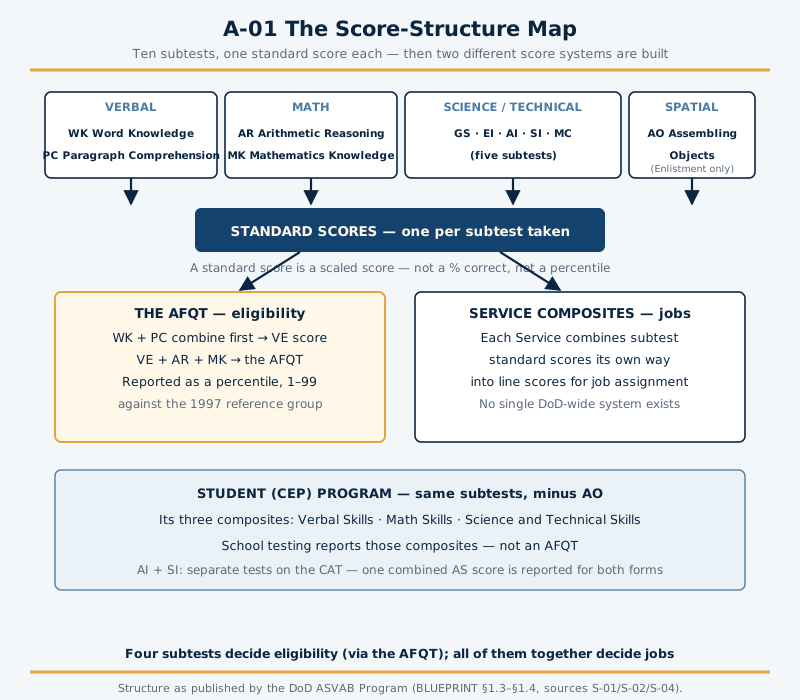
ten subtests feeding standard scores, the AFQT, service composites, and (for the Student program) the three CEP composites
Here is the whole battery on one page. Learn this table the way you would learn the layout of a new workplace: first the names, then what each one does, then — in the chapters named — how each one is mastered. The subtests are listed in the program's administration order, with the program's own descriptions (S-01, convergent with the program's sample-question index at S-06).
Four domains organize the ten: Verbal (WK, PC), Math (AR, MK), Science/Technical (GS, EI, AI, SI, MC), and Spatial (AO) (S-01). Notice the AFQT four hiding in plain sight in that list: AR and MK are the entire Math domain, and WK and PC are the entire Verbal domain. The AFQT is, by construction, a verbal-and-math measure. Science, technical knowledge, and spatial ability do not move it directly at all — they move the other decision, classification, which is why a candidate can clear an eligibility line and still stand in front of a short list of jobs, or clear it by the same margin as a friend and stand in front of a much longer one. Both halves of that sentence are this book's reason for existing in its present shape: the AFQT four receive the deepest treatment, and the technical subtests receive full from-zero teaching, because the dual purpose is real. A book that fed the AFQT by starving the technical subtests would be trading your job list for a slightly easier study month, on your behalf, without asking. This book does not make that trade (drafting rule D-r8, stated in the blueprint and honored in every part).
The AI/SI rule (S-01) — learn it now, because it governs every practice test in this book. Auto Information and Shop Information are administered as separate subtests on the computer form, but on the paper form they are combined into one test section labeled AS, and a combined AS score is reported for both forms. The battery therefore has two honest counts, and this book uses each where it belongs: ten subtests — the content areas, and the computer form's administration — and nine test sections on paper. Any sentence anywhere that calls the paper form "ten sections," or calls the battery "nine subtests" without this explanation, is an error. When you meet the two full practice tests in this book, built at the paper form's exact published shape, their AS section is composed of identified AI items and identified SI items — every item in this book carries its subtest address (rule D-r6) — so your combined-section practice still tells you which of the two content areas needs repair.
The battery is sat in one of two delivery forms. They measure the same abilities, and their scores are statistically linked — equated — so that, in the program's words, "you would be expected to receive a similar score regardless of whether you take the CAT-ASVAB or the P&P-ASVAB" (S-01). What differs is the experience of sitting, the pacing each form demands, and two rules — about reviewing answers and about guessing — that reverse between the forms and therefore reverse the correct strategy. Chapter 28 teaches those strategies as a craft. This section teaches the facts the strategies stand on.
The CAT-ASVAB is the computer form, administered at all MEPS (S-01). CAT stands for computerized adaptive testing, and adaptive is the load-bearing word. The program publishes how it works: the computer software selects each next item based on your responses to earlier items, targeting items suitable for your ability level (S-01). Answer well and the items that follow grow harder, because the software is narrowing in on a higher estimate of your ability. Struggle and the items ease, because the software is narrowing in from the other side. The measurement consequence — and the emotional consequence every first-time candidate should be warned about — is that a well-targeted adaptive test feels hard for almost everyone, almost all the time: the software's job is to keep presenting items near the edge of what you can do, because items far below or far above that edge carry little information about you. A candidate who leaves a CAT sitting thinking "that felt difficult, I must have done badly" has usually learned nothing about their score from the feeling. The feeling is the design working. Chapter 28 returns to this in full, because misreading it mid-test has talked more candidates out of their own performance than any content gap ever has.
Because the software targets efficiently, the CAT is shorter than the paper form: 135 scored items against the paper form's 225, with per-subtest limits summing to 197 minutes — while the program also publishes that the average examinee finishes in about an hour and a half (S-01). Administration mechanics, as published: you work at your own pace subtest by subtest, moving on to the next subtest as soon as you finish the one in front of you; and — the rule beginners violate in imagination a hundred times before test day — an answer cannot be reviewed or changed once it is submitted. There is no going back on the CAT, not to the last item, not ever. What that does to item strategy is Chapter 28's subject; what it means for study is simpler: the CAT rewards the candidate whose first answer is their considered answer, which is a trainable habit, and this book's quizzes can be practiced that way from the first week.
The CAT's second reversed rule concerns time expiring. If time runs out in a subtest, the program's published guidance is to keep answering rather than guess randomly, because "the CAT-ASVAB has a penalty for guessing" (S-01). Read that sentence exactly. It does not say never answer an item you are unsure of — during the body of a subtest, working an item honestly to your best answer is the test working as designed. It says that a blind random-guessing spree at the end is punished on this form, which is the opposite of the paper form's rule, below. One battery, two forms, opposite endgames. Confusing them is an unforced error, and it is entirely preventable by knowing which room you will be sitting in — something your recruiter can tell you before test day, and something you should ask.
A further published feature belongs here at exactly the level the sources support and no further (fence X-11). A CAT administration may include unscored tryout items in some subtests: items being field-tested for future use, not identified to the examinee, with additional time provided when they are administered. This book prints no per-subtest tryout count and no expanded time limit, because those figures are verified from the program's current tables at production (register item V-1) rather than repeated from secondary reporting. The strategic consequence needs no numbers at all: since a tryout item cannot be identified, the only honest strategy is to treat every item as scored — which is also, not coincidentally, the only strategy that works if there are no tryouts in your sitting at all. A candidate hunting for "the fake question" is spending scored time on an unscored errand.
The P&P-ASVAB is, in the program's words, "a traditional test, which means that everyone takes the same set of questions at the same pace" (S-01): the same booklet, the same items, administered section by section to the whole room together, in about three hours in all. It is the form most MET sites use (S-01). Its scored shape is the larger one: 225 items in nine timed sections, with section limits summing to 149 minutes of testing time inside that longer sitting, the difference being administration — instructions, transitions, and breaks taken as a room rather than at your own pace.
Its two rules are the CAT's rules reversed, and they are published just as plainly (S-01). Answers may be reviewed within the current subtest section — you can return to an earlier item, change an answer, check your work — but you cannot return to an earlier section once the room has moved on, and you cannot move ahead to the next section until instructed. And there is no penalty for guessing on the paper form, so that when time expires in a section, filling in an answer for every remaining item is, in the program's own assessment, to the examinee's advantage. On paper, a blank item is the only answer that is certainly wrong. The craft that follows from review-within-section — flagging, returning, spending leftover minutes where they earn the most — is taught in Chapter 28 alongside the CAT craft, form by form, never blended.
The table below is the book's shape of record, from the Fact Sheet's scored-item table (S-01, page 3). These are the numbers the Exam Blueprint page prints, the numbers Chapter 28 builds pacing from, and the numbers the diagnostic and practice tests in this book are composed against. No other table — no blog's, no older edition's, no memory's — outranks it in these pages.
| Subtest | CAT questions | CAT limit | P&P questions | P&P limit |
|---|---|---|---|---|
| General Science (GS) | 15 | 12 min | 25 | 11 min |
| Arithmetic Reasoning (AR) | 15 | 55 min | 30 | 36 min |
| Word Knowledge (WK) | 15 | 9 min | 35 | 11 min |
| Paragraph Comprehension (PC) | 10 | 27 min | 15 | 13 min |
| Mathematics Knowledge (MK) | 15 | 31 min | 25 | 24 min |
| Electronics Information (EI) | 15 | 10 min | 20 | 9 min |
| Auto Information (AI) | 10 | 7 min | — (in AS) | — |
| Shop Information (SI) | 10 | 6 min | — (in AS) | — |
| Auto & Shop Information (AS) | (combined score) | 25 | 11 min | |
| Mechanical Comprehension (MC) | 15 | 22 min | 25 | 19 min |
| Assembling Objects (AO) | 15 | 18 min | 25 | 15 min |
| Total | 135 | 197 min | 225 | 149 min |
Read the table as a pacing document, not just a census, because its contrasts are the test telling you what kind of performance each subtest is. On the CAT, Arithmetic Reasoning allows 55 minutes for 15 items — the battery's most generous ratio, room to translate, set up, compute by hand, and check. Word Knowledge allows 9 minutes for 15 — vocabulary as recognition, closer to a reflex test than a reasoning test: you know the word or you do not, and the craft of Chapter 7 is largely the craft of not spending reasoning-test time on recognition-test items. On paper the pressure changes shape: Word Knowledge becomes 35 items in 11 minutes, the battery's fastest sustained rate, while Arithmetic Reasoning compresses to 30 items in 36 minutes — still workable, no longer roomy. A candidate who studies content but never studies these ratios meets two different tests wearing one name and is surprised by both. You will not be: every chapter in this book closes with an "On the test" note naming the subtest it serves and the form-specific craft its table row demands.
Worked example (this book's arithmetic, from the table above). What is the CAT's average scored-item budget, in minutes per subtest, and why is that average almost useless for pacing? The CAT limits sum to 197 minutes across 10 subtests: 197 ÷ 10 = 19.7 minutes per subtest on average. The average is useless because no subtest is average: the real limits run from 6 minutes (SI) to 55 (AR), a ninefold spread, and pacing by the average would have you lingering over shop items you should answer in seconds and rushing word problems the form deliberately gives you time to work. Averages describe populations; tables pace individuals. That small computation — done by hand, checked against the printed table, and immediately interrogated for what it does not tell you — is the pattern of every worked example in this book.
The program publishes a third route into the same scores, and this book teaches it exactly as published — completely, once here, and again in its test-day setting in Chapter 30 (S-03; fence X-8 governs every sentence).
The PiCAT — the Pending Internet Computerized Adaptive Test — is, in the program's words, "another unproctored version of the CAT-ASVAB." Unproctored means no test administrator watches you take it: it is not taken at a MEPS or MET site. Its individual subtests have no time limits, and no tryout items are administered in it. Expect it to take 2 to 3 hours.
Access is recruiter-issued only, and this book cannot change that, simulate it, or soften it: to take the PiCAT you contact a military recruiter, who provides an access code. The code expires 30 days after it is issued. Once you begin, you must complete the PiCAT within 48 hours. It can be taken only once, and it is available only to those who have never taken the ASVAB before. The program's published delivery guidance is mundane and worth honoring: a current browser, and a screen at least seven inches diagonally, with tablets permissible. A phone with a cracked screen on a bus is technically a screen; it is not the setting in which to spend a once-only, never-tested-only opportunity, and that sentence is this book's guidance, labeled as such.
When you finish, an unfamiliar thing happens: you do not see your scores. The program publishes that the applicant has no immediate access to PiCAT scores and must contact the registering recruiter (S-03). Sit with that fact before you ever request a code. The PiCAT is not a free official practice test with a score report attached; it is the real battery taken at home, whose result is held by the process until the process confirms it. Which brings the story to its hinge.
The Verification Test — the Vtest — is what makes PiCAT scores real. If your PiCAT scores suggest you may be eligible for military service, you go to a MEPS or MET site and take a proctored Vtest, within 45 days of taking the PiCAT. The Vtest "is much shorter than the PiCAT and generally takes 25 to 30 minutes." No score is provided on the Vtest — it validates the PiCAT scores. And the program's sentence that the whole apparatus exists to reach: "If the Vtest is successful, then your PiCAT scores will become your official ASVAB scores of record and can be used to determine your enlistment eligibility" (S-03). The Vtest has a second use, met already in §1.2: scores from a school-staff-administered sitting (SST) likewise require a Vtest before they can be used to enlist (S-01, S-02, S-03).
Figure A-04 — The PiCAT → Vtest timeline.
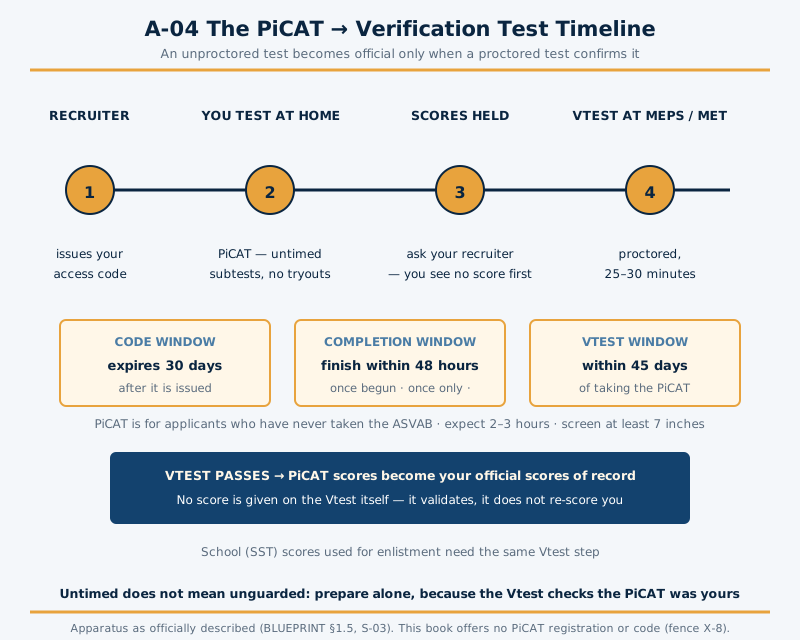
code issued (30 days to begin) → completion window (48 hours) → Vtest window (45 days), each window labeled from the program's published description
Now the integrity point, stated in the program's own logic because it is the program's design and not this book's moralizing. An unproctored score only becomes a score of record when a proctored test confirms it. The Vtest samples the same abilities under watched conditions, briefly, and compares. A PiCAT taken with help — a friend feeding answers, a phone searching vocabulary, a second person working the mathematics — manufactures scores the applicant cannot reproduce, and schedules its own exposure within 45 days, in a proctored room, on a 25-to-30-minute instrument built for exactly that comparison. Preparing for the PiCAT is what this entire book is for, and its untimed study mode (the book's own apparatus, described in the How to Use This Book pages and in Chapter 30) exists because the PiCAT's untimed subtests reward the same knowledge, worked without a clock first. Preparing on the PiCAT — treating the sitting itself as a group project — is preparing to fail the Vtest, and no score gained that way survives contact with the design. What happens beyond a failed Vtest — whether scores convert to some other administration or some other consequence follows — is not stated in the sources this book rests on, and so it does not print here (register item V-6). Anyone who tells you the consequence with confidence is telling you more than the program published to this book. Ask the recruiter; that question is theirs to answer.
Between this chapter and a testing chair stands a process, and this book teaches the parts of it the program publishes — and only those parts (fence X-9). It is a test-preparation book. It gives no advice about waivers, about presenting or concealing any fact of an application, or about negotiating anything; eligibility questions belong to the services' current official pages and to a recruiter, and Chapter 30 closes the book with that referral made carefully.
What the program publishes is this shape (S-02). Before testing, a recruiter interviews the applicant for disqualifying factors; a recruiter who determines that an applicant is not qualified will not send them to test. The recruiter may use a short pre-screening test to estimate AFQT performance, and may choose not to send an applicant for full testing on that basis. Two honest readings follow. First, a pre-screen estimate is an estimate — a screening instrument, not your AFQT, not a score of record, and not a verdict on your ceiling after study; candidates have treated a rough screening number as destiny in both directions, discouraged and overconfident, and both readings are errors. Second, the interview is part of the program's published design, not an obstacle placed in your path by an individual. The road runs: conversation and screening, scheduling, the sitting itself in one of the forms of §1.4 (or the PiCAT road of §1.5), scores, and then the two decisions of §1.1 made by the services from those scores and their current standards.
One more published frame belongs in a foundations chapter, stated at the general level the regulation states it and no narrower (S-08, from 32 CFR §66.6). For Regular enlistment the regulation's age frame is a minimum age of 17 and a maximum age of 42, with component and service standards set by the service concerned — which is why this book prints the federal frame and no service's age table. On education, a high school diploma is desirable although not mandatory in the regulation's words; the aptitude consequences of credential level — including the statutory rule that a person who is not a high school graduate may not be accepted unless their AFQT is at or above the 31st percentile — are taught where they belong, with the score system, in Chapter 2. Everything narrower than this frame is service- and applicant-specific, changes as services adjust, and is referred — here, in Chapter 2, and in Chapter 30, consistently — to the service's current official pages and to a recruiter. A test-prep book that printed a recruiting manual would be wrong in both directions at once: beyond its sources, and beyond its purpose.
Close the orientation by seeing the machine you are holding. Part 0, this part, assumes nothing: this chapter's map, Chapter 2's score decoding, and the three from-zero primers — numbers (Chapter 3), words and reading (Chapter 4), and the physical world (Chapter 5). Parts I–IV then build the domains in dependency order: verbal (Chapters 6–9), because the AFQT counts verbal twice and because reading is the tool every word problem quietly uses; math (Chapters 10–15), arithmetic reasoning on Chapter 3's foundation, then mathematics knowledge; science (Chapters 16–18), the General Science survey, which also stocks the vocabulary the technical parts spend; and technical (Chapters 19–27) — electronics, auto, shop, mechanical, spatial — each taught as physical things first, with labeled illustrations of the real objects, because four of these subtests test recognition of a physical world many beginners have simply never been shown. Part V (Chapters 28–30) is the exam layer proper — form strategy, score strategy, test day and retakes — placed last on purpose: strategy without knowledge is superstition, and this book does not teach superstition.
Around the chapters sits the practice apparatus, counted honestly in the front matter: a 225-item diagnostic across all ten subtests, taken before studying; a 15-item quiz at every chapter, this chapter's included, each with a full answer key in which every wrong answer is explained as carefully as the right one; two full practice tests at the paper form's exact published shape — 225 items, nine sections, the table of §1.4 made sittable; ten subtest repair sets and two AFQT-focus sets; and two labeled study modes — an adaptive rehearsal that simulates the direction of CAT difficulty in print, and an untimed mode for first passes — both described as what they are, this book's apparatus, on their faces. Practice results in this book are reported as what they are: raw counts and proportions, by subtest, for your own readiness judgment. No practice result is ever converted into an AFQT percentile or any official score, because no honest conversion exists outside the program's own scoring apparatus — Chapter 2 teaches why, in full, and the fence (X-5) prints on every practice test's face.
On the test — Chapter 1. Subtest addresses served: orientation for all ten (GS · AR · WK · PC · MK · EI · AI · SI · MC · AO). There is no item craft in this chapter because there is no item type in it; the craft is prior to items. Know which form you will sit — CAT at a MEPS, paper at most MET sites, or the PiCAT road — before you let anyone give you strategy, because the review rule and the guessing rule reverse between the forms (S-01). Know that the AFQT is computed, not sat. Know that AO is Enlistment-only. Everything else in the book hangs on those three hooks.
Beginners fear the unknown room more than the known questions, so walk the day at the level the program publishes it — no invented rituals, no borrowed horror stories. You arrive at a MEPS or a MET site (or, on the school road, at a school administration), having been scheduled through the process of §1.6. You will be checked in as an examinee of a specific administration: a specific form, a specific battery. On the computer road — the road roughly 70 percent of applicants travel (S-01) — you sit at a computer and work subtest by subtest at your own pace within each subtest's limit, submitting answers that cannot be taken back, moving forward when each subtest is done, finishing, on average, in about an hour and a half. On the paper road, you sit with a room that moves together: a section is timed, collected in effect by instruction, and only then does the next section begin; inside a section you may review, between sections you may not go back, and the whole sitting runs about three hours. On the PiCAT road, the sitting happened at home across an untimed 2-to-3-hour span, and the testing-site visit is the shorter, sharper one: the 25-to-30-minute proctored Vtest, after which — if it validates — the scores you earned at your kitchen table become scores of record (S-03).
Notice what is not in that walk-through, because its absence is also published information. There is no oral examination. There is no interview scored as part of the battery. There is no physical task, no calculator to request, no dictionary to borrow, and no second form offered mid-sitting to a candidate who dislikes the first. The battery is ten content areas, presented as items, answered in English, under the rules of the form in front of you. Candidates who arrive having rehearsed exactly that — in this book's diagnostic, chapter quizzes, and full paper-shape sittings — meet a room with no structural surprises left in it. The questions may still be hard. The shape will be familiar. In a high-stakes sitting, familiar shape is not a small thing; it is the difference between spending your attention on items and spending it on logistics.
One more feature of the day deserves naming, because Chapter 30 builds on it: the day ends without a percentile being calculated at the desk in front of you, by you. Scoring is the program's apparatus, applied to standard scores after the sitting (Chapter 2). A candidate's job on the day is performance, not arithmetic about performance. Every habit this book trains — first-answer discipline on the CAT, review discipline on paper, no blank items on paper, no random spree on the CAT — exists to keep the day about the items, where it belongs.
You will hear many confident claims about the ASVAB between now and your sitting: minimums quoted to the digit, a cousin's composite table photographed from somewhere, a video announcing that a subtest "doesn't count anymore," a site offering to compute your future AFQT from ten questions. This chapter ends with the checking method this book itself uses, because the method will outlast every fact in it.
Check in this order. First, the program's own current publications — the Fact Sheet and the program's pages at its official site — govern the battery: its subtests, counts, limits, forms, scoring construction, categories, and windows (S-01 through S-05 in this book's register). Second, the regulation's frame governs the general enlistment floor: categories in law, the Category IV cap, the non-graduate percentile rule, the age frame (S-08). Third, the service's own current pages — and only the service's, and only current — govern that service's minimums, composites, and job requirements (S-09 is this book's worked example of such a page, used for structure, fenced for numbers). Fourth, a recruiter, for the application of all of the above to one person's file, credential, and timing. Everything below those four rungs — aggregators, forums, videos, older prep books including, one day, this one — is commentary, and commentary is where stale numbers go to be repeated with confidence. When a claim cannot be traced up the ladder to a rung that owns it, treat it the way Chapter 2 teaches you to treat a conversion calculator: as a number in search of a source.
That is also the honest way to hold this book. Its basis line, printed on the title page, names its sources and its moment: built against the ASVAB as published by the U.S. Department of Defense ASVAB Program — the Fact Sheet, Enlistment Testing Program, October 2026, and the program's official pages — with an instruction to confirm current counts, limits, and retest rules on the official site before you test. Production re-verifies that basis at this book's own gates. You should re-verify it on the morning it matters. A book that teaches you to check its own claims against the authority it cites is not weakening itself; it is handing you the instrument the whole preparation runs on.
Before the quiz, compress the chapter into the paragraph you should be able to say, unprompted, to the next person who asks you what you are studying: The ASVAB is one battery of ten subtests run by the Department of Defense. It is given to applicants at MEPS and MET sites under the Enlistment Testing Program, and to students in schools under the Career Exploration Program, which is the same battery without Assembling Objects and with its own three composites. Applicants sit it as the adaptive CAT-ASVAB on computer or as the P&P-ASVAB on paper, or begin it as the untimed PiCAT at home and confirm it with a proctored Vtest. Four subtests — AR, MK, WK, and PC — are combined into the AFQT percentile that speaks to eligibility; all ten subtests feed the service composites that speak to jobs. There is no calculator, the test is in English, scores may be used for two years, and retakes wait by the calendar. A reader who can say that paragraph — and can point each clause of it at the section of this chapter that proves it — owns the map. The rest of Part 0 fills the map in: scores next, then numbers, words, and the physical world.
One discipline for the months between this chapter and the testing room deserves stating at orientation, because candidates violate it constantly and innocently: date every fact you collect. A minimum heard in a video from three years ago, a retake rule remembered from a sibling's enlistment, a composite table photographed from a wall — each was, perhaps, accurate when it was made, and each belongs to the class of program and service facts that this book's register exists to date and source. The battery's content — the ten subtests, their descriptions, the hand-arithmetic and reading and science in Parts I–IV — ages slowly. The battery's administration and policy shell — counts as republished, service standards, incentive language — can move faster, which is precisely why this book fences the shell to its current official sources (X-1, X-3) while teaching the content at full depth and without hedging. When you collect a fact about the shell, write its source and its date beside it in your notebook, the way this book's register does. A fact you cannot date is a rumor with good posture.
Orientation facts are simple, which is exactly why their misreadings survive: each one sounds almost like the truth. Work through six, in the clinic form this book uses throughout — the misreading stated fairly, then the correction pointed at the section that proves it. A reader who can diagnose all six in a friend's sentence owns Chapter 1 at the level the rest of the book assumes.
Misreading 1: "I am studying for two tests — the ASVAB first, then the AFQT." There is one exam (§1.1). The AFQT is a score computed from four of the subtests inside that exam, not a second sitting waiting behind it. The cost of this misreading is a distorted study plan: the candidate who believes it studies four subtests for "the second test" and treats the other six as decoration, when in fact all ten are sat in the one battery and all ten feed the classification decision.
Misreading 2: "The battery has nine subtests." It has ten subtests and, on the paper form, nine test sections (§1.3's AI/SI rule). The nine is a fact about how AI and SI share a paper section and a combined AS score; it is not a fact about how many content areas exist. A candidate carrying the nine-subtest version into a catalog or a practice book will eventually conclude that Auto Information or Shop Information "doesn't count," and will under-study a content area whose score is reported on both forms.
Misreading 3: "I'll flag the hard items and come back to them," said by a candidate booked for a MEPS sitting. That is paper-form craft applied to the computer form (§1.4). At a MEPS the CAT rules apply: an answer, once submitted, cannot be reviewed or changed, and the candidate moves subtest by subtest at their own pace. The same sentence spoken by a candidate booked at a paper MET site is sound craft — inside a section. The misreading is not about strategy; it is about not knowing which room you will be sitting in, which is why §1.7's orientation craft begins with asking.
Misreading 4: "The PiCAT is the program's free practice test, so I'll take it early to see where I stand." The PiCAT is the real battery, taken unproctored (§1.5): once only, never-tested applicants only, its scores held by the process and made official — if the Vtest validates them — as scores of record. Spending it as a diagnostic burns a once-only route and produces an official result, not a rehearsal. The diagnostic in this book's front matter exists precisely so that the first full-length sitting a candidate spends is one that costs nothing.
Misreading 5: "My screening score is my AFQT, so I already know my category." A recruiter's pre-screening instrument is a short estimate used to decide about sending an applicant for full testing (§1.6). It is not computed by the program's scoring apparatus from a full battery sitting, it issues no percentile against the 1997 reference sample of Chapter 2, and it assigns no category. Treating it as a score errs in both directions: it has discouraged candidates whose full, prepared battery would have performed far better, and it has sent others into the testing room unprepared on the strength of an estimate.
Misreading 6: "Assembling Objects is optional," said in both directions. An Enlistment applicant who treats AO as enrichment will meet it in the battery anyway — it is one of the ten subtests of their sitting, and its standard score feeds classification composites. A CEP student who treats it as a requirement will search their school sitting for a subtest that program does not administer (§1.2). The word optional belongs to neither program; the correct sentence is the fence this book prints wherever AO appears: Enlistment program — present in one program's sitting, absent from the other's, by the program's published design.
Notice the clinic's common thread. None of the six misreadings is a failure of intelligence or effort; each is a failure of address — a fact filed under the wrong program, the wrong form, or the wrong instrument. That is why this book is so repetitive about addresses: program, form, and score layer are attached to facts at the point of statement, every time, until attaching them becomes the reader's own reflex. The quiz that follows is the first place to practice it.
15 items. Answer key with full rationales follows this quiz.
1. Which statement about the AFQT is correct? A. The AFQT is a separate eleventh test given after the battery B. The AFQT is the name of the paper form of the battery C. The AFQT is given only to applicants who fail the ASVAB D. The AFQT is a score computed from four of the ASVAB's subtests; there is only one exam, the ASVAB
2. A student takes the ASVAB at school under the Career Exploration Program. Which subtest will that student NOT sit? A. Assembling Objects B. Mechanical Comprehension C. General Science D. Word Knowledge
3. On the CAT-ASVAB, once you submit an answer to an item, you may: A. Change it once, for a small penalty B. Review it until the subtest ends C. Not review or change it; the test moves on D. Return to it after finishing the next subtest
4. Time is expiring in a section of the P&P-ASVAB and several items remain unanswered. The program publishes that on this form you should: A. Leave them blank, because guessing is penalized B. Fill in an answer for every remaining item, because there is no penalty for guessing C. Stop working to preserve your other answers D. Answer only the items you are sure of
5. Time is expiring in a subtest of the CAT-ASVAB. The program's published guidance is to: A. Keep answering items as well as you can rather than guess randomly, because the CAT has a penalty for guessing B. Fill in random guesses for all remaining items as fast as possible C. Leave the remaining items blank to avoid the penalty entirely D. Ask the administrator to switch you to the paper form
6. Most Enlistment Testing Program testing is conducted at a: A. High school gymnasium B. Recruiting office back room C. Service academy testing center D. Military Entrance Processing Station (MEPS), with satellite MET sites for applicants who live farther away
7. A recruiter issues an applicant a PiCAT access code. The code expires: A. 48 hours after it is issued B. 30 days after it is issued C. 45 days after it is issued D. Two years after it is issued
8. After a successful PiCAT whose scores suggest eligibility, the proctored Verification Test must be taken within: A. 48 hours B. 30 days C. 45 days, at a MEPS or MET site D. Two years
9. The PiCAT is available: A. Only once, and only to those who have never taken the ASVAB before B. To any applicant, as often as they wish to practice C. Only to students in the Career Exploration Program D. Only after a first proctored ASVAB has been taken
10. Some CAT administrations include tryout items. The correct approach to them is to: A. Skip them, since they are marked as unscored B. Treat every item as scored, because tryout items are not identified to the examinee C. Answer them randomly to save time for scored items D. Ask the administrator which items are tryouts before beginning
11. Using the CAT-ASVAB time limits published in this chapter, a candidate adds the limits for General Science (12 minutes), Arithmetic Reasoning (55 minutes), and Word Knowledge (9 minutes) to plan a study simulation. What is the total? A. 21 minutes B. 67 minutes C. 79 minutes D. 76 minutes
12. Calculators are not permitted on the ASVAB because the program publishes that: A. Calculators are too slow for the Word Knowledge subtest B. Testing sites cannot supply enough of them C. Doing mathematics without a calculator is itself part of what the employment test assesses D. The battery predates calculators and has never been updated
13. On the P&P-ASVAB, Auto Information and Shop Information are: A. Omitted entirely B. Combined into one test section labeled AS, with a combined AS score reported for both forms C. Given as two separate timed sections D. Replaced by a second Mechanical Comprehension section
14. The scores of the CAT-ASVAB and the P&P-ASVAB are: A. Statistically linked, so an examinee would be expected to receive a similar score on either form B. Identical item for item, because the forms contain the same items C. Incomparable; each form has its own unrelated scale D. Converted by a table printed for candidates in the test booklet
15. Before testing, a recruiter gives an applicant a short pre-screening test. That pre-screening result is: A. A guarantee of the job the applicant will receive B. The applicant's official AFQT score C. An estimate of AFQT performance used in screening — not the applicant's AFQT or a score of record D. A substitute for the full ASVAB if the applicant does well
© 2026 Feras Alzubi
All rights reserved.
Mastering Careers & Skills
This book is an independent study publication. It is not published by, affiliated with, endorsed by, or approved by the U.S. Department of Defense, the ASVAB Program, or any branch of the U.S. Armed Services, and none of them participated in its creation. ASVAB and Armed Services Vocational Aptitude Battery name the test this book prepares you for; all practice questions, passages, and illustrations are original to this book. Whether you qualify to enlist, and for which jobs, is determined by the Services from your official scores and their current standards; no book can guarantee a score, an enlistment, or a job.
Built against the ASVAB as published by the U.S. Department of Defense ASVAB Program (ASVAB Fact Sheet, Enlistment Testing Program, October 2026, and the program's official pages at officialasvab.com). Confirm the current subtest counts, time limits, and retest rules on the official ASVAB website before you test.
This book is an independent study publication, as the disclosure above states. It was written from the U.S. Department of Defense ASVAB Program's own published material — above all the program's ASVAB Fact Sheet (Enlistment Testing Program), October 2026 version, and the program's official pages at officialasvab.com — together with the federal regulation that publishes the general enlistment frame, 32 CFR §66.6. Those sources are named wherever they are used and listed in full in the References in the back matter. The Department of Defense, the ASVAB Program, and the Armed Services did not write, review, or approve any page of it.
Five consequences of that independence are stated here at the front, not buried at the back.
First, this book teaches one battery, as it is currently published, and names it everywhere. The battery is the Armed Services Vocational Aptitude Battery (ASVAB) — in the program's own definition, "a multiple-aptitude battery that measures developed abilities and helps predict future academic and occupational success in the military," administered annually to more than one million military applicants, high school, and post-secondary students (ASVAB Program, official site). Its target form in this book is the Enlistment Testing Program battery: ten subtests, taken at a Military Entrance Processing Station (MEPS) or a satellite Military Entrance Test (MET) site, or begun unproctored as a PiCAT and made official by a proctored Verification Test. The program's current Fact Sheet — the October 2026 version — restates that established battery with the same ten subtests, the same two delivery forms, and the same counts, time limits, and scoring described in this book, and nothing the program has published announces any change to them; the dated change-watch on the Errata and Basis page in the back matter records that check in full. If the basis line above ever stops matching what the program publishes, this book's basis — not the program's — is what has aged, and the line is printed precisely so that you can check.
Second, there is no "passing score" for the ASVAB, and this book never prints that phrase for it. What exists is a system: each subtest yields a standard score; four of them build the Armed Forces Qualification Test (AFQT) score that determines enlistment eligibility; and all of them feed the composite scores the Services use for job assignment. Federal regulation sets the general frame — an AFQT in Category V (percentiles 1–9) is ineligible to enlist — and each Service sets its own minimums above that frame, by service and by education credential, and changes them with its needs. This book therefore prints no service's minimum score and no job's required score, anywhere — not in a table, not in a chapter, not in passing. The fence is stated for you in the program's own terms on the Exam Blueprint page below: "Your service's current minimums and your job's current required scores live on your service's official pages and with your recruiter. Any book that prints them as permanent tables is printing numbers that will go stale; this book teaches you the system those numbers live in." What this book teaches instead is the whole system those numbers live in — the categories, the statutory frame, and the method for confirming your service's current minimum before you test.
Third, this book does not promise or imply a score, a category, an enlistment, a job, a bonus, or any other outcome. It teaches all ten subtests' knowledge from zero — hand arithmetic before algebra, word-building before timed vocabulary, the physical world before engines, circuits, and machines — and it drills you with original practice: a diagnostic across all ten subtests, a quiz at every chapter, two full practice sittings at the paper form's exact published shape, subtest repair sets, AFQT-focus sets, and a labeled rehearsal of the computer form's adaptive logic. That is what a study book can honestly do. Where the program's own published language touches outcomes, this book keeps its modal verbs exactly as published: applicants who score in AFQT Category IIIA or higher "may qualify for enlistment incentives" (ASVAB Program, "Enlistment Eligibility") — may qualify, never a promise, here or anywhere else in these pages.
Fourth, every practice item in this book is original, and no score in this book is ever converted. Every question, passage, word list, diagram, and scenario was written for this book against the program's published subtest descriptions. No official sample item, and no actual, recalled, paraphrased, or dump-site test item, appears or is adapted anywhere in it. The ASVAB Program itself publishes a warning about fraudulent test-preparation claims on its official site; this book's provenance is the opposite of that material — the program's published facts, taught in this book's own words, with this book's own figures and its own items. The same honesty governs scoring: the program computes real scores from standard scores, normed against its reference group, through apparatus no book holds. No raw count, percentage, or practice result in this book is ever converted into an AFQT percentile, a standard score, a Verbal Expression score, or a service composite value — no conversion table exists in this book, and Chapter 2 teaches why any book or site that offers you one is inventing it. Your practice results are reported as what they are: raw counts, by subtest, for your own readiness judgment.
Fifth, print cannot adapt, and this book says so wherever that matters. Most applicants — roughly 70 percent, on the program's published figure — take the computer-adaptive CAT-ASVAB, which selects each next item from your earlier answers and cannot be printed. This book's full practice tests are therefore built at the paper form's published shape — the form that can honestly sit in print, complete and exactly timed — and the CAT is taught as everything print can honestly teach: how adaptive selection works, the rule that a submitted CAT answer cannot be reviewed or changed, the CAT's penalty for guessing and what it does to strategy, pacing from the CAT's own published table, and a labeled, book-designed adaptive rehearsal that simulates the direction of adaptive difficulty without claiming the program's algorithm, item pool, or scoring. The full statement of that boundary is printed in How to Use This Book below and again on the face of every practice test. It is not fine print. It is the honest shape of preparation in this medium.
A note on labels, because labels carry the facts in this subject. Every fact about the battery or the program carries its provenance in words where it appears — "the program publishes…", named to the Fact Sheet or the program's pages. Everything this book itself invented — the diagnostic's timing and routing lines, the study plans, the readiness lines, the adaptive rehearsal's routing rule, the untimed practice mode — is labeled this book's guidance or this book's design at every appearance. The program's published standards are never dressed as this book's invention, and this book's inventions never wear the program's voice. No blanket note substitutes for the label at the point of use.
Two standing rules of the test itself, stated once here and obeyed on every page. The ASVAB allows no calculator, ever: the program's Applicants' FAQs explain that the battery is an employment test of whether you can apply principles to problems as they arise on the job, and that doing math without a calculator is itself part of what is assessed — so every calculation in this book is a hand calculation, worked the way you must work it on test day. And the ASVAB is given only in English, for the reasons the program publishes; this is an English-language book for an English-language test.
Copyright © 2026 Feras Alzubi. All rights reserved. No part of this book may be reproduced, distributed, or transmitted in any form or by any means without the prior written permission of the copyright holder, except as permitted by law. The book stands on its sources, which are named wherever they are used and listed in full in the References.
Everything on this page is a fact the ASVAB Program or federal regulation publishes, with its source named in words: the ASVAB Fact Sheet (Enlistment Testing Program), October 2026 (the program, U.S. Department of Defense); the program's Applicants' FAQs; the program's "What to Expect When You Take the ASVAB"; the program's "ASVAB Scoring" and "Enlistment Eligibility" pages; the program's official site; and 32 CFR §66.6. Where a figure could not be verified from such a source, this page prints no figure at all — and says so, because the silence is itself information.
There is only one exam — the ASVAB. It runs in two programs with the same contents (ASVAB Fact Sheet; Applicants' FAQs):
Before testing, a recruiter interviews the applicant for disqualifying factors and may use a short pre-screening test to estimate AFQT performance; a recruiter who determines an applicant is not qualified will not send them to test (Applicants' FAQs). That is the published shape of the road to the testing room, and it is all this book — a test-preparation book — claims about the recruiting process.
The battery measures aptitudes in four domains — Verbal, Math, Science/Technical, and Spatial. The ten subtests, in the program's administration order, with the program's own descriptions (ASVAB Fact Sheet):
| # | Subtest | Domain | What the program says it measures | Builds the AFQT? |
|---|---|---|---|---|
| 1 | General Science (GS) | Science/Technical | Knowledge of physical and biological sciences | No |
| 2 | Arithmetic Reasoning (AR) | Math | Ability to solve arithmetic word problems | Yes |
| 3 | Word Knowledge (WK) | Verbal | Ability to select the correct meaning of a word presented in context and to identify the best synonym for a given word | Yes — through VE |
| 4 | Paragraph Comprehension (PC) | Verbal | Ability to obtain information from written passages | Yes — through VE |
| 5 | Mathematics Knowledge (MK) | Math | Knowledge of high school mathematics principles | Yes |
| 6 | Electronics Information (EI) | Science/Technical | Knowledge of electricity and electronics | No |
| 7 | Auto Information (AI) | Science/Technical | Knowledge of automobile technology | No |
| 8 | Shop Information (SI) | Science/Technical | Knowledge of tools and shop terminology and practices | No |
| 9 | Mechanical Comprehension (MC) | Science/Technical | Knowledge of mechanical and physical principles | No |
| 10 | Assembling Objects (AO) | Spatial | Ability to determine how an object will look when its parts are put together | No |
The AI/SI rule, which governs every count in this book: Auto Information and Shop Information are administered as separate tests in the CAT-ASVAB but combined into one test, Auto & Shop Information (AS), in the paper form, and a combined AS score is reported for both forms (ASVAB Fact Sheet). The battery is therefore honestly described two ways, and this book uses each where it belongs: ten subtests — the content areas, and the computer form's administration — in nine test sections on paper. Any sentence that says "nine subtests" without that explanation, or "ten sections" of the paper form, is an error.
What each subtest feeds. Four subtests build the AFQT, which determines enlistment eligibility. All subtests feed the Service composite (line) scores, which the Services use for job assignment — in the Fact Sheet's words, "Scores on all of the ASVAB tests are used to determine the best job for you in the military." There is no separate AFQT test and no separate job test. There is one battery, read two ways.
Both forms measure the same abilities, and their scores are statistically linked (equated): "you would be expected to receive a similar score regardless of whether you take the CAT-ASVAB or the P&P-ASVAB" (ASVAB Fact Sheet). This table is the book's shape of record — the program's published table of scored items and their limits (ASVAB Fact Sheet, page 3):
| Subtest | CAT questions | CAT limit | Paper questions | Paper limit |
|---|---|---|---|---|
| General Science (GS) | 15 | 12 min | 25 | 11 min |
| Arithmetic Reasoning (AR) | 15 | 55 min | 30 | 36 min |
| Word Knowledge (WK) | 15 | 9 min | 35 | 11 min |
| Paragraph Comprehension (PC) | 10 | 27 min | 15 | 13 min |
| Mathematics Knowledge (MK) | 15 | 31 min | 25 | 24 min |
| Electronics Information (EI) | 15 | 10 min | 20 | 9 min |
| Auto Information (AI) | 10 | 7 min | — (in AS) | — |
| Shop Information (SI) | 10 | 6 min | — (in AS) | — |
| Auto & Shop Information (AS) | (combined score) | 25 | 11 min | |
| Mechanical Comprehension (MC) | 15 | 22 min | 25 | 19 min |
| Assembling Objects (AO) | 15 | 18 min | 25 | 15 min |
| Total | 135 | 197 min | 225 | 149 min |
How each form is administered (ASVAB Fact Sheet). On the CAT-ASVAB, taken on computer at all MEPS, the software selects each next item based on your responses to earlier items, targeting your ability level — which is why the CAT is shorter than the paper form. You work at your own pace subtest by subtest, moving on as soon as a subtest is finished; an answer cannot be reviewed or changed once submitted; the average examinee finishes in about 1½ hours; and if time runs out, you should keep answering rather than guess randomly, because the CAT-ASVAB has a penalty for guessing. On the paper form, everyone takes the same set of questions at the same pace — about 3 hours in all. Answers may be reviewed within the current subtest, but you cannot return to an earlier subtest or move to the next until instructed; there is no penalty for guessing, so filling in remaining items when time expires is to your advantage.
Two pacing contrasts inside the table are named teaching points in this book, because candidates reliably misjudge them: the CAT gives Arithmetic Reasoning 55 minutes for 15 items — room to work — but Word Knowledge only 9 minutes for 15, because vocabulary on this battery is a speeded recognition test; on paper the pressure reverses shape, with 35 Word Knowledge items in 11 minutes and 30 Arithmetic Reasoning items in 36. Chapter 28 teaches pacing from this table and no other.
Tryout items, at exactly the level the program's published material supports: a CAT administration may also include unscored tryout items in some subtests. They are not identified to you, and additional time is provided when they are administered. This book prints no per-subtest tryout count and no expanded time limit, because it does not print figures its primary sources did not give it — and it teaches the only honest strategy under an unidentified-tryout design: treat every item as scored.
Standard scores — one per subtest. Every subtest you take yields a standard score, and standard scores are the building blocks of everything else: "AFQT scores are computed using the Standard Scores from four ASVAB subtests" (ASVAB Program, "ASVAB Scoring"). A standard score is a norm-referenced scaled score. It is not a percentage, not a percentile, and not a count of questions answered correctly, and no page of this book treats it as any of those.
The AFQT — a percentile from 1 to 99. The AFQT is computed from the standard scores of Arithmetic Reasoning, Mathematics Knowledge, Paragraph Comprehension, and Word Knowledge. Word Knowledge and Paragraph Comprehension are combined first into a scaled Verbal Expression (VE) score — in the U.S. Air Force's official published words, the two scores "are added together to form the Verbal Expression (VE) score" — and VE is the verbal input to the AFQT, carrying the doubled weight of the two subtests it combines. The result is reported as a percentile between 1 and 99 against a specific reference group: "a sample of 18 to 23 year old youth who took the ASVAB as part of a national norming study conducted in 1997" (ASVAB Fact Sheet). The program's own worked readings are this book's: an AFQT of 62 means you scored as well as or better than 62 percent of that nationally representative sample; 90 and 50 read the same way. An AFQT is therefore not a percentage of questions correct, not a percentage of the battery, and not comparable to a classroom grade. Chapter 2 opens with that misconception and removes it before any strategy is taught. The program's norming and equating apparatus — the tables that turn subtest performance into standard scores and percentiles — is the program's scoring machinery, not published candidate material; that is the mechanical reason the no-conversion fence in the note before you begin exists, and Chapter 2 teaches it in full.
AFQT categories — as the Department of Defense publishes them (ASVAB Program, "ASVAB Scoring," detailed form):
| AFQT Category | Percentile range |
|---|---|
| I | 93–99 |
| II | 65–92 |
| IIIA | 50–64 |
| IIIB | 31–49 |
| IVA | 21–30 |
| IVB | 16–20 |
| IVC | 10–15 |
| V | 1–9 |
The program's counselor-facing material ("Enlistment Eligibility") prints Category IV undivided, as 10–30; that is the same band at coarser grain, not a different table, and this book notes it once, here, so a "Category IV" in a counselor's or recruiter's material never confuses you. One incentive fact prints exactly as published, modal verb intact: "Applicants that score in AFQT category IIIA or higher may qualify for enlistment incentives" (ASVAB Program, "Enlistment Eligibility").
Service composite (line) scores — job classification. Each Service forms its own composites from different combinations of the individual test scores and uses them for military job assignment (Applicants' FAQs). There is no single Department of Defense line-score system to teach. Chapter 29 teaches the composite method and one published structural example — the U.S. Air Force's four aptitude areas, Mechanical, Administrative, General, and Electronics (MAGE), each a percentile built from a named combination of subtests, with Word Knowledge and Paragraph Comprehension entering through VE — dated and sourced where it stands, so you can see how any service's composite is built and where to find your own service's current version. No other service's formulas, and no job's required scores, print in this book.
The general enlistment frame — and only the general frame (32 CFR §66.6, publishing 10 U.S.C. 520 and 10 U.S.C. 505):
Retakes (ASVAB Fact Sheet; Applicants' FAQs). After your initial ASVAB, you must wait one calendar month to retake the test. You must wait an additional calendar month to retest a second time. After that, you must wait six calendar months between retests. Your scores may be used for enlistment for up to two years from the date of testing. Retest rules beyond those published waits are set in the program's retest policy and by the Services; Chapter 30 refers everything further to that policy and to your recruiter, and prints nothing beyond it.
The PiCAT and the Verification Test (ASVAB Program, "What to Expect When You Take the ASVAB"). The PiCAT — the Pending Internet Computerized Adaptive Test — is an unproctored version of the CAT-ASVAB, taught in this book exactly as the program describes it, in Chapters 1 and 30:
This book cannot register you for a PiCAT, issue you a code, or give any practice score official status, and it claims none of those things. Chapter 30 also states the program's integrity logic in the program's own terms: an unproctored score becomes a score of record only when a proctored test confirms it — so preparing with help on the PiCAT itself would be preparing to fail the Vtest.
The first full sitting in this book is the diagnostic, and it comes before the chapters on purpose. It is one sitting of 225 items at the paper form's exact published shape — the same nine sections, the same per-section counts, and the same per-section time limits, summing to 149 minutes of testing time — so your first sitting already rehearses the battery's true balance and its true pacing. It is scored by subtest — ten scores — and by an AFQT-four subtotal: Arithmetic Reasoning, Word Knowledge, Paragraph Comprehension, and Mathematics Knowledge together account for 105 of its 225 items, shown as their own line so you can see the eligibility core separately from the whole battery. Its routing pages send each subtest score to the chapters that teach that subtest, to the matching subtest repair set, and to a study-plan track in the back matter. Raw counts only — the diagnostic converts nothing, for the reasons the Exam Blueprint page gives. A Career Exploration Program reader's routing notes that Assembling Objects is Enlistment-only for them, and reads their scores through the three CEP composites instead.
Take the diagnostic cold. Its job is not to grade you; it is to tell the book where to spend your time.
The from-zero path is for the reader who may not have done school mathematics in years and may never have held a wrench or read a circuit. Read straight through, in chapter order, starting with Part 0. Those five foundation chapters assume nothing: Chapter 1 teaches what the battery is and the ways to sit it; Chapter 2 decodes the scoring system whole; and Chapters 3, 4, and 5 build the three toolkits every later chapter spends — hand arithmetic, fractions, and the no-calculator craft; how vocabulary and reading are built; and a from-zero primer of the physical world of matter, energy, machines, and systems. The domain parts then run in dependency order — verbal, then math, then science, then technical — so each domain's tools exist before the next domain spends them: arithmetic before electronics formulas, vocabulary before paragraph method, science before mechanics. Take each chapter's quiz as you finish the chapter, and follow the Standard study plan in the back matter.
The booked-applicant path is for the reader whose testing date is set, or nearly set. Take the diagnostic first, cold, and let its ten subtest scores set your emphasis: read weak subtests' chapters whole, confirm strong ones by their quizzes and repair sets, and work the exam layer — Part V and the two full practice tests — last and closest to your date, as the Intensive study plan in the back matter sets out. The Intensive plan's pace is labeled on its face as experience-dependent guidance: three weeks is a plan for a reader repairing a foundation, not building one, and the plan says so.
The CEP student path is for the reader meeting this battery in school, through the Career Exploration Program. Every subtest you will sit is taught here at full depth, in the same chapters, at the same standard — the shared subtests are not shorter, easier, or differently scored in your program. Two differences are yours to hold: you do not sit Assembling Objects (Chapter 27 is marked Enlistment-only, and you may read it or skip it as you choose), and your scores are reported as the three CEP composites — Verbal Skills, Math Skills, and Science and Technical Skills — which Chapter 2 teaches alongside the AFQT. If you later use school scores toward enlistment, the published rules that govern that are the two-year validity, the verification requirement, and the Vtest for school-staff-administered scores, all on the Exam Blueprint page above.
The book's organization follows the battery's own logic. The AFQT four — Arithmetic Reasoning, Mathematics Knowledge, and Word Knowledge with Paragraph Comprehension through VE — decide eligibility, and they receive the deepest treatment in the book: the verbal part comes first because VE carries two subtests' weight, and the math part is the largest single part. But read the warning Chapter 29 prints, because it is the most consequential strategy sentence in this book: the AFQT four decide whether you can enlist; the other six subtests decide what you can enlist for. A candidate chasing a technical job lives on Electronics Information, Mechanical Comprehension, Auto Information, and Shop Information, and a book — or a study plan — that slighted them to feed the AFQT would be narrowing that reader's future to widen a single number. The AFQT-focus sets in the practice layer exist for the reader whose diagnostic shows the eligibility core as the gap, and they carry that warning on their face. The AFQT-recovery study plan routes through them with the same warning attached.
Your real test will most likely be the CAT-ASVAB — the program administers the battery by computer at all MEPS, and roughly 70 percent of applicants test by computer. The CAT adapts to you and cannot be printed. This book's answer to that fact is structural, and it is stated here in full, in the same substance printed on every practice test's face:
Your real test will most likely be the CAT-ASVAB, which adapts to you and cannot be printed. These tests are the paper form, at its true published shape — the same abilities, the same scores by equating, as the program publishes. What transfers is the knowledge and the pacing; what cannot transfer is the adaptation itself, and Chapter 28 teaches that difference explicitly.
So the full practice tests are the paper form: two sittings, Tests A and B, each exactly the published paper battery — 225 items, 149 minutes of testing time, nine timed sections (General Science 25 items in 11 minutes · Arithmetic Reasoning 30 in 36 · Word Knowledge 35 in 11 · Paragraph Comprehension 15 in 13 · Mathematics Knowledge 25 in 24 · Electronics Information 20 in 9 · Auto & Shop Information 25 in 11 · Mechanical Comprehension 25 in 19 · Assembling Objects 25 in 15). The paper form's administration rules print with them: review within a section is allowed; you cannot return to a finished section; and there is no guessing penalty, so no item is ever left blank. Inside the combined AS section, the program publishes only the combined 25 items; the split between the two content areas — 13 Auto Information and 12 Shop Information in Test A, 12 and 13 in Test B — is this book's design, labeled on each test's face, with every item tagged so both content areas are provably covered.
The CAT itself is taught four ways print honestly can. Format knowledge: how adaptive selection works, from the program's published description, in Chapters 1 and 28. Rule craft: what the no-review rule and the guessing-penalty rule each do to item strategy — they pull in opposite directions from the paper form's rules, and Chapter 28 teaches both crafts separately rather than blurring them. Pacing: per-subtest budgets taken from the CAT's own published table on the Exam Blueprint page, not borrowed from the paper form's. And the adaptive rehearsal: not a test but a labeled rehearsal of 120 new items written for it — no item reused from the diagnostic, the repair sets, or the practice tests — in which you work each subtest in three labeled blocks — entry block, upper block, lower block — under this book's printed routing rule: a strong entry block routes you to the upper block, a weak one to the lower. Its key explains, per subtest, what the real CAT's targeting feels like from inside — items matched to your level feel uniformly hard, and that is the design working — and its face carries the fence above. It claims nothing about the program's algorithm, item pool, item calibration, or scoring. Its purpose is narrow and honest: no reader of this book should meet adaptive difficulty, or the inability to go back, for the first time at a MEPS.
The untimed mode completes the apparatus. Any set or test in this book may be taken untimed — work without the clock, then re-work the missed items against the chapters before ever timing the set. The mode exists because the PiCAT itself is untimed at subtest level and because untimed first passes are sound study method. It is this book's apparatus, never a claim about PiCAT scoring, and its page carries the integrity point from the Exam Blueprint page: the real PiCAT is taken alone, and only a proctored Vtest makes it count.
The practice census of this book is 1,615 items: 1,615 Original Practice Questions — 450 Chapter Quizzes + 225 Diagnostic + 450 Practice-Test Items (Two Full 225-Item Tests) + 120 Adaptive Rehearsal + 270 Repair + 100 AFQT Focus. The untimed mode is an administration mode over that counted stock and adds no items, and is described as such wherever it appears. The book carries 295 designated calculation items — a tagged subset of the book's items (CALC-1 107 · CALC-2 76 · CALC-3 43 · CALC-4 45 · CALC-5 24; chapter quizzes 108, exam layer 187). Assembling Objects items are figure-bearing multiple-choice items and are counted inside the census like every other item; their figures are practice exhibits, additional to the 93 teaching figures counted above. No total in this book blends unlike things to look larger.
The free sample of this book is Chapter 1 plus the full diagnostic — a sample that already shows the score teaching, carries the score-structure figure, shows both forms at their true published shapes, and gives you your own ten-subtest profile, scored by subtest with the chapters each score points to, before paying.
End of front matter.
End of the free sample. The complete book continues from here — the full A-to-Z course in book form, delivered as an EPUB you can read in Apple Books, Google Play Books, ReadEra, Thorium Reader, Adobe Digital Editions, or Send to Kindle.
Buy this ebook — $11.99 Back to the book page
Payments are securely processed by Payhip.