
Mastering Careers & Skills
Safety Professional Exams (ASP, CSP) · free sample from the book itself
Q1. Key: B. The ASP and CSP examine one professional body at two depths — fundamentals at professional depth, then the same body re-cut at program-level application — which is why one book teaches both. A is wrong because the two credentials cover the same occupation and the same body of work, not unrelated bodies. C is wrong because the ASP stands on its own as a certification and is not erased or replaced when a holder later earns the CSP. D is wrong because neither credential is a government license; both are voluntary professional certifications. [FIELD]
Q2. Key: D. Add the canon department lines step by step: 296 + 152 = 448; 448 + 88 = 536; 536 + 56 = 592; 592 + 48 = 640, the canon total. A is wrong because 630 drops 10 from the correct sum. B is wrong because 592 stops after four lines and drops the Office and Laboratory line of 48. C is wrong because 688 double-counts 48, adding the smallest line twice. [FIELD]
Q3. Key: A. The fence prints plainly: neither credential is a licence, neither licenses any regulated act, and the book confers nothing. B is wrong because neither credential licenses any act, field or program. C is wrong because reading a book creates no qualification or authorization to perform any act, supervised or otherwise. D is wrong because a voluntary certification and a government license are different instruments, as Section 1.1 defines them. [FIELD]
Q4. Key: C. Checking the same total two independent ways — by department and by shift, each summing to 640 — is how a professional learns whether a total can be trusted. A is wrong because shift counts do not determine employee-hours; the canon hours rest on the stated convention taught in Chapter 7. B is wrong because both counts use the same rule: each employee counted once. D is wrong because the committee's composition and duties do not require two headcount tables; the double check is a data-quality habit. [FIELD]
Q5. Key: B. The canon safety function is eight people: one EHS Director, two Safety Managers, three Safety Professionals, one Industrial Hygienist, and one EHS Coordinator. A is wrong because it miscounts the Professionals and deletes the Hygienist the canon includes. C is wrong because no canon fact states that any Hartline employee holds the CSP or any BCSP credential. D is wrong because it drops the Hygienist and the Coordinator, leaving six people instead of eight. [FIELD]
Q6. Key: A. Inside the labeled BLS block, $83,910 prints only as the median for the specialist component of BLS's combined entry, explicitly labeled as a component. B is wrong because the combined entry's own median is $78,900 per year, a different figure in the same block. C is wrong because the component median describes a BLS occupation group, not credential holders, and promises nothing to any reader. D is wrong because the component figure may print only inside the labeled block at its ruled loci, never anywhere pay is discussed. [FIELD]
Q7. Key: C. Add the canon recordable lines, each case counted once under its most severe outcome: 6 + 7 = 13; 13 + 9 = 22 total recordable cases. A is wrong because 16 drops part of the medical-treatment line. B is wrong because 13 is the DART subtotal (6 + 7) only, omitting the 9 medical-treatment cases. D is wrong because 20 mis-sums the three canon lines by 2. [FIELD]
Q8. Key: B. INC-2025-11 is one of the 22 recordable cases, and the canon never assigns it an outcome line in any telling, exercise, case, or key. A is wrong because investigation alone does not make a case a days-away case, and assigning that outcome invents a fact. C is wrong because the incident is inside the 22, not additional to them. D is wrong because assigning a restricted-duty outcome in the exercises only still assigns an outcome, which the canon forbids everywhere. [FIELD]
Q9. Key: D. The $48.00 figure is the specimen's own internal costing figure and must be labeled as such at every locus. A is wrong because the canon figure is not a market wage and Hartline figures are never market rates. B is wrong because labor-hours in CA-12 are a costing quantity only, never a wage basis, so the figure is not the technicians' pay. C is wrong because the figure is one fictional specimen's internal number, not a benchmark for anyone else's corrective actions. [FIELD]
Q10. Key: A. Add the canon CA-12 lines step by step: $1,152.00 + $2,340.00 = $3,492.00; $3,492.00 + $425.00 = $3,917.00, the canon total. B is wrong because $3,492.00 is the subtotal before the verification line is added — it drops the $425.00 line. C is wrong because $3,765.00 mis-sums the three lines by $152.00. D is wrong because $4,342.00 double-counts the $425.00 verification line. [FIELD]
Q11. Key: C. The technician rungs are named in this book as signposts only — name, owner, and one-line character — and are not taught here; the technician body belongs to a companion volume. A is wrong because no part of this book teaches the technician rungs in full. B is wrong because the ASP pathway taught in Chapter 2 does not require a technician credential as a first step. D is wrong because the technician credentials, like the professional ones, are voluntary certifications, not licenses. [FIELD]
Q12. Key: A. The preference expresses the control order taught throughout the book: controls that do not depend on a worker remembering to be careful are preferred, and personal protective equipment is the last layer, never the plan itself. B is wrong because worn equipment sits at the bottom of the preference order, not the top, whatever its cost. C is wrong because removing a hazard is the most preferred outcome, not a discouraged one. D is wrong because the controls are ranked, not equal, so cost alone never decides. [FIELD]
Q13. Key: B. Growth always prints paired with openings in this book because a percentage alone cannot show how much hiring the growth produces; about 18,300 openings per year supplies that scale. A is wrong because the pairing is an honesty rule about what the numbers mean, not a device to make the occupation look stronger. C is wrong because the pairing is this book's ruled form for the block, not a prohibition stated by BLS. D is wrong because a growth rate and an annual openings count measure different things and are not interchangeable. [FIELD]
Q14. Key: D. The canon states roles only: no canon fact states that any Hartline employee holds any BCSP credential, and no chapter may give one a credential. A is wrong because it assigns the CSP and the ASP to named Hartline roles, which the canon never does. B is wrong because it makes the ASP a condition of the Professional roles, another credential fact the canon does not state. C is wrong because the canon gives the Industrial Hygienist no credential of any kind, hygiene or otherwise. [FIELD]
Q15. Key: A. A walkthrough is program work when the same areas are covered on the same cadence with findings written down and closure tracked — Hartline's 416 documented tours rest on exactly that discipline. B is wrong because speed defeats observation; a fast tour misses the hazards the tour exists to find. C is wrong because varying the route so areas are skipped breaks the fixed cadence that makes the count meaningful. D is wrong because reporting only the most severe finding discards the record that follow-up and trending depend on. [FIELD]
This book prepares you for two examinations awarded by one body, the Board of Certified Safety Professionals (BCSP) — the awarding body for the professional safety credentials taught in this volume. The first credential prints in full here, as it does at every first locus in this book: the Associate Safety Professional (ASP) is a voluntary professional certification held by a practitioner who has met BCSP's education and experience requirements and passed the ASP examination. The second credential also prints in full here: the Certified Safety Professional (CSP) is a voluntary professional certification held by a practitioner who has met BCSP's higher experience requirement, holds a BCSP approved credential, and passed the CSP examination. Both expansions — Associate Safety Professional and Certified Safety Professional — name real credentials in the field's own vocabulary, and this book uses the full names wherever a credential is first introduced in a new part of the book.
A certification is a voluntary credential awarded by a professional body to a person who meets that body's published requirements and passes its examination; it attests to the holder's knowledge and experience at the time of award and through maintained standing. A certification is not a license — a government-issued permission to perform a regulated act — and neither credential in this book is a license of any kind. The plain fence for this whole volume stands here at the start: neither credential is a licence; neither licenses any regulated act; and reading this book confers no certification, license, qualification, or authority of any kind. That fence repeats at the pathway and examination chapters because it matters most where a reader is closest to acting on it.
What unites the two titles is the work underneath them. An ASP and a CSP do the same kind of work — finding hazards before people are hurt, building the programs that control those hazards, measuring whether the programs work, and persuading an organization to fund and follow them. The difference is depth and scope. The ASP layer tests the fundamentals of that body at professional depth: mathematics, programs, hygiene, fire, emergency work, environment, training, and law. The CSP layer tests the same body re-cut at application depth: applying principles to complex situations and managing programs that span a site or an organization. A reader who understands the day-to-day work first will find every later chapter easier, because the examinations test the work, not a separate academic subject that merely resembles it.
This chapter is the field chapter. It describes what safety professionals actually do, introduces the one fictional employer whose numbers carry this book's worked examples, places the two professional rungs on the wider credential ladder, looks at the tools of field work, and closes with the national occupation picture in its one ruled, labeled form. Eligibility numbers, fees, and examination mechanics do not print here; they belong to Chapters 2 and 3, where Gate-cleared facts print in their stamped forms.
Ask a working safety professional what filled the week and the answer is rarely a single dramatic event. The work is a repeating cycle of looking, judging, fixing, and proving. A hazard is a source, situation, or act with the potential to cause injury, illness, damage, or loss. A risk is the combination of how likely harm from a hazard is and how severe that harm would be. The professional's first craft is hazard recognition — the disciplined act of seeing a hazard in a real workplace, where hazards hide inside familiar routines: the guard removed for a jam and not yet replaced, the drum staged in front of an eyewash station, the new solvent introduced by purchasing before anyone reviewed it.
Recognition feeds hazard analysis — a structured study that breaks a job, a process, or a system into parts so hazards can be identified and judged before work starts or before a change is made. Analysis feeds control selection, and control selection follows the field's settled order of preference, from removing the hazard entirely down to protective equipment worn by the worker. Chapter 13 teaches that order in full. For now, hold the shape: the professional prefers controls that do not depend on a worker remembering to be careful, and treats personal protective equipment as the last layer, never the plan itself.
Around that core sits the program work. A safety and health program is an employer's organized system of policies, procedures, training, inspections, and records intended to find and fix hazards and to protect workers. The professional writes and maintains pieces of that program: the lockout procedure, the fall protection plan, the chemical inventory process, the incident investigation form. The professional also runs the program's calendar — walkthroughs, committee meetings, training sessions, audits — and keeps the records that prove the calendar happened.
A third strand is measurement. A recordable case is a work-related injury or illness that meets the recording criteria of the federal recordkeeping rule, counted once under its most severe outcome. Counting cases, hours, and days lets the professional compute rates that compare one period or one site with another, and Chapter 7 teaches that arithmetic from zero. Measurement also includes exposure work: a time-weighted average (TWA) is an average concentration of an airborne substance over a stated period, most often eight hours, computed from shorter measured segments. Chapter 8 teaches that arithmetic. The point for this chapter is simpler: the professional is the person who turns scattered observations into numbers an organization can act on, and who can defend those numbers when they are challenged.
The final strand is influence. Safety professionals rarely command the budgets or the crews whose work they affect. They persuade: they translate a hazard into cost, downtime, and human terms a manager can weigh; they train workers and supervisors; they sit in design reviews and purchasing decisions early enough to prevent hazards rather than chase them. Prevention through design is the practice of addressing hazards at the design stage of a facility, process, or job, before workers are exposed. Much of the CSP layer is exactly this: judgment exercised early, across an organization, with incomplete information — which is why the examinations reward reasoning, not recall alone.
Figure 1.1 (Class A) — The BCSP ladder map: technician rungs shown as signposts only, with the Associate Safety Professional and Certified Safety Professional rungs taught in this book.
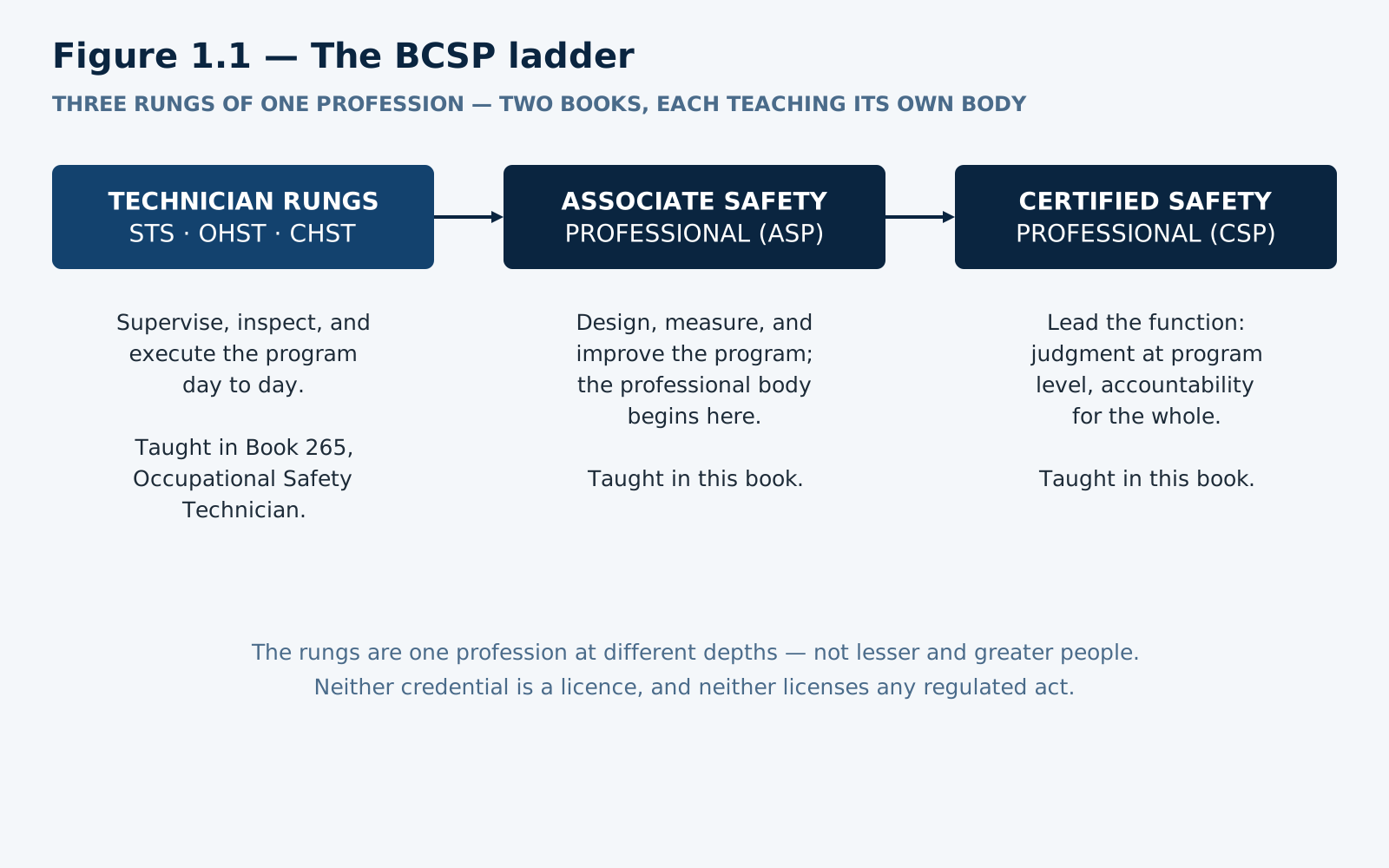
Figure 1.1 — The BCSP ladder map: technician rungs shown as signposts only, with the Associate Safety Professional and Certified Safety Professional rungs taught in this book.
Every worked number in this book that belongs to an employer belongs to one employer, introduced here and used identically in all forty chapters. The Hartline Manufacturing Campus (Hartline) is a fictional single-site employer — a specimen, labeled fictional on its face at this first use — combining a metal fabrication plant, a chemical blending unit, a regional warehouse, and the offices and laboratory that serve them. No real place, city, or state is named or implied for Hartline, and no Hartline figure is a market rate, a benchmark, a target, or a pay figure. Hartline exists so that arithmetic always has honest, consistent material to work on.
Hartline has four areas: the Fabrication Plant, the Chemical Blending Unit, Warehouse and Shipping, and Offices and Laboratory. Its total workforce is 640 employees, each counted once under a primary department: Fabrication 296, Warehouse and Shipping 152, Chemical Blending 88, Maintenance and Utilities 56, and Office and Laboratory 48. Those five lines sum to 640, and the shift count agrees: three shifts carry 288, 224, and 128 employees, which also sum to 640. A professional checks a headcount both ways — by department and by shift — because a total that only reconciles one way is a total not yet trusted. That checking habit, applied to every table in this book, is the first examination skill.
The safety function at Hartline has eight people: an EHS Director, two Safety Managers, three Safety Professionals, one Industrial Hygienist, and one EHS Coordinator. An industrial hygienist is a specialist in anticipating, recognizing, evaluating, and controlling workplace health hazards such as chemical exposures, noise, and radiation. Note carefully what the canon does not say: no Hartline employee is stated to hold any BCSP credential, and no chapter in this book gives one a credential. The specimen's staff are roles, not credential holders, so that no worked example ever borrows authority it has not earned.
Hartline's calendar year 2025 record, used across this book, is fixed. Employee-hours for the year are 1,280,000. Recordable cases total 22, counted once under the most severe outcome: 6 cases with days away from work, 7 cases with restricted duty or job transfer, and 9 cases involving medical treatment beyond first aid. Cases with days away or restriction — the DART cases, meaning cases counted in the days away, restricted, or transferred family — total 13. Days away total 74 days and restricted days total 96 days. First-aid-only cases total 44, near-miss and hazard reports total 132, and fatalities total 0. The safety committee has 14 members, seven employee and seven management, meeting monthly for 12 minuted meetings in the year. Documented area walkthroughs total 416, and one formal program audit is completed each year. One investigated incident, filed as INC-2025-11, is one of the 22 recordable cases; this book never assigns that incident an outcome line, in any telling, exercise, or key, because the canon deliberately leaves it unassigned as a discipline against inventing facts.
One costed corrective action anchors the money examples. Action CA-12, a ventilation hood retrofit in the Blending Unit, cost $3,917.00 in total: labor of $1,152.00, parts of $2,340.00, and verification of $425.00. The labor line is 24.0 labor-hours at $48.00 per hour, and $48.00 is the specimen's own internal costing figure, labeled as such here and at every later locus; it is never a wage and never a market rate. The parts line is a hood at $1,465.00 plus ductwork and fittings at $875.00. Labor-hours in CA-12 are a costing quantity only — never hours worked, never exposure hours, and never a wage basis. Chapter 32 returns to CA-12 to weigh cost against avoided loss; Chapter 5 uses its lines to teach careful addition.
BCSP awards credentials at more than one level, and a reader deserves the map before the climb. At the technician level sit credentials whose holders perform front-line safety tasks under the direction of professionals. Those technician rungs — named here as signposts only, in the form this book is permitted to use — are the Safety Trained Supervisor, the Occupational Health and Safety Technologist, and the Construction Health and Safety Technician, each identified by its acronym in the field as STS, OHST, and CHST. This book does not teach those rungs; a companion volume in this series teaches the technician body. Naming them here does one job only: it shows where the professional rungs stand in relation to the work beneath them.
The professional rungs are this book's subject. The ASP is the first professional door: it certifies a practitioner who has completed the required education, accumulated the required professional-level experience, and passed an examination weighted toward fundamentals applied at professional depth. The CSP is the second door on the same ladder: it requires more experience, requires the candidate to already hold a BCSP approved credential — the ASP is the approved credential this book teaches as the pathway — and its examination weights program management and advanced application most heavily. Chapter 2 prints the eligibility and fee facts in their stamped forms; this chapter keeps only the shape, because the shape is what a newcomer needs first: two doors, one ladder, one body of work examined at two depths.
Two neighboring signposts complete the map without opening either door. The hygiene profession has its own senior credential, named in this book only as a boundary signpost; a reader whose career moves fully into industrial hygiene will meet it there, and this book neither teaches it nor borrows its body. Likewise, other BCSP designations exist for specialized or transitional standing; they are named, where they appear at all, as signposts with owner and one-line character, never taught. The discipline matters for the examination itself: a well-built question never requires knowledge the blueprint does not claim, and a well-built book never teaches a credential it does not cover.
Standing back, the ladder explains the examinations' shared center. Both blueprints test safety programs, hazard control, hygiene, and training because both credential holders do that work. The CSP examination adds weight where the senior practitioner's week actually goes: running the program, managing risk across departments, and answering for results. When later chapters tag an item for one credential or both, the tag is not decoration; it records which sitting, at which depth, claims that piece of the work.
Figure 1.2 (Class P) — The safety professional's field kit ensemble, laid out: measurement, lighting, documentation, and communication families shown as generic types.
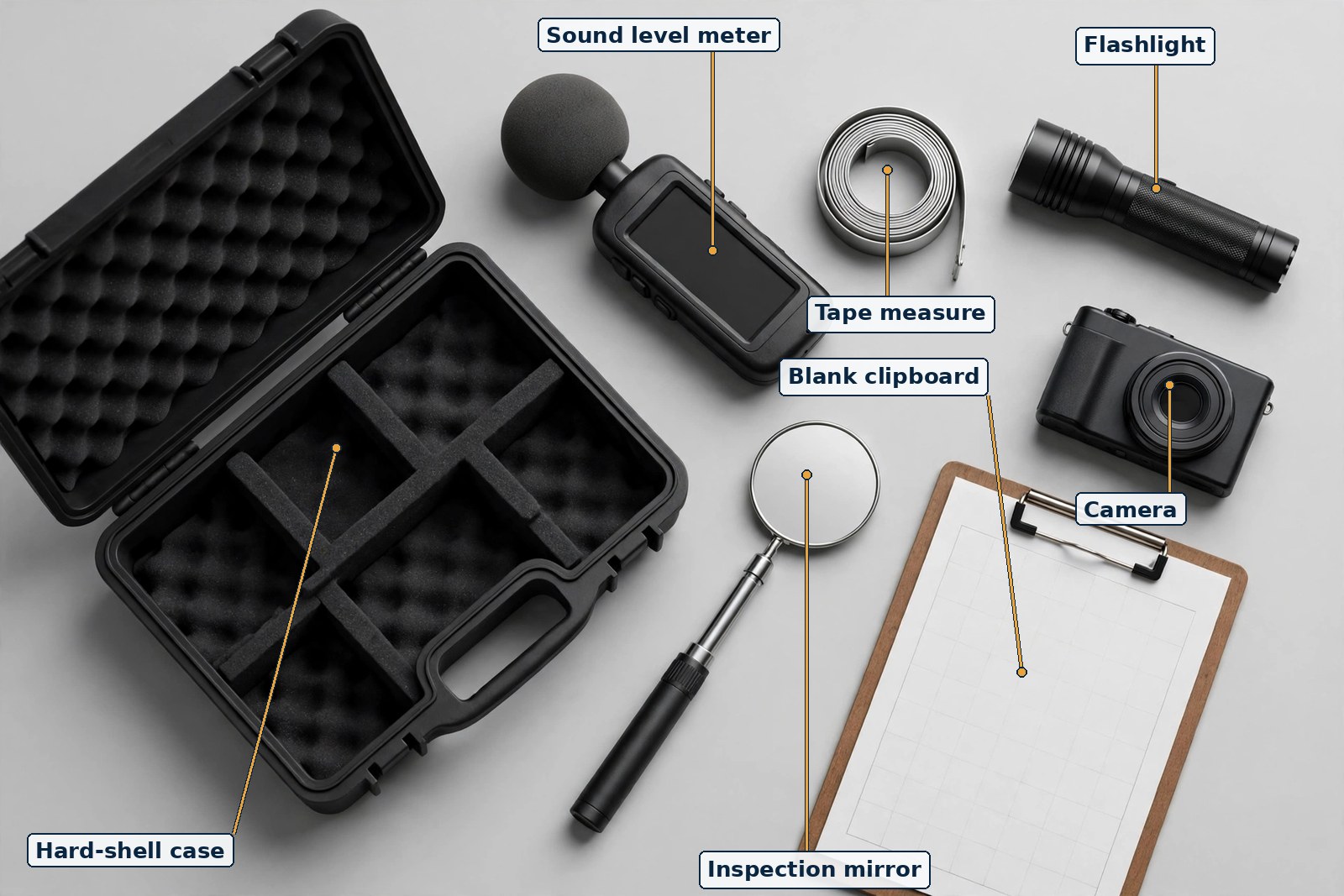
Figure 1.2 — The safety professional's field kit ensemble, laid out: measurement, lighting, documentation, and communication families shown as generic types.
Credentials examine knowledge, but the field rewards craft, and three crafts recur in every chapter that follows. The first is the walkthrough. A walkthrough is a documented, area-by-area inspection tour in which conditions and practices are observed, hazards are noted, and findings are recorded for follow-up. Hartline completes 416 documented walkthroughs in the canon year — eight inspection areas walked weekly — and the number matters less than the discipline behind it: same areas, same cadence, findings written down, closure tracked. An undocumented walk is a stroll; the record is what makes it program work.
The second craft is the conversation. Professionals learn more from a well-asked question at a workstation than from an hour with a procedure manual, because workers know where the guard sticks, which valve is mislabeled, and what the written procedure gets wrong about the real job. Worker participation — the involvement of workers and their representatives in identifying hazards, reporting concerns, and shaping controls — is both an ethical commitment of good programs and a practical source of the best information on any site. The examinations test it as program knowledge; the field tests it every day.
The third craft is writing that survives reading by a stranger. An investigation note, an inspection finding, or a training record may be read months later by a manager, a regulator, an insurer, or a court. The professional writes facts first — what was seen, where, when, measured how — and separates observation from conclusion. That separation is also an examination habit: the best answer on a professional item is usually the one that stays inside the evidence the stem actually gives, just as the best field note stays inside what the writer actually saw.
The field kit in Figure 1.2 serves those crafts. Its families are generic types, not brands: measurement instruments for the quantities the site requires, lighting for the spaces that defeat ordinary vision, documentation tools for notes and photographs taken under the site's own rules, and communication tools for reaching supervision and emergency help. No kit makes its carrier qualified to perform a regulated act. Sampling a worker's exposure, entering a confined space, and working on energized equipment are taught in this book as knowledge, method, and reasoning only; performing them requires the employer's program, training, and authorization, which no book can supply.
Readers reasonably ask what the occupation looks like beyond one campus. This book answers that question in exactly one labeled form, printed here in full, again in Chapter 2, and again in Chapter 40 — and nowhere else. The source is the United States Bureau of Labor Statistics (BLS), which publishes a single combined entry covering specialists and technicians together. Because BLS combines the two groups, every figure in the block describes the combined entry unless a line is explicitly labeled as a component. No pay figure outside this block prints anywhere in this book, and this book promises no job, salary, or outcome to any reader.
The block, in its ruled form: BLS entry name, exactly as published — "Occupational Health and Safety Specialists and Technicians." Edition stamp: Occupational Outlook Handbook, 2024 data; wages May 2024; projections 2024–34. For that combined entry, BLS reports median pay of $78,900 per year ($37.93 per hour), a number of jobs in 2024 of 163,700, a job outlook for 2024–34 of 12 percent growth (much faster than average), an employment change of 19,200 jobs, and openings of about 18,300 per year. Growth in this book always prints paired with openings, as it does here: 12 percent growth alongside about 18,300 openings per year, because a growth rate without the openings count cannot tell a reader how much hiring the growth actually produces. Inside the same block, one component figure is permitted and is labeled as a component: the median for the specialist component of BLS's combined entry is $83,910 (May 2024). That component figure describes the specialist track — the track this book's readers are on — inside the combined entry; it is not a separate entry, not a credential holder's wage, and not a promise. BLS's entry-education shape, printed as framing only inside this block, is that specialists typically need a bachelor's degree in occupational health and safety or a related field, while technicians typically need at least a high school diploma and receive on-the-job training.
Read the block the way a professional reads any combined figure: the combined median blends two groups with different education and duties, so it understates the specialist component and overstates nothing about any individual. The honest use of the block is orientation — the occupation is sizable, growing faster than average, and hiring steadily — not negotiation material and not a forecast for any one reader. Chapters that need money arithmetic use Hartline's program figures or round numbers labeled illustrative, never this block, because a national median cannot price a hood retrofit or justify a budget line.
This book teaches one professional body whole: the mathematics of Chapter 5 onward, the management systems of Part III, hazard control at program level, industrial hygiene at professional depth, ergonomics and human factors, fire, emergency and environmental programs, and the leadership work of Part VIII. It then gathers each examination's layer in its own chapter — the ASP layer in Chapter 36 and the CSP layer in Chapter 37 — so a candidate can review by sitting as well as by subject. Its apparatus of diagnostic items, chapter exercises, two timed practice tests, case batteries, and repair sets is this book's own design, built and disclosed as such; the timed practice tests borrow only the published time allowances of the real sittings, and no other feature of them claims to reproduce a real examination.
The refusals are as deliberate as the teaching. This book prints no passing score for either examination, because the awarding body publishes none in the sources this book rests on. It prints no item count for either real examination, for the same reason. It prints no exposure limit value for any named substance, no numeric value from the construction or general industry standards beyond the shapes the gate allows, and no state names in its framing. Where a fact belongs to an owner — BCSP for credential facts, the regulator for regulatory values, BLS for occupation figures — the book either prints it in the owner's stamped form at a ruled locus or teaches the shape and directs the reader to the owner. A reader who finishes this book should know the work, know the pathway, know the examinations' published shapes, and know exactly which numbers must be confirmed at the source before being relied on. That combination — competence plus honesty about its edges — is what the credentials themselves are meant to certify.
Key terms: hazard; risk; hazard recognition; hazard analysis; safety and health program; recordable case; time-weighted average (TWA); DART cases; prevention through design; industrial hygienist; certification; license; walkthrough; worker participation; Board of Certified Safety Professionals (BCSP); Associate Safety Professional (ASP); Certified Safety Professional (CSP); Hartline Manufacturing Campus.
Q1. Which statement best describes the relationship between the ASP and the CSP? A. They cover unrelated bodies of knowledge for different occupations. B. They examine one professional body at two depths, fundamentals first and then program-level application. C. The CSP replaces the ASP, which has no standing once the CSP is earned. D. The ASP is a government license and the CSP is a voluntary certification.
Q2. Hartline's department headcount lines are 296, 152, 88, 56, and 48. What is the total? A. 630 B. 592 C. 688 D. 640
Q3. What is the correct plain statement of this book's credential fence? A. Neither credential is a licence; neither licenses any regulated act; the book confers nothing. B. The ASP licenses field work and the CSP licenses program work. C. Reading this book qualifies the reader to perform regulated acts under supervision. D. A certification and a license are the same instrument with different names.
Q4. Hartline's shift counts are 288, 224, and 128. Why does the book check the headcount by both department and shift? A. Because shift counts determine employee-hours for the year. B. Because departments and shifts are counted under different rules. C. A total that reconciles two independent ways is a total that can be trusted; one that reconciles only one way is not yet trusted. D. Because the safety committee requires two headcount tables.
Q5. Which item belongs to Hartline's safety function as canon states it? A. Four Safety Professionals and no Industrial Hygienist. B. Eight people: an EHS Director, two Safety Managers, three Safety Professionals, one Industrial Hygienist, and one EHS Coordinator. C. Eight people, two of whom hold the CSP. D. Six people: a Director, two Managers, and three Professionals.
Q6. In the BLS block as printed in this chapter, the figure $83,910 is best described as what? A. The median for the specialist component of BLS's combined entry, labeled as a component. B. The median pay for the combined entry as a whole. C. The typical starting salary of a CSP holder. D. A figure this book may print anywhere pay is discussed.
Q7. Hartline's CY2025 recordable cases are 6 with days away, 7 with restriction or transfer, and 9 with medical treatment beyond first aid. What is the total number of recordable cases? A. 16 B. 13 C. 22 D. 20
Q8. Which treatment of INC-2025-11 follows the canon? A. It is counted as a days-away case because it was investigated. B. It is one of the 22 recordable cases, and its outcome line is never assigned in any telling. C. It is an additional case beyond the 22 because it has its own file number. D. It is counted as a restricted-duty case in the exercises only.
Q9. CA-12's labor line is 24.0 labor-hours at $48.00 per hour. How must the $48.00 figure be described at every locus? A. As the prevailing market wage for ventilation technicians. B. As the hourly pay of the Hartline technicians who did the work. C. As a national costing benchmark for corrective actions. D. As the specimen's own internal costing figure.
Q10. What is the total cost of CA-12 from its canon lines — labor $1,152.00, parts $2,340.00, verification $425.00? A. $3,917.00 B. $3,492.00 C. $3,765.00 D. $4,342.00
Q11. Which statement about the technician rungs (STS, OHST, CHST) is correct in this book? A. They are taught in full in Part I before the professional rungs. B. They are the required first step before any candidate may sit for the ASP. C. They are named as signposts only and are not taught in this book. D. They are BCSP licenses for front-line field work.
Q12. A professional prefers a control that removes the hazard over equipment worn by the worker. What principle does that preference express? A. Controls that do not depend on worker behavior are preferred, and personal protective equipment is the last layer, never the plan itself. B. Worn equipment is preferred because it is the least expensive control. C. Removing a hazard is discouraged because it changes the process. D. All controls are equal, so cost alone should decide.
Q13. In the BLS block, why is the 12 percent growth figure always printed paired with about 18,300 openings per year? A. Because openings are the larger number and make the occupation look stronger. B. A growth rate without the openings count cannot show how much hiring the growth actually produces. C. Because BLS forbids printing a growth rate on its own. D. Because the two figures are interchangeable measures of the same thing.
Q14. Which statement about Hartline's employees and BCSP credentials follows the canon? A. The EHS Director holds the CSP and the Industrial Hygienist holds the ASP. B. Three Safety Professionals hold the ASP as a condition of their roles. C. The canon gives the Industrial Hygienist a hygiene credential instead of a BCSP credential. D. No canon fact states that any Hartline employee holds any BCSP credential, and no chapter may give one a credential.
Q15. Hartline completes 416 documented walkthroughs in the canon year. What makes a walkthrough program work rather than a stroll? A. The same areas on the same cadence, with findings written down and closure tracked. B. Walking quickly so more areas can be covered each week. C. Varying the route each week so no area is visited twice. D. Reporting only the most severe finding from each tour.
Feras Alzubi
Exam Prep Series
2026 Edition
Copyright © 2026 Feras Alzubi. All rights reserved.
No part of this book may be reproduced, stored in a retrieval system, or transmitted in any form or by any means — electronic, mechanical, photocopying, recording, or otherwise — without the prior written permission of the author, except for brief quotations in reviews and other uses permitted by copyright law.
Every practice question, explanation, case file, and worked example in this book is original to this book. No examination question of the Board of Certified Safety Professionals (BCSP) is reproduced, recalled, paraphrased, or adapted anywhere in these pages, and no passage of any standard, handbook, or manufacturer's publication is reproduced into usable form.
Not-affiliated disclosure. This book is not affiliated with or endorsed by the Board of Certified Safety Professionals (BCSP). BCSP did not write, review, approve, or sponsor this book. The names Associate Safety Professional (ASP) and Certified Safety Professional (CSP) are named in this book as a statement of fact about the voluntary certifications this book prepares readers to study for. Certification decisions belong to BCSP alone; this book confers no certification, no eligibility, and no authorization of any kind.
The honesty fences, printed plainly. Neither credential is a licence, and neither licenses any regulated act. BCSP publishes no passing score for either examination, and this book prints none; results are reported in pass/fail form only. Hands-on and regulated acts — exposure sampling on a worker, confined-space entry, energized work, rescue, and the like — are taught in this book as knowledge, method, and reasoning only. Reading this book creates no authority to perform any act, and no chapter teaches a reader to defeat a guard, bridge an interlock, work energized, enter a confined space, or sample a worker's exposure on this book's word.
Specimen notice. The employer worked throughout this book — the Hartline Manufacturing Campus — is a fictional specimen employer, labeled a specimen on its face at first use in Chapter 1 and introduced in full later in this front matter. All specimen facts are fictional and illustrative. No real employer, person, or place is depicted, and every machine, tool, and product named is a generic type. All money figures attached to the specimen are the specimen's own program figures — never market rates, benchmarks, targets, or pay figures.
Front Matter
Part I — The Professional and the Pathway
Part II — Safety Mathematics
Part III — Management Systems and Programs
Part IV — Hazard Control at Program Level
Part V — Industrial Hygiene at Professional Depth
Part VI — Ergonomics and Human Factors
Part VII — Fire, Emergency, and Environment
Part VIII — Leading the Function
Part IX — The Credential Layers and the Career
Back Matter
This page states the two examinations themselves, from their owner's own publications. A few terms carry the whole page, so they are defined once, here. A certification is a voluntary credential awarded by a professional body to a person who meets its education and experience requirements and passes its examination; it is not permission from any government to do anything. A blueprint is the examination owner's published plan for what an examination covers, organized into domains — named areas of the professional body of knowledge — each carrying a published weight, the share of the examination that domain represents. Eligibility is the owner's determination, before scheduling, that a candidate meets the education, experience, and credential requirements for a credential. Recertification is the owner's periodic renewal process, in which a certificant maintains the credential by paying an annual fee and earning recertification points on a five-year cycle.
Source for both panels and for the common mechanics below: Board of Certified Safety Professionals (BCSP) — BCSP credential pages for the ASP and the CSP (bcsp.org, updated June 2026); Credentials At-A-Glance, V.2026.04.01; ASP11 Examination Blueprint, V.2024.04.24 (effective September 1, 2025); CSP11 Examination Blueprint, V.2024.04.24 (effective August 1, 2025); BCSP "What to Expect When Sitting for a BCSP Exam" page (updated March 31, 2025) — as published at bcsp.org and read for this book's fact gate on November 14, 2026. BCSP's own note prints with every fee in this book: fees and passing scores are subject to change without advance notice. Check BCSP for current fees and requirements before applying.
What both credentials are. The Associate Safety Professional (ASP) and the Certified Safety Professional (CSP) are voluntary professional certifications issued by the Board of Certified Safety Professionals (BCSP). Neither credential is a licence, and neither licenses any regulated act. No BCSP credential licenses any person to practice safety, to perform any regulated act, or to hold any job title a jurisdiction reserves, and this book confers no certification, eligibility, or authorization of any kind.
Common mechanics (both examinations). Application is open at any time through the candidate's BCSP My Profile. Once a candidate is determined eligible, the candidate has one (1) year to take and pass the examination; a one-time eligibility extension ($100) is available within 60 or fewer days of the deadline and is valid one year. Examinations are computer-delivered at Pearson test centers, scheduled through the My Profile single sign-on. Each item presents four possible answers with one best answer. An on-screen calculator emulating the TI-30XS is provided, and no physical calculator is permitted. For any question requiring a formula, the formula is included within the question unless the question specifically tests knowledge of the formula. Roughly 12% of items are unscored beta items, integrated into the examination and unidentified to the candidate. Official results are available as soon as the candidate submits the exam. A new attempt must be scheduled at least six (6) weeks from the last attempt. Applicants must disclose convictions and actions against a professional license or credential under BCSP's Criminal Conviction policy. Maintenance of either credential is an annual fee plus recertification points every five (5) years.
Passing standard, stated plainly. BCSP's candidate-facing publications state no numeric passing score for either examination, so this book records that absence rather than filling the space: no passing score for the ASP or the CSP prints anywhere in this book, from any source, and results are described in pass/fail form only. For the same reason, no item count for either real examination prints anywhere in this book: BCSP's own pages and blueprints, as read for this book, publish none. This book's own practice apparatus is described by its own counts only, and its two timed practice tests are sized and disclosed on their faces as this book's own design.
Identity. Associate Safety Professional (ASP) — a voluntary professional certification of the Board of Certified Safety Professionals (BCSP); not a licence.
Eligibility. Education: a bachelor's degree in any field, OR an associate degree in safety, health, and environmental (SH&E) whose program includes at least four courses with at least 12 semester hours of study in the SH&E domains of the ASP blueprint. Experience: one (1) year of SH&E experience, at least 50% preventative, professional-level work with breadth and depth of safety duties.
Fees (USD), in BCSP's full stated form. Application $160 · single examination $350 · app + exam combo $494 · exam bundle $600 (two attempts + one self-assessment; access six months) · app + exam bundle combo $744 · eligibility extension $100 · annual renewal $175. Fees and passing scores are subject to change without advance notice; check BCSP for current fees.
Format. Time allowed: 5 hours. Delivery, item form, calculator, results, and retake mechanics are the common mechanics stated above.
Domains (ASP11 Examination Blueprint, V.2024.04.24, effective September 1, 2025 — domain names and weights verbatim; the subjects inside each domain are taught in this book's own words). Mathematical Calculations 10% · Safety Programs and Concepts 25% · Ergonomics 8% · Fire Prevention and Protection 12% · Emergency Preparedness and Response 10% · Industrial Hygiene and Occupational Health 12% · Environmental Management 7% · Training, Education, and Communication 11% · Legal 5%. The nine weights sum to 100%.
Recertification. Five-year cycle: 25 points, including 0.5 points from ethics courses; the ethics requirement applies to cycles beginning on or after July 1, 2023. An annual renewal fee also applies, as listed in the fees above.
Identity. Certified Safety Professional (CSP) — a voluntary professional certification of the Board of Certified Safety Professionals (BCSP); not a licence.
Eligibility. Education: a minimum of a bachelor's degree in any field. Experience: four (4) years of SH&E experience, at least 50% preventative, professional-level work with breadth and depth of safety duties. Credential: a BCSP approved (qualified) credential is required. The ASP is one such credential, and it is the pathway this book teaches; BCSP publishes the full list of qualified credentials, and readers are directed to BCSP's current list for the rest.
Fees (USD), in BCSP's full stated form. Application $160 · single examination $350 · app + exam combo $494 · exam bundle $600 (two attempts + one self-assessment; access six months) · app + exam bundle combo $744 · eligibility extension $100 · annual renewal $185. Fees and passing scores are subject to change without advance notice; check BCSP for current fees.
Format. Time allowed: 5.5 hours. Delivery, item form, calculator, results, and retake mechanics are the common mechanics stated above.
Domains (CSP11 Examination Blueprint, V.2024.04.24, effective August 1, 2025 — domain names and weights verbatim; the subjects inside each domain are taught in this book's own words). Advanced Application of Safety Principles 25% · Program Management 25% · Risk Management 15% · Emergency Management 9% · Environmental Management 6% · Occupational Health and Applied Science 10% · Training 10%. The seven weights sum to 100%.
Recertification. Five-year cycle: 25 points, including 0.5 points from ethics courses; the ethics requirement applies to cycles beginning on or after July 1, 2023. An annual renewal fee also applies, as listed in the fees above.
A note on weights, so two different things are never confused. The domain weights printed above are facts about BCSP's examinations. This book's own study apparatus — the diagnostic strands, the timed practice tests' distributions, and the repair sets — is sized by this book's own design and is labeled as this book's own design on its face wherever it appears. The timed practice tests' distributions are sized to the blueprint weights as a study design; no strand or test proportion in this book is presented as anything other than this book's design, and performance on this book's apparatus is not a prediction of examination performance.
The ladder, in one view. The Board of Certified Safety Professionals (BCSP) maintains a family of certifications that climbs from technician and supervisor rungs to the professional rungs this book teaches. The two professional rungs are the Associate Safety Professional (ASP) and the Certified Safety Professional (CSP). Below them stand the technician rungs — the Safety Trained Supervisor (STS), the Occupational Hygiene and Safety Technician (OHST), and the Construction Health and Safety Technician (CHST). Those three rungs are named here as signposts only: they are not taught in this book, and readers who want that body are directed to its own volume in this line, Book #265, Occupational Safety Technician Exams (STS, OHST, CHST), and to BCSP's own pages at bcsp.org for the credentials themselves.
The ASP-to-CSP pathway, taught plainly. The road this book teaches runs in one direction. A candidate who meets the ASP's education and experience requirements — a bachelor's degree in any field, or the qualifying associate degree route, plus one year of qualifying SH&E experience — applies, sits the ASP examination, and, on passing, holds the ASP. The ASP then does double duty. It stands on its own as a certification in its own right, held and maintained on its own terms. It is also a BCSP qualified credential for the CSP: a professional who later meets the CSP's requirements — a bachelor's degree at minimum, four years of qualifying SH&E experience, and a BCSP qualified credential, which the ASP supplies — may apply for the CSP and sit its examination. Neither step is automatic, and neither is promised by this book: BCSP alone determines eligibility and awards each credential, on the stamped terms printed on the Exam Blueprint page in this front matter. A candidate may also reach the CSP holding a different BCSP qualified credential; BCSP publishes the full list, and this book teaches the ASP pathway because it is the road its two examinations share.
One body, two sittings. The reason one book carries both credentials is that the two examinations stand on one professional body. The CSP's blueprint re-cuts the same ground at application depth: its two lead domains, Advanced Application of Safety Principles and Program Management, together carry half of that examination, and its remaining domains apply the same systems, hygiene, and training body the ASP examines at foundation depth. That is why this book teaches the body once, whole, and then gathers each examination's layer separately — Chapter 36 for the ASP, Chapter 37 for the CSP — with every practice key cross-tagged to the domain or domains it serves.
The fences, once more, because they govern every page that follows. Neither credential is a licence, and neither licenses any regulated act. Certification is not a guarantee or assurance of the competence or ability of any particular individual, and holding a credential does not by itself qualify or authorize anyone to perform a regulated, energized, or hazardous act. Employers hire, qualify, and authorize safety personnel task by task; BCSP examines and certifies them; the regulators regulate workplaces, not this book's readers; this book teaches the knowledge the professional rungs stand on — knowledge, method, and reasoning only.
The labor-market context, stated under its own label. The Bureau of Labor Statistics (BLS) publishes one combined entry, "Occupational Health and Safety Specialists and Technicians," covering specialists and technicians together, and BLS publishes no separate professional-only set of figures for the readers of this book. That standing fact is stated here so that no figure printed anywhere in this book is ever mistaken for a professional-only figure; the labeled combined-entry figures themselves print only at the loci the book's fact gate rules, and no BLS figure of any kind prints in this front matter.
Not a manual, not site procedure, not professional advice. This book teaches occupational safety knowledge and method for education and examination preparation. It is not an employer's safety manual, a site procedure, or professional advice, and reading it does not qualify or authorize any reader to perform any regulated, energized, or hazardous act. Work in real workplaces belongs under the reader's employer's program and qualification, the equipment manufacturer's own instructions, and the standards of the responsible authority, to which readers are directed for their own work.
Every worked example in this book works on one employer, introduced here and labeled a specimen — a fictional teaching employer whose facts are fixed once, in this canon, and never change from chapter to chapter. The Hartline Manufacturing Campus ("Hartline") is a fictional single-site employer: a metal fabrication plant, a chemical blending unit, a regional warehouse, and the offices and laboratory that serve them. No real place, city, or employer is named or implied. Learn the specimen once, and every later chapter's arithmetic starts familiar — which is the point: on the job, a safety professional reads one workplace deeply, not fifty workplaces shallowly.
Areas and people. Hartline has 4 areas: Fabrication Plant · Chemical Blending Unit · Warehouse & Shipping · Offices & Laboratory. It employs 640 people, each counted once under their primary department: Fabrication 296 · Warehouse & Shipping 152 · Chemical Blending 88 · Maintenance & Utilities 56 · Office & Laboratory 48. The campus runs 3 shifts: Shift 1, 288 people · Shift 2, 224 people · Shift 3, 128 people. Its safety function has 8 people: an EHS Director (1), Safety Managers (2), Safety Professionals (3), an Industrial Hygienist (1), and an EHS Coordinator (1). No canon fact states that any Hartline employee holds any BCSP credential, and no chapter gives one a credential.
Hours and cadence, calendar year 2025 (CY2025). Hartline's employee-hours for CY2025 are 1,280,000 — the canon's stated convention of 640 employees × 2,000 hours, taught as this specimen's convention in Chapter 7 and never restated on another basis. The safety committee has 14 members (7 employee + 7 management), meets monthly — 12 meetings in the year — and minutes each meeting. Documented area walkthroughs total 416 in the year (8 inspection areas, each walked weekly). A formal program audit runs once per year; no audit finding count is a canon fact. New-hire orientation is given to every new hire before their first unsupervised shift; no hire count is a canon fact.
The record for CY2025. Recordable cases, each counted once under its most severe outcome: 6 cases with days away from work · 7 cases with restricted duty or job transfer · 9 cases of medical treatment beyond first aid — a total of 22 recordable cases. The DART cases — the days-away and restricted/transfer cases together — number 13. Days away total 74 days; restricted days total 96 days. First-aid-only cases number 44; near-miss and hazard reports number 132; fatalities number 0. Two rates, computed on OSHA's published convention and taught in Chapter 7, summarize the year: the total recordable incident rate (TRIR) is 3.44, and the DART rate is 2.03. No other rate for Hartline exists. One investigated incident, INC-2025-11, is one of the 22 recordables; its outcome line is never assigned, in any telling, exercise, case, or key in this book.
The one costed corrective action. CA-12, a ventilation hood retrofit in the Chemical Blending Unit, is the specimen's one costed corrective action, and its lines never change: labor of 24.0 labor-hours (3 technicians × 8.0 hours) at the specimen's internal costing figure of $48.00 per hour = $1,152.00 · parts of $2,340.00 (the hood at $1,465.00 + ductwork and fittings at $875.00) · verification at $425.00 · a total of $3,917.00. The $48.00 figure is the specimen's own internal costing figure, labeled as such at every place it appears; it is never a wage, a market rate, or a pay figure, and the labor-hours are a costing quantity only — never hours worked or exposure hours.
The exposure and ventilation records. The specimen's exposure record is one Blending Unit operator's solvent vapor day: 2.5 hours at 140 parts per million (ppm) + 4.0 hours at 90 ppm + 1.5 hours at 40 ppm, which Chapter 8 works into an 8-hour time-weighted average (TWA) — a concentration averaged over time, each concentration weighted by how long it lasted — of 96.25 ppm. That figure is a concentration record of the specimen, nothing more: no chapter calls 96.25 ppm safe, unsafe, compliant, or over any limit, and no exposure-limit value for any substance prints anywhere in this book. The ventilation record belongs to the CA-12 hood after its retrofit: a hood face of 2 feet × 3 feet = 6 square feet at 100 feet per minute of face velocity moves 600 cubic feet per minute (cfm) of air — the canon's one ventilation line, worked in Chapter 9.
The rhythm. This book teaches, then tests. Each of the 40 chapters teaches its body whole — every technical term bolded and defined at first use, foundations before the procedures that rest on them, the specimen carrying the worked examples — and closes with 15 practice questions. A separate key explains the correct answer and every wrong option for every question, so a wrong answer teaches as much as a right one. Two timed practice tests then rehearse each examination's sitting under its published time allowance, two case batteries work whole professional problems end to end, and eight repair sets give focused extra practice by strand. In all, the apparatus carries 1,010 explained practice items, and every one of them is original to this book.
Start with the diagnostic. Take the Readiness Diagnostic before Chapter 1. It is this book's own readiness instrument — not a BCSP examination, not a replica of one, and not a prediction of its contents. Its 50 items run in five strands of 10, sized by this book's own design and labeled as this book's own design on its face: MATH (Q1–Q10), SYSTEMS (Q11–Q20), HYGIENE (Q21–Q30), CONTROL (Q31–Q40), and LEAD (Q41–Q50). Score it by strand, never as one combined number: a strand score tells you which part of the book to study first, and a combined number would hide exactly that. The diagnostic's face routes each strand to its chapters and its repair sets; study the parts your weakest strands point to, and return to the matching repair set when a strand needs more work.
Study rhythms. Read a chapter in one sitting where you can; work its 15 questions closed-book in a second sitting; read the key in a third, including the explanations of the options you did not choose. Candidates preparing for the ASP should still study the shared body whole — the CSP layer stands on it — and then gather the ASP layer in Chapter 36. Candidates preparing for the CSP gather their layer in Chapter 37 and should treat the ASP-layer chapters as the foundation review they are. The study plans in the back matter lay out paced paths through the book, referenced to chapters.
One specimen, all the way through. Every worked number in this book is either a Hartline canon number, identical at every place it appears, or a round standalone number labeled illustrative on its face. When a fee, a requirement, or a blueprint weight appears, it appears in the stamped form of the Exam Blueprint page in this front matter, and nowhere else in the book carries a different version of it. Where a chapter teaches a procedure-shaped body, it teaches it as knowledge, method, and reasoning, with the escalation taught alongside it: follow the site's own procedure, work under the employer's program and qualification, and stop and escalate to the qualified person at the line the chapter names.
What this book will not do. It will not certify you, qualify you, or authorize you to perform any act. It will not substitute for your employer's program, your site's procedures, qualified supervision, or the standards themselves. It promises teaching only: a complete, honest preparation for two examinations, with its limits stated as plainly as its contents.
End of the free sample. The complete book continues from here — the full A-to-Z course in book form, delivered as an EPUB you can read in Apple Books, Google Play Books, ReadEra, Thorium Reader, Adobe Digital Editions, or Send to Kindle.
Buy this ebook — $11.99 Back to the book page
Payments are securely processed by Payhip.