
Mastering Careers & Skills
X-Ray Technologist Exam (ARRT Radiography) · free sample from the book itself
Google Play Books Exam Prep Series
Feras Alzubi
---
2026–2027 Edition · Built on two specifications editions that are both live across this edition's life: ARRT's Examination Content Specifications for Radiography, Board approved January 2021, implementation January 1, 2022, governing sittings before March 1, 2027, and the same specifications, Board approved January 2026, implementation March 1, 2027, governing sittings on and after that date — with ARRT's 2026 Primary Eligibility Pathway Handbook and the ARRT documents named on the Copyright and Version Page, as read October 31, 2026 · Confirm your own sitting date, and the specifications that govern it, before you study a single flagged passage.
Counts in this book. Every count in this front matter is an as-built count, taken at production from the items' own recorded addresses by the method printed on the crosswalk appendix's face: 1,120 practice items — a 60-item diagnostic, a 20-item quiz closing each of the 20 chapters (400), two full timed practice forms of 230 presented items each (460: 200 scored-shape + 30 pilot-position per form), and eight 25-item subcategory repair sets (200). Inside that census, 200 items are scored designated exercises in five families (DEC-01 44 · DEC-02 54 · DEC-03 38 · DEC-04 48 · DEC-05 16), and 6 further DEC-tagged items sit at pilot positions in the second full form — 206 DEC-tagged items in total. The register was designed at 256 designated exercises; it is reported as built at 206, because the chapter layer carries its as-built 60 rather than the 116 planned, and the shortfall is reported, never padded. The book carries 34 labeled figures (20 illustrations of the room, its machines, and the body itself, and 14 diagrams) and a 550-term glossary.
---
X-Ray Technologist Exam (ARRT Radiography) — 2026–2027 Edition
Copyright © 2026 Feras Alzubi.
All rights reserved. No part of this book may be reproduced or transmitted in any form or by any means without the publisher's prior written permission, except for brief quotations in a review.
Edition bases — the dual-edition statement. Read this page before you rely on any figure in this book.
ARRT changes the Radiography content specifications on March 1, 2027, inside this book's first edition cycle. This edition is therefore built, deliberately, on both specifications editions:
Supporting bases, each read as recorded in the References at the back of this book:
The manuscript teaches the union of the two specifications outlines. Every passage whose content differs between the editions carries its sitting-date flag at the teaching point. Practice forms are composed, as designed, at the 2027 weights as the book's forward default, with the 2022 composition printed beside every form, as designed, so a pre-transition reader can rebalance. A full dual crosswalk — chapter by chapter, against both outlines — closes the book.
Version: First edition, published November 1, 2026. The edition bases above are fixed for this edition and change only in a new, re-based edition. The production re-verification of both specifications editions was performed on the production date (November 1, 2026) and its dated result is recorded in the book's source register and noted in the Errata and Edition Note at the back of this book: both editions stand as printed, and the March 1, 2027 transition date is unchanged..
Exam names and trademarks belong to their respective owners and are used in this book only to identify the examination and its published structure.
---
This book is an independent study guide. It is not published by, affiliated with, endorsed by, or approved by the American Registry of Radiologic Technologists (ARRT), and it is likewise not affiliated with or endorsed by the American Society of Radiologic Technologists (ASRT), the National Council on Radiation Protection and Measurements (NCRP), or Pearson VUE. ARRT, R.T., and related marks belong to their owners. Passing any examination also depends on the candidate's own preparation; no book can guarantee a result, and this book makes no pass guarantee of any kind.
Every practice question in this book is original, written to the published specifications outlines. No item is an actual examination question, and none is a recalled or reconstructed one. Disclosing examination questions or answer options is itself a violation of ARRT's Standards of Ethics, as ARRT's Handbook records — which is why real items are never legitimately available, and why any product marketing "actual exam questions" is offering a violation, not a shortcut.
Every examination figure in this book traces to one of the ARRT publications named on the Copyright and Version Page, checked on October 31, 2026. The full source register, entry by entry, is printed as the References at the back of this book, and the register's numbered entries (entries 1 through 7) are the authority behind every examination fact printed here — with the methods and quality-control values resting, as the References now record, on the register's production verification records (production read 4 and production read 5) and the authorities those records name. Where secondary materials disagree with those publications — on how many questions are presented, on the form of the passing score, on the length of the sitting — the ARRT publications govern, and the older forms appear in this book nowhere as facts.
ARRT reports scaled scores, not raw scores. The total scaled score ranges from 1 to 99, and a scaled score of 75 is required to pass. ARRT and expert panels set, for each exam version, how many correct answers a scaled score of 75 requires — which is why 75 in this book is always a point on a scale and never a percentage, and never a count of correct answers. Section scores, reported in steps from 0.1 to 9.9, accompany the official score report as study feedback; the total is computed from the total number of correct answers, not as an average of section scores, and no section carries a separate passing hurdle.
Practice results in this book are printed as raw counts of this book's own items, with study guidance attached to the count. No practice result is converted to a scaled score, to a percentage of the passing standard, or to a prediction of any examination outcome — in the text, in a form's scoring guidance, or anywhere else.
The score shown at the end of a real sitting is preliminary only: it does not indicate pass or fail, and it cannot be printed. The official report follows by secure link, and certification status posts to ARRT's Verify Credentials within about four weeks, as ARRT's Handbook publishes it.
This book prints fees only in the form its sources allow, each with its source named at the point of use:
No program tuition, no state licensing fee, no testing-center fee, and no "total cost" or "total investment" figure built by adding amounts together is printed in this book.
Older preparation materials were built on one specifications edition. This book is built on two, because your sitting may fall on either side of March 1, 2027, and because a retake can cross that date: a candidate whose first attempt falls in February 2027 may retake in April under different weights and a revised outline — a warning ARRT's own Handbook gives retakers, and the reason Chapter 20 maps the boundary change by change. If ARRT moves the transition date, this edition's dating language is corrected through the errata commitment at the back of this book; the union manuscript — both outlines, flagged — stands either way.
---
The ARRT Radiography examination — the examination component of ARRT certification and registration in Radiography, a primary-pathway credential. The credential is Registered Technologist (R.T.). Passing the examination alone confers nothing until ARRT confirms the other two requirements below.
Eligibility is three requirements — Education + Ethics + Examination (ARRT, 2026 Primary Eligibility Pathway Handbook):
Certification is not licensure. ARRT certification and registration is the national credential; state licensure is a separate act of the state, and many states license on the basis of ARRT certification. Confirm your state's requirements with its licensing entity; no state's rule, fee, or process is printed in this book.
The sitting, as ARRT publishes it (ARRT, 2026 Primary Eligibility Pathway Handbook, exam-format chart; both specifications editions):
| Fact | Published form |
|---|---|
| Presented items | 230 |
| Scored / unscored (pilot) | 200 scored + 30 unscored (pilot), the pilots indistinguishable from the scored items |
| Test time | 230 minutes |
| Appointment | 250 minutes (4 hours, 10 minutes): 8-minute tutorial + 2-minute nondisclosure agreement (NDA) window + 230-minute test + 10-minute post-exam survey |
| Scheduled break | None in the Radiography sitting. Leaving the room runs the clock; an absence of more than 10 minutes triggers an incident report and ARRT investigation; leaving the building cancels the score and counts as an attempt |
| Navigation | Answer each question before advancing; items may be flagged and returned to for review if time remains; ARRT's pacing frame is approximately one minute per question |
| Item formats | Multiple-choice and sorted-list questions, as ARRT names them |
| Calculator | An on-screen calculator, taught in the tutorial; a basic four-function handheld calculator may be requested; no candidate calculator is admitted. Nothing may be written on the note booklet before accepting the NDA, and the NDA must be accepted within two minutes or the exam ends without counting as an attempt |
| Scoring | Scaled score 1–99; a scaled score of 75 passes; section scores 0.1–9.9 as feedback; the preliminary score at the center is not a result |
The content weights — both editions, each with its sitting dates. Weights are counts of scored questions, exactly as each specifications edition publishes them.
2022 specifications — sittings before March 1, 2027 (Board approved January 2021; in force January 1, 2022):
| Content category | Scored questions | Subcategories (scored questions) |
|---|---|---|
| Patient Care | 33 | Patient Interactions and Management (33) |
| Safety | 50 | Radiation Physics and Radiobiology (21) · Radiation Protection (29) |
| Image Production | 51 | Image Acquisition and Evaluation (26) · Equipment Operation and Quality Assurance (25) |
| Procedures | 66 | Head, Spine and Pelvis Procedures (18) · Thorax and Abdomen Procedures (20) · Extremity Procedures (28) |
| Total scored | 200 |
2027 specifications — sittings on and after March 1, 2027 (Board approved January 2026):
| Content category | Scored questions | Subcategories (scored questions) |
|---|---|---|
| Patient Care | 31 | Patient Interactions and Management (31) |
| Safety | 46 | Radiation Physics and Radiobiology (21) · Radiation Protection (25) |
| Image Production | 51 | Image Acquisition and Evaluation (26) · Equipment Operation and Quality Assurance (25) |
| Procedures | 72 | Head, Spine and Pelvis Procedures (20) · Thorax and Abdomen Procedures (22) · Extremity Procedures (30) |
| Total scored | 200 |
Maintaining the credential, in preview (taught in full in Chapter 20; ARRT, Guide to Maintaining Your ARRT Credential): renew every year, online, by midnight Central on the last day of your birth month, at the flat $65 fee effective January 1, 2026 · report 24 Category A or A+ continuing education credits per biennium (credits do not carry between biennia; missing the requirement leads to CE probation, with six months to complete it) · complete CQR every 10 years per discipline — professional profile, structured self-assessment, then prescribed continuing education — in addition to renewal and biennial CE, with the compliance period beginning in the eighth year after certification in that discipline.
---
Before Chapter 1, answer one question: when will you sit?
That decision selects your study plan below, tells you which weight table on the Exam Blueprint Page is yours, and tells every flag in the book how to speak to you. If your date changes, change your plan — the book is built so that you can.
This book is built for three readers at once, and its foundations part exists so that none of them is stranded.
Path 1 — From zero. You are a prospective student or career-changer, or a first-term student whose physics and anatomy are still new. Start at Chapter 1 and read Part I (Chapters 1–4) in order: the credential and the examination, the profession and the radiography room object by object, the language of positioning, and the body taught from zero. Take the diagnostic after Part I, not before it, and follow the post-transition or pre-transition plan below that matches your expected sitting date, in its 8-week form.
Path 2 — The program student. You are enrolled in, or newly graduated from, an ARRT-verified program. Take the diagnostic first. Where it routes you into Part I, read those chapters; where it does not, skim Part I for the book's conventions — the sitting-date flags, the addresses below, and the fences on the Disclosure page — and begin at the part your scores point to.
Path 3 — The retaker. You hold a score report. Read it the way Chapter 20 teaches — section scores as a study map, not as hurdles — then work the subcategory repair sets it points to. If your next sitting falls on the other side of March 1, 2027 from your last one, follow a retake-across-the-boundary plan below before you re-read anything else: what changed between the editions is smaller than the whole book, and it is exactly where an unflagged re-read wastes your weeks.
Whichever path you are on: no reader is assumed to have performed any clinical procedure, and every reader is assumed able to learn a system when it is shown, named, and worked. The complete-knowledge promise and the examination promise are the same book — foundations first, examination layer on top of them, neither sold as the other.
Designed structure, labeled as designed: the book as designed comprises twenty chapters in seven parts, with a prose target stated in its design and recorded, as a designed figure, in the production notes — no prose extent is asserted on this page as an as-built count.
Inside each chapter the architecture is the same, so you can navigate by habit: the content in plain words first, then at examination depth; every difference between the two specifications editions flagged where it is taught; worked examples, with designated exercises derived step by step; and a chapter quiz, keyed to the chapter, at the chapter's end.
Every practice item in this book carries an address in the item bank: the specifications edition or editions it serves (2022, 2027, or both), its category and subcategory in the outlines' published names, its outline line, and its chapter. An item serving only the 2022 outline is flagged for its sitting window exactly as prose is.
Designed figures, labeled as designed: the practice architecture as designed comprises a 60-item diagnostic, a 20-item quiz at the end of each of the twenty chapters, two full timed practice forms of 230 presented items each, and one 25-item repair set for each of the eight subcategories — 1,120 items as designed in total, of which, as designed, 1,060 are scored-shape items and 60 occupy pilot positions in the two full forms (see the forms statement below), and 256 as designed are designated exercises across the five DEC families. *As built (counted at production from the as-built item files and their key entries, and verified at Gate B): the book carries the same 1,120 items, of which 200 are scored designated exercises (DEC-01 44 · DEC-02 54 · DEC-03 38 · DEC-04 48 · DEC-05 16) and 6 further DEC-tagged items sit at pilot positions in the second full form (DEC-01 ×1, DEC-02 ×3, DEC-04 ×2) — 206 DEC-tagged items in total. The as-built counts supersede the designed figures wherever the two differ.*
As designed, each full form is a 230-item, 230-minute sitting rehearsal: 200 scored-shape items composed at the published weights, plus 30 pilot-position items distributed through the form, unmarked in the sitting pages and identified only in the answer key — where the key tells you they were excluded from your score, exactly as ARRT's pilot items are excluded from the real score. The book teaches you to expect 230 items and to pace for 230, because the real sitting presents 230.
A form is not a prediction. Its items are original; its result is a raw count of this book's items; and no surface in this book converts that count into a scaled score, a percentage of the passing standard, or a readiness guarantee. Form instructions rehearse the sitting's rules that a book can rehearse: complete every item, practice flag-and-return, work the designated exercises with a basic four-function calculator, and build the no-break endurance the real sitting demands.
As designed, the diagnostic is a 60-item form, composed at the 2027 proportions with its rounding disclosed on its face; a pre-transition reader uses the same form and the 2022 composition printed beside it. Score it by subcategory — never as a single blended verdict — then route by this table:
| If this subcategory is weak, re-read | Then work |
|---|---|
| Patient Interactions and Management — Chapters 5–7 | The Patient Interactions repair set |
| Radiation Physics and Radiobiology — Chapters 8–9 | The Physics and Radiobiology repair set |
| Radiation Protection — Chapter 10 | The Radiation Protection repair set |
| Image Acquisition and Evaluation — Chapters 11–12, 14 | The Image Acquisition repair set |
| Equipment Operation and Quality Assurance — Chapters 12–13 | The Equipment and QA repair set |
| Head, Spine and Pelvis Procedures — Chapters 18–19 | The Head, Spine and Pelvis repair set |
| Thorax and Abdomen Procedures — Chapter 17 | The Thorax and Abdomen repair set |
| Extremity Procedures — Chapter 16 | The Extremity repair set |
The diagnostic as built is the 60-item form printed with this book's exam layer: Patient Care 9 · Safety 14 (Radiation Physics and Radiobiology 6, Radiation Protection 8) · Image Production 15 (Image Acquisition and Evaluation 8, Equipment Operation and Quality Assurance 7) · Procedures 22 (Head, Spine and Pelvis 6, Thorax and Abdomen 7, Extremity 9) — composed at the 2027 proportions with the rounding disclosed on its face, sat in 60 minutes with an untimed option stated on its face. Nine of its items are designated exercises (DEC-01 ×2 · DEC-02 ×2 · DEC-03 ×2 · DEC-04 ×2 · DEC-05 ×1). Its scoring grid and per-subcategory result bands are printed with the form, in raw counts only, labeled as this book's guidance.
Keep one page for the whole candidacy, current by subcategory. A second set of rows on the same page makes it a candidacy ledger — the administrative half of the DEC-05 arithmetic, practiced on your real dates:
| Ledger row | Your entry |
|---|---|
| Educational program, and how you confirmed its ARRT-verified status | |
| Program completion date — the date both three-year clocks are read from | |
| Degree conferred (date) — must precede your sitting, and fall within three years of program completion | |
| Application submitted, with the application fee (date) | |
| Ethics matter, if any, reported within 30 calendar days, or Ethics Review Preapplication filed (date) | |
| Candidate Status Report received; one-year examination window (copy the dates exactly as assigned) | |
| Appointment scheduled with Pearson VUE (date, time, center) — scheduling opens 24 hours after the window is assigned | |
| Sitting date, and the specifications edition that governs it (before, or on/after, March 1, 2027) | |
| Official score report received (total scaled score; section scores copied as your repair map) | |
| If reapplying: reapplication received at least 30 calendar days before your three-year eligibility period expires (date) | |
| After passing: annual renewal month, current biennium, and CQR window (year 8 onward) |
This book does not replace its sources, and it tells you what they are:
---
Every plan in this section is this book's guidance — book apparatus, labeled as such wherever a plan is reprinted. Six plans follow: three tracks, keyed to sitting date as §7 of the book's design specifies, each in a 4-week and an 8-week form. A plan ends, by design, at a full timed form: 230 presented items in 230 minutes, sat as one sitting, scored as a raw count by subcategory. No plan's completion is a prediction of any examination outcome, and no practice result in any plan converts to one. Administrative tasks — the sitting-date decision, program and degree dates entered in the candidacy ledger, application timing against the one-year window and the 30-day reapplication rule — are placed first in every plan, on purpose: an administrative task discovered mid-plan costs study weeks; the same task done first costs none. Chapter and component references below are to this book's designed structure.
For a sitting before March 1, 2027. The 2022 flags are your live content — including CR — and the 2022 weight table is your composition table.
Week 1 — administration, foundations, and the diagnostic. Make the sitting-date decision and enter every candidacy date in the ledger. Read Part I (Chapters 1–4) — skim only where your program coursework makes a chapter familiar — then take the diagnostic at the week's end and score it by subcategory.
Weeks 2–3 — the content parts in order, 2022 flags forward. Read Parts II–VI (Chapters 5–19) in order, taking each chapter's quiz untimed as you finish the chapter and reading every explanation. Where a passage is flagged as 2027-only, note it and move on; where a passage is flagged for pre-March-2027 sittings, slow down — that is your edition speaking. Route every quiz miss to its subcategory repair set.
Week 4 — repair and forms. Complete the repair sets your diagnostic and quizzes routed you to, weakest subcategory first. Sit Full Form 1 as a single 230-minute sitting; score it by subcategory against the 2022 composition printed on its face; repair. Sit Full Form 2 at the week's end, then read Chapter 20 in full before your real sitting.
Weeks 1–2 — administration and foundations. Week 1 as in the 4-week form, without the diagnostic. Read Part I (Chapters 1–4) across both weeks at reading pace, and take the diagnostic at the end of Week 2.
Weeks 3–6 — one content part per week. Parts II, III and IV, V, and VI in order (Chapters 5–7; 8–10; 11–14; 15–19), quiz by quiz, explanations read in full, the tracker kept current by subcategory. Give Part VI the whole of Week 6 and part of Week 5 if your diagnostic says Procedures needs it: it is the largest category in your edition.
Weeks 7–8 — repair and forms. Repair sets by routed weakness, weakest first, across Week 7 and the start of Week 8. Full Form 1 mid-Week 8's start, repair, Full Form 2, and Chapter 20 in full, in that order.
For a sitting on and after March 1, 2027. The 2027 weight table is your composition table — it is also the basis the book's forms are composed on, as designed — and 2022-only content is context, not study load.
Week 1 — administration, foundations, and the diagnostic. As Track 1, Week 1, with one change of emphasis: as you read Part I, learn the flags themselves. From here on, a "From March 1, 2027…" flag marks your content, and a passage flagged as removed in 2027 — CR above all — is a passage to understand once, not to drill.
Weeks 2–3 — the content parts in order, 2027 basis. Read Parts II–VI (Chapters 5–19) in order, quiz by quiz, explanations in full. Spend the time the transition returns to you where the 2027 weights put it: Procedures grows in your edition, and Radiation Protection's smaller weight is a reallocation, not a permission to skim Chapter 10.
Week 4 — repair and forms. As Track 1, Week 4, scored against the 2027 composition the forms are built on, as designed. Chapter 20 in full closes the plan; read its maintenance half as carefully as its sitting half — renewal, the biennium, and CQR begin on the day you pass.
Weeks 1–2 — administration and foundations. As Track 2's first week, spread across two: Part I read at full pace, the diagnostic at the end of Week 2, every candidacy date in the ledger.
Weeks 3–6 — one content part per week. Parts II, III and IV, V, and VI in order, quiz by quiz. In Part V, work the digital-detector material at full depth and the flagged CR passages at reading depth only. In Part VI, give the 2027 additions — line placement, tube placement, the re-listed clavicle and bone age — the same drilling as the established families.
Weeks 7–8 — repair and forms. As Track 1's Weeks 7–8, scored on the 2027 composition.
For a reader whose previous sitting fell before March 1, 2027 and whose retake falls on or after it — or the reverse, while both windows remain possible. Delta first: this plan studies what changed before it re-studies anything else, because your score report already told you what you knew under the old outline.
Week 1 — the report and the delta. Read Chapter 20's boundary map in full, change by change, and lay your official score report beside it: mark every section score with the edition that produced it. Then read the delta passages in their chapters — CR's removal, the NCRP frame changes, body habitus, the contrast columns in the quality-factor matrix, virtual grids, the Procedures re-listings and additions, the removed and added studies — each at its flagged teaching point, before any general re-reading.
Weeks 2–3 — repair by subcategory, new edition forward. Work the repair set for every subcategory your report flags, weakest first — the sets are edition-neutral by design, so the same sets rebuild you for the new sitting — and re-read the chapters those sets point to. Take the diagnostic at the end of Week 3 and score it against your new edition's composition.
Week 4 — forms on the new basis. Full Form 1 as a single sitting, scored on the composition of the edition you are about to sit; repair the weakest subcategory from its chapter and set; Full Form 2 at the week's end. Confirm the candidacy arithmetic before you reapply: attempts used, the three-year eligibility clock, and the rule that your reapplication must be received at least 30 calendar days before that period expires.
Weeks 1–2 — the report, the delta, and the ledger. Week 1 of the 4-week form, spread across two weeks, with the candidacy ledger rebuilt from your real dates at the start — attempts, windows, and the 30-day rule computed on your own calendar, DEC-05 style, before any content work.
Weeks 3–6 — the content parts, delta-weighted. Read Parts II–VI in order, but at two speeds: delta passages and your report's weak subcategories at full study pace, with quizzes and explanations complete; strong, unchanged subcategories at review pace, quiz first and chapter only where the quiz routes you back.
Weeks 7–8 — repair and forms. Repair sets by routed weakness across Week 7; the diagnostic re-taken at Week 7's end if your first pass predates the delta work; Full Form 1, repair, Full Form 2, and Chapter 20 in full — its retake and maintenance halves both — across Week 8.
---
The cheat sheets bound with this book at production are: the quality-factor matrix in both editions' forms, with the 2027 contrast columns flagged; the SI quantities and units sheet — the radiation quantities in the specifications' forms, with their units, and nothing beyond them; the landmark index — the topographic landmarks the Procedures chapters use, by region; the DEC formula sheet — the five designated families' relationships, and nothing beyond them; and the candidacy calendar — the three requirements, the two three-year clocks, the one-year window, and the 30-day rule, on one dated line.
No cheat sheet in this book contains a dose-limit value, a raw-to-scaled score conversion, a percentage form of the passing standard, a pass rate, a state licensing rule, or any value whose production verification is still outstanding.
The five cheat sheets are printed at the back of this book, after the glossary.
---
End of front matter. The glossary, cheat sheets, References, dual crosswalk appendix, remaining appendices, and errata commitment are printed as the back matter.
Part I — Foundations: the Profession, the Room, the Language, the Body. This chapter is the credential map: it teaches no radiography yet, because it teaches the frame every later chapter stands inside. Every exam figure in it is named to its source at the point of use.
Imagine two students in the same radiography program, in the same cohort, sitting in the same classroom in the autumn of 2026. Both are diligent. Both have bought study materials, highlighted their textbooks, and made flashcards. Both plan to graduate, apply, and sit for the certification examination run by the American Registry of Radiologic Technologists — ARRT — as soon as they are eligible.
There is one difference between them, and it is not effort. The first student expects to sit in February 2027. The second, because of a family commitment and a later clinical rotation, expects to sit in April 2027. Between those two dates — on March 1, 2027 — ARRT changes the content specifications for the Radiography examination. The second student's exam is weighted differently from the first student's exam. Some content the first student must know leaves the outline entirely. Some content the second student must know does not appear on the first student's outline at all. Same program, same classroom, same teachers — and, in a real and published sense, two different examinations.
This chapter exists so that you know which examination is yours before you study a single fact for it. It gives you the whole road first: what a radiographer is, what ARRT certification is and is not, the three requirements every candidate must meet, how the examination is shaped and timed, how it is scored, what the clinical competencies are and why they belong to your program rather than to this book, what happens after a pass and after a failure, and what keeping the credential requires for the rest of a career. It also teaches this book's signature discipline — the dual basis — because this book was written for readers on both sides of March 1, 2027, and it refuses to let a correct fact reach you under the wrong date.
A word about how this book handles every number you are about to meet, because Chapter 1 is where you will meet the most of them. Every exam figure in this chapter comes from ARRT's own publications: the Examination Content Specifications for Radiography in both of its live editions (Board approved January 2021, implementation January 1, 2022; and Board approved January 2026, implementation March 1, 2027), the 2026 Primary Eligibility Pathway Handbook, the Radiography Didactic and Clinical Competency Requirements (effective January 2022), and the Guide to Maintaining Your ARRT Credential — each read in full for this book, with the reading recorded in this book's source register. Where a number belongs to this book rather than to ARRT — a pacing checkpoint, a study suggestion — the text says so plainly and labels it as this book's guidance. And where a fact depends on which side of March 1, 2027 your sitting falls, the text flags the date at the teaching point, every time. That flagging is not decoration. In this book, an undated fact about changing content is treated as an error, and you should treat it the same way in every other product you use.
A radiographer — also called a radiologic technologist in radiography — is the health care professional who produces diagnostic images using x-radiation: who positions the patient and the equipment, selects and controls the exposure, protects the patient and everyone else in the room from unnecessary radiation, cares for the patient through the examination, and evaluates the resulting image against criteria before it goes to the radiologist for interpretation. It is technical work, physical work, and patient work at once, performed in hospital radiology departments, outpatient imaging centers, clinics, operating rooms, emergency departments, and at the bedside with mobile equipment. Part VII of this book and the whole of its Procedures part teach the knowledge that work rests on. This chapter teaches the credential that stands at the work's gate.
That credential is awarded by ARRT, a national credentialing organization. A candidate who meets all of ARRT's requirements earns certification and registration and may use the title Registered Technologist, written R.T. — for this discipline, R.T.(R), the (R) denoting Radiography. Hold two facts about that title firmly from the first page, because the preparation shelf blurs both.
First, the examination alone confers nothing. Passing the exam is one of three requirements. Until ARRT confirms that the education and ethics requirements are also met, a candidate who has passed has passed an examination — no more. The credential exists when all three requirements stand together, and ARRT's publications are explicit that the title is usable while the holder continues to meet ARRT's ongoing requirements (§1.9 of this chapter).
Second, certification is not licensure. ARRT certification and registration is the national credential. A state license is a separate act of a separate authority: many states license radiographers, and many of those states use ARRT certification as the basis for issuing the license, but the license itself is issued by the state, under the state's own rules. This book prepares you for ARRT certification. It prints no state's licensing rule, fee, or process, and its complete treatment of licensure is the standing direction you will meet again in Chapter 20: confirm your state's requirements with its licensing entity. A product that presents the ARRT credential as itself a license — or that prints one state's rule as though it were national — has confused two different authorities, and the confusion costs candidates real money and real time. In this book's vocabulary, the sentence is always the same: ARRT certifies; states license.
Radiography is what ARRT calls a primary-pathway credential: it is earned directly, through the education–ethics–examination route this chapter describes, rather than by first holding a supporting credential. The pathway matters to beginners for one practical reason: there is no shorter side door. Whatever your background — a career changer, a recent high school graduate, a health care worker from another field — the road runs through an ARRT-verified radiography program, a degree, the ethics requirement, and the examination. Section 1.2 takes the three requirements one at a time, in ARRT's own form.
ARRT states eligibility as an equation with three terms, and this book prints it in ARRT's form wherever it appears: eligibility = education + ethics + examination. No term substitutes for another. A candidate with a perfect examination score and an unmet education requirement is not eligible. A candidate with flawless credentials and an unresolved ethics matter is not eligible. Learn the three terms as three separate doors, each with its own keeper and its own clock.
Education. The education requirement has two parts, and both must be understood exactly. The first part is completion of an ARRT-verified educational program in Radiography — a formal radiography program of the kind described in §1.5, inside which the candidate completes didactic coursework and the clinical competencies. The second part is a degree: an associate degree or higher, in any subject, earned from an institution accredited by an agency ARRT recognizes. Read the qualifiers slowly, because each one defeats a common misunderstanding. The degree may be in any subject — it need not be a science degree, and a degree earned in an unrelated field counts. It may be earned before, during, or after the radiography program. But it must be conferred before you sit for the examination — a degree in progress on exam day does not satisfy the requirement — and there is a clock on the pairing: you must earn the degree and submit your application no more than three years after completing the educational program. That three-year pairing clock is the first of this candidacy's two three-year clocks, and §1.7 works it as a dated example, because it is the deadline most likely to end a candidacy quietly while a graduate assumes there is no hurry.
Ethics. The ethics requirement is compliance with the ARRT Standards of Ethics, including its Rules of Ethics. Three features of this requirement surprise beginners, and all three are published. First, it reaches backward: conduct that occurred before application — including before enrollment — can fall under the Rules, and an applicant cannot assume that a matter predating the program is invisible to it. Second, it carries a reporting clock: violations must be reported within 30 calendar days of their occurrence. Third, it offers a door for uncertainty: a prospective applicant who is unsure whether a past matter affects eligibility may use the Ethics Review Preapplication route to obtain a ruling before applying. This book prints the route's existence and purpose; it prints no fee for it, because the fee enters this book only from a direct production-stage read of ARRT's published fees, and Chapter 1's discipline is that a fee ARRT has not been read publishing does not print. What matters for your planning is the shape: if you carry a charge, a conviction, a regulatory discipline, or another matter the Handbook names, the time to address it is early — before application, and where the preapplication route fits, before you build a calendar on an assumption.
One ethics rule deserves its own paragraph in a preparation book, because it governs preparation itself: disclosing examination content is an ethics violation. A candidate who reveals real exam questions or answer options — in substantially similar wording, to anyone, in any medium — violates ARRT's rules. That is why every item in this book is original, written to the published content specifications, and why any product advertising "actual questions" is advertising material obtained in breach of the very credential it claims to help you earn, or material that is not what it claims. Either way, it is not a foundation to build a career on, and using recalled content endangers the credential the content is supposed to earn. This book's alignment with the exam is the legitimate kind: ARRT publishes the content specifications openly, precisely so candidates can prepare for the real shape of the test; this book teaches that subject matter in its own words, with its own scenarios and its own exercises.
Examination. Once eligibility is established by application, the candidate has three years and three attempts to pass. Each attempt requires a new application and fee. ARRT assigns a one-year examination window per application — the window inside which that application's sitting must occur — and scheduling opens 24 hours after the Candidate Status Report assigns the window. A reapplication after a failed attempt must be received a minimum of 30 calendar days before the three-year eligibility period expires, or the candidate must requalify. That 30-day receipt rule is the second quiet candidacy-killer in this chapter, and Chapter 20 works it as a calendar example alongside the first. For now, file the examination requirement as a clock with three numbers on it: three years, three attempts, one-year windows — and a 30-day deadline guarding the end of the three years.
Figure 1.1 (Chapter 1) — The credential timeline. The whole candidacy on one dated line: program completion, degree and application within three years, the eligibility window with its three years and three attempts, the examination itself (230 items, 230 minutes, 200 scored plus 30 pilot, a scaled score of 75 to pass), and the credential held under the maintenance triad below it — renewal every year, 24 CE credits every two years, CQR every ten years. Chapter 20 revisits this figure with the calendar worked end to end.
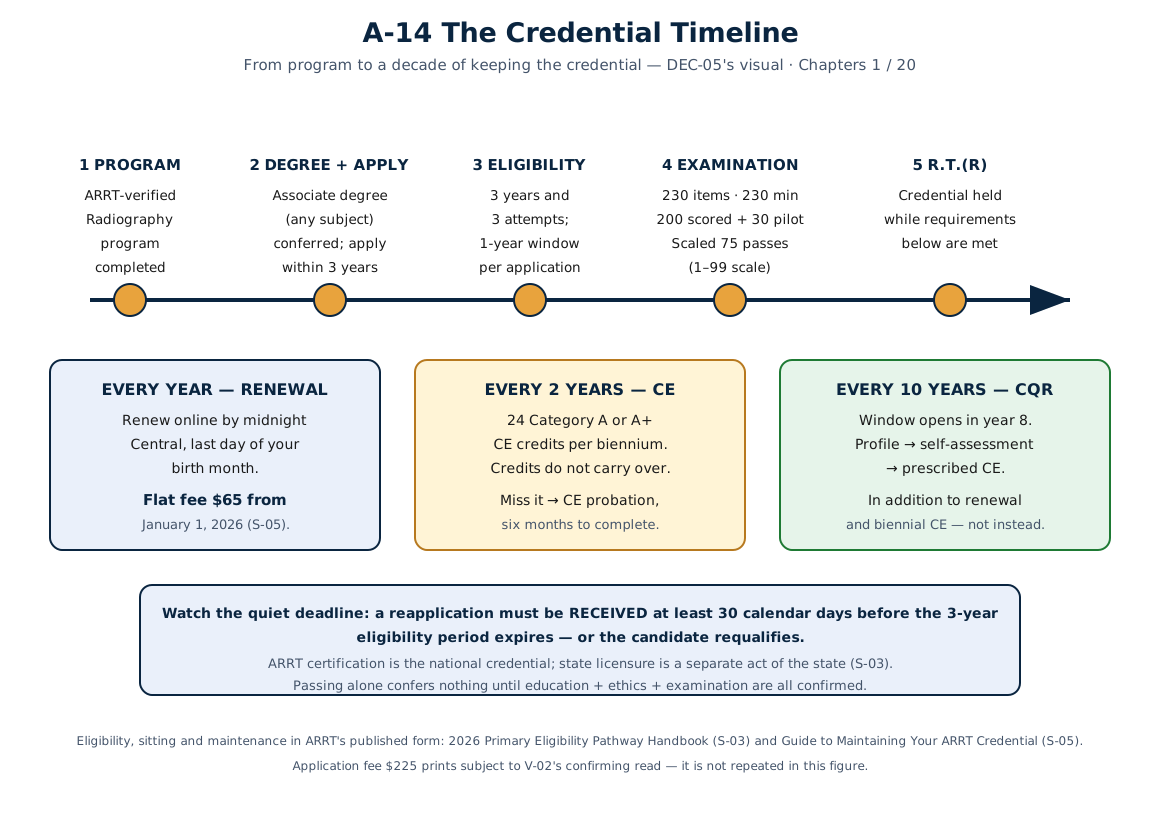 Figure 1.1 — The Credential Timeline
The application fee for the primary pathway is $225. This book prints that figure on the strength of its verification against ARRT's published material, recorded in the source register; the reapplication fee, by contrast, prints nowhere in this book until the same register records a direct read of ARRT's fees page — the Handbook itself names no amount and directs readers to ARRT's website. That asymmetry is deliberate, and it is the same discipline you met in the ethics paragraph: a fact prints at the strength of its source, and a number without a read source behind it does not print at all. When Chapter 20 walks the application mechanics, it will send you to ARRT's published fees for the current reapplication amount rather than fossilize a figure this book has not verified.
The examination is delivered at Pearson VUE test centers, and ARRT publishes its shape exactly. Learn the shape in ARRT's form, because the preparation shelf compresses it into forms that are wrong in ways that change how candidates rehearse.
You will be presented 230 items: 200 scored questions plus 30 unscored (pilot) questions. The pilot questions are being tried out for future examinations, and they are indistinguishable from the scored questions — there is no marker, no change of style, no way to identify them, and no strategy that finds them. Every question you meet must be treated as scored, because from your side of the screen, every question might be. The older circulating form of this fact — a smaller total with a smaller pilot count — appears in no current ARRT publication; both content specifications and the Handbook agree on 200 plus 30. If a study product gives you a different split, it is describing an exam that is not the one you will sit.
Your test time is 230 minutes. Your appointment is 250 minutes — four hours and ten minutes — and the appointment's arithmetic is published and exact: an 8-minute tutorial, a 2-minute nondisclosure agreement window, the 230-minute test, and a 10-minute post-exam survey. Eight plus two plus two hundred thirty plus ten is two hundred fifty. Read the consequence for rehearsal carefully: you do not have 250 minutes to answer questions, and you do not have "about four hours." You have 230 minutes to answer 230 presented items, which is why ARRT's own pacing frame is approximately one minute per question. This book's practice forms are built to that shape — 230 presented items in 230 minutes — so that the rehearsal's clock is the real sitting's clock and not a rounded cousin of it.
Inside the sitting, the navigation rules are these. You must answer each question before advancing to the next — there is no leaving a blank to fill later, because the road forward runs through an answer. You may flag questions and return to review them if time remains, and the flag is therefore your tool for uncertainty: answer with your best judgment, flag, move, and spend leftover minutes on flagged items rather than bleeding them on one hard question early. Because your score is based on the number of correct answers, answer every question, guessing when unsure — an unanswered question cannot be right, and the navigation rule means an item is never truly left behind in any case. Item formats include multiple-choice and sorted-list questions; the tutorial teaches the interface before the clock on the test itself begins.
Three disciplines of the room belong in this orientation, because each carries a consequence out of proportion to its size. First, the nondisclosure agreement must be accepted within two minutes or the exam ends — and an exam ended that way does not count as an attempt, though sitting again requires reapplying under a new window. Second, nothing may be written on the note booklet before accepting the NDA — the familiar advice to brain-dump formulas the moment you sit down is, in this room, a rule violation; your memory aids must wait until the agreement is accepted. Third, calculators: the tutorial teaches an on-screen calculator, and a basic four-function handheld calculator may be requested at the center — but no calculator of your own is admitted. Every quantitative exercise in this book is solvable with a basic four-function calculator, deliberately, because that is the arithmetic environment of the real sitting.
Finally, the break rule, stated without softening because candidates plan around a break that does not exist: there is no scheduled break in the Radiography sitting. You remain in your assigned seat unless Pearson staff authorize you to leave; leaving requires a palm scan out and in; you receive no extra test time if you leave the room — the clock runs; an absence of more than ten minutes triggers an incident report and ARRT investigation; and leaving the test-center building before completing the exam cancels your score and counts as an attempt. Plan hydration, meals, and endurance for an unbroken 230-minute sitting. Other ARRT examinations carry scheduled breaks; this one does not, and no surface in this book imports another exam's break into this one.
Exam trap — the compressed sitting. Any product that describes this exam as a "3.5-hour" or "4-hour" test, or that gives you 220 questions with 20 unscored, has replaced ARRT's published shape with a shelf invention. The correct form is always: 230 presented items (200 scored + 30 pilot), 230 minutes of test time, inside a 250-minute appointment, with no scheduled break.
Worked example — pacing checkpoints (DEC-05; this book's arithmetic on ARRT's published figures). ARRT publishes 230 presented items and 230 minutes and frames pacing at approximately one minute per question. This book's checkpoint table is simple division on those figures, labeled as this book's guidance: at one minute per item on average, you should be near item 60 at 60 minutes, near item 120 at 120 minutes, and near item 180 at 180 minutes, leaving roughly 50 minutes for the final 50 items and any flagged review your pace has banked. A candidate who reaches item 100 with 140 minutes gone is 40 minutes — roughly 40 items of average pace — behind, and must deliberately quicken on straightforward items rather than hope the back half of the test runs short. The checkpoint habit matters more than the exact numbers: check the clock at planned items, not at anxious moments, and let the flag carry uncertainty forward instead of letting one item consume the minutes of five.
ARRT reports scaled scores, not raw scores, and this book prints the scoring form exactly as ARRT publishes it, everywhere it appears:
The total scaled score ranges from 1 to 99. A scaled score of 75 is required to pass. Alongside the total, the official score report carries section scores ranging from 0.1 to 9.9, in tenth-point steps, reported by content area as study feedback. The total scaled score is computed from the total number of correct answers — it is not an average of the section scores — and the sections carry no separate passing hurdle: there is no rule that each section must clear its own bar.
Unpack the clause candidates most often violate. A scaled score of 75 is a point on ARRT's 1–99 scale. It is not a percentage. It does not mean 75 percent correct, it does not mean 150 of 200, and there is no published conversion from a raw count of correct answers to a scaled score. ARRT and its expert panels set, for each version of the examination, how many correct answers a scaled 75 requires, through standard-setting studies — which is why the number of correct answers corresponding to 75 can differ between versions while the standard itself stays the same. This is the ordinary machinery of credentialing examinations, and it defeats every folk rule built on percentages. A product that tells you to "aim for 75 percent" has confused a scale point with a share, and a candidate who rehearses against a percentage target is rehearsing against a number that does not govern anything.
The same discipline governs this book's practice results, and it is printed on every practice surface: your practice scores are raw counts of this book's items, with study guidance attached — they are never converted to scaled scores, never expressed as a percentage of the passing standard, and never presented as predictions. When a repair set tells you that a weak result means re-reading a chapter, that guidance is this book's study advice built on your raw count in a defined set of items. It is honest help. A converted "predicted scaled score" would be a fiction wearing the costume of precision, and this book does not print fictions.
Two score-report facts complete the picture. At the end of the sitting, the screen shows a preliminary score only: it does not indicate pass or fail, and it cannot be printed or retrieved after you leave the screen. Do not celebrate or grieve over it, and do not report it to an employer as a result. The official score report follows by secure link after ARRT's analysis; it shows your total scaled score and the breakdown by content area — the breakdown Chapter 20 teaches you to read as a study map if a retake is needed. Certification status posts to ARRT's Verify Credentials service within about four weeks of the sitting, and passers also receive a mailed packet with the official certificate. The road from the test-center screen to the verifiable credential runs in weeks, and planning a job start on the preliminary screen is planning on a document ARRT explicitly says is not a result.
Remember the form. Scaled scores 1–99; 75 passes; section scores 0.1–9.9 are feedback, not hurdles; the total comes from total correct answers, not from averaging sections; the center's preliminary score is not a result. The figure 75 never appears in this book as a percentage, and no practice result is ever converted into one.
Inside the education requirement sits an apparatus every radiography student meets and every beginner should understand before enrolling: ARRT's Didactic and Clinical Competency Requirements for Radiography, effective January 2022. Their role is precise, and this book prints them in exactly that role — as candidacy orientation, facts about what your program must contain — and never as examination content.
The didactic half is coursework: successful completion of courses addressing the topics in the content specifications, typically covered in a nationally recognized curriculum such as the ASRT Radiography Curriculum — the curriculum published by the American Society of Radiologic Technologists, which ARRT's own competency document names. The clinical half is performance: procedures the student has performed independently, consistently, and effectively during the formal education program, observed and verified by the program director or designee. Verification of program completion is recorded on ARRT's Program Completion Verification Form — and, a detail students routinely get wrong, the competency pages themselves are not sent to ARRT.
The published counts, dated to the requirements effective January 2022, are these. Ten mandatory general patient care procedures: CPR/BLS certification, plus demonstrated competence in nine more — vital signs (blood pressure, temperature, pulse, respiration, pulse oximetry), sterile and medical aseptic technique, venipuncture, assisted patient transfer, and care of patient medical equipment among them. Thirty-six mandatory imaging procedures. Fifteen elective imaging procedures chosen from a list of thirty-five, including at least one from the head section and two from the fluoroscopy studies section. And a maximum of ten imaging procedures may be simulated, under the document's simulation criteria — proper equipment, no x-ray beam activation, the same observation standard as a performed procedure.
Now the fence, stated as plainly as this book can state it, because your safety and your credential both stand behind it: this book is not clinical training, and nothing in it completes, substitutes for, or practices a competency. The competencies are performed on real patients (or, within the simulation limit, under program supervision on proper equipment) inside your program, under your program's observation. A written book can teach you the knowledge the examination tests — landmarks, projections, criteria, protection, patient care — and that is what this book does, thoroughly. It cannot watch you transfer a patient, and it does not pretend to. Wherever the competencies are described in this book, they are described as what they are: program-completed eligibility facts. A new edition of the competency requirements takes effect with the 2027 specifications cycle; students whose program completion falls under that edition should confirm its counts with their program director, and Chapter 20 repeats that direction at the point where it matters.
Notice what the competencies imply about program choice, since beginners read this chapter before enrolling. The program is not a lecture series with an exam at the end; it is a supervised clinical education in which you will perform real procedures on real patients under observation, across the range the lists describe. When you evaluate a program, you are evaluating its clinical placements and supervision as much as its classroom — because the clinical half of your education requirement is exactly that performance record, verified by that program's director.
Return now to the two students of the opening scenario, because their situation is this book's organizing fact and, quite possibly, yours.
ARRT revises its Radiography documents on a practice-analysis cycle, and the current revision changes the Examination Content Specifications on March 1, 2027 — inside this book's first edition cycle. Two specifications editions are therefore live across the edition's life:
For sittings before March 1, 2027, the governing edition is the 2022 specifications (Board approved January 2021, in force January 1, 2022). Its 200 scored questions divide as: Patient Care 33; Safety 50 — Radiation Physics and Radiobiology 21, Radiation Protection 29; Image Production 51 — Image Acquisition and Evaluation 26, Equipment Operation and Quality Assurance 25; Procedures 66 — Head, Spine and Pelvis 18, Thorax and Abdomen 20, Extremity 28.
For sittings on and after March 1, 2027, the governing edition is the 2027 specifications (Board approved January 2026). Its 200 scored questions divide as: Patient Care 31; Safety 46 — Physics and Radiobiology still 21, Radiation Protection 25; Image Production 51, unchanged at 26 and 25; Procedures 72 — Head, Spine and Pelvis 20, Thorax and Abdomen 22, Extremity 30.
What is unchanged across the transition is as important as what changes: the sitting's shape (200 scored plus 30 pilot, 230 minutes), the four category names and eight subcategory names, the Procedures four-topic frame, and the primacy of SI units. The 2027 edition is an evolution of the 2022 edition, not a new examination. What changes, beyond the weights, is a named set of content deltas, each of which this book teaches at its named place with its sitting-date flag:
Computed radiography — PSP plates, plate readers, erasure quality control, radiation fog — is removed entire from the 2027 outline; it remains live content for pre-transition sittings only. The NCRP frames are updated: SI units are framed by NCRP Report No. 184 in 2027, replacing No. 160; personnel monitoring is framed by NCRP Report No. 180, replacing No. 116. "Minimizing Patient Exposure" becomes "Minimizing Patient Exposure and Repeats," adding pregnancy and the Image Wisely and Image Gently resources. The patient-consideration wording "morbid obesity" becomes "body habitus." The quality-factor table gains explicit Image Contrast and Subject Contrast columns. Virtual grids are added to accessories and compensating filters are deleted. Intravenous urography is removed from the GU studies list. The clavicle moves from the Thorax list to Upper Extremities, and bone age is re-listed with the upper extremity. Myelography gains lumbar puncture and epidural injections; arthrography gains joint injection and aspiration. Line placement with a C-arm (for example, PICC placement) and NG/enteric tube placement are added. Informatics gains security and confidentiality, and teleradiology.
This book's ruling, printed here so you can hold it to the ruling on every page, is: one manuscript, dual-dated throughout. The book teaches the union of the two outlines. Every passage whose content differs between editions carries its sitting-date flag at the teaching point — "For sittings before March 1, 2027…" or "From March 1, 2027…" Practice forms are composed at the 2027 weights as the forward default, because this edition will live almost entirely after the transition, with the 2022 composition printed beside every form, and the repair sets are keyed to subcategories so a pre-transition reader can rebalance by adding one extra subcategory set. The back of the book carries a full dual crosswalk — chapter by chapter, outline line by outline line, for both editions — so a reader holding either sitting date, or a score report from either edition, can trace every line to its teaching pages.
Your first task as a reader is therefore a decision, and the front matter's How to Use This Book puts it first for a reason: find your sitting date. If your planned sitting is before March 1, 2027, study the union with the 2022 flags forward — the CR content in Chapter 12 is live for you, and the 2027-only additions are forward knowledge. If your sitting is on or after March 1, 2027, study the union with the 2027 flags forward — CR passages are background about a technology leaving the outline, and the additions are core. And if your calendar straddles the date — a first attempt in February, a possible retake in April — read §1.8 now, because ARRT's own Handbook warns retakers to compare the current specifications with those used for a previous attempt, and your retake may be governed by a different edition from your first attempt. The specifications trap is this examination's distinctive hazard, and it is entirely avoidable by reading dates before content.
Most candidacies that fail do not fail in the test center. They fail on a calendar, quietly, months earlier, when a deadline nobody circled passes unnoticed. This section lays the whole calendar out as one worked example — designated exercise DEC-05 in this book's register, candidacy arithmetic built only from ARRT's published figures — so you can run your own dates through it.
Worked example — the two clocks (DEC-05). Suppose a student completes her ARRT-verified radiography program on May 15, 2027. The first clock starts there: she must earn her degree and submit her application no more than three years after completing the program — by May 15, 2030. Suppose her associate degree (in any subject, from an ARRT-recognized accredited institution) is conferred in December 2028 and she applies in January 2029, comfortably inside the first clock, with the degree already conferred as sitting requires. Eligibility is established. The second clock starts: she has three years and three attempts to pass — her eligibility period runs to approximately January 2032, three years from establishment, with a one-year examination window assigned per application. Now the guard at the end of the second clock: if she has failed twice and needs a third attempt late in the period, her reapplication must be received a minimum of 30 calendar days before the three-year eligibility period expires. A reapplication she mails in the period's final fortnight does not preserve the third attempt; it ends the candidacy on that eligibility, and the road back is requalification. The lesson is not that the calendar is cruel. It is that every date in it is published, knowable on the day you apply, and fatal only to the candidate who never computed it. Compute yours the week your eligibility is established, and write the 30-day-guarded date — not the expiry date — on your calendar as the real deadline.
Two further calendar disciplines complete the map. The ethics reporting clock runs independently of both: a violation must be reported within 30 calendar days of its occurrence, including matters that predate application. And the scheduling clock is short and mechanical: once the Candidate Status Report assigns your one-year window, scheduling opens 24 hours later — you cannot schedule before the window exists, and you should not drift long after it opens, because popular centers and dates fill and your window, not the center's calendar, is the binding constraint.
Chapter 20 returns to this calendar with the application mechanics, the test-day walk-through, and the maintenance clocks — annual renewal, the two-year CE cycle, the ten-year CQR — worked the same way. The orientation to carry from Chapter 1 is the shape: three years to pair degree with application after the program; three years and three attempts once eligible; one-year windows; thirty days guarding the end; thirty days to report an ethics matter. Five numbers, all published, all yours to plan around.
A failed attempt is information plus a procedure, and both halves are published. The procedure: after a first or second failure, the Reapply button appears on your candidate dashboard; you reapply, paying the reapplication fee then published by ARRT, and sit again inside a new one-year window — provided the 30-day receipt rule of §1.7 is met. After a third failure, eligibility on that basis ends; the dashboard carries requalification information, and the road back runs through requalifying rather than reapplying. There is no published waiting period invention to add here and none is printed: the governing facts are the three-attempt limit, the three-year period, and the 30-day rule.
The information half is the official score report's section breakdown: section scores by content area, on the 0.1–9.9 scale, existing precisely so a retaker can rebuild a study plan from evidence instead of from anxiety. Chapter 20 teaches the reading in full; the orientation is that a section score is feedback, not a hurdle you failed separately — the total is computed from total correct answers, and your repair plan should weight the weakest sections heaviest without abandoning the strong ones, because the retake tests everything again.
Then the trap, which is this book's reason for existing in its dual form. Suppose your first attempt falls in February 2027 under the 2022 specifications, and you fail. Your retake, in April, falls under the 2027 specifications. The weights have moved — Procedures has grown by six questions, Radiation Protection has shrunk by four, Patient Care by two. CR has left the outline; virtual grids, pregnancy, repeats, line placement, and the updated NCRP frames have entered it. A retake plan that simply re-studies the February outline harder is a plan for an examination that no longer exists. ARRT's Handbook itself warns retakers to compare the current specifications with those used for the previous attempt; this book operationalizes the warning. The repair sets are keyed to subcategories — edition-neutral units — so a boundary-crossing retaker rebuilds from the section report, then works Chapter 20's change-by-change map of exactly what the new edition adds, removes, and reweights. If your calendar can straddle March 1, 2027, that map is the most valuable eight pages in the book for you, and you should read it before your first attempt, not after.
The credential is not a permanent possession; it is a standing that must be maintained, and Chapter 20 teaches the maintenance in full. The preview belongs here because beginners plan careers, and the maintenance shape is part of what the credential is. ARRT publishes three ongoing requirements.
Renew every year. Renewal is online, due by midnight Central time on the last day of the holder's birth month. Effective January 1, 2026, the renewal fee is a flat $65, regardless of how many credentials the holder carries. Older tiered fees that circulate in secondary material are superseded and print nowhere in this book; the flat $65 is the only renewal fee this book teaches.
Complete continuing education every two years. Most R.T.s report 24 Category A or A+ CE credits per biennium — one requirement per holder, not multiplied by the number of credentials held. Credits do not carry between biennia: an excess earned in one two-year period does not bank into the next. Missing the requirement leads to CE probation, with six months to complete it.
Fulfill Continuing Qualifications Requirements — CQR — every ten years, per discipline. The CQR compliance period begins in the eighth year after certification in that discipline; ARRT notifies the holder when the window opens. CQR has three steps, in order: a professional profile, a structured self-assessment, and prescribed continuing education arising from the assessment. It is completed in addition to annual renewal and biennial CE, never instead of them. Its purpose, in ARRT's framing, is to help the holder recognize where knowledge and skills may lag current qualification standards — a decade-scale version of the same honesty this chapter asks of candidates: know what governs you, check it on schedule, and repair what has drifted.
File the maintenance triad with the credential-vs-license frame of §1.1 and the orientation is complete: ARRT certifies nationally and maintains the credential on an annual, biennial, and decennial rhythm; your state licenses separately, on its own rules. Chapter 20 closes the book by walking both halves with the calendar worked end to end.
The book you are holding is built in seven parts, and the architecture is the dual-purpose standard of this series made visible: the complete knowledge first, the examination layer woven through it, and no chapter assuming a classroom you may not have had.
Part I — Foundations (Chapters 1–4) teaches the profession, the room, the language, and the body from zero: this credential map; the department and the radiography room object by object; the standard positioning terminology exactly as the specifications publish it; and anatomy at the orientation depth the later chapters build on. Part II — Patient Care (Chapters 5–7) covers the specifications' Patient Care category whole: ethics, law, and communication; assistance, monitoring, and emergencies; infection control, pharmacology, and contrast media. Part III — Safety I (Chapters 8–9) teaches radiation physics and radiobiology; Part IV — Safety II (Chapter 10) teaches radiation protection for patient and personnel. Part V — Image Production (Chapters 11–14) covers technique factors and quality, receptors and digital imaging, equipment operation, and quality control together with the image-evaluation method. Part VI — Procedures (Chapters 15–19) teaches positioning principles and then the regions — extremities, thorax and abdomen, head, spine and pelvis with the contrast and special studies — as knowledge: landmarks, positions, central-ray paths, adaptation, and evaluation criteria, never as a substitute for clinical training. Part VII — The Exam Layer (Chapter 20) runs the candidacy end to end and teaches the sitting, the retake, and the maintenance of the credential.
Around the chapters stands the practice architecture. A 60-item diagnostic test in the front matter routes you to a study plan before you begin. Every chapter closes with a 20-item quiz, untimed, with a full answer key in which every wrong option is explained — read the key even for items you answered correctly, because the explanations teach the neighboring facts the exam also tests. Two full timed practice tests reproduce the published shape — 230 presented items, 230 minutes — at the end of your preparation. Eight subcategory repair sets of 25 items each stand ready for the weaknesses your diagnostic, your quizzes, or a real score report reveal. And quantitative work is never decoration: the book's designated exercises — technique-factor maintenance, distance and geometry, kVp/grid/filtration reasoning, dose-quantity and exposure-index reasoning, and candidacy arithmetic like §1.7's worked example — are the computations the specifications actually assign, each solved from values the stem supplies, each solvable with the basic calculator the test center allows.
Three reading rules govern everything. First, dates govern facts: when a passage carries a sitting-date flag, the flag is part of the fact. Second, the specifications govern weights: every weight table in this book names its edition and its sitting dates. Third, your program governs your competencies and your state governs your license: this book's standing directions to your program director and your state licensing entity are not boilerplate — they are the correct answers to questions a national book must not pretend to answer for you.
If you are starting from zero — no program, no enrollment, perhaps no health care background at all — the map in this chapter converts into a short sequence of decisions, and the order matters because each decision constrains the next.
First, confirm the road fits the destination. Radiography is a licensed-adjacent, credential-gated profession: there is no self-taught route to the examination room, because the education requirement demands an ARRT-verified program and its supervised clinical competencies. A reader who wants to work with imaging but cannot commit to a formal program is not failing some test of seriousness; they are looking at a different occupation — perhaps one of the supporting roles in a department — and Chapter 2's tour of the department will help you see those roles clearly. But if the goal is the R.T.(R) credential, the program is not one option among several. It is the road.
Second, choose the program with the competencies in mind. Because the education requirement includes the performance record of §1.5 — the mandatory and elective imaging procedures, the patient care procedures, the supervised verifications — a program decision is a clinical decision. Ask where students rotate, what range of examinations the clinical sites see, and how the program verifies completion. Those questions sound advanced for an applicant; they are exactly the questions the competency apparatus makes relevant, and programs expect them.
Third, settle the degree early. The associate-or-higher degree may be in any subject and may predate the program, but the three-year pairing clock of §1.7 means a degree left indefinitely unfinished becomes a deadline problem, not a paperwork detail. If you already hold a degree from a recognized accredited institution, this decision is already made — verify it, file it, and forget it. If you do not, plan the degree's conferral date alongside the program's completion date, not after it.
Fourth, clear your own ethics ground before anyone asks you to. Read the Standards of Ethics with your own history in mind. If something in your past might fall under the Rules — a charge, a conviction, a discipline in another field — the Ethics Review Preapplication route exists precisely so that question can be answered before you invest years. Early clarity is cheap; late discovery is not.
Fifth, set your sitting target — and with it, your specifications edition. Work backward from a realistic program completion date to a planned application, and note on which side of March 1, 2027 the resulting sitting falls. That single date selects your study plan track in this book's front matter: pre-transition, post-transition, or the boundary-straddling retake track. Students graduating well after the transition are 2027-edition candidates and should treat the 2022-only content as background from the start; students who will sit within weeks of the boundary should read both flags everywhere, because a modest schedule slip — or one failed attempt — changes the governing edition under them.
Sixth, budget from published figures only. The fee this book can put in your budget today is the $225 application fee; your program's tuition and your state's licensing fees are real costs that belong to those authorities' own publications, and this book prints neither. A budget built from ARRT's $225, your program's published tuition, and your state board's published schedule is a real budget. A budget built from a forum's "total cost of becoming a radiographer" is a number about somebody else's state, program, and year.
None of these decisions requires any radiography knowledge at all — which is the point of placing this chapter first. The physics, the anatomy, and the procedures fill the next nineteen chapters. The credential map had to come first, because it tells you what all that knowledge is for, which edition of the examination will test it, and on what calendar. Turn the page, and the book stops talking about the examination and starts showing you the profession: the department, the room, and the machines, one object at a time.
Four small acts convert this chapter from reading into preparation, and all four take less than an hour together. Write down your sitting-date answer. One line, in your study notebook: your expected program completion, your planned application month, and your planned sitting — with the governing specifications edition named beside it. If the line cannot yet be written because a date is unknown, write the unknown; an honest unknown is a plan input, while a silent assumption is a trap. Draw your own calendar. Mark the first three-year clock from your program completion date, and — if you can project eligibility — the second clock, its one-year window, and the date thirty days before the eligibility period would expire. You will recompute these dates when the real ones replace the projections; the habit, not the arithmetic, is what this act installs. Read the two primary documents behind this chapter. ARRT's 2026 Primary Eligibility Pathway Handbook and the content specifications edition that governs your sitting are short, free, and written for candidates; this chapter is a guided tour of them, not a substitute for them, and a candidate who has read the Handbook once reads every later chapter of this book with better questions. Adopt the scoring discipline now. From this page forward, every practice result you record — diagnostic, quiz, form, repair set — is recorded as a raw count by category, with the study action it implies. No percentages of a passing standard, no converted scores, no predictions. The discipline feels austere only until the first time a classmate's invented target sends their study plan chasing a number that governs nothing; then it feels like what it is — the difference between preparing for the examination ARRT publishes and preparing for the one the shelf imagines.
With the map drawn, the book turns from the credential to the profession itself. Chapter 2 walks you into the department and the room, object by object, so that every later reference to a table, a tube, a detector, or a control booth names something you can already picture.
---
20 items. Untimed. Every item is original. Spec tags and full explanations are in the answer key (ch-01-key.md).
1. ARRT eligibility for the Radiography credential consists of which three requirements? A. Education, experience, and examination B. Education, examination, and continuing education C. Ethics, examination, and state licensure D. Education, ethics, and examination
2. Which statement about the education requirement is correct? A. An associate (or higher) degree in any subject, from an institution accredited by an agency ARRT recognizes, with the degree conferred before sitting B. The degree may be earned only after the radiography program is completed C. The required degree must be in radiography or a related science D. The degree and the application may be completed at any time after program completion, with no time limit
3. A student completes an ARRT-verified radiography program on May 15, 2027. By what date must the student earn the degree and submit the application? A. May 15, 2028 B. May 15, 2029 C. May 15, 2030 D. December 31, 2030
4. Under the ethics requirement, within what period must a violation be reported? A. Only if ARRT requests a report B. Within 90 calendar days of its occurrence C. At the time of the next annual renewal D. Within 30 calendar days of its occurrence
5. Once eligibility is established, a candidate has: A. Two years and two attempts to pass B. Three years and three attempts to pass, with a one-year examination window assigned per application C. Three years and unlimited attempts to pass D. Five years and three attempts to pass
6. A reapplication after a failed attempt must be received: A. At least 10 calendar days before the eligibility period expires B. On the final day of the eligibility period C. At least 30 calendar days before the three-year eligibility period expires, or the candidate must requalify D. Within 30 calendar days after the failed attempt
7. The Radiography sitting presents how many items? A. 230 items — 200 scored and 30 unscored (pilot), the pilots indistinguishable from the scored items B. 220 items — 200 scored and 20 unscored C. 200 items, all scored D. 230 items — 215 scored and 15 unscored
8. Which statement gives the sitting's time in its published form? A. A 3.5-hour examination with a scheduled break at the midpoint B. A 4-hour appointment with 240 minutes of test time C. 230 minutes of test time inside a 250-minute appointment: 8-minute tutorial, 2-minute nondisclosure window, 230-minute test, 10-minute survey D. 250 minutes of test time, with the tutorial and survey taken from breaks
9. At this book's published pacing checkpoints (ARRT's frame of approximately one minute per question), a candidate on average pace should be near which item when 120 minutes have elapsed? A. Item 120 B. Item 100 C. Item 60 D. Item 150
10. Which statement about breaks in the Radiography sitting is correct? A. A scheduled 30-minute break is provided at the midpoint B. A break stops the test clock for up to 15 minutes C. Breaks are unlimited provided the candidate scans out and in D. There is no scheduled break; leaving the room runs the clock, an absence over 10 minutes triggers an incident report, and leaving the building cancels the score and counts as an attempt
11. Which statement about examination navigation is correct? A. Questions may be left blank and completed in any order at the end B. Each question must be answered before advancing; questions may be flagged and returned to for review if time remains C. Flagged questions are removed from scoring D. The candidate may skip the pilot questions, which are marked on screen
12. A candidate does not accept the nondisclosure agreement within two minutes. What happens? A. The exam ends without counting as an attempt; sitting again requires reapplying under a new window B. The exam ends and counts as a failed attempt C. The exam proceeds with a time penalty D. The agreement is accepted automatically and the exam proceeds
13. Which statement about scoring is correct in ARRT's published form? A. A candidate passes by answering 75% of the scored questions correctly B. Each section must reach its own passing score of 7.5 C. A scaled score of 75 on the 1–99 scale is required to pass; section scores of 0.1–9.9 are study feedback, and the total is computed from total correct answers, not as an average of section scores D. The preliminary score shown at the test center is the official result
14. The clinical competency requirements in force January 2022 include: A. 5 mandatory general patient care procedures and 20 mandatory imaging procedures B. 10 mandatory general patient care procedures, 36 mandatory imaging procedures, and 15 elective imaging procedures chosen from a list of 35, with at most 10 imaging procedures simulated C. 36 elective imaging procedures chosen by the student, with unlimited simulation D. Competencies completed after certification, during the first year of practice
15. Which statement about the clinical competencies is correct? A. This book's exercises can be submitted to ARRT to satisfy them B. The competency pages are mailed to ARRT with the application C. They are tested as a practical examination at the Pearson VUE center D. They are performed during the formal education program, observed by the program director or designee, and verified on the Program Completion Verification Form; the competency pages are not sent to ARRT
16. For a sitting in February 2027, the governing specifications weights are: A. Patient Care 31 · Safety 46 · Image Production 51 · Procedures 72 B. Patient Care 30 · Safety 50 · Image Production 50 · Procedures 70 C. Patient Care 33 · Safety 46 · Image Production 51 · Procedures 72 D. Patient Care 33 · Safety 50 · Image Production 51 · Procedures 66
17. For a sitting in April 2027, which content change applies? A. Computed radiography (PSP plates, plate readers) becomes a larger part of the outline B. Intravenous urography is added to the GU studies list C. Computed radiography is removed from the outline; Procedures rises to 72 scored questions and Radiation Protection falls to 25 D. The clavicle moves from Upper Extremities to the Thorax list
18. The application fee this book prints for the primary pathway, and the flat annual renewal fee effective January 1, 2026, are: A. $225 application; $65 flat renewal regardless of credentials held B. $200 application; $30 renewal plus $15 per additional credential C. $250 application; $45 flat renewal D. $225 application; $65 renewal per credential held
19. Which statement about maintaining the credential is correct? A. Continuing education credits carry over from one biennium to the next B. Most R.T.s report 24 Category A or A+ CE credits per biennium; CQR is completed every 10 years per discipline, its compliance period beginning in the eighth year, in addition to renewal and CE C. CQR replaces biennial CE in the tenth year D. Renewal is due every two years, in the holder's birth month
20. Which statement about certification and licensure is correct? A. ARRT certification is itself a state license to practice B. ARRT certification is the national credential; state licensure is a separate act of the state, and many states license on the basis of ARRT certification C. Passing the examination alone confers the R.T. title, even before education and ethics are confirmed D. A state license is issued automatically when the credential is verified
1. Key: D — Education, ethics, and examination. ARRT's three-requirement equation (§1.2). · KI - A — Wrong. Experience is not one of the three published requirements; eligibility is established through education, ethics, and examination. - C — Wrong. State licensure is a separate act of the state (§1.1); it is not an ARRT eligibility requirement. - B — Wrong. Continuing education is a maintenance requirement after the credential is earned (§1.9), not an eligibility term.
2. Key: A — An associate (or higher) degree in any subject, from an ARRT-recognized accredited institution, conferred before sitting. (§1.2.) · KI - C — Wrong. The degree may be in any subject; it need not be a science or radiography degree. - B — Wrong. The degree may be earned before, during, or after the program — but it must be conferred before the candidate sits. - D — Wrong. The degree must be earned and the application submitted no more than three years after completing the educational program (§1.7).
3. Key: C — May 15, 2030. Derivation: program completion May 15, 2027 + three years = May 15, 2030; the degree must be earned and the application submitted by that date (§§1.2, 1.7). · DEC-05 - A — Wrong. One year is the examination-window length per application, not the degree-and-application deadline. - B — Wrong. Two years understates the published three-year period. - D — Wrong. The deadline runs from the program-completion date, not from the calendar year-end.
4. Key: D — Within 30 calendar days of its occurrence. (§1.2.) · KI - B — Wrong. Ninety days is not the published reporting period; the Standards of Ethics reporting clock is 30 calendar days. - C — Wrong. Reporting is not deferred to renewal; renewal is a maintenance act for credential holders, years after some reportable matters occur. - A — Wrong. The duty to report does not wait for an ARRT request.
5. Key: B — Three years and three attempts, with a one-year window per application. (§1.2.) · KI - A — Wrong. Both figures understate the published period and attempt count. - C — Wrong. Attempts are limited to three on an established eligibility; they are not unlimited. - D — Wrong. Five years is not the published eligibility period.
6. Key: C — Received at least 30 calendar days before the three-year eligibility period expires, or the candidate must requalify. (§§1.2, 1.7.) · KI - A — Wrong. Ten days understates the published 30-calendar-day receipt rule. - B — Wrong. A reapplication received on the final day arrives inside the guarded 30-day zone and does not preserve the attempt. - D — Wrong. The rule is keyed to the end of the eligibility period, not to the date of the failed attempt.
7. Key: A — 230 presented items: 200 scored + 30 unscored (pilot), indistinguishable. (§1.3; entry 1 of the source register, entry 2 of the source register, entry 3 of the source register.) · KI - C — Wrong. The sitting presents 230 items; 30 of them are unscored pilots. - B — Wrong. The 220/20 split is a superseded secondary form; both current specifications and the Handbook publish 200 + 30. - D — Wrong. The pilot count is 30, not 15; the scored count is 200.
8. Key: C — 230 minutes of test time inside a 250-minute appointment (8 + 2 + 230 + 10). (§1.3.) · KI - B — Wrong. Test time is 230 minutes, not 240; the appointment is 250 minutes in total. - A — Wrong. There is no scheduled break in the Radiography sitting, and the test time is not 3.5 hours. - D — Wrong. The tutorial and survey occupy their own published minutes inside the appointment; they are not taken from breaks, and test time remains 230 minutes.
9. Key: A — Item 120. Derivation: ARRT's frame is approximately one minute per question; 120 minutes × approximately 1 item per minute ≈ item 120 (this book's checkpoint arithmetic, §1.3). · DEC-05 - C — Wrong. Item 60 is the checkpoint at approximately 60 minutes, not 120. - B — Wrong. Item 100 at 120 minutes would put the candidate roughly 20 items behind average pace. - D — Wrong. Item 150 at 120 minutes would require a pace of 0.8 minutes per item, faster than the published frame.
10. Key: D — No scheduled break; leaving runs the clock; over 10 minutes triggers an incident report; leaving the building cancels the score and counts as an attempt. (§1.3.) · KI - A — Wrong. The scheduled break belongs to a different ARRT examination; Radiography has none. - C — Wrong. Leaving is permitted only as staff authorize, with palm scans, and confers no extra time. - B — Wrong. The clock does not stop when a candidate leaves the room.
11. Key: B — Answer before advancing; flag and return to review if time remains. (§1.3.) · KI - A — Wrong. The navigation rule requires an answer before advancing; blanks cannot be banked for the end. - C — Wrong. Flagging marks an item for the candidate's own review; it does not remove the item from scoring. - D — Wrong. Pilot questions are indistinguishable and unmarked; no question can be identified and skipped as a pilot.
12. Key: A — The exam ends without counting as an attempt; a new window requires reapplying. (§1.3.) · KI - C — Wrong. There is no time-penalty path; non-acceptance inside two minutes ends the exam. - B — Wrong. An exam ended for non-acceptance does not count as an attempt, failed or otherwise. - D — Wrong. Acceptance is an affirmative act inside the two-minute window; it is not automatic.
13. Key: C — A scaled score of 75 on the 1–99 scale passes; section scores 0.1–9.9 are feedback; the total derives from total correct answers. (§1.4; the governing fence.) · KI - A — Wrong. 75 is a scaled score, never a percentage; no percentage-correct passing form exists in ARRT's publications. - B — Wrong. Sections carry no separate passing hurdle, and 7.5 is not a published section standard. - D — Wrong. The preliminary score at the center does not indicate pass or fail and is not the official result.
14. Key: B — 10 general patient care, 36 mandatory imaging, 15 electives from 35, at most 10 simulated. (§1.5; entry 4 of the source register, effective January 2022.) · KI - A — Wrong. Both counts understate the published requirements. - C — Wrong. The mandatory/elective structure is reversed, and simulation is capped at ten imaging procedures. - D — Wrong. The competencies are completed during the formal education program, before eligibility — not after certification.
15. Key: D — Performed in the program, observed by the program director or designee, verified on the Program Completion Verification Form; the pages are not sent to ARRT. (§1.5; the governing fence.) · KI - A — Wrong. No book exercise satisfies a competency; competencies are program-completed performances. - B — Wrong. Verification is recorded on the Program Completion Verification Form; the competency pages themselves are not sent to ARRT. - C — Wrong. The Pearson VUE sitting is a written examination; there is no practical competency examination at the center.
16. Key: D — 2022 weights: Patient Care 33 · Safety 50 · Image Production 51 · Procedures 66. A February 2027 sitting falls before March 1, 2027, so the 2022 specifications govern (§1.6; entry 1 of the source register). · KI - A — Wrong. Those are the 2027 weights, governing sittings on and after March 1, 2027. - C — Wrong. It mixes editions: Safety 46 belongs to 2027, Patient Care 33 to 2022. - B — Wrong. No ARRT edition publishes those weights.
17. Key: C — From March 1, 2027, CR is removed; Procedures is 72 and Radiation Protection is 25. (§1.6; entry 2 of the source register.) · KI - A — Wrong. CR leaves the outline entirely in 2027; it does not grow. - B — Wrong. Intravenous urography is removed from GU studies in 2027, not added. - D — Wrong. The clavicle moves in the opposite direction — from the Thorax list to Upper Extremities.
18. Key: A — $225 application; $65 flat renewal from January 1, 2026. (§§1.2, 1.9; entry 5 of the source register.) · KI - B — Wrong. The $30 + $15 tier is the superseded pre-2026 renewal structure and prints nowhere in this book. - C — Wrong. Neither figure matches ARRT's published amounts as this book's register records them. - D — Wrong. The $65 renewal is flat regardless of the number of credentials held, not per credential.
19. Key: B — 24 CE credits per biennium; CQR every 10 years per discipline, window opening in year 8, in addition to renewal and CE. (§1.9; entry 5 of the source register.) · KI - A — Wrong. Credits do not carry between biennia. - C — Wrong. CQR is completed in addition to renewal and biennial CE, never instead of them. - D — Wrong. Renewal is annual, due by midnight Central on the last day of the holder's birth month.
20. Key: B — ARRT certification is the national credential; state licensure is separate, and many states license on the basis of ARRT certification. (§1.1; the governing fence.) · KI - A — Wrong. The credential is not itself a state license. - C — Wrong. Passing the exam alone confers nothing until ARRT confirms the education and ethics requirements are also met (§1.1). - D — Wrong. No license issues automatically; licensure is the state's own act under its own rules.
Designated items in this chapter's quiz: items 3 and 9 — DEC-05 (candidacy and session arithmetic), 2 items. All other items are KI. Quiz census: 20 items.
End of the free sample. The complete book continues from here — the full A-to-Z course in book form, delivered as an EPUB you can read in Apple Books, Google Play Books, ReadEra, Thorium Reader, Adobe Digital Editions, or Send to Kindle.
Buy this ebook — $11.99 Back to the book page
Payments are securely processed by Payhip.