
Mastering Careers & Skills
Aircraft Mechanic Certification Exam (FAA A&P) · free sample from the book itself
An aircraft mechanic certificate is not a diploma for finishing a course of study. It is a federal authorization, issued under Title 14 of the Code of Federal Regulations, part 65, subpart D, that allows a named person to perform, supervise, and in defined circumstances approve for return to service, maintenance, preventive maintenance, and alteration on aircraft and related products. That sentence matters because every part of it carries a limit. The work must be within the rating held. The approval must be within the privilege granted. The person must understand the current instructions for the work. The work itself must leave the product at least equal to its original or properly altered condition.
Chapter key fact: There is one mechanic certificate with two ratings — Airframe and Powerplant. Holding both ratings is what the field calls an A&P.
A person may hold the Airframe rating alone, the Powerplant rating alone, or both. Each rating is earned separately, tested separately, and exercised separately. When this book says A&P, it means a mechanic who holds both ratings. When it says mechanic, it means any certificated mechanic, with the rating question always in the background: rated for what?
Chapter key fact: This book prepares you for tests. It does not give you eligibility, experience, or hands-on competence.
That fence appears on the first page because it governs everything that follows. Reading, however carefully, is not performing maintenance under supervision. Passing practice questions, however honestly, is not passing an FAA test. Completing this book, however thoroughly, does not shorten the experience requirement by a single day and does not authorize you to touch an aircraft for maintenance outside a lawful, supervised setting. Your hands-on competence, if you earn the certificate, will be built in a certificated Aviation Maintenance Technician School, in documented on-the-job experience supervised by a certificated mechanic, or in evaluated military service — and it will be examined in person, not on a page. Hold that distinction from the first chapter to the last, because confusing study with experience is the most expensive misunderstanding a beginning mechanic can carry.
Since August 1, 2023, mechanic applicants have been tested against one governing standard: the Aviation Mechanic General, Airframe, and Powerplant Airman Certification Standards, FAA-S-ACS-1, dated November 1, 2021. The short name used throughout this book is the Mechanic ACS.
Chapter key fact: FAA-S-ACS-1 is incorporated by reference into the regulations themselves — into sections 65.75 and 65.79 for testing and into section 147.17 for schools.
Incorporation by reference means the ACS is not advice about the regulation. For testing purposes, it functions as part of the regulatory framework. A written test question is linked to an ACS knowledge element. A missed question is reported back to you by ACS code. An oral test retests the topics behind those codes. A practical test examines skill elements drawn from the same standard. A school curriculum must be designed to continually align with the same standard. One document therefore connects the classroom, the written test center, and the examiner's hangar. Learning to read that document's structure is learning to read the whole certification system.
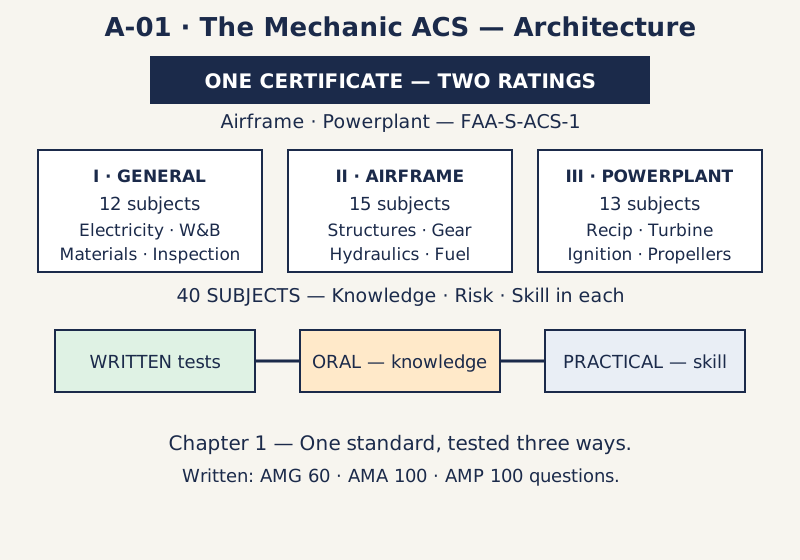
Figure A-01 — Mechanic ACS architecture diagram — one certificate, two ratings, three sections and 40 subjects, with the written, oral, and practical tests mapped to the Knowledge, Risk Management, and Skill element families
The ACS is organized in three sections that mirror the three written tests and the two ratings plus their common core.
Section I is General, with twelve subjects: Fundamentals of Electricity and Electronics; Aircraft Drawings; Weight and Balance; Fluid Lines and Fittings; Aircraft Materials, Hardware, and Processes; Ground Operations and Servicing; Cleaning and Corrosion Control; Mathematics; Regulations, Maintenance Forms, Records, and Publications; Physics for Aviation; Inspection Concepts and Techniques; and Human Factors. Every applicant for either rating studies General, because every mechanic, whatever the rating, works with electricity, drawings, weight, materials, records, and people.
Section II is Airframe, with fifteen subjects, from Metallic Structures and Non-Metallic Structures through Flight Controls, Airframe Inspection, Landing Gear, Hydraulic and Pneumatic Systems, Environmental Systems, Instruments, Communications and Lighting, Fuel Systems, Electrical Systems, Ice and Rain Control, Fire Protection, Rotorcraft Fundamentals, and Water and Waste Systems.
Section III is Powerplant, with thirteen subjects, from Reciprocating Engines and Turbine Engines through Engine Inspection, Engine Instruments, Engine Fire Protection, Engine Electrical Systems, Lubrication, Ignition and Starting, Engine Fuel and Fuel Metering, Induction and Cooling, Turbine Air Systems, Exhaust and Reverser Systems, and Propellers.
Chapter key fact: The ACS contains 40 subjects in total — 12 General, 15 Airframe, and 13 Powerplant.
Each subject is more than a title. Under each title the ACS states an objective and then lists elements in three families. Knowledge elements, coded with the letter K, state what the applicant must know and be able to explain. Risk Management elements, coded R, state the hazards the applicant must recognize, analyze, and control. Skill elements, coded S, state what the applicant must be able to do, to a stated standard, with the stated references and tools. A code such as AM.I.A.K1 can be read piece by piece: AM for Aviation Mechanic, I for Section I General, A for the first subject in that section, Fundamentals of Electricity and Electronics, and K1 for its first knowledge element. Once you can parse a code, a test report stops being a list of mysteries and becomes a study map.
The three test forms use those families differently, and understanding the difference prevents a common study error. The written tests sample knowledge. They do not, in a multiple-choice room, watch you safety-wire a turnbuckle or time a magneto. The oral test retests knowledge in conversation, without reference material, beginning with the topics you missed on the written test and adding randomly selected topics. The practical test examines skill in observed projects, with knowledge and risk management questioned in context while you work, and with reference material allowed for that questioning because real maintenance is performed with data, not from memory alone. A candidate who studies only facts will be unready for the practical. A candidate who practices only tasks will be unready for the oral. The ACS asks for both, on purpose.
A currency note belongs here, plainly stated once. Before the ACS, mechanic testing used the Practical Test Standards, FAA-S-8081-26B, and an older feedback system called Learning Statement Codes. That system is retired. Older books on a shelf, older videos, and older question sets may still be organized around it. They are not this book's structure, and their organization should not be imported into your study. If a source cannot show you how its material maps to FAA-S-ACS-1, treat its test advice as history, not guidance.
After the experience gate is satisfied, with two narrow exceptions for school students explained below, the applicant takes written tests administered by PSI, the FAA's contracted testing vendor, at approved testing centers.
Chapter key fact: AMG, the General written test, has 60 questions. AMA, the Airframe written test, has 100 questions. AMP, the Powerplant written test, has 100 questions. Each test allows 2.0 hours, and the passing score for each test is 70.
Those numbers come from the FAA Airman Knowledge Testing Matrix and the Companion Guide to the ACS. Notice what the passing score is and what it is not. Section 65.17 states the minimum passing grade for each test as 70 percent. That is the only passing figure Part 65 publishes for these tests, and this book prints it in exactly that sense: a threshold for a single applicant on a single test. It is not a school average, not a national rate, and not a prediction about any reader.
A candidate seeking one rating takes two written tests: General plus that rating's test. An Airframe-only candidate takes AMG and AMA. A Powerplant-only candidate takes AMG and AMP. A candidate seeking both ratings takes all three tests, 260 scored questions in total across the three sittings. The tests are objective multiple-choice, each question has a single correct response, and each question is independent of the others. A sitting may also include unscored validation questions inside the allotted time. The FAA publishes no fixed count for those validation questions, and this book invents none. Your practical response is simple: budget your time by the scored count you know, answer every question placed before you, and do not spend test time trying to guess which questions count.
Each test is accompanied at the center by a proctor-provided supplement, the Airman Knowledge Testing Supplement for Aviation Maintenance Technician — General, Airframe, and Powerplant; and Parachute Rigger, FAA-CT-8080-4G (2018). The supplement contains figures that some test questions refer to. Since April 2026 the mechanic tests also present some figures embedded directly in the question on screen, and the FAA has set no date for removing the printed supplements from test centers, so you keep access to the supplement for your exam until that changes (Airman Testing Community Advisory, September 2026). Either way, the figures are the test's exhibits and are never reproduced in this book: you will meet them first at the sitting. Chapter 32 teaches the skill of working from a supplement — finding a figure, reading its legend and scale, extracting the value a question actually asks for — practiced on this book's own original plates, which are deliberately fuller and more heavily labeled than test exhibits. Learning the skill without copying the exhibit is the honest and effective route.
The FAA publishes, in Chapter 3 of the Companion Guide, the blueprint ranges for each written test. A range is not a promise of an exact count. On AMG, Fundamentals of Electricity and Electronics and Ground Operations and Servicing each run from 5 to 15 percent, and each of the other ten General subjects runs from 5 to 10 percent. On AMA, Metallic Structures and Airframe Inspection each run from 5 to 15 percent, and the other thirteen Airframe subjects each run from 5 to 10 percent. On AMP, Reciprocating Engines and Engine Electrical Systems each run from 5 to 15 percent, and the other eleven Powerplant subjects each run from 5 to 10 percent. This book's practice forms are composed inside those published ranges, and each form's front note says so and discloses the form's own composition as the book's. Study guidance follows directly: no subject can be safely skipped, because even a subject at the bottom of its range still contributes multiple questions, and the two higher-range subjects on your test deserve depth, not merely familiarity.
When you finish a written test, you receive a printed Airman Knowledge Test Report, the AKTR. Keep the original. The AKTR documents your score and, for each question you missed, lists an ACS code tied to a specific subject element. That code list is the most valuable study document you will own between the written and oral tests, because the oral examiner will retest those coded topics first. An AKTR expires 24 calendar months after the month in which you completed the test. If it expires before you complete the practical test, you must retake, pass, and present a current AKTR to start or continue the practical. Duplicate reports for tests taken on or after January 13, 2020 can be reprinted from the PSI website; earlier tests follow the FAA replacement route.
If you fail a written test, section 65.19 governs retesting for all three kinds of test — written, oral, and practical. You may retest after 30 days, or sooner if you present a signed statement from an airman holding the certificate and rating you seek, certifying that the airman gave you additional instruction in each subject you failed and considers you ready for retesting. For a written retest, the failed AKTR is submitted to the testing center before retesting. The rule rewards targeted instruction over impatient repetition: the subjects failed are named on your report by code, the instruction must cover each of them, and the person certifying must actually hold what you are seeking.
Conduct matters as law, not etiquette. Under section 65.18, a person who commits a prohibited act in connection with a test — cheating, using unauthorized material, copying or removing test content — is ineligible for any airman certificate or rating for one year after the act, and the act is a basis for suspension or revocation of a certificate already held. This book contains no actual test items, no recalled items, and no reconstructed items for a related reason of integrity: the FAA does not publish its mechanic question bank, and any source claiming to sell actual questions is claiming fraudulent provenance. Every practice item here is original, written against a named ACS subject, with its reasoning explained.
Section 65.71 states the general eligibility requirements for a mechanic certificate and its ratings. A person must be at least 18 years of age. A person must be able to read, write, speak, and understand the English language, with a single stated exception: an applicant who does not meet the English requirement and who is employed outside the United States by a United States air carrier may have the certificate endorsed Valid only outside the United States. A person must have passed all of the prescribed tests within a period of 24 months. And a person must comply with the sections of subpart D that apply to the rating sought.
Chapter key fact: All prescribed tests for the rating sought must be passed within a period of 24 months — section 65.71(a)(3). That 24-month clock shapes every serious study plan.
Read the age rule carefully, because it is often misstated. The Testing Matrix lists age as not applicable for AMG, AMA, and AMP themselves. Age 18 is a certificate eligibility rule, not a minimum age printed for sitting a written test. The Companion Guide addresses the practical consequence: an applicant under 18 who has passed all tests holds the documentation until turning 18, then takes the results and the application forms to a Flight Standards office or a designated examiner for the temporary certificate. Do not build a plan on a slogan about test age. Build it on the texts: the tests have their shapes and authorizations, and the certificate has its eligibility rules, and both must be satisfied before the certificate issues.
For an additional rating, section 65.71(b) requires the applicant to meet the experience requirement of section 65.77 and, within 24 calendar months, pass the tests prescribed by sections 65.75 and 65.79 for the additional rating sought, except as provided in section 65.75(d). A mechanic adding the second rating does not retake General as an original-issuance candidate would; the authorization rules in the Testing Matrix reflect that, noting that an Added Rating application does not require AMG. Precision here saves real money and real sittings: before booking anything as an additional-rating applicant, confirm your authorization document states the added rating correctly.
Section 65.75(a) states the sequence in words that leave no room for a shortcut: except for the early General exception in paragraph (c), each applicant must, after meeting the applicable experience requirements of section 65.77, pass a written test appropriate to the rating sought. And section 65.75(b) adds that the applicant must pass each section of the written test before applying for the oral and practical tests under section 65.79. Experience, then written, then oral and practical. The two school exceptions bend the sequence at defined points for defined students. Nothing else does.
Chapter key fact: Section 65.77 is satisfied in one of two ways — an authenticated document from a certificated Aviation Maintenance Technician School under section 147.21, or documentary evidence, satisfactory to the Administrator, of 18 months of practical experience appropriate to the rating sought, or 30 months of practical experience concurrently performing duties appropriate to both ratings.
Memorize the structure, not just the numbers. Eighteen months is the figure for one rating. Thirty months concurrent is the figure for both ratings sought together on the experience route — concurrent means the months serve both ratings at once because the duties performed were appropriate to both, not that two separate eighteen-month blocks are added together into thirty-six. And the experience, whichever route proves it, is practical experience with the procedures, practices, materials, tools, machine tools, and equipment generally used in constructing, maintaining, or altering airframes or powerplants, appropriate to the rating sought. The regulation's list is a description of real maintenance work, not classroom attendance.
A certificated Aviation Maintenance Technician School, often shortened to AMTS, operates under part 147. Since the 2022 revision of that part, a school no longer follows prescriptive curriculum appendices printed in the regulation. Under section 147.17, each certificated school must establish, maintain, and utilize a curriculum designed to continually align with the Mechanic ACS, provide training of a quality meeting section 147.25, and ensure students have the knowledge and skills necessary to be prepared to test for a mechanic certificate and its ratings under subpart D of part 65.
Chapter key fact: Under current part 147, the school's curriculum is its own, competency-based in design, and continually aligned to FAA-S-ACS-1. The old printed curriculum appendices are gone.
When a student completes the curriculum, the school issues the authenticated document that section 65.77(a) accepts. The Testing Matrix describes what that document carries: the school's name and certificate number, the graduation date, the curriculum completed, and the applicant's name. A document showing graduation from an Airframe or Powerplant curriculum also authorizes the applicant to take AMG. Graduates of a certificated school, like military Certificate of Eligibility holders, do not need additional FAA authorization to begin the testing process. The FAA's public guidance offers an orientation figure — most part 147 schools estimate completion in 18 to 24 months depending on the ratings sought — and this book prints that figure only as the FAA's orientation guidance, not as a rule, because individual schools set their own programs, schedules, and requirements, and many first require a high school diploma or its equivalent. Ask the school for its own current requirements and schedule; do not plan a life around a range on a website.
Two early-testing privileges belong to this route alone, and both are frequently and dangerously generalized to all candidates. First, under section 65.75(c), a school student may take the General written test before meeting section 65.77, provided the student presents an authenticated document from the school demonstrating satisfactory completion of the general portion of the school's curriculum and specifying its completion date. The Companion Guide notes the school is not required to issue that early document; without it, the student cannot test early. Second, under section 65.80, when a part 147 school shows the Administrator that a student has made satisfactory progress and is prepared for the oral and practical tests, that student may take those tests during the final subjects of training, before meeting section 65.77 and before passing each section of the written test. Both privileges are school-documented and school-gated. An experience-route candidate has neither, and a student who leaves a program cannot carry either privilege out the door as a general entitlement.
The second way to satisfy section 65.77 is documentary evidence of the months described above. The FAA's experience guidance explains the discipline that makes evidence credible, and Chapter 34 returns to it as a daily habit. Document on-the-job training consistently in an AMT log recording three things for the work: the maintenance task performed, the time spent on each task, and validation by a certificated A&P technician. Civilian experience is gained working or volunteering at a maintenance facility, supervised by a mechanic who holds an A&P certificate. The evidence is reviewed by an Aviation Safety Inspector at the Flight Standards District Office, and authorization for experience-route candidates is given on FAA Form 8610-2, with Block V completed and signed by the FAA official. Examples of documentary evidence the FAA lists include course completion certificates, training records, an AMT log signed by the supervising mechanic, an employer statement, a letter of recommendation, and, for military applicants, DD Form 214 and additional qualification evidence.
One bright line in the FAA's guidance deserves its own paragraph, because plans fail on it every year.
Chapter key fact: Practical experience means actually performing maintenance. Time spent in training cannot be accepted for either the time or the experience determination.
Watching, classroom hours, and training time spent learning to perform a task are not the same, for section 65.77 purposes, as performing maintenance. If you are building experience outside a school, build the log as you go, have the supervising mechanic validate it as you go, and keep the underlying records — because reconstructing eighteen months of tasks from memory at the FSDO interview is exactly the failure the log exists to prevent. The inspector's question is not whether you were present in a hangar for the months claimed. It is whether the documents satisfactorily show practical experience, appropriate to the rating, for the months claimed.
Military aviation maintenance experience can be credited toward the Airframe rating, the Powerplant rating, or both, depending on the specialty. The evaluating body is the Joint Service Aviation Maintenance Technician Certification Council, JSAMTCC, established by the Department of Defense with the FAA, which evaluates aviation-related specialties for all United States military branches. Credit is determined by the applicant's military specialty — MOS, AFSC, or NEC, as the services variously code it — as listed in FAA Order 8900.1, and the product of a successful evaluation is a Military Certificate of Eligibility, the COE, which the Testing Matrix accepts as authorization for the tests it covers.
The FAA's two cautions for this route are printed here in substance because they are the route: you will not be authorized to test just because you served in the military, and only time working in the specialty counts, never time spent training for it. Active-duty applicants apply at the local FSDO, where an inspector interviews and evaluates; bring all training and qualification documentation and a letter from the Executive Officer, Maintenance Officer, or Classification Officer certifying length of service, time in each specialty code, and the make and model of aircraft and engine worked. A COE decides which ratings your evaluated experience supports. It does not decide that you are ready for the written tests — military specialties and the ACS do not map one-to-one, and Chapter 34's military plan names the ACS subjects that deserve deliberate study precisely because service experience, however deep, is deep in a particular fleet and a particular system, while the tests sample the whole standard.
Section 65.79 requires each applicant to pass an oral test and a practical test, as appropriate to the rating sought, by demonstrating satisfactory understanding of the knowledge, risk management, and skill elements for each subject in the ACS appropriate to that rating.
Chapter key fact: The oral and practical is typically conducted by a Designated Mechanic Examiner, a DME, under section 183.25 — sometimes by an FAA inspector — with no more than one applicant at a time.
A DME is a private person delegated to act as a representative of the Administrator: accepting applications, conducting the mechanic oral and practical tests, and, at the discretion of the appropriate local Flight Standards Inspector, issuing temporary certificates to qualified applicants. You schedule by contacting a DME, found through the FAA's designee listing at faa.gov or through a local Flight Standards Office. A pre-test interview sets the date, time, place, and schedule, and lets the evaluator see your AKTR codes and identify the deficient areas the oral will retest.
The test itself is not drawn from a fixed form you could memorize. The evaluator generates it with the internet-based Mechanic Test Generator, the MTG, from your own AKTRs. The oral portion consists of questions on the topics associated with the codes on your AKTRs, plus additional questions randomly selected by the MTG. If your written score was 100 percent, the minimum number of additional questions is asked. During the oral, you may use no reference material: the oral examines what you know, stated in your own words, with reasons. The practical portion continues with questioning specific to the projects being tested; for those questions, reference material is allowed. The evaluator personally observes all practical projects. Oral and practical portions are kept separate, and subjects and elements are not combined during testing. The MTG test — its questions, answers, projects, and performance standards — is specific to you and is not provided to you before or during the test beyond the tasks as they are assigned.
Three consequences follow, and your preparation in Part VI is built around them. First, you cannot know the selections in advance, and the ACS states the applicant's responsibility directly: demonstrating acceptable knowledge of the established standards in all subjects appropriate to the certificate and rating sought. Readiness across the whole rating is the only strategy that matches the generator. Second, every applicant demonstrates an approval-for-return-to-service standard where applicable — performing the project is not finished until the work, as you present it, would justify the return-to-service judgment the task calls for, or you explain why that standard was not met. Third, the evaluator provides all tools, equipment, and reference materials to support the practical, including the regulations, Airworthiness Directives, Advisory Circulars, and manufacturers' manuals and service information, unmarked and in good condition. Your own unprovided reference material is not permitted. Personal tools are allowed only at the evaluator's discretion, and a nonprogrammable calculator is permitted where appropriate.
Safety is not a scoring garnish on this test. Appendix 2 of the ACS makes safety the prime consideration: a project step that would jeopardize safety is simulated rather than performed unsafely, and any disregard for safety is not tolerated and will result in failure. Chapter 2 begins the safety discipline that the practical examiner will be watching for in every project, in every chapter's method, from your first practice task onward.
Documents for the pre-test interview and the test are specific, and missing documents may delay or terminate the test: two identically prepared FAA Forms 8610-2 with original signatures; passing written results for the ratings sought, unless testing early under section 65.80; current government-issued photo identification; and the eligibility document for your route — the school's authenticated document, the Block V signature for experience-route applicants, the JSAMTCC certificate, or the section 65.80 signatures as applicable.
On fees, this chapter states the whole published posture and nothing more, because nothing more is published. FAA designees may charge a reasonable fee for their services, and that fee should be discussed and agreed upon before the scheduled test. There is no published national amount, no schedule this book can print, and no figure from any website that this book will repeat. Ask the examiner directly, agree the fee before the test, and record what you agreed. Any source that quotes you a standard examiner fee is inventing it.
Outcomes are equally specific. Pass all required tests inside the prescribed period and meet all other eligibility requirements, and you are eligible to be issued a temporary airman certificate, typically issued by the DME, signed by the designee and by you, and valid for 120 days from issuance under section 65.13, pending FAA issuance of the certificate itself. Fail, and retesting is required before a certificate can issue. An oral retest covers the entire section that was failed — General, Airframe, or Powerplant — not merely the questions missed. A practical retest covers the failed projects plus any subject areas not tested previously. Retest applicants present all previous Forms 8610-2 annotating the failure or not-tested portions, plus the passed AKTRs, and section 65.19's timing rule — 30 days, or sooner with the signed instruction statement — governs when retesting may occur.
Privileges are taught in full in Part V, after you know enough systems work to classify real tasks. They are previewed here, at plain-words grain, so that no reader spends the foundations believing something false about the destination.
Under section 65.81, a certificated mechanic may perform or supervise the maintenance, preventive maintenance, or alteration of an aircraft or appliance, or a part of one, for which that person is rated.
Chapter key fact: Section 65.81 excludes, from what a mechanic may perform or supervise under that general privilege, major repairs to and major alterations of propellers, and any repair to or alteration of instruments.
Two personal limits in the same section are as important as the privilege itself. A mechanic may not supervise maintenance, preventive maintenance, or alteration, or approve for return to service any aircraft, appliance, or part for which the person is rated, unless that person has satisfactorily performed the work concerned at an earlier date. Having watched a task, studied a task, or managed a task is not the same as having satisfactorily performed it. And a mechanic may not exercise the privileges of the certificate and rating unless the person understands the current instructions of the manufacturer and the maintenance manuals for the specific operation concerned. Data you have not read does not become optional because a deadline is near. Chapter 30 builds the working habit behind that sentence: find the current data, read it before the work, and work to it.
Under sections 65.85 and 65.87, a mechanic with the Airframe rating may approve for return to service an airframe or any related part or appliance after performing, supervising, or inspecting its maintenance or alteration — and a mechanic with the Powerplant rating may do the same for a powerplant or propeller or any related part or appliance — in each case excluding major repairs and major alterations. Each rating also carries the privilege to perform the 100-hour inspection required by part 91 on the products within that rating, and to approve that inspection for return to service.
Now the boundary, stated as bluntly as the regulation draws it.
Chapter key fact: An A&P without an Inspection Authorization cannot approve an annual inspection, and cannot approve for return to service after a major repair or major alteration. Those are Inspection Authorization privileges under section 65.95.
An Inspection Authorization holder may inspect and approve for return to service an aircraft or related part or appliance after a major repair or major alteration, when the work was done in accordance with technical data approved by the Administrator, and may perform an annual inspection, or perform or supervise a progressive inspection, in accordance with sections 43.13 and 43.15. Eligibility for that authorization, under section 65.91, is a later career step: both ratings held for a total of at least three years, active engagement in maintaining aircraft for at least the two years before applying, a fixed base of operations, the equipment, facilities, and inspection data necessary to properly inspect, and a written test on inspecting to the safety standards for returning aircraft to service after major repairs and major alterations and annual and progressive inspections — with a wait of at least 90 days before retesting that test after a failure. This book maps the IA and fences it. It does not prepare you for the IA test, which is a different credential with its own study.
The inspection intervals that give those privileges their calendar come from section 91.409. An aircraft may not be operated unless, within the preceding 12 calendar months, it has had an annual inspection in accordance with part 43 and been approved for return to service by a person authorized for that approval — or an inspection for issuance of an airworthiness certificate. An aircraft carrying persons for hire, or used to give flight instruction for hire in an aircraft the instructor provides, must within the preceding 100 hours of time in service have received an annual or 100-hour inspection and been approved for return to service. The 100-hour limit may be exceeded by not more than 10 hours while en route to reach a place where the inspection can be done, and the excess time counts into the next 100 hours. An inspection performed under the 100-hour rule substitutes for a due annual only when it is performed by a person authorized to perform annual inspections and is entered as an annual inspection in the records. The practical translation every new mechanic must internalize: a 100-hour performed by an A&P is real, approvable work; an annual signed by an A&P without an IA is not a favor, a shortcut, or a paperwork difference — it is an approval the signer does not hold.
Recent experience gates the exercise of all of this. Under section 65.83, a certificated mechanic may not exercise the privileges of the certificate and rating unless, within the preceding 24 months, the Administrator has found the mechanic able to do the work, or the mechanic has for at least six months served as a mechanic under the certificate and rating, technically supervised other mechanics, supervised the maintenance or alteration of aircraft in an executive capacity, or served in any combination of those. The certificate does not carry a printed expiration in subpart D the way a driver's license does; section 65.83 instead asks whether you have stayed a working mechanic. A certificate earned and then left unused for years is not exercised lawfully again on the strength of the card alone.
Finally, the performance standard that sits underneath every task in this book, section 43.13: a person performing maintenance, alteration, or preventive maintenance must use the methods, techniques, and practices prescribed in the current manufacturer's maintenance manual or Instructions for Continued Airworthiness, or other methods acceptable to the Administrator; must use the tools, equipment, and test apparatus necessary to assure completion in accordance with accepted industry practices; and must leave the product at least equal to its original or properly altered condition with regard to aerodynamic function, structural strength, resistance to vibration and deterioration, and other qualities affecting airworthiness. And the classification system that decides whether work is major or minor is Part 43 Appendix A, which lists major alterations and major repairs in airframe, powerplant, propeller, and appliance families, and gives the closed list of preventive maintenance. Part V teaches classification as a method on worked examples. Until then, hold the rule of thumb the appendix enforces: if the work is on the major list, the A&P approval stops and the IA line begins.
Chapter 32 gives registration end to end. The outline here is enough to plan. First, obtain a Federal Tracking Number, an FTN, through IACRA, before testing; the AKTR carries the name exactly as entered in IACRA. Second, create an account with PSI. Third, select the test and testing center, then a time slot, then pay. At the center you present photo identification that includes a photograph, date of birth, signature, and residential address, together with your authorization document — the signed Form 8610-2, the school's authenticated document, or the Certificate of Eligibility, as your route requires. You retain your originals; the center copies them. A practice and tutorial session on the test software precedes the test itself.
Aids at the sitting follow the Companion Guide's published table, and the proctor makes the final determination. Acceptable aids include the proctor-provided supplement book; aviation-oriented or small electronic calculators that perform only arithmetic functions; calculators with simple programmable memories handled under the erasure discipline, switched on and off or reset before the proctor on entry and on completion, with printouts surrendered; scales, straightedges, protractors, plotters, and directly related calculators; and manufacturers' permanently inscribed instructions on such aids. Unacceptable are handwritten, printed, or electronic written materials; calculators with permanent or continuous memory that cannot be erased; magnetic media or any device storing prewritten test-related information; dictionaries; and any booklet or manual of test-aid instructions. Testing centers may provide calculators and may deny personal calculators. The study consequence is direct and worth acting on from Chapter 3 onward: learn your mechanic mathematics on a basic arithmetic calculator, by hand where the method matters, because that is the tool class you will actually hold in the room.
Accommodations under the Americans with Disabilities Act are requested through the PSI registration and scheduling process, with medical documentation, as the Companion Guide describes. If you will need an accommodation, start that process when you register, not in the week of the sitting.
This book is one volume for both ratings because the credential is one certificate with a shared General core, one subpart D, one test generator, and one handbook family; splitting it would have forced each half to reteach General, the regulations, and the foundations entire. Your reading path, however, is not required to be the whole book in page order, and Chapter 34 assembles four full plans. The short versions belong here, where choice is fresh.
If you are a part 147 student, read Part I now, then read each later part alongside your school's corresponding curriculum block rather than racing ahead of the instructors who will watch your hands. Take AMG on the section 65.75(c) early document as soon as your general curriculum completes, after working the AMG practice form in this book twice under time. Use the section 65.80 window deliberately: when your school shows satisfactory progress and schedules you for the oral and practical during your final subjects, the oral-style and practical-scenario banks in Part VI are your preparation in the months before, not the week before. Guard the 24-month clock from your first AKTR forward.
If you are on the experience route, this book starts working for you before you are eligible, and the most important chapter for your first month is not a systems chapter — it is the documentation discipline in this chapter and Chapter 34. Start the AMT log now, record task, time, and supervising A&P validation now, and pace study across your 18 or 30 months so that the written tests follow your Form 8610-2 authorization promptly, while the experience is fresh and the clock, once the first AKTR prints, still leaves generous room for the oral and practical.
If you are a military applicant, obtain the JSAMTCC evaluation first. The Certificate of Eligibility decides which ratings your specialty supports and therefore which written tests you schedule. Then map the gaps honestly: study the ACS subjects your specialty underweights — for many applicants, regulations and records, weight and balance, and general-aviation systems unlike the fleet they maintained — with the same seriousness as the subjects you already know cold.
If you seek a single rating, your path is explicit. Airframe only: Parts I, II, III, V, and VI, with the AMG and AMA forms. Powerplant only: Parts I, II, IV, V, and VI, with the AMG and AMP forms. Cross-rating chapters are marked optional reading in the plans, never silently skipped, and the crosswalk in Appendix A shows exactly which subjects your rating examines and which it does not — useful knowledge in a hangar, where airframe and powerplant work meet on the same aircraft every day, even when a rating line separates who may approve what.
Whatever your road, use the entry diagnostic that follows this chapter in the free sample before you settle a plan. It is a 60-item, untimed-in-presentation diagnostic spanning all three ACS sections, designed to be completed in about an hour. It does not predict a score and it carries no pass mark. It routes you: by family, showing which of this book's item families — electricity, shop and general subjects, weight and balance, mathematics, regulations, inspection, safety, airframe structures and systems, reciprocating and turbine powerplant, engine systems, propellers, troubleshooting — need your earliest hours; and by route, confirming which chapters your plan puts first. Take it with a basic calculator, answer every item, and keep the family profile. You will retake its lessons, in independently written forms, in the chapter quizzes and practice forms ahead.
Close this chapter by collecting its fences, because later chapters assume them. This book teaches and prepares; it does not confer eligibility, shorten experience, or substitute for supervised maintenance, and it never authorizes work on a real aircraft. No actual, recalled, or reconstructed FAA test item appears in it, and no supplement figure is reproduced, redrawn, or imitated; every practice item and every plate is original, written or drawn for this book against the ACS. No examiner fee figure appears in it, because none is published; the oral and practical fee is the examiner's reasonable fee, discussed and agreed before the test. No pass rate and no salary figure appears in it. The retired Practical Test Standards and Learning Statement Codes are named in this chapter only, as retired. The privileges previewed here are stated at the regulation's own grain, including the limit new readers most need to hear first: an A&P cannot approve an annual, and cannot return a major repair or major alteration to service. Those approvals belong to the Inspection Authorization.
The road, then, is honest and it is climbable: satisfy the experience gate by a real route and document it as you go; pass the written tests for your ratings inside the published shapes, and keep the AKTRs and their clocks in view; prepare for an oral that retests your written gaps without references and a practical that watches you work, with references, to a return-to-service standard; and exercise the certificate, once issued, inside section 65.81, inside your rating, inside current data, and inside your recent experience. The next chapter begins where every examiner, every employer, and every safe flight begins: with safety — in the shop, on the ground, and in the human factors that decide whether good knowledge becomes good work.
Entry diagnostic pointer: The 60-item entry diagnostic follows this chapter as part of the free sample. Complete it before starting Chapter 2 study planning, record your family profile, and keep the profile with your study plan in Chapter 34. There is no end-of-chapter quiz for Chapter 1 and therefore no key file content beyond the diagnostic's own explained key, which ships with the diagnostic bank.
The Complete Aircraft Maintenance Course — 1,525 Practice Questions, Diagnostic & 3 Full Timed Test Forms, Every Answer Explained
Feras Alzubi
Exam Prep Series · Book 51
Copyright © 2026 Feras Alzubi. All rights reserved. No part of this book may be reproduced or transmitted in any form or by any means without the prior written permission of the publisher, except for brief quotations in reviews and other fair use permitted by law.
Originality statement. This book is an original work, written for this book. Every practice item in it is original, written against the FAA Mechanic Airman Certification Standards (FAA-S-ACS-1) named in this book, and is not an actual, recalled, paraphrased, or adapted item of the Federal Aviation Administration (FAA) or of PSI.
Not-affiliated disclosure. This book is an independent study text. It is not published by, affiliated with, or endorsed by the Federal Aviation Administration (FAA) or by PSI. "A&P," "Airframe & Powerplant," and the test codes AMG, AMA, and AMP are the credential's and the tests' own names, used here as statements of fact. The FAA's publications referenced in this book — including the Aviation Mechanic Airman Certification Standards (FAA-S-ACS-1), its Companion Guide (FAA-G-ACS-1), the FAA Airman Knowledge Testing Matrix, and the Aviation Maintenance Technician Handbooks (FAA-H-8083 series) — are available free from the FAA.
Hands-on fence (short form). This book teaches maintenance knowledge, method, standards, and judgment. It does not authorise you to perform maintenance on any aircraft, and it is not a substitute for supervised experience: eligibility to test requires a Part 147 graduation document or 18 months (one rating) / 30 months (both ratings) of documented practical experience under 14 CFR § 65.77, and hands-on competence is built in a Part 147 programme or supervised on-the-job experience and examined by a Designated Mechanic Examiner. Nothing in this book shortens those requirements.
Accuracy and currency note. Testing-process facts in this book carry their sources' dates: the Mechanic ACS (FAA-S-ACS-1) is dated November 1, 2021; the Companion Guide (FAA-G-ACS-1) carries Changes 1 & 2, September 2024; the Airman Knowledge Testing Matrix consulted is dated September 25, 2026; the Airman Testing Community Advisory consulted is the September 2026 Special Edition; the PSI written-test price was re-read on November 3, 2026. Regulations and testing arrangements change; verify time-sensitive facts against the current eCFR, the FAA's current Testing Matrix, and the PSI scheduling system before acting on them.
This book serves one certificate with two ratings — Airframe and Powerplant — under one governing standard, the Mechanic ACS (FAA-S-ACS-1). It is built to be read three ways.
By route. Part 147 students read alongside their school's curriculum blocks and use Chapter 34's student plan, including the early-General document (§ 65.75(c)) and the § 65.80 oral-and-practical window. Experience-route (OJT) readers begin with Chapter 1 and Chapter 34 together: the documentation discipline (AMT log — task, time, validation by a certificated A&P) must start in your first month of experience, not your last. Military readers begin with the JSAMTCC Certificate of Eligibility: obtain it before planning any test date, because the ratings it credits decide your campaign's shape. Chapter 34 assembles each route's full plan.
By rating. A both-ratings reader reads Parts I–VI entire. An Airframe-only reader's spine is Parts I, II, III, V, VI (tests AMG + AMA); a Powerplant-only reader's spine is Parts I, II, IV, V, VI (tests AMG + AMP). Cross-rating chapters are marked optional reading for single-rating readers — valuable context, never silently required. Appendix A's crosswalk shows exactly which of the 40 ACS subjects your rating examines.
By instrument. The book's practice apparatus fits together in one sequence: the 60-item entry diagnostic (Chapter 1's companion) routes your first reading; each chapter from Chapter 2 onward closes with a 20-item quiz with a fully explained key; the written practice forms (AMG 60 · AMA 100 · AMP 100) are sat whole, under the tests' own 2.0-hour clocks, when a block is finished — each form is composed inside the FAA's published subject ranges and says so on its front note; the combined mixed form (100 items) belongs to the final fortnight; the oral-style bank (200 prompts) is worked aloud, closed-book, and the practical-scenario bank (120 scenarios) is worked on paper to a complete project plan — both train the method of the oral and practical; they do not rehearse the examination, whose selections the Mechanic Test Generator makes from your own test reports and which no one can preview. The five repair sets (25 items each) are assigned by weakness — a diagnostic family or a failed form's Airman Knowledge Test Report codes — never taken at random.
Readiness bars in this book are the book's. Where the book sets a practice threshold (for example, the re-sit bar of a repair set plus a fresh form at 80 percent), it labels that bar as its own. The FAA's published passing standard for each written test is 70. The book's bars are deliberately higher; the FAA's standard is never restated as anything else.
The two-tag family system. Practice items carry family tags — GEN-ELEC, GEN-SHOP, W&B, MATH-X, REG-X, INSP-X, SAFE-X, AF-STR, AF-SYS, PP-REC, PP-TURB, PP-SYS, PROP, DIAG-X, OP-X — so a weakness can be assigned precisely: a missed weight-and-balance computation is W&B and MATH-X at once, and the repair work follows both tags.
Foundations map. This book assumes no prior knowledge beyond school arithmetic and everyday mechanical familiarity. Chapters 3–5 exist because of that assumption: mechanic mathematics and physics, electricity, and drawings/materials/measurement are taught from zero before the ACS blocks build on them. If a later chapter's computation defeats you, the foundations map — Chapter 3 (mathematics and physics), Chapter 4 (electricity), Chapter 5 (drawings, materials, measurement), Chapter 7 (weight and balance) — is where the repair lives.
The framework. One certificate (Mechanic), two ratings (Airframe, Powerplant), one standard: the Aviation Mechanic General, Airframe, and Powerplant Airman Certification Standards, FAA-S-ACS-1 (November 1, 2021), incorporated by reference into 14 CFR §§ 65.75/65.79 and § 147.17 — 3 Sections, 40 Subjects (General 12 · Airframe 15 · Powerplant 13), each with coded Knowledge, Risk Management, and Skill elements. Testing has run on the ACS since August 1, 2023; the earlier Practical Test Standards are retired.
The three written tests (FAA Airman Knowledge Testing Matrix, September 25, 2026; Companion Guide FAA-G-ACS-1, Changes 1 & 2, September 2024):
AMG — Test: Aviation Maintenance Technician — General · Questions: 60 · Time: 2.0 h · Passing: 70
AMA — Test: Aviation Maintenance Technician — Airframe · Questions: 100 · Time: 2.0 h · Passing: 70
AMP — Test: Aviation Maintenance Technician — Powerplant · Questions: 100 · Time: 2.0 h · Passing: 70
One rating = General + that rating's test. Both ratings = all three. The sitting's supplement is FAA-CT-8080-4G (2018), provided by the proctor; since April 2026 the mechanic tests also present some figures embedded directly in the question on screen, and no date has been set for removing the printed supplements, so the supplement remains available at the sitting until then (Airman Testing Community Advisory, September 2026). A sitting may include unscored validation questions inside the allotted time; no count is published.
This book in numbers (counted from the shipped file). 34 chapters · 241,544 words of teaching prose · 1,525 practice items (60-item entry diagnostic · 660 chapter-quiz items · three written practice forms in the tests' own shapes, 60 / 100 / 100 · 100-item combined mixed form · 200 oral-style prompts · 120 practical scenarios · 125 repair items) · 92 original labeled figures (66 physical-subject plates + 26 diagrams) · a 472-entry glossary (452 definitions + 20 cross-references) · an ACS crosswalk covering all 40 subjects.
Published subject ranges (Companion Guide Ch. 3 — ranges, not exact weights). AMG: Fundamentals of Electricity and Electronics and Ground Operations and Servicing at 5–15%; the other ten General subjects at 5–10% each. AMA: Metallic Structures and Airframe Inspection at 5–15%; the other thirteen at 5–10%. AMP: Reciprocating Engines and Engine Electrical Systems at 5–15%; the other eleven at 5–10%.
Registration and fee. Obtain an FTN through IACRA, create a PSI account, select test and centre, select a slot, then pay. The PSI written-test fee is $175.00 per test (plus applicable tax) — PSI's published price, read November 3, 2026; confirm the amount in the PSI scheduling system when you book. Each retest is a new paid attempt.
The experience gate (before the written tests, § 65.77). One of: an authenticated document from a certificated Aviation Maintenance Technician School (Part 147); documentary evidence of 18 months' practical experience (one rating) or 30 months concurrently (both ratings); or a JSAMTCC Military Certificate of Eligibility. Two early exceptions belong to Part 147 students only: the General written before § 65.77 on the school's general-curriculum document (§ 65.75(c)), and the oral & practical before the written tests during final subjects (§ 65.80).
The Airman Knowledge Test Report (AKTR). Printed at the centre; reports the score and an ACS code for each missed question; presented to the oral & practical evaluator, whose oral retests the coded topics. An AKTR expires 24 calendar months after the test month (§ 65.71(a)(3)). All prescribed tests for a rating must be passed within 24 months. Retests (§ 65.19): after 30 days, or sooner with a signed statement of additional instruction in each subject failed from an airman holding the certificate and rating sought.
The oral & practical (§ 65.79), per rating. Conducted typically by a Designated Mechanic Examiner (found via faa.gov's designee listing or the local FSDO), one applicant at a time, generated per applicant by the Mechanic Test Generator from the AKTRs. Oral: AKTR-code topics plus randomly selected questions, no reference material. Practical: observed projects, references allowed, evaluator provides all tools, equipment, and reference materials. The examiner's fee is set by the examiner, is reasonable, and is discussed and agreed before the test; the FAA publishes no amount. Pass: temporary certificate valid 120 days (§ 65.13). Fail: an oral retest covers the entire failed Section; a practical retest covers failed projects plus untested subjects.
Privileges in one line. An A&P performs and supervises within the rating held — excluding major repairs to / major alterations of propellers and any repair to / alteration of instruments (§ 65.81) — approves for return to service excluding major repairs and major alterations, and performs the 100-hour inspection (§§ 65.85/65.87). Return to service after a major repair or alteration and the annual inspection are Inspection Authorization privileges (§ 65.95).
Free Sample Boundary statement. The free sample of this book contains, entire: Chapter 1, "The Mechanic Certificate — and the Honest Road to It," and the complete 60-item entry diagnostic with its explained key. The sample is the whole of those two components — not excerpts — so that a reader can judge the book's teaching voice, figure standard, and item standard before purchase. Everything else in the book — Chapters 2–34 and their quizzes, the written practice forms (AMG/AMA/AMP), the combined mixed form, the oral-style and practical-scenario banks, the repair sets, the glossary, and the appendices — is in the paid edition only. No chapter beyond Chapter 1 and no bank beyond the entry diagnostic is included in the sample in whole or in part.
Front matter (this section) · Part I — Foundations & the Credential: Chapter 1 — The Mechanic Certificate — and the Honest Road to It · Chapter 2 — Safety First — Shop Safety, Ground Operations & Human Factors · Chapter 3 — Mechanic Mathematics & Physics from Zero · Chapter 4 — Electricity from Zero · Chapter 5 — Drawings, Materials, Hardware & the Tools of Measurement · Part II — General: ACS Section I Completed: Chapter 6 — Electricity & Electronics in Aircraft Service · Chapter 7 — Weight & Balance · Chapter 8 — Fluid Lines, Fittings & Aircraft Plumbing · Chapter 9 — Cleaning & Corrosion Control · Chapter 10 — Ground Operations & Servicing in Depth · Chapter 11 — Inspection Concepts & Techniques · Part III — Airframe: ACS Section II: Chapter 12 — Metallic Structures & Sheet-Metal Work · Chapter 13 — Non-Metallic Structures: Wood, Fabric & Composites · Chapter 14 — Flight Controls, Assembly & Rigging · Chapter 15 — Airframe Inspection · Chapter 16 — Landing Gear Systems · Chapter 17 — Hydraulic & Pneumatic Systems · Chapter 18 — Environmental, Ice & Rain, and Fire Protection · Chapter 19 — Instruments, Communications & Aircraft Electrical Systems · Chapter 20 — Fuel Systems, Water & Waste, and Rotorcraft Fundamentals · Part IV — Powerplant: ACS Section III: Chapter 21 — Reciprocating Engines — Construction & Operation · Chapter 22 — Turbine Engines & Turbine Air Systems · Chapter 23 — Engine Inspection · Chapter 24 — Engine Instruments & Engine Fire Protection · Chapter 25 — Engine Electrical Systems, Ignition & Starting · Chapter 26 — Engine Fuel & Fuel Metering Systems · Chapter 27 — Lubrication Systems & Engine Cooling · Chapter 28 — Induction, Exhaust & Reverser Systems · Chapter 29 — Propellers · Part V — Maintenance Law in Practice: Chapter 30 — Doing the Work Right: Part 43 Performance Rules, Records & Return to Service · Chapter 31 — Who May Approve What: Major & Minor, the 100-Hour, the Annual & the IA Line · Part VI — The Tests & the Career: Chapter 32 — The Three Written Test Days · Chapter 33 — Oral & Practical Readiness: Working with a DME · Chapter 34 — Your Certification Plan: Routes, Records & the 24-Month Clock · The practice banks: entry diagnostic · written practice forms AMG / AMA / AMP · combined mixed form · oral-style bank · practical-scenario bank · repair sets · Back matter: Field Knowledge Map · References · Glossary · Appendix A — ACS Crosswalk · Appendix B — Forms & Documents · Appendix C — Glossary pointer · Errata & Edition Note · Study Plans · Index.
The Complete Aircraft Maintenance Course — 1,525 Practice Questions, Diagnostic & 3 Full Timed Test Forms, Every Answer Explained
Feras Alzubi
Google Play Books Exam Prep Series
End of the free sample. The complete book continues from here — the full A-to-Z course in book form, delivered as an EPUB you can read in Apple Books, Google Play Books, ReadEra, Thorium Reader, Adobe Digital Editions, or Send to Kindle.
Buy this ebook — $9.99 Back to the book page
Payments are securely processed by Payhip.