
Mastering Careers & Skills
Association of Chartered Certified Accountants (ACCA) Applied Skills · free sample from the book itself
Q1. Key: B. Accounting equation is correctly defined: the identity Assets = Equity + Liabilities, which every transaction preserves and every statement of financial position displays - the definition taught in FND-1. A is wrong: That is the definition of suspense account, a different term in FND-1 - the two must not be exchanged. C is wrong: That is the definition of book of prime entry, a different term in FND-1 - the two must not be exchanged. D is wrong: That is the definition of drawings, a different term in FND-1 - the two must not be exchanged. [Cross-tag: FND-1 · Applied Knowledge bridge — Financial Accounting (FA) foundations]
Q2. Key: A. Ledger is correctly defined: the book (now a database) holding one account for each asset, liability, equity, income, and expense heading - the definition taught in FND-1. B is wrong: That is the definition of capital, a different term in FND-1 - the two must not be exchanged. C is wrong: That is the definition of drawings, a different term in FND-1 - the two must not be exchanged. D is wrong: That is the definition of book of prime entry, a different term in FND-1 - the two must not be exchanged. [Cross-tag: FND-1 · Applied Knowledge bridge — Financial Accounting (FA) foundations]
Q3. Key: D. Suspense account is correctly defined: a temporary account holding a difference or an unplaced amount until its true home is found; a working tool, never a destination - the definition taught in FND-1. A is wrong: That is the definition of ledger, a different term in FND-1 - the two must not be exchanged. B is wrong: That is the definition of trial balance, a different term in FND-1 - the two must not be exchanged. C is wrong: That is the definition of accounting equation, a different term in FND-1 - the two must not be exchanged. [Cross-tag: FND-1 · Applied Knowledge bridge — Financial Accounting (FA) foundations]
Q4. Key: B. Drawings is correctly defined: value taken out of a business by its owner for personal use; a distribution of equity, not an expense of the business - the definition taught in FND-1. A is wrong: That is the definition of accounting equation, a different term in FND-1 - the two must not be exchanged. C is wrong: That is the definition of book of prime entry, a different term in FND-1 - the two must not be exchanged. D is wrong: That is the definition of suspense account, a different term in FND-1 - the two must not be exchanged. [Cross-tag: FND-1 · Applied Knowledge bridge — Financial Accounting (FA) foundations]
Q5. Key: D. Trial balance is correctly defined: a list of all ledger balances at a date, totaled to prove total debits equal total credits - the definition taught in FND-1. A is wrong: That is the definition of drawings, a different term in FND-1 - the two must not be exchanged. B is wrong: That is the definition of suspense account, a different term in FND-1 - the two must not be exchanged. C is wrong: That is the definition of capital, a different term in FND-1 - the two must not be exchanged. [Cross-tag: FND-1 · Applied Knowledge bridge — Financial Accounting (FA) foundations]
Q6. Key: B. Capital is correctly defined: the owner's stake in the business: amounts introduced plus retained profits, shown in equity - the definition taught in FND-1. A is wrong: That is the definition of ledger, a different term in FND-1 - the two must not be exchanged. C is wrong: That is the definition of trial balance, a different term in FND-1 - the two must not be exchanged. D is wrong: That is the definition of book of prime entry, a different term in FND-1 - the two must not be exchanged. [Cross-tag: FND-1 · Applied Knowledge bridge — Financial Accounting (FA) foundations]
Q7. Key: A. Book of prime entry is correctly defined: the first record of a class of transactions — sales day book, purchases day book, cash book, journal — from which postings reach the ledger - the definition taught in FND-1. B is wrong: That is the definition of credit, a different term in FND-1 - the two must not be exchanged. C is wrong: That is the definition of accounting equation, a different term in FND-1 - the two must not be exchanged. D is wrong: That is the definition of trial balance, a different term in FND-1 - the two must not be exchanged. [Cross-tag: FND-1 · Applied Knowledge bridge — Financial Accounting (FA) foundations]
Q8. Key: C. Debit is correctly defined: an entry on the left side of an account; debits increase assets and expenses and decrease liabilities, equity, and income - the definition taught in FND-1. A is wrong: That is the definition of credit, a different term in FND-1 - the two must not be exchanged. B is wrong: That is the definition of suspense account, a different term in FND-1 - the two must not be exchanged. D is wrong: That is the definition of trial balance, a different term in FND-1 - the two must not be exchanged. [Cross-tag: FND-1 · Applied Knowledge bridge — Financial Accounting (FA) foundations]
Q9. Key: B. The definition given is the definition of credit in FND-1. A is wrong: capital is defined differently in FND-1: the owner's stake in the business: amounts introduced plus retained profits, shown in equity C is wrong: accounting equation is defined differently in FND-1: the identity Assets = Equity + Liabilities, which every transaction preserves and every statement of financial position displays D is wrong: ledger is defined differently in FND-1: the book (now a database) holding one account for each asset, liability, equity, income, and expense heading [Cross-tag: FND-1 · Applied Knowledge bridge — Financial Accounting (FA) foundations]
Q10. Key: D. The definition given is the definition of debit in FND-1. A is wrong: suspense account is defined differently in FND-1: a temporary account holding a difference or an unplaced amount until its true home is found; a working tool, never a destination B is wrong: credit is defined differently in FND-1: an entry on the right side of an account; credits increase liabilities, equity, and income and decrease assets and expenses C is wrong: trial balance is defined differently in FND-1: a list of all ledger balances at a date, totaled to prove total debits equal total credits [Cross-tag: FND-1 · Applied Knowledge bridge — Financial Accounting (FA) foundations]
Q11. Key: B. The definition given is the definition of suspense account in FND-1. A is wrong: accounting equation is defined differently in FND-1: the identity Assets = Equity + Liabilities, which every transaction preserves and every statement of financial position displays C is wrong: debit is defined differently in FND-1: an entry on the left side of an account; debits increase assets and expenses and decrease liabilities, equity, and income D is wrong: drawings is defined differently in FND-1: value taken out of a business by its owner for personal use; a distribution of equity, not an expense of the business [Cross-tag: FND-1 · Applied Knowledge bridge — Financial Accounting (FA) foundations]
Q12. Key: D. The definition given is the definition of drawings in FND-1. A is wrong: ledger is defined differently in FND-1: the book (now a database) holding one account for each asset, liability, equity, income, and expense heading B is wrong: accounting equation is defined differently in FND-1: the identity Assets = Equity + Liabilities, which every transaction preserves and every statement of financial position displays C is wrong: capital is defined differently in FND-1: the owner's stake in the business: amounts introduced plus retained profits, shown in equity [Cross-tag: FND-1 · Applied Knowledge bridge — Financial Accounting (FA) foundations]
Q13. Key: A. The definition given is the definition of ledger in FND-1. B is wrong: suspense account is defined differently in FND-1: a temporary account holding a difference or an unplaced amount until its true home is found; a working tool, never a destination C is wrong: debit is defined differently in FND-1: an entry on the left side of an account; debits increase assets and expenses and decrease liabilities, equity, and income D is wrong: capital is defined differently in FND-1: the owner's stake in the business: amounts introduced plus retained profits, shown in equity [Cross-tag: FND-1 · Applied Knowledge bridge — Financial Accounting (FA) foundations]
Q14. Key: C. The definition given is the definition of accounting equation in FND-1. A is wrong: drawings is defined differently in FND-1: value taken out of a business by its owner for personal use; a distribution of equity, not an expense of the business B is wrong: credit is defined differently in FND-1: an entry on the right side of an account; credits increase liabilities, equity, and income and decrease assets and expenses D is wrong: book of prime entry is defined differently in FND-1: the first record of a class of transactions — sales day book, purchases day book, cash book, journal — from which postings reach the ledger [Cross-tag: FND-1 · Applied Knowledge bridge — Financial Accounting (FA) foundations]
Q15. Key: C. Correct: extract every ledger balance, list debits and credits in two columns, and investigate any difference until the totals agree A is wrong: That approach fails for the reason the chapter gives: it mishandles the task of proving the trial balance. B is wrong: That is a recognized error pattern in FND-1: it mishandles proving the trial balance. D is wrong: That approach is wrong for proving the trial balance - compare the chapter's stated method. [Cross-tag: FND-1 · Applied Knowledge bridge — Financial Accounting (FA) foundations]
Q16. Key: D. Correct: trace the suspense amount to the original transaction, post the correcting entry to the proper account, and clear the suspense account to zero A is wrong: That approach fails for the reason the chapter gives: it mishandles the task of treating a suspense balance. B is wrong: That is a recognized error pattern in FND-1: it mishandles treating a suspense balance. C is wrong: That approach is wrong for treating a suspense balance - compare the chapter's stated method. [Cross-tag: FND-1 · Applied Knowledge bridge — Financial Accounting (FA) foundations]
Q17. Key: A. Correct: record the sale first in the sales day book, then debit the customer's receivables account and credit revenue with the same amount B is wrong: That approach fails for the reason the chapter gives: it mishandles the task of posting a credit sale. C is wrong: That is a recognized error pattern in FND-1: it mishandles posting a credit sale. D is wrong: That approach is wrong for posting a credit sale - compare the chapter's stated method. [Cross-tag: FND-1 · Applied Knowledge bridge — Financial Accounting (FA) foundations]
Q18. Key: B. Book of prime entry is correctly defined: the first record of a class of transactions — sales day book, purchases day book, cash book, journal — from which postings reach the ledger - the definition taught in FND-1. A is wrong: That is the definition of suspense account, a different term in FND-1 - the two must not be exchanged. C is wrong: That is the definition of trial balance, a different term in FND-1 - the two must not be exchanged. D is wrong: That is the definition of debit, a different term in FND-1 - the two must not be exchanged. [Cross-tag: FND-1 · Applied Knowledge bridge — Financial Accounting (FA) foundations]
Q19. Key: D. Suspense account is correctly defined: a temporary account holding a difference or an unplaced amount until its true home is found; a working tool, never a destination - the definition taught in FND-1. A is wrong: That is the definition of accounting equation, a different term in FND-1 - the two must not be exchanged. B is wrong: That is the definition of trial balance, a different term in FND-1 - the two must not be exchanged. C is wrong: That is the definition of drawings, a different term in FND-1 - the two must not be exchanged. [Cross-tag: FND-1 · Applied Knowledge bridge — Financial Accounting (FA) foundations]
Q20. Key: C. Debit is correctly defined: an entry on the left side of an account; debits increase assets and expenses and decrease liabilities, equity, and income - the definition taught in FND-1. A is wrong: That is the definition of trial balance, a different term in FND-1 - the two must not be exchanged. B is wrong: That is the definition of book of prime entry, a different term in FND-1 - the two must not be exchanged. D is wrong: That is the definition of capital, a different term in FND-1 - the two must not be exchanged. [Cross-tag: FND-1 · Applied Knowledge bridge — Financial Accounting (FA) foundations]
Q21. Key: A. Accounting equation is correctly defined: the identity Assets = Equity + Liabilities, which every transaction preserves and every statement of financial position displays - the definition taught in FND-1. B is wrong: That is the definition of suspense account, a different term in FND-1 - the two must not be exchanged. C is wrong: That is the definition of trial balance, a different term in FND-1 - the two must not be exchanged. D is wrong: That is the definition of debit, a different term in FND-1 - the two must not be exchanged. [Cross-tag: FND-1 · Applied Knowledge bridge — Financial Accounting (FA) foundations]
Q22. Key: C. Four sessions a year is ACCA's published pattern for the session CBEs. A is wrong: That figure is wrong: Four sessions a year is ACCA's published pattern for the session CBEs. B is wrong: That figure is wrong: Four sessions a year is ACCA's published pattern for the session CBEs. D is wrong: That figure is wrong: Four sessions a year is ACCA's published pattern for the session CBEs. [Cross-tag: FND-1 · Applied Knowledge bridge — Financial Accounting (FA) foundations]
Q23. Key: A. PER is 36 months plus performance objectives — experience and objectives both. B is wrong: That figure is wrong: PER is 36 months plus performance objectives — experience and objectives both. C is wrong: That figure is wrong: PER is 36 months plus performance objectives — experience and objectives both. D is wrong: That figure is wrong: PER is 36 months plus performance objectives — experience and objectives both. [Cross-tag: FND-1 · Applied Knowledge bridge — Financial Accounting (FA) foundations]
Q24. Key: A. ACCA's exam-sessions guidance caps entry at four exams per session (and eight different exams per calendar year). B is wrong: That figure is wrong: ACCA's exam-sessions guidance caps entry at four exams per session (and eight different exams per calendar year). C is wrong: That figure is wrong: ACCA's exam-sessions guidance caps entry at four exams per session (and eight different exams per calendar year). D is wrong: That figure is wrong: ACCA's exam-sessions guidance caps entry at four exams per session (and eight different exams per calendar year). [Cross-tag: FND-1 · Applied Knowledge bridge — Financial Accounting (FA) foundations]
Q25. Key: D. The transition notice gives the mid-July 2027 window with the exact date to be confirmed — printed in this book in that form. A is wrong: That figure is wrong: The transition notice gives the mid-July 2027 window with the exact date to be confirmed — printed in this book in that form. B is wrong: That figure is wrong: The transition notice gives the mid-July 2027 window with the exact date to be confirmed — printed in this book in that form. C is wrong: That figure is wrong: The transition notice gives the mid-July 2027 window with the exact date to be confirmed — printed in this book in that form. [Cross-tag: FND-1 · Applied Knowledge bridge — Financial Accounting (FA) foundations]
Q26. Key: C. That line reproduces the chapter's own warning, which the teaching text states expressly. A is wrong: Worked examples teach method; examinations vary the facts - reproduction without method fails. B is wrong: Exceptions and boundaries are precisely what examinations test. D is wrong: Defined terms carry their chapter meanings, which often differ from everyday usage. [Cross-tag: FND-1 · Applied Knowledge bridge — Financial Accounting (FA) foundations]
Q27. Key: A. That statement is the chapter's canon note, stated in the teaching text. B is wrong: The canon is fixed: Kestrel & Vale's figures are identical wherever they print in this book. C is wrong: Consistency across the book is deliberate - cross-checking figures is part of the training. D is wrong: The canon is this book's own fictional specimen, not an ACCA publication. [Cross-tag: FND-1 · Applied Knowledge bridge — Financial Accounting (FA) foundations]
Q28. Key: B. The definition given is the definition of credit in FND-1. A is wrong: drawings is defined differently in FND-1: value taken out of a business by its owner for personal use; a distribution of equity, not an expense of the business C is wrong: suspense account is defined differently in FND-1: a temporary account holding a difference or an unplaced amount until its true home is found; a working tool, never a destination D is wrong: ledger is defined differently in FND-1: the book (now a database) holding one account for each asset, liability, equity, income, and expense heading [Cross-tag: FND-1 · Applied Knowledge bridge — Financial Accounting (FA) foundations]
Q29. Key: B. The definition given is the definition of debit in FND-1. A is wrong: book of prime entry is defined differently in FND-1: the first record of a class of transactions — sales day book, purchases day book, cash book, journal — from which postings reach the ledger C is wrong: capital is defined differently in FND-1: the owner's stake in the business: amounts introduced plus retained profits, shown in equity D is wrong: accounting equation is defined differently in FND-1: the identity Assets = Equity + Liabilities, which every transaction preserves and every statement of financial position displays [Cross-tag: FND-1 · Applied Knowledge bridge — Financial Accounting (FA) foundations]
Q30. Key: C. The definition given is the definition of book of prime entry in FND-1. A is wrong: accounting equation is defined differently in FND-1: the identity Assets = Equity + Liabilities, which every transaction preserves and every statement of financial position displays B is wrong: debit is defined differently in FND-1: an entry on the left side of an account; debits increase assets and expenses and decrease liabilities, equity, and income D is wrong: drawings is defined differently in FND-1: value taken out of a business by its owner for personal use; a distribution of equity, not an expense of the business [Cross-tag: FND-1 · Applied Knowledge bridge — Financial Accounting (FA) foundations]
Every item is tagged to its chapter and syllabus area for the crosswalk appendix in the back matter.
Applied Knowledge bridge — Financial Accounting (FA) foundations.
This chapter teaches FND-1 — The Language of Accounts: From Double Entry to the Trial Balance — in six sections, each opening with the idea in its simplest form and closing with the check the examiner will apply. Worked material comes before the exercises, as it does throughout this book: why accounts exist is where we begin.
The six sections, in the order the chapter builds them, are: Why accounts exist; Double entry; Ledgers, accounts, and the books of prime entry; From ledger to trial balance; The shape of the financial statements; Errors, suspense, and the discipline of the balanced book. Read them in order the first time — each section's opening assumes the section before has done its work — and revisit them out of order thereafter, because revision is navigation, not repetition. The specimen company runs underneath the whole chapter, so the figures you meet are the figures you already know from the front matter's canon page and from the chapters before this one; where a section needs a fresh figure — a rate, a factor, a threshold — the text gives it at the point of use and says that it is given, in the same discipline the examinations themselves observe.
Accounting begins with a simple bargain: those who provide money to a business are entitled to an account of what was done with it, and those who run the business need records good enough to decide with.
Start with the simplest version. Double entry is the grammar of that account: every transaction is recorded twice, once for what is received and once for what is given, so the books carry their own check on completeness. The examination rewards the candidate who can state the simple version first and then qualify it, because ACCA's marking looks for the qualification — the condition, the exception, the boundary — as much as for the rule itself. As you read, keep one question running: what would have to be true for this to come out differently? That question is the difference between recall and the professional judgment every later chapter assumes.
The specimen company exists to give those edges a home. Kestrel & Vale Ltd, the specimen company carried through the whole book, closes its year ended 31 December 2026 with total assets of £2,320,000 and equity of £1,220,000 — the position this chapter's footing proves. When the chapters that follow return to Kestrel & Vale — and they do, in every paper — the same edges reappear wearing different papers' clothes: a figure that is a costing input in PM is an audit population in AA and a ratio in FR. Noticing the same fact doing different work is not a distraction from revision; it is the structure of the Applied Skills level itself, which ACCA designed as one business seen from six professional directions.
There is also a professional reason this material is taught the way it is. In practice, nobody hands you a labeled problem: a client, a manager or a file presents a tangle in which the relevant rule is one strand. Training yourself to pause and ask 'which chapter is this?' before 'what is the answer?' is the habit the Applied Skills papers are quietly examining underneath their stated syllabuses. The foundations chapters return to this in FND-3's ethics material: competence is not only knowing, it is recognizing when knowing applies.
Transition notice (ACCA's published transition mapping for the redesigned qualification). Under ACCA's published mapping, current papers carry forward as: K1 Financial Accounting ← FA; K2 Management Accounting ← MA; K3 Business Law ← LW; E1 Taxation ← TX; E2 Financial Reporting ← FR; E3 Audit, Risk and Control ← AA; E4 Finance and Investment ← FM; E5 Performance with Data Analysis ← PM. Students may complete the Ethics and Professional Skills Module until mid-July 2027 (the exact date is to be confirmed by ACCA). The Practical Experience Requirement is unchanged at 36 months. This notice is printed as a dated notice of ACCA's published mapping; confirm your personal position with ACCA, because transition rules apply by individual record.
Figure 1.1 (Class A) — The accounting equation and double-entry flow: every transaction recorded twice, preserving Assets = Equity + Liabilities.
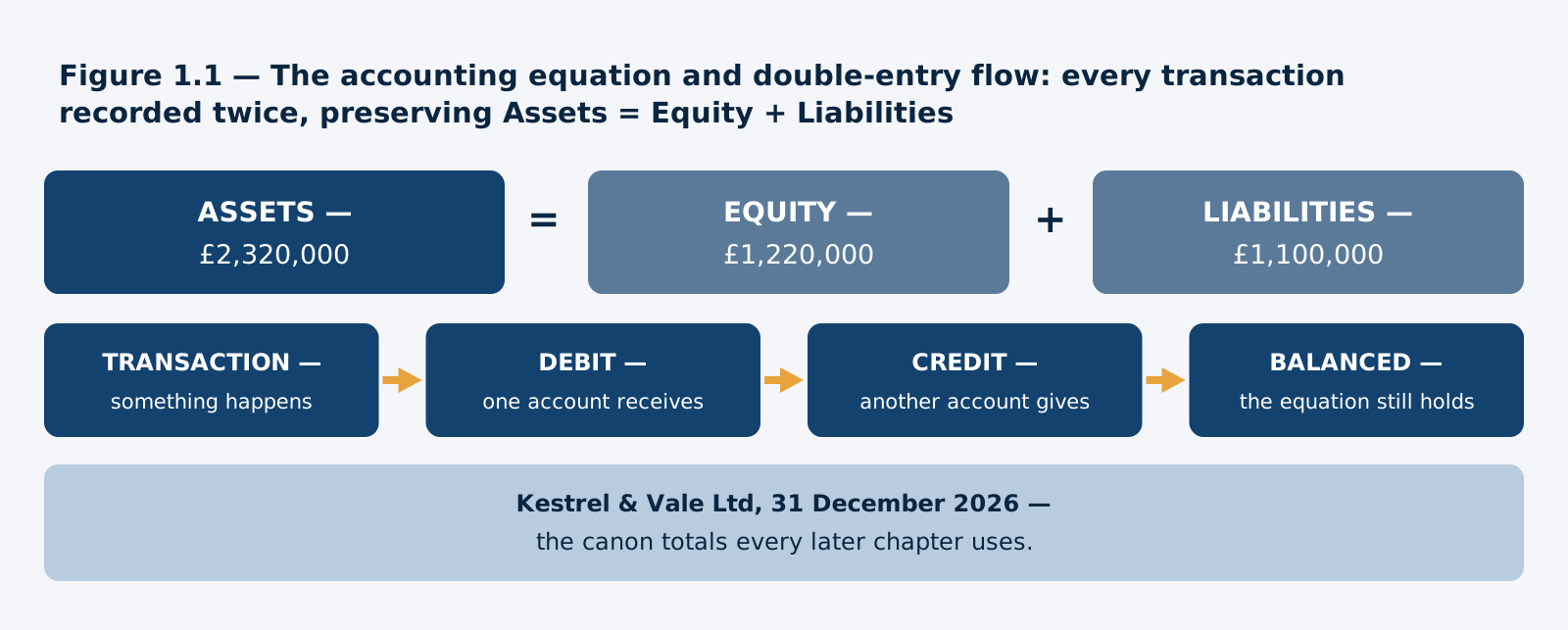
Figure 1.1 — The accounting equation and double-entry flow: every transaction recorded twice, preserving Assets = Equity + Liabilities.
Double entry is the grammar of that account: every transaction is recorded twice, once for what is received and once for what is given, so the books carry their own check on completeness.
There is a plainer way to see the same point. This section leans on three terms in particular: trial balance (a list of all ledger balances at a date, totaled to prove total debits equal total credits); accounting equation (the identity Assets = Equity + Liabilities, which every transaction preserves and every statement of financial position displays); ledger (the book (now a database) holding one account for each asset, liability, equity, income, and expense heading). None of these words is decorative: each is a term of art whose definition the glossary fixes and the examinations enforce. Candidates lose marks less often by not knowing a topic than by using its central word loosely — writing 'material' when the test is 'probable', or 'cost' when the method needs 'relevant cost'. The definitions are the discipline.
The detail that examiners probe sits one level down. Terms in this section are defined at first use and collected in the Key terms paragraph at the chapter's end; the glossary then gathers them across all 44 chapters. When a definition carries a condition — a threshold, a time limit, a stated basis — that condition is part of the definition for examination purposes. Quote the rule without its condition and you have quoted a different, wrong rule: many of this chapter's exercise items are built on exactly that swap.
One more pass, on the numbers side. Where this section touches a figure, the figure is either canon (fixed, and cross-checked across the book) or given in the question that uses it. That division is deliberate and it mirrors the examinations: what ACCA gives, you use as given; what the syllabus expects you to carry, you carry exactly. Confusing the two categories — reaching for a remembered rate where a given one sits in the question, or expecting the question to supply what the syllabus made you learn — is the most avoidable mark-leak in the whole level, and this book's fences exist to train it out of you.
The ledger is where the grammar becomes a system — one account for each kind of asset, liability, income, and expense, fed in order from the books of prime entry where transactions are first captured.
Now put the idea to work on the specimen. Kestrel & Vale Ltd, the specimen company carried through the whole book, closes its year ended 31 December 2026 with total assets of £2,320,000 and equity of £1,220,000 — the position this chapter's footing proves. Every figure in that note is fixed for the whole book, so the work you do here can be checked against the same numbers in the practice tests and the case batteries. Where this section's idea meets the canon, do the arithmetic yourself before reading on: the habit of computing before confirming is the single most transferable skill in this course, and the chapters are built to make you practice it dozens of times.
Do the small exercise the text sets you, even when — especially when — it looks trivial. Competence in these papers is mostly the automation of small correct moves: the right order of a computation, the right first question about a scenario, the right fence around a rate that must be taken as given. Automation is built by repetitions at low stakes, which is what the worked examples and the 30-item exercise sets are for. Skipping them to 'save time for the tests' inverts the design: the tests sample the skill; the chapters build it.
If you are studying with limited time, this section's priority order is: the rule and its conditions first, the worked pattern second, the exception third, the history and rationale last. That is not a counsel of superficiality — it is the order in which marks are actually distributed. The rationale matters, and the chapters give it in full; but a candidate who can state the rule, run the pattern and fence the exception will outscore a candidate who can discourse on the rationale and fumble the computation, every session, in every one of these six papers.
Look at the point from the examiner's chair. A question on this section's material is rarely a request to recite; it is a small situation — frequently the specimen company in a new posture — with the rule hidden inside it. The marking guide awards the first marks for identifying which rule the situation engages, the next for the rule's conditions, and the rest for the landing: the conclusion the facts support, stated without hedging beyond what the facts leave open. Reading with that grid in mind converts this section from information into marks, which is the conversion the whole book exists to perform.
The trial balance is the ledger's moment of self-examination: list every balance, add the debits, add the credits, and prove the two totals agree before any statement is drafted.
Consider how the point behaves at its edges. The syllabus areas behind this chapter — Applied Knowledge bridge — Financial Accounting (FA) foundations — are written by ACCA as capabilities, things the candidate can do, and the doing is always tested at boundaries: the transaction just inside a threshold, the case where two rules both seem to apply, the fact pattern with one fact changed from the textbook example. Read each rule asking where it stops. A rule whose limits you cannot state is a rule you only half know, and the half you are missing is the half that is examined.
A worked pattern is worth more than a second reading. Take the section's central move and run it on the canon facts in a different order: change which figure you start from, and confirm you arrive at the same place. If the method survives reordering, you own it; if it only works in the chapter's sequence, you have memorized a path rather than learned a method, and the practice tests — which deliberately start from unfamiliar ends — will find the gap.
Write the summary before you turn the page. Not a copy — a compression: the section in three lines, in your own words, with the one number or condition you are most likely to drop restored in capitals. Educational research and examiners' folklore agree on very little, but they agree on this: the act of compressing is where reading becomes knowledge. This book's cheat sheets at the back are exactly such compressions, written for you; they will work far better once you have written your own, because you will read them as a fellow-author rather than as a stranger.
There is also a professional reason this material is taught the way it is. In practice, nobody hands you a labeled problem: a client, a manager or a file presents a tangle in which the relevant rule is one strand. Training yourself to pause and ask 'which chapter is this?' before 'what is the answer?' is the habit the Applied Skills papers are quietly examining underneath their stated syllabuses. The foundations chapters return to this in FND-3's ethics material: competence is not only knowing, it is recognizing when knowing applies.
The specimen, looked at whole. Kestrel & Vale Ltd, the specimen company carried through the whole book, closes its year ended 31 December 2026 with total assets of £2,320,000 and equity of £1,220,000 — the position this chapter's footing proves. Hold that note against the chapter's map — Applied Knowledge bridge — Financial Accounting (FA) foundations — and the pattern of this book should now be visible: the same company, the same year, the same handful of people, examined from this chapter's direction. When you reach the practice tests you will meet Kestrel & Vale in postures no chapter rehearsed exactly, and that is the point: the canon gives you a known world so that the unknown question has somewhere to stand. Candidates who treat each chapter's examples as isolated puzzles must rebuild the world for every question; candidates who learn the canon carry the world with them, and spend their examination time on the question rather than on the scenery.
Financial statements are the trial balance rearranged for a reader: performance for a period in one statement, position at a point in time in another, each line traceable back to an account.
The detail that examiners probe sits one level down. Terms in this section are defined at first use and collected in the Key terms paragraph at the chapter's end; the glossary then gathers them across all 44 chapters. When a definition carries a condition — a threshold, a time limit, a stated basis — that condition is part of the definition for examination purposes. Quote the rule without its condition and you have quoted a different, wrong rule: many of this chapter's exercise items are built on exactly that swap.
Close the section by writing the one-sentence version from memory, then comparing it with the section's opening paragraph. Differences between the two are your personal errata for this section — the precise points where your understanding and the text diverge. The book's errata page works at the level of the whole book; this habit works at the level of your own reading, and candidates who keep it arrive at the practice tests with a map of their own gaps rather than a surprise.
Look at the point from the examiner's chair. A question on this section's material is rarely a request to recite; it is a small situation — frequently the specimen company in a new posture — with the rule hidden inside it. The marking guide awards the first marks for identifying which rule the situation engages, the next for the rule's conditions, and the rest for the landing: the conclusion the facts support, stated without hedging beyond what the facts leave open. Reading with that grid in mind converts this section from information into marks, which is the conversion the whole book exists to perform.
One more pass, on the numbers side. Where this section touches a figure, the figure is either canon (fixed, and cross-checked across the book) or given in the question that uses it. That division is deliberate and it mirrors the examinations: what ACCA gives, you use as given; what the syllabus expects you to carry, you carry exactly. Confusing the two categories — reaching for a remembered rate where a given one sits in the question, or expecting the question to supply what the syllabus made you learn — is the most avoidable mark-leak in the whole level, and this book's fences exist to train it out of you.
A trial balance that agrees is necessary but not sufficient — whole families of error leave the totals untouched, and the honest bookkeeper hunts those families by name rather than trusting the balance.
The specimen company exists to give those edges a home. Kestrel & Vale Ltd, the specimen company carried through the whole book, closes its year ended 31 December 2026 with total assets of £2,320,000 and equity of £1,220,000 — the position this chapter's footing proves. When the chapters that follow return to Kestrel & Vale — and they do, in every paper — the same edges reappear wearing different papers' clothes: a figure that is a costing input in PM is an audit population in AA and a ratio in FR. Noticing the same fact doing different work is not a distraction from revision; it is the structure of the Applied Skills level itself, which ACCA designed as one business seen from six professional directions.
Finally, the check. Examiners' reports on these papers return to the same small set of candidate errors: answering the question that was expected rather than the one set; stating rules without applying them to the facts given; and arithmetic that is never sense-checked against the story the figures tell. This section's content feeds all three traps. Before moving on, state the section's rule in one sentence, name its commonest misapplication, and check one canon figure by a second route. That three-part check, repeated across 44 chapters, is the revision system of this book in miniature.
If you are studying with limited time, this section's priority order is: the rule and its conditions first, the worked pattern second, the exception third, the history and rationale last. That is not a counsel of superficiality — it is the order in which marks are actually distributed. The rationale matters, and the chapters give it in full; but a candidate who can state the rule, run the pattern and fence the exception will outscore a candidate who can discourse on the rationale and fumble the computation, every session, in every one of these six papers.
The examination tests FND-1 as capability, not as recall: expect the chapter's rules inside short scenarios, its computations with the rates and factors given in the question, and its definitions enforced exactly as the Key terms paragraph states them. The 30 exercises that close this chapter sample the same ground in the examination's own formats, and the key explains every option — read the explanations for the questions you got right as carefully as for those you missed, because a right answer reached by a wrong route is a wrong answer waiting for a different question. The chapter's warning, printed below the worked example, names the trap this chapter's candidates fall into most; the repair sets at the back of the book collect the same traps across all 44 chapters for the final week's revision.
One study instruction governs this chapter above all others: never let a section close with a feeling of familiarity doing duty for command. Familiarity is what a second reading produces; command is what a closed book produces. The test is always the same — state the rule, run the computation, name the exception, apply it to the specimen — and it is deliberately uncomfortable the first few times, because the examination will be. The chapters are sequenced so that each one's command-test leans on the ones before: foundations before papers, statements before audit, costing before appraisal. Where a later chapter exposes an earlier gap, go back without negotiation; the crosswalk in the back matter exists to make those returns quick, and the specimen canon means you are never rebuilding the world, only revisiting it.
Kestrel & Vale Ltd's statement of financial position at 31 December 2026 is the trial balance's logic at statement scale. Add the asset side first, then the equity and liability side, and prove the two agree before a single ratio is computed.
What this shows. The canon position balances at £2,320,000. Every later chapter that uses these figures — FR's statements, AA's materiality, FM's gearing — starts from this proved footing.
Key terms. accounting equation — the identity Assets = Equity + Liabilities, which every transaction preserves and every statement of financial position displays; debit — an entry on the left side of an account; debits increase assets and expenses and decrease liabilities, equity, and income; credit — an entry on the right side of an account; credits increase liabilities, equity, and income and decrease assets and expenses; ledger — the book (now a database) holding one account for each asset, liability, equity, income, and expense heading; trial balance — a list of all ledger balances at a date, totaled to prove total debits equal total credits; book of prime entry — the first record of a class of transactions — sales day book, purchases day book, cash book, journal — from which postings reach the ledger; suspense account — a temporary account holding a difference or an unplaced amount until its true home is found; a working tool, never a destination; capital — the owner's stake in the business: amounts introduced plus retained profits, shown in equity; drawings — value taken out of a business by its owner for personal use; a distribution of equity, not an expense of the business.
The chapter's warning. Do not treat a balanced trial balance as proof of correctness: errors of omission, commission, principle, original entry, reversal, and compensating errors all survive a balanced trial balance. The balance proves arithmetic equality, nothing more.
Q1. Which of the following is the correct meaning of accounting equation?
A. a temporary account holding a difference or an unplaced amount until its true home is found; a working tool, never a destination B. the identity Assets = Equity + Liabilities, which every transaction preserves and every statement of financial position displays C. the first record of a class of transactions — sales day book, purchases day book, cash book, journal — from which postings reach the ledger D. value taken out of a business by its owner for personal use; a distribution of equity, not an expense of the business
Q2. Which of the following is the correct meaning of ledger?
A. the book (now a database) holding one account for each asset, liability, equity, income, and expense heading B. the owner's stake in the business: amounts introduced plus retained profits, shown in equity C. value taken out of a business by its owner for personal use; a distribution of equity, not an expense of the business D. the first record of a class of transactions — sales day book, purchases day book, cash book, journal — from which postings reach the ledger
Q3. Which of the following is the correct meaning of suspense account?
A. the book (now a database) holding one account for each asset, liability, equity, income, and expense heading B. a list of all ledger balances at a date, totaled to prove total debits equal total credits C. the identity Assets = Equity + Liabilities, which every transaction preserves and every statement of financial position displays D. a temporary account holding a difference or an unplaced amount until its true home is found; a working tool, never a destination
Q4. Which of the following is the correct meaning of drawings?
A. the identity Assets = Equity + Liabilities, which every transaction preserves and every statement of financial position displays B. value taken out of a business by its owner for personal use; a distribution of equity, not an expense of the business C. the first record of a class of transactions — sales day book, purchases day book, cash book, journal — from which postings reach the ledger D. a temporary account holding a difference or an unplaced amount until its true home is found; a working tool, never a destination
Q5. Which of the following is the correct meaning of trial balance?
A. value taken out of a business by its owner for personal use; a distribution of equity, not an expense of the business B. a temporary account holding a difference or an unplaced amount until its true home is found; a working tool, never a destination C. the owner's stake in the business: amounts introduced plus retained profits, shown in equity D. a list of all ledger balances at a date, totaled to prove total debits equal total credits
Q6. Which of the following is the correct meaning of capital?
A. the book (now a database) holding one account for each asset, liability, equity, income, and expense heading B. the owner's stake in the business: amounts introduced plus retained profits, shown in equity C. a list of all ledger balances at a date, totaled to prove total debits equal total credits D. the first record of a class of transactions — sales day book, purchases day book, cash book, journal — from which postings reach the ledger
Q7. Which of the following is the correct meaning of book of prime entry?
A. the first record of a class of transactions — sales day book, purchases day book, cash book, journal — from which postings reach the ledger B. an entry on the right side of an account; credits increase liabilities, equity, and income and decrease assets and expenses C. the identity Assets = Equity + Liabilities, which every transaction preserves and every statement of financial position displays D. a list of all ledger balances at a date, totaled to prove total debits equal total credits
Q8. Which of the following is the correct meaning of debit?
A. an entry on the right side of an account; credits increase liabilities, equity, and income and decrease assets and expenses B. a temporary account holding a difference or an unplaced amount until its true home is found; a working tool, never a destination C. an entry on the left side of an account; debits increase assets and expenses and decrease liabilities, equity, and income D. a list of all ledger balances at a date, totaled to prove total debits equal total credits
Q9. A candidate writes: "an entry on the right side of an account; credits increase liabilities, equity, and income and decrease assets and expenses" Which term from FND-1 has the candidate defined?
A. capital B. credit C. accounting equation D. ledger
Q10. A candidate writes: "an entry on the left side of an account; debits increase assets and expenses and decrease liabilities, equity, and income" Which term from FND-1 has the candidate defined?
A. suspense account B. credit C. trial balance D. debit
Q11. A candidate writes: "a temporary account holding a difference or an unplaced amount until its true home is found; a working tool, never a destination" Which term from FND-1 has the candidate defined?
A. accounting equation B. suspense account C. debit D. drawings
Q12. A candidate writes: "value taken out of a business by its owner for personal use; a distribution of equity, not an expense of the business" Which term from FND-1 has the candidate defined?
A. ledger B. accounting equation C. capital D. drawings
Q13. A candidate writes: "the book (now a database) holding one account for each asset, liability, equity, income, and expense heading" Which term from FND-1 has the candidate defined?
A. ledger B. suspense account C. debit D. capital
Q14. A candidate writes: "the identity Assets = Equity + Liabilities, which every transaction preserves and every statement of financial position displays" Which term from FND-1 has the candidate defined?
A. drawings B. credit C. accounting equation D. book of prime entry
Q15. In FND-1, which of the following correctly states how to approach proving the trial balance?
A. force the totals to agree by inserting the difference as a balance, which hides the error instead of finding it B. check only the largest accounts, which leaves small posting errors — the commonest kind — untouched C. extract every ledger balance, list debits and credits in two columns, and investigate any difference until the totals agree D. restart the ledger from scratch, which destroys the audit trail the investigation needs
Q16. In FND-1, which of the following correctly states how to approach treating a suspense balance?
A. leave the suspense balance in the statements, which publishes an unexplained amount as if it were a fact B. write the suspense balance off to profit, which converts an unidentified item into income or expense without evidence C. net the suspense balance against receivables, which mixes an unknown with a known asset D. trace the suspense amount to the original transaction, post the correcting entry to the proper account, and clear the suspense account to zero
Q17. In FND-1, which of the following correctly states how to approach posting a credit sale?
A. record the sale first in the sales day book, then debit the customer's receivables account and credit revenue with the same amount B. debit revenue and credit receivables, which reverses the transaction and understates both C. post the total to revenue only, which loses the personal account the business collects from D. record it in the cash book, which is for cash and bank movements only
Q18. Which of the following is the correct meaning of book of prime entry?
A. a temporary account holding a difference or an unplaced amount until its true home is found; a working tool, never a destination B. the first record of a class of transactions — sales day book, purchases day book, cash book, journal — from which postings reach the ledger C. a list of all ledger balances at a date, totaled to prove total debits equal total credits D. an entry on the left side of an account; debits increase assets and expenses and decrease liabilities, equity, and income
Q19. Which of the following is the correct meaning of suspense account?
A. the identity Assets = Equity + Liabilities, which every transaction preserves and every statement of financial position displays B. a list of all ledger balances at a date, totaled to prove total debits equal total credits C. value taken out of a business by its owner for personal use; a distribution of equity, not an expense of the business D. a temporary account holding a difference or an unplaced amount until its true home is found; a working tool, never a destination
Q20. Which of the following is the correct meaning of debit?
A. a list of all ledger balances at a date, totaled to prove total debits equal total credits B. the first record of a class of transactions — sales day book, purchases day book, cash book, journal — from which postings reach the ledger C. an entry on the left side of an account; debits increase assets and expenses and decrease liabilities, equity, and income D. the owner's stake in the business: amounts introduced plus retained profits, shown in equity
Q21. Which of the following is the correct meaning of accounting equation?
A. the identity Assets = Equity + Liabilities, which every transaction preserves and every statement of financial position displays B. a temporary account holding a difference or an unplaced amount until its true home is found; a working tool, never a destination C. a list of all ledger balances at a date, totaled to prove total debits equal total credits D. an entry on the left side of an account; debits increase assets and expenses and decrease liabilities, equity, and income
Q22. ACCA's session-based Applied Skills papers are examined in how many sessions per year?
A. Two — June and December B. Three C. Four — March, June, September and December D. Twelve — monthly
Q23. The Practical Experience Requirement for ACCA membership is:
A. 36 months of relevant experience, with performance objectives, recorded through ACCA's system B. 12 months of any employment C. 36 months that must precede the examinations D. An employer's letter with no objectives
Q24. Under ACCA's published session rules, the maximum number of exams a student may enter in one exam session is:
A. Four B. Eight C. Two D. Six
Q25. The Ethics and Professional Skills Module, under ACCA's published transition notice, may be completed:
A. Only before starting Applied Skills B. At any time with no transition deadline applying C. Until December 2026 only D. Until mid-July 2027 (exact date to be confirmed by ACCA)
Q26. A student revising FND-1 writes a one-line summary of the chapter. Which line is CORRECT?
A. The chapter's worked example can be memorized and reproduced as the answer to any question in this area B. Where the chapter gives a rule and an exception, the examination tests the rule only C. The chapter's warning stands: Do not treat a balanced trial balance as proof of correctness: errors of omission, commission, principle, original entry, reversal, and compensating errors all survive a balanced trial balance. The balance proves arithmetic equality, nothing more. D. Definitions in this chapter are interchangeable with their everyday meanings
Q27. Which statement about FND-1's subject matter is correct?
A. Kestrel & Vale Ltd, the specimen company carried through the whole book, closes its year ended 31 December 2026 with total assets of £2,320,000 and equity of £1,220,000 — the position this chapter's footing proves. B. The specimen company's figures change from chapter to chapter to suit each topic C. Figures in this book's examples are chosen fresh for each question and need not agree with each other D. The specimen canon is a set of examination facts published by ACCA
Q28. A candidate writes: "an entry on the right side of an account; credits increase liabilities, equity, and income and decrease assets and expenses" Which term from FND-1 has the candidate defined?
A. drawings B. credit C. suspense account D. ledger
Q29. A candidate writes: "an entry on the left side of an account; debits increase assets and expenses and decrease liabilities, equity, and income" Which term from FND-1 has the candidate defined?
A. book of prime entry B. debit C. capital D. accounting equation
Q30. A candidate writes: "the first record of a class of transactions — sales day book, purchases day book, cash book, journal — from which postings reach the ledger" Which term from FND-1 has the candidate defined?
A. accounting equation B. debit C. book of prime entry D. drawings
An independent study guide for the six Applied Skills papers of the ACCA Qualification: Corporate and Business Law (LW), Performance Management (PM), Taxation (TX), Financial Reporting (FR), Audit and Assurance (AA) and Financial Management (FM).
Built around one specimen company — Kestrel & Vale Ltd — whose accounts, people and problems run through all 44 chapters, so that every paper is learned as a view of the same business.
© 2026 Feras Alzubi. All rights reserved.
No part of this book may be reproduced, stored in a retrieval system, or transmitted in any form or by any means — electronic, mechanical, photocopying, recording or otherwise — without the prior written permission of the copyright holder, except for brief quotations in reviews and for the buyer's own study notes.
Every question, case, worked example and explanation in this book is original to this book. No examination question, past paper, or tuition-provider material is reproduced or paraphrased. The specimen company Kestrel & Vale Ltd, its subsidiary Bramble Components Ltd, its auditor Halloway Grant LLP, its supplier Fenwick Packaging, and all named individuals in scenarios are fictional; any resemblance to real companies, firms or persons is coincidental.
This is an independent study guide. It is not published by, affiliated with, endorsed by, or approved by ACCA. ACCA did not participate in its production and does not endorse its contents. ACCA, the ACCA logo, and the names of ACCA qualifications and papers are trademarks of the Association of Chartered Certified Accountants and belong to their owner. No book can guarantee an examination result; this book's undertaking is narrower and checkable — complete coverage of the published syllabuses, faithful examination formats, and every answer explained.
Examination facts (formats, fees, pass rates, transition arrangements) are printed only in the stamped forms recorded on the Exam Blueprint page of this front matter, from the ACCA publications listed in the References. Where a fact could not be verified from an opened ACCA source, this book fences it rather than printing it; the fences are listed on the Errata and Currency page.
The route. Take the diagnostic first (about 60 minutes), then work the foundations chapters FND-1 to FND-4, then your paper's chapters in order, then that paper's two practice tests, its case battery and its repair set. Candidates sitting several papers in one session should interleave: one chapter per paper per week beats six chapters of one paper, because the papers share the specimen company and reinforce each other.
Figure 0.1 (Class A) — Diagnostic route map: each paper's strand pointing to the part that reteaches it.
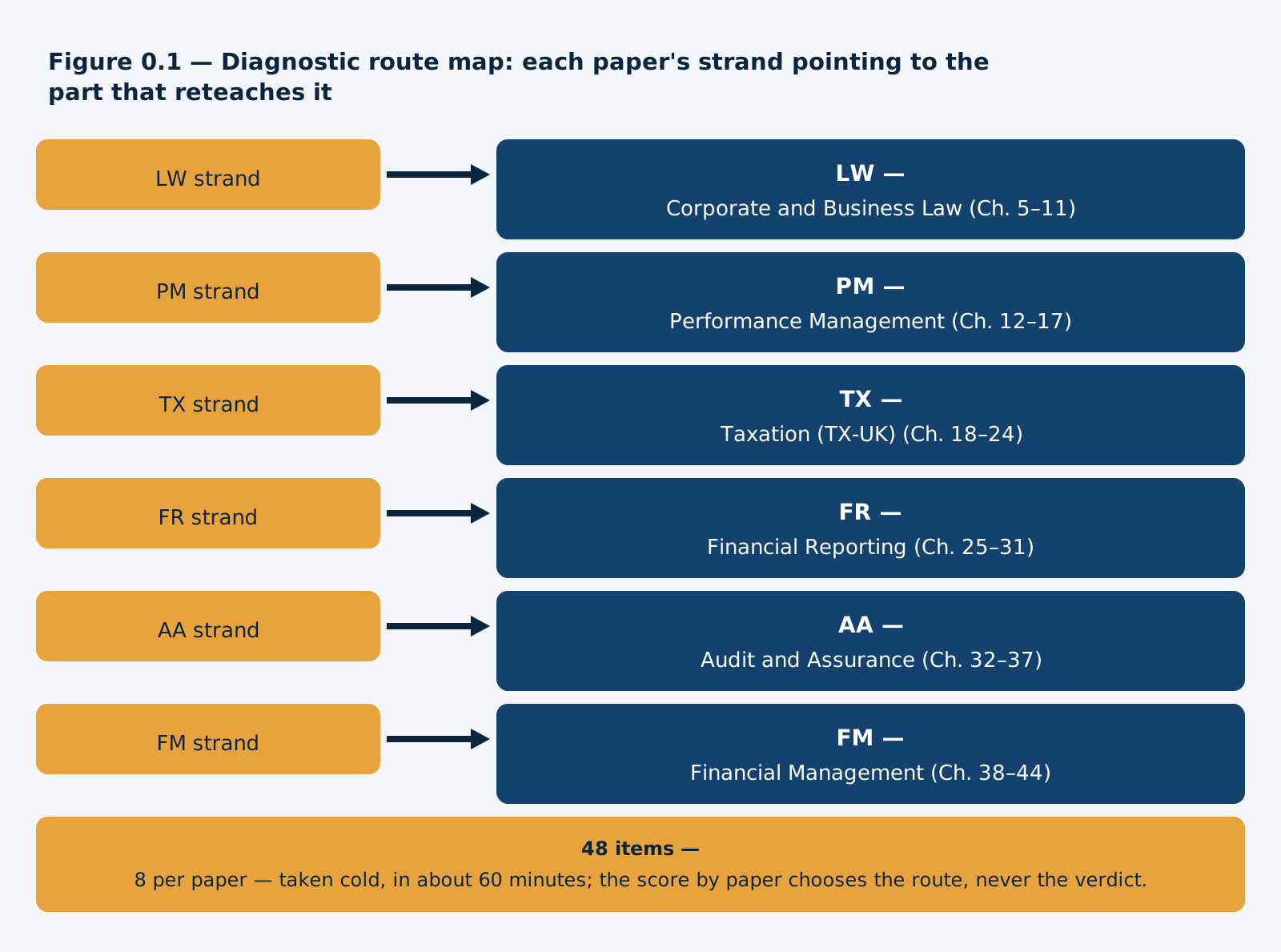
Figure 0.1 — Diagnostic route map: each paper's strand pointing to the part that reteaches it.
Chapters. Each chapter teaches in six sections (simplify, explain, add the detail, show it on the specimen, do it, check it), works at least one example in full before asking anything of you, and closes with 30 exercise questions. Every term is defined at first use. Do the exercises in writing; the key explains the correct answer and why each wrong option is wrong, individually, by letter.
Calculation discipline. Wherever a computation needs a tax rate, an allowance, a discount factor or a similar figure, the question gives it — exactly as the examinations give tax rates and allowances in the TX paper and as this book gives factors throughout. Never import a remembered rate where a given one exists; using the given figure is itself an examined skill.
Counting convention. This book's questions are counted as its apparatus is built: the diagnostic (48), chapter exercises (44 × 30 = 1,320), practice-test items (394 — an LW multi-task question counts as one item of 6 marks), case battery tasks (72) and repair items (150) total 1,984, every one with a full explanation in its key. Counts of the built apparatus are verified at the book's production gates before they are relied on in packaging.
Figure 0.2 (Class A) — Apparatus map: diagnostic, chapter exercises, practice tests, case batteries and repair sets as one system of distinct item sets.
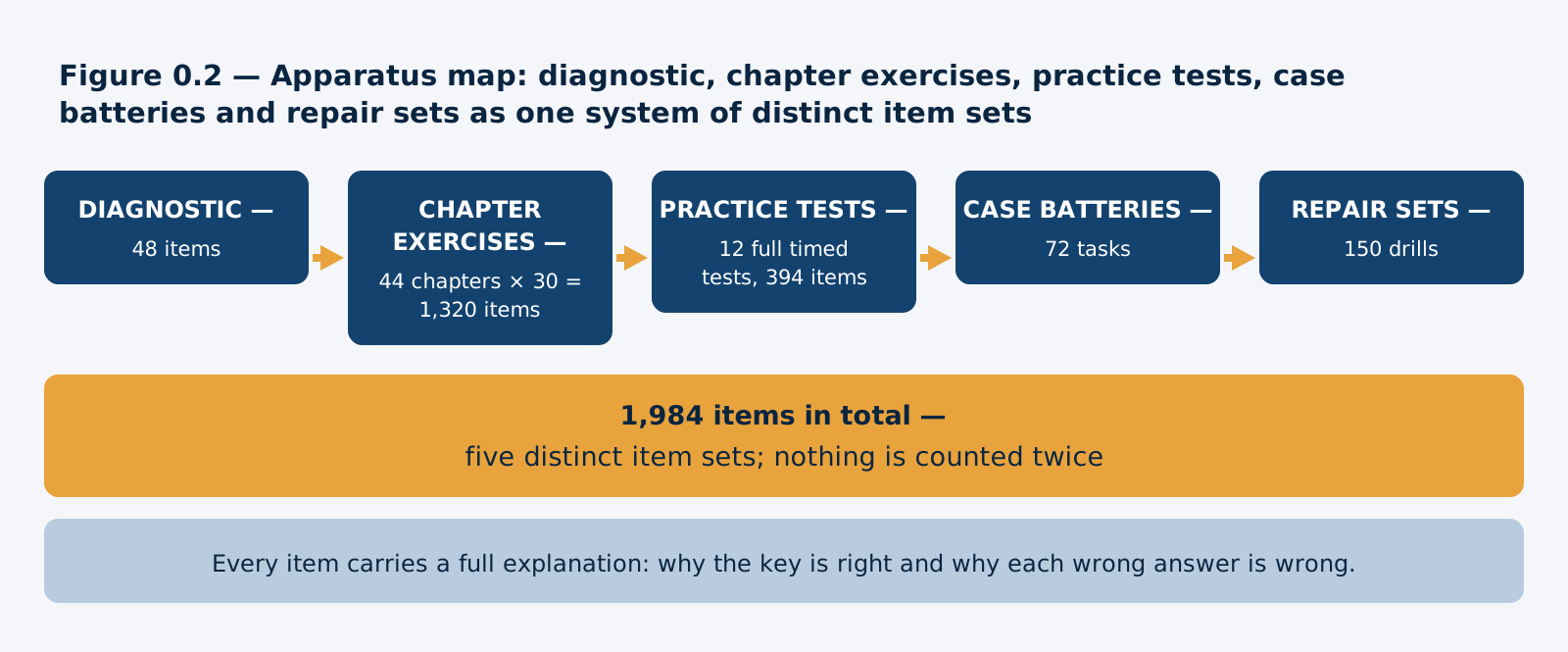
Figure 0.2 — Apparatus map: diagnostic, chapter exercises, practice tests, case batteries and repair sets as one system of distinct item sets.
The papers. Applied Skills is the middle level of the ACCA Qualification: LW, PM, TX, FR, AA, FM. The pass mark for all ACCA Qualification examinations is 50% (ACCA's syllabus and study guides state this verbatim).
Figure 0.3 (Class A) — The level map: the six Applied Skills papers standing on the Applied Knowledge foundations.
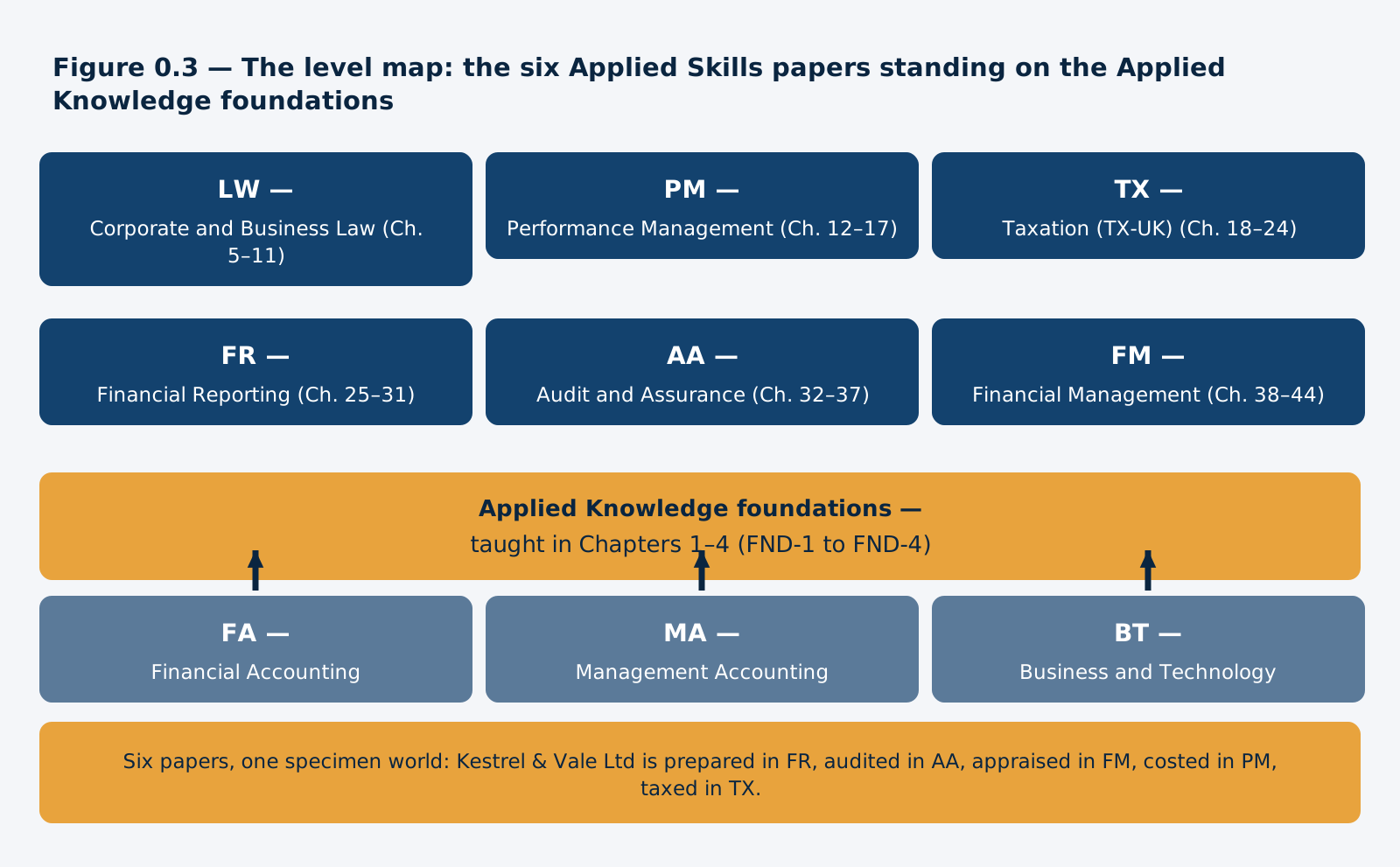
Figure 0.3 — The level map: the six Applied Skills papers standing on the Applied Knowledge foundations.
Formats (verified shapes). LW is a two-hour, 100-mark, wholly objective computer-based examination in both variants: Section A holds 25 questions of 2 marks and 20 of 1 mark; Section B holds five 6-mark multi-task questions. PM, TX, FR and FM are three-hour, 100-mark session examinations: Section A 15 objective questions of 2 marks; Section B three case questions of five objective questions of 2 marks each; Section C constructed responses of 40 marks (PM, FR, FM: two of 20; TX: three of 10, 15 and 15). AA is a three-hour, 100-mark session examination in its own shape: Section A three case questions of five objective questions (30 marks); Section B one 30-mark and two 20-mark constructed responses (70 marks). A formulae sheet is provided in the PM examination (PM syllabus and study guide). FM's shape is stated as ACCA publishes it on its Financial Management (FM) essentials on one page.
Figure 0.4 (Class A) — Practice-test shape diagram: the section shapes of the six papers side by side, each in its own published form.
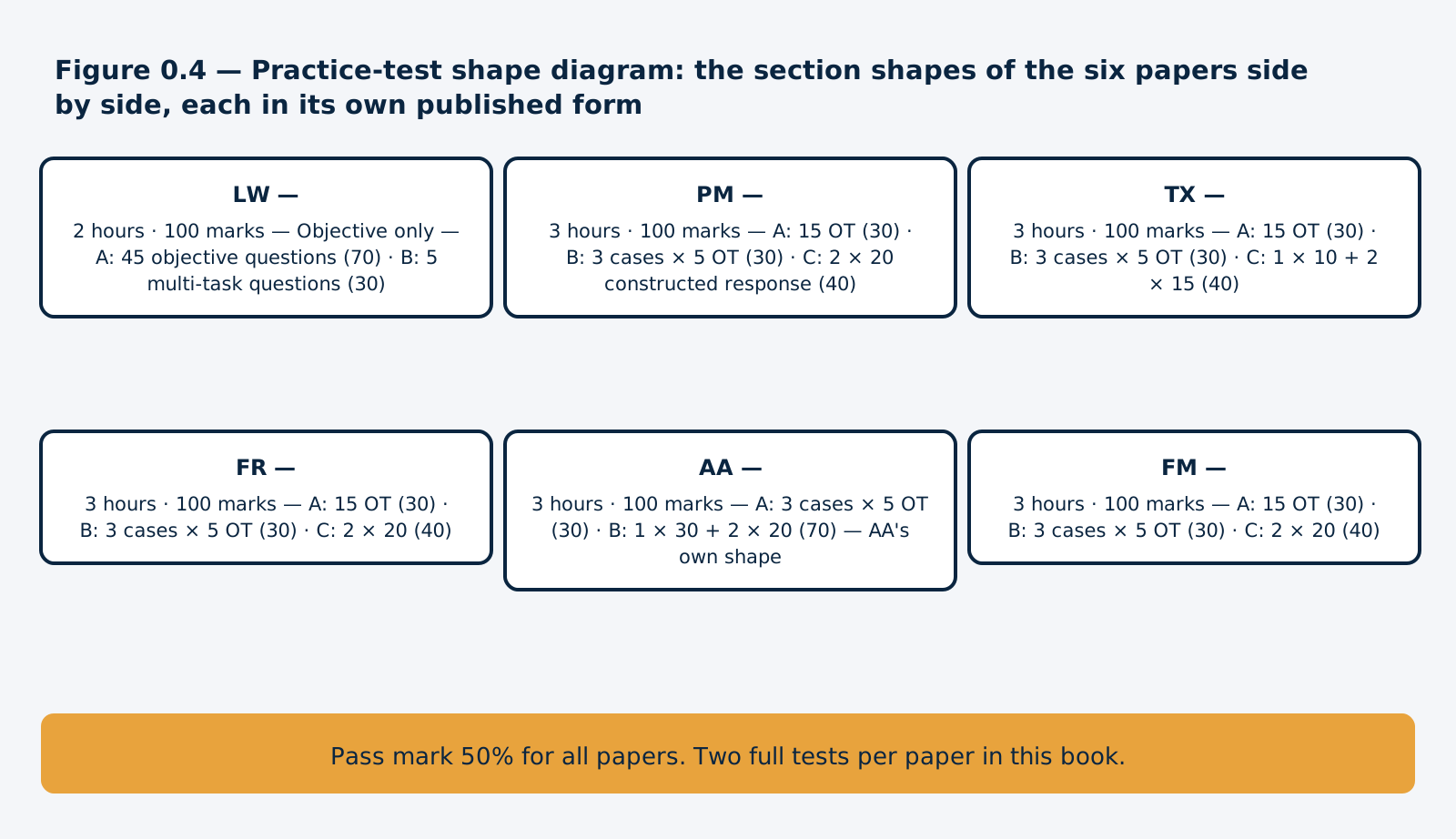
Figure 0.4 — Practice-test shape diagram: the section shapes of the six papers side by side, each in its own published form.
Availability. LW (English and Global variants) is available on demand; PM, TX, FR, AA and FM are session-based, in four sessions a year (March, June, September, December). A student may enter a maximum of four exams per session and a maximum of eight different exams per calendar year (ACCA exam sessions guidance).
TX variant. This book teaches TX-UK, the United Kingdom variant of Taxation — ACCA's recommended default where no national variant is available. ACCA examines TX in a range of national variants; this book teaches the UK variant only and covers no other variant's content. TX-UK examinations in the cycle 1 June 2026 to June 2027 are based on the Finance Act 2025 (ACCA TX-UK examinable documents); tax rates and allowances are given in the examination itself, and every rate in this book's TX material is given in its question, stamped to that cycle.
LW variants. This book teaches LW in two explicitly labeled tracks sharing one examination shape and a common core: the LW-ENG track (English law) and the LW-GLO track (global law). Their syllabus areas B and C differ in substance; candidates prepare the B and C chapters of their own track.
Fees (United Kingdom, December 2026 session — ACCA's published fees for that session; fees vary by market: check accaglobal.com for your market). Initial registration £89; re-registration £89; annual subscription (2026) £140; exemption fees £98 per Applied Knowledge paper and £123 per Applied Skills paper; Applied Skills examination entry, standard entry (closed 2 November 2026, 23:59 GMT): £173 per exam; late entry (closed 9 November 2026, 23:59 GMT): £439 per exam; Ethics and Professional Skills Module £83. These are that session's published fees, printed here for planning; later sessions carry their own published fees.
Pass rates (June 2026 session only, as published by ACCA; no other session's rates are printed in this book, and these figures are a cohort's outcomes, not a prediction of any individual's). LW 82% · TX 55% · FR 52% · PM 41% · FM 48% · AA 47%.
Scale. ACCA describes its community as "over 257,900 members and 530,100 future members in 180 countries" (ACCA, June 2026 release) — the only scale figure this book prints, in that attributed form.
Transition notice (ACCA's published transition mapping for the redesigned qualification). Under ACCA's published mapping, current papers carry forward as: K1 Financial Accounting ← FA; K2 Management Accounting ← MA; K3 Business Law ← LW; E1 Taxation ← TX; E2 Financial Reporting ← FR; E3 Audit, Risk and Control ← AA; E4 Finance and Investment ← FM; E5 Performance with Data Analysis ← PM. Students may complete the Ethics and Professional Skills Module until mid-July 2027 (the exact date is to be confirmed by ACCA). The Practical Experience Requirement is unchanged at 36 months. This notice is printed as a dated notice of ACCA's published mapping; candidates must confirm their personal position with ACCA, because transition rules apply by individual record.
Kestrel & Vale Ltd is a fictional UK private limited company manufacturing commercial kitchen equipment, year end 31 December 2026. Its canon figures, used unchanged in every chapter: revenue £2,400,000; cost of sales £1,440,000; gross profit £960,000; distribution costs £180,000; administrative expenses £300,000; operating profit £480,000; finance costs £40,000; profit before tax £440,000; tax £110,000; profit for the year £330,000. Statement of financial position: property, plant and equipment £1,450,000; intangibles £50,000; inventories £320,000; receivables £410,000; cash £90,000; total assets £2,320,000; share capital £500,000; retained earnings £720,000; 6% loan notes £600,000; deferred tax £30,000; payables £350,000; tax payable £110,000; accruals £10,000; total equity and liabilities £2,320,000. Kestrel owns 80% of Bramble Components Ltd (acquired 1 January 2026 for £280,000; goodwill £56,000). Its auditor is Halloway Grant LLP (fictional). Its flagship product is the ValePro oven (price £500; standard variable cost £212; contribution £288). Its appraisal project is Project Calder (outlay £500,000; NPV at 10% +£46,970 on given factors; payback 3.0 years). Its founder-director is Nadia Rahman; its tax case individual is Amara Osei; its supplier is Fenwick Packaging. All are fictional and original to this book.
End of the free sample. The complete book continues from here — the full A-to-Z course in book form, delivered as an EPUB you can read in Apple Books, Google Play Books, ReadEra, Thorium Reader, Adobe Digital Editions, or Send to Kindle.
Buy this ebook — $11.99 Back to the book page
Payments are securely processed by Payhip.